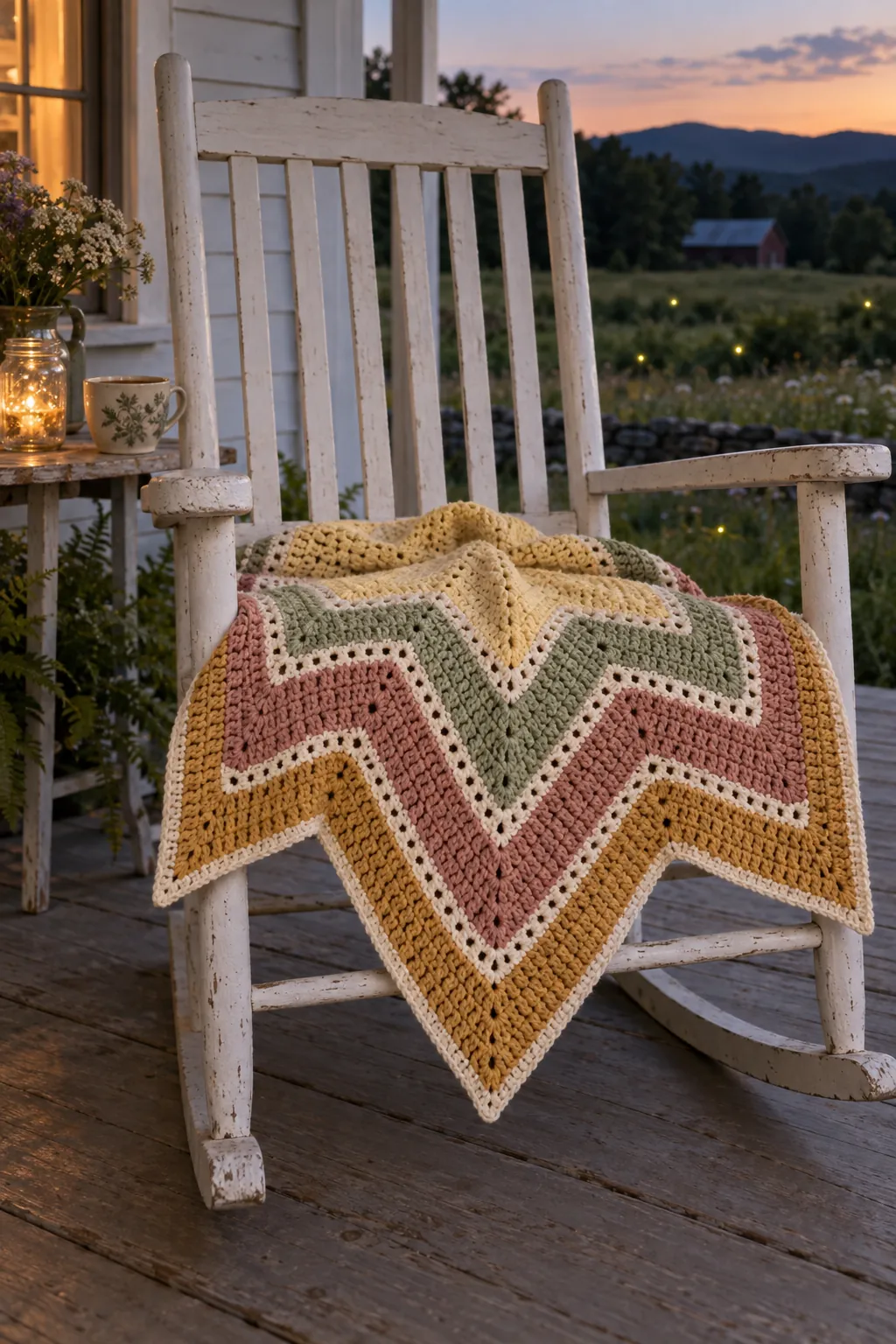
In late June the Vermont fields fill with fireflies, and for a couple of weeks a whole slope can blink gold after dark. This crochet star blanket keeps a little of that light. It’s a 7-point star worked in rounds from the center out, with a honey middle and bands of butter, sage, clay rose and honey that grow outward ring by ring. A thin line of cream eyelets runs between every band, like a string of tiny lights.
The body is all double crochet in a DK cotton blend on a 4 mm (US G-6) hook, so it stays light enough for a summer night on the porch. The pattern is written for a throw about 48 in (122 cm) across from point to point, and the size section adds a 36 in (91 cm) baby star and a 60 in (152 cm) large one. Picture it folded over the back of a porch rocker all summer.
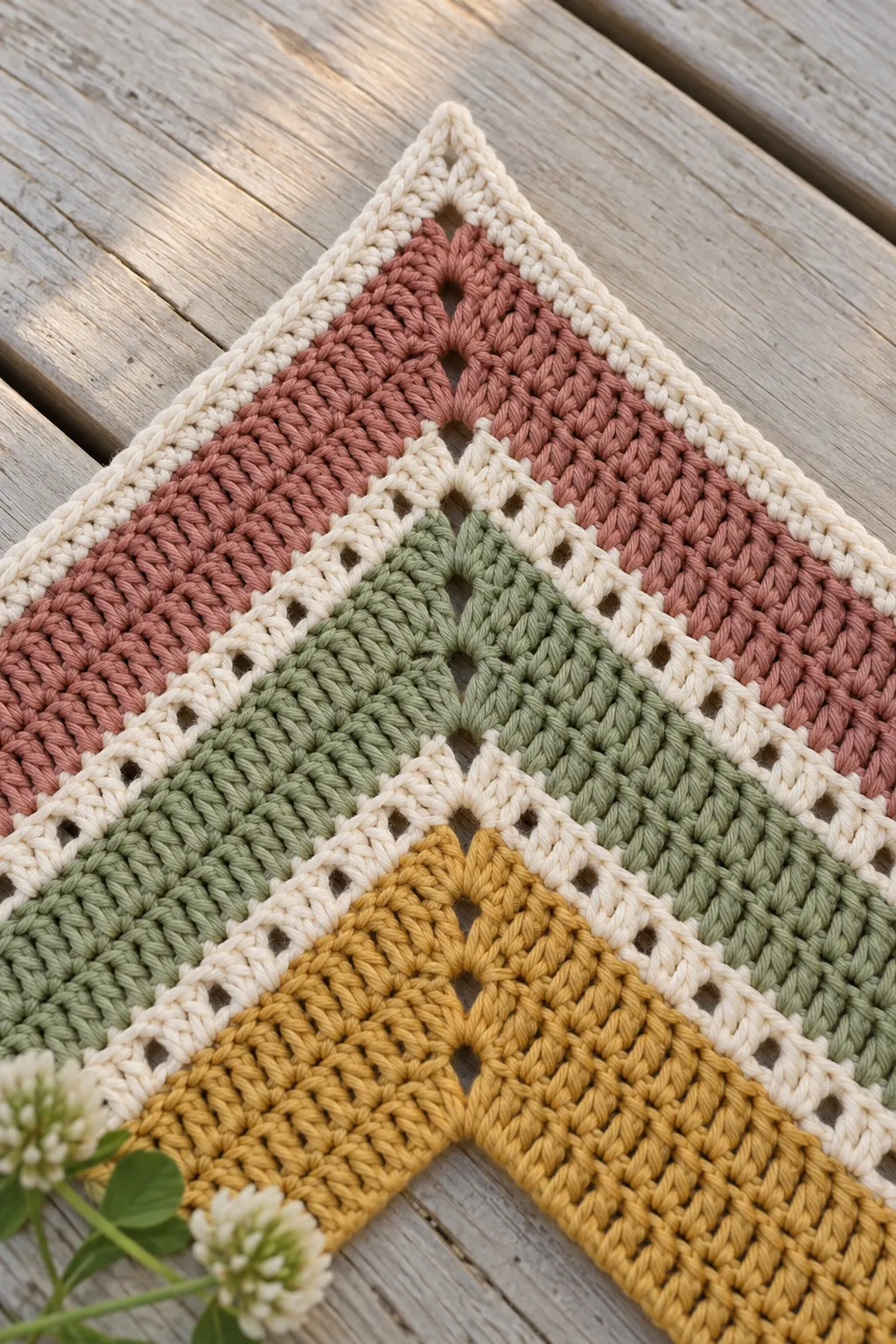
Is this crochet star blanket a good step up from straight rows?
It is if you can already work a chain and a double crochet without stopping to think about the steps. Those two stitches make the whole star. The border adds single crochet, and some rounds close with one half double crochet.
It’s rated Intermediate, and here’s why. No single stitch is hard. What takes practice is keeping 7 points and 7 valleys lined up while every round gets longer. At each point you work (2 dc, ch 2, 2 dc) into the chain-2 space, which pushes the tip outward. At each valley you skip 2 stitches, which pulls the fabric in. Skip the wrong stitches or put a point in the wrong space, and the star starts to lean a round or two later.
Rounds 1 to 4 are the fiddliest: small, tight, and the points barely look like points until Round 6 or so.
Two techniques may be new. A magic ring is an adjustable loop you work the first round into, then pull shut so the center has no hole. The joining hdc closes a round with a half double crochet instead of a chain 2: it fills the same space and leaves your hook exactly where the next round begins. Both are written out in the card. If the brackets and asterisks look like code, the Beginner Guide explains how to read a crochet pattern. And if you’ve made a ripple throw worked back and forth in rows, you already know the peak-and-valley idea. This star just bends it into a circle.
A DK cotton blend that keeps seven points crisp
Look for a 3 and the word “DK” or “light” on the label, with a suggested hook somewhere around 3.75 to 4.5 mm. The pattern uses 4 mm (US G-6), on the snug side, so the double crochet is firm enough to hold a point.
For a spring and summer blanket, choose a cotton blend, cotton with acrylic or cotton with bamboo, roughly half and half. The cotton gives clean stitch definition and feels cool on bare legs, and the other fiber adds a little stretch and keeps the weight down. Pure cotton works, but it’s stiffer and very heavy when wet, and a big star can pull out of shape when you lift it out of the washer.
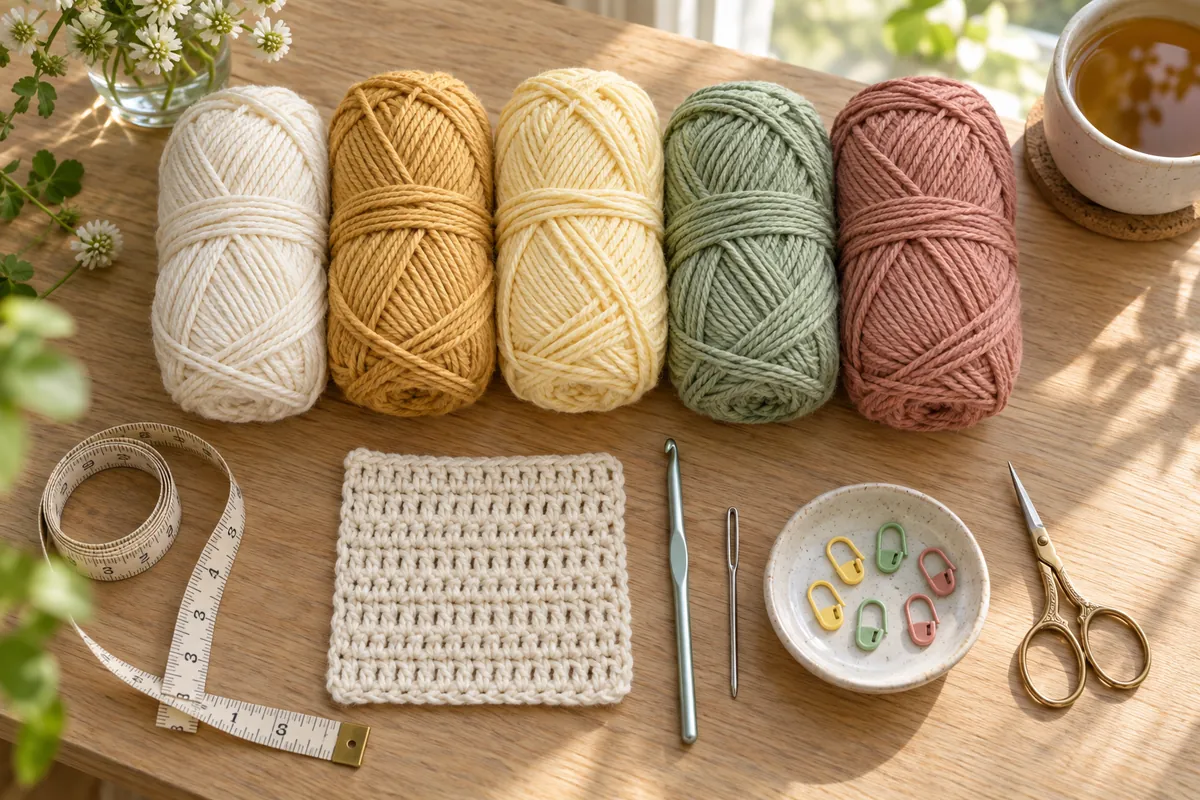
Buy each color in a single dye lot. On a star every band is a full ring, so a skein of sage that’s a shade off shows up as a lopsided stripe all the way around.
If you swap in a different DK, make the gauge swatch in the card first: 18 dc and 10 rows over 4 in (10 cm). Gauge matters more on a star. Each round adds about 1/2 in (1.3 cm) at the tips, so a small difference on every round adds up fast over 48 of them.
Honey in the middle, cream lace between every band
Five colors, five jobs. Honey makes the first 4 rounds and comes back as a band every 16 rounds, so the glow repeats as the star grows. Butter, sage and clay rose fill the other bands, each one 3 rounds of solid double crochet. Cream works the single eyelet round between bands and the two border rounds.
Because cream separates every band, the other four colors never touch, so almost any set works. A few palettes with the same layout:
- Lake House: cream eyelets with navy, denim, pale blue and sand
- Strawberry Patch: cream eyelets with berry, blush, leaf green and soft gold
- Blueberry Hill: ivory eyelets with blueberry, lavender, dusty teal and pale gray
- Garden Gate: oatmeal eyelets with olive, mustard, terracotta and moss
Whatever the palette, keep the eyelet rounds in a very light shade. The little holes show against pale yarn and mostly disappear in a dark one.
Before you buy, wrap a few yards of each color around a strip of cardboard in band order. If two neighbors blur together from across the room, swap one.
Star sizes from 36 to 60 inches across
Every size uses the same stitches and the same color order: you just stop after a different round. A 7-point star has no point directly across from another, so measure between the two points that sit farthest apart. Treat these as close estimates, since blocking can pull the tips out a little further.
- Baby, about 36 in (91 cm) across and 18 1/2 in (47 cm) from center to tip: magic ring and 36 rounds (504 sts in Round 36), border of 511 then 518 sc, about 850 yd (777 m) in all: 200 yd Honey, 200 yd Cream, 100 yd Butter, 150 yd Sage and 200 yd Clay Rose. The last band is Honey.
- Throw, written in the pattern, about 48 in (122 cm) across and 24 1/2 in (62 cm) from center to tip: 48 rounds (672 sts), border of 679 then 686 sc, about 1,400 yd (1,280 m): 200 yd Honey, 300 yd Cream, 250 yd Butter, 300 yd Sage and 350 yd Clay Rose.
- Large, about 60 in (152 cm) across and 30 1/2 in (77 cm) from center to tip: 60 rounds (840 sts), border of 847 then 854 sc, about 2,150 yd (1,966 m): 400 yd Honey, 450 yd Cream, 450 yd Butter, 500 yd Sage and 350 yd Clay Rose. The last band is Sage.
The yardage includes about 10% extra, rounded up to the next 50 yd. The baby star is for the stroller, a play mat or tummy time with you right there. Babies under 12 months should never sleep with a loose blanket in the crib, and this one should never get buttons, ties or any small add-on a baby could pull off. If you’d rather make a little rectangle in the same yarn weight, the fern-textured blanket for small babies is a gentler project.
Keeping the peaks sharp and the valleys even
- Count by the round number. On every round, each side from valley to point has as many stitches as the round number. Round 20 has 20 per side, 40 per point and 280 in all. Counting one side catches most mistakes before they spread.
- Mark the points, not the valleys. Clip a locking marker into each chain-2 space as you make it and move it up every round. The valleys sit halfway between.
- Skip exactly 2 at each valley. The two lowest stitches between points get skipped, one from each side. Skipping 1 or 3 is the most common star mistake. It shows as a side that bulges or a valley that puckers.
- Trust the joining hdc. A lone half double crochet where you expect a chain 2 looks odd the first time. Work the first dc of the next round around its post and the space looks like all the others. You only use it when the next round is the same color.
- Work over your tails. The throw has about 48 yarn ends, two for every color band and every eyelet round. Lay each new tail along the top of the round below and crochet over it for a few inches, then trim.
- Don’t judge the center too early. The first rounds can look wavy or cupped. Check your count, then give the points a few rounds to grow.
US crochet terms
The pattern
Materials
- Yarn: DK weight (#3 light) cotton blend, cotton with acrylic or cotton with bamboo, about 1,400 yd (1,280 m) in total, each color from a single dye lot
- Cream: about 300 yd (274 m)
- Honey: about 200 yd (183 m)
- Butter (pale yellow): about 250 yd (229 m)
- Sage (soft green): about 300 yd (274 m)
- Clay Rose (dusty pink): about 350 yd (320 m)
- For example, with skeins of about 250 yd (229 m): 2 Cream, 1 Honey, 1 Butter, 2 Sage, 2 Clay Rose
- Hook: 4 mm (US G-6)
- 7 locking stitch markers
- Yarn needle, scissors, measuring tape, rustproof pins, and foam mats or towels for blocking
Gauge
- 18 dc and 10 rows = 4 in (10 cm) in rows of dc
- To check: ch 24. Row 1: dc in 4th ch from hook and in each ch across (22 sts; the 3 skipped ch count as 1 dc). Rows 2–12: ch 3 (counts as dc), turn, dc in each st across. Measure 4 in (10 cm) in the middle of the swatch.
- More sts than 18? Try a larger hook. Fewer? Try a smaller one.
Finished size
- About 48 in (122 cm) across, measured between the two points farthest apart, after blocking
- About 24 1/2 in (62 cm) from the center to the tip of a point
Abbreviations
- ch chain
- dc double crochet
- hdc half double crochet
- rep repeat
- sc single crochet
- sc2tog single crochet 2 together (insert hook in next st, yo and pull up a loop, insert hook in following st, yo and pull up a loop, yo and pull through all 3 loops on hook)
- sk skip
- sl st slip stitch
- sp(s) space(s)
- st(s) stitch(es)
- yo yarn over
Notes
- The star is worked in joined rounds with the right side facing you. Never turn.
- On the body, the ch 3 at the start of a round counts as 1 dc; on the next round, work into its top like any other st. On the border, the ch 1 does not count as a st.
- If you prefer not to use a magic ring, ch 4 and join with a sl st in the first ch to make a ring.
- Each point has a ch-2 sp at its tip. Between two points, the sides meet at a valley. At every valley, sk the 2 lowest sts, one from each side.
- From Round 2 on, each side from valley to point has as many sts as the round number, and the whole round has 14 × the round number in sts, plus 7 ch-2 sps. Count each ch-1 sp as 1 st.
- Place a locking marker in each ch-2 sp and move it up as you go.
- Joining a new color: join with a sl st in any ch-2 sp.
- Closing a round when the next round is the same color: 2 dc in first sp, then hdc in top of beginning ch-3. This joining hdc takes the place of the last ch 2. Begin the next round with ch 3 and dc around the post of the joining hdc.
- Closing the last round of a color: 2 dc in first sp, ch 2, sl st in top of beginning ch-3. Fasten off.
- Color plan for the throw:
- Rounds 1–4: Honey
- Eyelet rounds, all in Cream: Rounds 5, 9, 13, 17, 21, 25, 29, 33, 37, 41 and 45
- Color bands of 3 rounds: 6–8 Butter, 10–12 Sage, 14–16 Clay Rose, 18–20 Honey, 22–24 Butter, 26–28 Sage, 30–32 Clay Rose, 34–36 Honey, 38–40 Butter, 42–44 Sage, 46–48 Clay Rose
- Border: Cream
- Other sizes, same color order: for the baby star (about 36 in or 91 cm across, about 850 yd or 777 m), stop after Round 36, a Honey band. For the large star (about 60 in or 152 cm across, about 2,150 yd or 1,966 m), continue to Round 60, with eyelet rounds through Round 57 and a last band of Sage. Border Round 1 has 14 × the last body round + 7 sc, and Round 2 has 7 sc more.
Instructions
Two round types
- Standard round: Start in a ch-2 sp (join the new color there, or begin around the joining hdc). Ch 3, dc in same sp, *dc in each st and each ch-1 sp to the 2 sts at the valley, sk those 2 sts, dc in each st and each ch-1 sp to the next ch-2 sp, (2 dc, ch 2, 2 dc) in that sp; rep from * 5 more times, dc in each st to the 2 sts at the valley, sk those 2 sts, dc in each st to the first sp, then close the round. (14 sts more than the round before)
- Eyelet round: Join Cream with a sl st in any ch-2 sp. Ch 3, dc in same sp, *dc in next st, [ch 1, sk next st, dc in next st] to the 2 sts at the valley, sk those 2 sts, dc in next st, [ch 1, sk next st, dc in next st] to the next ch-2 sp, (2 dc, ch 2, 2 dc) in that sp; rep from * 5 more times, work the last two sides the same way, 2 dc in first sp, ch 2, sl st in top of beginning ch-3. Fasten off. (The bracket repeat always fits exactly. Round 9: 84 dc and 42 ch-1 sps)
Body
- Round 1 (Honey): Make a magic ring. Ch 3 (counts as dc), 13 dc in the ring. Pull the tail to close the ring. Join with a sl st in top of beginning ch-3. (14 dc)
- Round 2: Ch 3, dc in same st as join, ch 2, 2 dc in next st, *2 dc in next st, ch 2, 2 dc in next st; rep from * 5 more times. Join with a sl st in top of beginning ch-3. (28 dc and 7 ch-2 sps: these are the 7 points)
- Round 3: Sl st in next dc and in next ch-2 sp. Ch 3, dc in same sp, *dc in next st, sk next 2 sts, dc in next st, (2 dc, ch 2, 2 dc) in next ch-2 sp; rep from * 5 more times, dc in next st, sk next 2 sts, dc in next st, 2 dc in first sp, hdc in top of beginning ch-3. (42 dc)
- Round 4: Ch 3, dc around the post of the joining hdc, *dc in each of next 2 sts, sk next 2 sts, dc in each of next 2 sts, (2 dc, ch 2, 2 dc) in next ch-2 sp; rep from * 5 more times, dc in each of next 2 sts, sk next 2 sts, dc in each of next 2 sts, 2 dc in first sp, ch 2, sl st in top of beginning ch-3. Fasten off. (56 dc)
- Round 5 (Cream): Work an Eyelet round. Each side is dc, ch 1, dc. (56 dc and 14 ch-1 sps, 70 sts)
- Rounds 6–48: Follow the color plan in Notes, working each eyelet round as an Eyelet round and every other round as a Standard round. In each 3-round color band, close the first two rounds with the joining hdc, and close the third with ch 2, a sl st and fasten off. (Round 48: 672 sts and 7 ch-2 sps)
- Count checkpoints: Round 12: 168 sts. Round 24: 336 sts. Round 36: 504 sts. Round 48: 672 sts.
Border
- Round 1 (Cream): Join with a sl st in any ch-2 sp. Ch 1, sc in same sp, *sc in each st to the 2 sts at the valley, sc2tog over those 2 sts, sc in each st to the next ch-2 sp, (sc, ch 2, sc) in that sp; rep from * 5 more times, sc in each st to the 2 sts at the valley, sc2tog, sc in each st to the first sp, sc in first sp, hdc in first sc. (679 sc, 97 per point)
- Round 2: Ch 1, sc around the post of the joining hdc, *sc in each st to the sc2tog at the valley, sk the sc2tog, sc in each st to the next ch-2 sp, (sc, ch 2, sc) in that sp; rep from * 5 more times, sc in each st to the sc2tog, sk it, sc in each st to the first sp, sc in first sp, ch 2, sl st in first sc. Fasten off. (686 sc, 98 per point)
- Finishing: Weave in all ends. Dampen the star, pin each point out to a sharp tip through its ch-2 sp, line up the valleys and let it dry completely.
Washing and re-pinning a cotton star after summer evenings outside
Check the yarn band first. Most cotton and acrylic DK blends can go in the machine on a cold, gentle cycle. Put the star in a large mesh laundry bag so the points don’t snag or stretch, and add a color-catching sheet for the first few washes. Honey and clay rose sit right against cream eyelet rounds, where any bleeding would show.
Skip the dryer unless the label allows it. Spread the star flat on towels or blocking mats while it’s still damp, ease each point out to a tip, pin it, and line up the valleys by eye. Let it dry all the way before you move it. Don’t drape a wet star over a clothesline, because the weight stretches the lower points longer than the upper ones.
Store it folded in a cotton bag. If the tips curl after a winter on the shelf, mist them and pin them out for an hour.
Questions about the Firefly Star
Why does my crochet star blanket ripple instead of lying flat?
Count first. Each forgotten valley skip adds 2 stitches to that point, and extra stitches show up as waves along the sides. If the count matches the round number, your double crochet may be shorter than the gauge, so try pulling up a slightly taller first loop on each dc. If the star cups into a bowl instead, check that every point gets 2 dc on each side of its chain 2.
Can I make a 6-point star with the same stitches?
Yes. Work 12 dc in the ring on Round 1, then 6 repeats instead of 7 on every round after that. Each round then has 12 times the round number in stitches, and border Round 1 has 12 times the last round plus 6 sc. The star will come out a little smaller, so plan a few more rounds for the same width.
Can I leave out the cream eyelet rounds?
Yes. Work those rounds as Standard rounds in Cream or in the band color, and the counts stay exactly the same, because each ch-1 space in an eyelet round counts as a stitch. You’ll get a solid, slightly warmer star.
How do I get sharp tips instead of rounded ones?
Blocking does most of the work: pin each tip right through its chain-2 space while the star is damp and let it dry fully. The (sc, ch 2, sc) at each point of the border also keeps the corners crisp, so don’t drop that chain 2 to save time.
Quick recap
- Make the swatch and check for 18 dc and 10 rows over 4 in on a 4 mm (US G-6) hook.
- In Honey, work Rounds 1–4 from a magic ring to set up 7 points (56 dc).
- Work Round 5 as the first Cream eyelet round.
- Repeat 3 Standard rounds in a color and 1 Cream eyelet round through Round 48 (672 sts), following Butter, Sage, Clay Rose and Honey.
- Add 2 Cream border rounds (679, then 686 sc).
- Weave in the ends and pin out all 7 points to block.
Put your crochet star blanket somewhere it can catch the last light of the day, on a porch swing or across the foot of a summer bed. If a count won’t add up or you’d like a size that isn’t listed, send a note through the contact page and say which round you’re on.