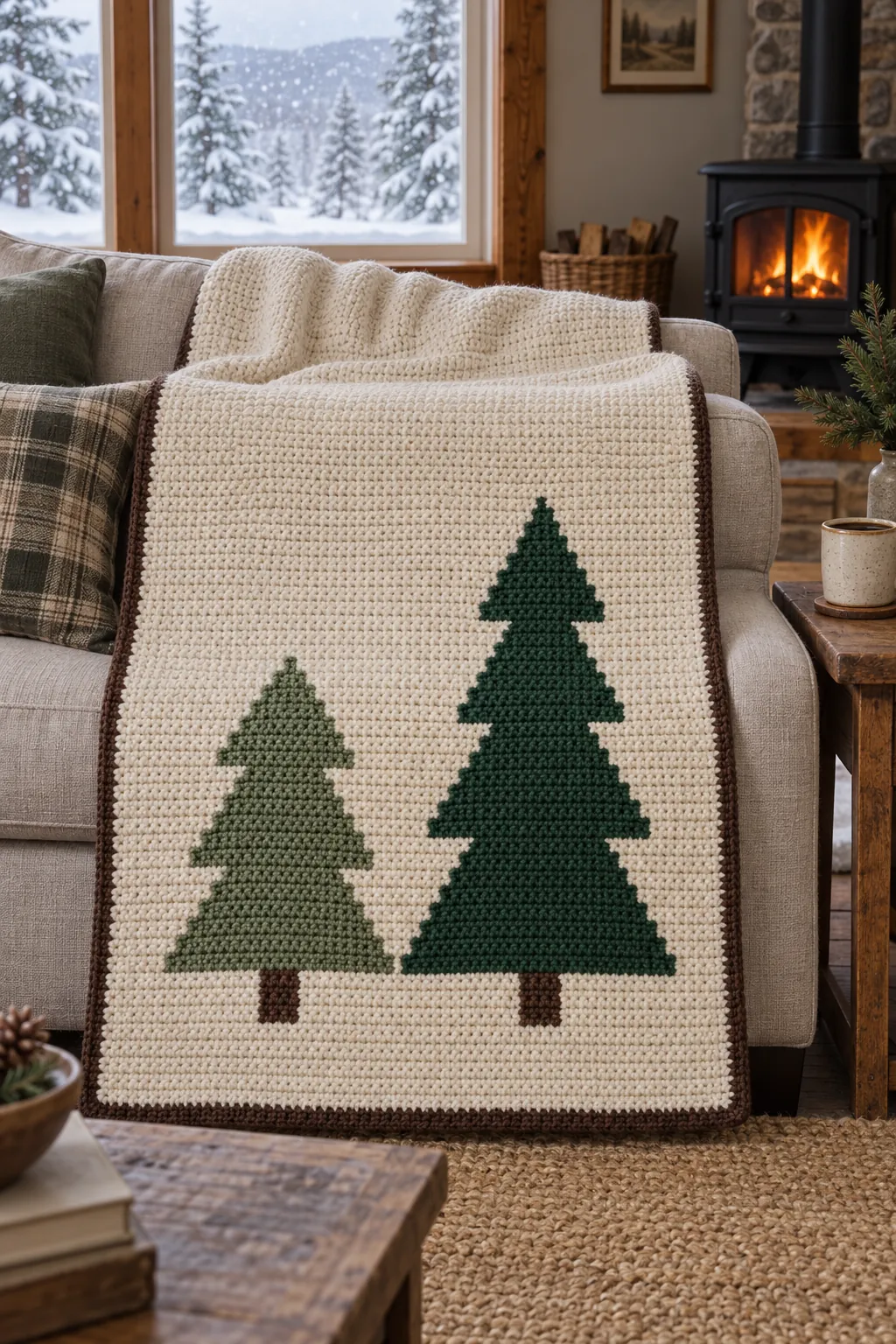
Picture the hill behind a Vermont farmhouse the morning after the first real snow. Everything is white except two spruces, one tall and one young, standing a few steps apart. The Spruce Hill Throw is a Christmas tree crochet blanket worked entirely in single crochet, with a deep spruce tree and a soft sage tree on a cream background, a walnut trunk under each one and a walnut border around the edge.
The trees grow row by row, with a separate strand for each patch of color, so nothing is sewn on later. You can make it about 49 1/2 × 59 1/2 in or a roomier 59 1/2 × 69 1/2 in. The trees are identical in both sizes; only the snow around them grows.
Is this Christmas tree crochet blanket a good first try at intarsia?
It is if plain rows of single crochet feel easy and long counts don’t scare you. The rating is Intermediate because of the color work, not the stitches. Every stitch in the body is single crochet, the foundation and turning chains are chain, and the middle round of the border is half double crochet.
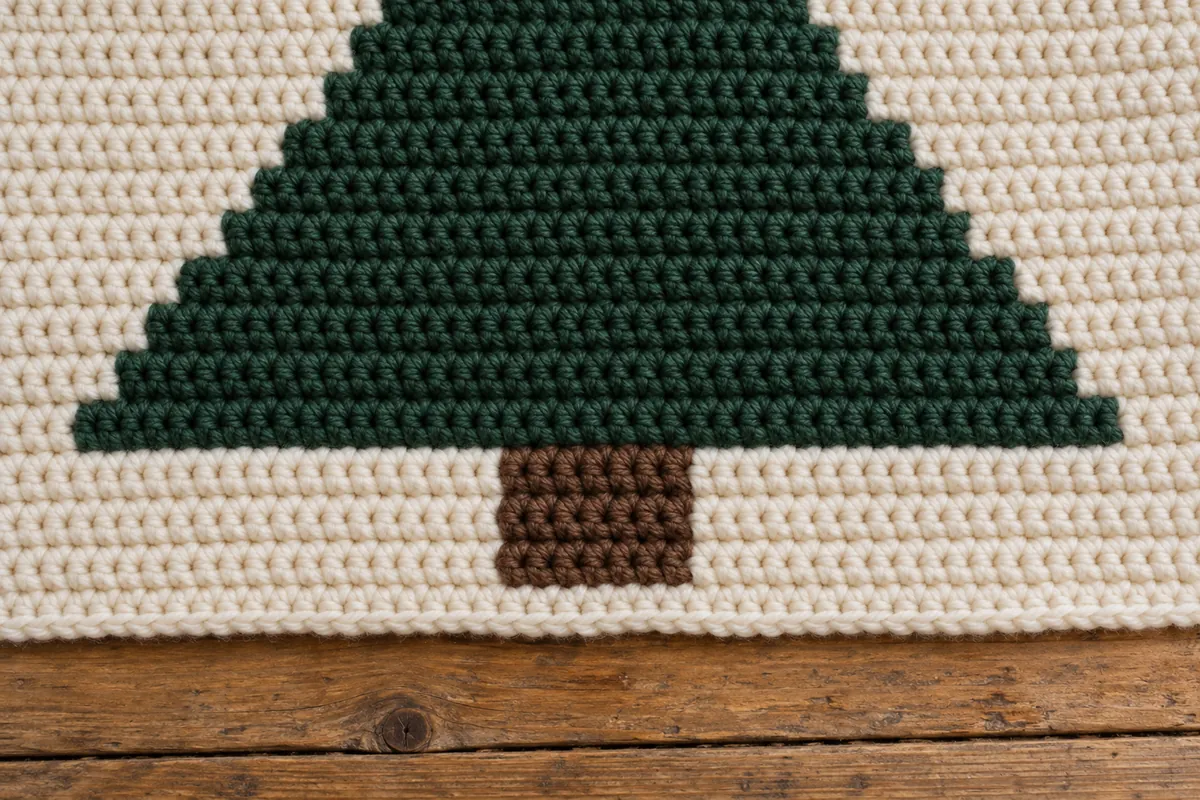
The color technique is intarsia. Each area of color has its own strand: when you reach the edge of a tree, you finish the last stitch of the old color with the new one, drop the old strand on the back and keep going. Nothing is carried inside the stitches, so the cream never shows through the green. The busiest rows have five strands hanging at once: three of cream, plus two of walnut in the trunk rows or one each of spruce and sage higher up.
The tree rows are written as runs of stitches, listed from left to right as you see the front, for example “54 A, 7 D, 59 A”. On right side rows you work the runs from the last number back to the first; on wrong side rows, in the order written. It feels backwards for about two rows, then it clicks. If brackets and row ranges are new to you, the Beginner Guide explains how to read a crochet pattern.
One move may be new: the step rows. When a new tier of branches juts out, the tree widens by 5 to 26 stitches at once, and its strand hangs a few inches from where the tier begins. You lay that strand back along the row below and crochet over it, so it hides inside stitches of its own color. The card marks all eleven step rows.
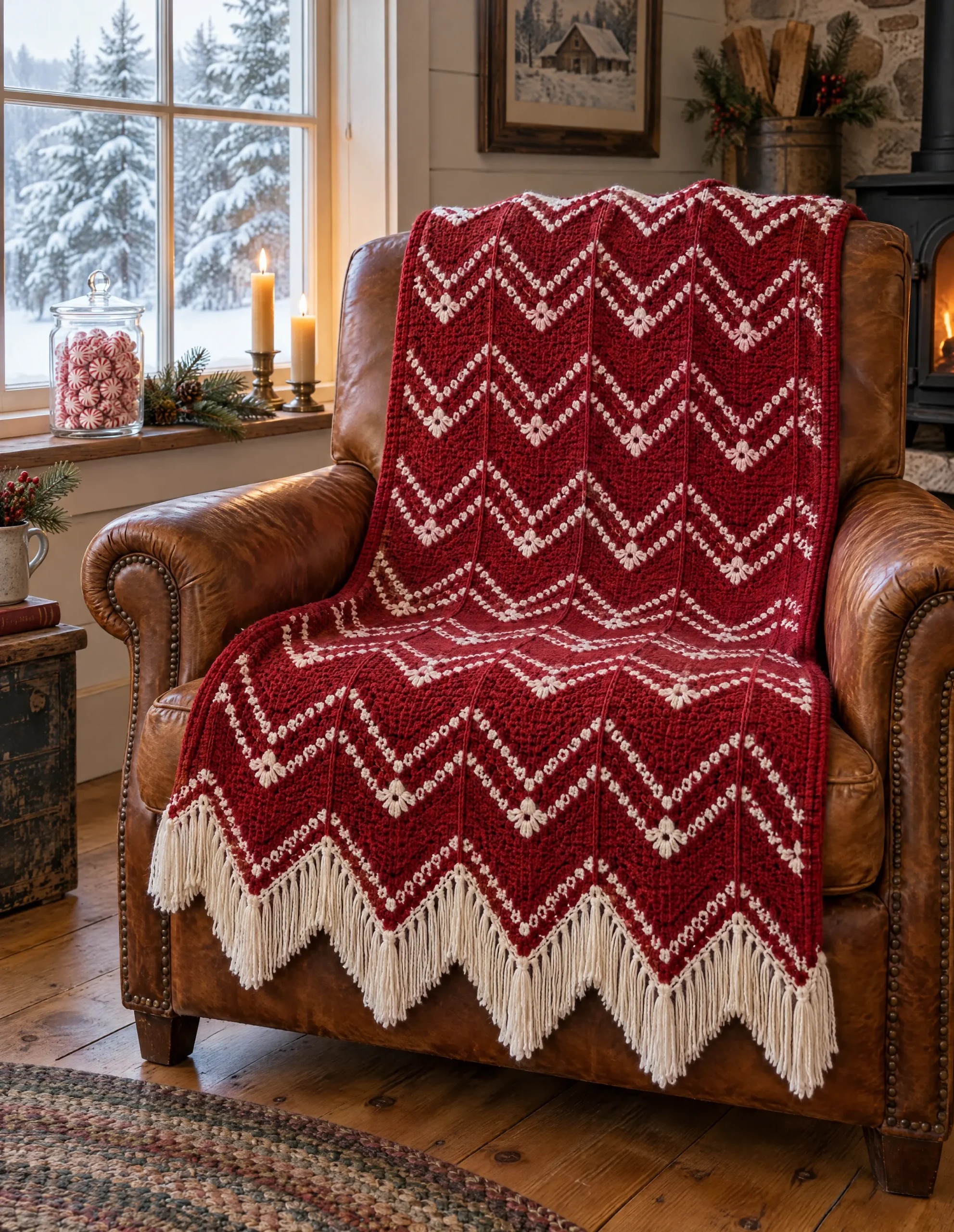
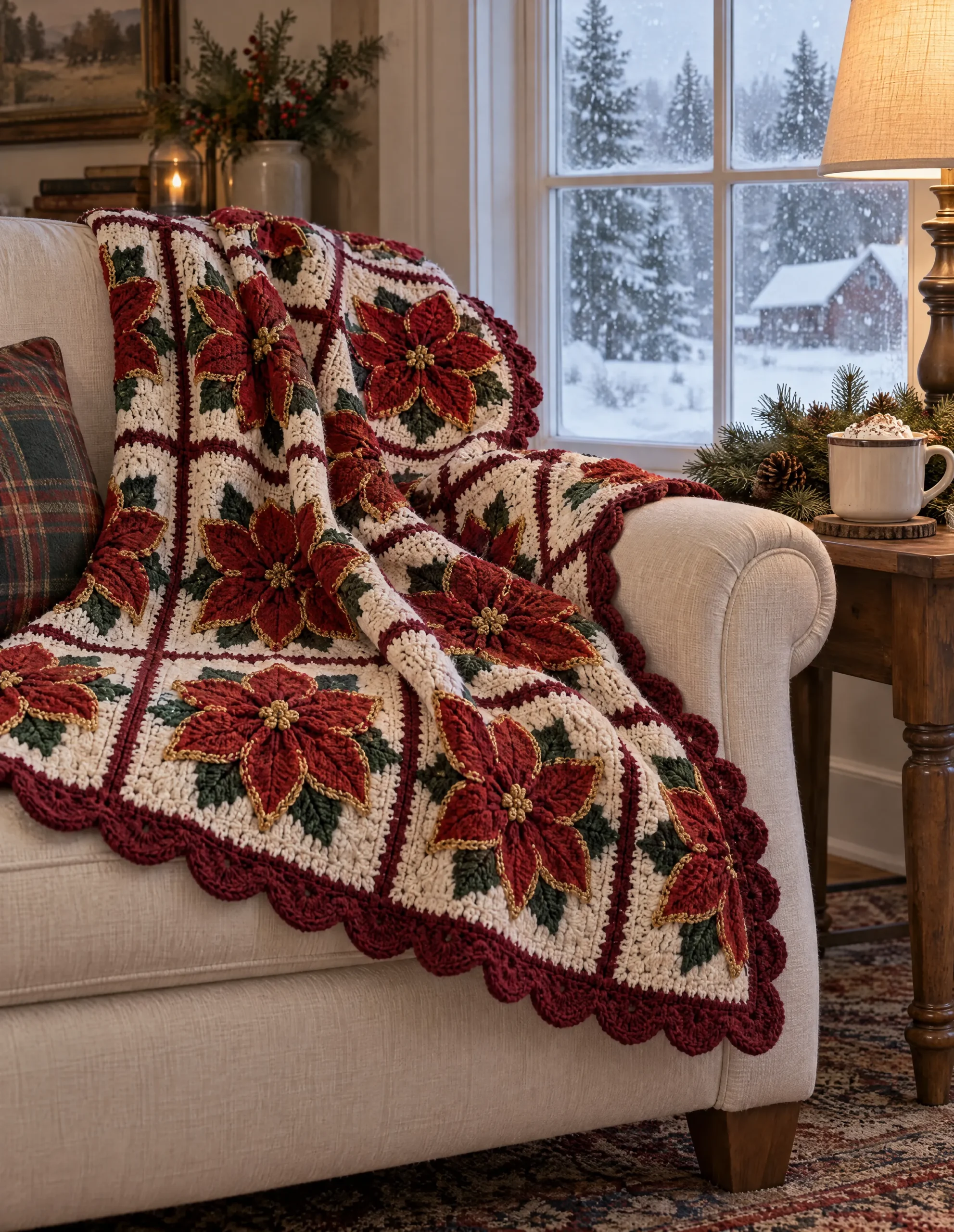
If you’d rather skip the strands, a holiday coverlet built from granny squares brings the season indoors another way.
Smooth worsted for crisp tree edges, and every skein of cream from one dye lot
Look for the number 4 on the label. A smooth, tightly plied acrylic or acrylic and wool blend works best. The tree edges are made of tiny one-stitch steps that only look sharp when each stitch stands out, so skip fuzzy yarns, and keep every color solid: variegated yarn breaks up the silhouette.
Cream is more than four fifths of the yarn: about 3,650 yd for the throw and 5,300 yd for the large throw. Buy all of it at once, in a single dye lot. In the tree rows three strands of cream work side by side, so a second lot would show up as a patch around a tree. Substitute by yardage, not by skein count, and keep all four colors in the same weight and fiber so the stitches line up at every color change.
Make a swatch before you buy the whole lot: 24 sc and 27 rows should give a 6 in (15 cm) square. Row gauge matters more here than in a plain blanket, because it sets the shape of the trees. At 16 rows per 4 in instead of 18, the tall spruce grows from about 26 3/4 in to 30 in and looks skinnier. If your swatch is too wide, try a 4.5 mm (US 7) hook; too narrow, a 5.5 mm (I-9).
Spruce, sage and walnut on a field of snow
Cream is the snow and the sky, the empty space that lets the two silhouettes read from across the room. Spruce, the darkest green, goes on the tall tree so it stands forward. Sage, lighter and grayer, goes on the small tree and makes it look a few steps farther back. Walnut appears only in the trunks and the border, which ties the trees to the frame.
Other palettes work if the background is clearly lighter or darker than both trees:
- Spruce Hill: cream background, spruce tall tree, sage small tree, walnut trunks and border, as written.
- Red Barn Christmas: ivory background, hunter green tall tree, olive small tree, barn red trunks and border.
- Tamarack Gold: oatmeal background, forest green tall tree, mustard small tree, cinnamon trunks and border.
- Cabin Night: charcoal background, oatmeal tall tree, pale sage small tree, chocolate trunks and border.
- Blue Spruce Frost: ivory background, gray-blue spruce tall tree, silver sage small tree, taupe trunks and border.
Before you commit, take a black and white phone photo of the four skeins. If a tree color and the background turn the same gray, swap one of them.
Throw or large throw: the same two trees in more snow
The trees never change size. The tall spruce is 61 stitches wide and 120 rows high, about 15 1/4 × 26 3/4 in (39 × 68 cm), and the small tree is 41 stitches by 81 rows, about 10 1/4 × 18 in (26 × 46 cm). The card lists sizes as throw [large throw].
- Throw: about 49 1/2 × 59 1/2 in (126 × 151 cm). Ch 193, then 261 rows: 56 rows of snow, 120 tree rows and 85 rows of sky. Border Round 1 has 848 sc. About 3,650 yd of cream, 300 yd of spruce, 150 yd of sage and 250 yd of walnut.
- Large throw: about 59 1/2 × 69 1/2 in (151 × 177 cm). Ch 233, then 306 rows: 76 rows of snow, 120 tree rows and 110 rows of sky. Border Round 1 has 1,008 sc. About 5,300 yd of cream, 300 yd of spruce, 150 yd of sage and 300 yd of walnut.
Every yardage is an estimate with about 10% extra built in. In acrylic, the throw weighs around 4 3/4 lb (2.2 kg) and the large throw around 6 1/2 lb (3 kg).
To resize, add the same number of stitches to the first and last cream runs of every tree row, so the trees stay centered, and add rows to the snow and sky. Keep the total row count a multiple of 9 so the border still fits. At bed size the trees look small in a wide field, so the motif shows best as a throw.
Five strands, 120 tree rows: keeping the spruces sharp
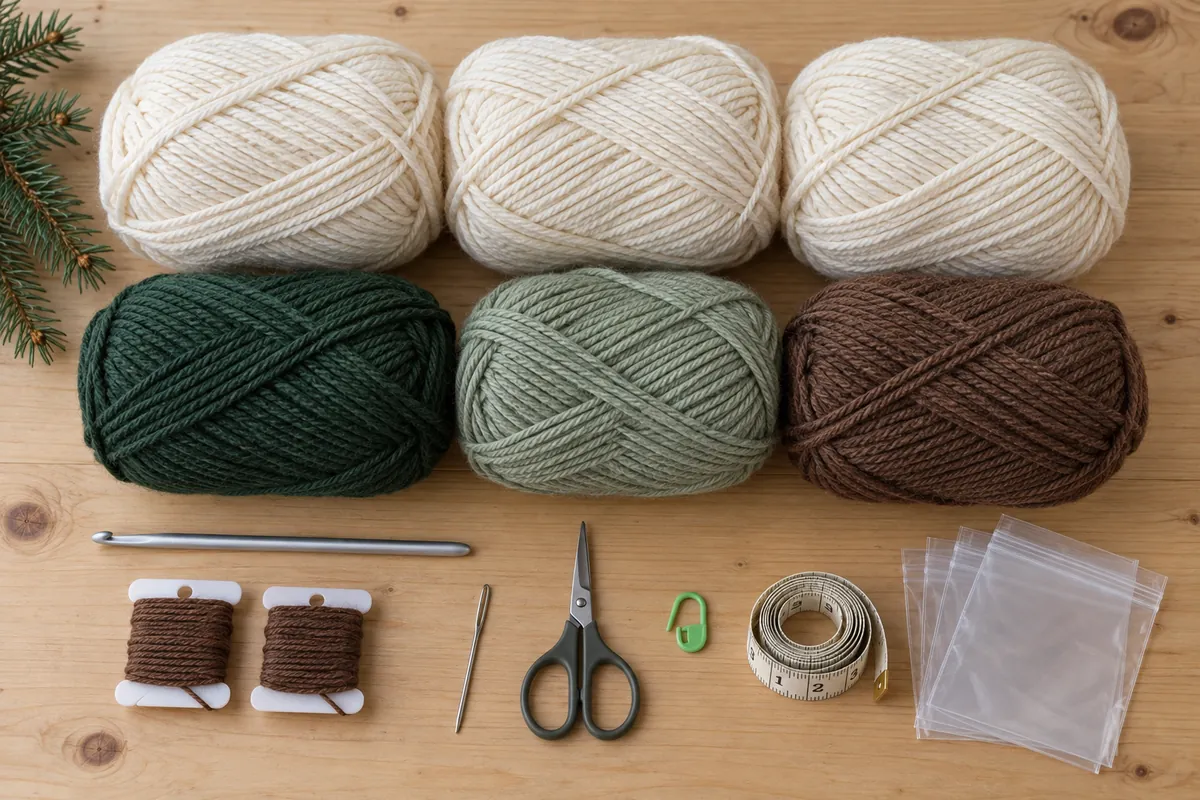
Bag every strand. Keep each skein of cream, spruce and sage in its own zip bag with the yarn coming out of one corner. The trunks only need about 6 and 8 yd of walnut, so wind two small bobbins of 10 yd each.
Turn one way, then the other. Always turning the same way twists the strands into a rope. Turn clockwise at the end of right side rows and counterclockwise at the end of wrong side rows, and the twist undoes itself.
Mark the right side. Clip a marker to the front after Row 1. Every odd-numbered row, in the snow, the trees and the sky, is worked with that marker facing you.
Drop the old color on the back. On right side rows the strands hang behind the work; on wrong side rows they hang toward you. Give each dropped strand a light tug when you pass it on the next row.
Count the first run of every row. From Row T36 to T45 and from T57 to T71, the two trees taper at different moments, so the counts change on almost every row. Check the first run of each row against the card, and cross off each line as you finish it.
Weave ends into their own color. The tree section leaves about a dozen ends, plus one at every new skein of cream. Run each one through stitches of the same color so no green or brown shows in the snow.
US crochet terms
The pattern
Materials
- Worsted weight yarn (CYC #4 Medium), smooth acrylic or acrylic and wool blend, about 200 yd (183 m) per 3.5 oz (100 g) skein. Estimated yardage:
- A, Snow (cream): 3,650 [5,300] yd (3,338 [4,846] m), 19 [27] skeins.
- B, Spruce (deep green): 300 yd (274 m), 2 skeins, both sizes.
- C, Sage: 150 yd (137 m), 1 skein, both sizes.
- D, Walnut (trunks and border): 250 [300] yd (229 [274] m), 2 skeins.
- Total: about 4,350 [6,050] yd (3,978 [5,532] m).
- 5.0 mm (H-8) crochet hook.
- 2 small yarn bobbins and 5 zip-top bags.
- 1 locking stitch marker.
- Yarn needle, scissors and tape measure.
Gauge
- 16 sc and 18 rows = 4 in (10 cm) in sc with the 5.0 mm (H-8) hook.
- Swatch: 24 sc and 27 rows = 6 in (15 cm) square.
Finished size
- Throw: about 49 1/2 × 59 1/2 in (126 × 151 cm).
- Large throw: about 59 1/2 × 69 1/2 in (151 × 177 cm).
- Measured flat after blocking, border included. Tall tree about 15 1/4 × 26 3/4 in (39 × 68 cm), small tree about 10 1/4 × 18 in (26 × 46 cm) in both sizes.
Abbreviations
- ch chain
- hdc half double crochet
- rep repeat
- RS right side
- sc single crochet
- sl st slip stitch
- sp(s) space(s)
- st(s) stitch(es)
- WS wrong side
- yo yarn over
Notes
- Sizes are written as throw [large throw]. A single number applies to both sizes.
- Colors: A = Snow (cream), B = Spruce, C = Sage, D = Walnut.
- The body is worked in rows of sc in 3 sections: Snow (Rows 1–56 [1–76]), Trees (Rows T1–T120) and Sky (Rows S1–S85 [S1–S110]). Row 1 is a RS row. In every section, odd-numbered rows are RS rows and even-numbered rows are WS rows.
- Turning chains never count as a st. Begin every row with ch 1 and work the first sc in the first st; end every row with turn. In the border, the beginning ch never counts as a st either.
- Reading the tree rows: each line lists the color runs from left to right as they appear with the RS facing. Each number is that many sc in that color. On RS rows, work the runs from the last one listed back to the first; on WS rows, work them in the order written. If you crochet left-handed, follow the same rule: your trees will be mirrored, which is fine.
- Intarsia: use a separate strand for every run (at most 3 strands of A, 1 of B, 1 of C and 2 of D at once). Never carry a color across another color’s run.
- Color change: work the last sc of the old color until 2 loops remain on the hook, yo with the new color and draw through both loops. Drop the old color on the WS of the work: behind it on RS rows, toward you on WS rows.
- Step rows: the tree’s run begins several sts before the spot where its strand hangs. Bring the strand back loosely along the top of the row below and work the first sc of the run over it until you reach the point where it hangs. The strand ends up hidden inside sts of its own color.
- To keep the strands from twisting, turn clockwise after RS rows and counterclockwise after WS rows.
- Join each new skein of A the same way as a color change, at the end of a run.
- Stitch multiple: multiple of 2 + 1 ch, at least 193 ch (192 sc, the width the trees need). To resize, add the same number of sts to the first and last runs of every tree row and add rows to the Snow and Sky. Keep the total row count a multiple of 9 so the side edges of border Round 1 still work out to 8 sc for every 9 rows.
Instructions
Snow
- Foundation: with A, ch 193 [233].
- Row 1 (RS): sc in 2nd ch from hook and in each ch across, turn. (192 [232] sc)
- Place the marker on the RS.
- Rows 2–56 [2–76]: ch 1, sc in each st across, turn. (192 [232] sc)
- The piece measures about 12 1/2 [17] in (32 [43] cm). Do not fasten off.
Trees
- Wind each D strand onto a bobbin (about 10 yd each). Keep 2 more skeins of A ready for the extra A runs.
- Work every Tree row as: ch 1, the runs listed, turn. Rows marked “Step row” widen a tree into a new tier (see Notes).
- Rows T1–T12: 54 [74] A, 7 D, 59 A, 9 D, 63 [83] A; in Row T1, the A strand from the last Snow row works the last run listed (the first one you crochet), and you join D and the 2 extra A strands at the start of their runs. (192 [232] sts)
- Row T13 (RS): 54 [74] A, 24 C, 42 A, 35 B, 37 [57] A; cut both D strands after Row T12, then join B and C at the start of their runs. (192 [232] sts)
- Row T14 (WS): 37 [57] A, 41 C, 16 A, 61 B, 37 [57] A. Step row. (192 [232] sts)
- Row T15 (RS): 37 [57] A, 41 C, 16 A, 61 B, 37 [57] A. (192 [232] sts)
- Rows T16–T17: 38 [58] A, 39 C, 18 A, 59 B, 38 [58] A. (192 [232] sts)
- Rows T18–T19: 39 [59] A, 37 C, 20 A, 57 B, 39 [59] A. (192 [232] sts)
- Rows T20–T21: 40 [60] A, 35 C, 22 A, 55 B, 40 [60] A. (192 [232] sts)
- Rows T22–T23: 41 [61] A, 33 C, 24 A, 53 B, 41 [61] A. (192 [232] sts)
- Rows T24–T25: 42 [62] A, 31 C, 26 A, 51 B, 42 [62] A. (192 [232] sts)
- Rows T26–T27: 43 [63] A, 29 C, 28 A, 49 B, 43 [63] A. (192 [232] sts)
- Rows T28–T29: 44 [64] A, 27 C, 30 A, 47 B, 44 [64] A. (192 [232] sts)
- Rows T30–T31: 45 [65] A, 25 C, 32 A, 45 B, 45 [65] A. (192 [232] sts)
- Rows T32–T33: 46 [66] A, 23 C, 34 A, 43 B, 46 [66] A. (192 [232] sts)
- Rows T34–T35: 47 [67] A, 21 C, 36 A, 41 B, 47 [67] A. (192 [232] sts)
- Row T36 (WS): 42 [62] A, 26 C, 37 A, 39 B, 48 [68] A. Step row. (192 [232] sts)
- Row T37 (RS): 42 [62] A, 31 C, 32 A, 39 B, 48 [68] A. Step row. (192 [232] sts)
- Row T38 (WS): 42 [62] A, 31 C, 33 A, 37 B, 49 [69] A. (192 [232] sts)
- Row T39 (RS): 43 [63] A, 29 C, 34 A, 37 B, 49 [69] A. (192 [232] sts)
- Row T40 (WS): 43 [63] A, 29 C, 35 A, 35 B, 50 [70] A. (192 [232] sts)
- Row T41 (RS): 44 [64] A, 27 C, 36 A, 35 B, 50 [70] A. (192 [232] sts)
- Row T42 (WS): 44 [64] A, 27 C, 37 A, 33 B, 51 [71] A. (192 [232] sts)
- Row T43 (RS): 45 [65] A, 25 C, 38 A, 33 B, 51 [71] A. (192 [232] sts)
- Row T44 (WS): 45 [65] A, 25 C, 32 A, 39 B, 51 [71] A. Step row. (192 [232] sts)
- Row T45 (RS): 46 [66] A, 23 C, 33 A, 45 B, 45 [65] A. Step row. (192 [232] sts)
- Row T46 (WS): 46 [66] A, 23 C, 33 A, 45 B, 45 [65] A. (192 [232] sts)
- Rows T47–T48: 47 [67] A, 21 C, 35 A, 43 B, 46 [66] A. (192 [232] sts)
- Rows T49–T50: 48 [68] A, 19 C, 37 A, 41 B, 47 [67] A. (192 [232] sts)
- Rows T51–T52: 49 [69] A, 17 C, 39 A, 39 B, 48 [68] A. (192 [232] sts)
- Rows T53–T54: 50 [70] A, 15 C, 41 A, 37 B, 49 [69] A. (192 [232] sts)
- Rows T55–T56: 51 [71] A, 13 C, 43 A, 35 B, 50 [70] A. (192 [232] sts)
- Row T57 (RS): 51 [71] A, 18 C, 39 A, 33 B, 51 [71] A. Step row. (192 [232] sts)
- Row T58 (WS): 46 [66] A, 23 C, 39 A, 33 B, 51 [71] A. Step row. (192 [232] sts)
- Row T59 (RS): 46 [66] A, 23 C, 40 A, 31 B, 52 [72] A. (192 [232] sts)
- Row T60 (WS): 47 [67] A, 21 C, 41 A, 31 B, 52 [72] A. (192 [232] sts)
- Row T61 (RS): 47 [67] A, 21 C, 42 A, 29 B, 53 [73] A. (192 [232] sts)
- Row T62 (WS): 48 [68] A, 19 C, 43 A, 29 B, 53 [73] A. (192 [232] sts)
- Row T63 (RS): 48 [68] A, 19 C, 44 A, 27 B, 54 [74] A. (192 [232] sts)
- Row T64 (WS): 49 [69] A, 17 C, 45 A, 27 B, 54 [74] A. (192 [232] sts)
- Row T65 (RS): 49 [69] A, 17 C, 46 A, 25 B, 55 [75] A. (192 [232] sts)
- Row T66 (WS): 50 [70] A, 15 C, 47 A, 25 B, 55 [75] A. (192 [232] sts)
- Row T67 (RS): 50 [70] A, 15 C, 48 A, 23 B, 56 [76] A. (192 [232] sts)
- Row T68 (WS): 51 [71] A, 13 C, 49 A, 23 B, 56 [76] A. (192 [232] sts)
- Row T69 (RS): 51 [71] A, 13 C, 49 A, 29 B, 50 [70] A. Step row. (192 [232] sts)
- Row T70 (WS): 52 [72] A, 11 C, 44 A, 35 B, 50 [70] A. Step row. (192 [232] sts)
- Row T71 (RS): 52 [72] A, 11 C, 44 A, 35 B, 50 [70] A. (192 [232] sts)
- Rows T72–T73: 53 [73] A, 9 C, 46 A, 33 B, 51 [71] A. (192 [232] sts)
- Rows T74–T75: 54 [74] A, 7 C, 48 A, 31 B, 52 [72] A. (192 [232] sts)
- Rows T76–T77: 55 [75] A, 5 C, 50 A, 29 B, 53 [73] A. (192 [232] sts)
- Rows T78–T79: 56 [76] A, 3 C, 52 A, 27 B, 54 [74] A. (192 [232] sts)
- Rows T80–T81: 57 [77] A, 1 C, 54 A, 25 B, 55 [75] A. (192 [232] sts)
- Rows T82–T83: 113 [133] A, 23 B, 56 [76] A; after Row T81, cut C and the A strand of the middle run, so the A strand of the first run listed works across their place in Row T82. (192 [232] sts)
- Rows T84–T85: 114 [134] A, 21 B, 57 [77] A. (192 [232] sts)
- Rows T86–T87: 115 [135] A, 19 B, 58 [78] A. (192 [232] sts)
- Rows T88–T89: 116 [136] A, 17 B, 59 [79] A. (192 [232] sts)
- Rows T90–T91: 117 [137] A, 15 B, 60 [80] A. (192 [232] sts)
- Rows T92–T93: 118 [138] A, 13 B, 61 [81] A. (192 [232] sts)
- Row T94 (WS): 112 [132] A, 19 B, 61 [81] A. Step row. (192 [232] sts)
- Row T95 (RS): 112 [132] A, 25 B, 55 [75] A. Step row. (192 [232] sts)
- Row T96 (WS): 112 [132] A, 25 B, 55 [75] A. (192 [232] sts)
- Rows T97–T98: 113 [133] A, 23 B, 56 [76] A. (192 [232] sts)
- Rows T99–T100: 114 [134] A, 21 B, 57 [77] A. (192 [232] sts)
- Rows T101–T102: 115 [135] A, 19 B, 58 [78] A. (192 [232] sts)
- Rows T103–T104: 116 [136] A, 17 B, 59 [79] A. (192 [232] sts)
- Rows T105–T106: 117 [137] A, 15 B, 60 [80] A. (192 [232] sts)
- Rows T107–T108: 118 [138] A, 13 B, 61 [81] A. (192 [232] sts)
- Rows T109–T110: 119 [139] A, 11 B, 62 [82] A. (192 [232] sts)
- Rows T111–T112: 120 [140] A, 9 B, 63 [83] A. (192 [232] sts)
- Rows T113–T114: 121 [141] A, 7 B, 64 [84] A. (192 [232] sts)
- Rows T115–T116: 122 [142] A, 5 B, 65 [85] A. (192 [232] sts)
- Rows T117–T118: 123 [143] A, 3 B, 66 [86] A. (192 [232] sts)
- Rows T119–T120: 124 [144] A, 1 B, 67 [87] A. (192 [232] sts)
- After Row T120, cut B and the A strand that ends beside the top of the tall tree. The A strand at the edge works Row S1.
Sky
- Rows S1–S85 [S1–S110]: ch 1, sc in each st across, turn. (192 [232] sc)
- Fasten off. The body measures about 48 × 58 [58 × 68] in (122 × 147 [147 × 173] cm).
Border
- Round 1 (RS): with RS facing, join D with sl st in the first st of the top edge, at the corner where a RS row would begin. Ch 1, sc in same st and in each st across (192 [232] sc), ch 2; working in row-ends down the side, (sc in each of next 8 row-ends, skip next row-end) 29 [34] times (232 [272] sc), ch 2; working in the free loops of the foundation chain, sc in each ch across (192 [232] sc), ch 2; working in row-ends up the other side, (sc in each of next 8 row-ends, skip next row-end) 29 [34] times (232 [272] sc), ch 2, join with sl st in first sc. (848 [1,008] sc and 4 ch-2 sps)
- Round 2: ch 2, hdc in same st as join and in each st across to next ch-2 sp, (2 hdc, ch 2, 2 hdc) in ch-2 sp, *hdc in each st across to next ch-2 sp, (2 hdc, ch 2, 2 hdc) in ch-2 sp; rep from * 2 more times, join with sl st in first hdc. (196 [236] hdc across top and bottom, 236 [276] hdc along each side, between corner ch-2 sps; 864 [1,024] hdc and 4 ch-2 sps)
- Round 3: ch 1, sc in same st as join and in each st across to next ch-2 sp, (sc, ch 2, sc) in ch-2 sp, *sc in each st across to next ch-2 sp, (sc, ch 2, sc) in ch-2 sp; rep from * 2 more times, join with sl st in first sc. Fasten off. (198 [238] sc across top and bottom, 238 [278] sc along each side, between corner ch-2 sps; 872 [1,032] sc and 4 ch-2 sps)
Finishing
- Weave in each end through sts of its own color.
- Lay the throw flat, mist it lightly and pat it to about 49 1/2 × 59 1/2 [59 1/2 × 69 1/2] in (126 × 151 [151 × 177] cm). Let it dry.
Washing a cream throw that holds dark spruce and walnut
Spruce and walnut touch cream along every tree edge, so check them first. Press a wet length of each dark yarn into a white paper towel; if it leaves a tint, add a color-catching sheet to the first few washes.
Machine wash cold on a gentle cycle with mild detergent. The large throw weighs about 6 1/2 lb dry and much more wet, so use a large front-loading machine. Tumble dry low or dry it flat, patting the edges straight while it’s damp. Don’t hang it over a line: the weight of all that single crochet stretches the length.
Store it in a breathable cotton bag, refolding it along new lines now and then so no crease settles across a tree. With a wool blend, add a cedar block for the summer months.
Questions about the spruces, the strands and the snow
Can I make this Christmas tree crochet blanket with tapestry crochet instead of separate strands?
You can, but the throw changes. Tapestry crochet carries the unused colors inside every stitch across the whole row, so with three colors in some rows the fabric gets stiff and heavy, and specks of green show through the cream. Separate strands keep the snow clean and the throw soft.
Why is there a loose stitch where the green meets the cream?
The last loop of the old color can loosen, most often where the tree edge moves over by a stitch. Pull the new color snug before you make the next stitch, and tug the dropped strand lightly when you pass it on the next row. A loose spot that’s already there usually closes when you weave a nearby end through it.
Why does each new tier stick out on one side first?
Each tier widens over two rows, starting on the side where its strand is waiting, so the yarn never crosses a run of cream. For one row the tier is lopsided; the next row evens it out. From a few feet away the step reads as a straight branch line.
My tall tree jumps sideways for a row. What happened?
Most often a RS row was worked in the written order instead of from the last run back to the first. That mirrors the row, so the tree shifts over. Compare the first run you crocheted with the last number on the card’s line, and if they don’t match, rip back that row.
Can I add a star to the top of the tall tree?
Yes, once the throw is finished. With a yarn needle and gold or mustard worsted, embroider a small star of straight stitches radiating from a point just above Row T120 of the spruce. Keep it under 2 in across and work it loosely so the cream doesn’t pucker.
Quick recap
- Chain 193 [233] in cream and work 56 [76] rows of sc for the snow.
- Work Tree rows T1–T120 in intarsia: two walnut trunks, then three sage tiers and four spruce tiers.
- Finish the body with 85 [110] rows of cream sc for the sky.
- Work three walnut border rounds of sc, hdc and sc, with ch-2 corners.
- Weave each end into its own color and block flat.
When the last border round is done, lay the Spruce Hill Throw over the back of the couch with the trees facing the room. If a count in this Christmas tree crochet blanket doesn’t match the stitches on your hook, or a tier won’t sit where the card says, send a note through the Contact page.