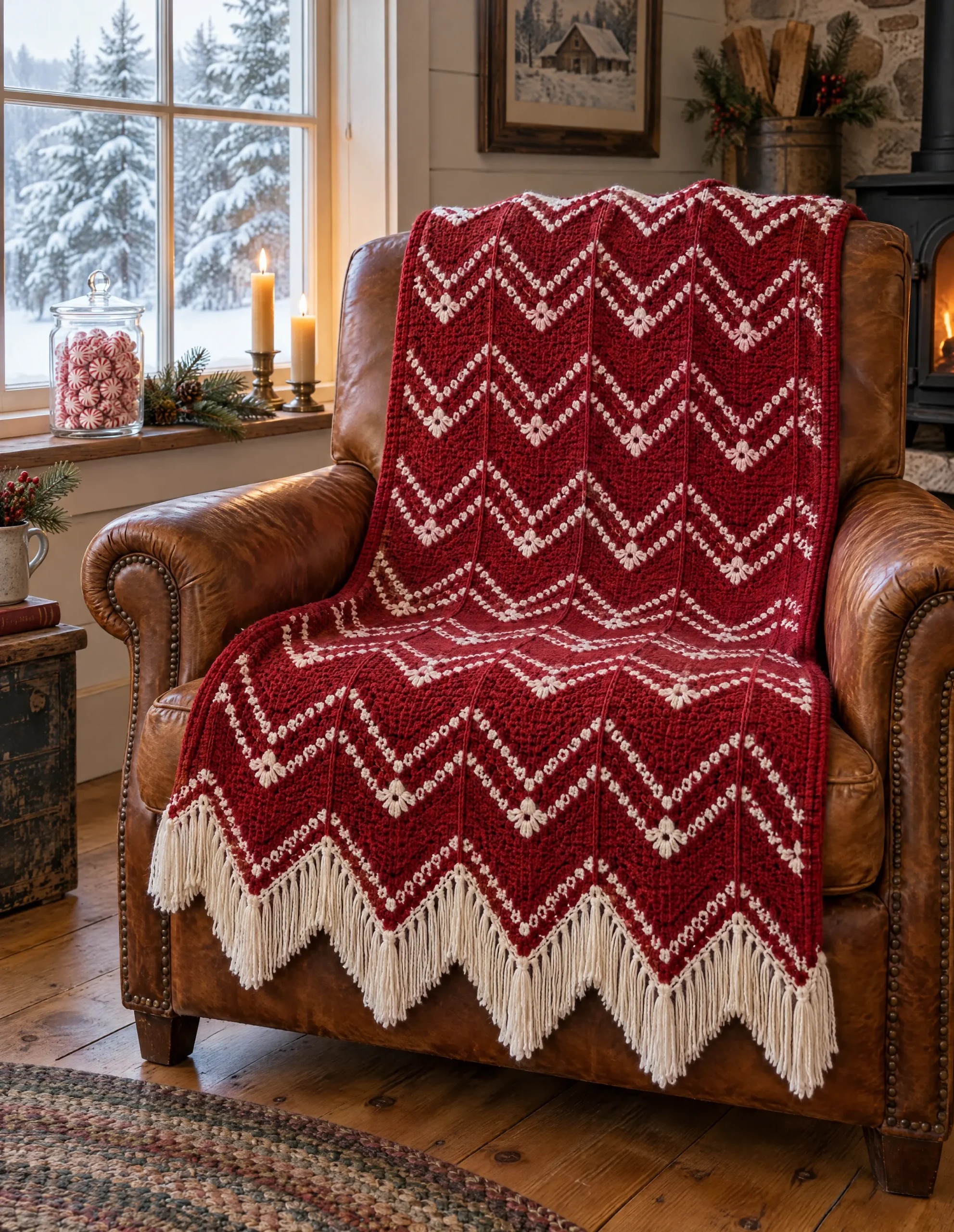
Picture a snowy December afternoon in Vermont, a jar of peppermint candies on the windowsill and a deep red throw over the armchair, crossed by fine white zigzags that meet in little white fans at every point. The Peppermint Ripple Throw is a Tunisian ripple blanket made of narrow strips, each one a single chevron with a white fan at its peak.
Sewn side by side, the strips line up into rows of zigzags across the whole blanket, and a white fringe follows the points at both ends. The pattern below takes you from the first chain to the last fringe, in a baby size, a throw and a twin.
Is this Tunisian ripple blanket right for your first Tunisian project?
It’s an Intermediate pattern, so it suits you best if you’ve already tried the forward and return passes of Tunisian simple stitch, even on a swatch. Tunisian crochet uses a longer hook and keeps a whole row of loops on it: you pick them up going right to left (the forward pass), then work them off going left to right (the return pass). The work never turns, so the right side always faces you.
On top of that, the strip adds a few moves. You increase on each side of the center bar to build the peak, and a special return pass decreases at both edges, so every row keeps exactly 33 loops. The white rows add a Tunisian treble and a long loop, both reaching three rows down. The finishing uses a chain, a row of single crochet along each long side, a whipstitch seam and a knotted fringe. If the abbreviations look new, the guide to reading a crochet pattern walks through them, and every Tunisian stitch is spelled out in the Notes.
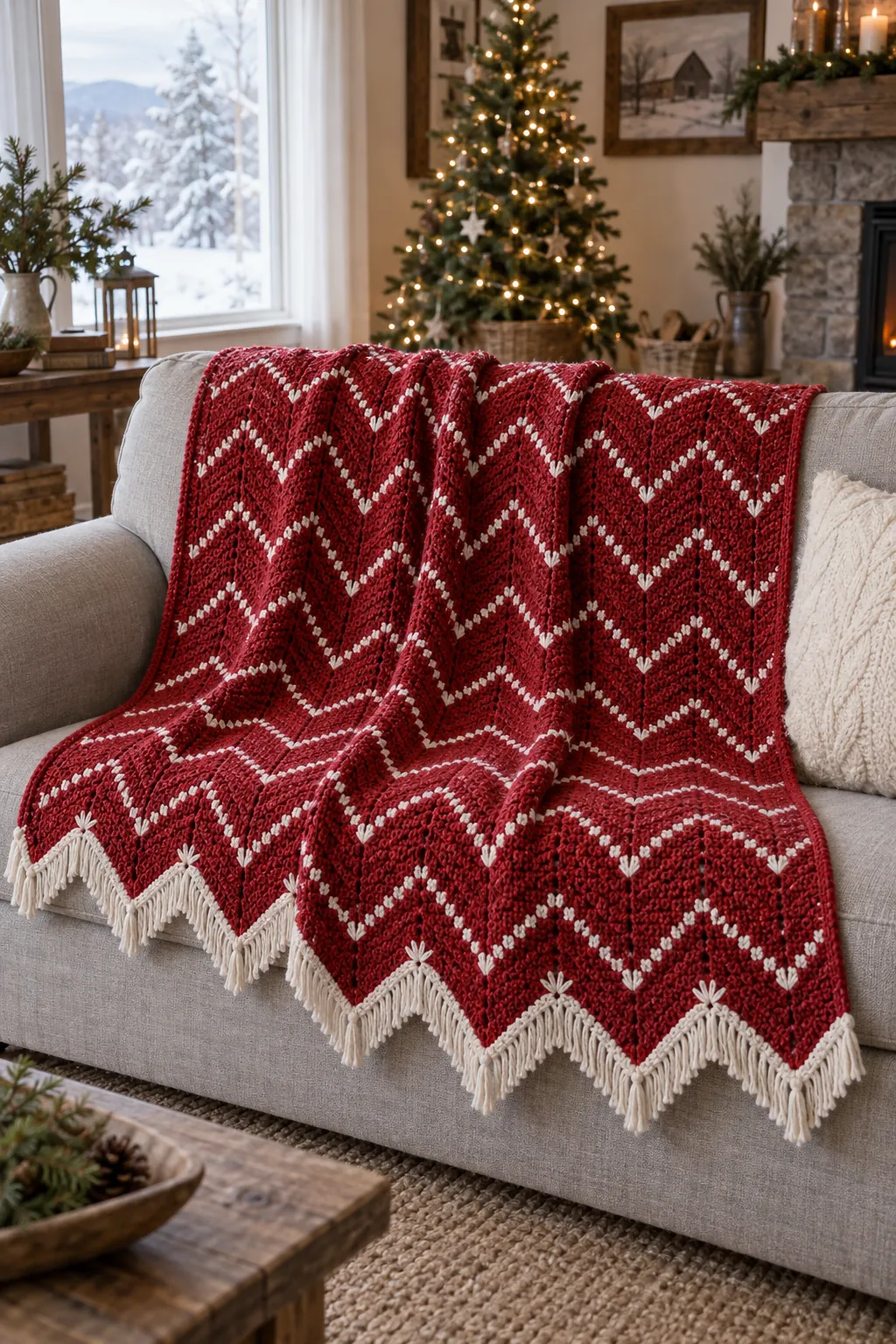
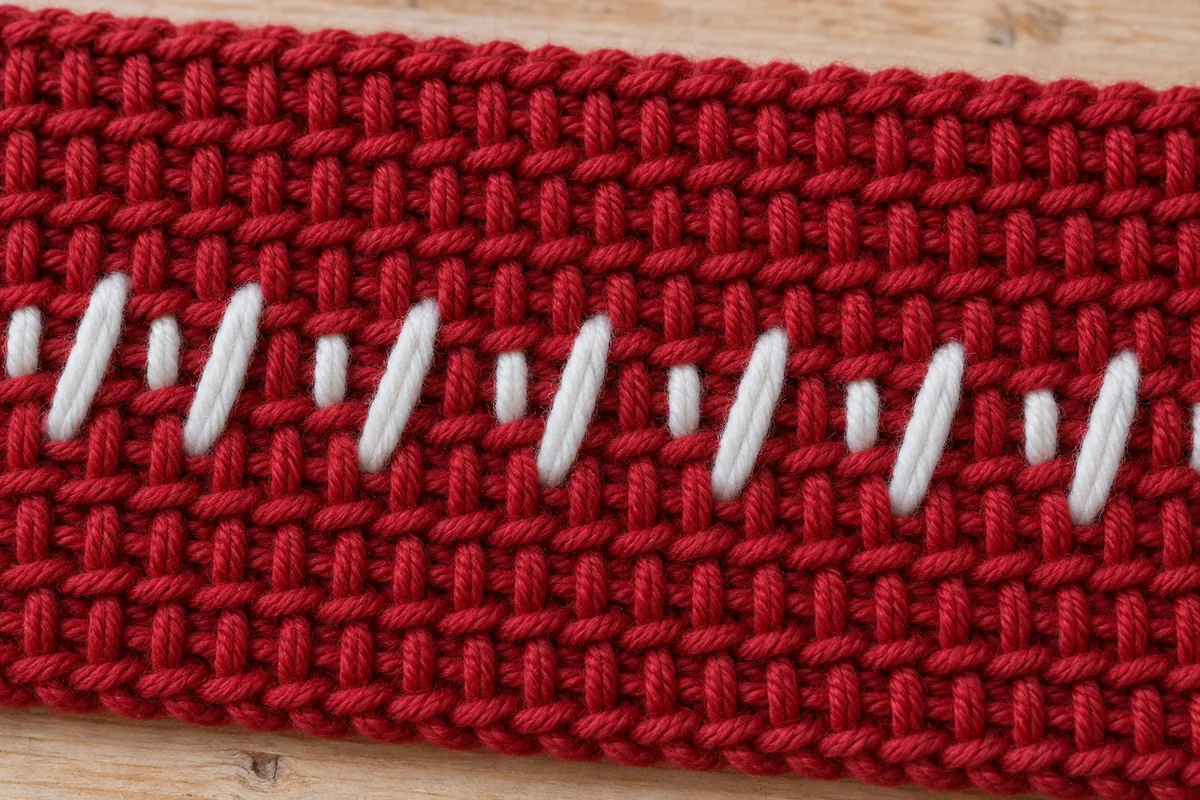
In the white rows, every other stitch is a Tunisian treble loop worked into the row three rows below. The long white stitch lies over the red like a slanted dash, and the short white stitches between them keep the row firm.
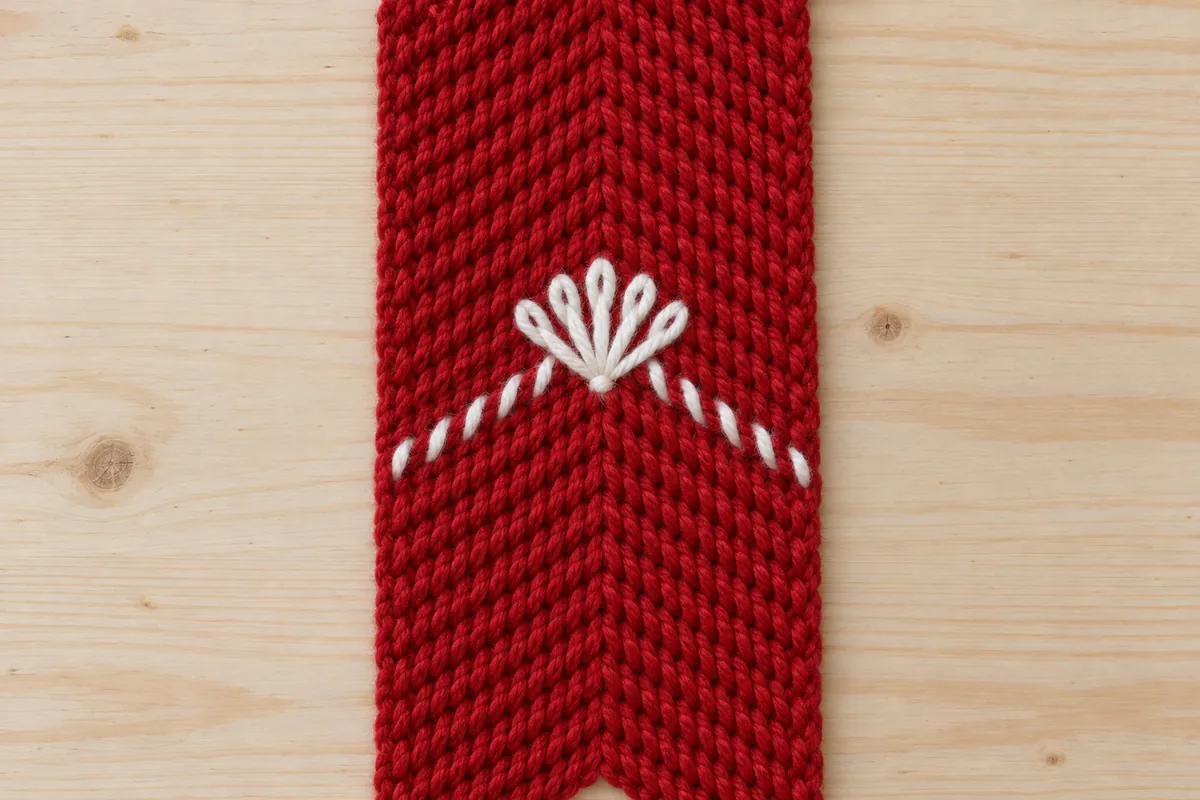
At the center of each white row, five long loops come up through the same stitch, three rows down, and open into a small fan above the peak. Some white rows carry the fan alone and others carry the fan and the dashes, so the stripes don’t look flat.
A worsted yarn and a bigger Tunisian hook
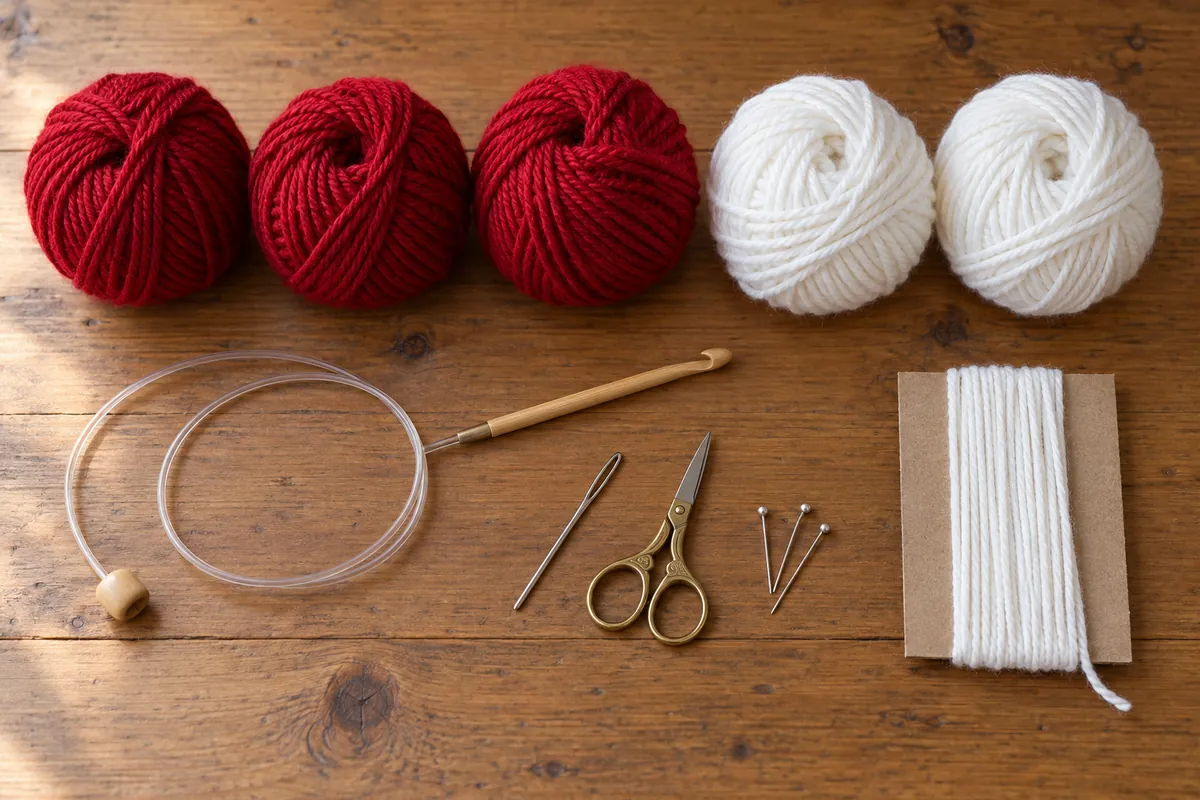
Look for a 4 on the label, with medium or worsted next to it. The amounts in the card assume skeins of about 200 yd (183 m) per 100 g. Wool, a wool blend or acrylic all work; for the baby size, choose a soft acrylic or a superwash wool that goes in the washer.
Tunisian simple stitch is a dense fabric, so it needs a bigger hook than the same yarn would take in regular crochet. The card uses a 6 mm (J-10) Tunisian hook. A strip never holds more than 33 loops, so a straight Tunisian hook at least 10 in (25 cm) long is enough, and a hook with a cable works just as well if you own one.
Tunisian crochet also uses more yarn than regular crochet, and the amounts already account for that. The red is the big purchase: about 3,207 yd for the throw, against about 814 yd of white including the fringe. Buy each color from one dye lot.
Before the first strip, work the 30-stitch gauge swatch in the card. Tunisian gauge varies a lot from one crocheter to the next, and the swatch tells you whether your strips will come out 5 in wide.
Peppermint red and snow white, or two other pairs
The blanket uses only two colors. A is the main color: plain rows, the return passes of the white rows, the seams and the side edging. B is the contrast color: the forward passes of the white rows and the fringe. Because the return passes of the contrast rows are worked in A, the white loops sit cleanly on the red with no white line underneath.
- Classic Peppermint: A peppermint red, B snow white, as written.
- Evergreen: A spruce green, B cream.
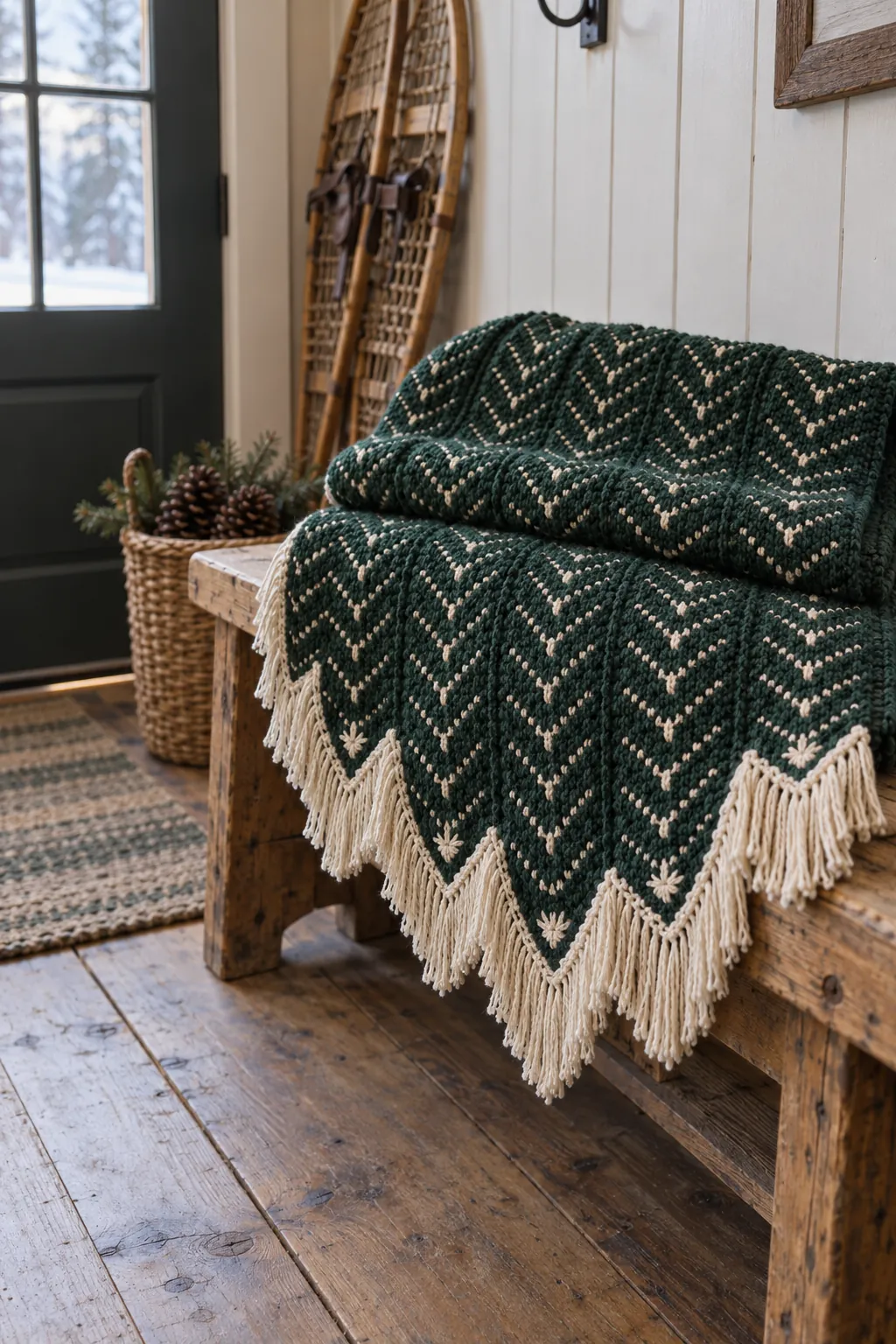
- Winter Frost: A denim blue, B snow white.
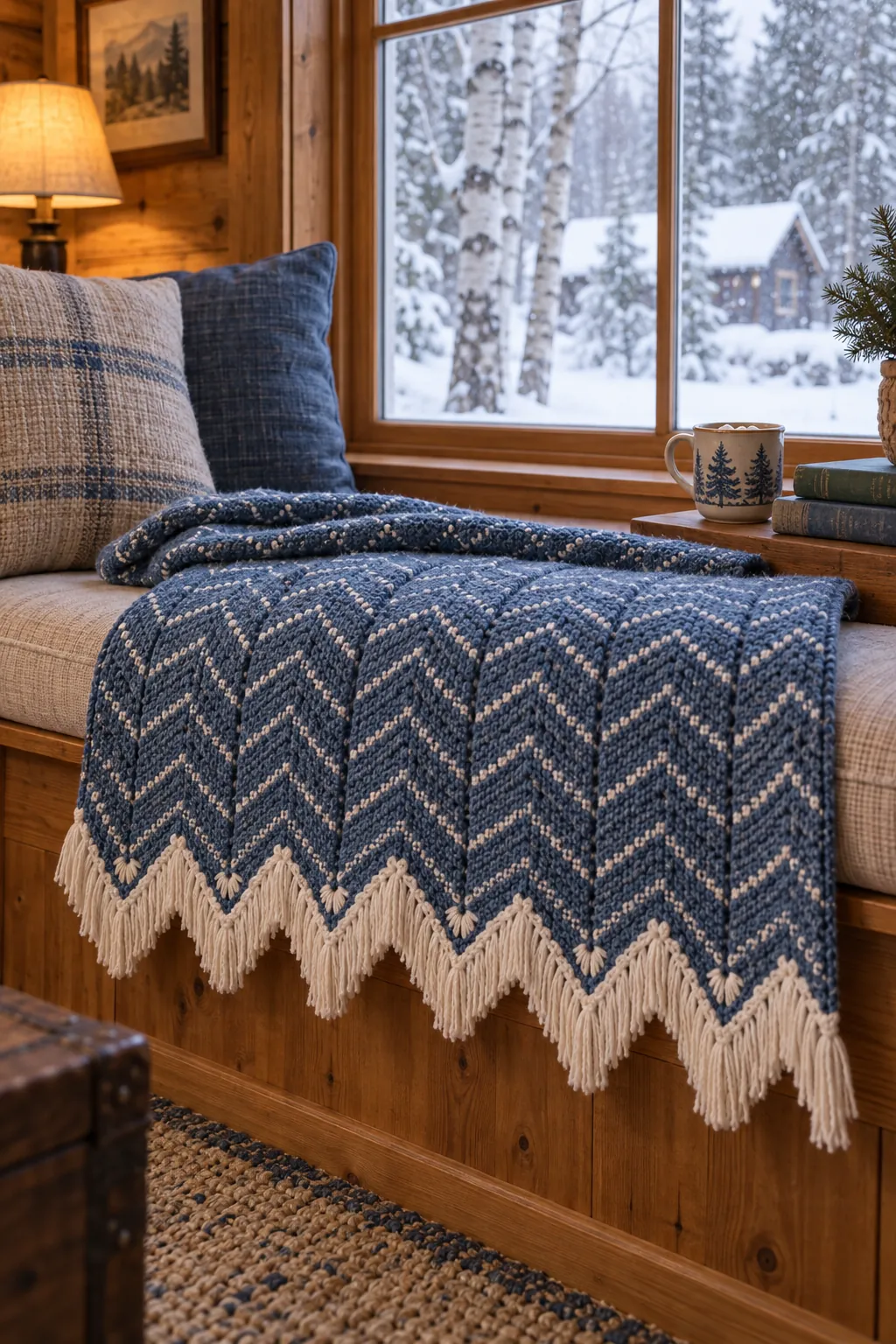
Choose a contrast clearly lighter or darker than the main color. The dashes and fans are only one row tall, and a soft contrast lets them disappear into the ground.
Baby, throw and twin, strip by strip
Every strip starts with the same 31 chains and keeps 33 loops on every row, so the blanket only grows in whole strips across and whole 20-row repeats up. Each strip adds about 5 in (12.7 cm) of width, and each repeat about 5 in of length. The card is written as Baby [Throw, Twin], and the sizes are measured without the fringe.
- Baby: about 30 1/2 × 35 in (77.5 × 89 cm). 6 strips of 140 rows, no fringe. A 1,130 yd, B 234 yd.
- Throw: about 50 1/2 × 60 in (128 × 152 cm). 10 strips of 240 rows, fringe about 3 in (7.5 cm) at each end. A 3,207 yd, B 814 yd.
- Twin: about 65 1/2 × 90 in (166 × 229 cm). 13 strips of 360 rows, fringe at each end. A 6,239 yd, B 1,492 yd.
The baby size never gets a fringe: loose strands aren’t safe for a baby. For a baby under 12 months, keep any loose blanket out of the crib and use it on the stroller, on a play mat or for supervised cuddles.
Counting 33 loops and finding the center bar
Count your loops at the end of every forward pass. The answer is always 33. If you have 32, you probably forgot one of the two increases at the center; if you have 34, you probably worked into bar 2 at the start, which you always skip.
The center bar is bar 17, counted from the right edge, and it sits in the same column on every row. Hook a stitch marker into the center bar of Row 1 and move it up every few rows. All the white fans come from that column, and the long loops of each fan go through the center stitch three rows below the row you’re working.
“Three rows below” trips people up the first time. In Row 5, count down: Row 4 is the first row below, Row 3 the second, Row 2 the third. Pull each treble loop and long loop up to the height of the current row and leave it relaxed, never tight, or the white dashes pucker the red.
Each white row leaves 4 ends at the edges of the strip: 238 per strip for the throw. Weave them in after every few white rows, into stitches of their own color, so a finished strip is truly finished. When you sew, pin the white rows of two neighboring strips together first, so the zigzags line up across the seam.
If you’d like a bigger Tunisian project in one piece, the Covered Bridge afghan works Tunisian simple stitch in panels. For a ripple in regular crochet, the soft oat-colored ripple is a gentle place to start.
US crochet terms
The pattern
Materials
- Worsted weight yarn (#4), wool, wool blend or acrylic, about 200 yd (183 m) per 100 g skein, in 2 colors (estimate, a margin included):
- A, Peppermint Red (main color: plain rows, return passes of the contrast rows, seams, side edging): about 1,130 [3,207, 6,239] yd (1,033 [2,932, 5,705] m), 6 [17, 32] skeins
- B, Snow White (forward passes of the contrast rows, fringe): about 234 [814, 1,492] yd (214 [744, 1,364] m), 2 [5, 8] skeins, of which 145 [188] yd (133 [172] m) for the fringe of the Throw [Twin]
- 6 mm (J-10) Tunisian hook, straight and at least 10 in (25 cm) long, or with a cable
- Yarn needle and scissors
- Rustproof pins and a blocking surface
- Throw and Twin: a stiff card 3 1/2 in (9 cm) wide for cutting the fringe
Gauge
20 sts and 16 rows = 4 in (10 cm) in Tunisian simple stitch, worked flat without shaping, after blocking, with a 6 mm (J-10) Tunisian hook. One strip measures about 5 in (12.7 cm) across, and one 20-row repeat about 5 in (12.7 cm) in length. Estimate: your size may vary with your gauge.
Swatch: with A, work 30 sts and 30 rows in Tunisian simple stitch and block it. If you have more than 20 sts over 4 in, use a 6.5 mm (K-10 1/2) hook; if you have fewer, use a 5.5 mm (I-9) hook. Then check the width of your first strip after Row 21: about 5 in (12.7 cm).
Finished size
- Baby: about 30 1/2 × 35 in (77.5 × 89 cm), 6 strips
- Throw: about 50 1/2 × 60 in (128 × 152 cm), 10 strips
- Twin: about 65 1/2 × 90 in (166 × 229 cm), 13 strips
- Measured after blocking, side edging included, fringe not included (it adds about 3 in / 7.5 cm at each end of the Throw and Twin). Estimates based on the gauge above.
Abbreviations
- approx. approximately
- ch chain
- FwP forward pass
- rep repeat
- RetP return pass
- RS right side
- sc single crochet
- sl st slip stitch
- st(s) stitch(es)
- tss Tunisian simple stitch
- WS wrong side
- yo yarn over
Notes
- Sizes are written as Baby [Throw, Twin]. A number given once applies to all sizes.
- One row = a forward pass (FwP, right to left, loops picked up and kept on the hook) + a return pass (RetP, left to right, loops worked off). The work is never turned: the RS always faces you.
- The loop on the hook at the start of every row counts as the first stitch. There is no turning chain.
- Tss: insert the hook from right to left under the front vertical bar of the next stitch, yo, pull up a loop and keep it on the hook.
- Tunisian simple stitch curls toward you. Blocking the strips and seaming them take most of the curl out.
- Left-handed crocheters work every FwP from left to right and every RetP from right to left, and read “right” as “left” throughout.
- Bars are counted from the right edge on every row: the bar under the loop on the hook is bar 1. Each row has 33 bars, and the center bar is bar 17. It sits in the same column on every row: hook a marker into the center bar of Row 1 and move it up every few rows.
- The stitch count after each row is the number of loops on the hook at the end of the FwP: 33 loops on every row.
- Decrease return (every row): yo and pull through 2 loops (do not make the usual edge chain); *yo and pull through 2 loops; rep from * until 3 loops remain; yo and pull through all 3 loops. One loop remains on the hook. This return ties the 2 outer bars together at each edge, so after it the row shows 31 sts; the next FwP takes each tied pair as one stitch.
- Increase: insert the hook in the space between two vertical bars (under the horizontal strand of the RetP), yo and pull up a loop. It adds 1 loop and uses no bar.
- Joined last stitch: insert the hook under the front bars of the last 2 sts together, yo and pull up a loop.
- Locked loop (Row 1 only): insert the hook in the chain, yo and draw up a loop, then yo and pull through that new loop only. One loop is added.
- “3 rows below”: in the row you’re working (for example Row 5), count down 3 rows: the 1st row below is Row 4, the 2nd is Row 3, the 3rd is Row 2.
- Tr loop: yo twice, insert the hook from right to left under the front vertical bar of the stitch in the next column, 3 rows below; yo and draw up a loop to the height of the current row, without pulling it tight; (yo, pull through 2 loops) twice. The last loop stays on the hook. Skip the bar of the row just below that sits behind the tr loop.
- Long loop: insert the hook from front to back through the center of the center stitch (column 17), 3 rows below, between its front and back bars; yo and draw the loop up to the height of the current row, without pulling it tight, and keep it on the hook. Skip the bar of the row just below that sits behind the long loop. All 5 long loops of a fan go through the same stitch.
- Each tr loop and each long loop counts as 1 st: 1 loop on the hook, 1 bar of the row below used up (the skipped one).
- Contrast rows are Rows 5, 9, 13, 17 and 21 of each repeat. Their FwP is worked in B and their RetP in A.
- Joining B: at the start of the row, drop A at the right edge without cutting it. With B, leaving a 6 in (15 cm) tail, yo and pull a loop of B through the loop on the hook. Work the FwP in B.
- RetP with an A strand: at the left edge, make a slip knot on a new strand of A, leaving a 6 in (15 cm) tail, and cut B, leaving a 6 in (15 cm) tail. Work the decrease return with the A strand: its first yo is made with the slip knot loop.
- Picking up A: at the right edge, cut the A strand, leaving a 6 in (15 cm) tail. Yo with the main A left hanging at the start of the row and pull it through the loop on the hook; work the next FwP with it.
- Ends: each contrast row leaves 4 ends at the strip edges. With the 2 ends of the strip itself, that makes 138 [238, 358] ends per strip, 828 [2,380, 4,654] in all. Weave them in on the WS along the strip edge, into stitches of their own color, after every few contrast rows; never just trim them. Finish each strip, ends included, before joining.
- Baby size: no fringe; loose strands are not safe for a baby. Never add buttons or other small parts.
- Yardage and sizes are estimates based on the gauge above.
Instructions
Strips (make 6 [10, 13])
Every strip is worked the same way, with A unless the row says otherwise.
- Row 1 (foundation row): With A, ch 31, loosely. FwP: The loop on the hook counts as the 1st st. Working in the back bump of each ch, draw up a loop in the 2nd ch from the hook and in each of the next 13 ch; work 3 locked loops in the next ch (the 16th ch, center ch); draw up a loop in each of the last 15 ch. (33 loops) RetP: Decrease return.
- Rows 2–4 (plain rows): FwP: Skip bar 2; tss in bar 3 and in each bar up to the center bar (14 tss); increase in the space before the center bar; tss in the center bar; increase in the space after the center bar; tss in each bar up to the last 2 bars (14 tss); joined last stitch. (33 loops) RetP: Decrease return.
- Row 5 (full contrast row): Join B. FwP in B: Skip bar 2; tss in bar 3; [tr loop in the next column, 3 rows below, skipping the bar behind it; tss in the next bar] 5 times (tr loops in columns 4, 6, 8, 10 and 12, tss in bars 5, 7, 9, 11 and 13); long loop (skip bar 14); tss in bar 15; long loop (skip bar 16); increase in the space before the center bar; long loop (skip the center bar, bar 17); increase in the space after the center bar; long loop (skip bar 18); tss in bar 19; long loop (skip bar 20); tss in bar 21; [tr loop in the next column, 3 rows below, skipping the bar behind it; tss in the next bar] 5 times (tr loops in columns 22, 24, 26, 28 and 30, tss in bars 23, 25, 27, 29 and 31); joined last stitch. (33 loops) RetP: With a new strand of A, decrease return; pick up the main A.
- Rows 6–8 (plain rows): Work as Rows 2–4. (33 loops)
- Row 9 (full contrast row): Work as Row 5: the tr loops and the long loops go 3 rows below (Row 6 on the first repeat). (33 loops)
- Rows 10–12 (plain rows): Work as Rows 2–4. (33 loops)
- Row 13 (fan row): Join B. FwP in B: Skip bar 2; tss in bars 3 to 13 (11 tss); long loop (skip bar 14); tss in bar 15; long loop (skip bar 16); increase in the space before the center bar; long loop (skip the center bar); increase in the space after the center bar; long loop (skip bar 18); tss in bar 19; long loop (skip bar 20); tss in bars 21 to 31 (11 tss); joined last stitch. (33 loops) RetP: With a new strand of A, decrease return; pick up the main A.
- Rows 14–16 (plain rows): Work as Rows 2–4. (33 loops)
- Row 17 (full contrast row): Work as Row 5: the tr loops and the long loops go 3 rows below (Row 14 on the first repeat). (33 loops)
- Rows 18–20 (plain rows): Work as Rows 2–4. (33 loops)
- Row 21 (fan row): Work as Row 13: the long loops go 3 rows below (Row 18 on the first repeat). (33 loops)
- Repeat: Rows 2–21 form the repeat. Rep Rows 2–21 5 [10, 16] more times (6 [11, 17] times in all), ending with a Row 21: 121 [221, 341] rows. In every repeat, the tr loops and long loops of a contrast row go into the row 3 rows below the one you’re working.
- Last rows: Work Rows 2–20 once more, ending with a plain row: 140 [240, 360] rows in all.
- Bind-off row: With A, skip bar 2; *insert the hook under the front bar of the next st, yo, pull up a loop and pull it straight through the loop on the hook (sl st); rep from * in bar 3 and in each bar up to the last 2 bars; sl st through the front bars of the last 2 sts together. There is no increase at the center on this row. (31 sts, the loop on the hook included) Fasten off, leaving a 6 in (15 cm) tail.
Blocking
- Weave in all the ends of each strip first. Pin each strip flat, RS up, to about 5 in (12.7 cm) wide and 35 [60, 90] in (89 [152, 229] cm) long, with straight side edges and the rows forming an even chevron. Mist it (wool or blends) or steam it lightly from above without touching it (acrylic), and let it dry completely.
Joining
Lay the strips side by side, RS up, all with the foundation row at the bottom.
- Seam method (whipstitch): Place two strips right sides together, side edges matching, and pin the contrast rows of both strips together so they meet exactly. With A and the yarn needle, leaving a 6 in (15 cm) tail, sew one whipstitch through the edge stitches of each pair of matching rows, from the foundation row to the bind-off row: 141 [241, 361] whipstitches per seam. Pull each stitch snug, not tight; the seam ridge stays on the WS. Fasten off and weave in the tails along the seam.
- Order: Join the strips in order from right to left: 5 [9, 12] seams.
Side edging
- First long side: With A and the RS facing, join A in the end of the first row at one corner of a long outer side. Ch 1 (does not count), then work 1 sc in the end of each row along the side, inserting the hook under both bars of the edge stitch, from Row 1 to the bind-off row. (141 [241, 361] sc) Fasten off.
- Second long side: Work the other long outer side the same way. (141 [241, 361] sc)
The short ends get no edging: they keep their points, and the Throw and the Twin are finished with the fringe. Lay each side flat after a short section: it should neither ruffle nor pull.
Fringe (Throw and Twin only)
Never add the fringe to the Baby size.
- Step 1: Weave in the edging tails first.
- Step 2: Wrap B loosely around the 3 1/2 in (9 cm) card and cut along one edge: every strand is 7 in (18 cm) long. Cut 648 [840] strands for the Throw [Twin].
- Step 3: Each fringe takes 4 strands. On each strip end, the fringes go in sts 1, 5, 9, 12, 16, 20, 23, 27 and 31, counted from the right corner with the RS facing: in the foundation ch at the bottom end, in the bind-off sts at the top end. St 16 is the center of the strip, sts 1 and 31 its corners.
- Step 4: At each seam, st 31 of one strip and st 1 of the next sit side by side: knot one fringe through both of them together.
- Step 5: To knot a fringe, fold 4 strands in half. With the WS facing, insert the hook from the WS to the RS through the stitch, catch the fold and pull it through to the WS; pull all the ends through the loop and snug the knot against the edge without puckering it.
- Step 6: That makes 81 [105] fringes on each end, 162 [210] in all: one at each point, one at each notch and 3 on each slope between them.
- Step 7: Lay the blanket flat, comb the strands straight and trim them evenly to about 3 in (7.5 cm).
Finishing
- Lay the finished blanket flat on towels or blocking mats, mist it (wool or blends) or steam it lightly from above (acrylic), pat the strips straight and the points even, and let it dry completely before moving it.
Washing a red and white blanket with long loops
Red is the color most likely to bleed onto white. Before you start, wash a scrap of each color together, or add a color-catcher sheet to the first few washes. For wool and wool blends, hand wash in cool water with a wool wash, press the water out without wringing and dry flat. For acrylic, machine wash cold on a gentle cycle in a large mesh bag and dry flat or tumble dry low.
The long loops and fans can catch on rings, zippers and buttons, so wash the blanket on its own. Shake the fringe out while it’s damp and trim any strand that grows longer. Store the blanket folded, never hung by the fringe.
Peppermint Ripple questions about strips, loops and fringe
Do I need a cable hook for this Tunisian ripple blanket?
No. A strip never holds more than 33 loops, so a straight 6 mm (J-10) Tunisian hook at least 10 in (25 cm) long is enough. A hook with a cable works just as well if you already own one.
Why is the blanket made in strips instead of one piece?
Each strip carries one chevron, with the increases at its center and the decreases at its edges, so every row keeps the same 33 loops. Strips stay light in your lap, a mistake only costs one strip, and the seams line up the white rows into zigzags across the whole blanket.
My strip curls into a tube. Did I do something wrong?
No, Tunisian simple stitch always curls toward you. Blocking each strip flat takes out most of the curl, and the seams and side edging hold the rest once the blanket is joined.
Can I swap the white for another contrast color?
Yes. Only the colors change; the rows, counts and yarn amounts stay the same. Evergreen and Winter Frost show two options, and any pair with a strong contrast works.
Quick recap
- Crochet 6 [10, 13] strips of 140 [240, 360] rows, with 33 loops on every row and a white contrast row every fourth row.
- Weave in the ends of each strip and block it to about 5 in (12.7 cm) wide.
- Whipstitch the strips together, matching the white rows.
- Work one row of single crochet along each long side.
- Knot the white fringe along both pointed ends of the throw and twin, then block the whole blanket.
Strip by strip, this Tunisian ripple blanket turns into rows of peppermint zigzags with a fan at every peak. If a row or a count puzzles you, ask through the Contact page.