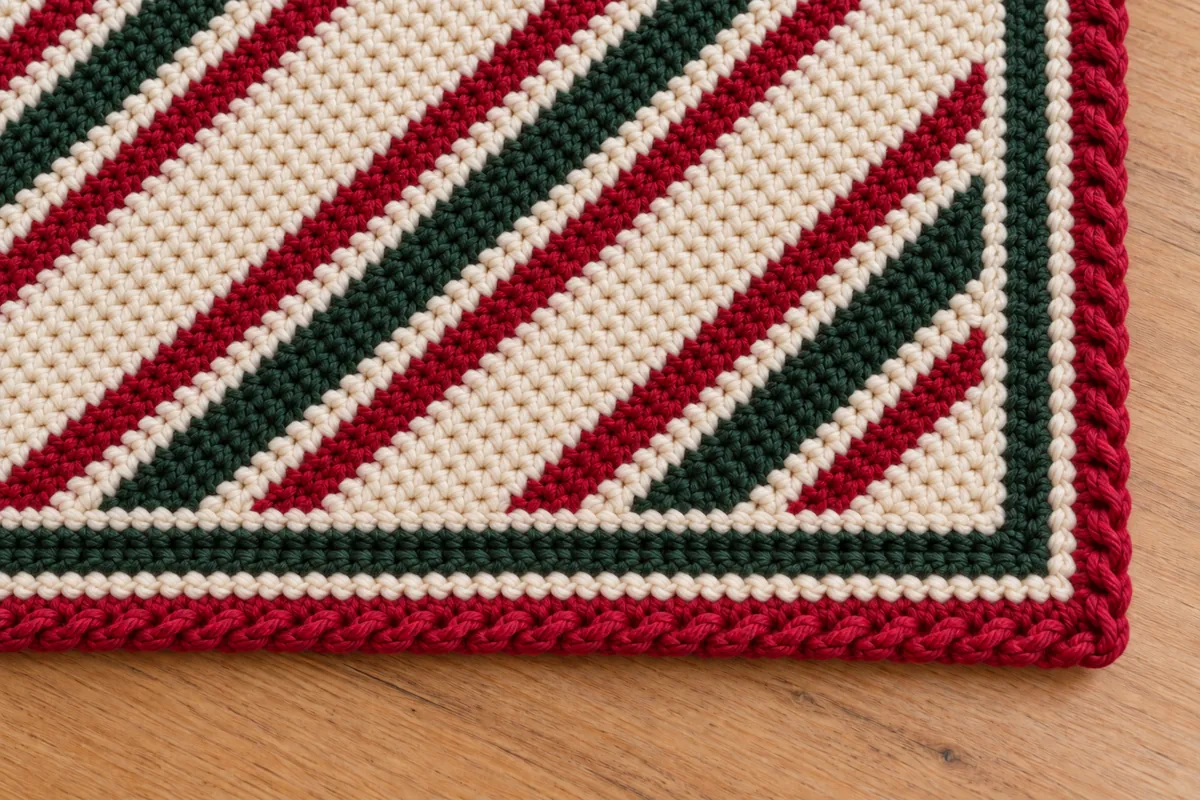
Picture a snowy Saturday in Vermont, coffee on the stove and a basket of cream, cranberry and balsam yarn waiting by the couch. The Ribbon Lane Afghan is a diagonal stripe crochet blanket made entirely of single crochet rows. It starts at one tiny corner and grows across the blanket on a slant, so every stripe runs like a ribbon from one edge to the other.
There are no motifs to join and no seams to sew. You’ll work one piece from corner to corner in worsted weight yarn: adding stitches on most rows, holding steady through the middle, then shrinking back to a point. The pattern comes in three sizes, a 36 × 48 in lapghan, a 50 × 60 in throw and a 66 × 90 in twin, and the holiday colors are easy to swap for a palette that suits any month of the year.
Is this diagonal stripe crochet blanket a good next step for you?
Only two basic stitches carry this whole afghan: the chain that starts Row 1 and the single crochet that fills every row after it. The shaping adds two decreases. A sc2tog joins two stitches into one, and a sc3tog joins three, which happens exactly once, on the very last stitch of the blanket. The border finishes with reverse single crochet, also called crab stitch, worked backward from left to right for a corded edge. All three are written out in full in the card, and if the abbreviations are new to you, the guide to reading a pattern walks through them.
One thing to clear up before you buy yarn: this blanket is worked corner to corner, but it isn’t the tile technique most people call C2C. Tile C2C builds little blocks of double crochet and chains, the way the Cider Mill Afghan does. Here every row is a plain row of single crochet laid on the bias, so the fabric is smooth and dense and the stripes come out as clean slanted lines with no stair steps.
The stitches are basic, but the pattern is rated Intermediate, and honestly so. The blanket is built in three sections with different shaping, every fifth row is worked without shaping, and in the middle section the increase moves from the start of the row to the end depending on which side faces you. None of it is hard once you see the rhythm. It just asks you to keep count.
Picking one worsted yarn for all three Ribbon Lane colors
Look for the #4 medium (worsted) symbol on the label, and buy all three colors in the same yarn line. Single crochet on the bias is a dense fabric, and two yarns of slightly different thickness show right away: one color’s stripes come out wider or stiffer than the others, and the edges start to wander. One yarn and one gauge keep the slant even from corner to corner.
A soft acrylic is the practical pick for a throw that gets dragged to the couch and washed often. Wool blends work too. Cotton is heavier and has less give, which a bias fabric relies on, so swatch first if you love it. The materials list assumes skeins of about 200 yd (183 m) per 3.5 oz (100 g); if yours hold a different length, divide the yardage for your size by the length on your label.
Cream is the color you’ll use most, about half of all rows, so buy every skein of it at once and check that the dye lot numbers match. Then crochet the gauge swatch. On this blanket the row gauge matters as much as the stitch gauge, because the ratio between the two decides whether your edges come out straight at 45 degrees. The quickest check is in the card: after Row 30, each edge should measure about 10 in (26 cm).
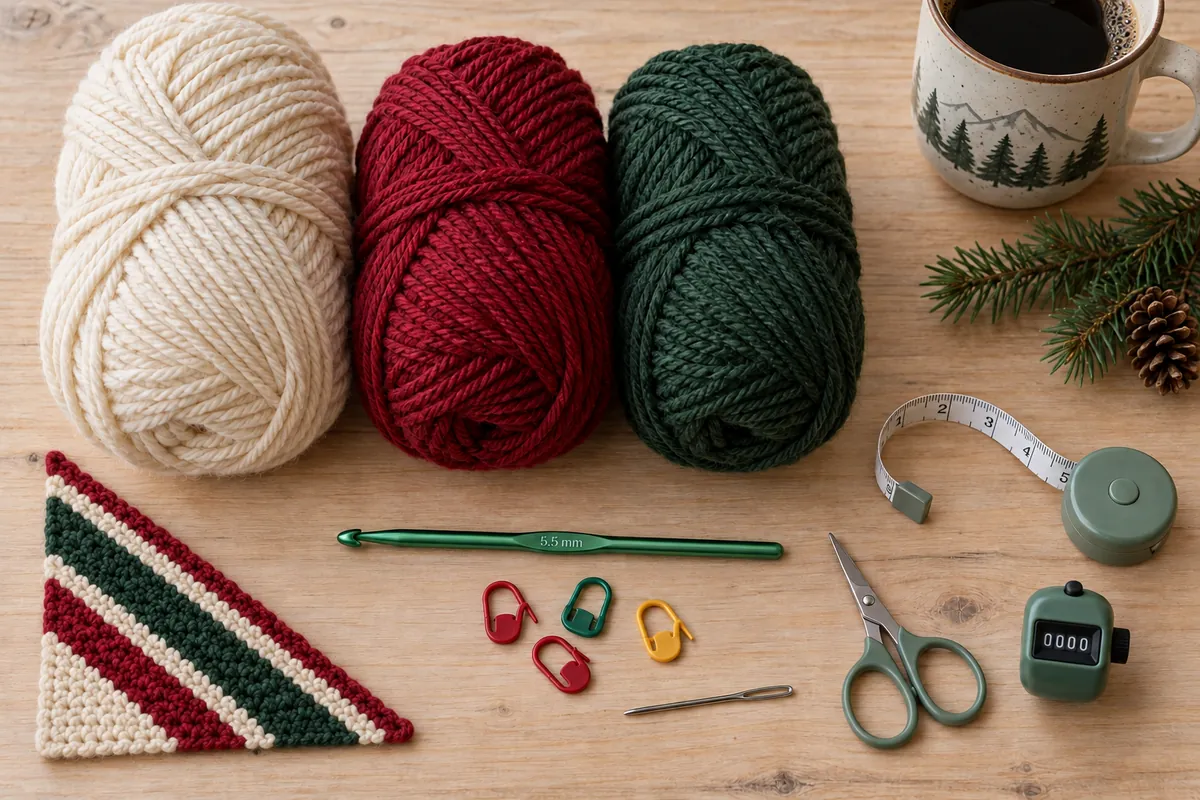
How cream, cranberry and balsam share each 20-row ribbon
The stripe sequence is 20 rows long: 6 rows of cream, 4 of cranberry, 2 of cream, 4 of balsam, 2 of cream and 2 of cranberry, then it starts again. Cream is the background that lets the diagonals read. Cranberry is the bold ribbon, and the thin pair of cranberry rows at the end of each repeat echoes it. Balsam sits in the middle, deep enough to balance the red without fighting it.
Every stripe has an even number of rows, so each new color starts on a right side row at the same edge. Your tails gather along one side, where the border covers them.
- Balsam and berries: cream, cranberry and balsam green, the holiday version in the card.
- Maple sugarhouse: oatmeal, maple and walnut brown.
- Blueberry barrens: cream, denim blue and heather gray.
- Garden gate: ivory, dusty rose and sage.
- Lake morning: white, lake blue and sand.
Keep the lightest shade in the cream role. With bands of it on both sides of every colored stripe, a dark background would swallow the ribbon effect. If you’re unsure, crochet the first 20 rows as your swatch and look at it from across the room.
Ribbon Lane sizes, row counts and yardage
The card is written for all three sizes, in the order Lapghan [Throw, Twin]. Each one starts with the same ch 2 and the same Row 1. What changes is where each section ends, how many stitches the widest rows hold, the border counts and the yarn. These numbers are estimates based on a gauge of 13 sc and 16 rows to 4 in (10 cm) until a measured swatch confirms them, and the yardage includes a 15 percent margin.
- Lapghan, 36 × 48 in (91 × 122 cm): first corner Rows 1–96, side Rows 97–131, final corner Rows 132–227; widest rows 155 sts; border Round 1 528 sc; cream about 887 yd (810 m), cranberry 566 yd (517 m), balsam 407 yd (372 m).
- Throw, 50 × 60 in (127 × 152 cm): Rows 1–137, 138–166 and 167–303; widest rows 221 sts; border Round 1 698 sc; cream about 1,559 yd (1,425 m), cranberry 980 yd (896 m), balsam 692 yd (632 m).
- Twin, 66 × 90 in (168 × 229 cm): Rows 1–183, 184–252 and 253–435; widest rows 295 sts; border Round 1 1,002 sc; cream about 3,089 yd (2,824 m), cranberry 1,918 yd (1,753 m), balsam 1,332 yd (1,217 m).
The twin is a serious project in single crochet, with more than 6,000 yd of worsted and a finished blanket that’s warm and noticeably heavy. And if straight stripes would make you just as happy, the Weekend Stripe Blanket is worked flat in bulky yarn and goes much faster.
Keeping the Ribbon Lane edges straight and the counts honest
- Let the row number do the thinking. Every row whose number ends in 0 or 5 is an even row, with no increase or decrease, from the first corner to the last. A clicker row counter turns that rule into a glance.
- Mark the growing edge on Row 1. Clip a locking marker on the edge where right side rows begin, and move it up every 20 rows. In the side section that edge keeps increasing while the other one turns its corner, and the marker saves you from ripping back a row.
- Count at every row ending in 0. Through Row 80 the counts are the same for all sizes: 33, 65, 97 and 129 sts at Rows 20, 40, 60 and 80. One stitch short usually means a missed second sc in the last stitch of an increase row.
- Measure along the edge, not across. At the end of the first corner, lay the tape along each slanted edge; the two should match each other and the card.
- Work tails in as you go. With 68 [91, 130] stripes, there are a lot of ends. After each color change, lay both tails along the top of the row and work the next 8 or more stitches over them, so the weaving is nearly done when the last stitch is.
- Keep the edge increases relaxed. Two sc in an edge stitch tighten easily as you turn. A tight edge makes the border ruffle later.
US crochet terms
The pattern
Materials
- Yarn: worsted weight (#4 medium) soft acrylic, one yarn line in 3 colors, skeins of about 200 yd (183 m) per 3.5 oz (100 g); about 1,859 [3,230, 6,338] yd (1,699 [2,952, 5,793] m) in total (estimate)
- Color A, cream: about 887 [1,559, 3,089] yd (810 [1,425, 2,824] m), 5 [8, 16] skeins
- Color B, cranberry: about 566 [980, 1,918] yd (517 [896, 1,753] m), 3 [5, 10] skeins
- Color C, balsam green: about 407 [692, 1,332] yd (372 [632, 1,217] m), 3 [4, 7] skeins
- Hook: 5.5 mm / I-9, or the size that gives the gauge
- Notions: yarn needle, scissors, tape measure, 4 locking stitch markers, extra markers for the border, row counter
Gauge
13 sc and 16 rows = 4 in (10 cm) in sc worked flat, after blocking (estimate). Bias check: after Row 30 (49 sts), each of the two edges measures about 10 in (26 cm). Every 5 rows add about 1¾ in (4.4 cm) to each growing edge.
Finished size
Lapghan 36 × 48 in (91 × 122 cm) [Throw 50 × 60 in (127 × 152 cm), Twin 66 × 90 in (168 × 229 cm)], after blocking, border included. Body before the border: 33 × 45 [47 × 57, 63 × 87] in.
Abbreviations
- ch chain
- sc single crochet
- sc2tog single crochet 2 stitches together
- sc3tog single crochet 3 stitches together
- rev sc reverse single crochet
- sl st slip stitch
- st(s) stitch(es)
- yo yarn over
- RS right side
- WS wrong side
- rep repeat
Notes
- The blanket is worked on the bias, in rows of sc, from one corner to the opposite corner: a first corner that grows, a side section that keeps the same count, and a final corner that shrinks. This is not tile (box stitch) C2C.
- Ch 1 at the start of every row does not count as a stitch; never work into it.
- The first row is the RS. Odd rows are RS rows, even rows are WS rows.
- Even-row rule: every row whose number ends in 0 or 5 is an Even Row, in all three sections. The last row of the blanket is the only exception.
- Even Row: ch 1, turn, sc in each st across. (count unchanged)
- Increase Row: ch 1, turn, 2 sc in first st, sc in each st to last st, 2 sc in last st. (+2 sts)
- Side Row RS: ch 1, turn, 2 sc in first st, sc in each st to last 2 sts, sc2tog. (count unchanged)
- Side Row WS: ch 1, turn, sc2tog, sc in each st to last st, 2 sc in last st. (count unchanged)
- Decrease Row: ch 1, turn, sc2tog, sc in each st to last 2 sts, sc2tog. (−2 sts)
- sc2tog: [insert hook in next st, yo, pull up a loop] twice, yo, pull through all 3 loops on hook.
- sc3tog: [insert hook in next st, yo, pull up a loop] 3 times, yo, pull through all 4 loops on hook.
- rev sc: working from left to right (right to left if left-handed), insert hook in next st to the right, yo, pull up a loop, yo, pull through both loops.
- Growing edge: place a marker on the edge where RS rows begin and move it up as you go. Increases in the side section always fall on this edge.
- Stripe sequence, 20 rows, repeated from Row 1 to the last row: 6 rows A, 4 rows B, 2 rows A, 4 rows C, 2 rows A, 2 rows B. To find the color of any row, subtract the largest multiple of 20 below it: Row 137 works like Row 17 (A).
- Color change: on the last stitch of the last row of a stripe (always a WS row), work it until 2 loops remain on the hook (3 loops for a sc2tog) and finish it with the new color. When that stitch is an increase, change on the second sc. Turn and ch 1 with the new color.
- Tails: cut the old color, leaving 6 in (15 cm). Lay both tails along the top of the next stitches and work at least 8 sts over them. Weave in any other tail on the WS.
- If your edges reach the stated measurements before or after the stated row, follow the measurements: keep the even-row rule and the stripe sequence, and recount your rows from there.
Instructions
First corner
- Row 1 (RS): With A, ch 2, 3 sc in 2nd ch from hook. (3 sts)
- Rows 2–4: Increase Row. (9 sts)
- Row 5: Even Row. (9 sts)
- Rows 6–9: Increase Row. (17 sts)
- Row 10: Even Row. (17 sts)
- Rows 11–95 [11–135, 11–180]: Rep Rows 6–10 another 17 [25, 34] times. (153 [217, 289] sts)
- Row 96 [Rows 136–137, Rows 181–183]: Increase Row. (155 [221, 295] sts)
- Checkpoints: 33 sts after Row 20, 65 after Row 40, 97 after Row 60, 129 after Row 80. Throw and Twin: 161 after Row 100, 193 after Row 120. Twin: 225 after Row 140, 257 after Row 160, 289 after Row 180.
- Measure: each edge is now about 33 [47, 63] in (84 [120, 160] cm). Place a marker in the last st of the last row on the edge without the growing-edge marker: Corner 2. Row 1 is Corner 1.
Side
- Rows 97–131 [138–166, 184–252]: Even Row on every row ending in 0 or 5; Side Row RS on the remaining odd rows; Side Row WS on the remaining even rows. (155 [221, 295] sts on every row)
- That is 28 [23, 55] Side Rows and 7 [6, 14] Even Rows.
- Measure: the growing edge is now about 45 [57, 87] in (115 [145, 221] cm) from Corner 1. Place a marker in the last st of the last row on the growing edge: Corner 3.
Final corner
- Rows 132–226 [167–302, 253–434]: Even Row on every row ending in 0 or 5; Decrease Row on all remaining rows. (3 sts)
- Checkpoints: 77 [103, 155] sts after Row 180 [240, 340]; 13 [7, 27] sts after Row 220 [300, 420].
- Row 227 [303, 435]: Ch 1, turn, sc3tog. (1 st) Fasten off. This last st is Corner 4.
Border
- Before the border: lay the blanket flat and check that both short sides measure about 33 [47, 63] in and both long sides about 45 [57, 87] in. Place a marker every 4 in (10 cm) along each side; work about 13 sc between two markers. Along the slanted row ends, that is about 8 sc for every 7 row ends.
- Round 1 (RS): Join A with a sl st in Corner 3, ch 1, 3 sc in the same place; work 109 [155, 208] sc along each short side and 149 [188, 287] sc along each long side, with 3 sc in each corner; join with a sl st in first sc. Work over any hanging tails as you go. (528 [698, 1,002] sc)
- Round 2: Fasten off A. Join C with a sl st in the center sc of any corner, ch 1, 3 sc in the same sc, *sc in each sc to the center sc of the next corner, 3 sc in it; rep from * around, ending with sc in each sc to the first corner; join with a sl st in first sc. Each side gains 2 sc. (536 [706, 1,010] sts)
- Round 3: Sl st in next sc (corner center), ch 1, 3 sc in the same sc, then work as Round 2 from *. (544 [714, 1,018] sts)
- Round 4: Fasten off C. With A, work as Round 2. (552 [722, 1,026] sts)
- Round 5: Fasten off A. With B, work as Round 2. (560 [730, 1,034] sts)
- Round 6: Do not turn. Ch 1, rev sc in each sc around; join with a sl st in first rev sc. (560 [730, 1,034] sts) Fasten off.
Finishing
- Weave in the remaining ends on the WS.
- Block to 36 × 48 [50 × 60, 66 × 90] in (91 × 122 [127 × 152, 168 × 229] cm). Check that both diagonals measure the same, then let it dry flat.
Washing a bias throw with cranberry stripes
A soft acrylic throw can go in the machine on a cold, gentle cycle. Red yarn is the one most likely to lose a little dye in its first wash, so give that first wash cold water and toss in a color-catcher sheet to protect the cream rows. Tumble dry on low, or lay the blanket flat on a clean towel. If you chose a wool blend, use the wool cycle or a hand wash and always dry flat.
Bias fabric relaxes along its diagonals when it’s wet, and that’s normal. Pat the damp blanket back to its measurements, square up the corners with your hands and let it dry where it can lie flat. Between seasons, fold it and keep it on a shelf. Hanging it over a door or a hook for weeks lets gravity pull the stitches long on the slant, and the stripes start to sag.
Ribbon Lane questions about slant, rhythm and stretch
Is a diagonal stripe crochet blanket the same as C2C crochet?
Not quite. Both start at one corner and end at the opposite one, but tile C2C is built from little blocks of double crochet and chains. This one is ordinary single crochet worked in slanted rows, so the stripes have smooth edges and the fabric is denser.
Why is every fifth row worked without increasing?
Single crochet is shorter than it is wide, so increasing on every row would push the edges out faster than the rows climb. Skipping the increase on every fifth row keeps both edges at 45 degrees and the corners square. That rhythm suits a gauge of 13 sts and 16 rows; if your swatch is very different, the edges will tell you once you measure them.
What if the edges reach the right length before the row number in the card?
Follow the tape measure. The row numbers come from the estimated gauge, and a slightly tighter or looser row height shifts them. End the first corner when both edges reach the stated length and keep the even-row rule from there. Your border counts still follow the measurements, at 13 sc for every 4 in.
Can I turn the Ribbon Lane into a square blanket?
Yes. Work the first corner until both edges reach the side length you want, skip the side section and go straight to the final corner. The Decrease Rows bring you back to a point at the same pace, and the border works the same way with the same count on all four sides.
Will a blanket worked on the bias stretch out of shape?
It has more give than a blanket worked in straight rows, which is why it drapes so nicely. The border rounds steady the edges, and blocking sets the shape. Drying flat and storing it folded keep it square for years.
Quick recap
- Swatch and check that each edge measures about 10 in after Row 30.
- Work the first corner with Increase Rows and an Even Row on every row ending in 0 or 5.
- Work the side section, increasing on the growing edge and decreasing on the other.
- Work the final corner with Decrease Rows down to 3 sts, then finish with a sc3tog.
- Add five rounds of sc in cream, balsam and cranberry, then a round of crab stitch, and block.
The Ribbon Lane is a diagonal stripe crochet blanket that rewards a little counting with stripes that look far more planned than they are. Every 20 rows becomes a small finish line of its own. If a row number or a measurement doesn’t add up on your hook, reach out through the Contact page.