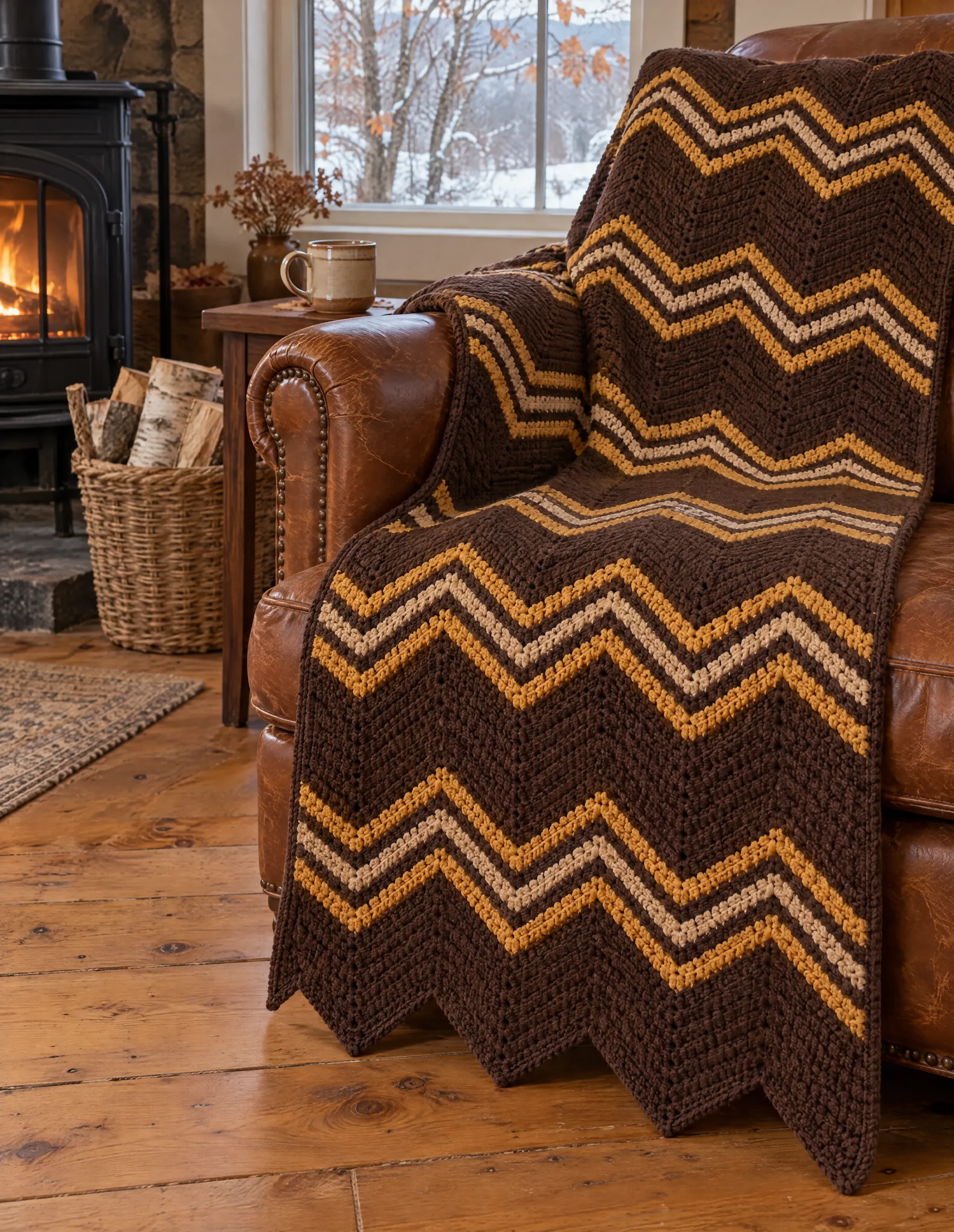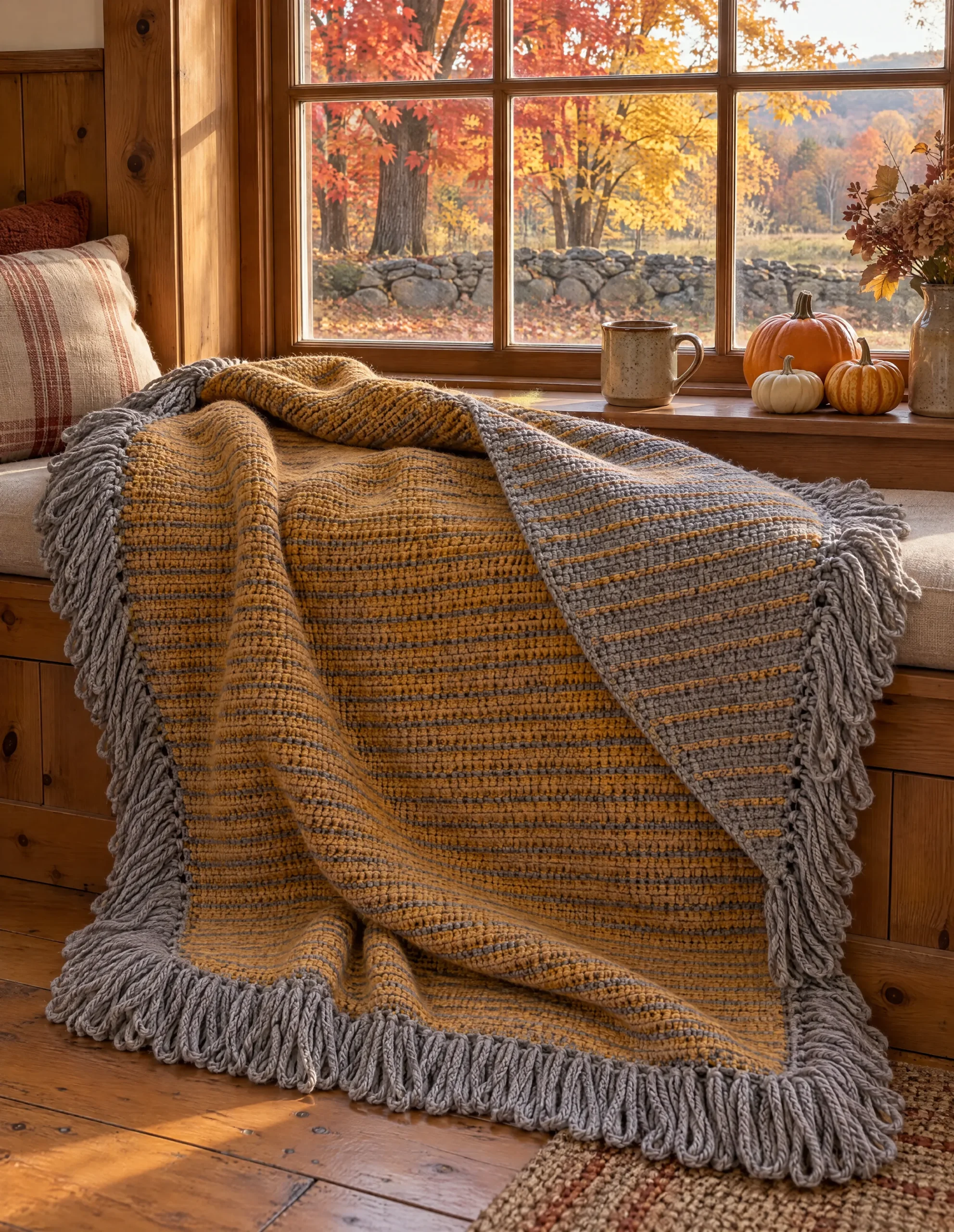
Picture a window seat on a late October afternoon, the maples outside gone red and gold, and a reversible crochet blanket thrown over the cushion: amber on the side you see first, ash gray where a corner has flipped over. The Ember and Ash Afghan gives you two blankets in one, with no lining and nothing to sew.
It’s one piece, one stitch and one row of each color, framed by a thick looped fringe in gray. The pattern below comes in a throw, a twin and a queen, and every row has the same count from the first to the last.
How does one stitch make a reversible crochet blanket?
The whole afghan is worked in half double crochet, with one small twist. From Row 2 on, every stitch goes into the third loop: the horizontal bar that sits just below the V at the top of each half double crochet, on the side facing you. When you work into that bar, the V of the stitch below rolls to the other side and stands up as a raised chain.
Now add color. Row 1 is ash gray, Row 2 amber, Row 3 gray again, one row of each color to the end. Because you turn after every row, all the amber chains land on one face and all the gray chains on the other. One side reads amber with fine gray lines, the other gray with fine amber lines.
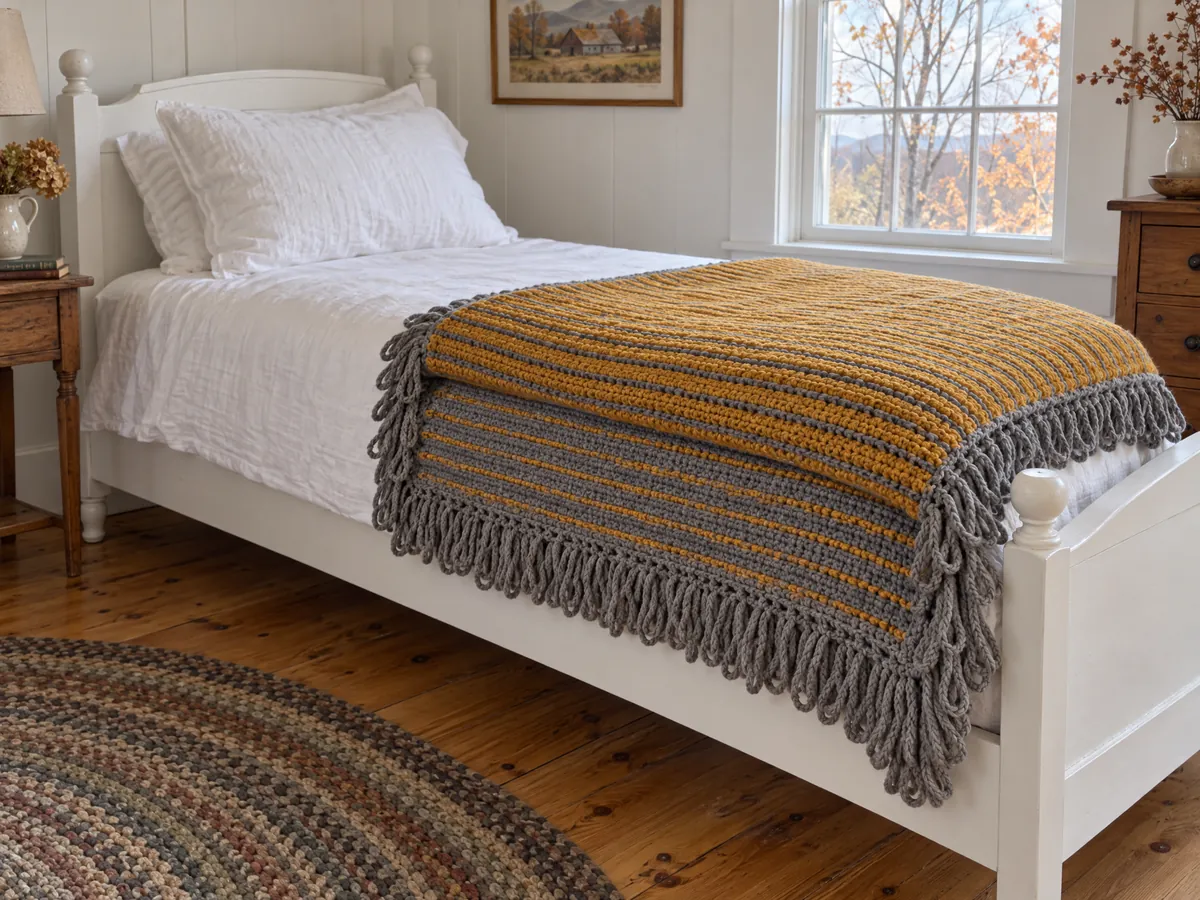
The rows start with a chain of 2 that counts as the first stitch, and the frame is a round of single crochet with a long loop on every stitch. If the abbreviations are new, the guide to reading a crochet pattern covers them. The pattern is rated Easy: the third loop takes a few rows to spot, then you stop thinking about it.
A smooth, plied worsted for crisp ridges
Look for a 4 on the label, with worsted or medium next to it. The amounts in the card assume skeins of about 200 yd (183 m). A smooth, plied wool, wool blend or acrylic shows the ridges best, since each raised chain is the top of a whole row. Skip single-ply, fuzzy or brushed yarns: the ridges blur, and the third loop gets hard to find.
The hook is a 6 mm (J-10), a size up from what most worsted labels suggest. The stitch needs room. Pull each loop up to the height of the turning chain, because tight stitches hide the third loop and make the fabric stiff.
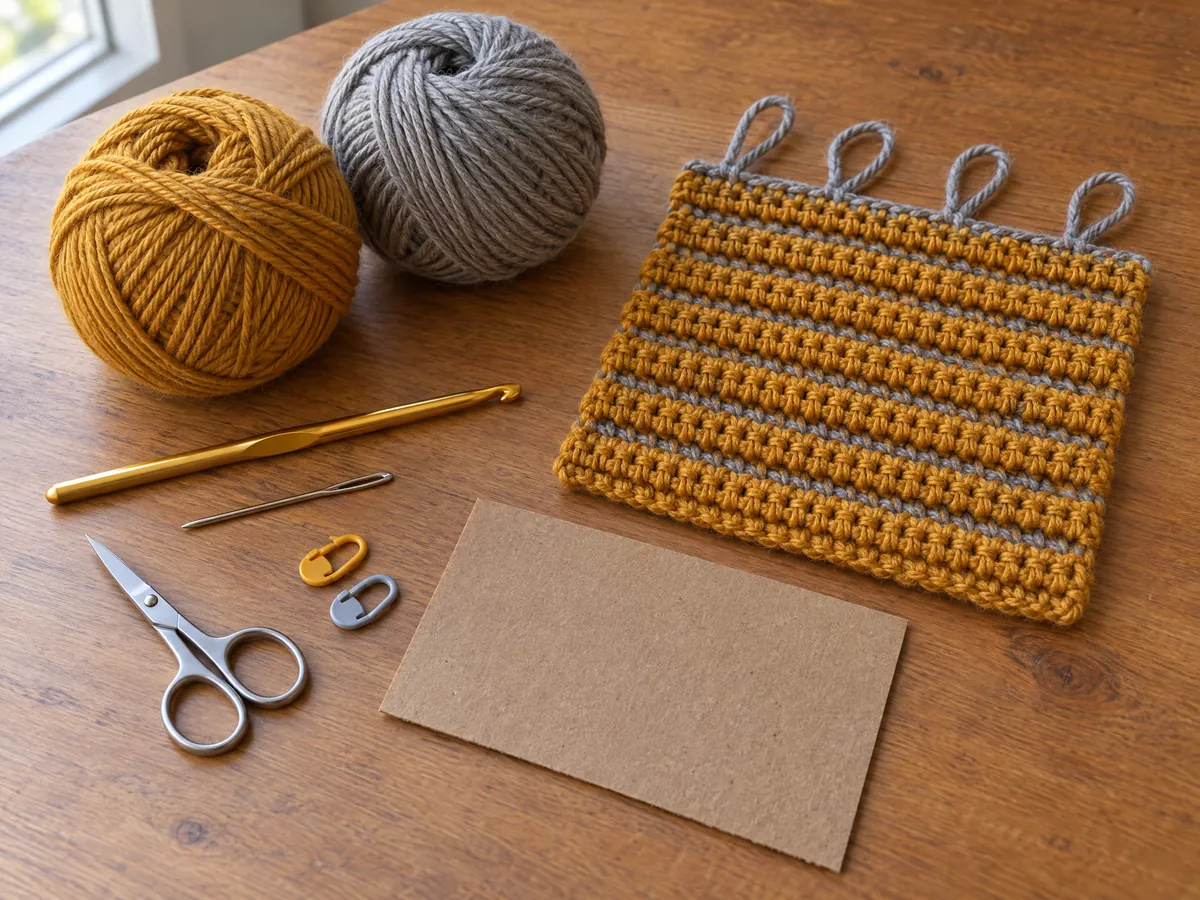
Loose stitches eat yarn, so the amounts in the card are generous on purpose. The ash gray includes the fringe round, which alone takes about 264 yd for the throw. Buy each color from one dye lot and keep the labels. You’ll also need a strip of stiff cardboard 4 in (10 cm) wide to size the fringe loops.
Two colors, two moods
Color A is the lighter one: it works the odd rows and the fringe, so it frames the afghan on both faces. Color B works the even rows. Each face simply gets its own color, so the blanket suits two moods: warm amber for the sofa in November, quiet gray for a guest bed.
- Ember and Ash: A ash, a warm light gray; B ember, an amber gold, as written.
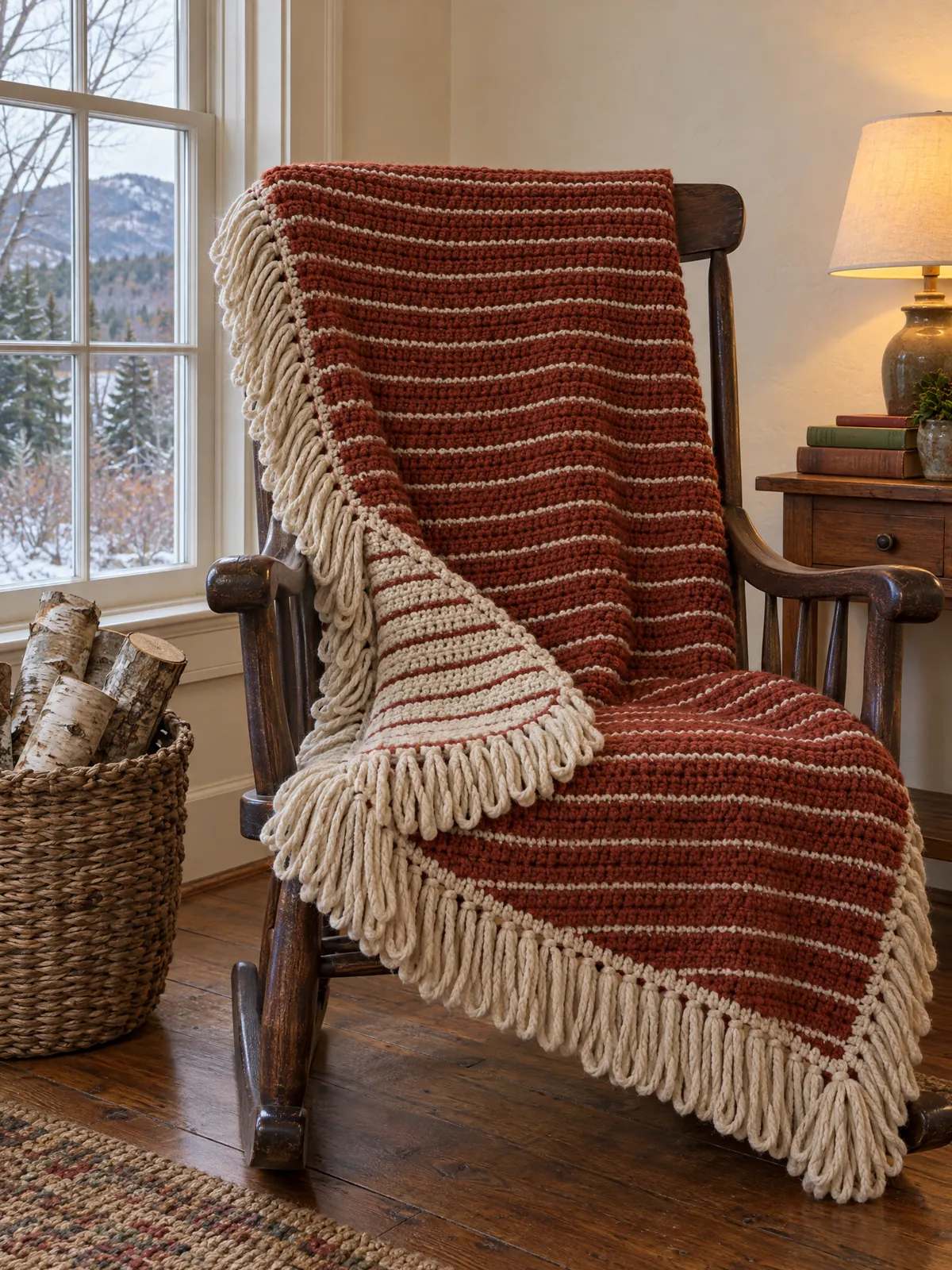
- Maple Bark: A oatmeal; B rust.
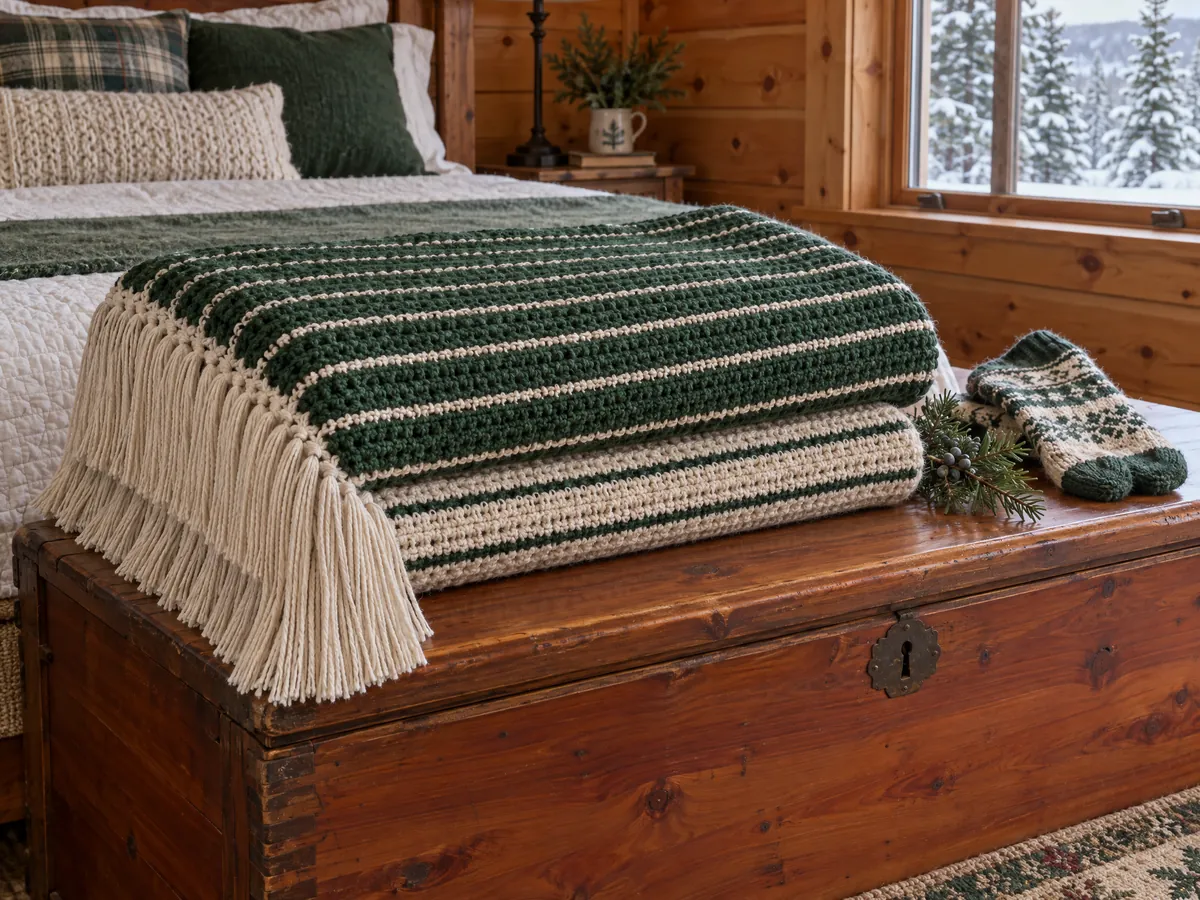
- Juniper: A oatmeal; B deep juniper green.
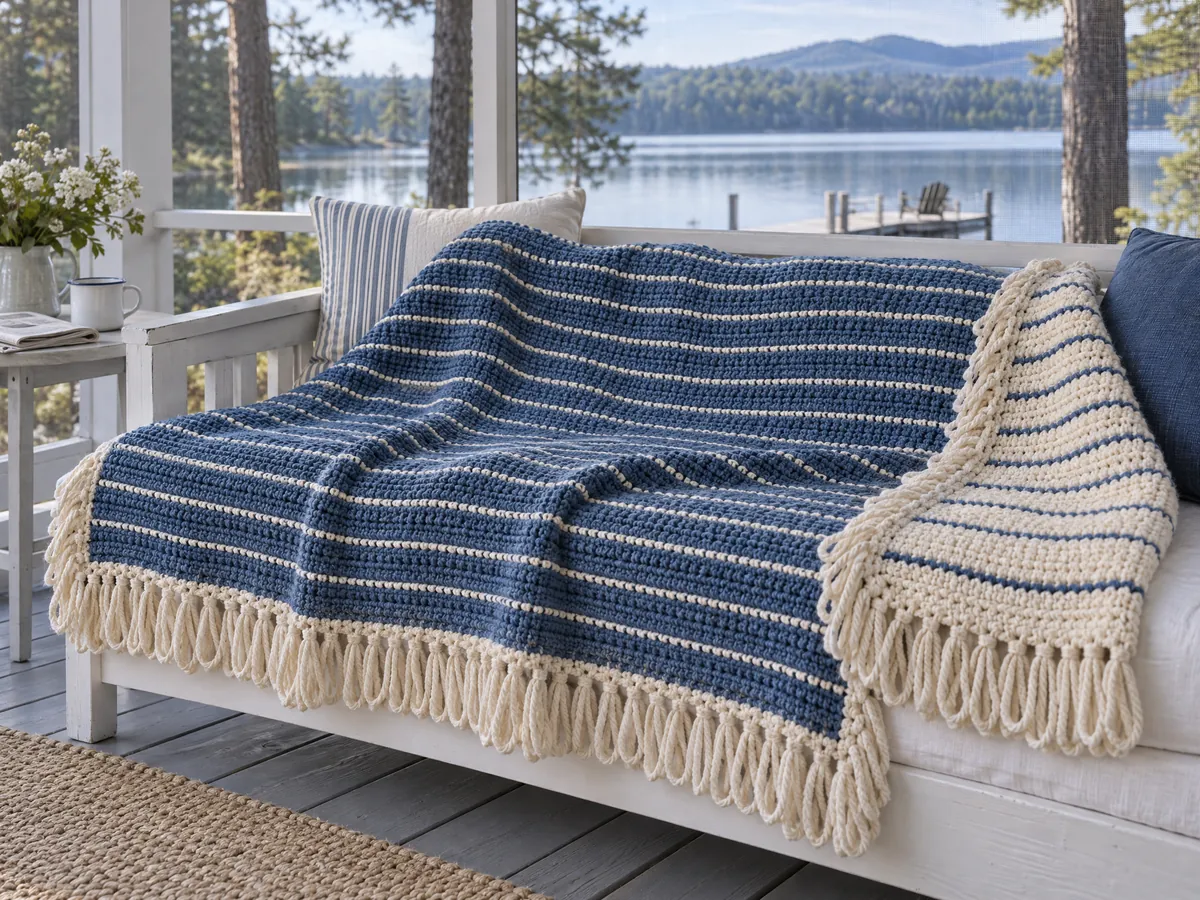
- Lake Morning: A natural cream; B denim blue.
Pick two colors with clear contrast. Each face shows thin lines of the other color between its ridges, and if the two colors are close, both faces look like the same muddy blend.
Throw, twin and queen, one row at a time
Any number of chains works: the foundation is the number of stitches plus 1, and every 3 chains add about 1 in (2.5 cm) of width. The card is written as Throw [Twin, Queen]. Sizes are measured without the fringe, which adds about 4 in (10 cm) on every side.
- Throw: about 50 × 60 in (127 × 152 cm). Ch 149, 148 stitches in every row, 133 rows, 712 looped stitches in the fringe round. Ash about 2,379 yd, ember 2,084 yd.
- Twin: about 66 × 90 in (168 × 229 cm). Ch 198, 197 stitches, 201 rows, 1,014 looped stitches. Ash about 4,620 yd, ember 4,200 yd.
- Queen: about 90 × 100 in (229 × 254 cm). Ch 270, 269 stitches, 223 rows, 1,224 looped stitches. Ash about 6,879 yd, ember 6,368 yd.
To change the length, add or remove rows in pairs, so the afghan still starts and ends with an ash row.
Finding the third loop and keeping the edges tidy
After you turn, look at the top of the row you just made. Each stitch shows a V, and just below the V, on the side facing you, there’s a horizontal bar. That’s the third loop. Insert the hook under that bar only. If you see the V roll away from you as you pull through, you’re in the right place.
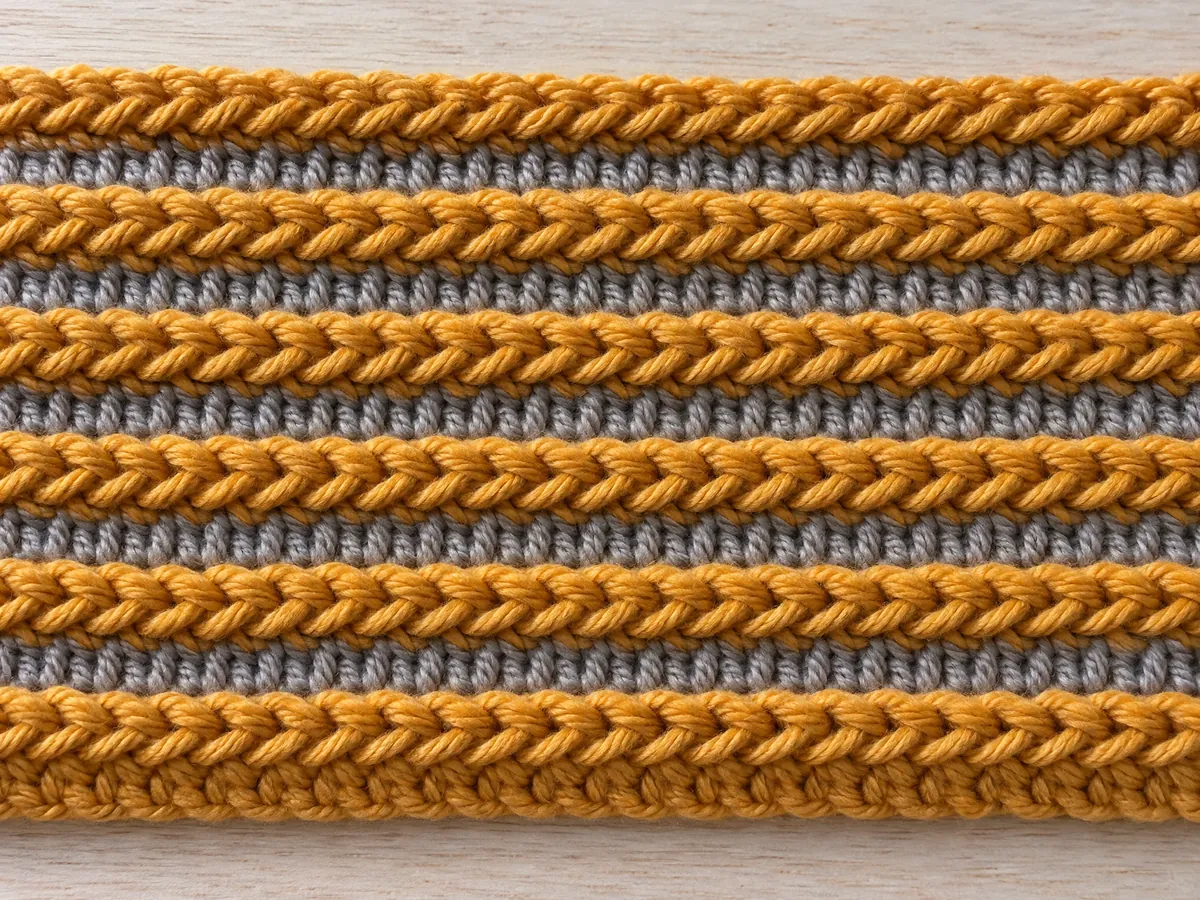
Count the first few rows: 148 stitches for the throw, with the turning chain as the first one. The two edge stitches are the usual trouble spots. Skip the stitch right under the turning chain, and work the last half double crochet into the top of the turning chain of the row below, in plain half double crochet, not in the third loop.
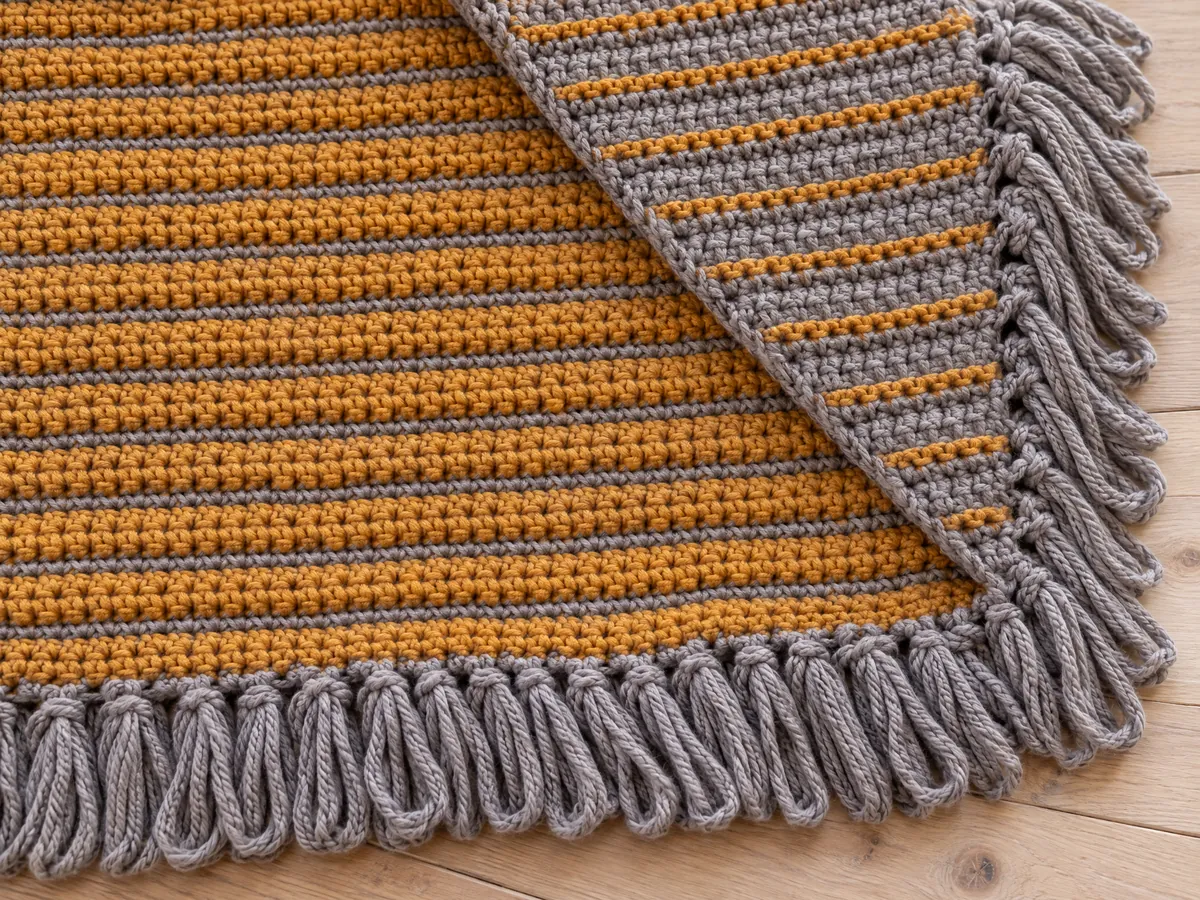
Each color is cut at the end of its row, since the next row of that color starts at the other edge. That’s two tails per row, 266 on the throw. Weave them in every ten rows or so, through the edge stitches of their own color, and the job stays small. The fringe round covers the side edges afterward.
Keep the locking marker on the Ash side and move it up every few rows. If you put the work down mid-row, it tells you at a glance which face should be toward you. The rule is simple: the color of the yarn on your hook always matches the ridges on the face you’re looking at, gray on an ash row, amber on an ember row.
For the fringe, keep the last 4 or 5 loops on the cardboard as you go, so they all stay the same length. Five looped stitches go into each corner, and the fringe fans around the turn.
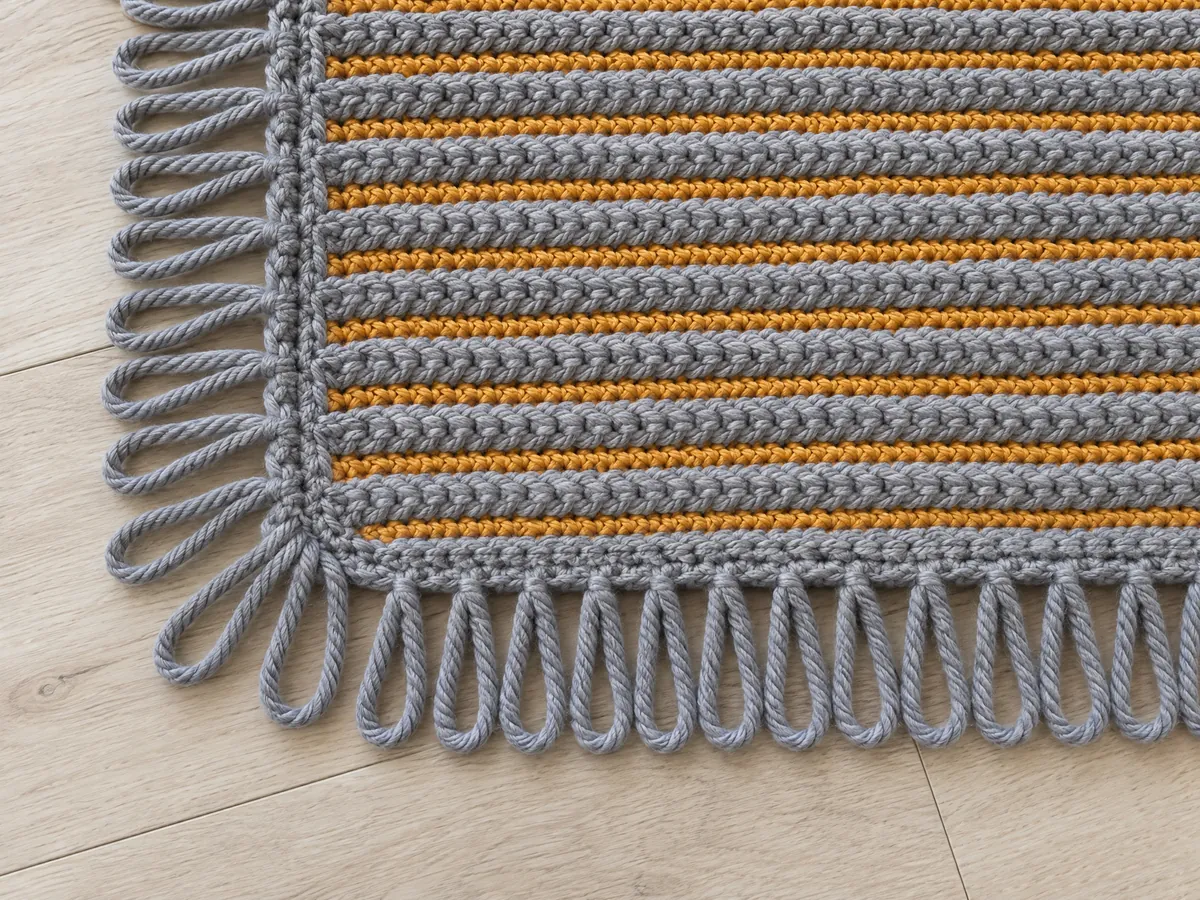
For another throw with ridged rows, try the baby afghan in back-loop single crochet stripes, and for a different kind of fringe, the griddle stitch throw with a fringe at every stripe.
US crochet terms
The pattern
Materials
- Worsted weight yarn (#4), smooth and plied, wool, wool blend or acrylic, about 200 yd (183 m) per skein, in 2 colors (estimate, generous on purpose):
- A, Ash (odd rows and the whole fringe round): about 2,379 [4,620, 6,879] yd (2,175 [4,225, 6,290] m), 12 [24, 35] skeins, of which about 264 [376, 454] yd (241 [344, 415] m) for the fringe round
- B, Ember (even rows): about 2,084 [4,200, 6,368] yd (1,906 [3,840, 5,823] m), 11 [21, 32] skeins
- 6 mm (J-10) crochet hook
- Yarn needle with a large eye
- Scissors
- 2 locking stitch markers, to mark the Ash side
- A strip of stiff cardboard 4 in (10 cm) wide and about 6 in (15 cm) long, for the fringe loops
Gauge
12 sts and 9 rows = 4 in (10 cm) in the pattern (hdc3lo, one row of each color), after a light blocking, with a 6 mm (J-10) hook. Estimate: your size may vary with your gauge.
Swatch: chain 25 with A and work Rows 1–4 of the afghan on 24 sts, then repeat Rows 3–4 until the swatch has 20 rows, and finish with one A row worked like the afghan’s last row (21 rows). Measure 4 in (10 cm) in the center. More stitches than the gauge: try a larger hook. Fewer stitches: try a smaller one.
Finished size
- Throw: about 50 × 60 in (127 × 152 cm)
- Twin: about 66 × 90 in (168 × 229 cm)
- Queen: about 90 × 100 in (229 × 254 cm)
- Measured after a light blocking, fringe round included, loops not included (they add about 4 in / 10 cm on every side). Before the fringe round, the body measures about 49 1/4 × 59 [65 3/4 × 89 1/4, 89 3/4 × 99] in. Estimates based on the gauge above.
Abbreviations
- approx approximately
- ch chain
- ch- refers to a chain made earlier, such as the turning ch-2
- hdc half double crochet
- hdc3lo half double crochet in the third loop only (see Notes)
- sc single crochet
- sk skip
- sl st slip stitch
- st(s) stitch(es)
- yo yarn over
Notes
- Sizes are written as Throw [Twin, Queen]. A number given once applies to all sizes.
- Any number of chains works: the foundation chain is the number of stitches plus 1. Every 3 chains add or remove about 1 in (2.5 cm) of width. To change the length, add or remove rows in pairs, so the afghan still starts and ends with an A row.
- Two faces: the face toward you while you work the odd rows (Row 1, Row 3 and so on) is the Ash side: its ridges are color A. The other face is the Ember side, with ridges in color B. Mark the Ash side with a locking marker after Row 1 and move it up as you go.
- Turning chain: the ch 2 at the start of each row counts as the first hdc. Skip the first st of the row (the one under the ch-2), and work the last hdc of the row in the top of the turning ch-2 of the row below, under its top two strands. In Row 1, the 2 skipped chains count as the first hdc; in Row 2, the last hdc goes in the top of those 2 skipped chains. Every row has the same count.
- hdc3lo (half double crochet in the third loop only): after you turn, look at the top of the row just made. Each stitch shows a V (its two top loops), and just below the V, on the side facing you, a horizontal bar: the third loop. Yo, insert the hook under that bar only, yo, pull up a loop (3 loops on hook), yo and pull through all 3 loops. The V of the stitch below rolls away from you and stands up as a raised chain on the other face.
- Work loosely: pull each loop up to the height of the ch-2. Tight stitches hide the third loop and make the fabric stiff.
- Color change: change colors on the last hdc of every row: work it until 3 loops remain on the hook, drop the old color, yo with the new color and pull through all 3 loops. Ch 2 with the new color, turn, and cut the old color, leaving a 6 in (15 cm) tail.
- Tails: there are 2 tails at the end of every row, 266 [402, 446] in all, all of them along the two side edges. Weave each tail in with the yarn needle through the edge stitches of its own row and color, about 2 in (5 cm) in, then back about 1 in (2.5 cm). Weave them in every 10 rows or so.
- Loop sc (fringe round): hold the cardboard strip behind the work, one long edge along the stitches you’re about to work. Bring the working yarn from the front over the card and down behind it. Insert the hook in the st (or row end), catch the strand that runs behind the card and draw it through (2 loops on hook), yo and pull through both loops. The yarn around the card becomes a 4 in (10 cm) loop. Slide the card along as you go, keeping the last 4 or 5 loops on it so they keep their length, and slip the oldest loop off as you make each new one. The loops form on the side away from you.
- Yardage and sizes are estimates based on the gauge above.
Instructions
Body
- Foundation: With A, ch 149 [198, 270], loosely.
- Row 1 (A, Ash side): Hdc in 3rd ch from hook (the 2 skipped ch count as the first hdc) and in each ch across, changing to B on the last hdc. (148 [197, 269] sts) Cut A. Place a marker on the side facing you: this is the Ash side.
- Row 2 (B, Ember side): Ch 2 (counts as hdc), turn. Sk first st, hdc3lo in each st across to the 2 skipped ch of Row 1, hdc in the top of those 2 skipped ch, changing to A on this last hdc. (148 [197, 269] sts) Cut B.
- Row 3 (A, Ash side): Ch 2 (counts as hdc), turn. Sk first st, hdc3lo in each st across to the turning ch-2, hdc in top of the turning ch-2, changing to B on this last hdc. (148 [197, 269] sts) Cut A.
- Row 4 (B, Ember side): Work as Row 3, but changing to A on the last hdc. (148 [197, 269] sts) Cut B.
- Rows 5–132 [5–200, 5–222]: Rep Rows 3–4 64 [98, 109] more times, ending with a Row 4 (a B row). (148 [197, 269] sts in every row)
- Row 133 [201, 223] (A, Ash side, last row): Work as Row 3, but do not change color on the last hdc. (148 [197, 269] sts) Fasten off A.
The afghan has 133 [201, 223] rows: 67 [101, 112] rows of A and 66 [100, 111] rows of B. Before the fringe round, weave in any tails left along the side edges, lay the afghan flat and give it a light blocking (a spritz of water or a little steam, as your yarn’s label allows).
Fringe round
Work the round in A with the Ember side facing you, so the loops form on the Ash side. Each stitch of the round is a loop sc (see Notes).
- Join: Join A with sl st in the last hdc of Row 133 [201, 223], at the top right corner. Ch 1 (does not count).
- Top edge: 5 loop sc in the same st (corner), 1 loop sc in each of the next 146 [195, 267] sts, 5 loop sc in the top of the turning ch-2 (corner).
- Left side: Working in the row ends from Row 133 [201, 223] down to Row 1, under the turning ch or around the post of the edge hdc, work 2 loop sc in the end of each odd row (A rows) and 1 loop sc in the end of each even row (B rows). (200 [302, 335] loop sc)
- Bottom edge: Working in the remaining loops of the foundation chain, 5 loop sc in the ch at the base of the 2 skipped ch of Row 1 (corner), 1 loop sc in each of the next 146 [195, 267] ch, 5 loop sc in the first ch of the foundation (corner).
- Right side: Working in the row ends from Row 1 up to Row 133 [201, 223], 2 loop sc in the end of each odd row and 1 loop sc in the end of each even row. (200 [302, 335] loop sc)
- Close: Join with sl st in the first loop sc. Fasten off. (146 [195, 267] loop sc along the top and along the bottom between the corners, 200 [302, 335] along each side and 5 in each of the 4 corners: 712 [1,014, 1,224] loop sc in all)
Ease all the loops out over the edges so they hang evenly.
- Loops whole or cut: Leave the loops whole for a soft, looped edge. For a straight fringe, slide one blade of sharp scissors into each loop at its tip and cut: each loop becomes 2 strands about 4 in (10 cm) long. Comb the strands and trim them evenly.
Finishing
- Weave in the two tails of the fringe round. Lay the afghan flat, shape the corners and give it a final light blocking if your yarn allows it.
Washing a looped fringe without snags
Follow the yarn label first. Washable wool, wool blends and acrylic can usually go in the machine on a gentle, cool cycle; a twin or a queen needs a large machine, or a bathtub and a gentle hand wash. Turn the afghan Ember side out and put it in a large mesh laundry bag, so the loops can’t catch on the drum or on each other.
Dry it flat and comb the fringe straight with your fingers while it’s damp. Wet, the queen is very heavy, so lift it with both arms rather than by one edge. A cut fringe can be trimmed again after the first wash, once the strands have relaxed.
Ember and Ash questions about ridges, faces and loops
Is this reversible crochet blanket the same on both sides?
The texture is the same, the color isn’t. Each face shows raised chains of its own color with fine lines of the other color between them: amber ridges on the Ember side, gray ridges on the Ash side.
Where exactly is the third loop?
Turn your work and look at the top of the last row. Below the V of each half double crochet, on the side facing you, there’s a horizontal bar. That bar is the third loop. It comes from the yarn over of the half double crochet, which is why this afghan uses that stitch.
Why is the yarn cut at the end of every row?
Each color works every other row, and the next row of that color starts at the opposite edge. Carrying it up the side would leave long strands, so you cut it and weave in the two tails at the side edges, where the fringe round hides them.
Should I leave the fringe loops whole or cut them?
It’s your choice, and the yarn amount is the same. Whole loops make a soft, shaggy edge that’s harder to snag on a sofa. Cut loops make a classic straight fringe that you can trim after washing.
Quick recap
- Chain 149 [198, 270] in ash and work Row 1 in half double crochet.
- Work every following row in the third loop, alternating one row of ember and one row of ash, cutting the yarn at the end of each row.
- End with an ash row, at Row 133 [201, 223].
- Weave in the side tails and block lightly.
- Work one round of loop single crochet in ash all around, with 5 loop stitches in each corner.
One stitch, two colors and a strip of cardboard: that’s all this reversible crochet blanket takes to give you two afghans in one. If a row or the fringe puzzles you, ask through the Contact page.