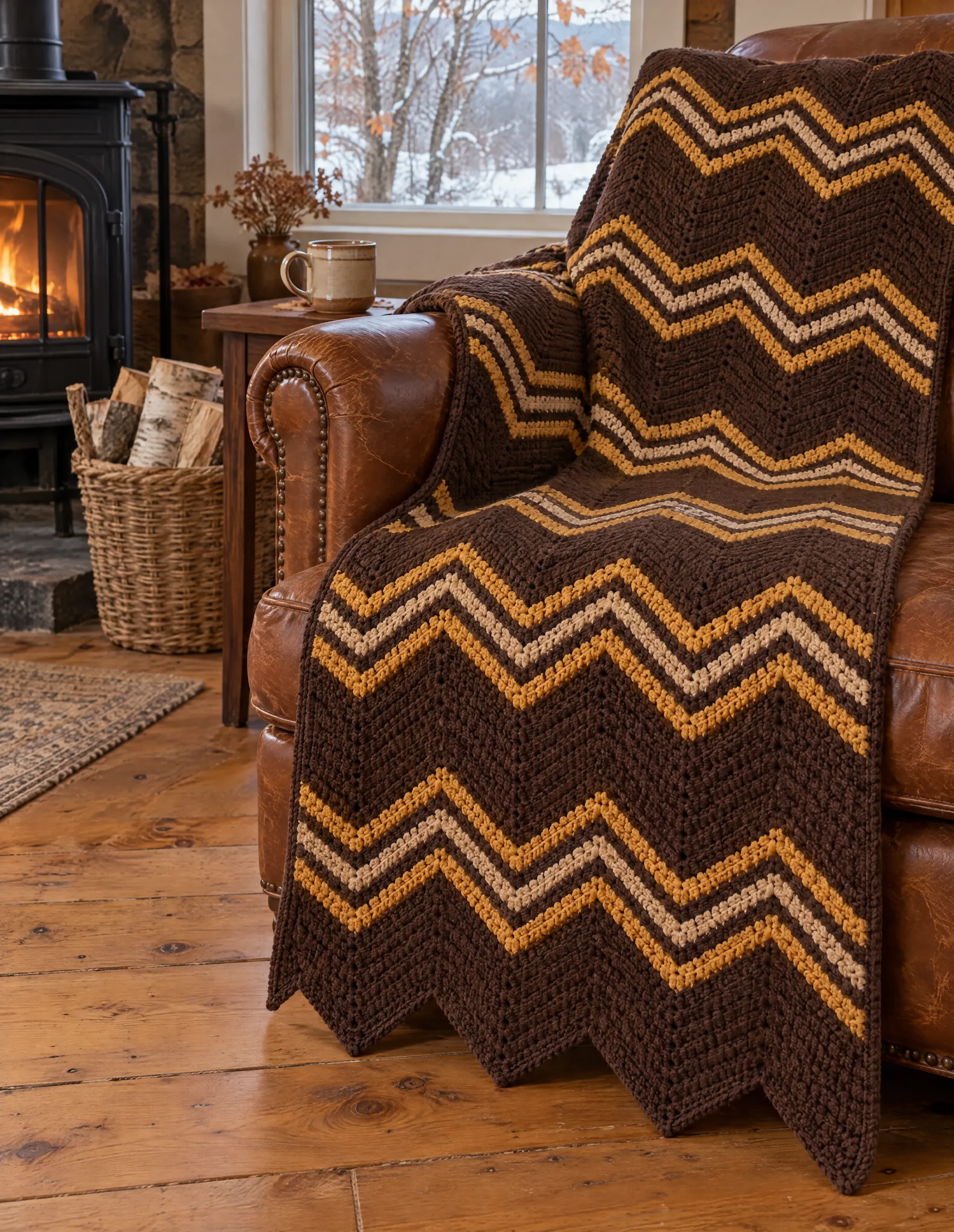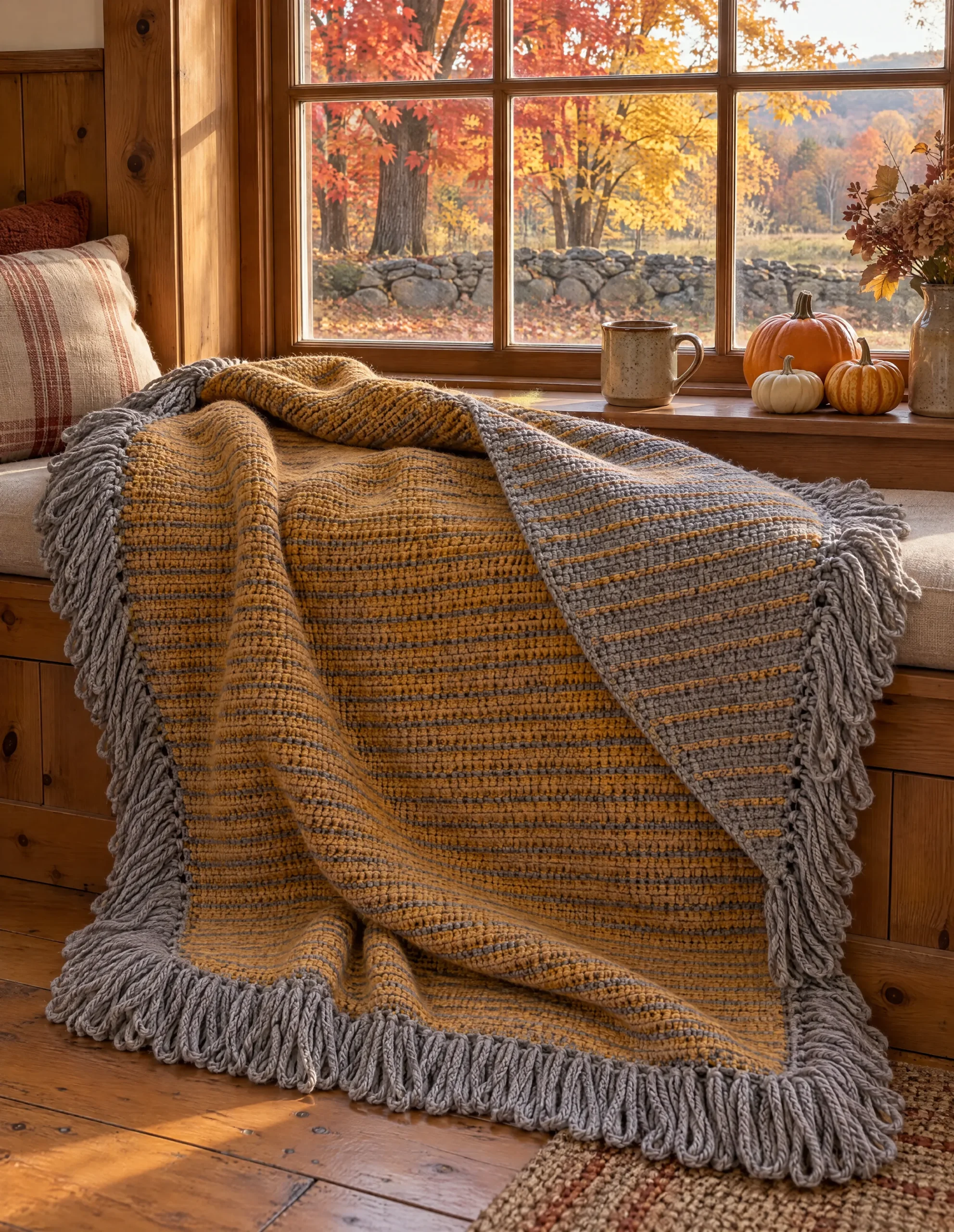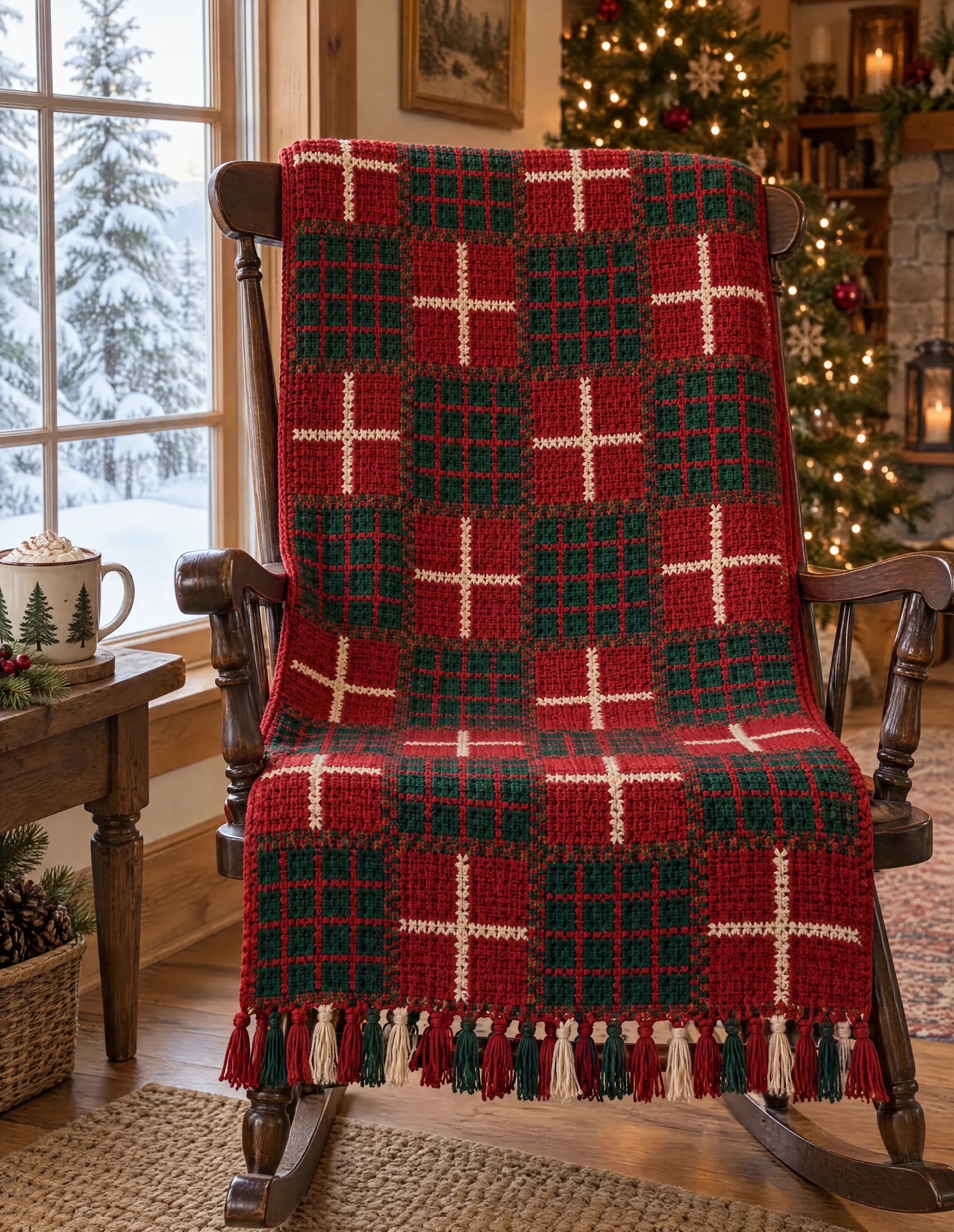
Picture a December afternoon with snow on the pines, cocoa warming on the stove and a real plaid spread across your lap, stripes crossing in both directions and a knotted fringe at each end. The Hearthside is a crochet tartan afghan made with an old trick: you crochet a striped mesh, then weave yarn up through its columns with a needle.
The horizontal stripes come from the crochet, the vertical ones from the weaving. You never carry two colors in a row, and there are no bobbins anywhere. The pattern below comes in a throw, a full and a queen, with every row, every column color and every fringe knot counted.
Is a crochet tartan afghan really an easy project?
It is, if you’re happy to count. The mesh uses three stitches you probably know: a long chain, double crochet for the posts, and single crochet for the side edging. Each space is one double crochet and one chain over a skipped stitch, and every row after the first is the same row. If abbreviations like ch, dc and sk still slow you down, the guide to reading a crochet pattern walks you through them.
The weaving is the part that’s new for most crocheters. You thread two strands into a large-eye needle and pass them up one column of spaces, over one chain bar and under the next. A second pair goes up the same column in the opposite order, so every bar is covered. That’s the whole technique, repeated column after column. It takes evenings, not skill.
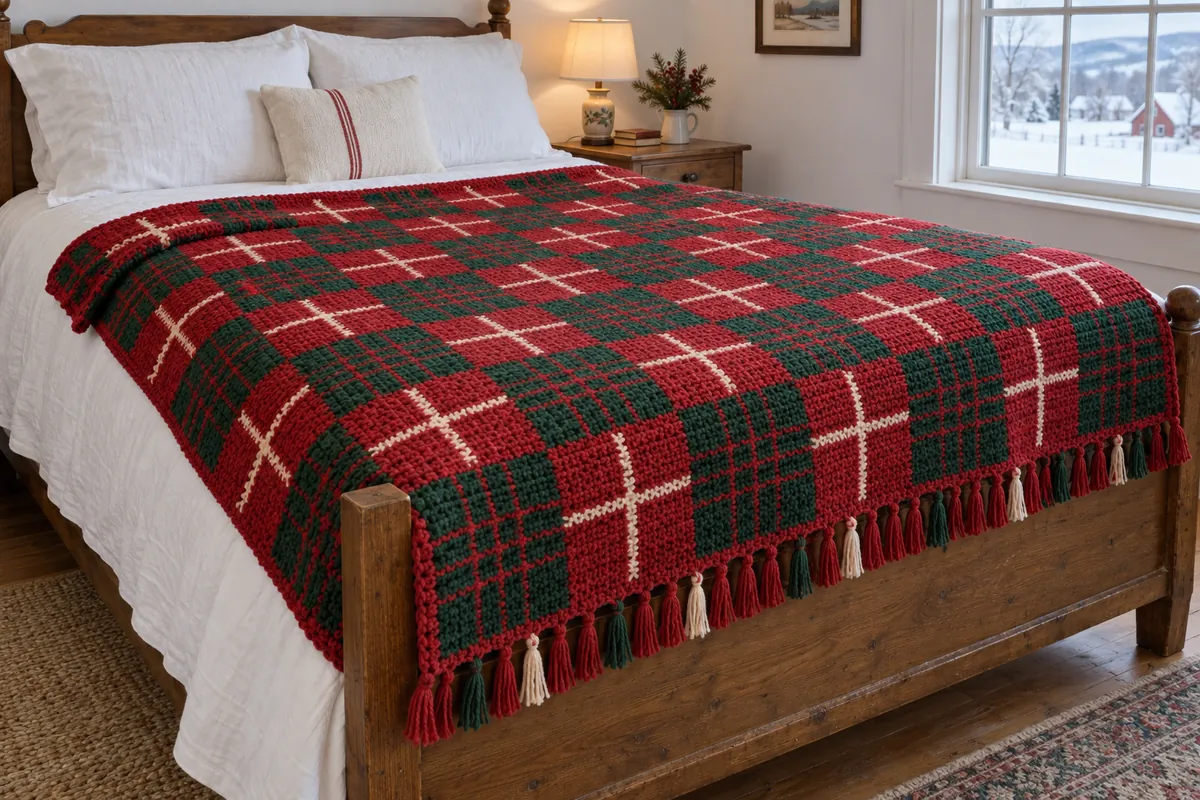
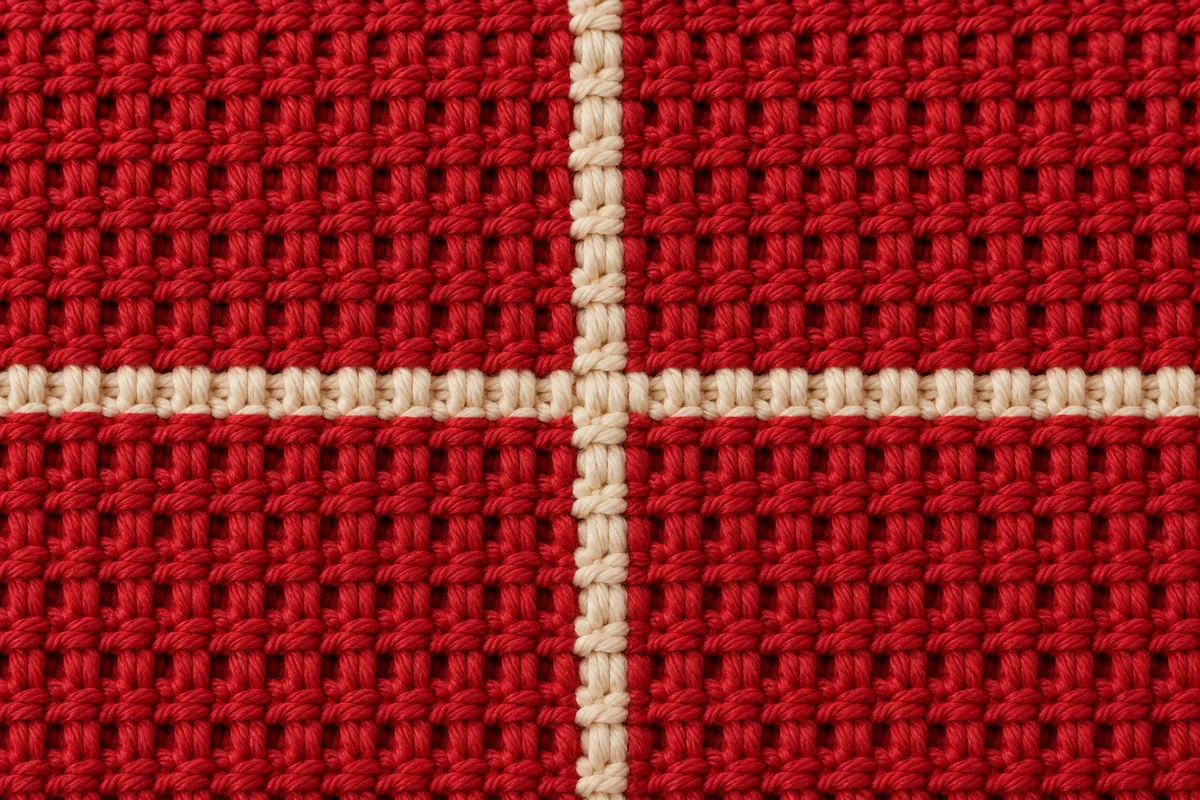
The whole plaid comes from two 15-row blocks. Section A is holly red with one cream row through its middle. Section B is pine green, cut by three single red rows. The columns follow nearly the same order, with one difference: a red block has 8 columns on each side of its cream column, one more than the 7 rows. That extra column squares up the checks once the strands fill the mesh.
Worsted yarn for a mesh and its woven strands
Look for a 4 on the label, with worsted or medium next to it. The amounts in the card assume skeins of about 200 yd (183 m) per 100 g and a 4.0 mm (G-6) hook. The hook is on the small side for worsted, which keeps the mesh square and stops the spaces from swallowing the woven strands.
Wool, a wool blend or a soft acrylic all work. Wool fills the spaces nicely and gives the plaid a soft, slightly brushed look after washing. Acrylic keeps a queen lighter and goes in the washer. Avoid slippery yarns like bamboo or mercerized cotton: the woven strands slide around in the columns.
A woven plaid takes more yarn than a crocheted one of the same size, because the strands cover the mesh a second time. About a third of each color goes into the weaving. Buy all of each color at once, from one dye lot, since a new lot of red in the middle of a block shows clearly in a plaid.
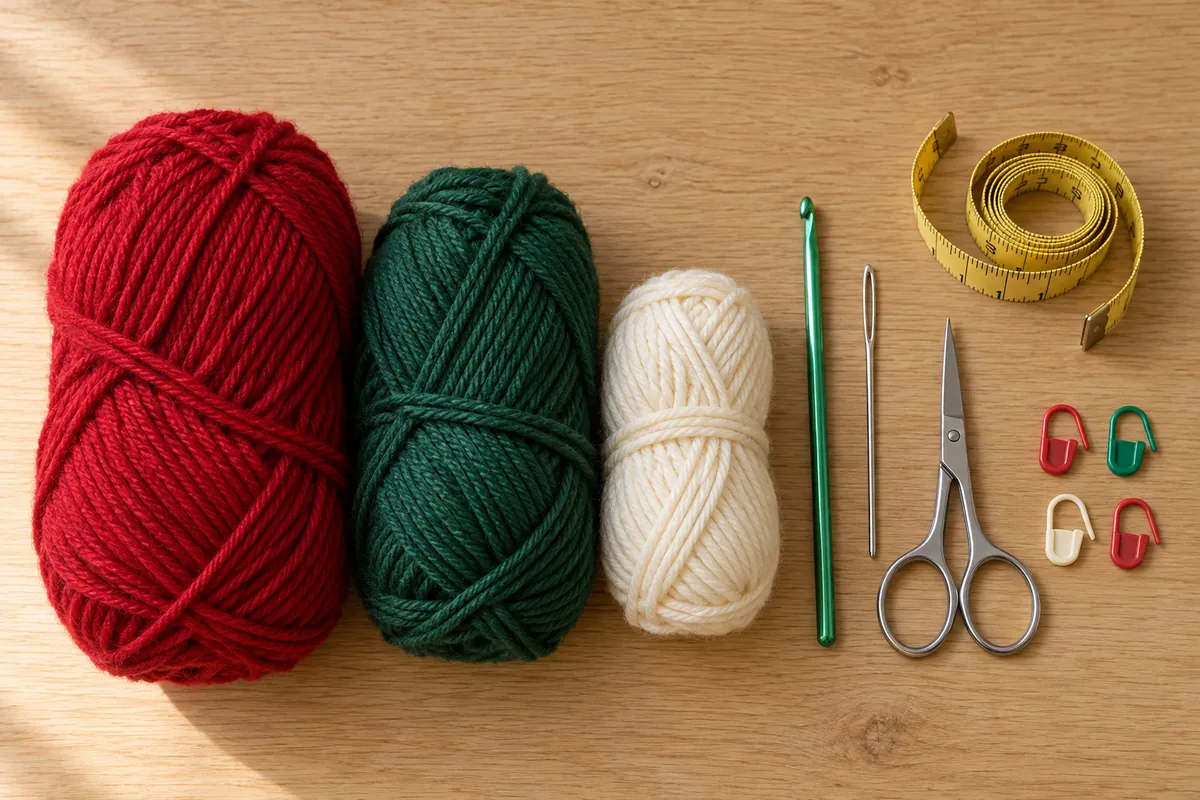
You’ll also need a blunt tapestry needle or a bodkin with an eye big enough for two strands of worsted at once. Try it in the store with your yarn if you can.
Holly red, pine green and a single cream line
Color A covers the most area and sets the mood. Color B fills the second block, and color C appears only once in each red block, in one row and one column. Make C the lightest or brightest of the three, so the small square where its row and column cross reads clearly.
- Holly and Pine: A holly red, B pine green, C cream, as written in the card.
- Snowy Pine: A cream, B pine green, C cranberry, softer and lighter for a winter bedroom.
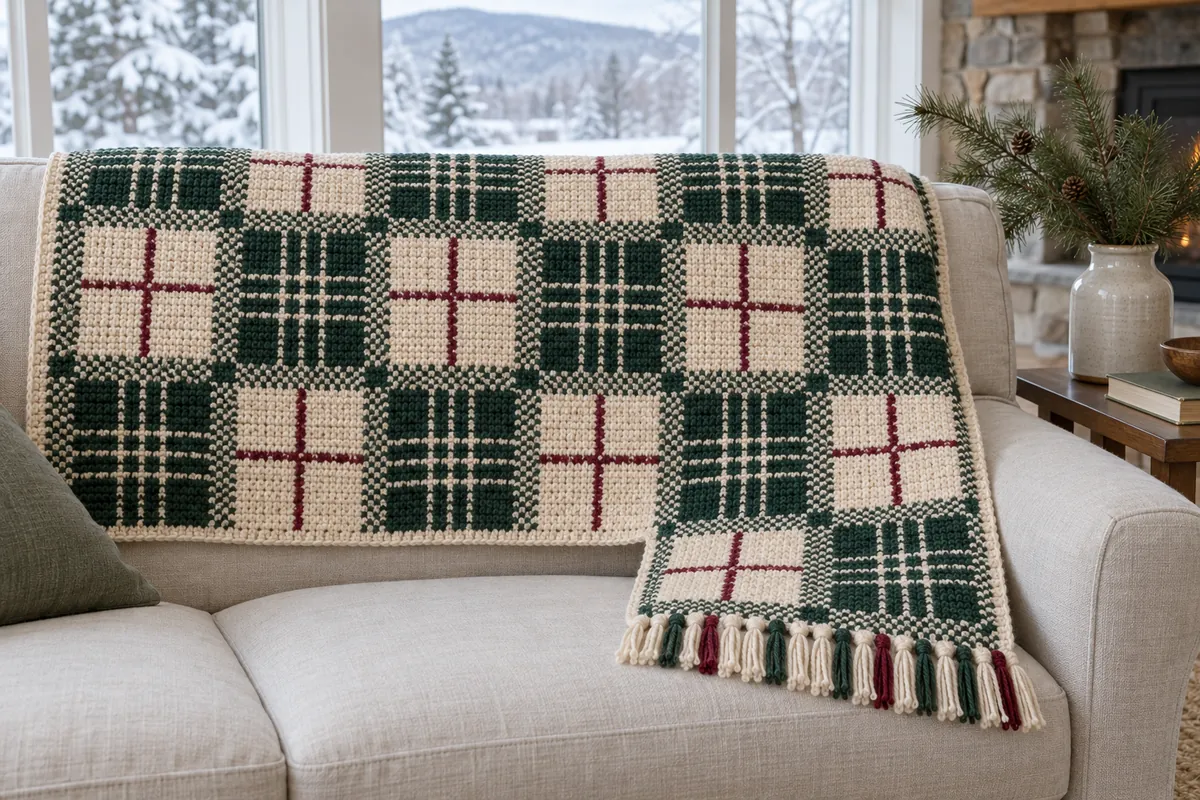
- Maple Sugar: A oatmeal, B walnut, C honey, warm neutrals you can leave out all year.
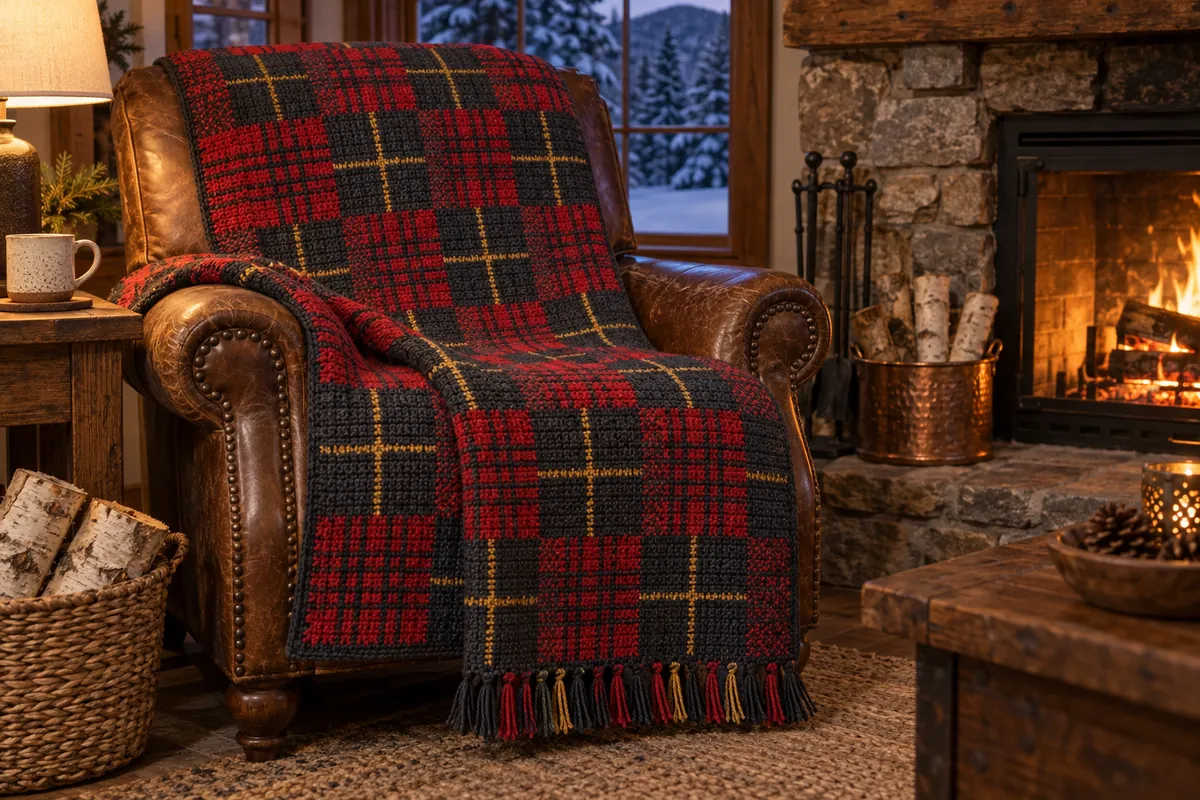
- Coal and Scarlet: A charcoal, B scarlet, C gold, a bold classic tartan.
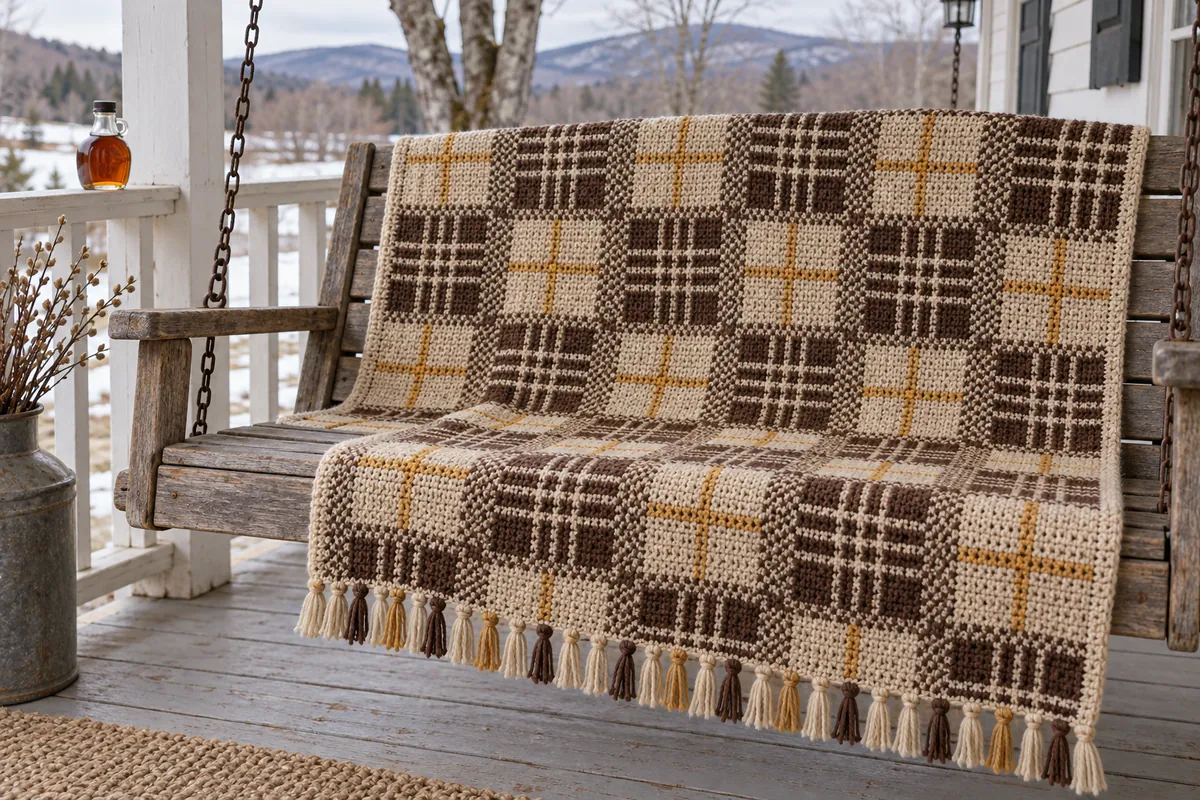
Keep a clear contrast between A and B. Where a red row crosses a green column, the two colors mix into the darker checks between the blocks, and if A and B are too close, those checks blur into mud from a few steps away. Lay the two skeins side by side and squint: if they merge, pick a lighter or darker B.
Throw, full or queen: blocks across and blocks down
The afghan grows in whole blocks, so that a red Section A sits at all four edges. The card is written as Throw [Full, Queen]. Sizes are given without the fringe, which adds about 4 in (10 cm) at each end.
- Throw: about 49 × 66 in (124 × 168 cm). Ch 294, 145 spaces, 165 rows, 9 blocks across and 11 down. About 4,112 yd in all: A 2,517 yd, B 1,447 yd, C 148 yd.
- Full: about 81 × 90 in (206 × 229 cm). Ch 486, 241 spaces, 225 rows, 15 blocks across and 15 down. About 9,313 yd: A 5,595 yd, B 3,394 yd, C 324 yd.
- Queen: about 92 × 102 in (234 × 259 cm). Ch 550, 273 spaces, 255 rows, 17 blocks across and 17 down. About 11,957 yd: A 7,150 yd, B 4,394 yd, C 413 yd.
There’s no baby size on purpose. Loose woven strands and a long fringe aren’t safe in a crib.
Counting 145 spaces and weaving relaxed columns
Clip a marker every 50 chains in the foundation, then count the spaces of Row 1 and Row 2 before you go any further. A long chain is easy to miscount, and the plaid only works if both edges end with a full red block.
Every row has the same count. If a row loses a space, you skipped the turning chain at the end; if it gains one, you forgot to skip the first double crochet. Count once per color change, which comes every 1 to 7 rows, and you’ll never rip back far.
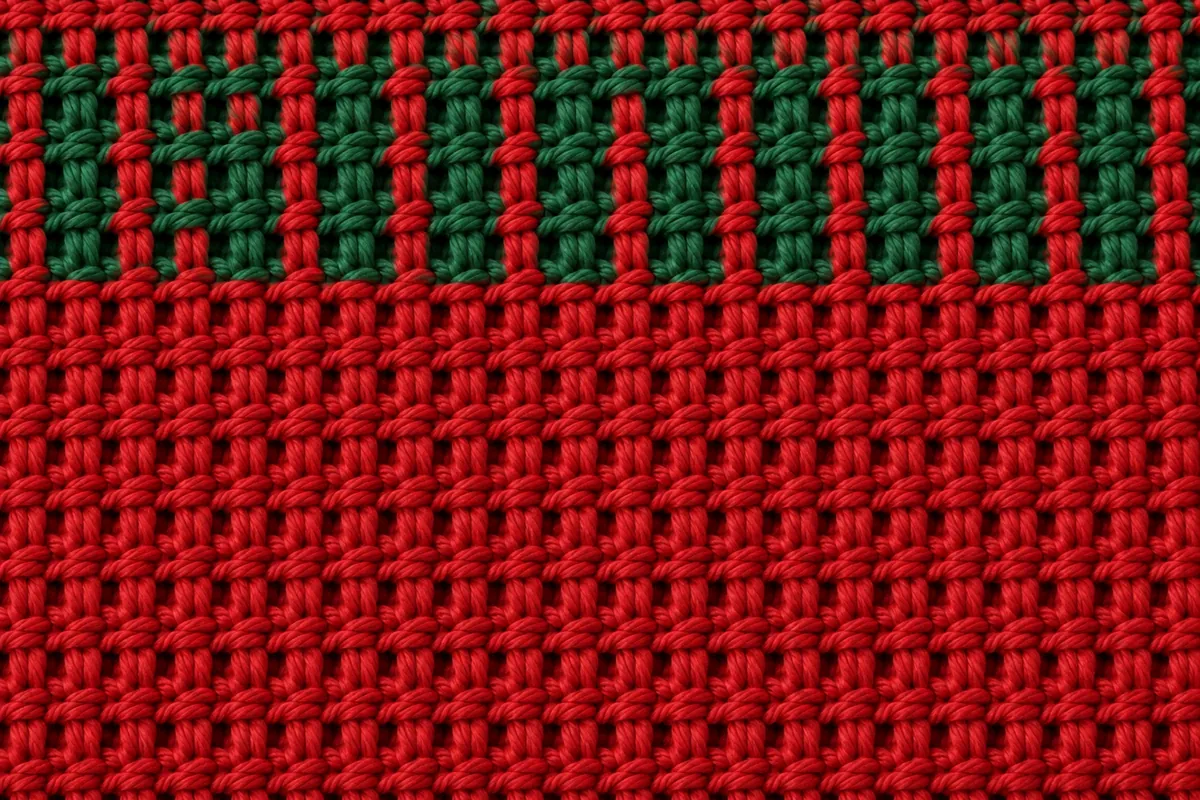
For the weaving, lay the afghan flat on a bed or a clean floor, right side up, Row 1 at the bottom. Cut the strands for one block of columns at a time and lay them in order, so you don’t grab a red pair for a green column. After each pass, smooth the strands along the column with your palm. They should lie flat and relaxed. Strands pulled tight draw the afghan in and shorten it, and you can’t fix that with blocking.
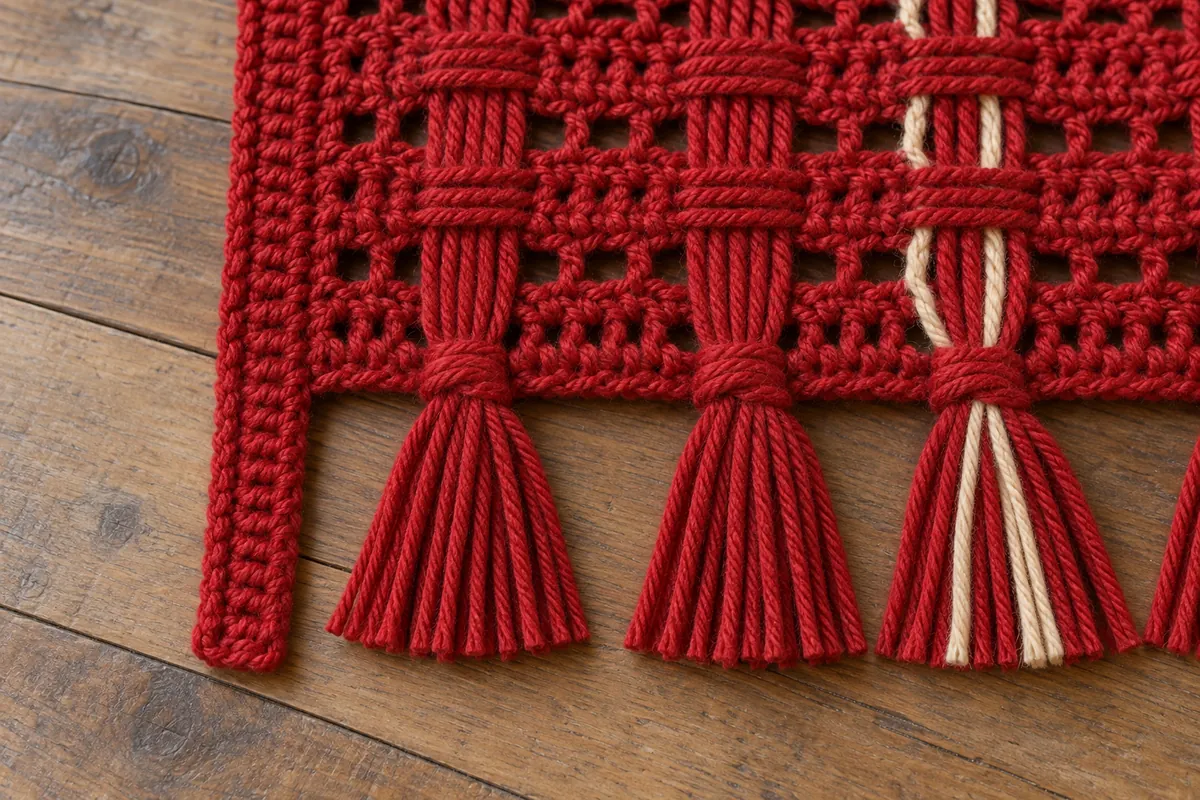
The fringe is the woven strands themselves, so there’s nothing extra to cut. Slide each overhand knot up with your fingers until it sits against the edge of the mesh, then tighten it. Knot the whole bottom edge before you trim anything.
If you’d rather work a plaid entirely in stitches, with no weaving, the Cabin Plaid pattern takes that route.
US crochet terms
The pattern
Materials
- Worsted weight yarn (#4), wool, wool blend or soft acrylic, about 200 yd (183 m) per 100 g skein, in 3 colors (estimate, mesh, edging and woven strands included):
- A, Holly Red (main color): about 2,517 [5,595, 7,150] yd (2,302 [5,116, 6,538] m), 13 [28, 36] skeins
- B, Pine Green: about 1,447 [3,394, 4,394] yd (1,323 [3,103, 4,018] m), 8 [17, 22] skeins
- C, Cream (accent line): about 148 [324, 413] yd (135 [296, 378] m), 1 [2, 3] skeins
- Share of these amounts used for the woven strands: A 941 [2,078, 2,656] yd, B 491 [1,172, 1,518] yd, C 52 [112, 143] yd
- 4.0 mm (G-6) crochet hook, or size needed to obtain gauge
- Large-eye blunt tapestry needle or bodkin that holds two strands of worsted at once
- Scissors, tape measure and stitch markers
- A bed or a clean floor large enough to lay the afghan flat for the weaving
Gauge
12 sps and 10 rows = 4 in (10 cm) in the mesh, before weaving, with a 4.0 mm (G-6) hook. Estimate: your size may vary with your gauge.
Swatch: ch 36 and work Rows 1 and 2 of Step 1, then repeat Row 2 until the swatch has 14 rows (16 sps across). Measure in the center. If you have more than 12 sps over 4 in, use a larger hook; if you have fewer, use a smaller hook.
Finished size
- Throw: about 49 × 66 in (124 × 168 cm), 9 × 11 blocks
- Full: about 81 × 90 in (206 × 229 cm), 15 × 15 blocks
- Queen: about 92 × 102 in (234 × 259 cm), 17 × 17 blocks
- Side edging included in the width; fringe not included (it adds about 4 in / 10 cm at each end). Estimates based on the gauge above.
Abbreviations
- ch chain
- dc double crochet
- rep repeat
- RS right side
- sc single crochet
- sk skip
- sl st slip stitch
- sp(s) space(s)
- st(s) stitch(es)
- WS wrong side
- yo yarn over
Notes
- Sizes are written as Throw [Full, Queen]. A number given once applies to all sizes.
- How it’s made: Step 1, crochet the mesh in rows, in two color sections; Step 2, work a row of single crochet along each long side; Step 3, weave strands through the columns of spaces; Step 4, knot the woven ends into the fringe at the top and bottom.
- Turning chain: the ch 4 at the start of each row counts as a dc and ch 1 throughout. Every row has 146 [242, 274] sts, the turning chain counting as a dc, and 145 [241, 273] sps, the space made by the ch 4 included. If a row loses a space, the last dc was not worked into the turning chain; if it gains one, the first dc was not skipped.
- Right side: the mesh looks the same on both sides. After Row 1, place a marker on the side facing you and call it the RS. Work the side edging and the weaving with this side facing.
- Row sections, 15 rows each. Section A: 7 rows A, 1 row C, 7 rows A. Section B: 3 rows B, 1 row A, 3 rows B, 1 row A, 3 rows B, 1 row A, 3 rows B. The afghan starts and ends with a Section A: Section A, then (Section B, Section A) 5 [7, 8] times, for 11 [15, 17] sections and 165 [225, 255] rows. In all, 99 [133, 150] rows are in A, 60 [84, 96] in B and 6 [8, 9] in C.
- Column sections: a Section A of columns has 8 columns of A on each side of the C column (17 columns); a Section B of columns is the same as a Section B of rows (15 columns).
- Changing color: change color at the end of the last row of a color. Work the last dc until 2 loops remain on the hook, drop the old color, yo with the new color and pull it through both loops. Ch 4 with the new color and turn. Cut the old color at every change, leaving a 6 in (15 cm) tail; do not carry it up the side. The side edging is worked over the tails.
- Stitch multiple: the mesh works on any even number of chains (2 per space, plus 4). For the plaid to start and end with a Section A in both directions, the number of spaces must be a multiple of 32 + 17 (foundation chain: multiple of 64 + 38) and the number of rows a multiple of 30 + 15.
- Counting: place a marker every 50 chains in the foundation chain, and count the spaces of the first rows before you go on.
- Yardage and sizes are estimates based on the gauge above.
Instructions
Step 1: Crochet the mesh
- Foundation: With A, ch 294 [486, 550], placing a marker every 50 ch.
- Row 1 (A): Dc in 6th ch from hook (the 5 skipped ch count as a dc, ch 1 and a skipped ch), *ch 1, sk next ch, dc in next ch; rep from * across. (146 [242, 274] sts, 145 [241, 273] sps)
- Row 2 (A): Ch 4 (counts as dc and ch 1), turn. Sk the dc at the base of the ch-4 and the first sp, dc in next dc, *ch 1, sk next sp, dc in next dc; rep from * until 1 sp remains, ch 1, sk next ch of the turning chain, dc in next ch. (146 [242, 274] sts, 145 [241, 273] sps)
From here on, every row is a repeat of Row 2. Only the color changes, and every row keeps the same count.
- Rows 3–7 (A): Rep Row 2. At the end of Row 7, change to C.
- Row 8 (C): Rep Row 2. At the end of the row, change to A.
- Rows 9–15 (A): Rep Row 2. At the end of Row 15, change to B. Section A is complete.
- Rows 16–18 (B): Rep Row 2. At the end of Row 18, change to A.
- Row 19 (A): Rep Row 2. At the end of the row, change to B.
- Rows 20–22 (B): Rep Row 2. At the end of Row 22, change to A.
- Row 23 (A): Rep Row 2. At the end of the row, change to B.
- Rows 24–26 (B): Rep Row 2. At the end of Row 26, change to A.
- Row 27 (A): Rep Row 2. At the end of the row, change to B.
- Rows 28–30 (B): Rep Row 2. At the end of Row 30, change to A. Section B is complete.
- Rows 31–165 [31–225, 31–255]: Rep Row 2, working the colors of Rows 1–30 (Section A, then Section B) 4 [6, 7] more times, then the colors of Rows 1–15 (Section A) once more. (146 [242, 274] sts, 145 [241, 273] sps on every row)
The last row is Row 165 [225, 255], in A. You have 11 [15, 17] sections. Fasten off, leaving a 6 in (15 cm) tail.
Step 2: Side edging
The top and bottom edges are not edged: the fringe goes there.
- First long side: With the RS facing, join A with a sl st around the edge st of Row 1, at one end of a long side. Ch 1 (does not count as a st). Working along the side, 2 sc in the end of each row (around the post of the edge dc, or under the ch-4 where it forms the edge), working over the color tails as you go. (330 [450, 510] sc) Fasten off.
- Second long side: With the RS facing, join A with a sl st around the edge st of the last row, at the end of the other long side. Ch 1 and work as for the first side. (330 [450, 510] sc) Fasten off.
Lay a short length of edging flat from time to time: if it ruffles, your sc are too loose; if it pulls in, too tight. Weave the two ends of each side into the edging and trim any tail that still shows.
Step 3: Weave the columns
Lay the afghan flat, RS facing up, with Row 1 at the bottom. A column is one vertical line of spaces, one space per row: 165 [225, 255] spaces from bottom to top. Work the columns from right to left. Column 1 is the line of spaces next to the right-hand edging.
Column colors:
- Columns 1–17 (Section A): Columns 1–8 in A, Column 9 in C, Columns 10–17 in A.
- Columns 18–32 (Section B): Columns 18–20 in B, Column 21 in A, Columns 22–24 in B, Column 25 in A, Columns 26–28 in B, Column 29 in A, Columns 30–32 in B.
- Columns 33–145 [33–241, 33–273]: Rep the colors of Columns 1–32 3 [6, 7] more times, then the colors of Columns 1–17 once more.
The last column is Column 145 [241, 273], in A, next to the left-hand edging. You have 9 [15, 17] sections of columns: 92 [149, 168] columns in A, 48 [84, 96] in B and 5 [8, 9] in C.
For each column:
- Strands: Cut 4 strands of the column color, each 80 [110, 124] in (203 [279, 315] cm) long. In all, you cut 368 [596, 672] strands of A, 192 [336, 384] of B and 20 [32, 36] of C.
- Pass 1: Thread 2 strands together into the needle. From the WS, bring the needle up through the bottom space of the column, down through the space above it, up through the next space, and so on to the top. Each pass goes over one chain bar and under the next. Pull the strands through until equal tails hang at the top and bottom.
- Pass 2: Thread the other 2 strands and weave the same column the opposite way: down where Pass 1 came up, and up where it went down. Every chain bar of the column is now covered, on one side or the other.
- Smoothing: Smooth the strands along the column so they lie flat and relaxed. Do not pull them tight: tight strands draw the afghan in and shorten it.
Cut the strands for one section of columns at a time, and check each column’s color against the list before you weave it.
Step 4: Fringe
Work along the bottom edge first, starting at the right-hand corner, with the RS facing up.
- Knot 1: Gather the strands of Columns 1–3 (12 strands). Make a loop with the whole group, pass the ends through the loop, slide the knot with your fingers up against the edge of the mesh, then tighten it. The knot sits snug against the edge without pulling it in.
- Next knots: Rep with the strands of the next 3 columns, and so on across. Throw and Full only: the last knot takes the strands of the last 4 columns (16 strands). Queen: every knot takes 3 columns. (48 [80, 91] knots along the bottom edge)
- Top edge: Turn the afghan around and knot the top edge the same way, with the same groups. (48 [80, 91] knots)
- Trim: Lay the afghan flat, comb the strands straight with your fingers and trim them all evenly to about 4 in (10 cm).
Finishing
- Lay the afghan flat and smooth it into a rectangle of 49 × 66 [81 × 90, 92 × 102] in. Ease any column that pulls in, so the woven strands lie relaxed.
- Mist it lightly with water and let it dry completely before you move it. Never press acrylic with a hot iron.
Washing a woven plaid without felting the strands
Follow the yarn label first. For wool, wash by hand in cool water with a wool wash and squeeze gently. Never wring or rub it: friction can felt the woven strands into the mesh, and then you can’t smooth a column again. For a machine-washable yarn, use a gentle cycle in cold water, alone or with a few light items, and dry flat.
While the afghan is still damp, run your palm up each column so the strands lie straight, and comb the fringe with your fingers. Fold it loosely along the columns and store it flat. A full or queen afghan gets heavy, so lift it with both arms rather than by the fringe.
Hearthside questions about weaving, fringe and yarn
How much weaving does a crochet tartan afghan need?
Plan it as a second project after the mesh: every column gets two passes from bottom to top, 145 columns on the throw and 273 on the queen. Working one block of columns per sitting keeps the job in manageable pieces and the strands for each color sorted.
Can the woven strands slip out of the mesh?
The two pairs in each column pass the chain bars in opposite order, so they hold each other in place, and the knots at both ends lock them. Keep them relaxed when you smooth each column so the afghan keeps its width.
What if I run short on strands for the last columns?
The amounts in the card include the woven strands with a margin, so this shouldn’t happen at your gauge. Cut strands one block at a time and weigh what’s left before the last few blocks; if a color looks short, buy more with the same dye lot number before you weave on.
Do I need a loom or a frame for the weaving?
No. The afghan lies flat on a bed or a clean floor while you weave, right side up, with the first row at the bottom. A large-eye blunt needle or a bodkin is the only tool.
Quick recap
- Crochet the mesh in one piece, alternating Section A and Section B, starting and ending with A.
- Work 2 single crochet in each row end along both long sides, over the color tails.
- Weave each column with two pairs of strands, right to left, following the column colors.
- Knot the woven ends three columns at a time at both ends, then trim the fringe.
- Block the afghan flat and let it dry.
This crochet tartan afghan is built from one row of mesh and a needle, and it looks like a real woven plaid from across the room. If a count or a column puzzles you, ask through the Contact page.