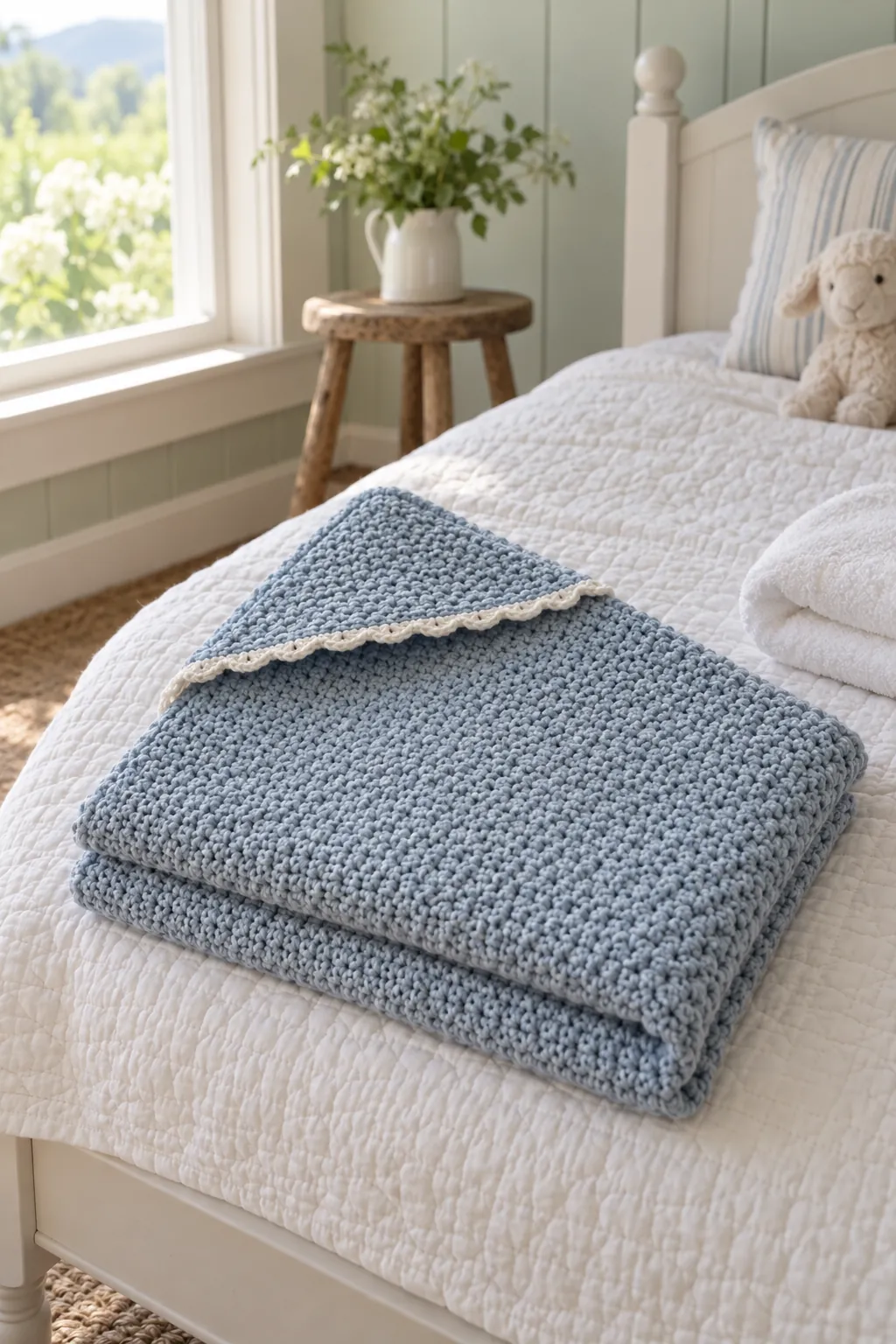
Picture a warm June evening in Vermont, the bath water still running out, and a small damp head tucked into a soft blue hood. That’s the whole idea behind this hooded baby blanket crochet pattern: a square-cornered wrap with a little triangle hood stitched onto one corner, so the blanket stays put on the head while you dry, carry and cuddle.
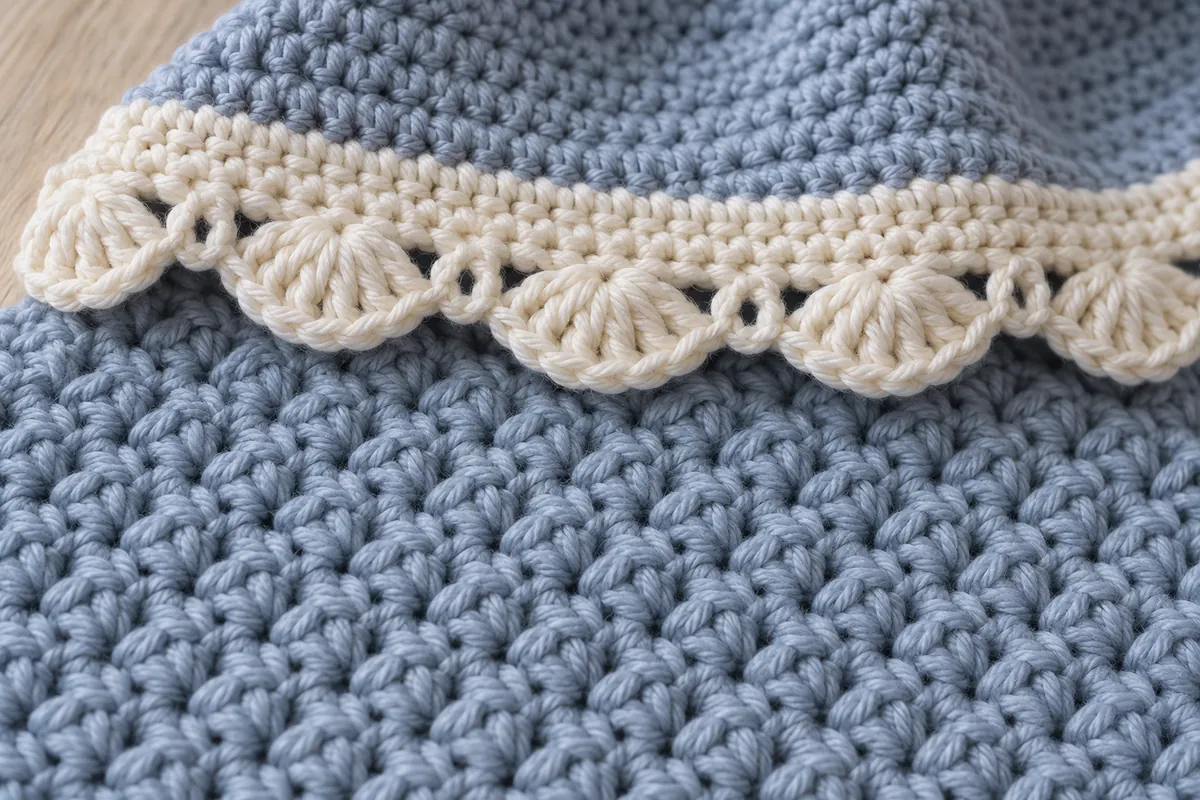
Brookside is worked in worsted weight cotton-blend yarn with a 6 mm hook. The blanket is one piece of Suzette stitch, a textured pairing of single and double crochet. The hood is a separate single crochet triangle with a cream edge of shells and short picots, sewn on at the end. There are two blanket sizes, Baby and Stroller, and each comes with its own hood: one for heads up to about 18 in (0 to 12 months), one for heads up to about 20 in (1 to 3 years).
Is this hooded baby blanket crochet pattern easy enough for you?
If you can make a chain, a single crochet and a double crochet, you already know every stitch in it. The texture comes from placing them, not from anything new. Each Suzette group is a single crochet and a double crochet worked into the same stitch, and then you skip the next stitch. On every row after the first pattern row, the groups land in the single crochets of the row below and hop over the double crochets. If the abbreviations look like code, the section on reading a pattern walks through them.
The hood adds two small skills. It grows from a point by working 2 single crochet in the first and last stitch of most rows, with a plain row every fourth row. The shells are 5 double crochet in one stitch, with a picot made on a slip stitch between them. Then you whipstitch the hood in place with a yarn needle. All of it sits comfortably at the Easy level.
Choosing a worsted cotton blend for an after-bath Suzette blanket
Look for a #4 Medium (worsted) label. A cotton-acrylic blend suits this blanket well: the cotton soaks up water after a bath, the acrylic keeps it light and quick to dry, and the blend survives the washing machine. Pure cotton works too, but it gets heavy when wet and the Suzette rows can feel stiff. Plain baby acrylic is softer and lighter, and it dries fastest.
Two traps are worth avoiding. Buy all the blue in one dye lot, because a lot change across a solid blue blanket shows as a stripe. And skip fuzzy or loopy novelty yarns for the hood: the shells need clear, smooth stitches to read as scallops.
The numbers in the card come from a gauge of 12 stitches and 12 rows over 4 in (10 cm) in Suzette stitch. That’s an estimate taken from published worsted Suzette work, not a measured swatch, so crochet the small swatch described in the card before you commit. If your square is bigger, go down to a 5.5 mm hook; if it’s smaller, try 6.5 mm.
Misty blue with a cream hood edge, and other pairings
Brookside uses two colors with clear jobs. The main color (A) makes the blanket, the hood and the seam, so it’s the color of almost everything. The edging color (B) only appears in the two narrow single crochet rows and the shell row across the front of the hood, where it frames the face. A light edging color on a deeper main color makes the scallops stand out.
- Brookside: misty blue and cream.
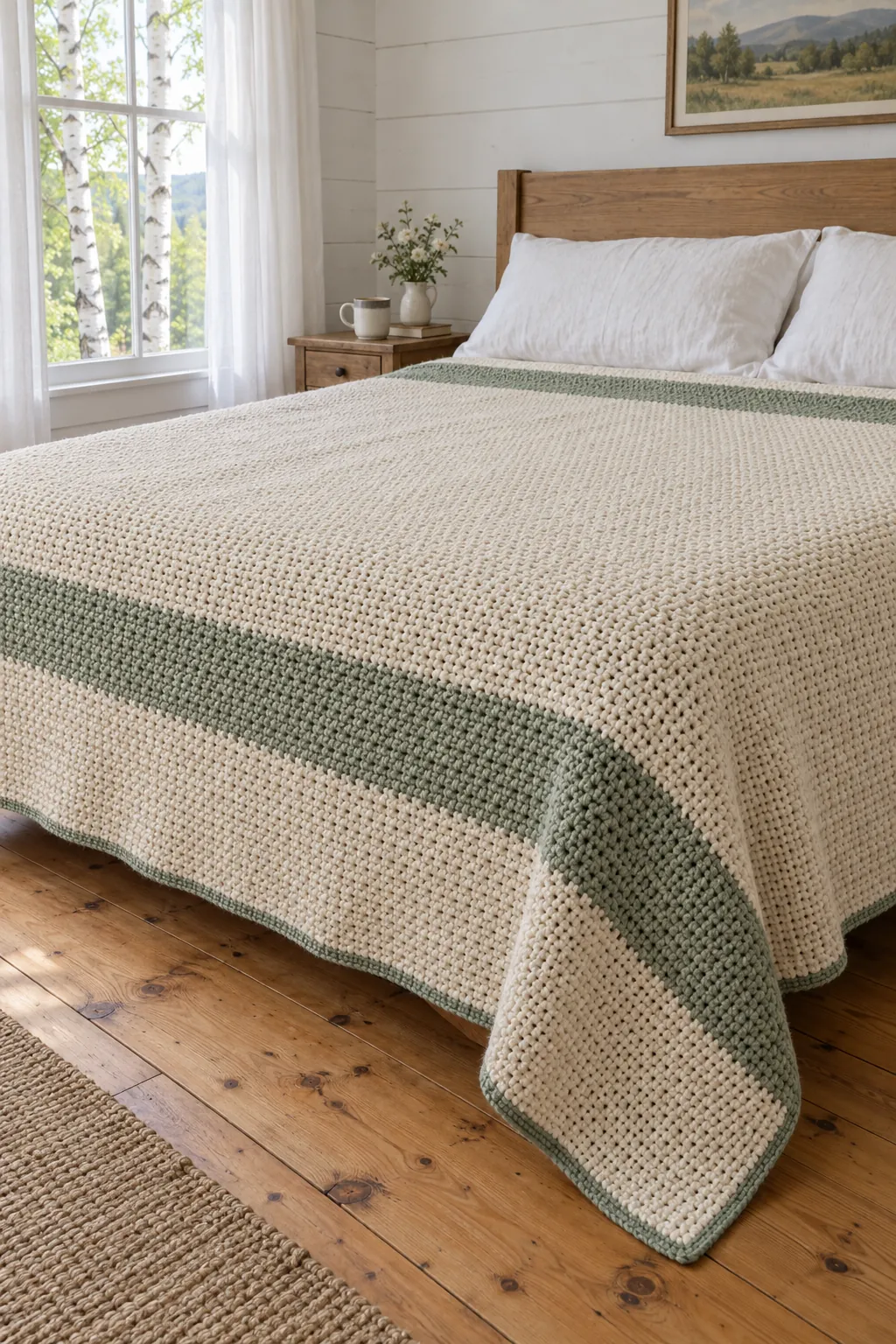
- Pear blossom: sage green and oatmeal.
- Sorrel: dusty rose and natural white.
- Driftwood: dove gray and soft white.
- Buttercream: butter yellow and ivory.
One practical tip: B is such a small amount that a leftover ball works fine. Wash a strip of B with a strip of A before you start, so a strong blue never bleeds into the cream frame.
Two blanket sizes and the hood that goes with each
The card is written for both sizes, smallest first, with the larger size in brackets. The hood follows the head, not the blanket, so each hood is listed with the blanket it was planned for.
- Baby, about 30 × 36 in (76 × 91 cm), with the 0 to 12 month hood: ch 89, 108 rows, 89 stitches per Suzette row (44 groups + 1 sc). Hood: 20 rows plus 3 edging rows, front edge about 11 in (28 cm). Yarn A: about 1,148 yd (1,050 m); yarn B: about 15 yd (14 m).
- Stroller, about 36 × 45 in (91 × 114 cm), with the 1 to 3 year hood: ch 107, 134 rows, 107 stitches per Suzette row (53 groups + 1 sc). Hood: 28 rows plus 3 edging rows, front edge about 15 in (38 cm). Yarn A: about 1,725 yd (1,577 m); yarn B: about 21 yd (19 m).
All yardage is an estimate and includes a 15% margin. The toddler hood is a little roomy on purpose: the shell edge only works on certain stitch counts, so the hood rounds up rather than down. Either hood can go on either blanket. If you’d like a lighter option in DK for warmer days, Little Fern is worked in plain rows, and Maple Lane in bulky yarn goes much faster.
Tips for the Suzette rows, the hood point and the seam
- Write “Row 2” and “Row 3” on a sticky note. They end differently. Row 2 sits on the single crochet foundation row, which has one stitch less, so it has no skip before the last single crochet. From Row 3 on, every row ends with “skip 1, sc in the last stitch.”
- Count groups, not stitches. Each row has 44 [53] groups plus one closing single crochet. Counting 44 little “sc-dc” pairs is faster than counting 89 loose stitches, and a group stacked on a double crochet tells you right away where you slipped.
- Check the hood point on a real corner. After Row 12, lay the hood on the corner of a book. Both slanted edges should follow the sides without rippling. If they flare, your rows are shorter than the gauge; if they pull inward, your rows are taller. A firmer or looser tension usually fixes it.
- Try stripes. Change color every 2 rows, on the closing single crochet of the second row, and you get narrow, even stripes that follow the texture. Start and end with the main color so the Row 1 and last-row edges match.
- Frame the whole blanket. You can work the cream shell edge all the way around. First work a round of single crochet with 3 sc in each corner stitch: 85 [105] sc evenly across the top and the bottom between the corners, and 109 [133] along each side (400 [488] sts). Then work 7 double crochet in the center stitch of each corner, and along each side repeat “skip 1, picot, skip 1, shell,” ending with “skip 1, picot, skip 1” before the next corner. That gives 21 [26] shells along the short sides, 27 [33] along the long sides and one picot more than shells on every side. Plan on about 174 [213] yd (159 [195] m) of extra cream, an estimate.
- Chenille or velvet yarn is fine, with a new swatch. Plush yarns are much thicker than worsted, so the gauge changes completely. Swatch first, then recalculate the chain from your own count.
US crochet terms
The pattern
Materials
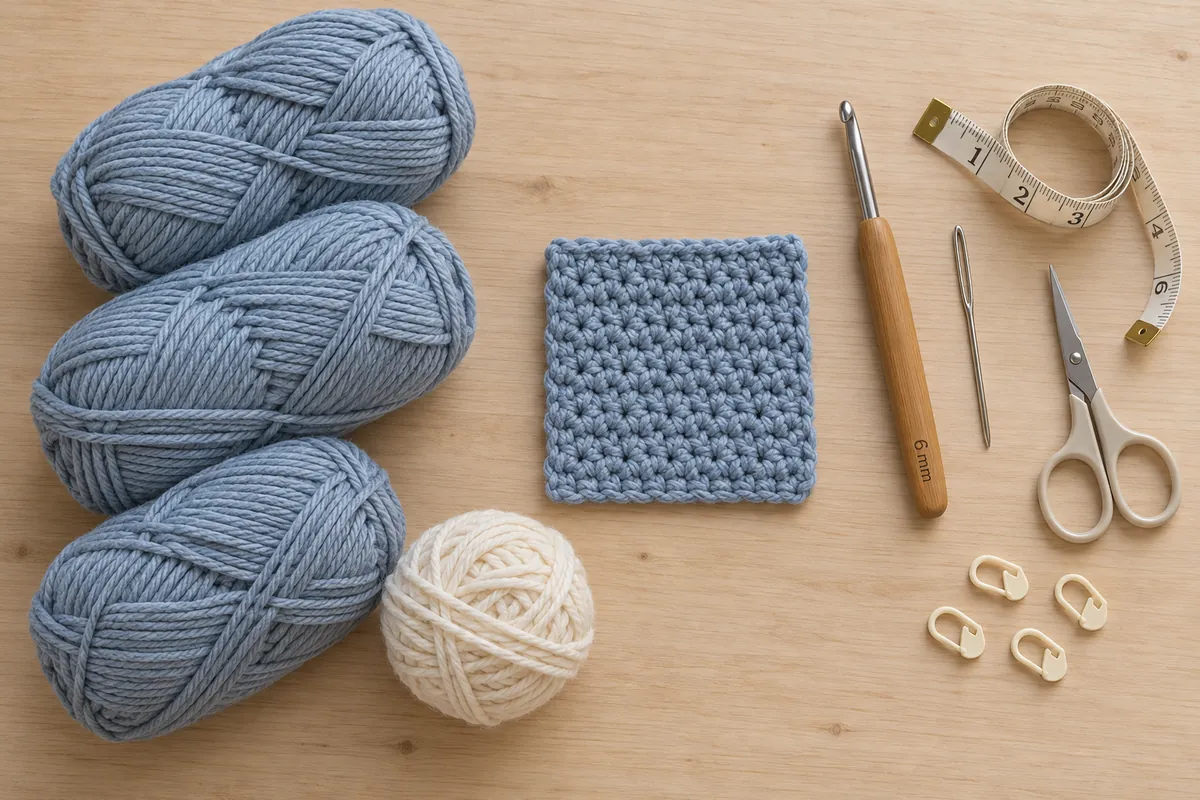
- Yarn: worsted weight (CYC #4, Medium), cotton-acrylic blend, in 2 colors.
- Color A, misty blue: about 1,148 [1,725] yd (1,050 [1,577] m), estimate, for the blanket, hood and seam.
- Color B, cream: about 15 [21] yd (14 [19] m), estimate, for the hood edging.
- Hook: 6.0 mm / J-10.
- Notions: yarn needle, scissors, 4 locking stitch markers or pins, tape measure.
Gauge
12 sts and 12 rows = 4 in (10 cm) in Suzette stitch; 12 sts and 16 rows = 4 in (10 cm) in sc (hood). These are estimates, not measured. To check: ch 15 and work Rows 1-3 of the blanket, then repeat Row 3 until you have 13 rows (15 sts: 7 groups + 1 sc); measure in the center.
Finished size
- Blanket: about 30 × 36 [36 × 45] in (76 × 91 [91 × 114] cm).
- Hood: front edge about 11 [15] in (28 [38] cm), each slanted side about 7¾ [10½] in (20 [27] cm). The smaller hood fits heads up to about 18 in (0-12 months), the larger one heads up to about 20 in (1-3 years).
Abbreviations
- ch chain
- dc double crochet
- rep repeat
- sc single crochet
- sh shell
- sk skip
- sl st slip stitch
- st(s) stitch(es)
Notes
- Two pieces: the blanket is worked in rows from the bottom edge; the hood is worked separately from its point, then sewn onto one corner.
- Turning chain: the ch 1 at the start of every row does not count as a stitch and is never worked into.
- Stitch multiple: the foundation chain is a multiple of 2 + 1. Add or remove 2 chains to change the width by about ⅔ in (1.7 cm).
- Suzette stitch: (sc, dc) in the same st, then sk the next st. From Row 3 on, each group goes into the sc of a group of the row below and each dc of the row below is skipped. Row 2 and Row 3 end differently: write both out.
- Hood: 2 sc in the first and last st adds 2 sts. From Row 3 on, three increase rows and then one row without increases keep both slanted sides at a square corner, so they lie along the blanket edges.
- Special stitches: shell (sh) = 5 dc in the same st. Picot = sl st in next st, ch 3, sl st in the same st. The sl sts and ch-3 loops are not counted as stitches.
- Color change: join B with a sl st in the first st of the row, leaving a 6 in (15 cm) tail.
- Shell row: the ch 3 at the start of the row and the sl st that follows form the first picot.
- Safety: weave every tail in securely with the needle. No buttons, beads or pompoms. Use the blanket for cuddles, the stroller and after baths with an adult nearby; babies under 12 months should sleep without loose blankets.
Instructions
Blanket
- Foundation: with A, ch 89 [107].
- Row 1: sc in 2nd ch from hook and in each ch across. (88 [106] sts)
- Row 2: ch 1, turn, (sc, dc) in first st, *sk next st, (sc, dc) in next st; rep from * to last st, sc in last st. (89 [107] sts: 44 [53] groups + 1 sc)
- Row 3: ch 1, turn, (sc, dc) in first st, *sk next st, (sc, dc) in next st; rep from * to last 2 sts, sk next st, sc in last st. (89 [107] sts: 44 [53] groups + 1 sc)
- Rows 4-107 [4-133]: rep Row 3. (89 [107] sts each row)
- Row 108 [134]: ch 1, turn, sc in each st across. (89 [107] sts) Fasten off.
Hood
- Foundation: with A, ch 2.
- Row 1: 3 sc in 2nd ch from hook. (3 sts)
- Row 2: ch 1, turn, 2 sc in first st, sc in next st, 2 sc in last st. (5 sts)
- Row 3: ch 1, turn, 2 sc in first st, sc in each st to last st, 2 sc in last st. (7 sts)
- Row 4: rep Row 3. (9 sts)
- Row 5: rep Row 3. (11 sts)
- Row 6: ch 1, turn, sc in each st across. (11 sts)
- Rows 7-18 [7-26]: rep Rows 3-6 3 [5] times. (29 [41] sts)
- Row 19 [27]: rep Row 3. (31 [43] sts)
- Row 20 [28]: rep Row 6. (31 [43] sts) Fasten off.
Hood edging
Worked across the last row of the hood, the long straight edge.
- Row 1: turn the hood, join B with a sl st in the first st, ch 1, sc in same st and in each st across. (31 [43] sts)
- Row 2: ch 1, turn, 2 sc in first st, sc in each st to last st, 2 sc in last st. (33 [45] sts)
- Row 3: ch 3, turn, sl st in first st (edge picot), *sk next st, sh in next st, sk next st, picot in next st; rep from * across. (33 [45] sts used: 8 [11] shells, 9 [12] picots) Fasten off.
Finishing
- Weave in all tails on the wrong side, then lay both pieces flat.
- Lay the blanket right side up. Place the hood right side up on one corner: the point of the hood on the corner, the slanted sides along the two blanket edges, the shells across the corner. Pin the point, then pin each end of the shell edge 7¾ [10½] in (20 [27] cm) from the corner.
- Thread the needle with about 30 in (76 cm) of A. Whipstitch each slanted side to the blanket edge under it, through both layers: one stitch in each hood row end (23 [31] per side), catching the blanket stitch or row end beside it. Keep the stitches snug, not tight.
- Secure the yarn with two stitches in the same place at each end and weave the tails into the seam.
Washing a cotton-blend hooded blanket after bath time
Machine wash on a gentle cycle in cool or lukewarm water, with a mild detergent and no fabric softener, which coats cotton and makes it less absorbent. Turn the blanket so the hood sits inside the fold; that keeps the shells from catching on other laundry. Tumble dry low or dry flat, and pull the hood gently into shape while it’s damp so the scallops sit straight.
Before each wash, take ten seconds to check the seam and the tails around the hood point, since that corner gets tugged the most. A loose end is easy to stitch back in now. And keep the use simple: this is a blanket for after the bath, the stroller and supervised cuddles. Babies under 12 months should sleep with no loose blanket in the crib.
Brookside questions about the hood, the Suzette stitch and sizing
Which hood should I make for a hooded baby blanket crochet gift if the baby is between sizes?
Make the larger one. A hood that’s a little deep still works and the shell edge simply frames more of the face, while a hood that’s too shallow slides off. You can put the 1 to 3 year hood on the Baby blanket without changing anything else.
Why does Row 2 end differently from Row 3?
Row 1 is plain single crochet with an even count, and Row 2 adds one stitch by ending with a single crochet in the last stitch. From Row 3 on, the row below already has its closing single crochet, so you skip the double crochet before it. The count stays 89 [107] from Row 2 to the end.
Can I sew this hood onto a blanket I already made?
Yes, as long as the corner is square and the edge is firm. Work a round of single crochet first if the edge is loose or lacy, then pin and whipstitch exactly as in the card. Check that the slanted sides lie flat along the edges before you sew.
Why are there no pompoms on the corners?
Pompoms are tied with loose loops that little fingers and mouths can pull apart, so this version leaves them off. The cream shells and picots on the hood give the blanket its finish instead.
Can I make the hood itself in cream, with a blue edge?
Yes. Work hood Rows 1 to 20 [28] in B and the three edging rows in A, then sew it on with A so the seam blends into the blanket. The hood needs about 28 [54] yd (26 [50] m) more of B, an estimate, and a little less of A.
Quick recap
- Chain 89 [107] and work one row of single crochet.
- Work the Suzette rows, writing out Row 2 and Row 3, until you have 107 [133] rows, then close with a row of single crochet.
- Crochet the hood from its point: three increase rows, one plain row, repeated to 31 [43] stitches.
- Add the cream edging: two single crochet rows and a row of shells and picots.
- Pin the hood on a corner and whipstitch both slanted sides through both layers.
Small, soft and quick to throw over a damp head, this hooded baby blanket crochet pattern makes a gift that slips easily into bath-time routines. If a row count stumps you, send a question through the Contact page.