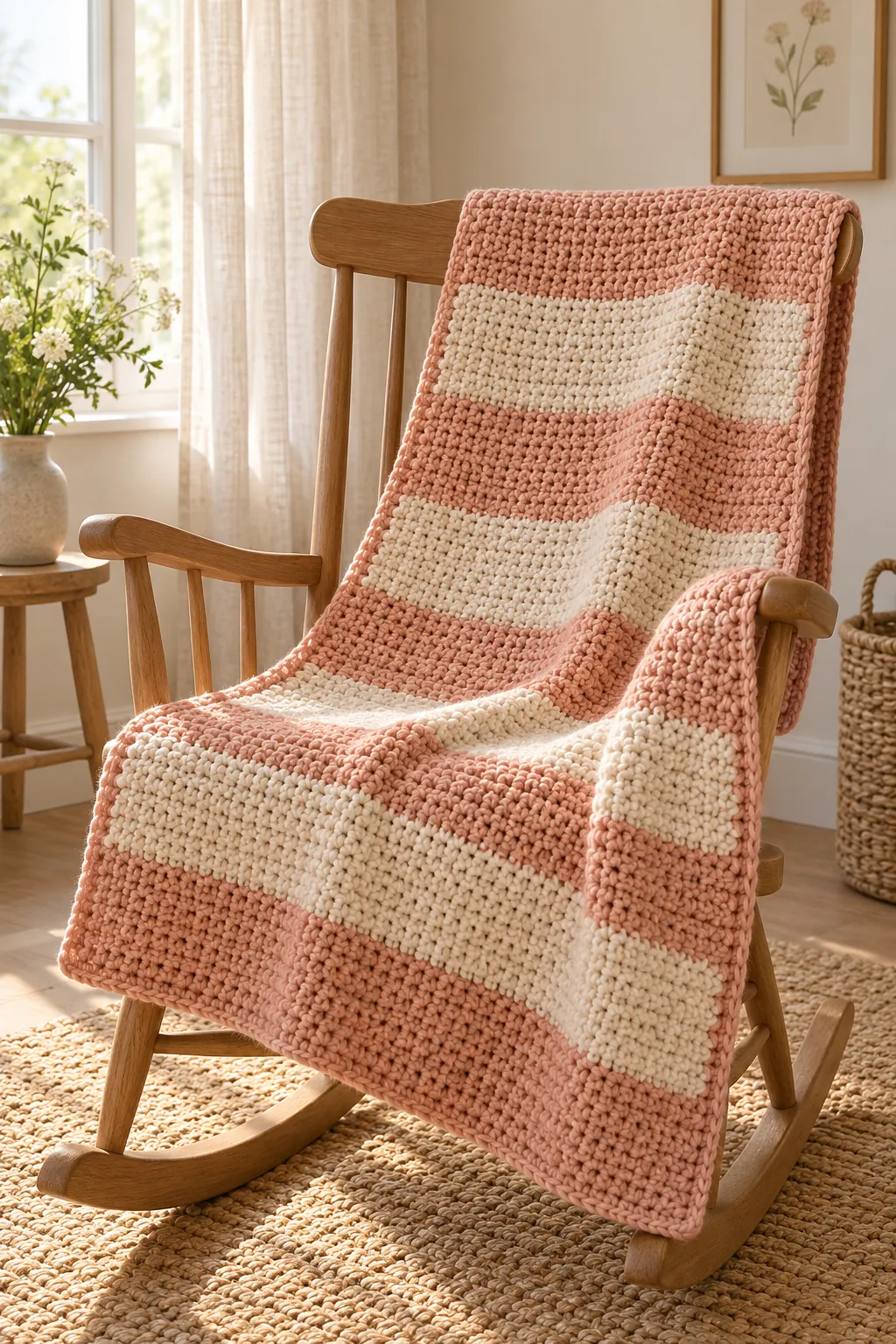
Maple Lane is the crochet baby blanket I make whenever someone I know is expecting. It’s nine stripes of peach and cream in bulky yarn, and the only stitch in the body is single crochet. The first one went to a friend’s little girl, and I’ve kept the pattern on my hook ever since.
Every row has 79 stitches. Every stripe has 12 rows. You start with peach and you finish with peach, and that’s all the planning there is. The blanket ends up about 30 × 37 in (76 × 94 cm), big enough to tuck around a stroller and light enough to fold over its handle.
Why single crochet makes this crochet baby blanket a good first project
You only need two stitches for the body: the chain for the foundation and single crochet for all 108 rows. The border adds one more, the slip stitch, which you’ll use just to close each round: insert your hook in the stitch, yarn over, and pull the yarn through the stitch and the loop on your hook in one go. If the letters in the pattern look like code, here’s how to read crochet abbreviations before you start.
Single crochet is the smallest of the basic stitches, so it makes a dense fabric with almost no gaps. Tiny fingers don’t poke through it, and it holds its shape after a lot of washing. Each stitch sits like a little V, so a missed one shows up as a dip at the edge.
The honest downside is speed: short stitches mean more rows, 108 of them. Bulky yarn helps, since a stripe comes together in an evening or two.
The only new technique is the color change: you finish the last stitch of a stripe with the new color, so the next row starts clean.
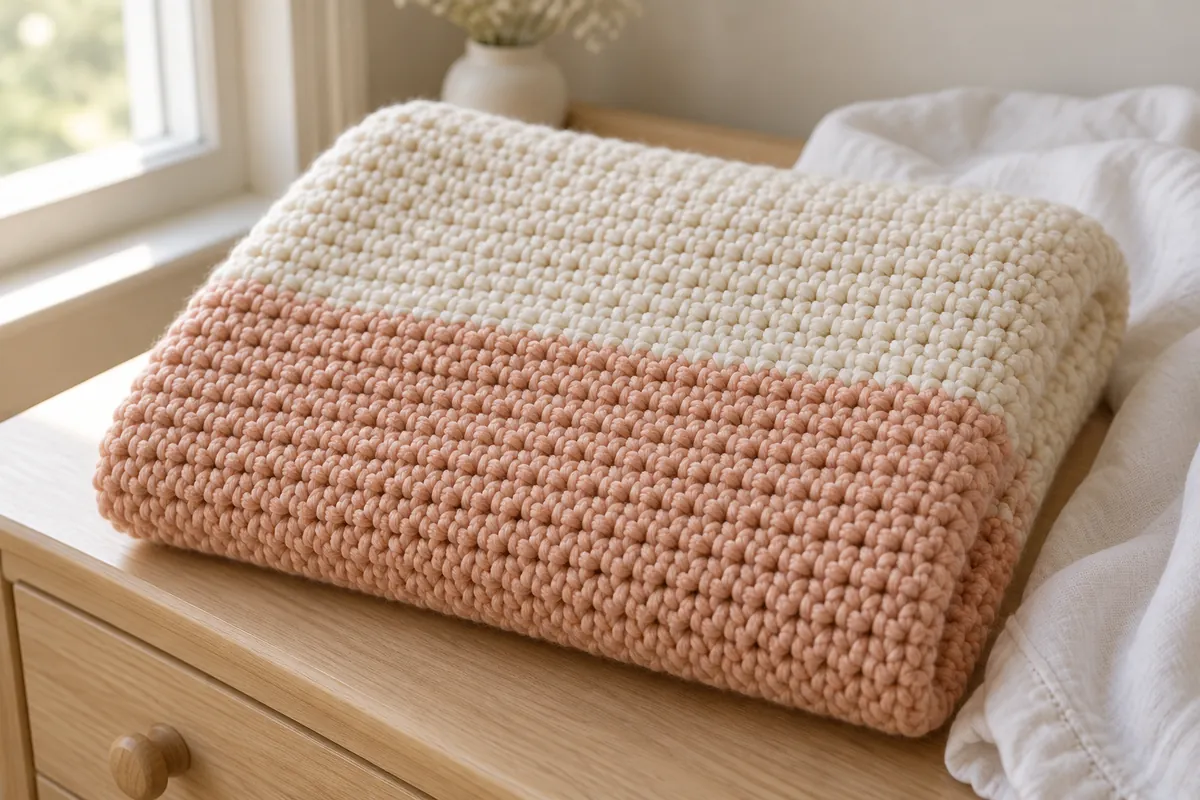
Picking a washable bulky yarn for peach and cream stripes
Look for the number 5 in the skein symbol on the label: that’s bulky weight, with a recommended hook of about 6.5 to 9 mm.
For a baby, I stick with a soft acrylic or acrylic blend sold as baby yarn. It survives the washing machine and doesn’t itch. Cotton blends work too, but bulky cotton in single crochet gets heavy and a little stiff. Plush chenille-style yarns hide the top of each stitch, so keep those for your second blanket.
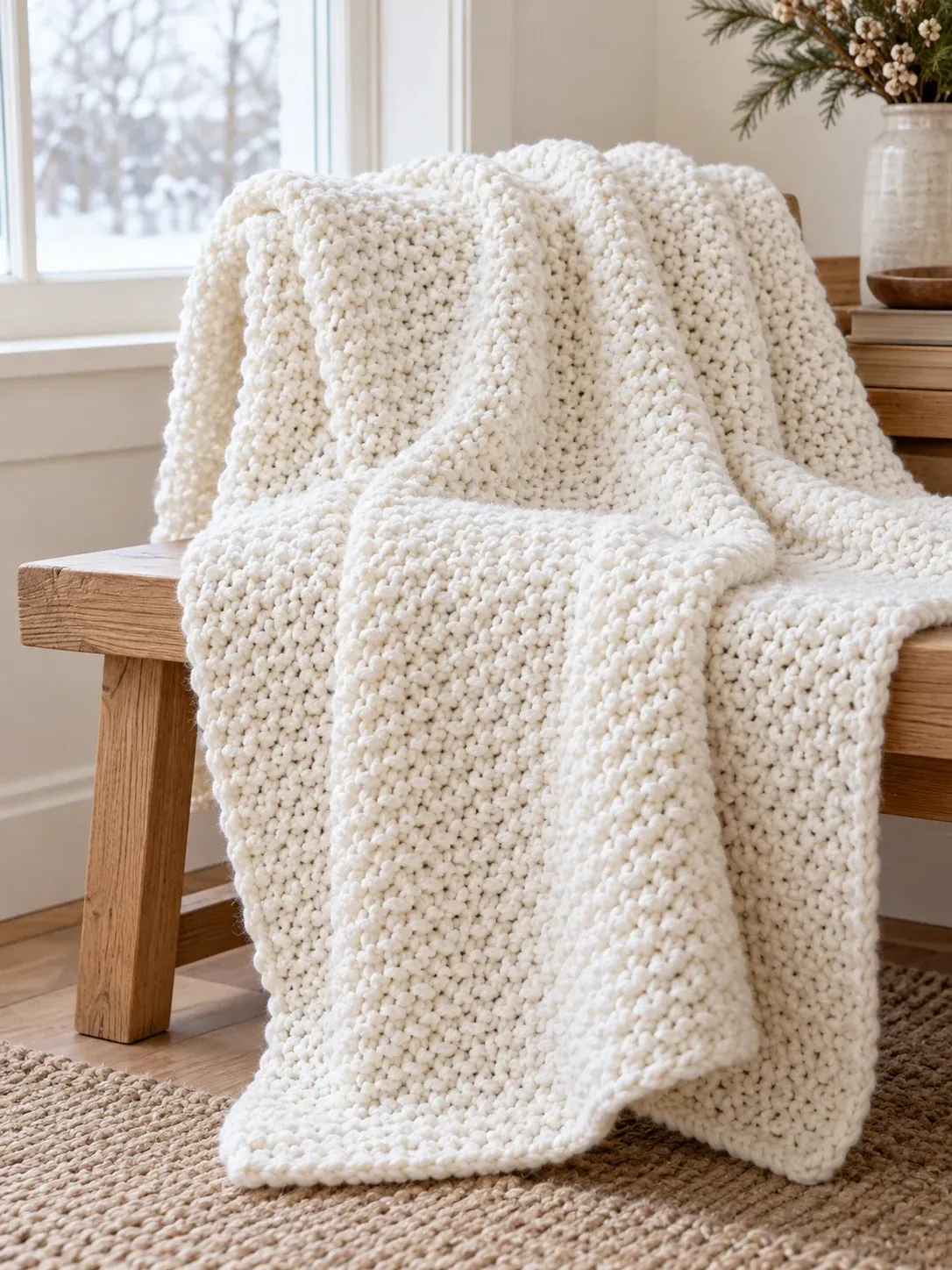
Don’t go thicker. Super bulky single crochet turns into a stiff mat, so I save that weight for my ivory couch throw in super bulky yarn.
To work out how many skeins to buy, divide the yardage by what’s on the label and round up. With 120-yd skeins, 400 yd of peach is 3.3 skeins, so you’d buy 4, and 300 yd of cream is 2.5, so you’d buy 3. Buy all the skeins of each color at the same time and check that they share a dye lot number. Two lots of peach can look like two different stripes in daylight.
To substitute, stay at weight 5 and crochet a swatch about 15 sc wide and 15 rows tall, then measure the middle. You’re aiming for 11 sc and 12 rows in 4 in (10 cm). With cotton, wash that swatch with a scrap of cream attached to see whether the peach bleeds.
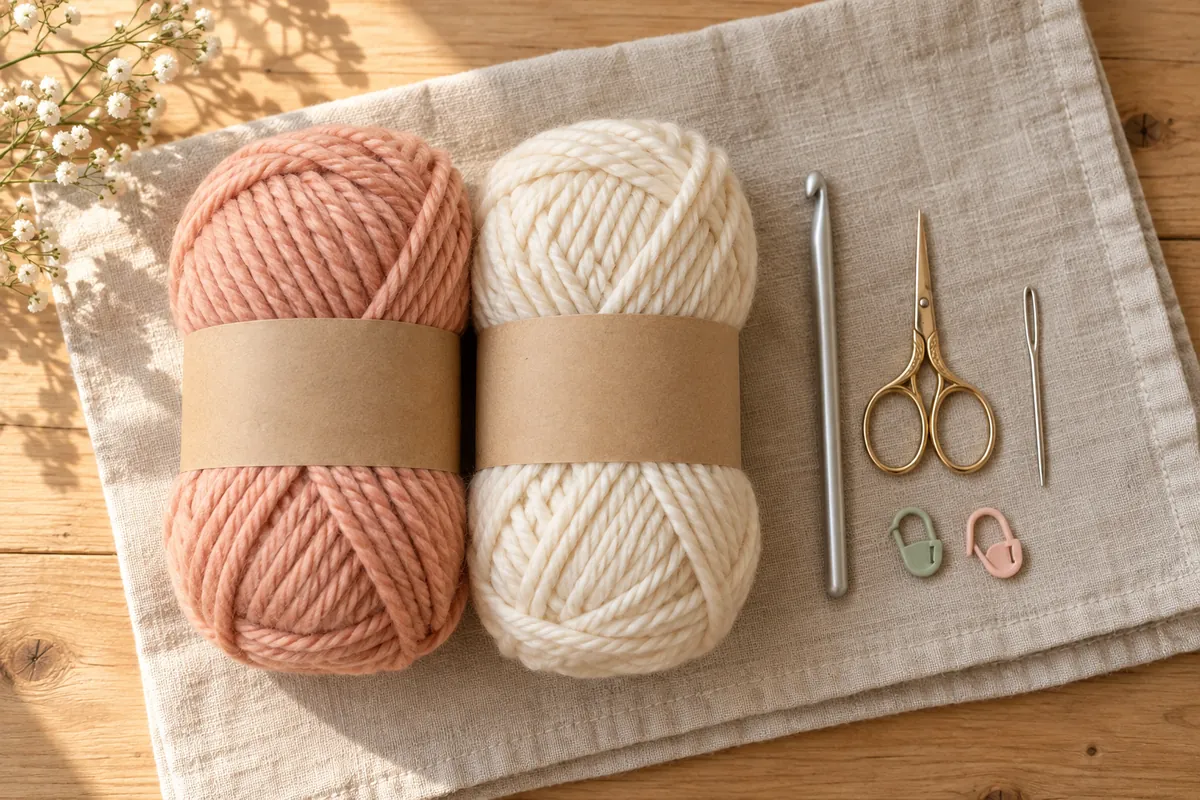
Peach and cream, and other color pairs for 12-row stripes
Peach is Color A: five of the nine stripes, including both ends, plus the border, so it frames the blanket. Cream, Color B, fills the four stripes inside. Pick the deeper of your two shades for Color A, since the edges get the most handling and a deeper color hides the wear.
If peach isn’t your shade, these pairs keep the same calm feel. Name Color A first:
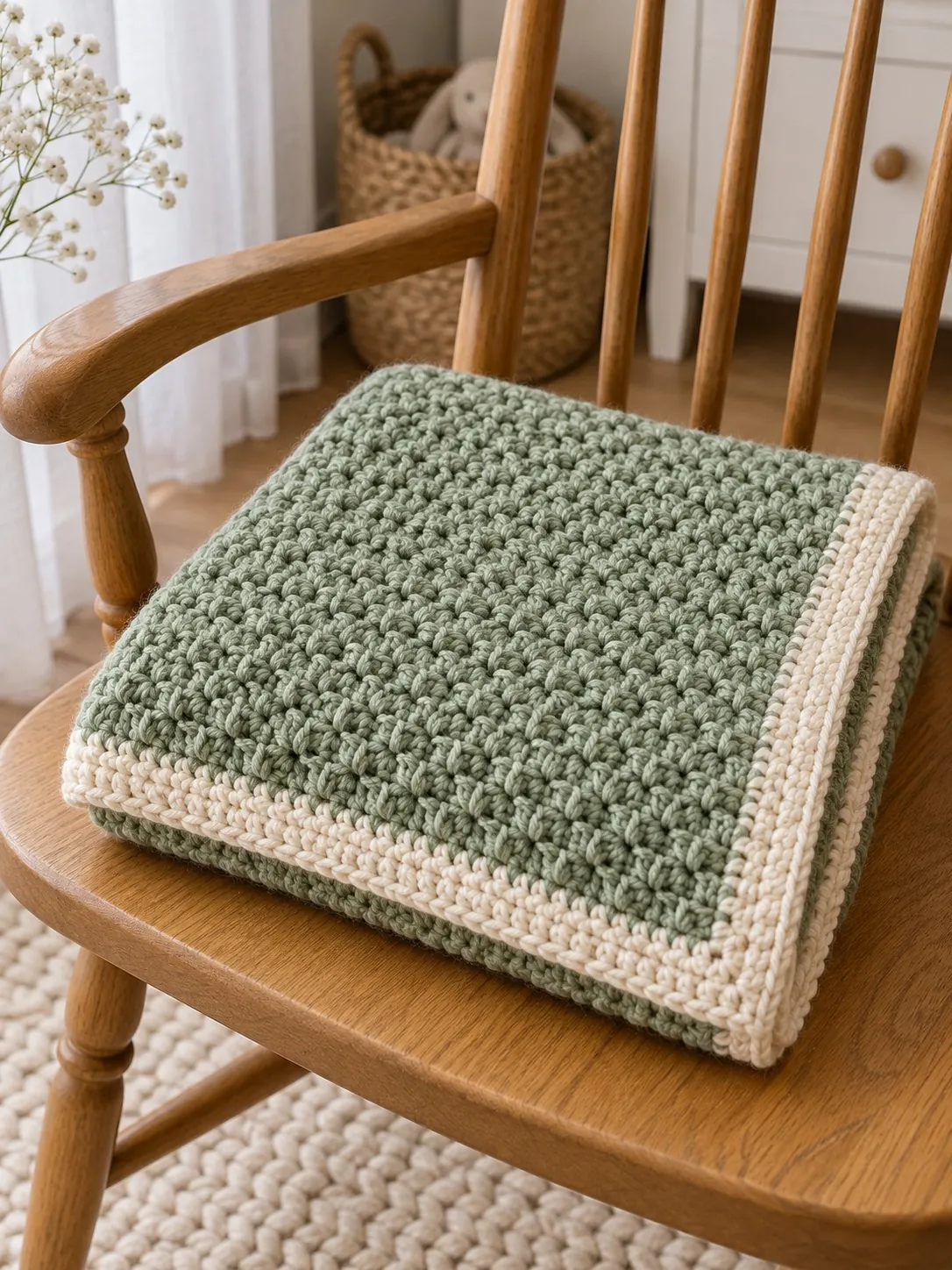
- Sage and oat: gentle, and good when you don’t know if it’s a boy or a girl.
- Dusty blue and ivory: soft next to white nursery furniture.
- Lilac and pale gray: a cool pair for wood floors.
- Terracotta and sand: warmer and earthier than peach.
Before buying, put the two skeins side by side and take a photo in black and white. If they turn into the same gray, the stripes will blur together from across the room. You want one clearly darker than the other.
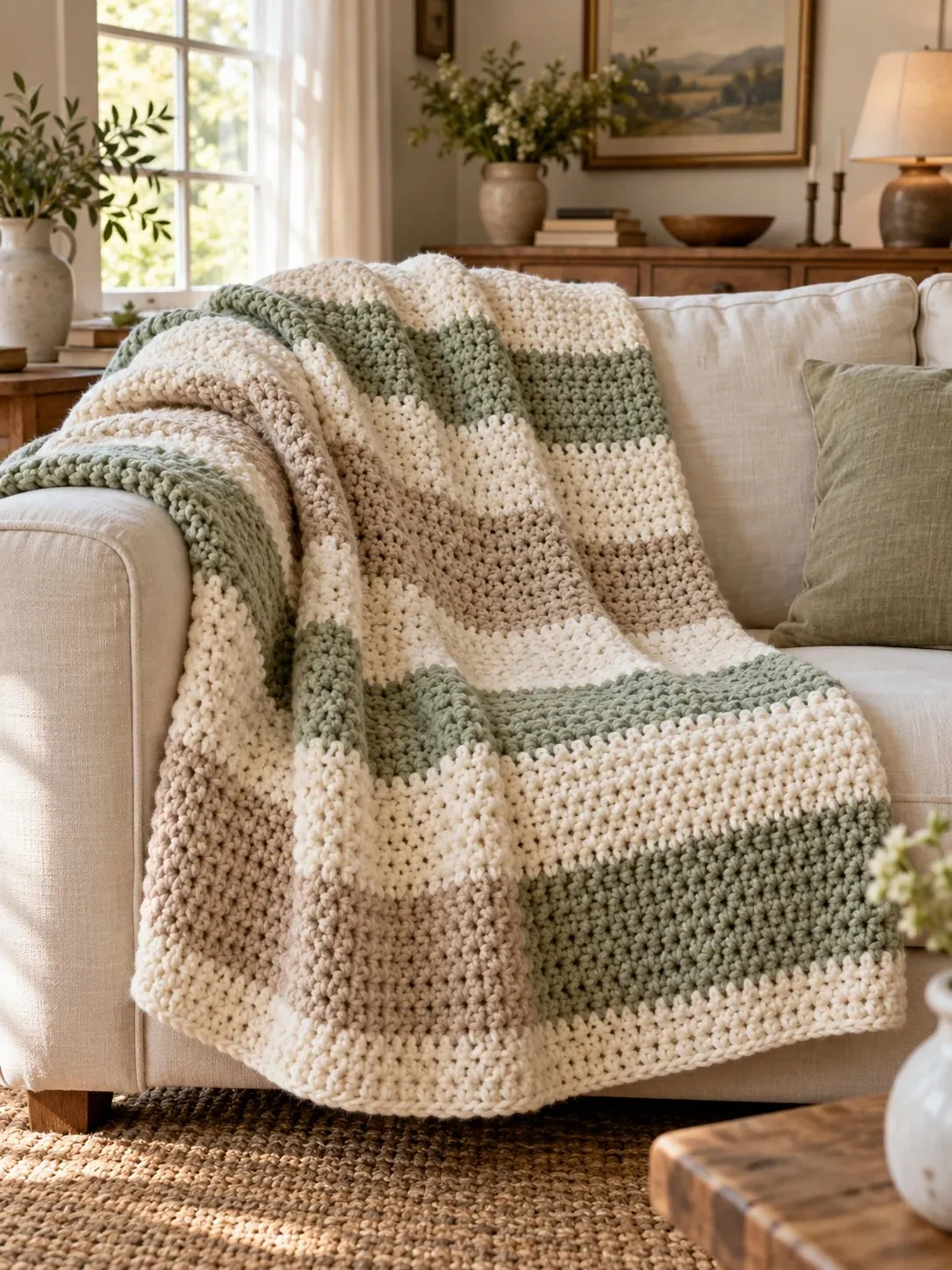
If you love these stripes and want one for the grown-ups, my three-color throw with wide cream, sage and taupe bands uses the same bulky weight with half double crochet.
Maple Lane in lovey, stroller, crib and toddler sizes
The pattern is written for the stroller size. For the others, change the foundation chain and the number of stripes, keeping 12 rows per stripe and an odd number of stripes so peach stays on both ends.
- Lovey, about 13 × 13 in (33 × 33 cm): ch 34 (33 sc), 3 stripes (36 rows). Border Round 1: 146 sc. Yarn: about 100 yd (90 m) of Color A and 50 yd (45 m) of Color B.
- Stroller, about 30 × 37 in (76 × 94 cm): ch 80 (79 sc), 9 stripes (108 rows). Border Round 1: 382 sc. Yarn: about 400 yd (365 m) of Color A and 300 yd (275 m) of Color B. This is the size in the pattern.
- Crib, about 36 × 45 in (91 × 114 cm): ch 96 (95 sc), 11 stripes (132 rows). Border Round 1: 462 sc. Yarn: about 575 yd (525 m) of Color A and 475 yd (435 m) of Color B.
- Toddler, about 42 × 53 in (107 × 135 cm): ch 113 (112 sc), 13 stripes (156 rows). Border Round 1: 544 sc. Yarn: about 775 yd (710 m) of Color A and 650 yd (595 m) of Color B.
The top and bottom edges each take your stitch count plus 4: 3 sc in each corner stitch and 1 sc in every stitch between. Along the foundation chain, that means working into your stitch count minus 2 between the corners (31, 77, 93 or 110). Each side takes 1 sc per row-end, since a single crochet row is about as tall as a stitch is wide. So Round 1 is 2 × (stitches + rows) + 8. For the stroller size, that’s 2 × (79 + 108) + 8 = 382. Round 2 adds 2 sc at each corner, for 154, 390, 470 and 552 sc.
I scaled each color from the stroller size by the number of stitches worked in it (the border counts as peach), then rounded up to the next 25 yd. These are estimates, so buy an extra skein of Color A for the bigger sizes.
A word on safety, because these sizes have baby names. The lovey is for cuddles while your baby is awake and someone’s nearby. The crib size is named for the mattress it fits, not for a sleeping infant: use it for a toddler over 12 months, on the floor for play, over the stroller, or on your lap. Babies under 12 months should sleep with nothing loose in the crib, not a blanket and not a lovey.
Staying at 79 stitches and getting clean color changes
- Watch both ends of the row. The first sc goes right at the base of the ch 1, and the last one hides tight against the edge. A marker in each, moved up every row, keeps you at 79.
- Count by stripe. Count every row of the first stripe. After that, a full count at the end of each stripe catches a mistake before it’s buried.
- Expect all the changes on one edge. Since every stripe has an even number of rows, each new color starts on the same side as Row 1. That edge collects 16 tails from the 8 changes, so weave them in as each stripe ends.
- Weave each tail into its own color. Run a peach tail through peach stitches and a cream tail through cream. A cream tail woven into peach peeks through single crochet.
- Don’t carry the yarn up the side. That leaves 4 in loops along the edge, just right for catching little fingers.
- Let the stripes count the border for you. Down each side, you’ll work 12 sc per stripe. Each color line is a built-in checkpoint, and you’ll reach the corner at 108.
US crochet terms
The pattern
Materials
- Bulky weight yarn (weight 5) in 2 colors, in a soft, machine-washable acrylic or acrylic blend made for babies:
- Color A (peach): about 400 yd (365 m)
- Color B (cream): about 300 yd (275 m)
- Yardage is an estimate with a little extra built in. Yarns vary, so buy one extra skein of Color A if you can.
- 6.5 mm (K-10.5) crochet hook
- Scissors
- Yarn needle
- 2 stitch markers
Gauge
11 sc and 12 rows = 4 in (10 cm) in single crochet.
Gauge isn’t critical for a baby blanket, but it changes the finished size and how much yarn you’ll use. If your square has more stitches than this, try a bigger hook. If it has fewer, try a smaller hook.
Finished size
About 30 × 37 in (76 × 94 cm), including the border. The body measures about 29 × 36 in before the border.
Abbreviations
- ch chain
- sc single crochet
- sl st slip stitch
- st(s) stitch(es)
- rep repeat
Notes
- The ch 1 at the beginning of each row does not count as a stitch. Work your first sc into the very first stitch of the row.
- Place a stitch marker in the first and last stitch of each row, and check that you have 79 sc at the end of every row.
- To change colors: work the last sc of the row until you have 2 loops on your hook. Pick up the new color, yarn over and pull it through both loops. Cut the old color, leaving a 6 in (15 cm) tail.
- Baby blankets get washed often, so weave in every tail securely: about 3 in (8 cm), changing direction once or twice.
- Skip buttons, beads or any small decorations: they aren’t safe for babies.
- For safe sleep, keep loose blankets out of the crib for babies under 12 months.
- Want a different width? Chain any number you like, plus 1. Every 11 sc adds about 4 in (10 cm). The border then changes too: along the foundation chain, work into your stitch count minus 2 between the corners, and Round 1 has 2 × (your stitch count + 108) + 8 sc.
Instructions
Body
- Foundation: With Color A, ch 80.
- Row 1 (A): Sc in the 2nd ch from the hook and in each ch across. Turn. (79 sc)
- Row 2 (A): Ch 1 (does not count as a stitch), sc in each st across. Turn. (79 sc)
- Rows 3–12 (A): Rep Row 2. At the end of Row 12, change to Color B. (79 sc)
- Rows 13–24 (B): Rep Row 2. At the end of Row 24, change to Color A. (79 sc)
- Rows 25–36 (A): Rep Row 2. At the end of Row 36, change to Color B. (79 sc)
- Rows 37–48 (B): Rep Row 2. At the end of Row 48, change to Color A. (79 sc)
- Rows 49–60 (A): Rep Row 2. At the end of Row 60, change to Color B. (79 sc)
- Rows 61–72 (B): Rep Row 2. At the end of Row 72, change to Color A. (79 sc)
- Rows 73–84 (A): Rep Row 2. At the end of Row 84, change to Color B. (79 sc)
- Rows 85–96 (B): Rep Row 2. At the end of Row 96, change to Color A. (79 sc)
- Rows 97–108 (A): Rep Row 2. Do not fasten off. (79 sc)
Border
The border is worked in Color A, in rounds, straight after Row 108.
- Round 1: Ch 1, turn. 3 sc in the first st (corner), sc in each st across to the last st, 3 sc in the last st (corner). Working down the side, sc in each row-end (108 sc along the side). Working along the opposite side of the foundation chain, into the base of the Row 1 stitches: 3 sc in the base of the first stitch (corner), sc in the base of each of the next 77 stitches, 3 sc in the base of the last stitch (corner). The skipped chain at the end of the foundation chain is not worked. Working up the other side, sc in each row-end (108 sc along the side). Sl st in the first sc to join. (382 sc)
- Round 2: Ch 1 (does not count as a stitch), sc in the first st, 3 sc in the next st (the center of the corner), *sc in each st to the next corner center, 3 sc in the corner center; rep from * 2 more times, sc in each remaining st. Sl st in the first sc to join. (390 sc)
Finishing
- Finishing: Fasten off and weave in all remaining ends securely with your yarn needle.
- Blocking (optional): Wash the blanket following the yarn label and let it dry flat. It helps the stripes and edges lie nice and even.
Keeping the cream stripes bright through lots of washing
Check your label first, but most acrylic baby yarns can be machine washed on a gentle cycle with mild detergent. The first time, wash it with light colors only, or add a color catcher sheet, in case the peach releases a little dye onto the cream.
Spit-up shows on the cream stripes first. Rinse it under cold water soon, since hot water sets milk stains.
Tumble dry on low if the label allows it, or lay the blanket flat on a towel. High heat can make acrylic go limp and shiny for good, so skip the hot cycle and never iron it. Fold the blanket for storage rather than hanging it, because bulky single crochet is heavy enough to stretch on a hanger.
After every few washes, run your hands along the border and the color-change edge. If a tail has worked loose, weave it back in before the blanket goes back to the baby.
Questions you might have before starting Maple Lane
Can I give this crochet baby blanket to a newborn?
Yes, as long as it’s used while the baby is awake, like tucked around them in the stroller or spread under them for floor play while you watch. Babies under 12 months shouldn’t have any loose blanket in the crib, so mention that on the gift tag. And leave off buttons or appliqués.
Why is my blanket getting narrower as I go?
You’re losing a stitch at one of the edges, usually the first stitch next to the ch 1 or the tight last stitch. Count the row you’re on. If it’s short, pull the work back to the last row that had 79 and redo it with a marker in the first and last stitches.
Can I make the stripes thinner or wider?
Yes. Keep the same number of rows in every stripe and keep an odd number of stripes, so peach stays on both ends. The border side count always equals your total rows. If your stripes have an odd number of rows, the color changes switch from one edge to the other.
There’s a little bump of the old color at the start of each stripe. What happened?
The color probably changed after the last stitch was finished. Change one step earlier: with 2 loops of the last sc still on your hook, pull the new color through.
Quick recap
- Chain 80 in peach and work 79 sc on every row.
- Change color every 12 rows for 9 stripes, starting and ending with peach.
- Weave in the tails on the color-change edge as each stripe ends.
- Work Border Round 1 in peach for 382 sc, then Round 2 for 390 sc.
- Weave in the last ends, then wash and dry flat if you like.
I hope this crochet baby blanket ends up in a stroller you love, on its way to the park in the spring sun. If you get stuck on a stripe or a corner, send me a note and I’ll help you sort it out.