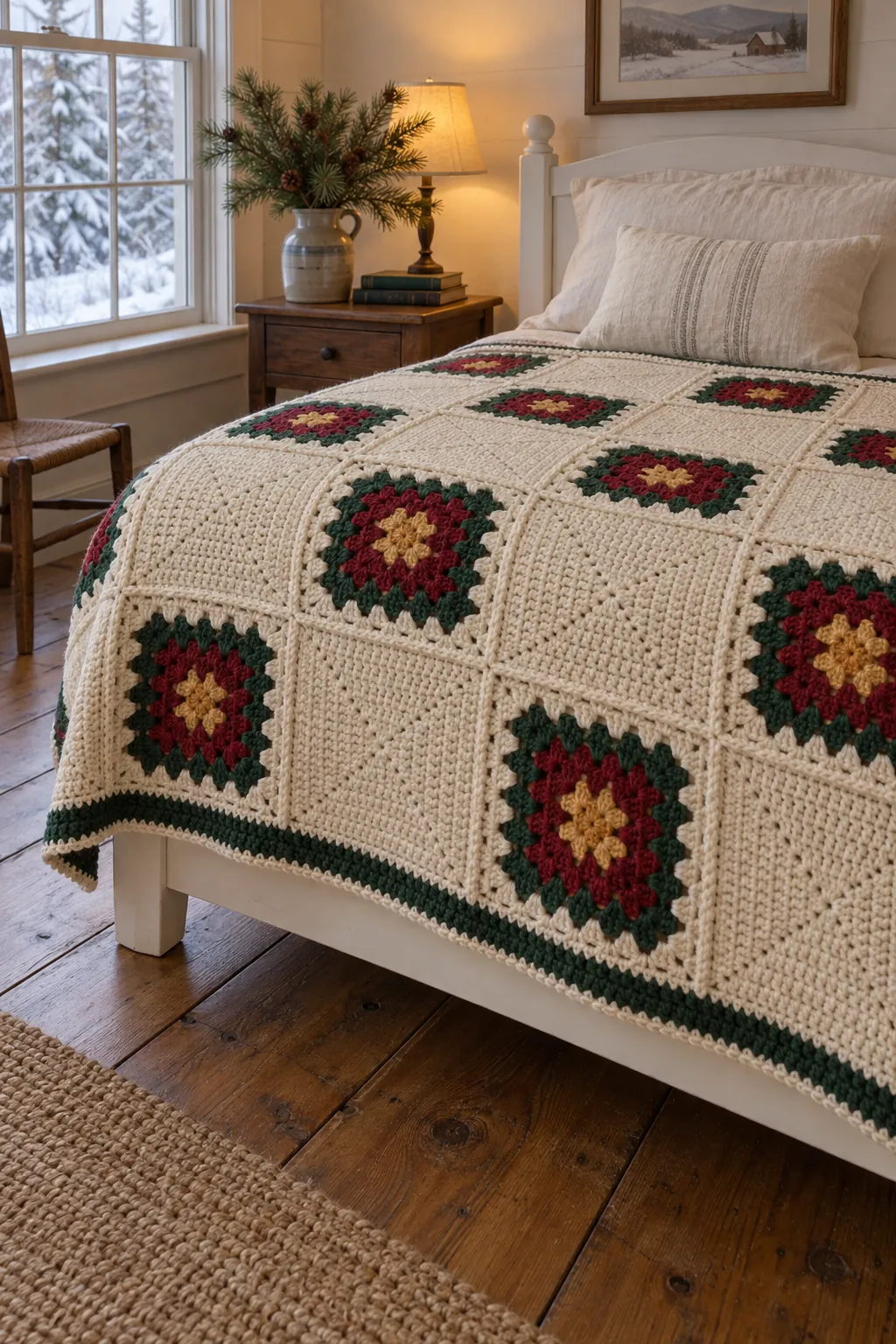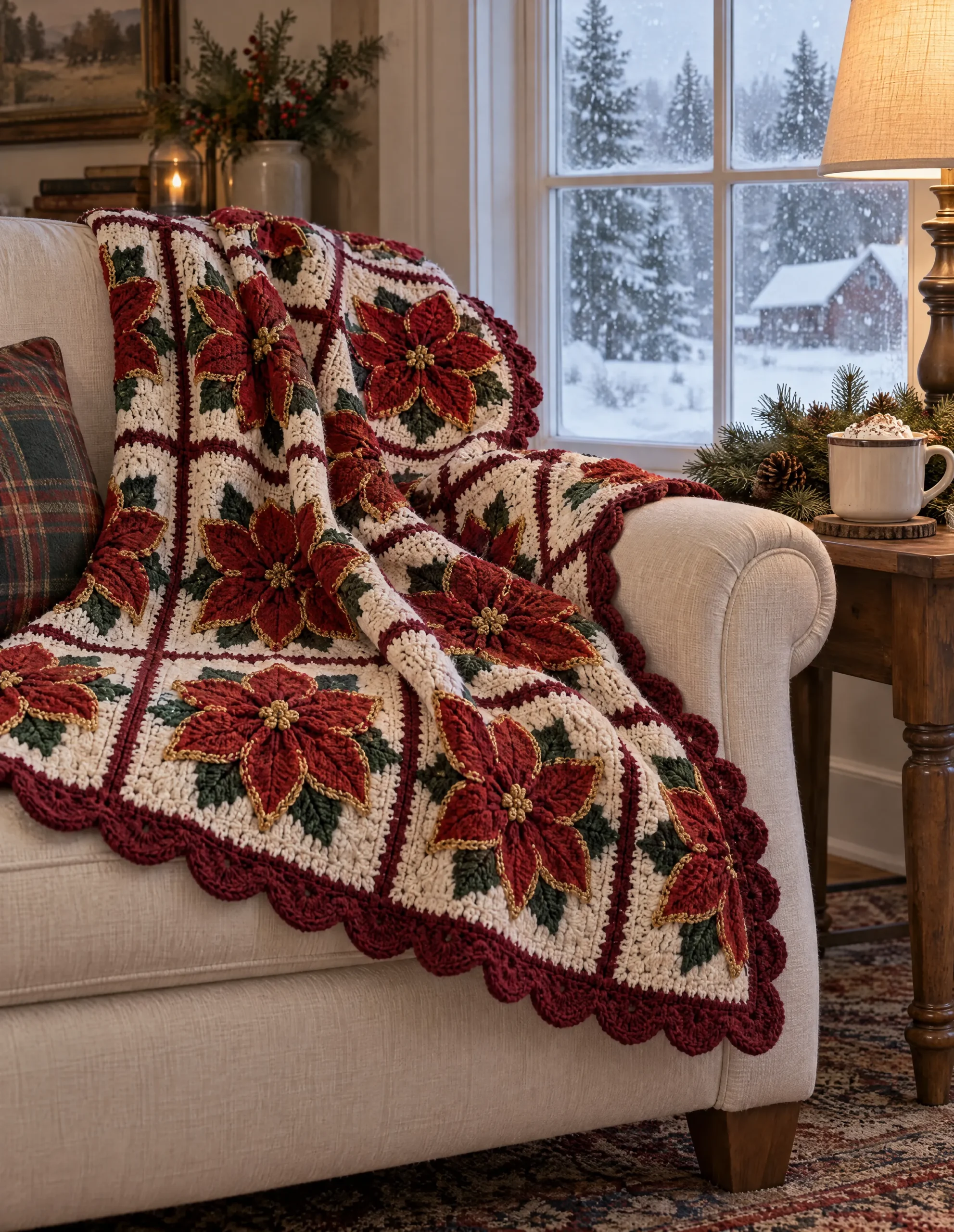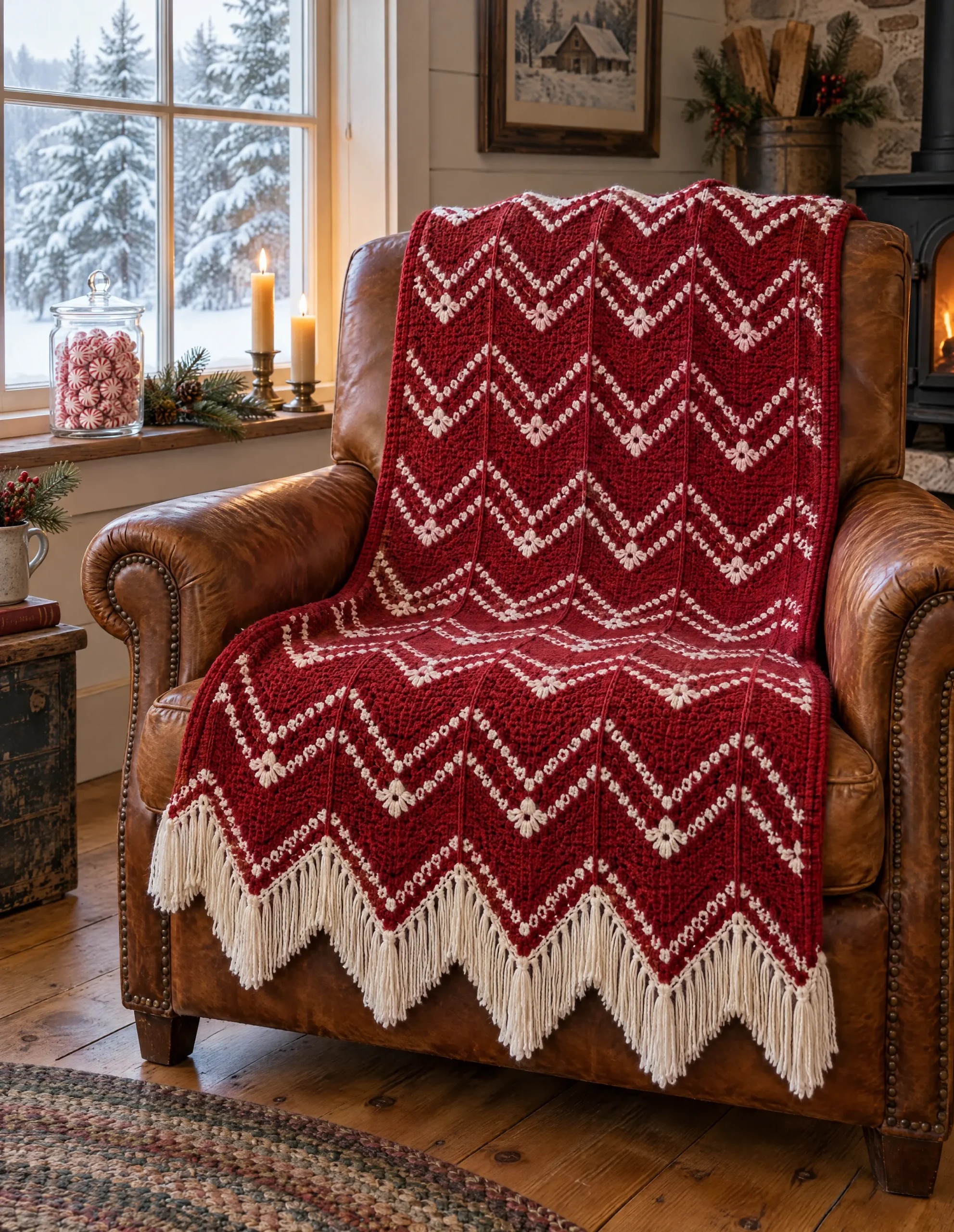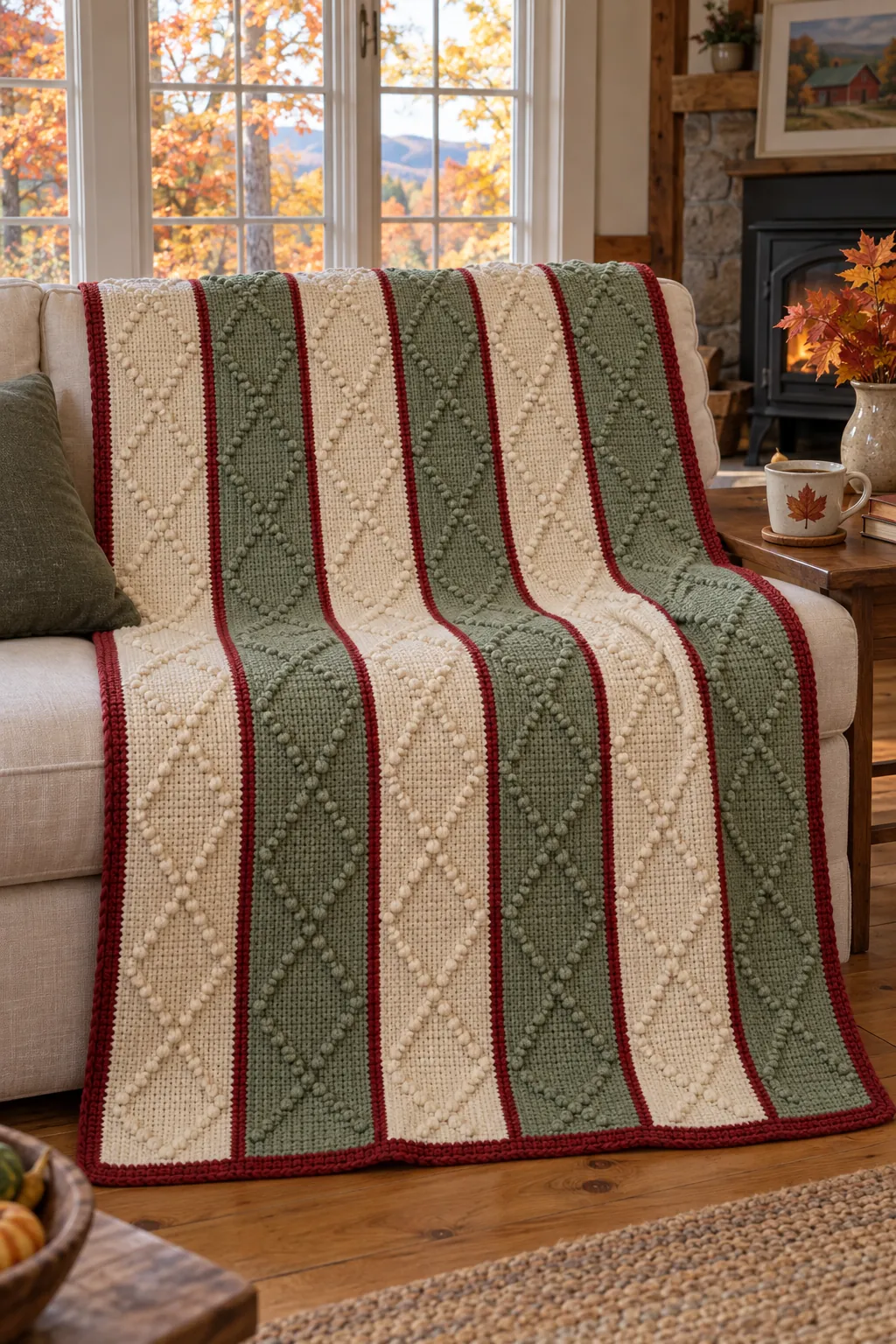
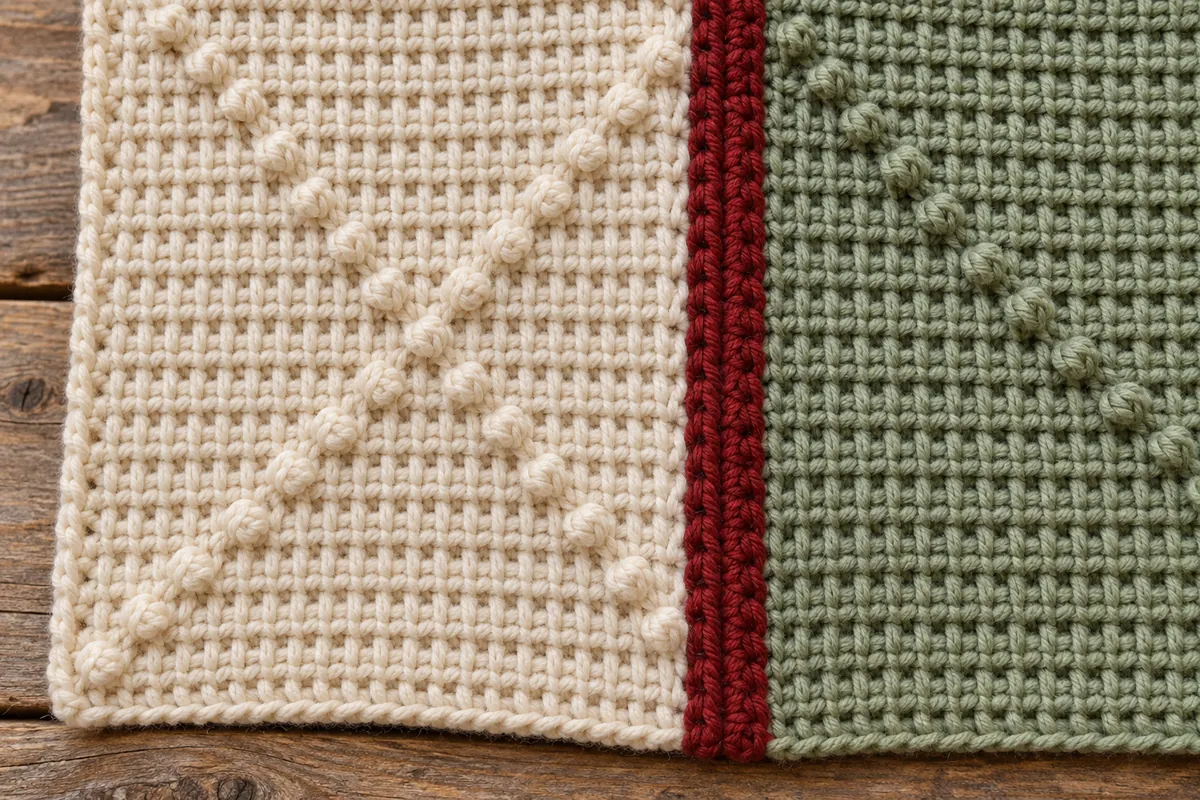
Picture an old covered bridge over a Vermont river, painted barn red, with afternoon light slipping through the crossed timbers inside. The Covered Bridge Afghan borrows that crisscross. It’s a Tunisian crochet blanket made of long cream and sage panels, each one carrying a lattice of raised picots that cross in diamonds from bottom to top, with barn red borders and seams holding everything together like the beams of the bridge.
Tunisian crochet works a little like knitting on one hook: you pick up a row of loops, then work them off again. The fabric is thick, warm and almost woven, which is why the stitch was long called the afghan stitch. Each panel is only 31 stitches wide, so it fits on a standard Tunisian hook. The card gives a throw at about 51 × 62 1/2 in (130 × 159 cm) and a twin at about 67 × 90 in (170 × 229 cm).
Is this Tunisian crochet blanket a good first afghan stitch project?
It’s marked Intermediate. The stitch is easy, but it’s new to many crocheters, and on lattice rows you place picots by counting.
The panels are all Tunisian simple stitch (Tss). Each row has two halves, worked without turning. On the forward pass, you slide the hook under each vertical bar of the row below and pull up a loop, so the loops collect on your hook. On the return pass, you work them off two at a time until one loop is left. The right side always faces you.
The picots are three chains made in the middle of a return pass. They sit on the fabric as small bumps, and on the next forward pass you push each one to the front. The card gives their places as a short line of numbers, such as Return: 6, picot, 6, picot, 6, picot, 6, picot, 6. Each number is how many times you yarn over and draw through 2 loops.
The rest is regular crochet with a 5.0 mm hook: a chain for the foundation, a round of single crochet around each panel, slip stitch seams and a round of half double crochet to finish the edge. If notation like rep from * still slows you down, the Beginner Guide explains how to read a crochet pattern. And if you’d rather build texture with your usual hook first, a waffle-textured blanket worked in post stitches uses only regular crochet.
A smooth worsted yarn for dense afghan stitch panels
Use a smooth worsted weight yarn, the #4 medium on the label, in acrylic or an acrylic-wool blend. Tss makes a dense fabric, and a round, tightly plied yarn gives crisp vertical bars and picots that stand up. Splitty or fuzzy yarns fight you, because the forward pass slides under every bar and catches any loose ply.
Skip 100% cotton for this one. Tunisian fabric is heavy already: the throw weighs roughly 6 lb (2.8 kg) in acrylic and the twin close to 12 lb (5.3 kg). Cotton would add weight and sag in the long panels.
Cream and sage each take 7 [14] skeins of about 350 yd (320 m), so buy each color from a single dye lot and check the lot number on every label.
To substitute, pick a yarn whose label suggests a 5.0 to 5.5 mm crochet hook; you’ll go up to 6.0 mm for the Tunisian part. Work a swatch of 20 Tss over 16 rows, steam it lightly and measure. You need 16 stitches and 14 rows to 4 in (10 cm). Row gauge matters more than usual here, because the length of every panel comes from counting rows. If your swatch has more rows per inch, your panels will come out shorter, so plan an extra lattice repeat or two.
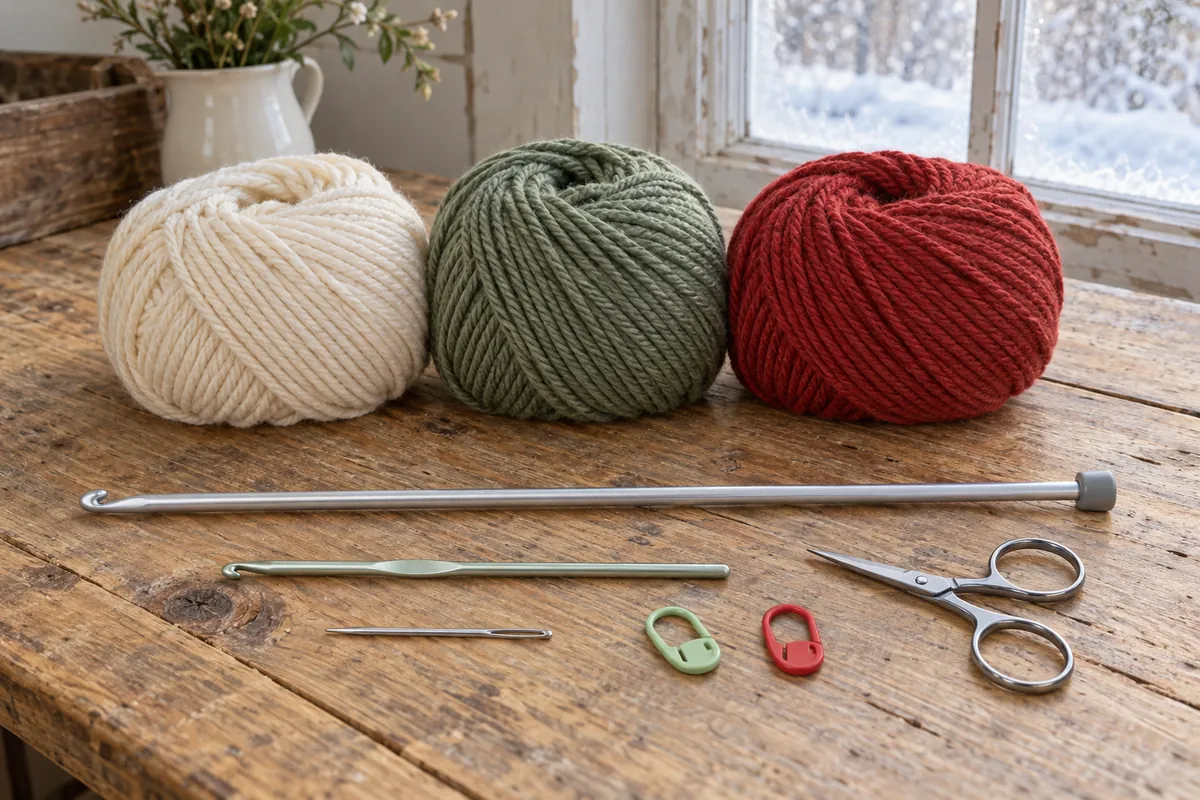
Cream, sage and barn red, and the job each one does
Cream (A) and sage (B) fill the panels and alternate across the blanket. Both are light enough for each picot to cast a small shadow, which makes the lattice readable across a room. Barn red (C) does all the framing: the single crochet round around each panel, the seams and the edging. Each seam shows two red borders side by side, and the outer frame adds two more rounds of edging, like the heavier beams around the edge of a bridge.
With an even number of panels, one long side ends in cream and the other in sage. The card is written that way.
Other palettes that suit the picots: Sugarhouse pairs oatmeal and honey gold panels with a walnut brown frame. Stone Wall uses pale gray and cream with a charcoal frame, for cooler light. Snowbank keeps every panel cream and frames them in spruce green, so the lattice becomes the only pattern.
Keep the panel colors solid or very lightly heathered. Tweeds and variegated yarns break up the picot lines, and the diamonds disappear. Look at your two panel colors together in daylight; if you can’t tell them apart from a few steps away, choose a sage one shade deeper.
Two sizes built from the same 31-stitch panel
Both sizes use the same 31-stitch panel; only the number of panels and their length change. The card is written as Throw [Twin], and all yardage is an estimate.
- Throw, about 51 × 62 1/2 in (130 × 159 cm): 6 panels (3 cream, 3 sage) of 212 rows with 17 lattice repeats; 492 sc in each panel border; edging of 830 sc, then 838 hdc; about 2,350 yd cream, 2,350 yd sage and 375 yd barn red.
- Twin, about 67 × 90 in (170 × 229 cm): 8 panels (4 cream, 4 sage) of 308 rows with 25 lattice repeats; 684 sc in each panel border; edging of 1,154 sc, then 1,162 hdc; about 4,550 yd cream, 4,550 yd sage and 625 yd barn red.
For a custom size, each bordered panel adds about 8 1/4 in (21 cm) of width and each 12-row lattice repeat adds about 3 1/2 in (9 cm) of length. A large throw of about 59 × 73 in, for instance, takes 7 panels with 20 repeats each. The border counts change with any new size, so count your row ends before you start the edging.
Keeping 31 loops straight and every picot in its place
The last stitch of the forward pass is the one that goes missing most often. Slide the hook under both strands of the edge stitch, then count 31 loops before you start back. A panel that loses width almost always skipped it.
Keep the return pass relaxed. Pulling it tight is what makes Tss roll up from the bottom edge. The 6.0 mm hook helps, and so does steaming each panel flat before its border.
On lattice rows, trust the numbers more than the fabric. Every line adds up to 30, and the first and last numbers always match. If the numbers you worked on a row don’t add up to 30, one picot is out of place. Rows 8 and 14 make easy checkpoints, with 6 between every picot and four bumps spaced evenly across.
Clip the second marker into Row 5 of your first repeat and move it up every 12 rows. Counting 17 repeats is far easier than counting 212 rows.
After each lattice row, flick every chain-3 toward you with a fingertip before the forward pass.
Weigh your first finished panel on a kitchen scale. Panels of the same size use the same amount of yarn, so that one number tells you whether the rest of your skeins will cover the blanket.
Before seaming, lay every panel out with Row 1 at the bottom, then work the slip stitches loosely. If a seam ends up shorter than the panels beside it, pull it out and redo it with a lighter hand.
US crochet terms
The pattern
Materials
- Worsted weight yarn (#4 medium), acrylic or acrylic-wool blend, estimated 5,075 [9,725] yd (4,640 [8,890] m) in total:
- A, Cream: 2,350 [4,550] yd (2,150 [4,160] m), about 7 [14] skeins of 350 yd (320 m)
- B, Sage: 2,350 [4,550] yd (2,150 [4,160] m), about 7 [14] skeins of 350 yd (320 m)
- C, Barn Red: 375 [625] yd (345 [570] m), about 2 [2] skeins of 350 yd (320 m)
- 6.0 mm (J-10) Tunisian (afghan) hook, at least 10 in (25 cm) long, or a cabled Tunisian hook
- 5.0 mm (H-8) crochet hook for borders and seams
- Yarn needle
- 2 removable stitch markers
Gauge
16 Tss and 14 rows = 4 in (10 cm) in Tunisian simple stitch with the 6.0 mm Tunisian hook, after light steaming. One panel of 31 sts measures about 7 3/4 in (20 cm) wide before its border.
Finished size
- Throw: about 51 × 62 1/2 in (130 × 159 cm), 6 panels
- Twin: about 67 × 90 in (170 × 229 cm), 8 panels
- Measured after blocking. Each bordered panel is about 8 1/4 in (21 cm) wide.
Abbreviations
- ch chain
- hdc half double crochet
- lp(s) loop(s)
- rep repeat
- RS right side
- sc single crochet
- sk skip
- sl st slip stitch
- st(s) stitch(es)
- Tss Tunisian simple stitch
- yo yarn over
Notes
- Sizes are written as Throw [Twin]. A number given once applies to both sizes.
- Stitch multiple: every panel is a fixed 31 sts, with the lattice centered on st 16, so the foundation chain is 31 for both sizes. To resize, change the number of panels (each about 8 1/4 in wide with its border) or the number of lattice repeats (each about 3 1/2 in long). Give every panel the same number of rows.
- Tss rows are worked with the RS facing, without turning. Each row has a forward pass and a return pass.
- Forward pass: sk the first vertical bar, *insert hook from right to left under the next vertical bar, yo, pull up a lp; rep from * across, working the last st under both strands of the edge st. (31 lps on hook)
- Return pass: yo, draw through 1 lp, *yo, draw through 2 lps; rep from * until 1 lp remains.
- Turning chain: Tss rows have no turning chain. The lp left on the hook after a return pass counts as the first st of the next row. In the border and edging rounds, ch 1 at the start does not count as a st.
- Picot: at the point given in a return pass, ch 3 (yo and draw through the lp on hook 3 times), then go on with the return pass. On the next forward pass, push each ch-3 to the RS before picking up the bars beside it. Picots never change the st count.
- Lattice rows are written in short form. “Return: 3, picot, 12” means: yo, draw through 1 lp, [yo, draw through 2 lps] 3 times, picot, [yo, draw through 2 lps] 12 times, and so on. The numbers on each row add up to 30, and the first and last numbers always match.
- Place one marker on the RS of Row 1 to mark the bottom edge, and keep Row 1 at the bottom of every panel when joining.
Instructions
Panels (make 3 [4] in A and 3 [4] in B)
- Foundation: With the 6.0 mm Tunisian hook, ch 31.
- Row 1: Insert hook in 2nd ch from hook, yo, pull up a lp, *insert hook in next ch, yo, pull up a lp; rep from * across (31 lps on hook). Work a return pass. (31 Tss)
- Rows 2–4: Tss. (31 Tss)
- Row 5: Forward pass. Return: 3, picot, 12, picot, 12, picot, 3. (31 Tss, 3 picots)
- Row 6: Forward pass. Return: 4, picot, 10, picot, 2, picot, 10, picot, 4. (31 Tss, 4 picots)
- Row 7: Forward pass. Return: 5, picot, 8, picot, 4, picot, 8, picot, 5. (31 Tss, 4 picots)
- Row 8: Forward pass. Return: 6, picot, 6, picot, 6, picot, 6, picot, 6. (31 Tss, 4 picots)
- Row 9: Forward pass. Return: 7, picot, 4, picot, 8, picot, 4, picot, 7. (31 Tss, 4 picots)
- Row 10: Forward pass. Return: 8, picot, 2, picot, 10, picot, 2, picot, 8. (31 Tss, 4 picots)
- Row 11: Forward pass. Return: 9, picot, 12, picot, 9. (31 Tss, 2 picots)
- Row 12: Work as Row 10. (31 Tss, 4 picots)
- Row 13: Work as Row 9. (31 Tss, 4 picots)
- Row 14: Work as Row 8. (31 Tss, 4 picots)
- Row 15: Work as Row 7. (31 Tss, 4 picots)
- Row 16: Work as Row 6. (31 Tss, 4 picots)
- Rows 17–208 [17–304]: Rep Rows 5–16 another 16 [24] times, for 17 [25] lattice repeats in all. The panel measures about 59 1/2 [87] in. (31 Tss)
- Row 209 [305]: Work as Row 5. (31 Tss, 3 picots)
- Rows 210–212 [306–308]: Tss. (31 Tss)
- Bind-off row: Sk the first vertical bar, *insert hook under the next vertical bar, yo, draw through the bar and the lp on hook; rep from * across, working the last st under both strands of the edge st. Fasten off. (30 sl sts)
- Blocking: Pin each panel flat to about 7 3/4 × 60 1/2 [88] in and steam lightly, holding the iron above the yarn. Let it cool and dry before the border.
Panel border (all panels)
- Round 1: With RS facing, the 5.0 mm hook and C, join with sc in the top right corner (above the edge st where the bind-off row began), 2 more sc in the same place, sc in each of the next 29 sl sts, 3 sc in the last sl st; working down the side, sc in the end of each row from Row 212 [308] to Row 2; working in the unused lps of the foundation ch, 3 sc in the first ch, sc in each of the next 29 ch, 3 sc in the last ch; working up the side, sc in the end of each row from Row 2 to Row 212 [308]; join with sl st to first sc. Fasten off. (492 [684] sc: 29 on each short edge and 211 [307] on each long edge between corners, plus 3 in each corner)
Joining
- Layout: Lay the panels RS up with Row 1 at the bottom, alternating colors: A, B, A, B, A, B [A, B, A, B, A, B, A, B].
- Seams: Place two neighboring panels RS together with their edges matched. With the 5.0 mm hook and C, join with sl st through the outer lps (the back lps) of the center sc of the top corners of both panels, then sl st loosely through the outer lps of each matching pair of sts along the long edge, ending in the center sc of the bottom corners. Fasten off. (215 [311] sl sts)
- Rep the seam until all panels are joined. (5 [7] seams)
Edging
- Round 1: With RS facing, the 5.0 mm hook and C, join with sc in the center sc of the top right corner of the blanket, 2 more sc in the same st, *sc in each st across to the center sc of the next corner of the blanket, 3 sc in that st; rep from * twice more, sc in each remaining st, working 1 sc in each of the two corner sts at every seam; join with sl st to first sc. (830 [1,154] sc: 196 [262] between corners on the top and bottom edges, 213 [309] on each side, 3 in each corner)
- Round 2: Ch 1, hdc in the same st as the join, 3 hdc in the next sc, *hdc in each sc across to the center sc of the next corner, 3 hdc in that sc; rep from * twice more, hdc in each remaining sc; join with sl st to first hdc. Fasten off. (838 [1,162] hdc: 198 [264] between corners on the top and bottom edges, 215 [311] on each side, 3 in each corner)
- Finishing: Weave in all ends along the red borders, then steam the edging lightly so it lies flat.
Caring for a heavy afghan stitch blanket with red seams
Barn red is the color to watch. Before the first wash, dampen a corner of the red edging and press it with a white paper towel. If any color comes off, wash the blanket on its own in cold water with a color catcher sheet.
An acrylic version goes in the machine on a gentle cold cycle. The twin is very heavy when wet, so use a large front-loader or a laundromat machine. Tumble dry on low and take it out while it’s still slightly damp, then lay it flat to finish.
For an acrylic-wool blend, use the wool cycle or hand wash in cool water. Roll the blanket in towels to press the water out, never wring it, and dry it flat across two racks.
Never hang this afghan from a line, a peg or a hanger. Its weight pulls the long panels and stretches the seams. Store it folded on a shelf, and keep it away from hook-and-loop fasteners and cat claws. If a picot gets pulled, ease the extra yarn back along its row with a yarn needle.
Covered Bridge Afghan questions
Do I need a special hook for this Tunisian crochet blanket?
Yes. A Tunisian, or afghan, hook is long with a stopper at the end, because it holds all 31 loops of the forward pass. A straight 10 in (25 cm) hook is enough for these panels, and a cabled Tunisian hook is easier on the wrists. You’ll still need a regular 5.0 mm hook for the borders and seams.
Why do my panels curl up at the bottom, and will they flatten?
Tunisian simple stitch naturally rolls toward the right side, most of all along the foundation chain. Pin each panel flat, steam it with the iron held above the yarn and let it cool before the border. After that, the barn red border and the seams keep the panels flat.
How do I rescue a picot that slipped to the wrong side of a panel?
It happens when the chain-3 isn’t pushed to the front before the next forward pass, so the hook traps it behind the bar. You can often coax it through to the right side with the tip of a small crochet hook. On the next panel, check the right side after every lattice row.
Will the diamonds line up from one panel to the next?
Yes, as long as every panel has the same number of rows and lies with Row 1 at the bottom. The outer picot lines run close to the panel edges, so the half diamonds on two neighboring panels meet across the red seam and read as one continuous lattice.
Can I skip the sage and make every panel cream?
Yes, or all sage if you prefer. Add the two panel amounts together: about 4,700 yd for the throw and 9,100 yd for the twin, with the barn red unchanged. A single panel color leaves the picot lattice as the only pattern.
Quick recap
- Chain 31 with the 6.0 mm Tunisian hook and work 4 plain rows of Tss.
- Work the 12-row picot lattice 17 [25] times, add one more Row 5 and 3 plain rows, then bind off.
- Make 3 [4] panels in cream and 3 [4] in sage, and steam each one flat.
- Work a barn red sc round around every panel, then slip stitch the panels together in alternating colors.
- Finish with a round of sc and a round of hdc in barn red around the whole blanket.
When the last round is done, spread the Covered Bridge Afghan across the bed and look at it in low evening light, when every picot throws a small shadow. If a count in this Tunisian crochet blanket doesn’t match what’s on your hook, or a picot line won’t meet its neighbor, send a note through the Contact page.