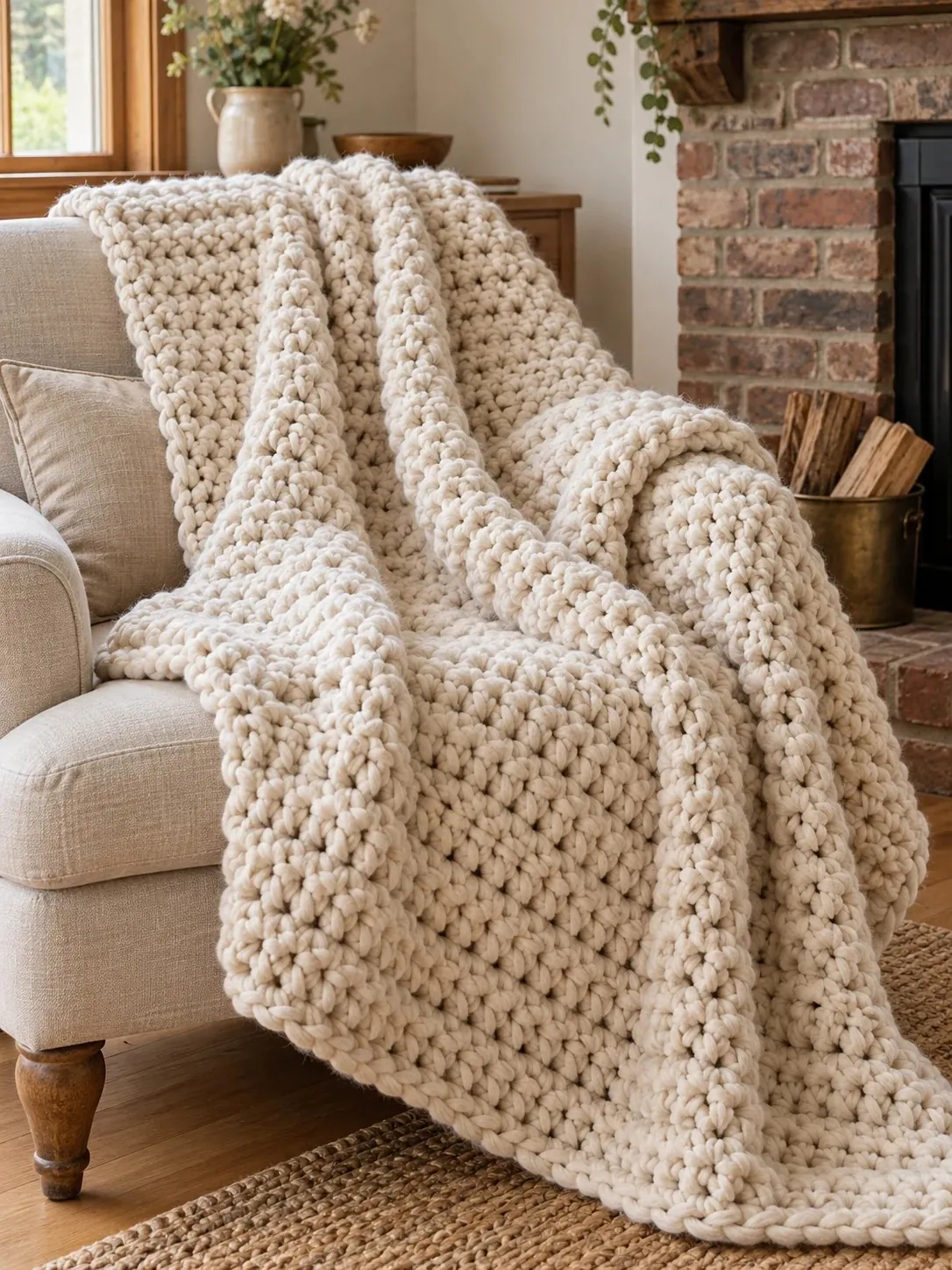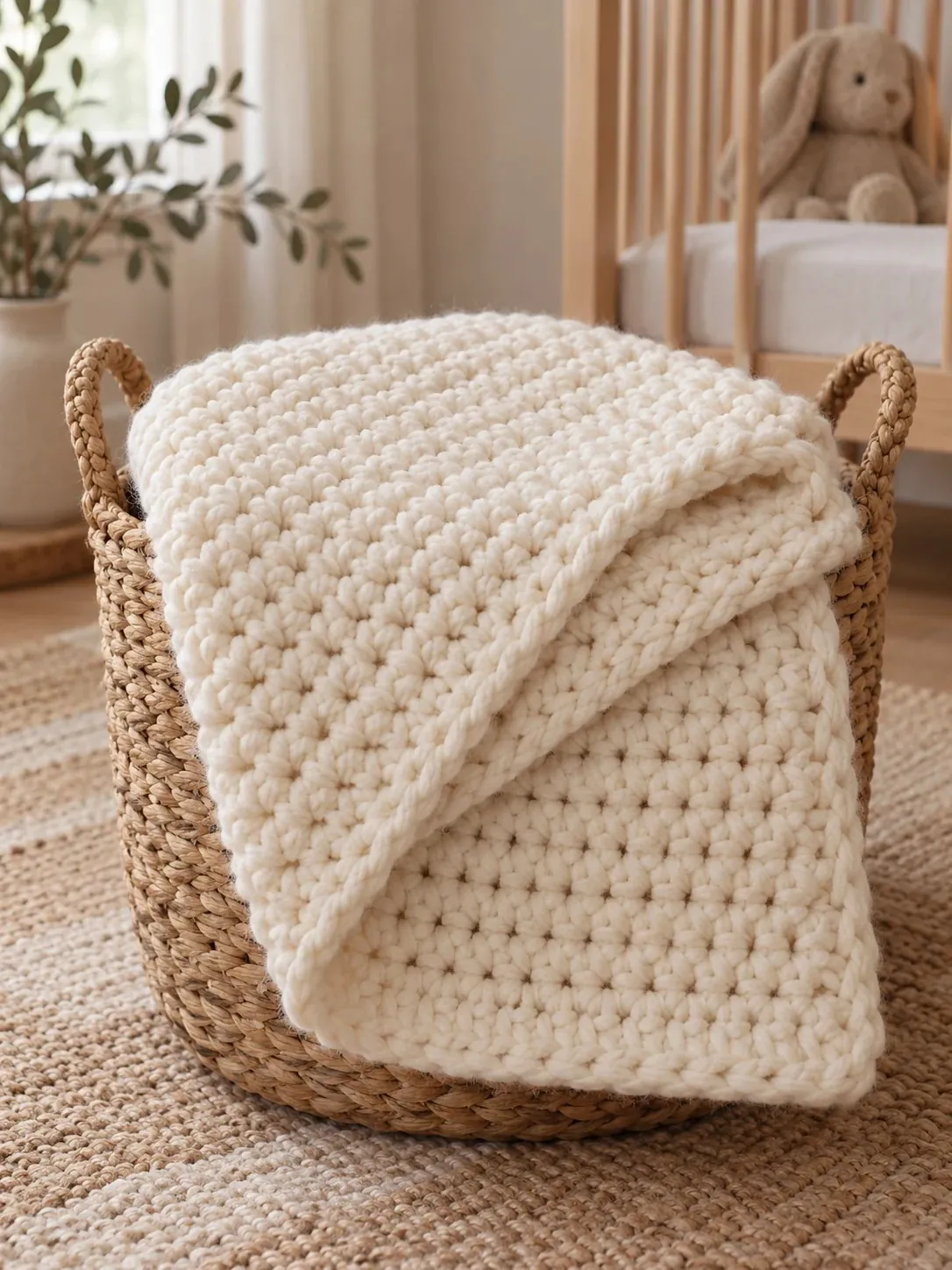
The first frost usually reaches my garden in late September, and every year it catches my tomatoes off guard. That white, crunchy morning is the color of this blanket. First Frost is a super bulky baby blanket crochet pattern in one shade of cream, made with nothing but rows of single crochet and a single round of border. On a 9 mm hook the rows pile up fast, so a stroller-size blanket fits into a long weekend instead of a whole season.
Thick yarn gives you a plump, cushy fabric that holds warmth on a cold walk and folds into a soft stack in a nursery basket. The pattern is written for about 30 × 36 in (76 × 91 cm), and three more sizes follow, from a small lovey to a play mat for the floor.
One stitch, one color: is this super bulky baby blanket crochet pattern for you?
If you can make a chain and a single crochet, you can make this blanket. The body is 59 chains, then 79 rows of 58 single crochets. No color changes, no repeat to track.
The only other stitch is the slip stitch that closes the border round. Push your hook into the first stitch of the round, catch the yarn, and draw it through the stitch and the loop on your hook together. Done.
The border itself may be new to you. It runs all the way around the blanket, so along the sides you work into the row-ends, the bumpy edges where each row turns. You place one single crochet in each of them. At each corner, three single crochets go into one stitch, which lets the edge turn flat instead of cupping.
Big yarn is a real help when you’re learning. You can see the two loops on top of every stitch without squinting, and a missed stitch shows right away as a dip in the edge. The catch is tension: super bulky yarn pulled tight turns stiff. Keep your loops loose enough that the hook slides through them easily.
If short forms like sc and sl st still look like a code, the Beginner Guide spends a section decoding the abbreviations in a pattern, and every one used here is listed in the card.
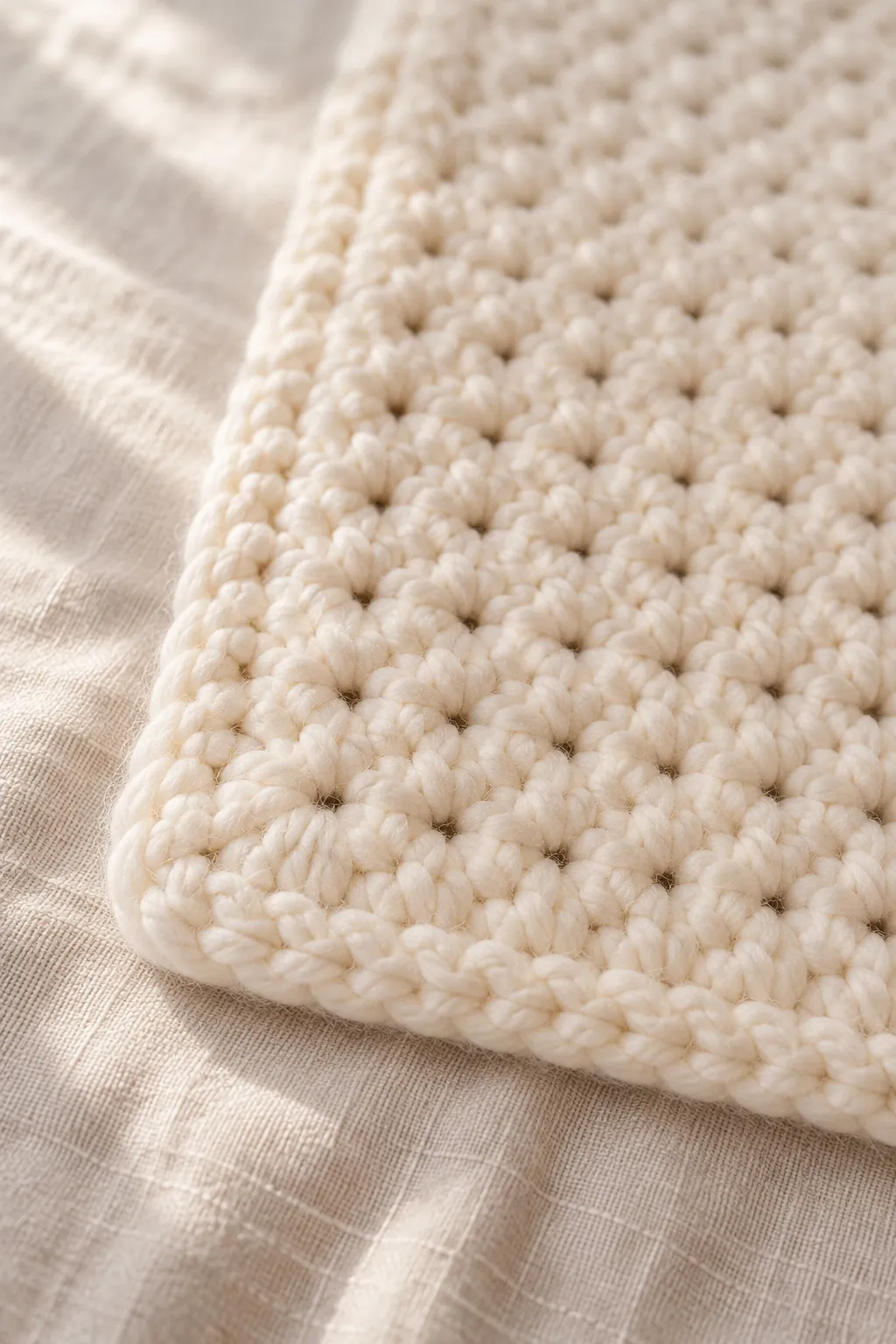
A #6 yarn that stays soft and washable for a baby
Check the label for the number 6 and the words “super bulky.” Most of these labels suggest a hook of 9 mm or larger, and 9 mm (US M/N-13) is what gives the dense, little-holed fabric you see in the photo. A bigger hook opens up those holes, and small fingers love to poke into holes.
For a baby, choose a soft acrylic or a superwash wool blend that the label says can go in the washing machine. Skip loosely spun roving that pulls apart when you tug it, and anything fuzzy that sheds: it pills under busy hands and leaves fibers where a baby can put them in their mouth. Plush chenille “blanket” yarns also carry a 6 and are popular for baby gifts. They hide the tops of the stitches, though, and work up at a different gauge, so swatch carefully if you go that way.
Cream is trickier to match than it looks. One dye lot can lean yellow and the next one a little gray, and in a one-color blanket that change shows up as a stripe you never planned. So buy all 650 yd in one trip, and compare the lot numbers printed on the bands before you leave the store.
Weight 6 skeins come in very different lengths, from about 50 yd to well over 100 yd. The yardage on the band is what matters: divide 650 yd by the length of one skein and round up. With 100 yd skeins, that’s 7.
Bulky (#5) yarn is not a direct swap. The same 58 stitches would come out several inches narrower. If bulky is what you have, my striped Maple Lane blanket in peach and cream is written for it.
The swatch in the pattern card takes about 15 minutes in this yarn, and it decides the width. At 9 stitches over 4 in instead of 8, the body shrinks from 29 in to about 26 in.
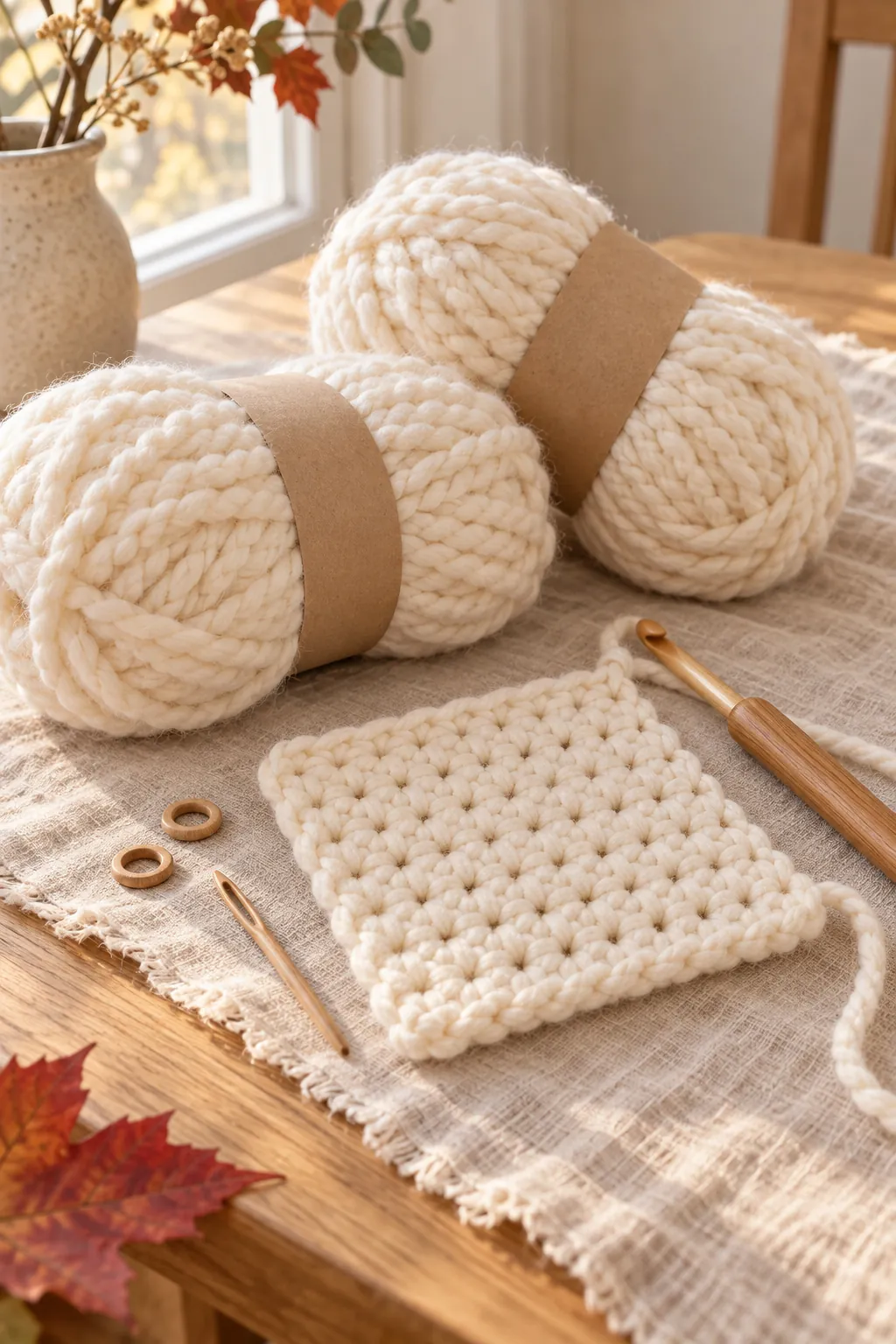
Frost white, and other single shades for big single crochet
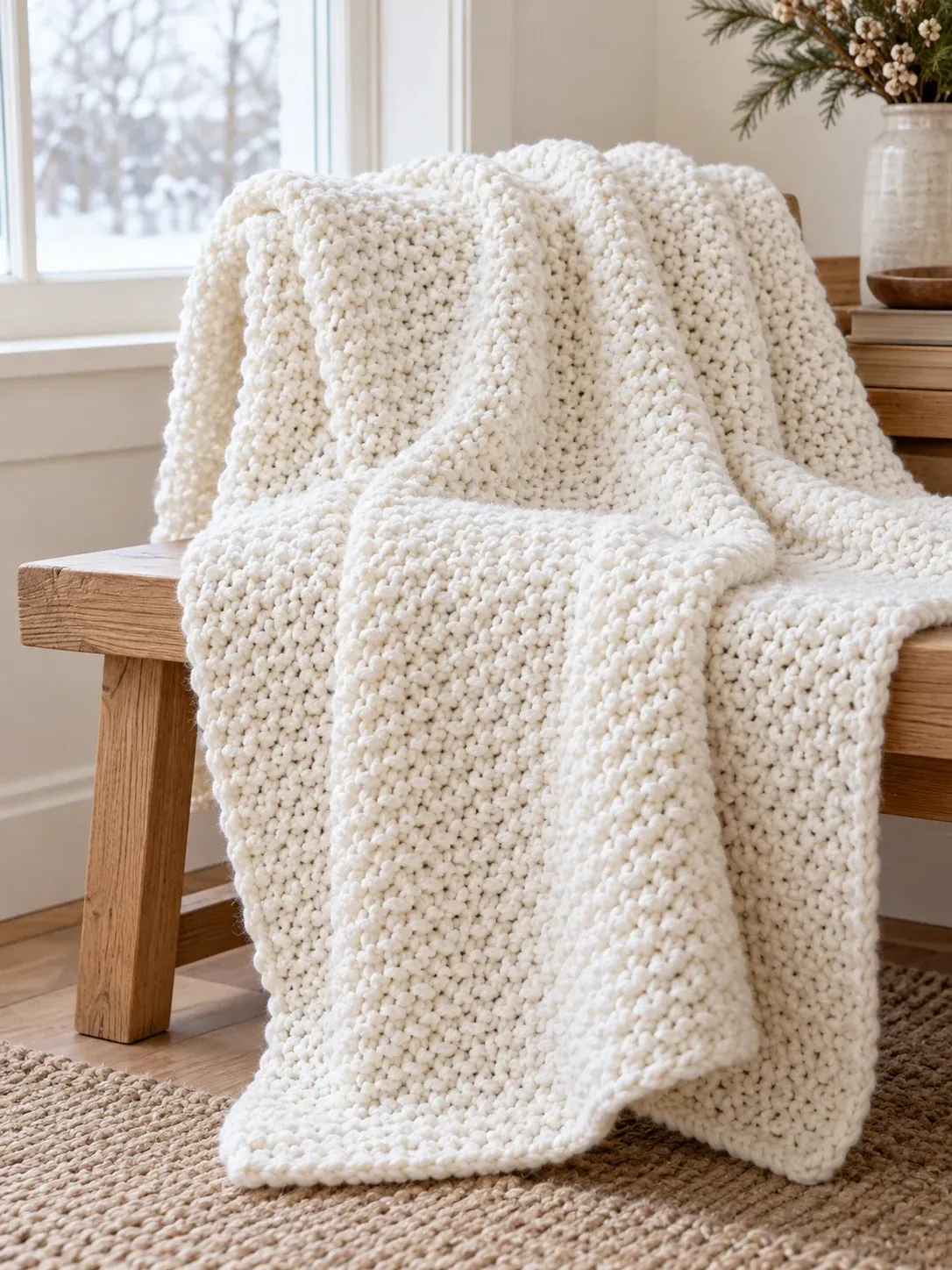
With only one color, the texture does all the work. Single crochet in thick yarn makes a grid of tiny holes between the stitches, and light shades catch the shadow in each hole. Dark yarn swallows that dotted look. A few shades I’d use:
- First Frost: warm cream, as in the photo.
- Birch bark: pale oatmeal with a light heather, which forgives small marks.
- Morning fog: soft dove gray, good for a nursery with white furniture.
- Lichen: a muted gray-green.
- Cider: light caramel, cozy against a wooden crib or stroller.
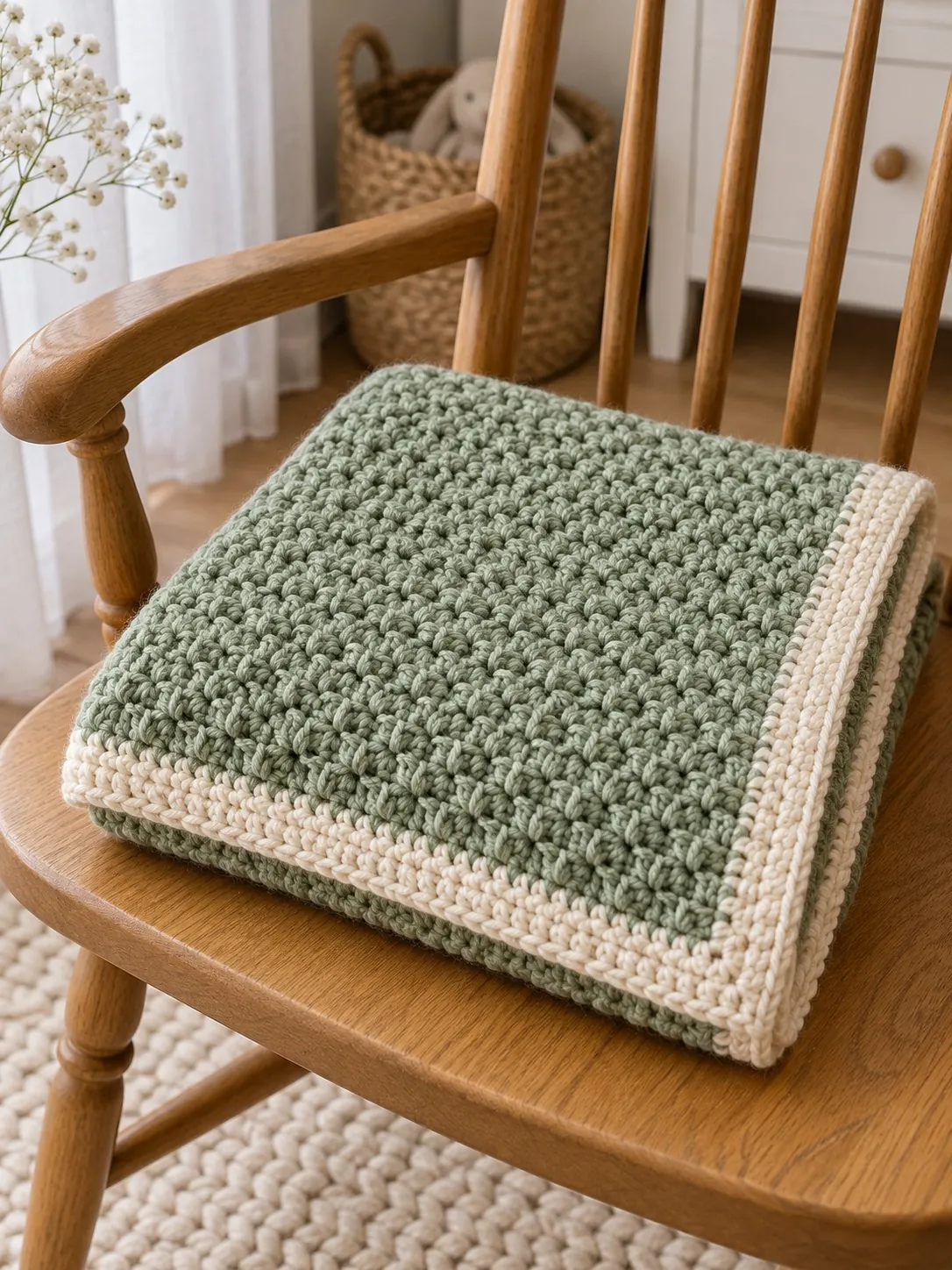
Pure bright white shows every drip of milk, so for a gift that will see daily use, a cream or oatmeal is kinder to the parents. If you want an outline, work the border round in a second color. It only takes about 40 yd (37 m).
First Frost in four sizes, from lovey to play mat
The four sizes share one gauge, 8 sc and 9 rows over 4 in, and one rule: chain one more than the stitches you want. The border round always has 2 × stitches + 2 × rows + 8 sc. The card covers the stroller size. My yardage figures are estimates with roughly 10% spare, rounded up to the next 25 yd.
- Lovey, about 16 × 16 in (41 × 41 cm): ch 31, 30 sts, 34 rows; border 136 sc; about 150 yd (137 m).
- Stroller, about 30 × 36 in (76 × 91 cm), the size in the card: ch 59, 58 sts, 79 rows; border 282 sc; about 650 yd (594 m).
- Toddler, about 36 × 45 in (91 × 114 cm): ch 71, 70 sts, 99 rows; border 346 sc; about 950 yd (869 m).
- Play mat, about 42 × 52 in (106 × 132 cm): ch 83, 82 sts, 115 rows; border 402 sc; about 1,275 yd (1,166 m).
Super bulky blankets get heavy as they grow. Keep the toddler size for children past their first birthday, and use the play mat as a soft spot on the floor while you’re watching, never as a cover. If you’d like the same yarn weight in a size for your own couch, the ivory half double crochet throw I keep by the fireplace is a good next project.
Keeping 58 stitches and square corners in thick yarn
- Chain on the 10 mm hook. Super bulky yarn chains tighter than the rows that follow, so the bottom edge can end up narrower than the top. Make the 59 chains with the bigger hook, then pick up the 9 mm for Row 1.
- Find the first stitch right under the ch 1. The ch 1 doesn’t count. Your first sc goes into the stitch at its base. In this yarn it looks like a big loop off to the side, and it’s easy to skip.
- Watch the last stitch too. The final sc of a row tends to roll toward the back. Clip a marker into the first and last sc of each row and move them up as you go.
- Count in pairs. Twenty-nine pairs make 58, and pairs are quicker to count than single stitches.
- Lay it flat at Row 18. It should measure 8 in (20 cm) from the chain. Shorter means your stitches are tightening, which often happens as the blanket gets heavier in your lap.
- Plan for skein joins. You’ll join about six new skeins. Do it at the end of a row and leave 6 in (15 cm) tails. Super bulky tails are thick, so weave each one through at least two directions with a large-eye needle.
US crochet terms
The pattern
Materials
- Yarn: super bulky (#6) yarn in a soft, machine-washable acrylic or superwash wool blend, cream, about 650 yd (594 m) in total, all from one dye lot (for example, 7 skeins of about 100 yd / 91 m each). Yardage is an estimate.
- Hook: 9 mm (US M/N-13)
- Optional: 10 mm (US N/P-15) hook for the foundation chain
- Large-eye yarn needle, 2 stitch markers, scissors, measuring tape
Gauge
- 8 sc and 9 rows = 4 in (10 cm) in single crochet
- Swatch: ch 13. Sc in 2nd ch from hook and in each ch across (12 sc). Ch 1, turn, sc in each st across (12 sc). Work 14 rows in total, about 6 in (15 cm) square, and measure 4 in (10 cm) across the middle.
- More than 8 sc in 4 in: go up a hook size. Fewer: go down one.
Finished size
- About 30 × 36 in (76 × 91 cm) with the border, before blocking
- Body before the border: about 29 × 35 in (74 × 89 cm)
Abbreviations
- ch chain
- sc single crochet
- sl st slip stitch
- st(s) stitch(es)
- yo yarn over
- rep repeat
Notes
- The ch 1 at the start of each row does not count as a st. Work the first sc into the first st of the row, at the base of the ch 1.
- Every body row has 58 sc. Place a stitch marker in the first and last sc of each row.
- Join a new skein at the end of a row: work the last sc until 2 loops remain on the hook, yo with the new yarn and pull it through both loops. Leave 6 in (15 cm) tails and weave them in later.
- Border corners: 3 sc in the same st.
- Border sides: 1 sc in the end of each row. If a side ruffles, skip 1 row end about every 8 rows; the round will then have fewer sc than the count given.
- Safety: this blanket is for awake time (stroller, lap, supervised floor play). Never use a loose blanket for sleep with a baby under 12 months, and never cover a baby’s face or head. No buttons or small trims; weave in every end securely.
- To change the size: chain any number; the body has 1 st fewer than the chain. With this gauge, 2 sts add about 1 in (2.5 cm) of width and 9 rows add about 4 in (10 cm) of length. Border Round 1 has 2 × sts + 2 × rows + 8 sc.
Instructions
Body
- Foundation: Loosely ch 59.
- Row 1: Sc in 2nd ch from hook and in each ch across. (58 sc)
- Row 2: Ch 1, turn. Sc in each st across. (58 sc)
- Rows 3–79: Rep Row 2. (79 rows; body measures about 29 × 35 in / 74 × 89 cm)
- Do not fasten off.
Border
- Round 1: Ch 1, turn. Working across Row 79: 3 sc in first st (corner), sc in each of next 56 sts, 3 sc in last st (corner). Working down the side: sc in the end of each row (79 sc). Working into the opposite side of the foundation chain (the chains that hold the Row 1 sts; the single extra ch at one end stays empty): 3 sc in first ch (corner), sc in each of next 56 ch, 3 sc in last ch (corner). Working up the other side: sc in the end of each row (79 sc). Join with sl st to first sc. (282 sc: 62 across top and bottom, corners included, and 79 along each side)
- Finishing: Fasten off and weave in all ends securely, going in at least two directions.
Washing a thick cream blanket without stretching it
Read the label first, since care depends on the fiber. Most acrylic super bulky yarns go in the machine on a cold, gentle cycle. Put the blanket in a large mesh bag or a zipped pillowcase so the big loops don’t snag on the drum. A superwash wool blend usually wants the wool cycle and a mild wool wash.
Wet super bulky yarn holds a lot of water and gets heavy fast. Never hang it on a line or over a door: the weight drags the rows longer and they don’t spring back. Press out the water in a towel and dry it flat, or tumble on low if the label allows.
Cream shows milk marks first. Blot them and soak the spot in cool water before they dry, since warm water fixes milk into the fibers. If a few pills appear where little hands grab the edge, pick them off by hand or with a sweater comb. Between seasons, store the blanket folded in a basket or a cotton bag. Super bulky tails are fat and springy, so check the corners now and then for an end poking out and tuck it back with the needle.
First Frost questions from new crocheters
Is a super bulky baby blanket crochet pattern too heavy for a baby?
It’s heavier than a DK blanket. The stroller size comes to roughly 2 lb (about 1 kg), depending on the yarn. That’s cozy over a lap in the stroller or spread on the floor, but never lay it over a sleeping baby, and babies under 12 months shouldn’t sleep with any loose blanket.
Can I use a 10 mm hook instead of the 9 mm?
You can, but the blanket changes. It will come out wider, likely around 33 in instead of 29 in for the body, and use more yarn. The holes between stitches also open up. If you go up a hook size, chain fewer stitches to keep the width you want.
Why are the corners of my border curling?
Check that each corner has exactly 3 sc in one stitch, and count them on all four. If the count is right and the corners still pull, your border tension is tighter than your body tension. Work the round with the 10 mm hook.
Do I have to block a super bulky acrylic blanket?
Usually not. A first wash and a flat dry even out most wobbly rows on their own. With a superwash wool blend, you can pin the damp blanket to 30 × 36 in on towels and let it dry there to square it up.
How long will the stroller size take me?
The blanket has about 4,900 stitches, chain and border included. At 10 to 15 single crochets a minute, that’s roughly 6 to 9 hours of crochet.
Quick recap
- Make the 12-stitch swatch and check for 8 sc and 9 rows over 4 in on a 9 mm (US M/N-13) hook.
- Loosely ch 59 and work Row 1: 58 sc.
- Ch 1, turn, and sc across each row until you have 79 rows.
- Without fastening off, work 1 round of sc around the blanket, with 3 sc in each corner (282 sc).
- Hide the tails in two directions, then wash following the yarn label.
When the first cold mornings arrive, I hope this super bulky baby blanket crochet pattern keeps a little one warm on the way out the door. If your stitch count drifts or you need a size that isn’t listed, write to me and tell me what you’re making.