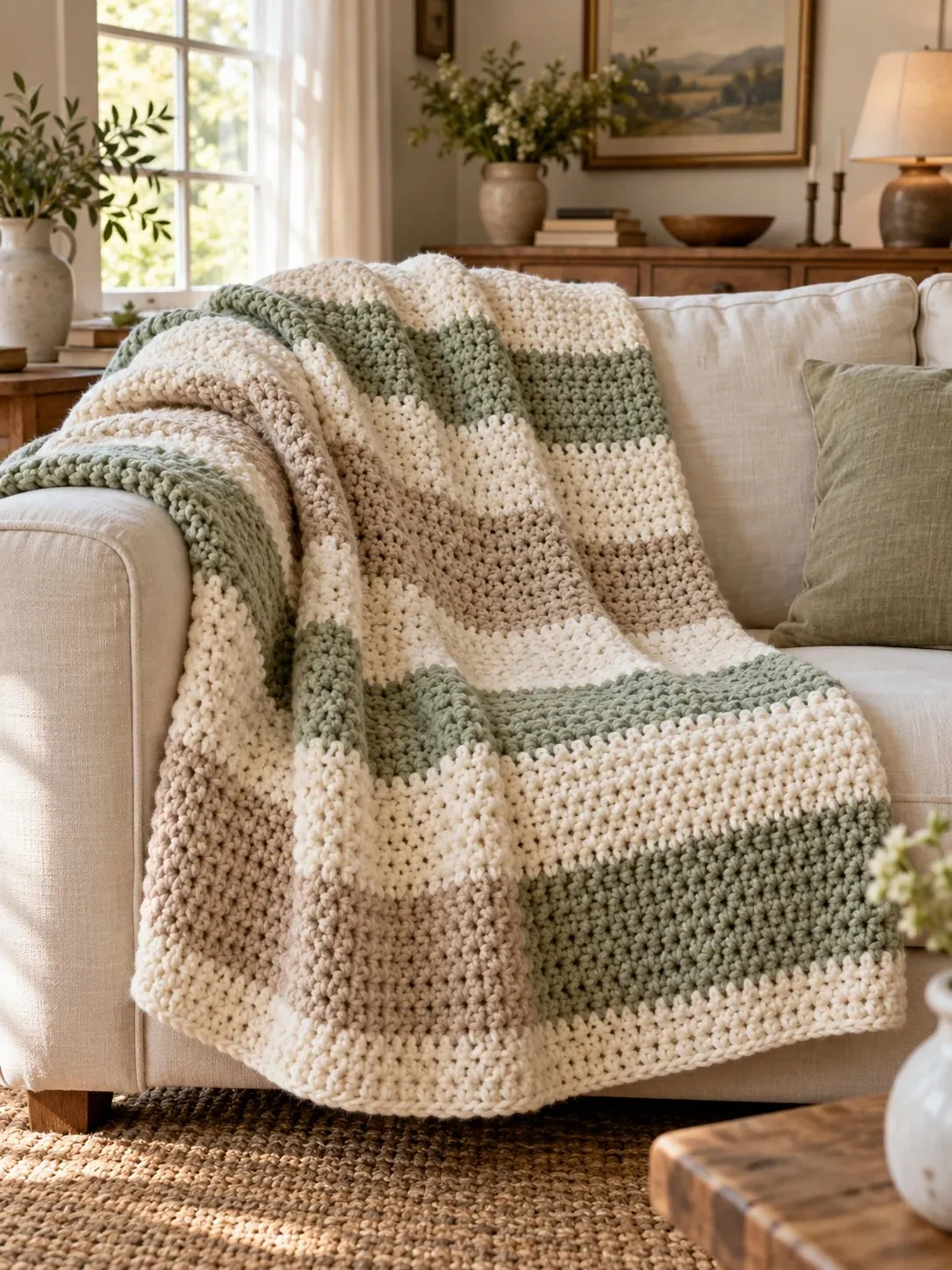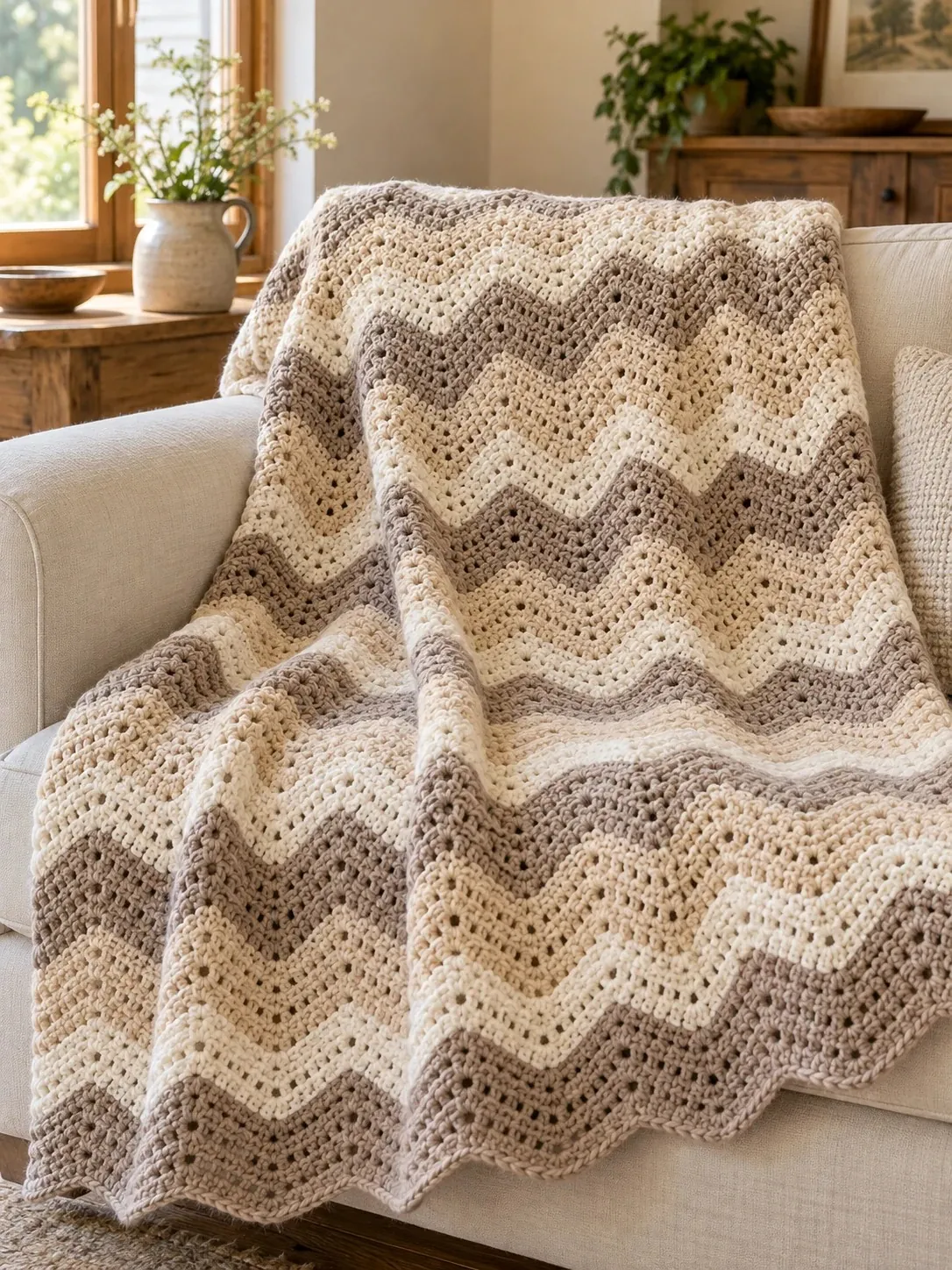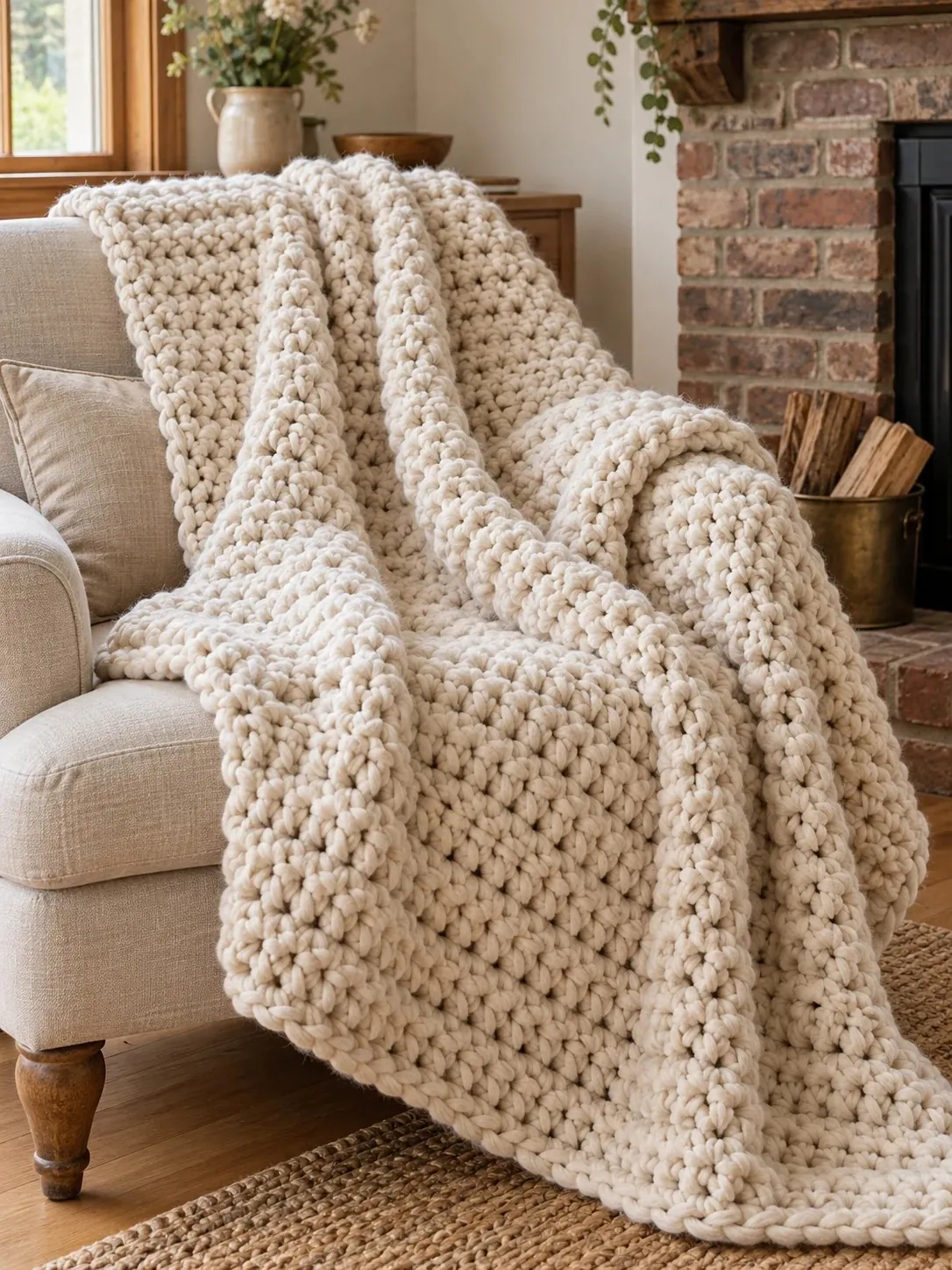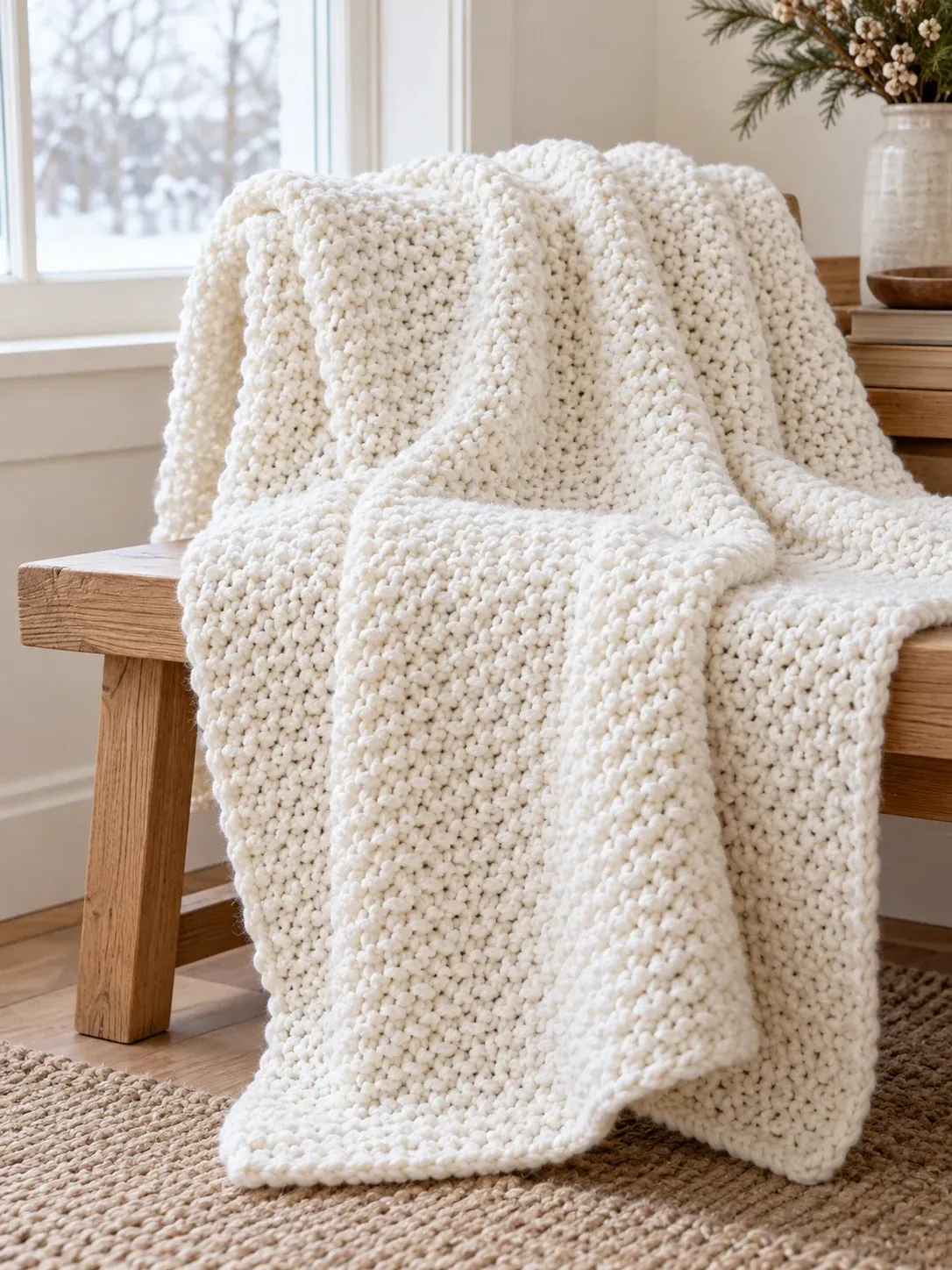
The first real snow in Vermont always shows up before I’ve found my mittens, and that’s the week I start reaching for anything cream and squishy. This moss stitch crochet blanket came out of that mood. It’s one color from edge to edge, worked in bulky yarn, and all of its charm lives in the texture: row after row of tiny staggered bumps, a bit like fresh snow on a porch rail.
You only need two stitches and a two-row repeat. Once your hands learn it, you can keep going while you talk, or while you watch the flakes come down with a second cup of coffee. The throw in the pattern is about 50 × 60 in (127 × 152 cm), big enough to cover your legs on the couch or fold across the foot of a bed, and there are three more sizes below if you’d rather start small or go big.
Is this moss stitch crochet blanket a good first big project?
If you can make a chain and a single crochet, yes. The chain and single crochet are the only stitches in the body, and the border is two plain rounds of single crochet. The only other move is a slip stitch to close each border round: insert your hook, yarn over, and pull the loop through the stitch and the loop on your hook in one go.
Here’s how the moss stitch works. On the first row you single crochet, chain 1, skip a chain, and single crochet again, all the way across. From then on, every single crochet lands in a ch-1 space from the row below, and every chain 1 sits on top of a single crochet. That half-step shift lines the bumps up diagonally, like bricks in a wall, and it keeps the fabric flat, which really matters on a blanket this size. You may also see it called linen stitch or granite stitch.
What’s new for most beginners is the counting. In this pattern a ch-1 space counts as a stitch, just like a single crochet, so every row of the throw has 147 stitches. If notation like ch-1 sp or the asterisks still look like a secret code, the Beginner Guide shows how to read a crochet pattern, and Row 2 will make a lot more sense afterward. And if you’d like to meet the stitch on something smaller first, the plaid pattern built from little moss stitch squares uses it one square at a time.
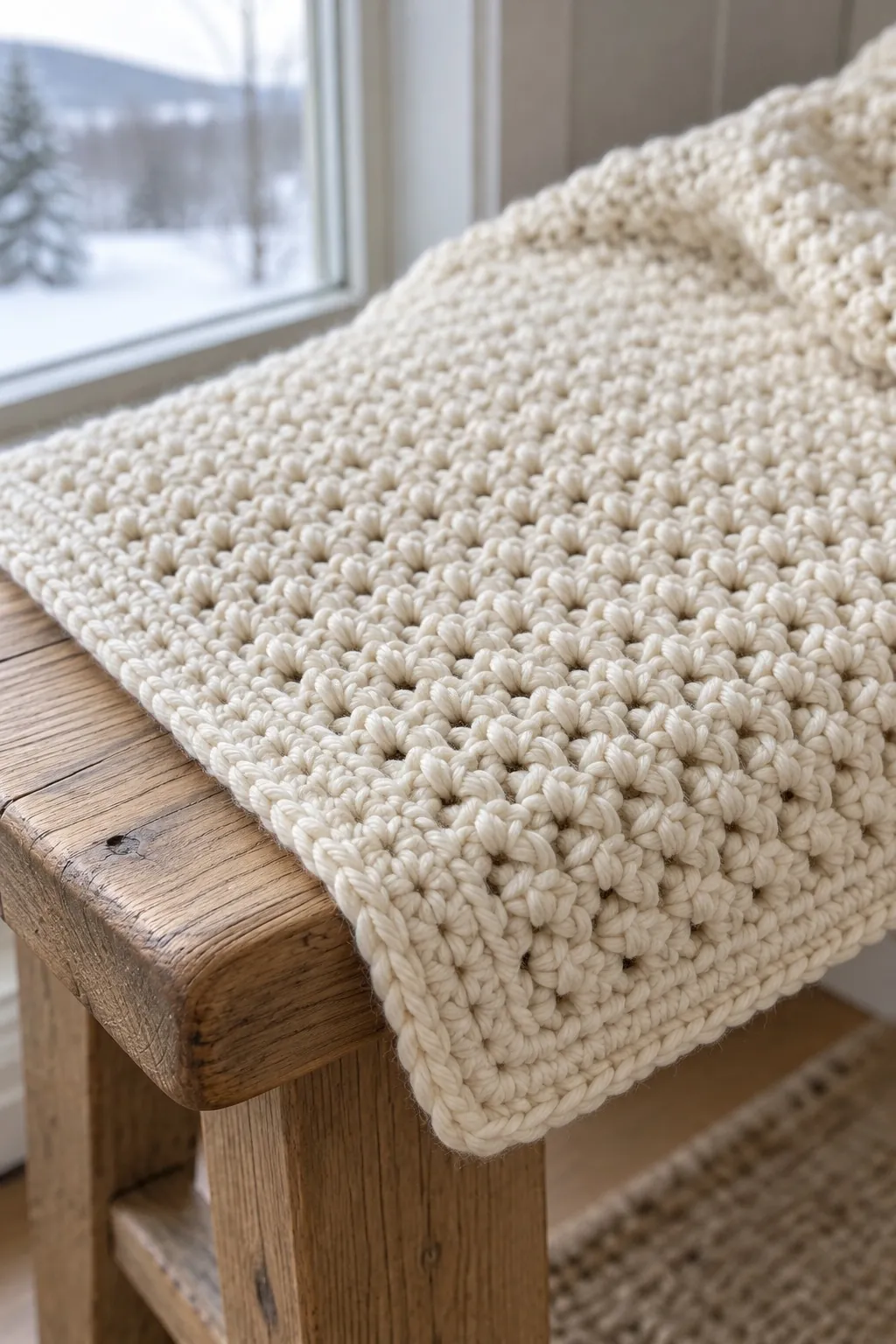
Picking a bulky cream yarn that keeps every bump crisp
Look for the number 5 on the label, the bulky weight symbol, with a recommended hook somewhere around 6.5 to 9 mm. I use an 8 mm (L-11) hook here, a size bigger than many people would grab for plain single crochet. Moss stitch is dense, and the larger hook keeps it soft enough to drape over a bench or around your shoulders.
Smooth, plied yarn shows the stitch best. Soft acrylic is easy to wash and kind to your budget, and a wool and acrylic blend adds warmth and a little bounce. I’d skip fuzzy or velvety chenille-style yarns for this one. The fuzz blurs the bumps, and slippery chenille makes the ch-1 spaces hard to find and harder to count.
Because the whole throw is one color, the dye lot matters more than usual. Buy all your skeins at once and check that every label shows the same lot number. Two batches of cream can look identical in the store and still leave a visible line across the blanket in daylight.
To substitute, compare by yardage, never by skein count, since bulky skeins run anywhere from about 100 to more than 200 yd. Then make the 17-stitch swatch from the pattern card. If you get 13 stitches over 4 in instead of 12, your throw comes out about 4 in narrower, so those twenty minutes are worth it. And if you’re tempted to go thicker, don’t just switch this pattern to super bulky yarn: the one-color super bulky throw in half double crochet is written for that weight.
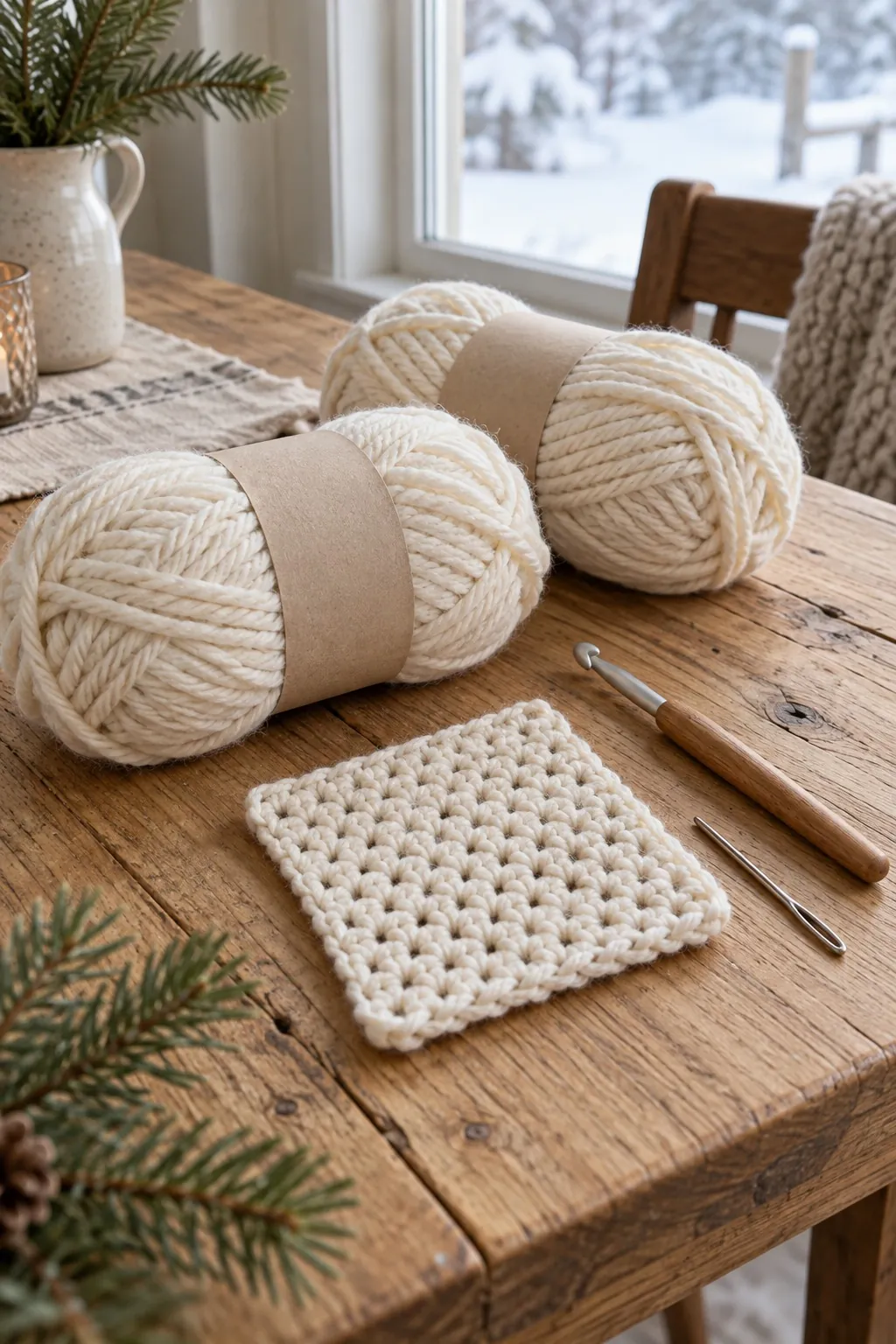
One soft shade: why Snowfall works best in light solids
In a one-color blanket, the color has a single job: catching light on all those bumps so the texture shows from across the room. Pale, solid shades do that best. Dark colors and variegated yarns swallow moss stitch, and you end up with something that just looks like plain fabric.
Here are a few one-color versions I’d happily make:
- Snowfall cream: the warm ivory in the photo, lovely with wood floors and a jute rug.
- Birch gray: a pale heathered gray that forgives dog hair and the odd coffee drip.
- Frost blue: a very light, icy blue for a bedroom, or a sweet baby size.
- Oatmeal tweed: a beige with darker flecks, which add depth without hiding the stitch.
One practical tip: hold a skein up to a window before you buy. Under store lighting, cream can lean yellow or gray, and you’ll mostly be looking at this blanket by daylight.
Snowfall sizes, from baby blanket to queen bed
Every size uses the same gauge of 12 stitches and 13 rows over 4 in. The chain is always an even number, the body has one stitch fewer than the chain, and the row count is always odd so the top edge matches the bottom. The pattern card is written for the throw. Yardage is an estimate, about half a yard per square inch of finished blanket, rounded up to the next 50 yd.
- Baby, about 30 × 36 in (76 × 91 cm): ch 88, 87 sts, 113 rows; border 404 sc, then 412 sc; about 550 yd (503 m).
- Throw, about 50 × 60 in (127 × 152 cm): ch 148, 147 sts, 191 rows; border 680 sc, then 688 sc; about 1,550 yd (1,417 m).
- Twin, about 66 × 90 in (168 × 229 cm): ch 196, 195 sts, 289 rows; border 972 sc, then 980 sc; about 3,000 yd (2,743 m).
- Queen, about 90 × 90 in (229 × 229 cm): ch 268, 267 sts, 289 rows; border 1,116 sc, then 1,124 sc; about 4,100 yd (3,749 m).
For any size, the first border round has the number of body stitches plus 4 across the top and bottom, corners included, and the number of rows minus 2 along each side. The second round adds 8. Be honest with yourself about the big ones: with 267 stitches per row in bulky yarn, the queen sits heavy on your lap toward the end and takes most of a winter.
Keeping 147 stitches and straight edges for 191 rows
- Chain loosely. A tight foundation pulls the bottom edge in, and you’ll only notice once the border is on. If your chains are snug, make them with a 9 mm hook and switch to the 8 mm for Row 1.
- Count bumps, not chains. At the end of a row, count only the single crochets: 74 on odd rows, 75 on even rows. That’s far quicker than counting all 147 stitches.
- Mind the doubled edge. Even rows start and end with two single crochets side by side. Forget one and the edge leans inward; add an extra into the turning chain and the blanket slowly widens.
- Leave the turning chain alone. The ch 1 from the start of the previous row sits right next to the last single crochet. It doesn’t count, so don’t work into it.
- Find the spaces by feel. Each ch-1 space is a small gap between two bumps. Your hook should slide in without splitting the yarn.
- Measure every 26 rows. That’s about 8 in (20 cm) at the right gauge. If you’re getting there in fewer rows, your tension is loosening as you relax, and the throw will be longer than planned.
- Join new skeins at the edge. Leave 6 in (15 cm) tails at the start of a row and weave them along the side later. The border hides them.
US crochet terms
The pattern
Materials
- Yarn: bulky weight (#5) yarn in soft acrylic or a wool-acrylic blend, about 1,550 yd (1,417 m) in total
- Color: cream or ivory, all from the same dye lot (for example, 11 skeins of about 150 yd / 137 m each)
- Hook: 8 mm (US L-11)
- Optional: 9 mm (US M/N-13) hook for the foundation chain
- Yarn needle, 2 stitch markers, scissors, measuring tape
Gauge
- 12 sts and 13 rows = 4 in (10 cm) in moss stitch, counting each sc and each ch-1 sp as 1 st
- Swatch: ch 18 and work Rows 1–3 of the body (17 sts), then rep Rows 2 and 3 until the swatch measures about 5 in (13 cm). Measure 4 in (10 cm) across the middle.
- Too many sts per 4 in: try a larger hook. Too few: try a smaller one.
Finished size
- About 50 × 60 in (127 × 152 cm) with the border, before blocking
- Body before the border: about 49 × 59 in (124 × 150 cm)
Abbreviations
- ch chain
- sc single crochet
- sl st slip stitch
- sk skip
- sp(s) space(s)
- st(s) stitch(es)
- rep repeat
Notes
- The ch 1 at the start of each row does not count as a st. Never work into it.
- Each sc counts as 1 st and each ch-1 sp counts as 1 st. Every body row has 147 sts.
- Odd rows begin and end with 1 sc and have 74 sc. Even rows begin and end with 2 sc side by side and have 75 sc. The doubled sc keep the side edges straight.
- From Row 2 on, every sc is worked into a ch-1 sp, except the first and last sc of each row, which go into the edge sc.
- Moss stitch looks the same on both sides, so the body has no right or wrong side.
- Join a new skein at the start of a row, leaving 6 in (15 cm) tails to weave in along the side edge.
- To change the width, chain any even number; the body has 1 st fewer than the chain. To change the length, work any odd number of rows. Border Round 1 then has (sts + 4) sc across top and bottom, corners included, and (rows − 2) sc along each side; Round 2 adds 8 sc.
Instructions
Body
- Foundation: Loosely ch 148.
- Row 1: Sc in 2nd ch from hook, *ch 1, sk next ch, sc in next ch; rep from * across. (74 sc and 73 ch-1 sps: 147 sts)
- Row 2: Ch 1, turn. Sc in first sc, sc in next ch-1 sp, *ch 1, sk next sc, sc in next ch-1 sp; rep from * to last sc, sc in last sc. (75 sc and 72 ch-1 sps: 147 sts)
- Row 3: Ch 1, turn. Sc in first sc, *ch 1, sk next sc, sc in next ch-1 sp; rep from * to last 2 sc, ch 1, sk next sc, sc in last sc. (74 sc and 73 ch-1 sps: 147 sts)
- Rows 4–191: Rep Rows 2 and 3 another 94 times, ending with a Row 3. (191 rows; body measures about 49 × 59 in / 124 × 150 cm)
Border
- Round 1: Do not fasten off. Ch 1, turn. Working across the last row: 3 sc in first sc (corner), sc in each sc and ch-1 sp across to last sc (145 sc), 3 sc in last sc (corner). Working down the side: sc in the end of each row from Row 190 to Row 2 (189 sc). Working in the free loops of the foundation chain: 3 sc in the loop at the base of the first sc of Row 1 (corner), sc in each free loop across to the loop at the base of the last sc of Row 1 (145 sc), 3 sc in that loop (corner); the single extra ch at the end of the foundation stays empty. Working up the other side: sc in the end of each row from Row 2 to Row 190 (189 sc). Join with sl st to first sc. (680 sc: 151 across top and bottom, corners included, and 189 along each side)
- Round 2: Ch 1, do not turn. Sc in same st as join, 3 sc in next sc (corner), [sc in each sc to center sc of next corner, 3 sc in center sc] 3 times, sc in each remaining sc. Join with sl st to first sc. (688 sc: 155 across top and bottom, corners included, and 189 along each side)
- Finishing: Fasten off and weave in all ends.
Washing a one-color cream throw in bulky yarn
Check the yarn label first, because care depends on the fiber. Most acrylics can go in the machine on a cold, gentle cycle, inside a large mesh laundry bag or a zipped pillowcase, then lie flat or tumble on low. A wool blend usually wants a cool hand wash with a little wool wash: press the water out without wringing, roll the throw in a towel, and dry it flat.
Bulky moss stitch holds a surprising amount of water. Lift a wet throw with both arms under it, never by one corner, or the weight will stretch it out of shape.
Cream shows everything. Spot clean small marks right away with cool water and a drop of mild soap, dabbing instead of rubbing so the bumps don’t fuzz. Between seasons, store it folded on a shelf rather than hanging over a rail, since a heavy blanket slowly grows longer under its own weight. A sweater comb takes care of any pills on the spots that get the most use.
Snowfall questions from first-time moss stitchers
Is a moss stitch crochet blanket warm enough for a Vermont winter?
Yes. Moss stitch is one of the densest fabrics you can make with single crochet, because each row fills in the ch-1 spaces of the row before. In bulky yarn it keeps drafts out well. A wool blend feels warmest, and acrylic is still cozy and simpler to wash.
Why is my blanket getting narrower as I go?
You’re most likely losing a stitch at one edge, usually the second single crochet at the start or end of an even row. Count the single crochets every few rows, 74 on odd rows and 75 on even rows, and you’ll catch the slip within a row or two.
Can I use worsted weight yarn instead?
You can, but it becomes a different blanket. Worsted moss stitch on a 5.5 mm hook usually lands around 16 to 18 stitches per 4 in, so the same width needs roughly 200 to 220 stitches and many more rows. Make a swatch, multiply your stitches per inch by the width you want, round to an odd number, and chain one more.
How do I make the throw longer without starting over?
Keep repeating Rows 2 and 3 before you start the border, and stop after a Row 3 so the total stays odd. Every 26 extra rows add about 8 in (20 cm) and roughly 200 yd (183 m) of yarn at the throw width. The side counts of the border grow with the rows: rows minus 2 on each side.
Does moss stitch have a right side?
Not really. Both faces show the same staggered bumps, which is handy for a throw that gets tossed over a bench. The only small difference is at the border, where the slip stitch joins sit on the side that faced you.
Quick recap
- Swatch to 12 sts and 13 rows over 4 in with an 8 mm (L-11) hook.
- Loosely ch 148 and work Row 1 in sc and ch-1 spaces (147 sts).
- Rep Rows 2 and 3 until you have 191 rows, ending with a Row 3.
- Work 2 rounds of sc around the edge, with 3 sc in each corner (680, then 688 sc).
- Weave in the ends and wash the throw as the yarn label says.
I hope this moss stitch crochet blanket keeps you warm long after the first snowfall. If a row count stops making sense, or you’d like a size I haven’t listed, send me a note and we’ll figure it out together.