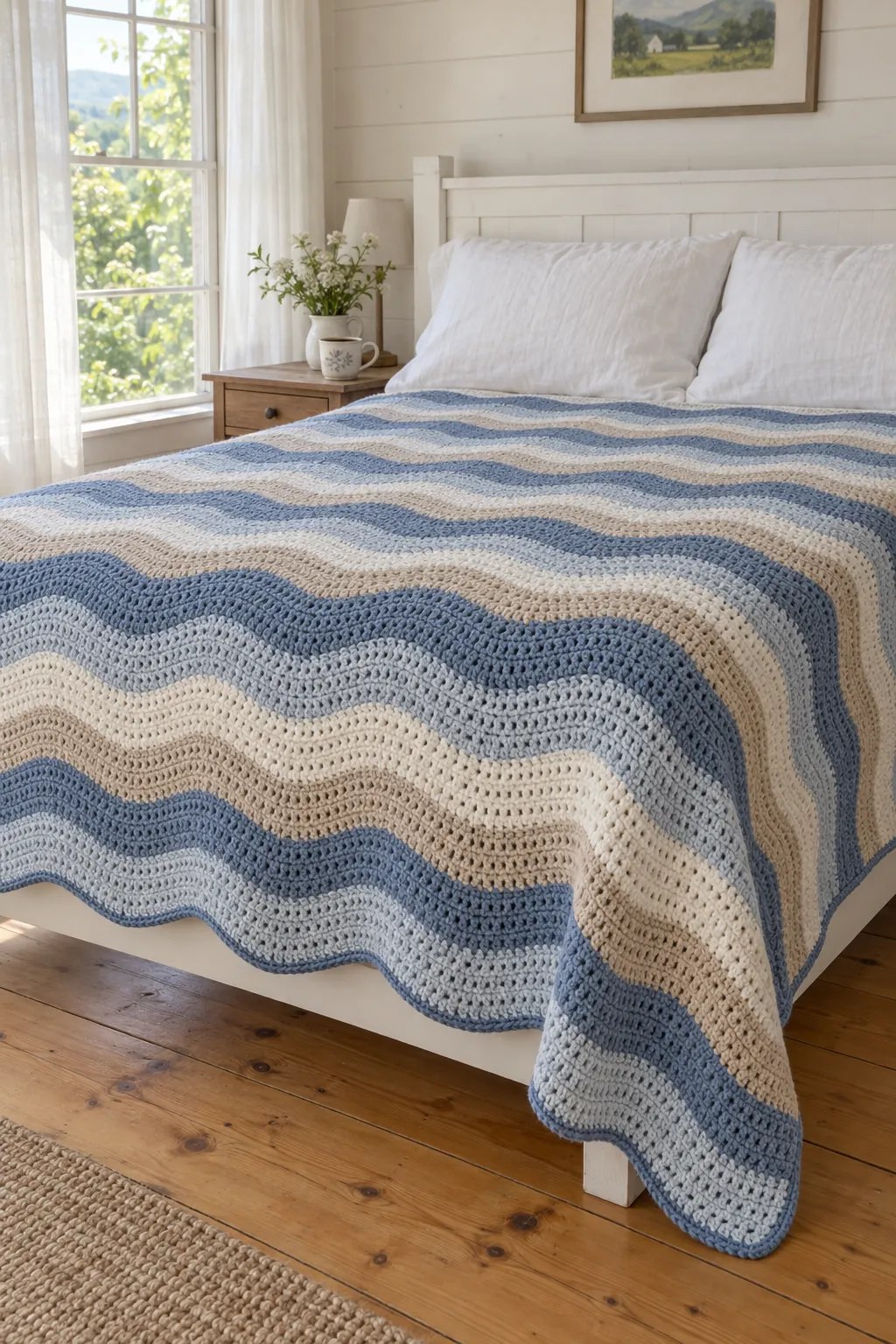
From May to September, the heavy quilt can go into the closet and this can go on the bed. It’s a crochet bedspread pattern built on one soft wave, repeated 15 times across a queen bed: slate blue, misty blue, cream and warm sand, four rows of each, rolling from the headboard down to the foot. The top and bottom edges come out gently scalloped all on their own, and you’ll want to run your hand along them when you make the bed.
It isn’t small. The queen has 360 stitches in every row and 196 rows. But every row is the same row. Once your hands know one wave (six stitches, four increases, six stitches, four decreases), you can work it while you listen to the radio or watch the light change on the water. Each four-row stripe is its own little finish line, and there are 49 of them.
Is this crochet bedspread pattern a good first big project?
It’s rated Easy. If you’ve finished one blanket worked in rows and you can keep a count going, you can make this. The hard part is patience, not technique.
You’ll use three stitches:
- Chain for the long foundation and the turning chains.
- Double crochet for the whole body.
- Single crochet for the two border rounds.
The waves come from two small moves. An increase is simply 2 double crochets worked into the same stitch, and four of them in a row push up a rounded peak. A decrease, written dc2tog, is two double crochets started in two neighboring stitches and finished together, so they become one. Four of those in a row pull down a valley. Everything else is plain double crochet.
New to abbreviations like dc2tog? The page on reading a pattern walks through them one by one. And if you’d like to practice the up-and-down rhythm on something you can finish faster, a lap-size wave pattern in bulky yarn is a good warm-up before you commit to 362 chains.
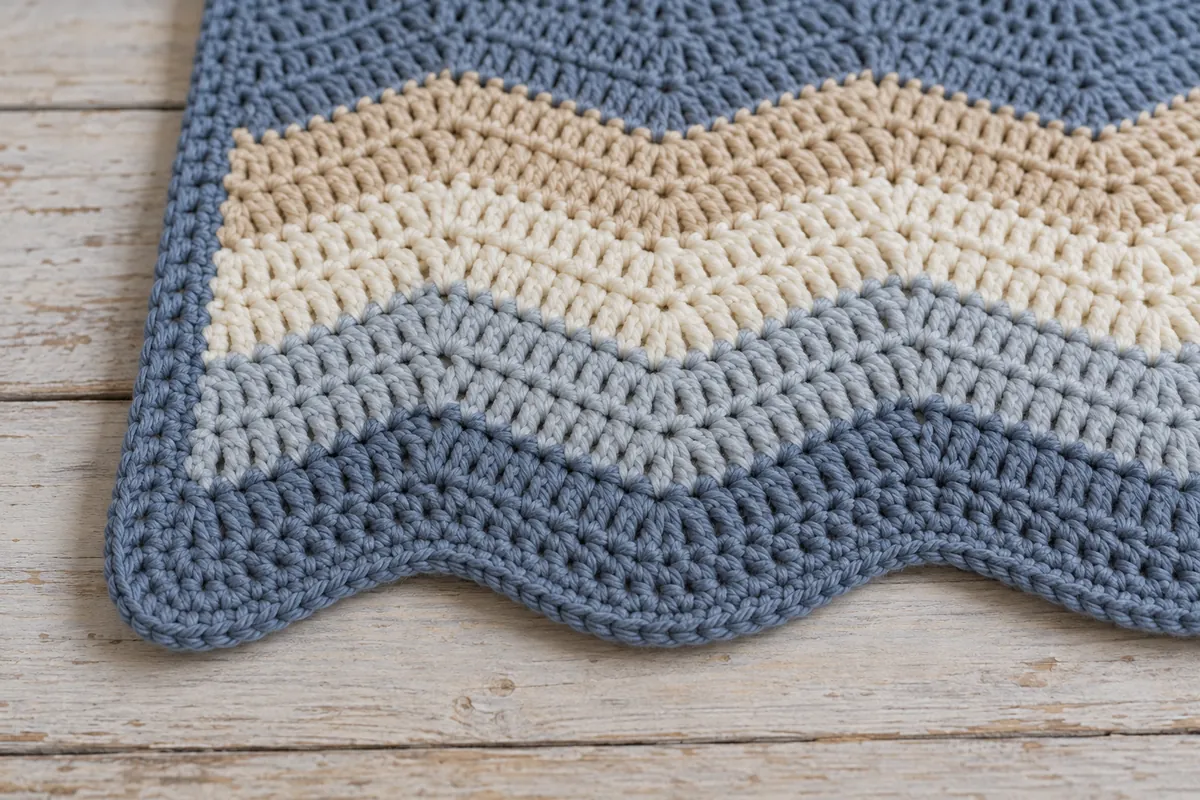
A worsted cotton blend light enough for July nights
Look for a 4 (worsted) on the label, ideally a cotton and acrylic blend close to half and half. Cotton gives the peaks and valleys crisp edges, and it breathes on a warm night. Acrylic keeps the weight down and dries faster. That second part matters here: a queen in this yarn is around 8,500 yards, and in 100% cotton it gets very heavy and slow to dry. An all-acrylic worsted works too. The bedspread will just feel a bit warmer.
The yardage is based on balls of about 200 yd (183 m) per 3.5 oz (100 g). If your yarn comes in a different put-up, go by yards, not ball count. You’ll need about 2,420 yd of Slate and 2,030 yd of each of the other three colors for the queen.
Buy all of each color at once, from one dye lot. Slate is the one to watch. It runs through 13 stripes and both border rounds, and a slightly different lot shows up as a band that looks dusty next to its neighbors.
Before you chain 362, work the gauge swatch in the card: two waves, ten rows. It should measure 12 in (30.5 cm) across. If yours is wider, every one of your 15 waves grows too. Just 1/4 in extra per wave makes the queen almost 4 in wider, with yarn to match.
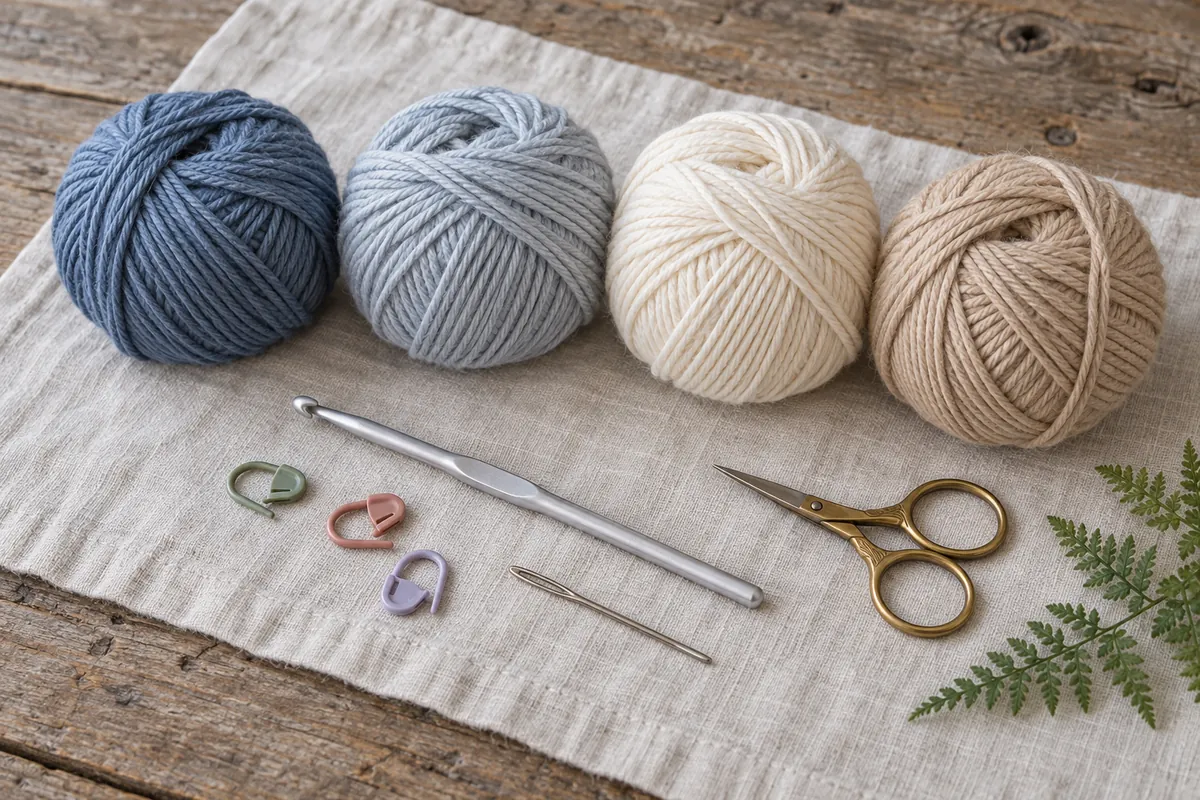
Slate, mist, cream and sand: what each stripe is doing
Slate is the anchor. It starts the bedspread, ends it, and works the border, so the whole piece looks framed when it’s on the bed. Mist is the bridge between the dark and the light, and Cream is the brightest stripe, the one your eye follows across the waves. Sand is what keeps all that blue from feeling cold. The cream-to-sand change is the softest one in the sequence, and that’s on purpose: it gives the eye a rest before the next Slate.
If blue isn’t your room, keep the same four roles and swap the shades:
- Lakeshore: slate blue, misty blue-gray, cream and sand, as written.
- Fern Hollow: forest green, sage, cream and oatmeal.
- Peach Orchard: terracotta, apricot, cream and honey.
- Woodsmoke: charcoal, dove gray, ivory and camel.
- Lilac Hour: plum, dusty lilac, cream and blush.
Whatever you pick, put your darkest color in the Slate spot. Wrap each yarn a few times around a strip of cardboard in stripe order, Slate, Mist, Cream, Sand, Slate, and look at it from across the room. If two neighbors melt together from there, they’ll melt together on the bed.
Twin, queen and king: waves, rows and yarn for each size
The card is written for the queen. The other sizes use the exact same rows, with more or fewer waves across and fewer rows for the twin. Each wave is 24 stitches and about 6 in (15 cm) wide, and 8 rows make 4 in (10 cm). The border adds about 1/2 in (1.3 cm) on every side.
- Twin, about 67 × 91 in (170 × 231 cm): 11 waves, ch 266, 264 sts per row, 180 rows (45 stripes). Border Round 1 has 1,256 sc, Round 2 has 1,264. About 5,780 yd (5,285 m): Slate 1,670 yd, Mist, Cream and Sand 1,370 yd each.
- Queen (written in the card), about 91 × 99 in (231 × 251 cm): 15 waves, ch 362, 360 sts per row, 196 rows (49 stripes). Border Round 1 has 1,512 sc, Round 2 has 1,520. About 8,510 yd (7,782 m): Slate 2,420 yd, Mist, Cream and Sand 2,030 yd each.
- King, about 103 × 99 in (262 × 251 cm): 17 waves, ch 410, 408 sts per row, 196 rows (49 stripes). Border Round 1 has 1,608 sc, Round 2 has 1,616. About 9,630 yd (8,806 m): Slate 2,730 yd, Mist, Cream and Sand 2,300 yd each.
These yardages are estimates. They include the border, the tails and about 10% extra, but tension can move them a lot on a piece this size. All three sizes are coverlets rather than floor-length spreads: on a queen mattress, about 15 in hangs down each side and there’s enough length to tuck under the pillows.
For a size of your own, chain 24 times the number of waves you want, plus 2. Keep the number of rows a multiple of 4, with a number of stripes one more than a multiple of 4 (45, 49, 53…), so you start and end with Slate.
Keeping 15 waves lined up across 360 stitches
A foundation chain this long tends to tighten up and make the bottom edge pucker. Chain with a 5.5 mm hook, or just chain loosely, then switch to the 5 mm for Row 1. Clip a marker into every 24th chain as you go. Counting 15 markers is a lot easier than counting 362 chains twice.
After Row 1, stop counting stitches and start counting waves. Each group of four increases should sit right above the four increases in the row below, with six plain dc on each side. If a peak ever looks a few stitches off from the one beneath it, you’ve worked five or seven plain dc somewhere in that wave. Fix it now. A drifted peak doesn’t get better on the next row.
The edges are where most miscounts start. The ch-2 at the beginning of each row doesn’t count as a stitch, so your first dc2tog goes into the very first stitch, right at the base of that chain. At the other end, the last dc2tog finishes in the last real stitch of the row, which is the top of the previous row’s first dc2tog. Skip the ch-2 there. Work into it and you’ll gain a stitch every other row.
Because each stripe is four rows, every color change lands on the same side of the bedspread. Weave each tail back into its own stripe, a few inches along the row, so a Slate end never peeks through Cream.
By the halfway point the queen weighs several pounds. Work at a table, or let the finished part rest folded on a footstool instead of hanging from your hook. That pull is what stretches the last rows longer than the first ones.
US crochet terms
The pattern
Materials
- Worsted weight (#4) cotton-acrylic blend yarn, about 200 yd (183 m) per 3.5 oz (100 g) ball, about 8,510 yd (7,782 m) in total (estimate, including about 10% extra):
- Slate (slate blue): 2,420 yd (2,213 m), 13 balls
- Mist (pale blue-gray): 2,030 yd (1,856 m), 11 balls
- Cream: 2,030 yd (1,856 m), 11 balls
- Sand (warm beige): 2,030 yd (1,856 m), 11 balls
- 5 mm (US H-8) crochet hook
- 5.5 mm (US I-9) crochet hook for the foundation chain (optional)
- 15 locking stitch markers
- Yarn needle
- Scissors
Gauge
- In the ripple pattern with a 5 mm hook: one wave (24 sts) = 6 in (15 cm) wide, and 8 rows = 4 in (10 cm) tall. This is about 16 dc over 4 in.
- Gauge swatch: ch 50. Work Row 1, working the section from * to * once only (48 sts, 2 waves). Rep Row 2 until you have 10 rows. The swatch should measure 12 in (30.5 cm) wide and 5 in (12.7 cm) tall, laid flat and measured through the middle of the waves.
Finished size
- Queen: about 91 × 99 in (231 × 251 cm) after light blocking, including the border, measured through the middle of the waves.
- Twin: about 67 × 91 in (170 × 231 cm). King: about 103 × 99 in (262 × 251 cm). Counts for both are in Notes.
Abbreviations
- ch chain
- dc double crochet
- dc2tog double crochet 2 together (yo, insert hook in next st, yo and pull up a loop, yo and draw through 2 loops; rep in the following st; yo and draw through all 3 loops on hook)
- rep repeat
- sc single crochet
- sl st slip stitch
- st(s) stitch(es)
- yo yarn over
Notes
- The ch-2 at the beginning of each row does not count as a stitch. Every row of the queen has 360 sts.
- Each wave is 24 sts: 6 dc, 4 increases (2 dc in the same st), 6 dc and 4 dc2tog. Peaks sit above peaks and valleys above valleys. The side edges fall in the middle of a valley, so every row begins and ends with 2 dc2tog.
- Work the first dc2tog of each row into the first st, at the base of the ch-2. The last dc2tog ends in the last st of the row, never in the ch-2.
- Stripes are 4 rows each, in this order: Slate, Mist, Cream, Sand, repeated. The first and last stripes are Slate.
- To change color, work the last dc2tog of the 4th row of a stripe until 3 loops remain on the hook, then yo with the new color and draw through all 3 loops. Leave 6 in (15 cm) tails and weave each one into its own stripe.
- Twin: ch 266, 264 sts per row (11 waves: work the section from * to * 10 times in all), 180 rows (45 stripes). Border Round 1: 1,256 sc; Round 2: 1,264 sc. About 5,780 yd (5,285 m): Slate 1,670 yd (1,527 m), Mist, Cream and Sand 1,370 yd (1,253 m) each.
- King: ch 410, 408 sts per row (17 waves: work the section from * to * 16 times in all), 196 rows (49 stripes). Border Round 1: 1,608 sc; Round 2: 1,616 sc. About 9,630 yd (8,806 m): Slate 2,730 yd (2,496 m), Mist, Cream and Sand 2,300 yd (2,103 m) each.
Instructions
Body
- Foundation: With Slate and the 5.5 mm hook (or the 5 mm hook, chaining loosely), ch 362, placing a marker in every 24th ch as you go (15 markers, then 2 extra ch). Change to the 5 mm hook.
- Row 1: Starting in 3rd ch from hook, (dc2tog) twice, *dc in next 6 ch, (2 dc in next ch) 4 times, dc in next 6 ch, (dc2tog) 4 times*; rep from * 13 more times, dc in next 6 ch, (2 dc in next ch) 4 times, dc in next 6 ch, (dc2tog) twice. Remove the markers as you reach them. (360 sts: 15 waves)
- Row 2: Ch 2 (does not count as a st), turn. (Dc2tog) twice, *dc in next 6 sts, (2 dc in next st) 4 times, dc in next 6 sts, (dc2tog) 4 times*; rep from * 13 more times, dc in next 6 sts, (2 dc in next st) 4 times, dc in next 6 sts, (dc2tog) twice. (360 sts)
- Rows 3–4: Rep Row 2. Change to Mist at the end of Row 4.
- Rows 5–196: Rep Row 2, changing color at the end of every 4th row in this order: Mist (Rows 5–8), Cream (Rows 9–12), Sand (Rows 13–16), Slate (Rows 17–20), then Mist again. Continue the sequence until you finish the 49th stripe, in Slate (Rows 193–196). Do not fasten off. (360 sts in every row)
Border
- Round 1: With Slate, ch 1, turn. 3 sc in first st, sc in each st across to last st, 3 sc in last st (364 sc along the top). Working down the side in row ends, 2 sc in each row end (392 sc). Working in the free loops on the other side of the foundation ch, 3 sc in first ch, sc in each ch across to the last ch that holds a st, 3 sc in that ch (364 sc), leaving the 2 unworked ch at this corner alone. Working up the second side, 2 sc in each row end (392 sc); join with sl st to first sc. (1,512 sc)
- Round 2: Ch 1, sc in same st as join, 3 sc in next sc, *sc in each sc to center sc of next 3-sc corner, 3 sc in center sc*; rep from * 2 more times, sc in each remaining sc; join with sl st to first sc. Fasten off. (1,520 sc)
- Finishing: Weave in all ends. Lay the bedspread flat, spritz it with water, pat the waves and the scalloped edges into shape, and let it dry.
Washing a queen-size cotton blend spread with slate next to cream
Check your yarn label first, but most cotton and acrylic blends are fine with a cold, gentle machine wash. Toss in a color-catcher sheet for the first few washes, since every Cream stripe sits between Slate and Sand. A queen or king really needs a large front-loader, so this is a laundromat job. A home top-loader can pull hard on a wet spread this heavy and stretch the waves out of shape.
Tumble it on low until it’s just damp, then spread it out flat to finish: over your bed, or on a clean sheet on the grass in the shade on a dry summer afternoon. Don’t hang it over a clothesline while it’s wet. The weight pulls the stripes longer, and the scallops flatten. For winter storage, fold it loosely into a cotton bag rather than plastic, and change the fold lines each year.
Questions about the Lakeshore waves
Can I make this crochet bedspread pattern for a full-size bed?
Yes. Use 13 waves: ch 314 and work the section from * to * 12 times in all, for 312 sts per row. With 180 rows (45 stripes), it measures about 79 × 91 in (201 × 231 cm), with about 12 1/2 in hanging over each side of a full mattress. Border Round 1 has 1,352 sc and Round 2 has 1,360, and you’ll need about 6,820 yd in total: 1,960 yd of Slate and 1,620 yd each of Mist, Cream and Sand.
My first Slate stripe looks almost flat. When do the waves show up?
Row 1 is worked into a stretchy chain, so the waves barely show at first. By the end of the first stripe, the peaks should start to stand up, and by the second stripe they’re obvious. If they still look flat after Row 8, count your peaks: you should see 15, each one right above the last.
One of my waves is leaning to the side. How do I fix it?
A leaning wave almost always means one stretch of plain dc has 5 or 7 stitches instead of 6. Look for the row where the four increases stop sitting directly over the ones below, and pull back to there. Losing a row hurts less than a wave that drifts across a whole stripe.
The sides of my border are ruffling. Should I change the 2 sc per row end?
Two sc per dc row end suits most tension, but if your rows are short, it can add too many stitches. Try 3 sc over every 2 row ends on both sides instead. Your Round 1 total will be lower than the card says, which is fine as long as the two sides match.
Quick recap
- Chain 362 in Slate, with a marker every 24 chains.
- Work Row 1 into the chain: 15 waves, 360 stitches.
- Repeat Row 2 for 196 rows, in 4-row stripes of Slate, Mist, Cream and Sand, ending with Slate.
- Without fastening off, work 2 rounds of sc all around in Slate, with 3 sc at each corner.
- Weave in the ends, then spritz and pat the waves flat to dry.
There’s something about pulling a finished crochet bedspread pattern over a whole bed for the first time. You’ve seen it stripe by stripe for weeks, and suddenly it’s one long sweep of water and sand. If you make yours in other colors, or work out a size that isn’t covered here, send a note through the contact page.