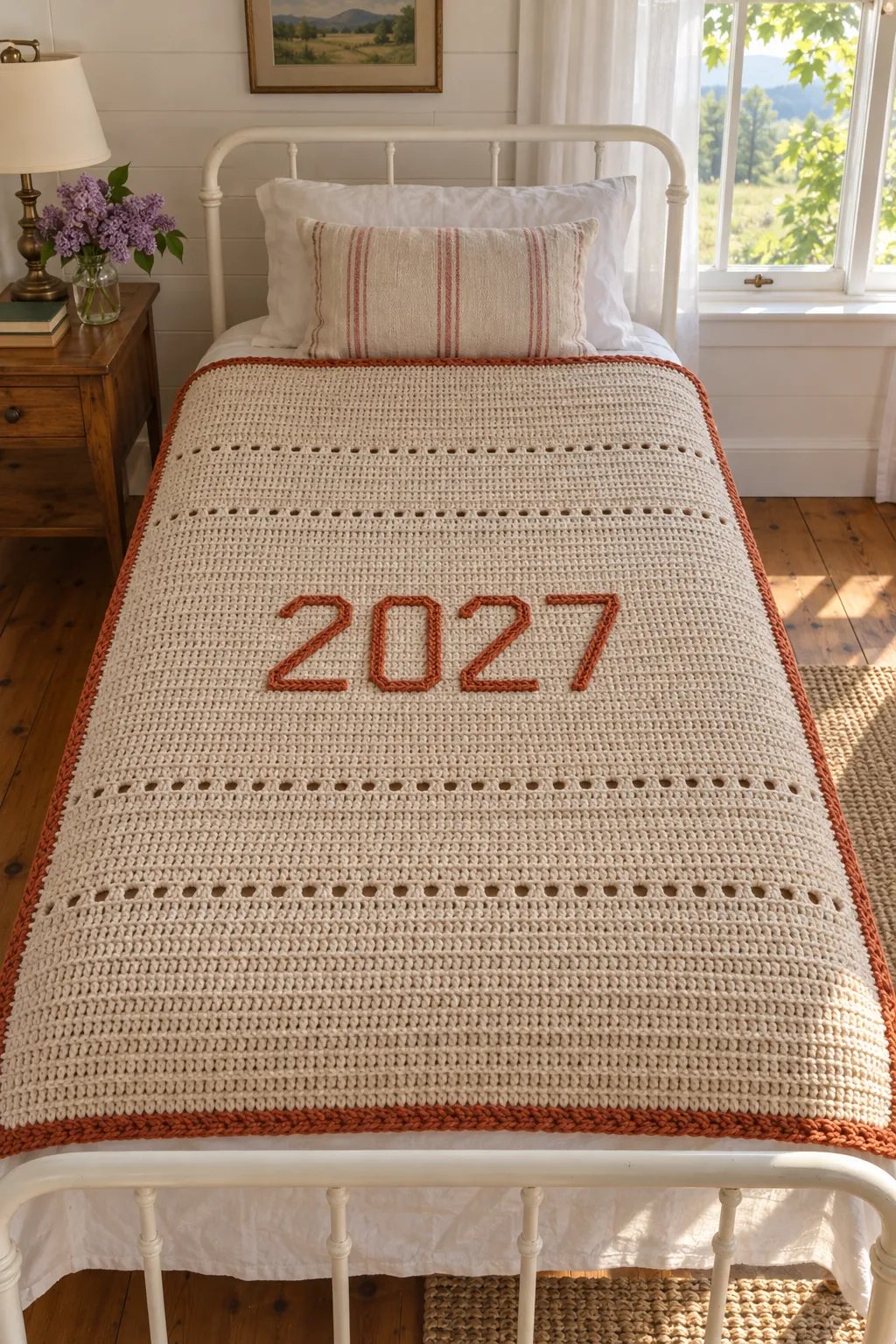
Picture a June morning in Vermont, a graduation gown still hanging on the closet door and a twin bed about to be stripped and packed for a dorm. The Mile Marker Afghan was planned for that week. It’s a personalized crochet blanket in oatmeal double crochet, with narrow bands of eyelets above and below a plain center panel, and a year sewn across the middle in thick terracotta cord.
The blanket in the photos says 2027, for the class that graduates next spring. The pattern card charts every digit from 0 to 9, though, so a birth year or a wedding year works just as well. The body is one color from the first row to the last, with no color changes and very few ends. The personal part comes at the very end, once the blanket is blocked and you can see exactly where each number goes.
Is this personalized crochet blanket a good pick if you’ve never done appliqué?
Yes, if you’re comfortable with double crochet in rows. The eyelet rows and the sewn year are what make it Easy rather than Beginner.
The body uses just a chain and double crochet. The chain 3 at the start of each row counts as your first stitch, so you skip the stitch right below it and put your last double crochet into the top of the previous chain 3. Every so often you work an eyelet row: chain 1, skip one stitch, then work 5 double crochet. On the next row, you double crochet into each chain-1 space, and a little round hole stays behind.
The border is three rounds of single crochet closed with a slip stitch, then one round of reverse single crochet. That last one is a single crochet worked backward, from left to right, and it twists into a firm, rope-like edge. If abbreviations like sk or sp still slow you down, the Beginner Guide walks through reading a crochet pattern.
The year is a chain appliqué. You crochet a length of chain, lay it along a shape you’ve pinned out, and sew it down by hand with small overcast stitches. If you like the eyelets and want a smaller project first, a baby afghan with rows of tiny eyelets in cream and pink uses the same kind of open row.
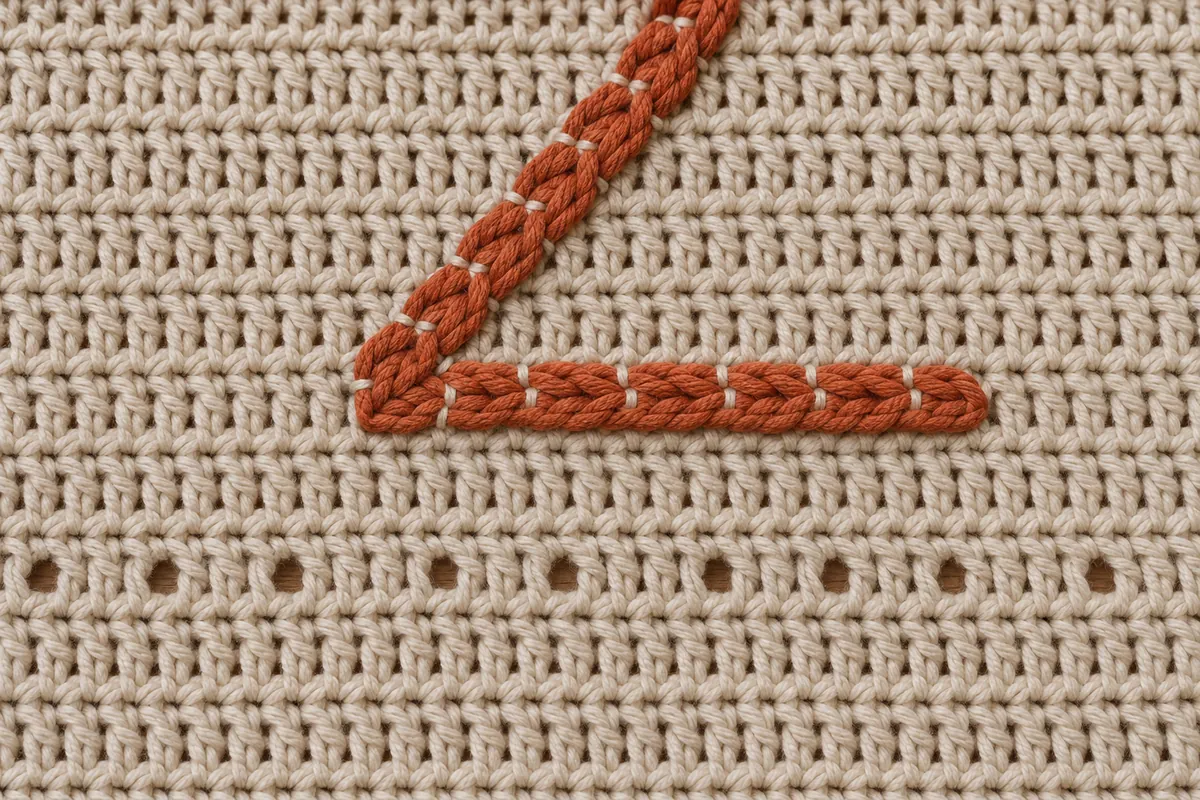
A cotton blend worsted that keeps a twin from getting too heavy
Look for a worsted weight yarn, the #4 medium symbol on the label, in a cotton-acrylic blend. Cotton keeps the fabric cool for a dorm room in May, and the acrylic keeps the weight down. A twin in pure cotton would be much heavier, and cotton double crochet tends to grow in length when it hangs off the side of a bed.
Pick a smooth, matte yarn with a firm twist. Brushed or fuzzy yarns soften the eyelets until they barely show, and a fuzzy cord makes the digits look blurry from across the room.
Oatmeal takes 10 [21] skeins of about 200 yd (183 m), so check that every label carries the same dye lot number. A slightly different shade would show as a stripe right behind the year.
The digits are chained with two strands of terracotta held together. You don’t need a second skein for that: pull one end from the center of the skein and take the other from the outside.
To substitute, choose a yarn whose label suggests a 5.0 to 5.5 mm hook. The numbers in this pattern are an estimate, not yet checked on a measured swatch, so your swatch matters more than usual. Crochet one about 8 in (20 cm) square with an eyelet row in the middle, and block it. Aim for 12 double crochet and 6 1/2 rows to 4 in (10 cm). Too many stitches calls for a bigger hook; too few, a smaller one. Then chain 20 with two strands of terracotta on the 6.5 mm hook and sew it onto the swatch. If the line looks thin and wiry, chain a little looser.
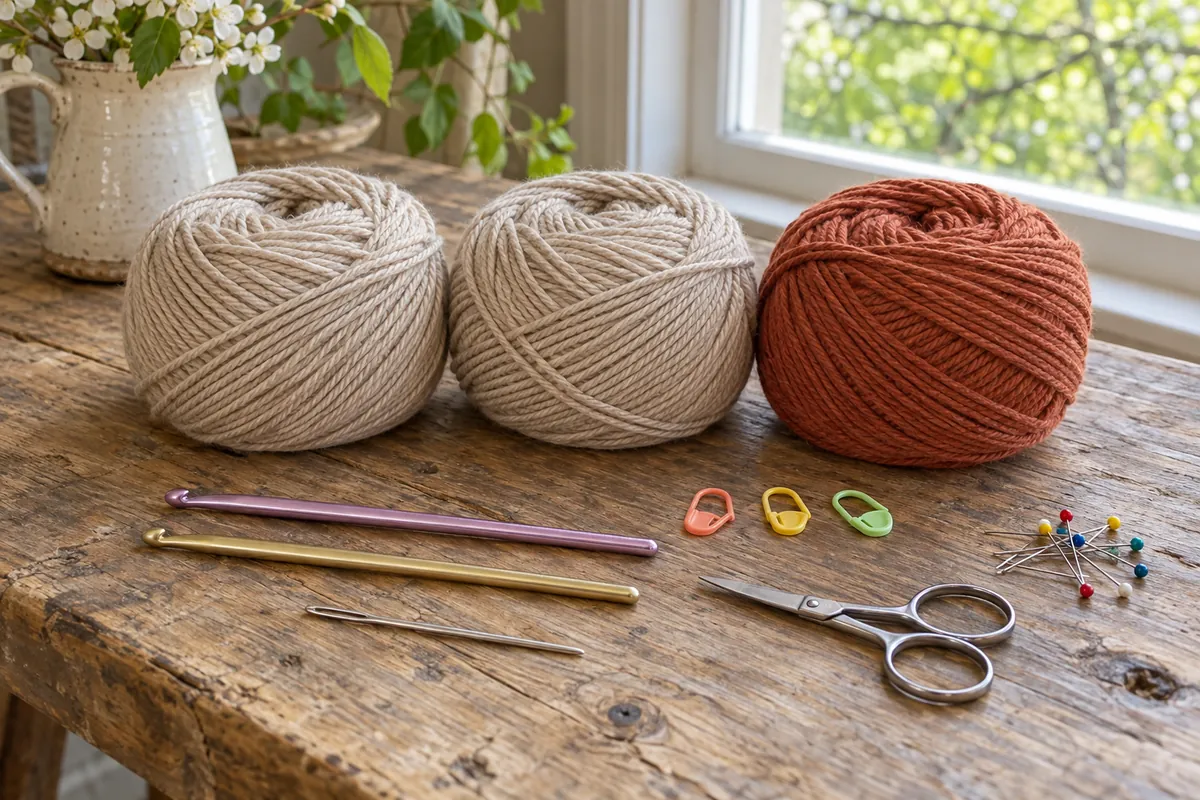
Oatmeal for the field, terracotta for the year and the frame
Oatmeal (A) is the whole field. It’s light enough that each eyelet throws a small shadow, and quiet enough that the year is the first thing anyone sees. Terracotta (B) does two jobs: it makes the digits, and it frames the blanket in four border rounds, so the year and the edge look like they belong together.
Some other pairs that keep the year easy to read:
- Clay Road: oatmeal and terracotta, as written in the card.
- Pine Needle: natural cream with a deep pine green year and border.
- Lake Champlain: pale stone gray with denim blue.
- Cranberry Bog: ecru with a dark cranberry.
- Honey Jar: oatmeal with mustard gold, a softer contrast.
For a graduation gift, school colors are the obvious choice. Use the lighter school color for the body and the darker one for the year. Before you buy, set the two skeins side by side and take a photo in black and white. If the two colors turn into the same gray, the digits will fade into the background too, so pick a deeper shade for the year.
Throw or twin, with the year in the same place on both
Both sizes use the same 15-stitch digit boxes, so the year comes out the same size, about 25 in (64 cm) wide with each digit about 8 5/8 in (22 cm) tall. The twin simply adds width and two more eyelet bands on each side of the center. The card is written as Throw [Twin], and every figure is an estimate.
- Throw, about 49 3/4 × 60 1/2 in (126 × 154 cm): chain 145 for 143 double crochet, 95 rows with 6 eyelet bands; border rounds of 666, 674 and 682 sc, then 682 reverse sc; about 2,000 yd oatmeal (10 skeins) and 300 yd terracotta (2 skeins).
- Twin, about 65 3/4 × 90 in (167 × 229 cm): chain 193 for 191 double crochet, 143 rows with 10 eyelet bands; border rounds of 954, 962 and 970 sc, then 970 reverse sc; about 4,020 yd oatmeal (21 skeins) and 410 yd terracotta (3 skeins).
For a custom width, use any chain that’s a multiple of 6 plus 1. That always gives an odd number of stitches, so the year can be centered with the same number of plain stitches on each side. For length, each extra eyelet band with its 9 plain rows adds about 7 3/8 in (19 cm); add the same number above and below the center panel so the year stays in the middle.
Keeping 143 stitches honest and the four digits level
Count every eyelet row as you go. On the throw there are 23 eyelets [31 on the twin], with exactly 5 double crochet between them and 5 at each end. If the last group comes out with 4 or 6, you’ve drifted, and it’s far easier to fix on that row than three rows later.
If your stitch count drops by one, the last double crochet missed the top of the chain 3. If it grows by one, you forgot to skip the first stitch. Check the end of each row before you turn.
When you reach Row 41 [65], clip a marker into the side edge. Do the same at Row 55 [79]. Those are the bottom and top rows of the year, and the markers save you from counting 41 rows on a damp, blocked blanket later.
Block the blanket before you pin a single digit. Cotton blends relax when they’re wet, and a year placed on unblocked fabric can end up crooked once it dries.
Pin the points of all four digits before you chain anything, then step back across the room. A misplaced point is obvious from there and invisible up close.
US crochet terms
The pattern
Materials
- Worsted weight yarn (#4 medium), cotton-acrylic blend, estimate:
- A, Oatmeal: 2,000 [4,020] yd (1,830 [3,680] m), about 10 [21] skeins of 200 yd (183 m)
- B, Terracotta: 300 [410] yd (275 [375] m), about 2 [3] skeins of 200 yd (183 m), for the border and the year
- 5.5 mm (I-9) crochet hook
- 6.5 mm (K-10½) crochet hook for the year cords
- Yarn needle
- 3 removable stitch markers
- About 50 straight pins with large heads
Gauge
12 dc and 6 1/2 rows = 4 in (10 cm) in dc rows with the 5.5 mm hook, after blocking. This gauge is an estimate: check it on a swatch about 8 in (20 cm) square before you start.
Finished size
- Throw: about 49 3/4 × 60 1/2 in (126 × 154 cm)
- Twin: about 65 3/4 × 90 in (167 × 229 cm)
- After blocking, border included. Each digit is about 4 2/3 × 8 5/8 in (12 × 22 cm); a 4-digit year is about 25 in (64 cm) wide.
Abbreviations
- ch chain
- dc double crochet
- rep repeat
- RS right side
- sc single crochet
- sk skip
- sl st slip stitch
- sp(s) space(s)
- st(s) stitch(es)
- yo yarn over
Notes
- Sizes are written as Throw [Twin]. A number given once applies to both sizes.
- Stitch multiple: the foundation chain is a multiple of 6 + 1 (rows of a multiple of 6 + 5 sts). Any chain on this multiple keeps the eyelets symmetrical and lets the year sit in the center.
- Ch 3 counts as a dc throughout, and every stitch count includes it.
- Dc row: Ch 3 (counts as dc), turn, sk the first st, dc in each st across, working the last dc in the 3rd ch of the turning ch-3.
- In the eyelet row, each ch-1 sp replaces a skipped st and counts as 1 st.
- In the border, ch 1 at the start of a round does not count as a st.
- Reverse sc (special stitch): working from left to right without turning, insert hook in the next st to the right, yo, pull up a loop, yo, pull through both loops on hook. The loops twist into a rope-like edge.
- The whole body is worked in A. The border and the year are worked in B.
- Clip a marker to the RS of Row 1.
- All yardage is an estimate. Add the year after the border and blocking.
Instructions
Body
- Foundation: With A and the 5.5 mm hook, ch 145 [193].
- Row 1 (RS): Dc in 4th ch from hook (the 3 skipped ch count as the first dc), dc in each ch across. (143 [191] dc)
- Rows 2–8: Work dc rows. (143 [191] dc)
- Row 9 (eyelet row): Ch 3 (counts as dc), turn, sk the first st, dc in each of the next 4 sts, *ch 1, sk the next st, dc in each of the next 5 sts; rep from * across, working the last dc in the 3rd ch of the turning ch-3. (143 [191] sts, including 23 [31] ch-1 sps)
- Row 10: Ch 3 (counts as dc), turn, sk the first st, dc in each dc and in each ch-1 sp across, working the last dc in the 3rd ch of the turning ch-3. (143 [191] dc)
- Rows 11–19: Work dc rows. (143 [191] dc)
- Rows 20–31 [20–55]: Rep Rows 8–19 1 [3] more time(s). The piece measures about 19 [34] in. (143 [191] dc; 2 [4] eyelet rows)
- Rows 32–34 [56–58]: Work as Rows 8–10. (143 [191] dc)
- Rows 35–61 [59–85]: Work dc rows. Clip a marker to the side edge of Row 41 [65] and of Row 55 [79] as you work them. (143 [191] dc)
- Rows 62–64 [86–88]: Work as Rows 8–10. (143 [191] dc)
- Rows 65–73 [89–97]: Work dc rows. (143 [191] dc)
- Rows 74–85 [98–133]: Rep Rows 62–73 1 [3] more time(s). (143 [191] dc)
- Rows 86–88 [134–136]: Work as Rows 8–10. (143 [191] dc)
- Rows 89–95 [137–143]: Work dc rows. Fasten off. The body measures about 47 3/4 × 58 1/2 [63 3/4 × 88] in and has 95 [143] rows and 6 [10] eyelet rows. (143 [191] dc)
Border
- Round 1: With RS facing, the 5.5 mm hook and B, join with sl st in the top of the ch-3 at the beginning of Row 95 [143] (top right corner), ch 1, 3 sc in the same st, sc in each of the next 141 [189] sts, 3 sc in the last st (corner); working down the side edge, 2 sc in the end of each row from Row 94 [142] to Row 2; working along the foundation edge, 3 sc at the base of the last st of Row 1 (corner), sc at the base of each of the next 141 [189] sts, 3 sc at the base of the ch-3 at the beginning of Row 1 (corner); working up the other side edge, 2 sc in the end of each row from Row 2 to Row 94 [142]; join with sl st to the first sc. (666 [954] sc: 141 [189] on the top and bottom edges and 186 [282] on each side between corners, plus 3 in each corner)
- Round 2: Ch 1, sc in each sc around, working 3 sc in the center sc of each corner; join with sl st to the first sc. (674 [962] sc: 143 [191] on the top and bottom edges and 188 [284] on each side between corners, plus 3 in each corner)
- Round 3: Ch 1, sc in each sc around, working 3 sc in the center sc of each corner; join with sl st to the first sc. (682 [970] sc: 145 [193] on the top and bottom edges and 190 [286] on each side between corners, plus 3 in each corner)
- Round 4: Ch 1, reverse sc in each sc around, working from left to right and keeping the sts relaxed; join with sl st to the first st. Fasten off and weave in all ends. (682 [970] reverse sc)
- Blocking: Pin the blanket flat to the finished size, mist it until damp and let it dry completely.
Year
- Grid: Lay the blanket RS up with Row 1 at the bottom. The year fills 4 boxes, each 15 sts wide and 15 rows tall, in Rows 41–55 [65–79] (the marked rows). Counting body sts from the left edge (border not included), Box 1 covers sts 35–49 [59–73], Box 2 sts 55–69 [79–93], Box 3 sts 75–89 [99–113] and Box 4 sts 95–109 [119–133].
- Points: Each point below is written (column, row) inside its box. Column 1 is the box’s first st on the left; row 1 is Row 41 [65]. A point sits at the center of that st in that row. For example, point (3, 15) in Box 1 is st 37 [61] of Row 55 [79].
- Mark: For each digit of your year, push a pin into every point of that digit, in its box. The cord runs in straight lines from point to point, in the order listed.
- Trial cord: Before the first digit, ch 20 holding 2 strands of B together with the 6.5 mm hook and sew it onto your swatch. Adjust your tension until the cord looks like a solid line about 3/8 in (1 cm) wide.
- Cord: Holding 2 strands of B together, with the 6.5 mm hook, ch to fit, laying the chain along the pinned points as you go. Stop when it covers the shape exactly and fasten off, leaving a 24 in (60 cm) tail. The ch counts below are a guide only. Thread the starting tail back through the chain with the yarn needle.
- Sew: Pin the cord over the points, gently stretched so it doesn’t wave. With the long tail and the yarn needle, whipstitch over the chain, catching the tops of the fabric sts without going through to the back where you can, and add an extra stitch at every corner point. Weave in the end on the wrong side.
- 0 (1 cord, about 60 ch): (3, 15), (13, 15), (15, 13), (15, 3), (13, 1), (3, 1), (1, 3), (1, 13), back to (3, 15).
- 1 (1 cord, about 25 ch): (5, 12), (8, 15), (8, 1).
- 2 (1 cord, about 50 ch): (1, 13), (3, 15), (13, 15), (15, 13), (15, 10), (1, 1), (15, 1).
- 3 (1 cord, about 55 ch): (1, 15), (15, 15), (7, 9), (13, 9), (15, 7), (15, 3), (13, 1), (3, 1), (1, 3).
- 4 (1 cord, about 50 ch): (11, 1), (11, 15), (1, 5), (15, 5). The cord crosses the stem at (11, 5).
- 5 (1 cord, about 55 ch): (15, 15), (1, 15), (1, 9), (13, 9), (15, 7), (15, 3), (13, 1), (1, 1).
- 6 (1 cord, about 65 ch): (14, 15), (3, 15), (1, 13), (1, 3), (3, 1), (13, 1), (15, 3), (15, 7), (13, 9), (1, 9).
- 7 (1 cord, about 35 ch): (1, 15), (15, 15), (6, 1).
- 8 (2 cords, about 35 ch each): top cord (3, 15), (13, 15), (15, 13), (15, 11), (13, 9), (3, 9), (1, 11), (1, 13), back to (3, 15); bottom cord (13, 9), (15, 7), (15, 3), (13, 1), (3, 1), (1, 3), (1, 7), (3, 9), so both ends meet the middle line of the top cord.
- 9 (1 cord, about 65 ch): (2, 1), (13, 1), (15, 3), (15, 13), (13, 15), (3, 15), (1, 13), (1, 9), (3, 7), (15, 7).
- Example, 2027: Box 1 = 2, Box 2 = 0, Box 3 = 2, Box 4 = 7.
Washing an oatmeal blanket with a terracotta year on it
Terracotta and other warm, deep shades can bleed onto a light body. Before the first wash, dampen a bit of the border and press it with a white paper towel. If any color transfers, wash the blanket on its own in cold water with a color catcher sheet.
A cotton-acrylic blend can go in the machine on a gentle, cold cycle. Slip it into an old duvet cover or a large mesh laundry bag first, so the cords can’t catch. Wash the twin in a large front-loader, since it gets heavy when wet.
Tumble dry on low and take the blanket out while it’s still slightly damp, then lay it flat and smooth the digits with your palms. Don’t hang it from a line or a door: the weight stretches the double crochet, and a stretched panel pulls the year out of shape.
After each wash, run your fingers along every cord. If a stitch has worked loose, sew it down again right away with a length of terracotta before the cord starts to lift.
Mile Marker Afghan questions
My year has a 1 in it. Will it look lopsided?
A 1 sits on the center column of its box, so it has extra room on both sides. Keep the boxes where the card puts them anyway: from a few steps back the spacing reads like normal type, and the year stays centered.
How far away can you read the year on this personalized crochet blanket?
Each digit is about 8 5/8 in (22 cm) tall, and the doubled cord makes a line about 3/8 in (1 cm) wide, so the year is readable from across a bedroom or a dorm room. A single strand of worsted would blend into the texture of the fabric after a few steps. That’s why the cord is chained with two strands on a larger hook.
Can I crochet the numbers straight onto the blanket instead of sewing them?
That would be surface slip stitch, a different technique where the hook shapes each line as you go. It’s harder to keep even, and a wobble is much harder to fix. A sewn cord can be pinned, lifted and pinned again until every point sits right, which makes it the forgiving choice for big digits.
Will the cords stay flat through the wash?
They will if they’re sewn down along their whole length. Space your whipstitches about one per chain, catch the top of a fabric stitch each time and add an extra stitch at every corner. A cord that is only tacked at the ends will twist in the machine.
Why are my eyelet bands narrower than the plain rows?
Usually the chain 1 is tighter than your double crochet, or the next row went into the chain instead of the space. Loosen the chain and count 143 [191] stitches after each band. Blocking evens out a small difference, not lost stitches.
Quick recap
- Chain 145 [193] and work double crochet rows, with an eyelet band at Rows 8–10 and every 12 rows after.
- Work the 27-row plain center panel, marking Rows 41 and 55 [65 and 79], then mirror the eyelet bands to Row 95 [143].
- Work three rounds of single crochet and one round of reverse single crochet in terracotta, then block.
- Pin the points of your year in the four boxes and chain each cord to fit with two strands held together.
- Sew every cord down along its whole length and weave in the ends.
Once the last cord is sewn, fold the blanket with the year facing out and let it wait for moving day. If a count in this personalized crochet blanket doesn’t match what’s on your hook, or a digit won’t sit right on the grid, send a note through the Contact page.