Little Fern Baby Blanket
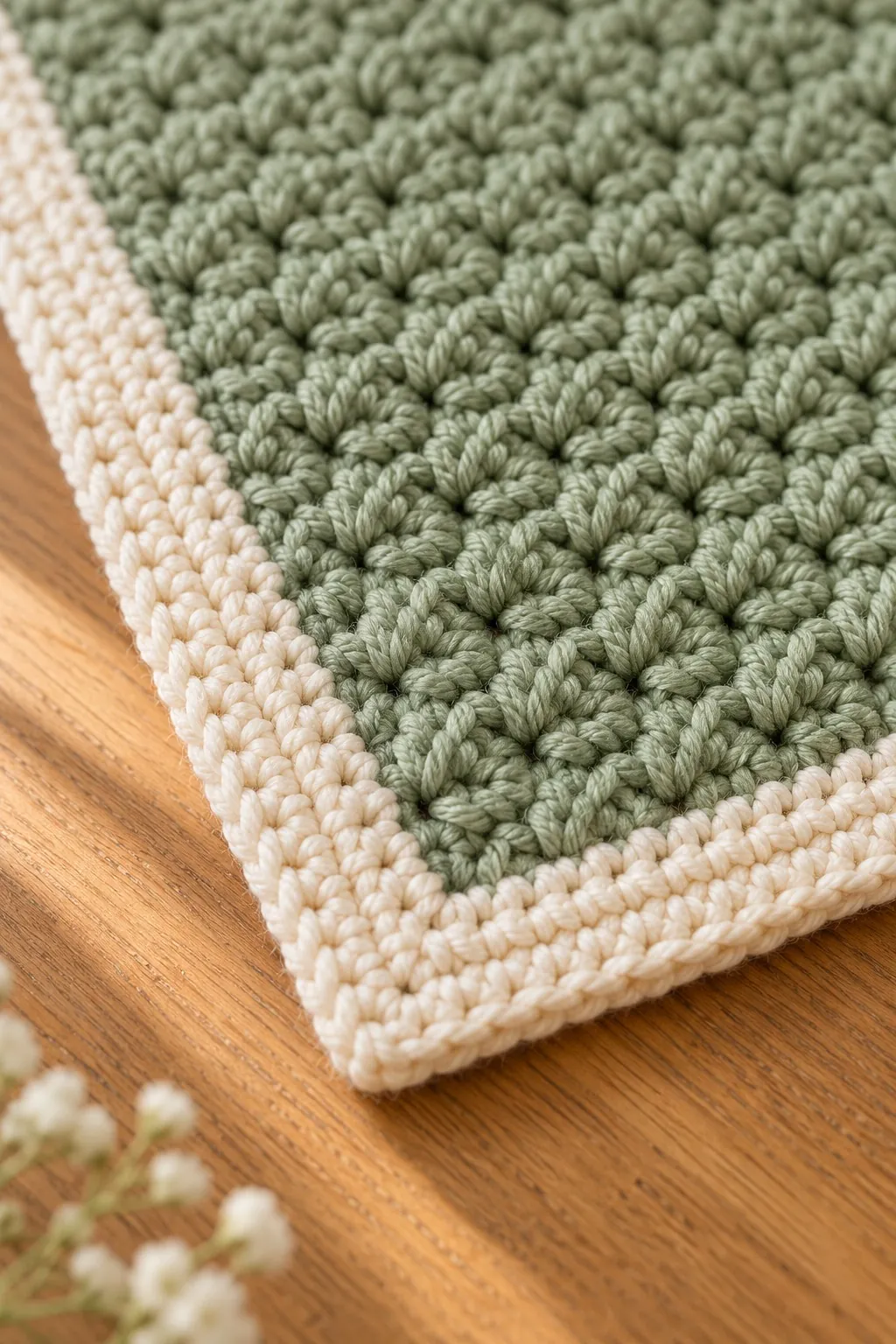
In May the ferns along the stone wall behind my house unroll almost overnight, and that soft, grayish green is the color I wanted for this one. Little Fern is a DK baby blanket crochet pattern in a single sage shade, finished with a narrow cream border. The body is worked in the suzette stitch, so every row is a line of tiny two-stitch clusters that lean a little to one side, like the leaflets on a fern frond.
DK yarn gives you a lighter blanket than the chunky ones everywhere right now. It folds small enough for a diaper bag and drapes softly over a stroller on a cool spring morning. The pattern is written for a stroller size of about 30 × 36 in (76 × 91 cm), and three more sizes follow below.
Is this DK baby blanket crochet pattern a good first baby gift?
Yes, if you’re comfortable with a chain, a single crochet and a double crochet. Those three are the whole body. The border is three rounds of single crochet, and the only extra move is a slip stitch to join the cream yarn and close each round: insert your hook, yarn over, and pull the loop through the stitch and the loop on your hook at once.
The suzette stitch is a one-row repeat. You work a single crochet and a double crochet into the same stitch, skip the next stitch, and do it again. After Row 1, every row is identical: each little cluster goes into a single crochet of the row below, and every double crochet from the row below gets skipped. Each row ends with one lonely single crochet at the edge.
You’ll see the clusters written as (sc, dc) in next sc. The parentheses mean both stitches go into the same spot. If that notation, the asterisks or the rep from * still look like a puzzle, the Beginner Guide walks you through reading a crochet pattern line by line.
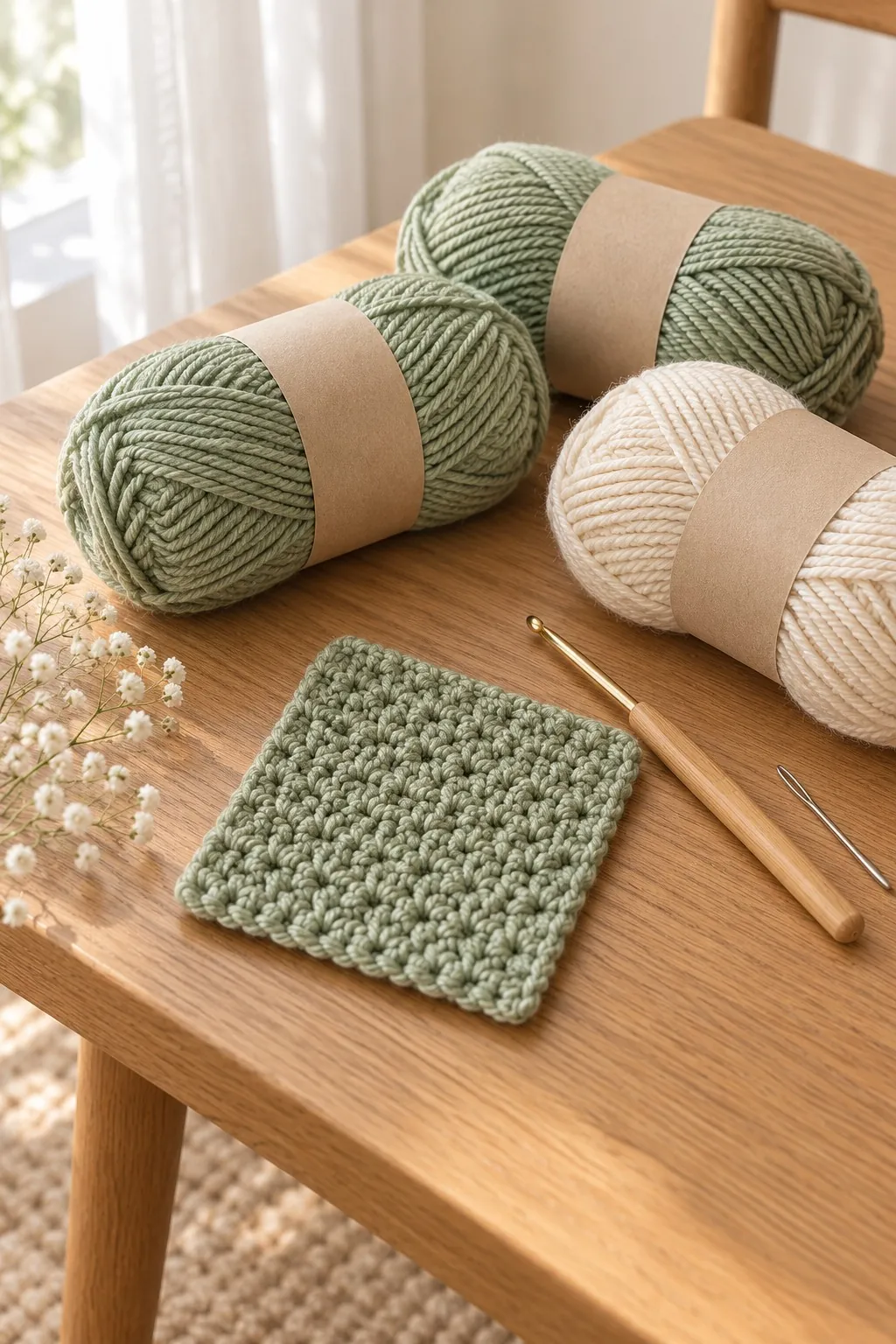
A soft DK yarn that suits a sage baby blanket
Look for the number 3 on the label. That’s the light weight symbol, which covers DK and light worsted, and the hook suggested on the band will usually sit between 3.5 and 4.5 mm. I go to the top of that range here, a 4.5 mm (US 7), because the double crochet in every cluster makes the fabric thicker than plain single crochet, and a baby blanket should bend, not stand up on its own.
For a baby, washability comes first. Soft baby acrylic goes through the machine and keeps its color. A cotton and acrylic blend feels cooler for summer, though it has less give, so uneven tension shows a little more. Superwash merino is lovely and warm, but check that it really can go in the washer. Skip mohair, eyelash yarn and anything fuzzy or loopy: fibers that shed and loops that catch tiny fingers don’t belong on a baby blanket.
Buy all the sage in one go and check that each label carries the same dye lot number. In a one-color body, two lots can show up as a faint band across the middle. The cream border only needs about 100 yd (91 m), so one skein covers it.
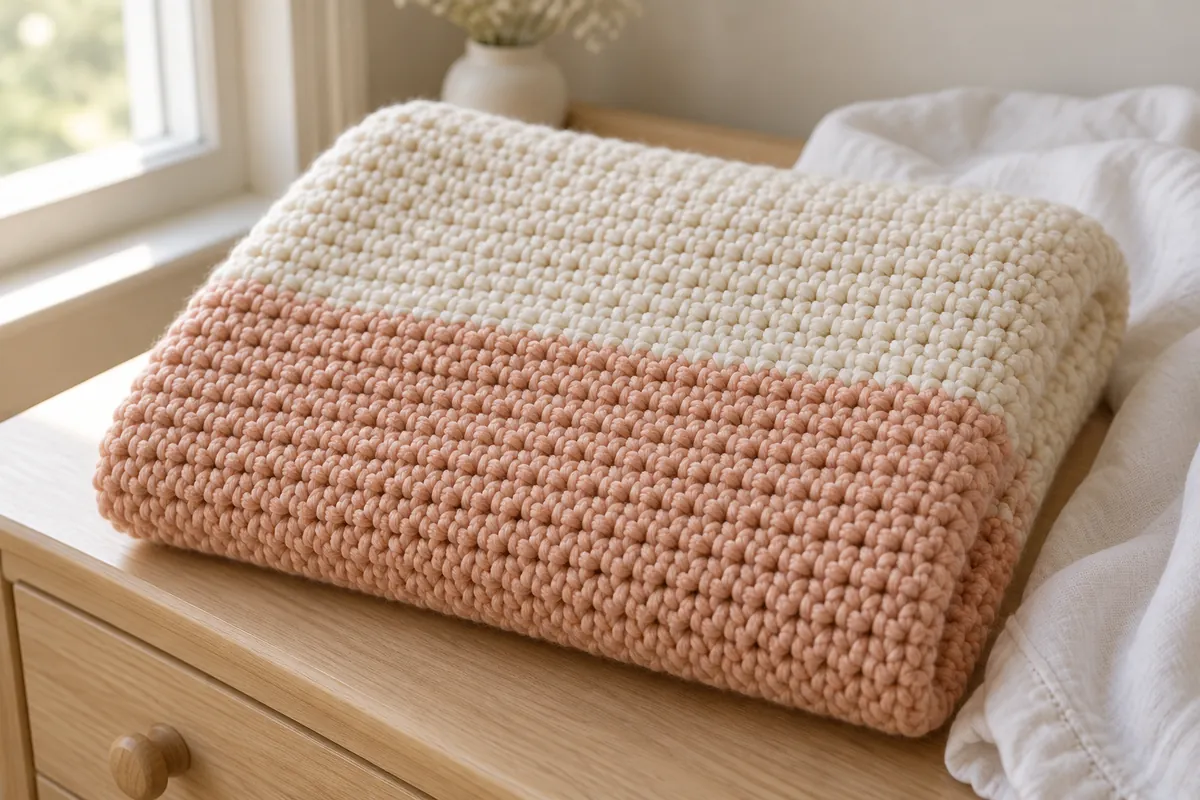
DK skeins vary a lot in length, from roughly 120 yd in a 50 g ball to almost 300 yd in some 100 g skeins, so always compare yardage, never the number of skeins. Then make the swatch from the pattern card. If you get 20 stitches over 4 in instead of 18, your blanket comes out almost 3 in narrower. And if you’d rather finish faster with thicker yarn, my peach and cream stripes in bulky single crochet make a stroller blanket in far fewer rows.
Sage with a cream edge, and four other pairings
The body color has one job: catching enough light that the clusters show. Mid-light solids do that best. Dark navy or charcoal hide the texture, and variegated yarn breaks it up into blotches. The border color frames the blanket, so a lighter or warmer shade than the body gives you that crisp outline you see in the photo.
A few pairs I’d happily make:
- Little Fern: sage body with a cream border, as shown.
- Lake morning: soft denim blue with a cream border, very Vermont in June.
- Buttercup: pale yellow with a bright white edge, nice for a spring baby.
- Pebble path: light heathered gray with a white edge, which hides everyday marks well.
- Rose and oat: oatmeal body with a dusty rose border.
One practical tip: since the border uses so little yarn, it’s tempting to grab a leftover. That’s fine, as long as it’s the same weight and has the same washing instructions as the body. A border that shrinks or bleeds in the wash will pucker the whole edge.
Little Fern sizes, from pram blanket to toddler
All sizes use the same gauge of 18 stitches and 16 rows over 4 in. The chain is always an even number, and the body has one stitch fewer. The row count is chosen so that the rows minus 2 divide by 8, which keeps the side repeat of the border tidy. The pattern card is written for the stroller size. Yardage is an estimate, rounded up to the next 50 yd, so add a skein if you tend to crochet loosely.
- Pram, about 24 × 28 in (61 × 71 cm): ch 104, 103 sts, 106 rows; border 448, 456, then 464 sc; about 700 yd (640 m) sage and 100 yd (91 m) cream.
- Stroller, about 30 × 36 in (76 × 91 cm): ch 130, 129 sts, 138 rows; border 572, 580, then 588 sc; about 1,100 yd (1,006 m) sage and 100 yd (91 m) cream.
- Play mat, about 36 × 36 in (91 × 91 cm): ch 158, 157 sts, 138 rows; border 628, 636, then 644 sc; about 1,350 yd (1,234 m) sage and 100 yd (91 m) cream.
- Toddler, about 40 × 50 in (102 × 127 cm): ch 176, 175 sts, 194 rows; border 790, 798, then 806 sc; about 2,100 yd (1,920 m) sage and 100 yd (91 m) cream.
For any size, Round 1 of the border has the number of body stitches plus 4 across the top and bottom, corners included. Each side gets one sc per row end, from the second row to the second-to-last row, plus one extra sc for every 8 of those rows. Rounds 2 and 3 each add 8 stitches. The play mat is meant for supervised floor time, and the toddler size is for children over 12 months.
Keeping 64 clusters on every row of Little Fern
- Chain loosely. A tight chain pinches the bottom edge, and the border makes it more obvious. If your chains run snug, make them with a 5 mm hook and switch to the 4.5 mm for Row 1.
- Count the double crochets. Every row of the stroller size has 64 of them. Counting dc is much faster than counting all 129 stitches.
- Watch the last stitch. The final single crochet of a row sits tight against the edge, right beside the turning chain. Clip a stitch marker into it, and on the way back your first cluster goes straight into the marked stitch.
- Leave the turning chain alone. The ch 1 at the start of each row doesn’t count. Working into it adds a stitch, and the blanket slowly grows wider.
- Keep both stitches in one hole. The sc and the dc of a cluster share the same stitch. If the dc drifts into the next stitch, you’ve lost the skip, and the row comes out long.
- Measure every 16 rows. That’s 4 in (10 cm) at the right gauge. If you need fewer rows to get there, your tension has loosened, and you can switch to a 4 mm hook.
- Join new skeins at the edge. Leave 6 in (15 cm) tails at the start of a row and weave them into the side.
US crochet terms
The pattern
Materials
- Yarn: DK weight (#3 light) yarn in baby acrylic, a cotton-acrylic blend or superwash merino, about 1,200 yd (1,097 m) in total
- Color A, sage green: about 1,100 yd (1,006 m), all from one dye lot (for example, 5 skeins of about 230 yd / 210 m each)
- Color B, cream: about 100 yd (91 m), 1 skein
- Hook: 4.5 mm (US 7)
- Optional: 5 mm (US H-8) hook for the foundation chain
- Yarn needle, 2 stitch markers, scissors, measuring tape
Gauge
- 18 sts and 16 rows = 4 in (10 cm) in suzette stitch, counting each sc and each dc as 1 st
- Swatch: with A, ch 22 and work Row 1 (10 clusters and 1 sc: 21 sts), then rep Row 2 until the swatch measures about 5 in (13 cm), about 20 rows. Measure 4 in (10 cm) across the middle.
- Too many sts per 4 in: try a larger hook. Too few: try a smaller one.
Finished size
- About 30 × 36 in (76 × 91 cm) with the border, before blocking
- Body before the border: about 28¾ × 34½ in (73 × 88 cm)
Abbreviations
- ch chain
- sc single crochet
- dc double crochet
- sl st slip stitch
- sk skip
- st(s) stitch(es)
- rep repeat
Notes
- Cluster: (sc, dc) in the same st. Each cluster counts as 2 sts.
- The ch 1 at the start of each row does not count as a st. Never work into it.
- Every body row has 64 clusters and 1 sc at the end: 129 sts, including 64 dc.
- From Row 2 on, every cluster is worked into a sc of the row below, and every dc of the row below is skipped.
- Each row ends with 1 sc in the last sc. This edge st is easy to miss: mark it with a stitch marker before you turn.
- The body looks almost the same on both sides. Work the border with your favorite side facing.
- Join a new skein at the start of a row, leaving 6 in (15 cm) tails to weave in along the side edge.
- The sides of the border get 9 sc for every 8 rows so they lie flat. If a side ruffles, work 1 sc in each row end instead; if it pulls in, add an extra sc more often.
- Safety: use this blanket while the baby is awake, in the stroller, for cuddles or supervised floor time. Babies under 12 months should not sleep with a loose blanket. Do not add buttons or other small decorations.
- To change the size, chain any even number (the body has 1 st fewer than the chain) and work a number of rows where rows − 2 is a multiple of 8. Border Round 1 then has (sts + 4) sc across top and bottom, corners included, and (rows − 2) + (rows − 2) ÷ 8 sc along each side. Rounds 2 and 3 each add 8 sc.
Instructions
Body
- Foundation: With A, loosely ch 130.
- Row 1: (Sc, dc) in 2nd ch from hook, *sk next ch, (sc, dc) in next ch; rep from * to last 2 ch, sk next ch, sc in last ch. (64 clusters and 1 sc: 129 sts)
- Row 2: Ch 1, turn. (Sc, dc) in first sc, *sk next dc, (sc, dc) in next sc; rep from * to last 2 sts, sk next dc, sc in last sc. (64 clusters and 1 sc: 129 sts)
- Rows 3–138: Rep Row 2. (138 rows; body measures about 28¾ × 34½ in / 73 × 88 cm)
- Fasten off A.
Border
- Round 1: Turn the blanket so you can work back across Row 138. Join B with sl st in the last sc of Row 138, ch 1. Working across Row 138: 3 sc in same st (corner), sc in each st across to last st (127 sc), 3 sc in last st (corner). Working down the side, into the ends of Rows 137 to 2: [sc in end of next 7 rows, 2 sc in end of next row] 17 times (153 sc). Working in the free loops of the foundation chain: 3 sc in the loop at the base of the last sc of Row 1 (corner), sc in each free loop across to the loop at the base of the first cluster of Row 1 (127 sc), 3 sc in that loop (corner); the single extra ch beside it stays empty. Working up the other side, into the ends of Rows 2 to 137: [sc in end of next 7 rows, 2 sc in end of next row] 17 times (153 sc). Join with sl st to first sc. (572 sc: 133 across top and bottom, corners included, and 153 along each side)
- Round 2: Ch 1, do not turn. Sc in same st as join, 3 sc in next sc (corner), [sc in each sc to center sc of next corner, 3 sc in center sc] 3 times, sc in each remaining sc. Join with sl st to first sc. (580 sc: 137 across top and bottom, corners included, and 153 along each side)
- Round 3: Ch 1, do not turn. Sc in same st as join and in next sc, 3 sc in next sc (corner), [sc in each sc to center sc of next corner, 3 sc in center sc] 3 times, sc in each remaining sc. Join with sl st to first sc. (588 sc: 141 across top and bottom, corners included, and 153 along each side)
- Finishing: Fasten off and weave in all ends securely, going back and forth at least twice.
Washing a sage blanket with a cream border
Start with the yarn label, since care depends on the fiber. Most baby acrylics and cotton blends can go in the machine on a gentle cycle in cool water, inside a mesh laundry bag. Superwash merino usually wants the wool setting and a mild wool wash.
For the first wash, add a color catcher sheet. Sage dyes rarely run, but a little bleed onto the cream border would be a shame. Rinse spit-up and milk under cold water as soon as you can. Hot water sets those stains, and the cream edge shows them first.
Dry the blanket flat on a towel, or tumble on low if the label allows it. Never iron acrylic: heat flattens the clusters and can make the yarn limp and shiny for good. Every few washes, run your fingers along the border and the side edges, and weave back any tail that has worked loose before the blanket goes back to the baby.
Little Fern questions from first-time baby blanket makers
Can I make this DK baby blanket crochet pattern with worsted yarn?
You can, but the blanket grows. Worsted suzette on a 5.5 mm hook often lands around 15 stitches over 4 in, which turns the same 129 stitches into a blanket roughly 34 in wide. Make a swatch, multiply your stitches per inch by the width you want, round to an odd number, and chain one more. Expect to need more yardage too.
My rows keep coming up one stitch short. What am I missing?
Almost always, it’s the last single crochet of the row, the small one tucked against the edge. Count your double crochets every few rows: 64 on every row of the stroller size. If one row comes up short, pull it back and work it again with a marker in that last stitch.
Is it safe to give this to a newborn?
Yes, for awake time: in the stroller, during cuddles, or spread on the floor while you watch. Babies under 12 months shouldn’t sleep with any loose blanket, so mention that on the gift tag. Keep it free of buttons and beads, and weave every end in securely.
How do I make it longer without changing the border?
Add rows in groups of 8, so the side repeat still fits. Each 8 rows add about 2 in (5 cm) of length, roughly 65 yd (59 m) of sage at the stroller width, and 9 sc to each side of the border, which means 18 more sc in every round.
Does the suzette stitch have a right side?
Not really. The clusters look almost the same on both faces. The only small difference shows at the border, where the slip stitch joins sit on the side that was facing you.
Quick recap
- Swatch to 18 sts and 16 rows over 4 in with a 4.5 mm (US 7) hook.
- With sage, loosely ch 130 and work Row 1: 64 clusters and 1 sc (129 sts).
- Rep Row 2 until you have 138 rows, then fasten off.
- Join cream and work 3 rounds of sc, with 3 sc in each corner (572, 580, then 588 sc).
- Weave in the ends securely and wash the blanket as the yarn label says.
I hope this DK baby blanket crochet pattern brings a bit of spring green into a new baby’s first months. If a row count stops adding up, or you’d like a size I haven’t listed, send me a note and we’ll sort it out together.