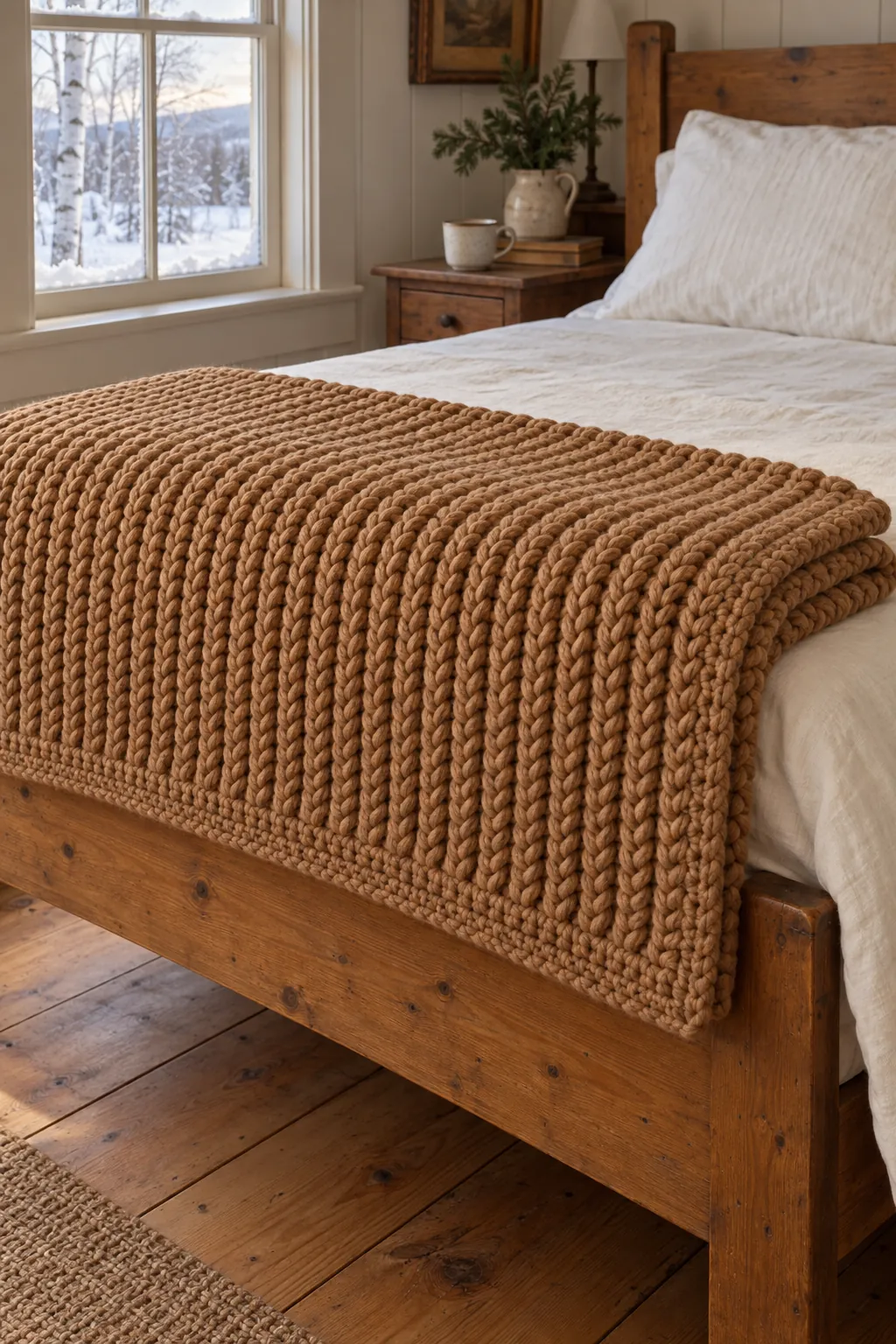
Picture a March morning at a Vermont sugarhouse, steam rolling off the evaporator while the syrup darkens to caramel. The Sugarbush Blanket brings that color to a bed. It’s a chunky post stitch crochet blanket in a single shade of super bulky yarn, and every stitch wraps around the stitch below it, so the fabric stacks up in thick raised columns that look almost knitted.
There’s no color change and no repeat to memorize. After the first row you alternate two rows: back post single crochet on the wrong side, front post single crochet on the right side, with a plain single crochet at each end. The card gives a twin at about 66 × 90 in (168 × 230 cm) and a full at about 80 × 90 in (203 × 230 cm), each finished with three rounds of single crochet.
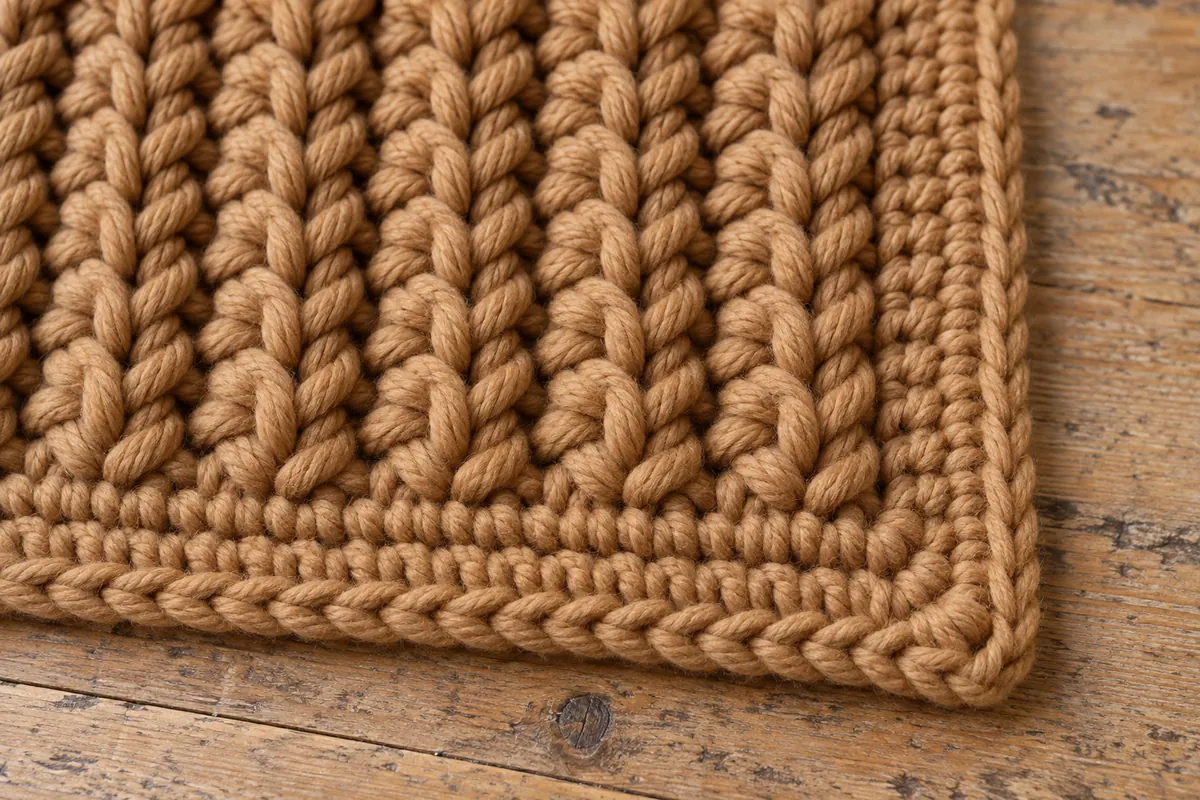
Is this chunky post stitch crochet blanket a good next step after plain rows?
It’s marked Intermediate: post stitches are new to many crocheters, and the twin holds about 25,000 of them. There are only two, though, and they’re mirror images.
A post stitch goes around the post, the upright body of a stitch in the row below, instead of into its top two loops. For a front post single crochet (FPsc), push the hook from front to back in the gap before the stitch, then from back to front in the gap after it, so the post lies in front of your hook. A back post single crochet (BPsc) takes the opposite path, with the post behind the hook. From there you finish both like an ordinary single crochet: yarn over, pull up a loop, yarn over, pull through both loops.
Why both kinds? You turn at the end of every row. A BPsc on a wrong-side row pushes its post away from you, which is toward the right side, and an FPsc on a right-side row pushes its post toward you. Every ridge lands on the same face.
The rest is basic: a long chain, one row of single crochet into it, and a plain single crochet in the first and last stitch of every post row. That edge stitch has no gap on its outer side, so a regular single crochet keeps the sides straight and gives the border firm tops to work into. If “FPsc around each st to last st” still reads like code, the Beginner Guide walks through reading a crochet pattern.
Want the same yarn weight without the post stitches first? A one-color super bulky throw in half double crochet is a gentler start.
A smooth super bulky yarn that shows off every post
Look for a 6 and the words “super bulky” on the label. A 7, often sold as jumbo, crowds a 10 mm hook and makes post stitches stiff. Pick a round, smooth, tightly plied acrylic or acrylic-wool blend.
Skip chenille here, even though it’s sold everywhere as blanket yarn. Its velvety pile hides the gaps between stitches, and you need to find two of those gaps for every single post stitch. Loosely spun single-ply roving is the other trap: the hook splits it on the way around each post.
The 10 mm (N/P-15) hook is a size or two above what most super bulky labels suggest. Post single crochet packs tightly, and the bigger hook keeps it soft instead of board-like.
This is a lot of yarn. The twin takes about 4,285 yd (3,920 m) and the full about 5,190 yd (4,745 m), so 43 [52] skeins of 100 yd (91 m). Skein sizes vary, so divide by the yardage on your label. Buy everything in one go, from a single dye lot, and check the lot number on each label before you wind. Finished, it feels closer to a weighted blanket than a throw.
Swatch before you buy the full amount. Chain 21, work Row 1, then repeat the two post rows for about 20 rows. If it’s a wool blend, wash and dry it the way you’ll wash the blanket. In the center, you’re aiming for 8 stitches and 9 rows to 4 in (10 cm). These counts are an estimate, not a measured swatch, so your swatch decides. More rows per inch is fine, since you work to a length, but more stitches per inch makes a narrower blanket.
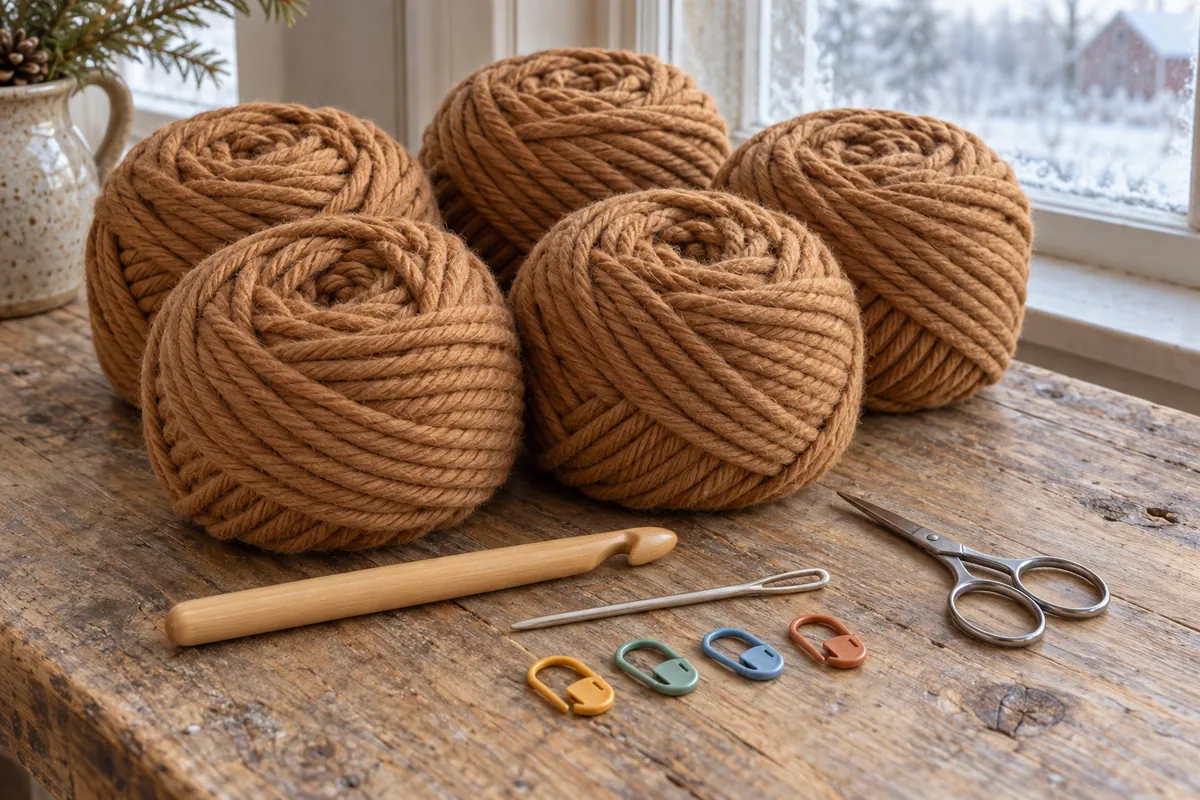
Caramel, or another single shade with good shadows
One color does the job here, because the pattern is the shadow along each raised column. Warm mid-tones show those shadows best. Very dark shades like navy or charcoal swallow them, and the blanket reads as plain from across the room.
Shades that suit the stitch:
- Sugarbush: the caramel in the card, warm on cream or white sheets.
- Birch Bark: a warm oatmeal for a quiet, farmhouse bed.
- Woodsmoke: a soft warm gray that still lets the ridges cast a line.
- Lichen: a muted sage, nice against pine furniture.
- Cranberry Bog: a deep rose-red for the coldest months.
The only easy place for a second color is the border. Work the three rounds in a darker shade, such as walnut with caramel. Then plan on about 4,030 [4,910] yd for the body, 41 [50] skeins, and about 260 [285] yd for the border, 3 skeins.
Twin and full sizes, both 200 rows long
The card is written as Twin [Full], and all yardage is an estimate.
- Twin, about 66 × 90 in (168 × 230 cm): ch 129 for 128 stitches, 200 rows; border rounds of 620, 628 and 636 sc; about 4,285 yd (3,920 m), 43 skeins of 100 yd.
- Full, about 80 × 90 in (203 × 230 cm): ch 157 for 156 stitches, 200 rows; border rounds of 676, 684 and 692 sc; about 5,190 yd (4,745 m), 52 skeins of 100 yd.
The stitch has no multiple. Chain the number of stitches you want plus 1. At this gauge, 8 stitches add about 4 in of width and 9 rows add about 4 in of length. Keep an even number of rows so you finish on a wrong-side row and start the border with the right side facing. Any custom size changes the border counts, so recount before you start: each round 1 is twice the stitches, plus twice the side count, plus 8.
Keeping 128 stitches and straight sides for 200 rows
Check the count after Row 1 and every 10 rows after that. On the twin, 128 stitches means 126 post stitches between two edge single crochets; on the full, 154 between two. A removable marker every 25 stitches makes the recount quick.
The ch 1 at the start of each row doesn’t count, and you never work into it. A row that gains a stitch almost always picked up the ch 1. A row that loses one usually skipped the edge single crochet.
If you put the work down mid-row and can’t tell which row you’re on, look at the side facing you. Raised columns toward you means a right-side row, so FPsc. The flatter back, with folded stitch tops, means a wrong-side row and BPsc.
Keep your loops relaxed. Post single crochet already pulls the rows tight.
Every 20 rows, lay the work flat and look at the columns. If they start to lean, check that you’re entering every post from the same side each time, right to left if you’re right-handed.
With 40-plus skeins, you’ll join new yarn often. Join at the start of a row, on the edge single crochet, and leave tails long enough to weave into the border later.
Twenty rows are a tenth of the body, so they should use about 400 [490] yd. If yours take noticeably more, buy extra yarn from the same dye lot now, not when you’re halfway up the bed.
Once the blanket gets heavy, let the finished part rest on a table or the floor. Its weight hanging from your lap stretches the rows. For deeper post stitch texture next time, try a bulky blanket with a raised waffle grid.
US crochet terms
The pattern
Materials
- Super bulky weight yarn (#6), smooth acrylic or acrylic-wool blend, estimated 4,285 [5,190] yd (3,920 [4,745] m), about 43 [52] skeins of 100 yd (91 m), in caramel
- Includes about 260 [285] yd (235 [260] m) for the border
- 10 mm (N/P-15) crochet hook
- Yarn needle
- Removable stitch markers
Gauge
8 sts and 9 rows = 4 in (10 cm) in the post stitch pattern (alternating BPsc and FPsc rows) with the 10 mm hook. Estimate, not a measured swatch: work a swatch of about 20 sts × 20 rows and measure in the center.
Finished size
- Twin: about 66 × 90 in (168 × 230 cm)
- Full: about 80 × 90 in (203 × 230 cm)
- Measurements include the border, which is about 1 1/2 in (4 cm) wide.
Abbreviations
- BPsc back post single crochet
- ch chain
- FPsc front post single crochet
- rep repeat
- RS right side
- sc single crochet
- sl st slip stitch
- st(s) stitch(es)
- WS wrong side
- yo yarn over
Notes
- Sizes are written as Twin [Full]. A number given once applies to both sizes.
- Stitch multiple: any number of chains (minimum 4). Foundation chain = number of sts + 1. Each 8 sts adds about 4 in of width and each 9 rows about 4 in of length.
- Row 1 is the RS. Place a marker on it. Turn at the end of every row.
- Turning chain: ch 1 at the start of every row does not count as a st. Never work into it. The ch 1 at the start of each border round does not count either.
- Edge sts: in every post row, work the first and last st as a regular sc into both top loops of the st below. Work one post st around each st in between, skipping none.
- FPsc: insert hook from front to back in the gap before the next st, then from back to front in the gap after it, so the post of the st lies in front of the hook; yo, pull up a loop around the post, yo, pull through both loops on hook.
- BPsc: insert hook from back to front in the gap before the next st, then from front to back in the gap after it, so the post of the st lies behind the hook; yo, pull up a loop around the post, yo, pull through both loops on hook.
- Post sts are worked around the sts of the row just below. WS rows are BPsc and RS rows are FPsc, so every raised column shows on the RS.
- Work loosely. The fabric is dense and the columns can lean if your hook enters the posts from different sides.
- Join new skeins at the start of a row, on the edge sc.
- If your row gauge differs, keep repeating Rows 2–3 to a body length of about 87 1/2 in (222 cm), ending with a WS row, and work the border side counts in the same proportion (about 8 sc for every 9 rows).
- The finished blanket is heavy. Let the worked part rest on a table as it grows.
Instructions
Body
- Foundation: Ch 129 [157].
- Row 1 (RS): Sc in 2nd ch from hook and in each ch across. Turn. (128 [156] sts)
- Row 2 (WS): Ch 1, sc in first st, BPsc around each st to last st, sc in last st. Turn. (128 [156] sts: 126 [154] BPsc and 2 sc)
- Row 3 (RS): Ch 1, sc in first st, FPsc around each st to last st, sc in last st. Turn. (128 [156] sts: 126 [154] FPsc and 2 sc)
- Rows 4–199: Rep Rows 2–3 another 98 times. (128 [156] sts)
- Row 200 (WS): Work as Row 2. Do not fasten off. The body measures about 63 × 87 1/2 in (160 × 222 cm) [77 × 87 1/2 in (195 × 222 cm)]. (128 [156] sts)
Border
- Round 1 (RS): With RS facing, ch 1, 3 sc in first st (corner), sc in each of next 126 [154] sts, 3 sc in last st (corner); working along the row ends of the side, work 178 sc evenly spaced (about 8 sc for every 9 rows); working in the unused loops of the foundation ch at the base of the Row 1 sts, 3 sc in first ch (corner), sc in each of next 126 [154] ch, 3 sc in next ch (corner); working along the row ends of the other side, work 178 sc evenly spaced; join with sl st to first sc. (620 [676] sc: 128 [156] across the top and bottom, 180 along each side, plus the center sc of each corner)
- Round 2: Ch 1, *sc in each st to center sc of next corner, 3 sc in center sc; rep from * 3 more times, sc in each remaining st; join with sl st to first sc. (628 [684] sc: 130 [158] across the top and bottom, 182 along each side, plus 4 corner sts)
- Round 3: Ch 1, *sc in each st to center sc of next corner, 3 sc in center sc; rep from * 3 more times, sc in each remaining st; join with sl st to first sc. Fasten off. (636 [692] sc: 132 [160] across the top and bottom, 184 along each side, plus 4 corner sts)
- Finishing: Weave in all ends along the WS of the border, then lay the blanket flat to settle.
Washing and storing a blanket this heavy
Wet super bulky yarn gets very heavy, and that shapes everything about washing this blanket. An all-acrylic version can go through a gentle cold cycle, but only in a large front-loader. A laundromat machine is the easy answer for the twin and the full. Tumble dry on low, take it out while it’s still a little damp and lay it flat to finish.
For an acrylic-wool blend, use a wool cycle or hand wash in a bathtub of cool water with a wool wash. Press the water out without wringing, roll it in towels in sections, then dry it flat across a couple of racks. Give it a full day or more.
Never hang it from a line or a door. The weight pulls the rows long and the border wavy. Store it folded on a shelf or at the foot of the bed. Between washes, shake it out and spot-clean.
Sugarbush Blanket questions
Can I make this chunky post stitch crochet blanket in worsted yarn?
You can, but it becomes a different blanket. The columns shrink to fine ribs, and a twin needs roughly twice as many stitches and rows. Swatch in the post pattern with your worsted and hook, then work out the chain and rows from your own gauge, since the counts in this card only fit super bulky.
Why do the columns lean to one side after a few rows?
Stacked post single crochet can skew if the hook doesn’t enter every post the same way. Check that you always go in from the same side and come out in the gap after the stitch. Tight tension makes the lean worse, so relax your hand or go up a hook size. Blocking won’t fully straighten columns that were worked crooked.
The raised columns show on both sides of my blanket. What went wrong?
Two rows were swapped somewhere: an FPsc row worked on the wrong side or a BPsc row on the right side. Each one sends its posts to the back. Look for the row where the ridges change sides and frog back to it. The marker on Row 1 helps you see which side is which.
Could I make a queen size from this card?
The stitch allows it: chain 178 for 177 stitches and work about 222 rows for 90 × 100 in. At this gauge, though, a queen needs well over 60 skeins of 100 yd, and the blanket gets hard to wash or even lift. Recount the border for the new size before you start it.
Why are the first and last stitches of every row plain single crochet?
The edge stitch has a gap on only one side, so a post stitch there pulls the edge in and leaves it ragged. A plain single crochet keeps the sides straight and gives Round 1 of the border a firm stitch to sit on. It’s also why every row count includes 2 regular sc.
Quick recap
- Chain 129 [157] with the 10 mm hook and work a row of sc.
- Alternate a BPsc row on the WS and an FPsc row on the RS, with a plain sc at each end.
- Repeat until you have 200 rows and the body measures about 87 1/2 in, ending with a WS row.
- Work three rounds of sc around the blanket, with 3 sc in each corner.
- Weave in the ends along the border and lay it flat.
When the last round is done, fold the Sugarbush Blanket across the foot of the bed and watch the morning light catch every raised column. If a count in this chunky post stitch crochet blanket doesn’t match what’s on your hook, send a note through the Contact page.