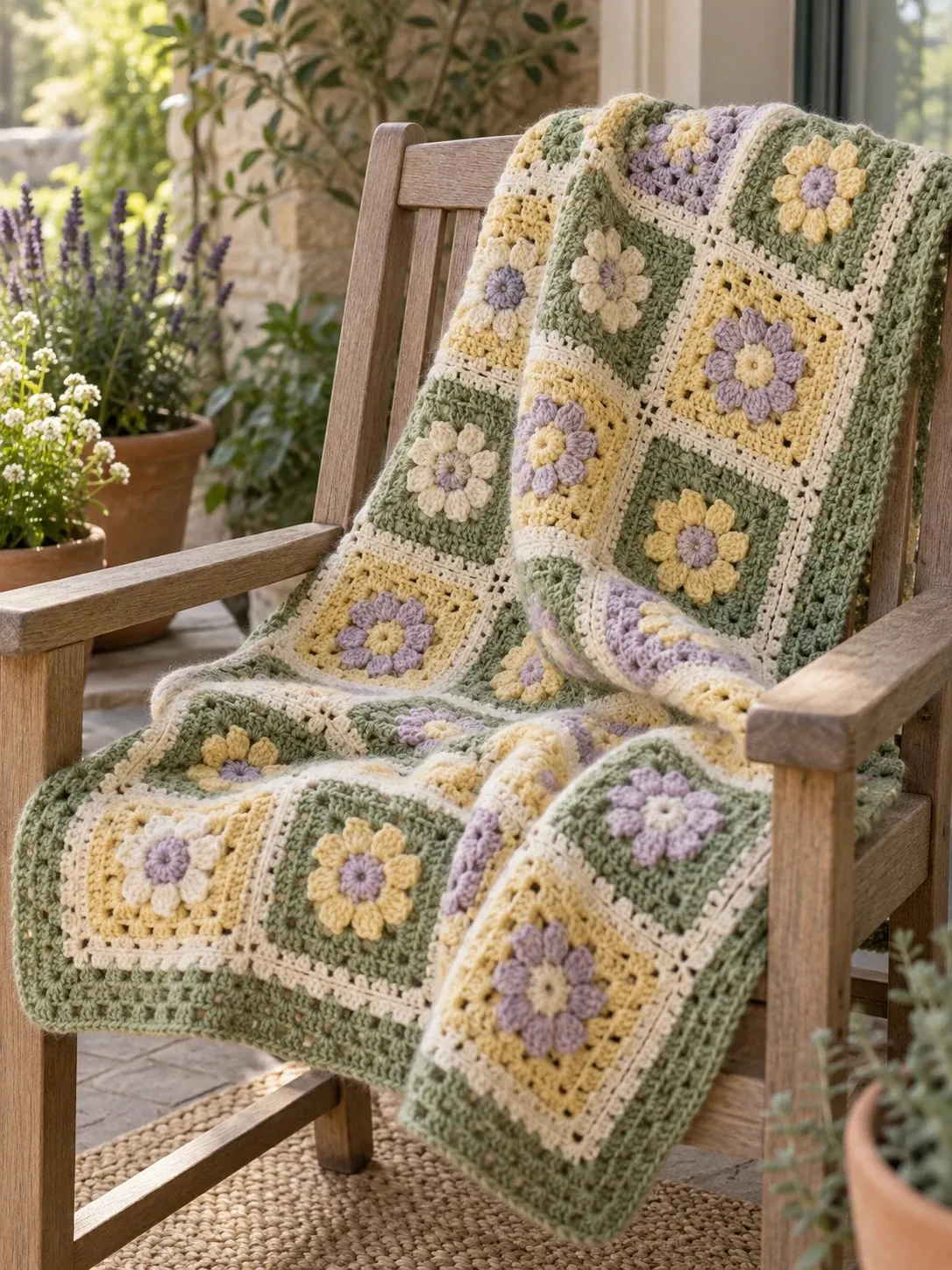
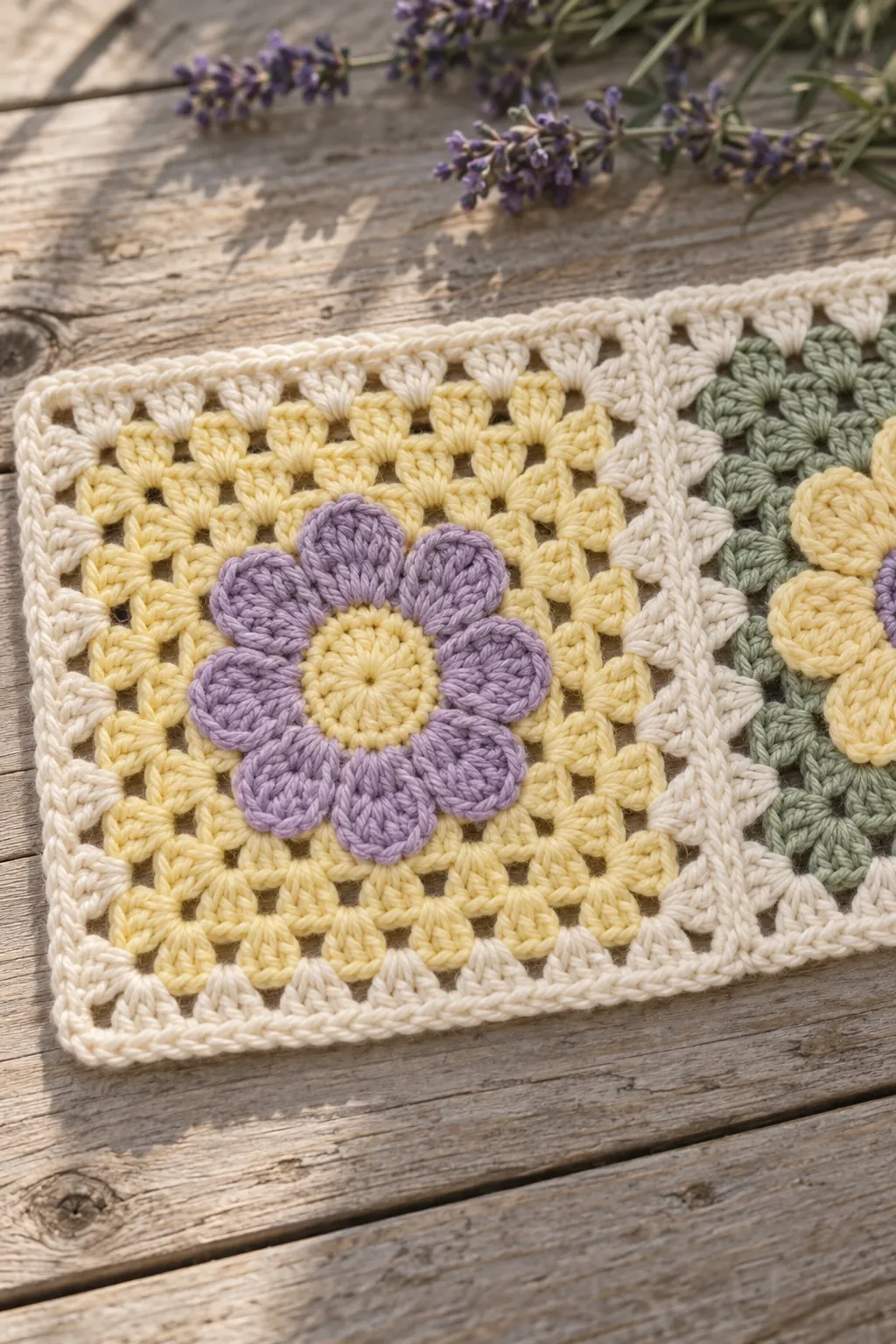
The lavender by my back steps doesn’t do much until July, and then it suddenly hums with bees. Past it, the edge of our field fills up with buttercups and white yarrow. This flower granny square blanket is my way of keeping that view for the rest of the year. Each square holds one eight-petal flower in lavender, butter yellow or cream, set on a sage or butter background and framed in cream. It lives on the porch chair from May until the first cold nights of September.
There are 42 squares of 8 in (20 cm), sewn together with flat cream seams and wrapped in a sage border. The throw comes out at about 51 1/2 × 59 1/2 in (131 × 151 cm), a good size for one person and a book. Smaller and larger sizes are listed below, from a 20-square baby blanket to a twin.
Is a flower granny square blanket a good next step for you?
If you’ve made a few plain rows, you know most of what’s needed. The flower center is a ring of double crochet, worked after a short chain. Each petal is a little fan of 5 stitches in one stitch: a half double crochet, 3 double crochets and another half double crochet. The loops that turn the round flower into a square are single crochet and chains, and the border ends with a round of single crochet too. Rounds close with a slip stitch: hook in, yarn over, pull through everything on the hook.
The squares are joined with a whipstitch, the simplest seam there is. With a yarn needle, you pass the yarn through the edge loops of two squares, bring it over the top and go in again, like a loose spiral.
I rate it Easy instead of Beginner because of the four color changes in each square and the assembly of 42 squares. If notation like (hdc, 3 dc, hdc) or [ ] 5 times still looks like code, the Beginner Guide explains how to read a crochet pattern one piece at a time. And if you’d like to warm up on squares without petals, the Green Mountain pattern sticks to classic clusters in bulky yarn.
Worsted yarn that keeps eight petals crisp
Look for a 4 on the label, the worsted symbol, and use a 5 mm (US H-8) hook. Go bigger and the petals start to flop over; go smaller and the ring in the center can buckle.
For a throw you’ll actually take outside, a plied acrylic or an acrylic and cotton blend is the easy choice: soft, light enough for June evenings and fine in the washing machine. A cotton blend gives the petals a crisper edge, which I like. A soft halo is fine, but heavily brushed yarn blurs every petal into a smudge.
Your biggest orders are sage, with 850 yd (777 m) for the throw, and butter, with 650 yd (594 m). Buy each of those from a single dye lot. Sage matters most, because it fills half the backgrounds and the whole border, and a second batch dyed a shade darker would show along one edge.
To substitute a yarn, compare yards per skein, not the number of skeins. Then make one full square. After Round 4 it should be about 4 in (10 cm) across, and the finished square 8 in (20 cm). A square of 7 3/4 in makes the throw 1 1/2 in (4 cm) narrower, so change your hook now rather than after square twenty.
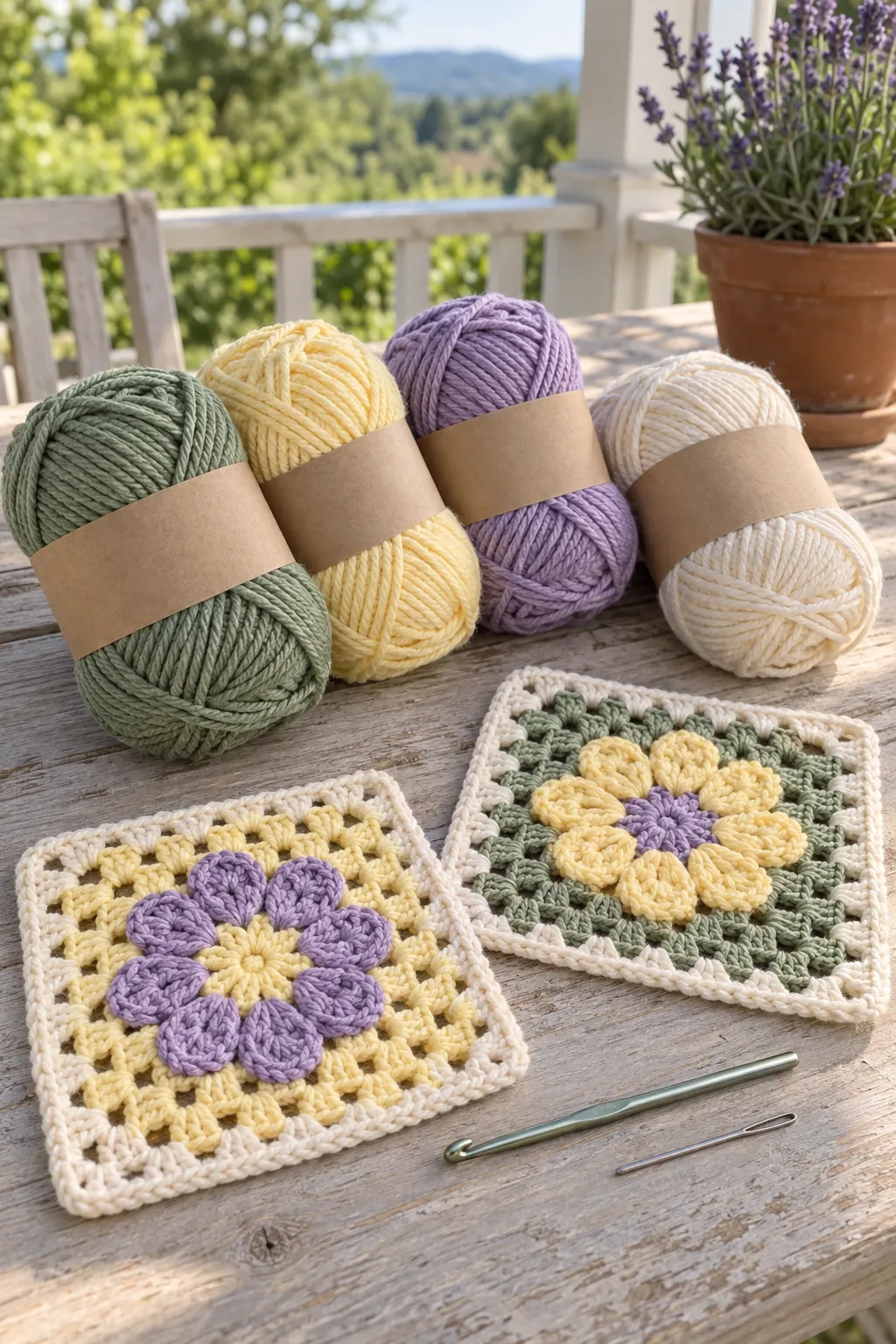
Butter, lavender, sage and cream: what each color does
- Sage is the ground, like grass under the flowers. It’s the background of half the squares and the border.
- Butter is the sunny background of the other half, and the petals of the flowers that sit on sage.
- Lavender is the accent. It needs only one skein for the throw, since it appears in small doses: petals on half the squares, centers on others.
- Cream is the frame. Every square ends with a cream round, so the joins form a soft cream grid that ties all 42 flowers together.
There are four square recipes. A and B have butter backgrounds, with lavender and cream flowers. C and D have sage backgrounds, with butter and lavender flowers. A row of A and C squares, then a row of D and B, gives you a checkerboard of backgrounds where no two matching squares touch, even at the corners. The photo scatters its flowers a little more freely; the pattern keeps four fixed recipes in a regular layout so every count stays simple.
Other meadows work just as well if you keep one green ground, one warm background, an accent and a light frame:
- Blue Hour: moss green and pale blue grounds, periwinkle accents, white frames.
- Goldenrod and Aster: olive and mustard grounds, purple accents, oatmeal frames.
- Clover Patch: mint and blush pink grounds, raspberry accents, ivory frames.
- Sea Glass: seafoam and sand grounds, coral accents, white frames.
Each flower center uses only about 2 yd (2 m), so this is a great place for leftover scraps. Just keep the background colors from a single purchase.
Wildflower Meadow sizes, from a 20-square baby blanket to a twin
Every size uses the same 8 in (20 cm) square and the same four-round border, which adds about 1 3/4 in (4.5 cm) on each side. The pattern card is written for the throw. Square counts are listed as A / B / C / D, and yarn as butter / lavender / cream / sage. Yardage is an estimate with about 15% extra, rounded up to the next 50 yd.
- Baby, about 35 1/2 × 43 1/2 in (90 × 110 cm): 4 squares across, 5 down (6 / 4 / 6 / 4). Border Round 1: 130 clusters; Round 4: 560 sc. Yarn: 350 / 100 / 300 / 450 yd (1,200 yd, 1,097 m).
- Lap, about 43 1/2 × 51 1/2 in (110 × 131 cm): 5 across, 6 down (9 / 6 / 6 / 9). Border Round 1: 158 clusters; Round 4: 672 sc. Yarn: 450 / 150 / 450 / 650 yd (1,700 yd, 1,554 m).
- Throw, about 51 1/2 × 59 1/2 in (131 × 151 cm): 6 across, 7 down (12 / 9 / 12 / 9). Border Round 1: 186 clusters; Round 4: 784 sc. Yarn: 650 / 150 / 600 / 850 yd (2,250 yd, 2,057 m). This is the size in the pattern.
- Twin, about 67 1/2 × 91 1/2 in (171 × 232 cm): 8 across, 11 down (24 / 20 / 24 / 20). Border Round 1: 270 clusters; Round 4: 1,120 sc. Yarn: 1,350 / 300 / 1,200 / 1,550 yd (4,400 yd, 4,023 m).
For a grid of your own, each seam takes 29 whipstitches per square it runs along, and border Round 1 has 7 clusters per square along each side, plus 1. Rounds 2 and 3 add one cluster per side, and Round 4 has 4 sc per cluster on each side, minus 1, plus 3 sc in each corner.
Flat flowers and tidy joins, 42 squares in a row
- Fold the petals forward on Round 3. Your chain-4 loops should pass behind each petal, so the flower sits on top of the background. Count 8 loops before you start Round 4.
- Fix a cupped square early. My first one curled up like a saucer after Round 4. That means the ch-4 loops are too tight, so chain them a little looser.
- Carry the background up instead of cutting it. Rounds 3 to 7 are one color, so you slip stitch into the next corner and keep going. That leaves 8 ends per square instead of 16.
- Block before you sew. Pin each square to 8 × 8 in (20 × 20 cm), mist it and let it dry. Squares of one size line up stitch for stitch, so the seams stay straight.
- Lay out all 42 before the first seam. Put them on the floor, A and C, then D and B, and take a photo. Swapping two flowers takes a second now and an evening later.
- Sew through the outer loops only. Catching just the loops at the edge keeps the seam flat, so the cream rounds of two squares read as one soft line, as in the photo.
- Tame the ends as you go. The squares alone leave 336. Work over each new tail for a few stitches, and weave in the rest after every few squares.
US crochet terms
The pattern
Materials
- Yarn: worsted weight (#4) acrylic or acrylic-cotton blend, about 2,250 yd (2,057 m) in total, each color from a single dye lot
- Sage (green): about 850 yd (777 m)
- Butter (pale yellow): about 650 yd (594 m)
- Cream: about 600 yd (549 m)
- Lavender: about 150 yd (137 m)
- For example, with skeins of about 200 yd (183 m): 5 Sage, 4 Butter, 3 Cream, 1 Lavender
- Hook: 5 mm (US H-8)
- Yarn needle, scissors, measuring tape, rustproof pins, and a foam mat or large towel for blocking
Gauge
- Rounds 1–4 of the square = about 4 in (10 cm) across
- One finished square (8 rounds) = 8 in (20 cm) square, after blocking
- Make one full square to check. If it’s larger than 8 in, use a smaller hook; if it’s smaller, use a larger one.
Finished size
- About 51 1/2 × 59 1/2 in (131 × 151 cm) with the border, after blocking
- Joined squares before the border: about 48 × 56 in (122 × 142 cm)
Abbreviations
- ch chain
- dc double crochet
- hdc half double crochet
- sc single crochet
- sl st slip stitch
- sp(s) space(s)
- st(s) stitch(es)
- rep repeat
Notes
- A cluster is 3 dc worked in the same sp.
- The ch 3 at the start of a round counts as 1 dc. The ch 1 at the start of Round 3 and of Border Round 4 does not count as a st.
- Square colors, by round:
- Square A (make 12): Round 1 Butter, Round 2 Lavender, Rounds 3–7 Butter, Round 8 Cream
- Square B (make 9): Round 1 Lavender, Round 2 Cream, Rounds 3–7 Butter, Round 8 Cream
- Square C (make 12): Round 1 Lavender, Round 2 Butter, Rounds 3–7 Sage, Round 8 Cream
- Square D (make 9): Round 1 Cream, Round 2 Lavender, Rounds 3–7 Sage, Round 8 Cream
- Fasten off after Rounds 1, 2, 7 and 8. Rounds 3 to 7 are worked in one color without cutting the yarn.
- Each seam has 29 whipstitches per square it runs along: 1 in each corner sp and 27 along the side.
- Work over the tails of each new color for a few sts to save weaving time.
Instructions
Squares (make 42)
- Round 1 (center): With the center color, ch 4, sl st in first ch to form a ring. Ch 3, 15 dc in ring. Join with sl st to top of ch-3. Fasten off. (16 dc)
- Round 2 (petals): Join the petal color with sl st in any dc. *(Hdc, 3 dc, hdc) in next dc, sl st in next dc; rep from * 7 more times, working the last sl st in the same st as the join. Fasten off. (8 petals, 8 sl sts)
- Round 3: Join the background color with sl st in any sl st between 2 petals, ch 1, sc in same st. *Ch 4, fold the next petal toward you, sc in next sl st between petals; rep from * 6 more times, ch 4. Join with sl st to first sc. Do not fasten off. (8 sc, 8 ch-4 sps)
- Round 4: Sl st in next ch-4 sp. Ch 3, (2 dc, ch 2, 3 dc) in same sp, *ch 1, 3 dc in next ch-4 sp, ch 1, (3 dc, ch 2, 3 dc) in next ch-4 sp; rep from * 2 more times, ch 1, 3 dc in next ch-4 sp, ch 1. Join with sl st to top of ch-3. (12 clusters: 36 dc, 8 ch-1 sps, 4 ch-2 sps)
- Rounds 5–7: Sl st in next 2 dc and in next ch-2 sp. Ch 3, (2 dc, ch 2, 3 dc) in same sp, *[ch 1, 3 dc in next ch-1 sp] across to next corner, ch 1, (3 dc, ch 2, 3 dc) in next ch-2 sp; rep from * 2 more times, [ch 1, 3 dc in next ch-1 sp] across to end, ch 1. Join with sl st to top of ch-3. (Round 5: 16 clusters, 48 dc. Round 6: 20 clusters, 60 dc. Round 7: 24 clusters, 72 dc, 20 ch-1 sps) Fasten off after Round 7.
- Round 8: Join Cream with sl st in any ch-2 corner sp. Ch 3, (2 dc, ch 2, 3 dc) in same sp, *[ch 1, 3 dc in next ch-1 sp] 5 times, ch 1, (3 dc, ch 2, 3 dc) in next ch-2 sp; rep from * 2 more times, [ch 1, 3 dc in next ch-1 sp] 5 times, ch 1. Join with sl st to top of ch-3. Fasten off. (28 clusters: 84 dc, 24 ch-1 sps, 4 ch-2 sps; 7 clusters per side)
- Blocking: Pin each square to 8 × 8 in (20 × 20 cm), mist it and let it dry. Weave in any remaining ends.
Layout
- Grid: Lay out the squares in 7 rows of 6. Rows 1, 3, 5 and 7: A, C, A, C, A, C. Rows 2, 4 and 6: D, B, D, B, D, B.
Joining (Cream)
- Horizontal seams: Thread a yarn needle with about 3 yd (2.7 m) of Cream. Hold the first square of Row 1 and the first square of Row 2 with right sides together and edges matching. Whipstitch through the outer loops of both squares: 1 stitch in the corner ch-2 sps, 1 in each dc and ch across (27), 1 in the next corner ch-2 sps. Without cutting, place the next 2 squares of the same rows together and continue the same way across. Start a new length of yarn whenever needed. (174 whipstitches: 29 per pair of squares) Join Row 2 to Row 3 the same way, and continue until all 6 horizontal seams are done.
- Vertical seams: Fold the blanket along the line between the first and second columns of squares, right sides together, and whipstitch the full length the same way, 29 stitches per pair of squares, crossing the horizontal seams as you go. (203 whipstitches) Rep for the remaining 4 vertical seams.
Border (Sage)
- Round 1: With right side facing, join Sage with sl st in the ch-2 sp at any outer corner of the blanket. Ch 3, (2 dc, ch 2, 3 dc) in same sp. Along the side: [ch 1, 3 dc in next ch-1 sp] 6 times across the first square, *ch 1, 3 dc in the seam between 2 squares (insert the hook through both corner ch-2 sps together), [ch 1, 3 dc in next ch-1 sp] 6 times across the next square; rep from * to the end of the side (5 times on the short sides, 6 times on the long sides), ch 1, (3 dc, ch 2, 3 dc) in the outer corner sp. Work the other 3 sides the same way, ending the last side with ch 1 instead of a corner. Join with sl st to top of ch-3. (186 clusters: 558 dc; 43 clusters along each short side and 50 along each long side, counting the corner clusters)
- Rounds 2–3: Sl st in next 2 dc and in next ch-2 sp. Ch 3, (2 dc, ch 2, 3 dc) in same sp, *[ch 1, 3 dc in next ch-1 sp] across to next corner, ch 1, (3 dc, ch 2, 3 dc) in next ch-2 sp; rep from * 2 more times, [ch 1, 3 dc in next ch-1 sp] across to end, ch 1. Join with sl st to top of ch-3. (Round 2: 190 clusters, 570 dc. Round 3: 194 clusters, 582 dc)
- Round 4: Ch 1, sc in same st as join and in next 2 dc, 3 sc in next ch-2 sp, *sc in each dc and ch-1 sp across to next corner, 3 sc in corner ch-2 sp; rep from * 2 more times, sc in each dc and ch-1 sp to end. Join with sl st to first sc. (784 sc: 179 sc between the corner groups on each short side, 207 on each long side)
- Finishing: Fasten off and weave in all ends. Pin the blanket flat with the cream lines straight, mist it and let it dry.
Washing a worsted meadow throw with lavender and cream
Go by the yarn labels, and follow the most delicate one if you mixed brands. Most acrylic and acrylic-cotton worsteds can go in the machine on a cold, gentle cycle. A large mesh laundry bag keeps the petals from snagging.
The first wash is the one to watch. Lavender and sage both sit right next to cream, and a dye that bleeds will tint the joins. Use cold water and add a color-catcher sheet for the first two or three washes. Dry acrylic on low heat or flat over a drying rack. A cotton blend holds water longer, so lay it flat and turn it once so the middle dries.
If your throw spends the summer on a porch like mine, bring it in when you’re not using it. Strong sun fades lavender faster than the other colors, and you’ll see it first on the petals along the top of the chair. In winter, store it folded in a cotton bag, not plastic.
Wildflower Meadow questions from first-time flower square makers
How many squares do I need for a flower granny square blanket this size?
The throw uses 42 squares of 8 in (20 cm): 6 across and 7 down. That gives about 51 1/2 × 59 1/2 in (131 × 151 cm) with the border. Each extra row of six adds 8 in (20 cm) and about 280 yd of yarn.
Why do my petals ruffle instead of lying flat?
Usually Round 1 is too tight, so 8 petals are crowded onto a small ring. Make your 16 dc a bit looser, or use a hook half a size larger for Round 1. Ruffles can also come from a missed stitch in Round 1, so count to 16 before you add the petals.
Can I join the squares as I go instead of sewing them?
You can, by linking each new square to its neighbors with slip stitches during its cream round. It saves the sewing at the end, but it’s harder to keep the four recipes in order, and the corners where four squares meet take practice. For a first flower blanket, sewing afterward is more forgiving.
Do I have to cut the yarn after every color?
Only four times per square: after the center, the petals, Round 7 and Round 8. Rounds 3 to 7 share one color, so you slip stitch to the next corner and keep going.
Will this work in pure cotton for a summer blanket?
It will, and the petals look very crisp in cotton. Cotton has less stretch, so check your square size carefully, and expect a heavier blanket that takes longer to dry.
Quick recap
- Make one square with a 5 mm (H-8) hook and check that it measures 8 in (20 cm).
- Make all 42 squares, each ending in a cream round: 12 A, 9 B, 12 C and 9 D.
- Block them and lay them out with A and C squares in the odd rows, D and B in the even rows.
- Sew 6 horizontal and 5 vertical cream whipstitch seams.
- Add four sage border rounds (186 clusters, 190, 194, then 784 sc), weave in the ends and block.
I hope this flower granny square blanket gives you a little meadow to pull over your knees, in July or in the middle of February. If a cluster count stops making sense or you’d like a size I didn’t list, send me a note and we’ll work it out together.