Fireside Chunky Throw
Some winter evenings in Vermont, all I want is a fire going and something heavy across my knees. This chunky crochet throw is my answer to those nights. It’s one color of super bulky yarn, worked in half double crochet on a 10 mm hook, and it covers a lap after just a few evenings.
I keep mine folded over the armchair closest to the fireplace from October until the snow melts. There are no stripes to plan and no color changes, so the only ends to weave in come from joining new skeins. If you’ve been waiting for a first blanket that won’t take all winter, start here.
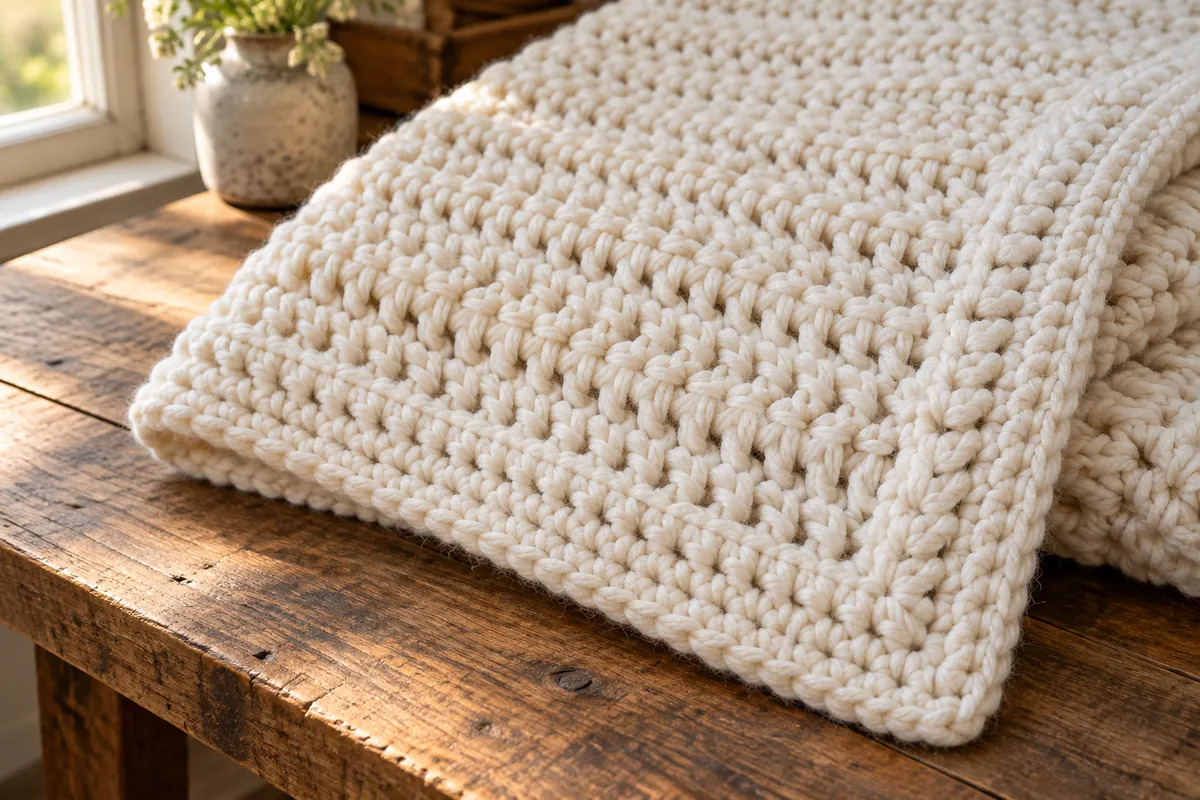
Is a chunky crochet throw in super bulky yarn a good first blanket?
Yes. The stitches are big enough that you always know where your hook goes, and after Row 1 every row is the same: 80 half double crochet stitches, 66 times over.
You’ll use three stitches. The foundation is a row of 82 chains. Every row of the body is half double crochet, and both border rounds are single crochet. Each border round closes with a slip stitch: insert the hook, yarn over, and pull the yarn through the stitch and the loop on your hook in one motion. If “hdc” and “sl st” still look like code, the Beginner Guide section on how to read a crochet pattern decodes them.
Two parts may be new: joining a fresh skein, which you’ll do several times, and the border. Its first round travels along the row-ends (the side edges of the rows), then along the underside of the foundation chain. In this yarn each row-end is too big to miss, so it’s a good place to learn.
Keep your loops relaxed, too. Super bulky yarn pulled tight turns stiff, and the guide to holding the hook and yarn helps if you’re still finding your grip.
Super bulky, weight 6: finding the right yarn for the Fireside throw
Look for the number 6 and the words “super bulky” on the label. Don’t mix it up with weight 7, often sold as jumbo. Jumbo yarn is much thicker, and on a 10 mm hook it makes a crowded, stiff throw.
Choose a soft, washable acrylic or acrylic blend: a wet wool throw this size is a lot to lift out of a sink. For a first try, I’d skip chenille and velvet-style yarns. They hide the stitches, so counting to 80 turns into guesswork.
Since the whole throw is one color, buy every skein at once and check that they share the same dye lot, the batch number on the label. In plain ivory, a slightly different batch would show as a band across the middle.
Skein sizes in super bulky vary a lot from one brand to the next, so let the label do the math. Divide 950 yd by the yards in one skein, round up, and add one spare. With 100 yd skeins, that’s 10 skeins plus 1.
No super bulky in your shade? Two strands of bulky (weight 5) held together come out at roughly the same thickness, but you’ll need about 950 yd of each strand. Either way, check your gauge, how many stitches and rows fit in 4 in. A 4 in square holds only 7 stitches, so chain 16 and work 10 rows of 14 hdc instead: it should measure about 8 × 8 in.
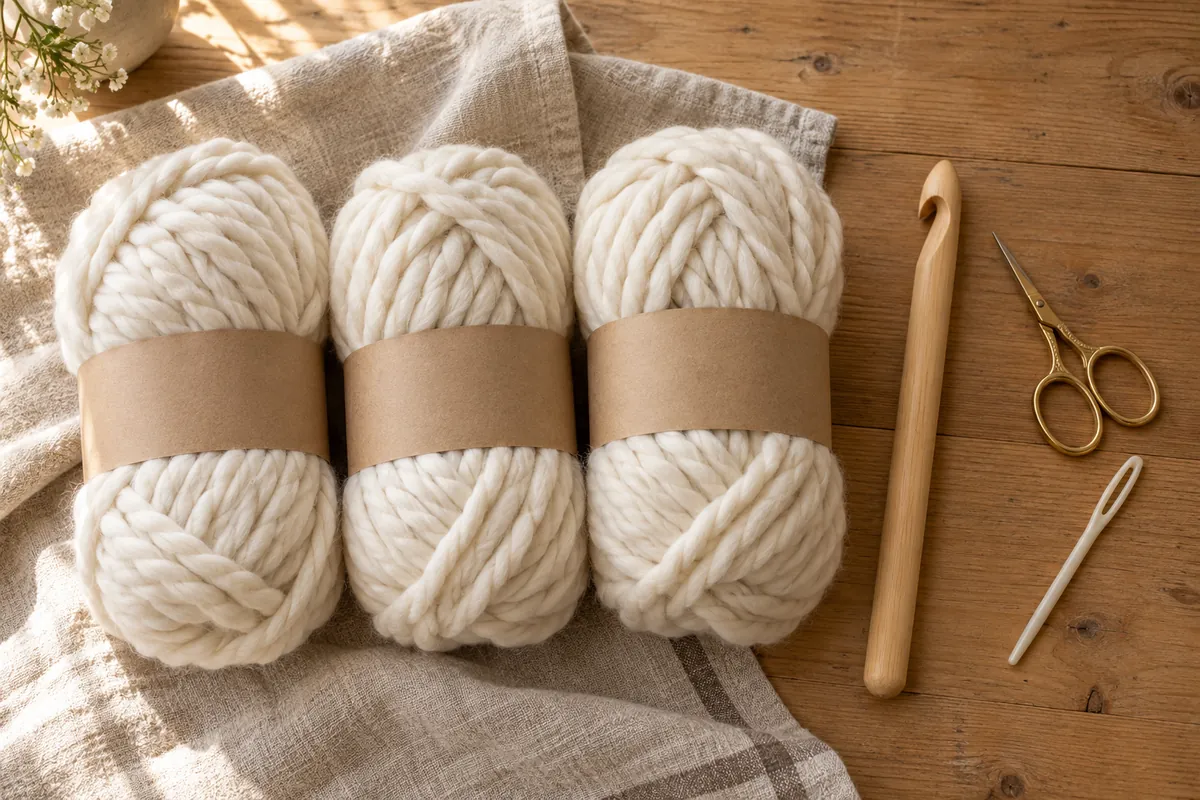
One shade, no stripes: choosing a color for big stitches
With a single color, the texture does all the work, and light shades show the rows of half double crochet best. A few one-color ideas:
- Fireside ivory: the original, bright and soft, though it shows a spilled coffee right away.
- Oatmeal heather: a flecked beige that forgives small marks.
- Cranberry: a deep red that looks warm against brick or dark wood.
- Moss green: earthy and calm, lovely on a gray sofa.
- Charcoal: striking, but harder on the eyes while you work.
For a first blanket, stay with a light or medium shade. On charcoal, finding the top of each hdc under a lamp takes real squinting, 80 times a row.
If one color feels too plain, my three-color striped throw keeps the same half double crochet body and adds wide bands of cream, sage and taupe in bulky yarn.
Fireside counts for a baby, throw, twin or queen blanket
The pattern is written for the throw. For another size, change the foundation chain and the number of rows; the rows and border are worked the same way.
- Baby, about 30 × 36 in (76 × 91 cm): ch 51 (49 hdc), 43 rows. Border Round 1: 234 sc, with 64 sc along each side. Yarn: about 400 yd (365 m).
- Throw, about 48 × 56 in (122 × 142 cm): ch 82 (80 hdc), 67 rows. Border Round 1: 368 sc, with 100 sc along each side. Yarn: about 950 yd (870 m). This is the size written in the pattern.
- Twin, about 66 × 91 in (168 × 231 cm): ch 114 (112 hdc), 111 rows. Border Round 1: 564 sc, with 166 sc along each side. Yarn: about 2,125 yd (1,945 m).
- Queen, about 90 × 92 in (229 × 234 cm): ch 156 (154 hdc), 113 rows. Border Round 1: 654 sc, with 169 sc along each side. Yarn: about 2,950 yd (2,700 m).
In Round 1, the top and bottom edges each take the number of hdc plus 4 (3 sc in both corner stitches, 1 sc in each stitch between). Each side gets 3 sc for every 2 row-ends, plus 1 in the last one. Round 2 adds 2 sc at each corner: 242, 376, 572 and 662 sc.
Every size has an odd number of rows on purpose: the side repeat (sc, then 2 sc) ends with a single sc in the last row-end, which only works out with an odd count.
I scaled the throw’s 950 yd to the area of each size, so the amounts are estimates with the same extra built in. For the twin and queen, buy a couple of spare skeins, and work the second half at a table, where the heavy finished part can rest.
The baby size suits supervised floor play or a stroller on a cold walk. For something lighter, Maple Lane, a striped blanket sized for the stroller, uses bulky yarn.
Holding on to 80 stitches when every hdc is this big
Big stitches are easy to see, and just as easy to miscount. These habits keep the Fireside throw square:
- Watch the ch 2. In super bulky, it looks almost like a real stitch. It doesn’t count, so if you work into it on the next row, you’ll have 81.
- Mark every 20th chain. A scrap of contrasting yarn at 20, 40, 60 and 80 makes recounting the 82 chains quick.
- Check your size after Row 5. Five rows should be about 4 in tall and close to 46 in wide. More than an inch off? Change hooks now.
- Look at the skein before each row. If it looks too small to finish 80 stitches, join the next one at this edge.
- Split thick tails before weaving them in. If your yarn is made of plies (thinner strands twisted together), untwist each tail into two bundles and weave them in opposite directions. They vanish far better than one fat tail.
US crochet terms
The pattern
Materials
- Super bulky weight yarn (weight 6) in ivory, in a soft, washable acrylic or acrylic blend: about 950 yd (870 m) in total.
- Yardage is an estimate with a little extra built in. Super bulky yarns vary a lot, so buy one extra skein if you can.
- 10 mm (N/P-15) crochet hook
- Scissors
- Yarn needle with a large eye
- 2 stitch markers
Gauge
7 hdc and 5 rows = 4 in (10 cm) in half double crochet.
Gauge isn’t critical for a throw, but it changes the finished size and how much yarn you’ll use. If your square has more stitches than this, try a bigger hook. If it has fewer, try a smaller hook.
Finished size
About 48 × 56 in (122 × 142 cm), including the border. The body measures about 46 × 54 in before the border.
Abbreviations
- ch chain
- hdc half double crochet
- sc single crochet
- sl st slip stitch
- st(s) stitch(es)
- rep repeat
Notes
- The ch 2 at the beginning of each row does not count as a stitch. Work your first hdc into the very first stitch of the row.
- Place a stitch marker in the first and last stitch of each row, and check that you have 80 hdc at the end of every row.
- Joining a new skein: try to join at the end of a row. Work the last hdc of the row until you have 3 loops on your hook, then yarn over with the new skein and pull it through all 3 loops. Leave 6 in (15 cm) tails to weave in later.
- Super bulky stitches are easy to count, so it’s a great project to practice keeping straight edges.
- Want a different width? Chain any number you like, plus 2. Every 7 hdc adds about 4 in (10 cm).
Instructions
Body
- Foundation: Ch 82.
- Row 1: Hdc in the 3rd ch from the hook and in each ch across. Turn. (80 hdc)
- Row 2: Ch 2 (does not count as a stitch), hdc in each st across. Turn. (80 hdc)
- Rows 3–67: Rep Row 2. At the end of Row 67, do not fasten off. (80 hdc)
Border
The border is worked in rounds, straight after Row 67.
- Round 1: Ch 1, turn. 3 sc in the first st (corner), sc in each st across to the last st, 3 sc in the last st (corner). Working down the side, *sc in the next row-end, 2 sc in the next row-end; rep from * to the last row-end, sc in the last row-end (100 sc along the side). Working along the opposite side of the foundation chain, into the base of the Row 1 stitches: 3 sc in the base of the first stitch (corner), sc in the base of each of the next 78 stitches, 3 sc in the base of the last stitch (corner). The 2 skipped chains at the end of the foundation chain are not worked. Working up the other side, work the row-ends exactly as for the first side (100 sc along the side). Sl st in the first sc to join. (368 sc)
- Round 2: Ch 1 (does not count as a stitch), sc in the first st, 3 sc in the next st (the center of the corner), *sc in each st to the next corner center, 3 sc in the corner center; rep from * 2 more times, sc in each remaining st. Sl st in the first sc to join. (376 sc)
Finishing
- Finishing: Fasten off and weave in all ends with your yarn needle. Super bulky tails are thick, so weave them in a little farther than usual, about 3 in (8 cm), changing direction once.
- Blocking (optional): Wash the throw following the yarn label and let it dry flat. It helps the edges lie straight.
Washing a heavy super bulky throw without stretching it
Check your label, but most acrylic super bulky yarns can be machine washed. Wash the throw on its own, cold and gentle, in a large front-loader if you can, since it fills a small washer quickly.
Wet, it weighs far more than it did dry. Lift it out with both arms underneath instead of pulling it by a corner, because the weight of the soaked fabric can stretch the stitches. If the label allows the dryer, use low heat and take the throw out while it’s still a little damp, then lay it flat to finish. Otherwise, spread it over a drying rack or across two chairs and turn it once.
Ivory shows marks, so dab spills right away with cool water, without rubbing. Store it folded, not hung, so its weight doesn’t pull it out of shape.
Questions about the Fireside throw
Can I make this chunky crochet throw with weight 7 jumbo yarn?
Not with these counts. Jumbo yarn is much thicker than super bulky, so 80 stitches would come out far wider, and the fabric would be stiff on a 10 mm hook. If you love jumbo yarn, use the hook on its label, make a gauge swatch, and work out a new chain from your own stitches per inch, plus 2.
My border ripples, or it pulls in. What went wrong?
Ripples usually mean too many stitches along the sides, and pulling in means too few. Count one side first: on the throw, it should be 100 sc for 67 row-ends. If the count is right and the border still waves, work it again with a smaller hook.
How do I make the throw longer without making it wider?
Keep the 82-chain foundation and add rows. Every 5 rows adds about 4 in (10 cm), and you’ll need about 70 yd (65 m) more yarn for each 5 rows. Stop on an odd row so the border repeat works out: 77 rows, for example, gives about 64 in finished, with 115 sc along each side in Round 1.
Is it normal for my hands to get tired with a 10 mm hook?
Yes, at first. A big hook and heavy yarn need a lighter grip than you might expect, so try holding the hook loosely and resting every few rows. Let the blanket sit on your lap or a table instead of hanging from the hook, because its weight pulls on your wrist as it grows.
Quick recap
- Chain 82 and work Row 1 in half double crochet, starting in the 3rd chain from the hook: 80 stitches.
- Repeat Row 2 up to Row 67, with a ch 2 that doesn’t count and 80 hdc in every row.
- Join each new skein at the end of a row, leaving 6 in tails.
- Without fastening off, work border Round 1 in single crochet, with 3 sc in each corner: 368 sc.
- Work Round 2 for 376 sc, then fasten off and weave in the tails.
Once your chunky crochet throw is done, fold it over the arm of your favorite chair and claim the first evening under it. If a row or a count gives you trouble along the way, write to me through the Contact page and tell me which row you’re on.