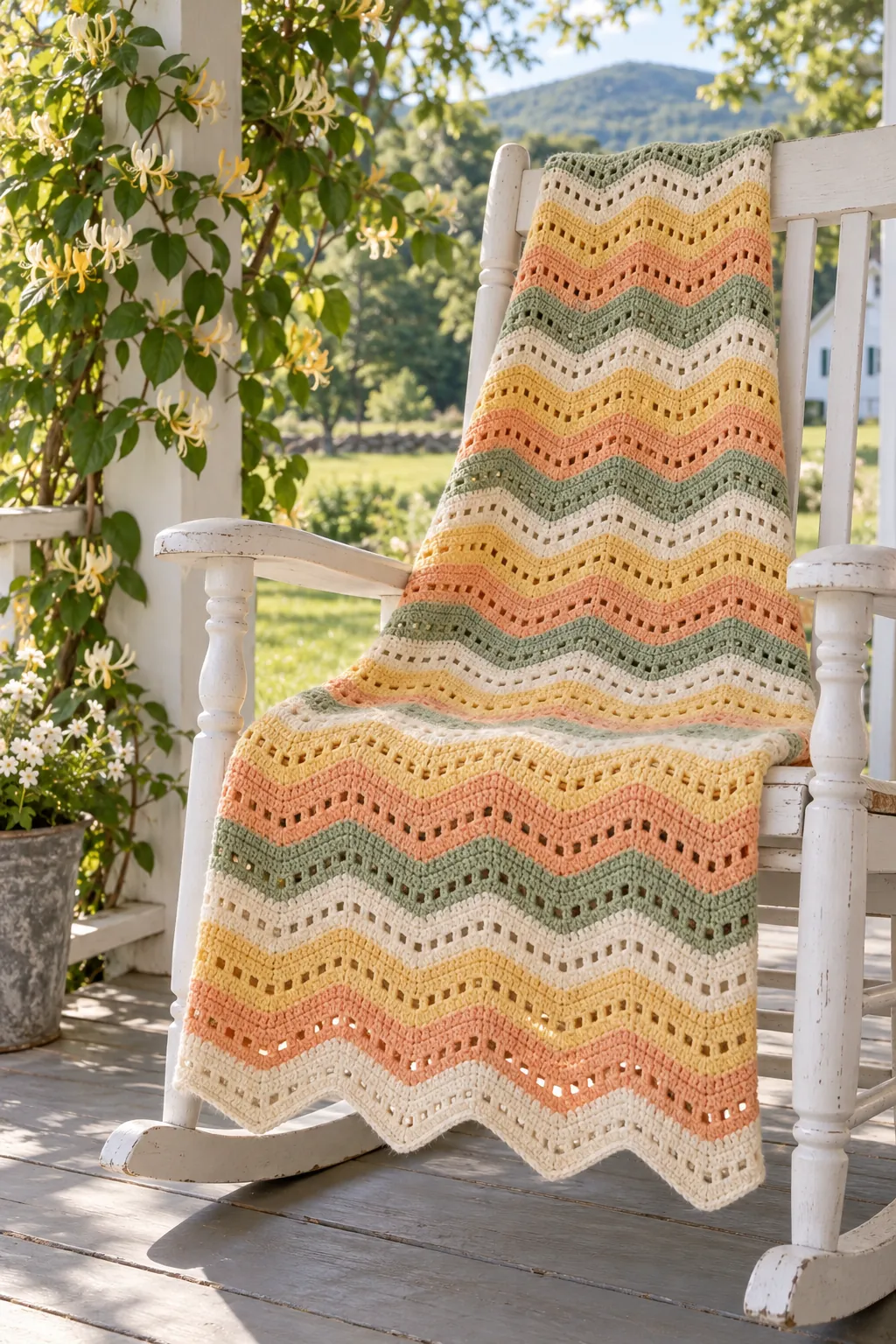
Picture a June evening on a Vermont porch, when the honeysuckle by the steps finally opens and the air turns sweet after supper. It’s too cool for bare arms and far too warm for wool. That’s the moment this summer crochet blanket was designed for. Every stripe is two rows: one solid row of double crochet, then one open mesh row in the same color, both following the same soft wave. The holes let air through, and the solid rows keep it from feeling flimsy.
The colors come straight from the vine: cream, honey and apricot for the blossoms, sage for the leaves. You’ll work it in a DK cotton blend on a 4.5 mm hook, and you can stop at a porch throw, a couch throw or a large throw. All three sizes are written into the same pattern card.

Is this summer crochet blanket a good first wave pattern?
Yes, if you’re comfortable with a chain and a double crochet. Those two stitches make the whole body. The border is one round of single crochet. If the brackets and abbreviations in the card look like a puzzle, the Beginner Guide walks you through how to read a crochet pattern.
It’s rated Easy rather than Beginner because of the wave. Two ideas may be new. The first is dc3tog, which joins 3 double crochets into one at the top and pulls each valley down. The second is the mesh row: you alternate a dc with a chain 1 and skip the stitch under the chain, which opens a row of little windows. At each peak you work (dc, ch 2, dc) into the same space, and that pushes the point up. Once you see that every side of every wave has 10 stitches, the rest is counting.
If you’ve made a cozy bulky throw built on the same rise and fall, you already know how peaks and valleys behave. The mesh row is the new part, and since nearly half of its stitches are chains, it goes faster than a solid row.
A DK cotton blend that breathes on warm nights
Look for a 3 on the label, with the words DK or light. This throw uses a 4.5 mm (US 7) hook, the top of the usual DK range, so the mesh rows stay open and the fabric drapes over a chair instead of standing stiff.
A cotton blend is the right fiber for a warm-weather throw. Something close to half cotton and half acrylic works well, and so does cotton with bamboo. Pure cotton is lovely to touch, but it’s heavier, and an open fabric this size can stretch longer every time you lift it. All-acrylic works too. It just feels warmer and a little less summery.
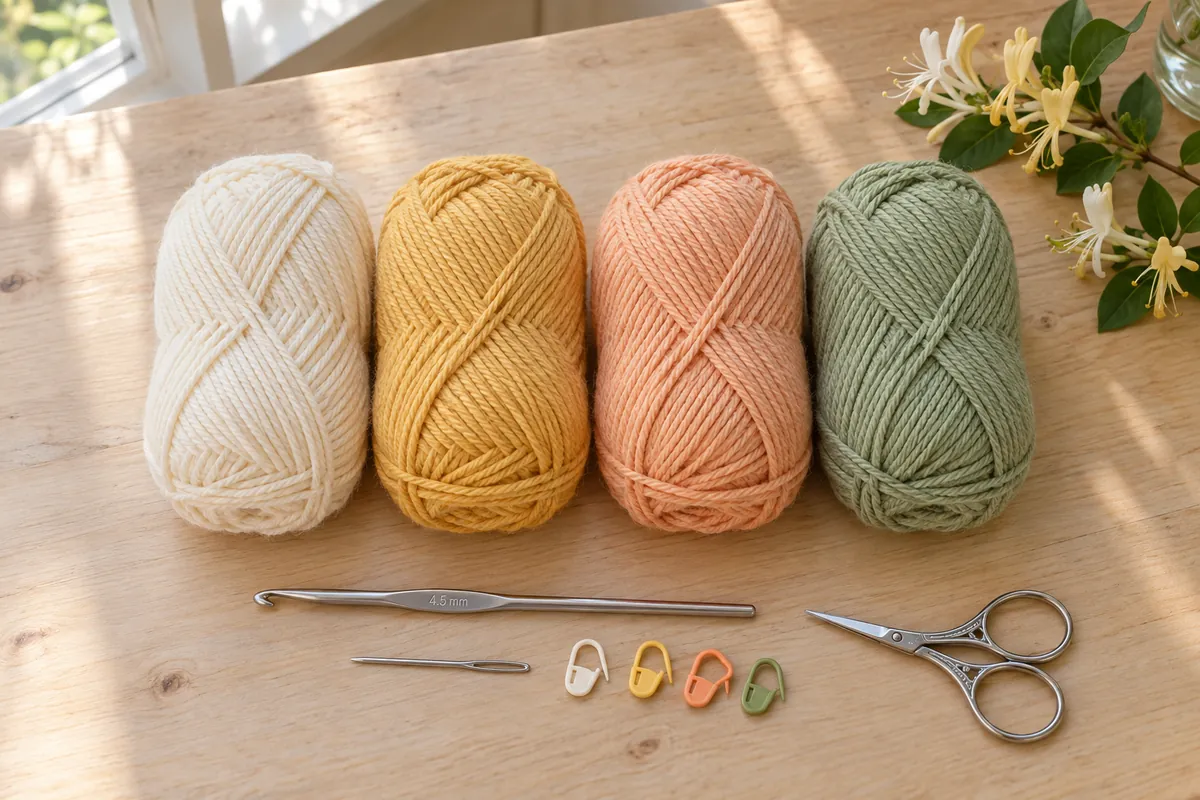
Cream is the color you’ll use most, since it opens and closes the blanket and makes the border. Buy all of it at once, from one dye lot. Two cream skeins from different lots can look identical in the store and still show a line once they sit next to each other in a stripe. The same goes for brands: two DK cotton blends can differ in thickness, so keep one brand for all four colors.
Before you commit, chain 50 and work a swatch of 11 rows following the card. It should come out about 10 1/2 in (26.7 cm) wide, with 9 rows measuring 4 in (10 cm). If it’s wider, try a 4 mm hook. If it’s narrower, go up to 5 mm. If you want to use worsted yarn instead, each wave grows to about 6 in, so the same chain makes a noticeably bigger blanket.
How cream, honey, apricot and sage take turns
The stripe order is fixed: cream, honey, apricot, sage, then back to cream. Each color gets one solid row and one mesh row. Cream starts the blanket, ends it with one last solid row, and wraps it in the border, so the waves look framed at both ends.
You’ll notice that one color reads differently on its two rows. On the solid row it’s at full strength. On the mesh row, whatever sits under the blanket shows through the holes, so the same yarn looks lighter and softer. That’s why the palette works best with colors of similar depth. A very dark color among pale ones would make its stripe jump out every eight rows.
Some other combinations in the same spirit:
- Rhubarb Patch: cream, rhubarb pink, soft blush and leaf green.
- Blueberry Hill: cream, faded denim, lavender gray and moss.
- Garden Wall: cream, terracotta, warm sand and olive.
- Sugar Snap: cream, butter yellow, pea green and pale mint.
Tie a small paper tag with its letter (A, B, C or D) to each skein before you start. On row 90, when you’re tired, the tag decides for you.
Porch, couch or large: three sizes counted in 24-chain waves
Every wave uses 24 chains and measures about 5 1/4 in (13.3 cm) across. The length moves in steps of 8 rows, one full round of the four colors, so each size ends with a sage stripe followed by one cream row. Yardage is an estimate, with about 10% added for swatching and tails.
- Porch throw: 42 1/2 × 50 3/4 in (108 × 129 cm). Ch 194, 113 rows, 842 sc in the border round. About 1,700 yd (1,554 m): cream 500 yd, honey, apricot and sage 400 yd each.
- Couch throw: 53 × 61 1/2 in (135 × 156 cm). Ch 242, 137 rows, 1,034 sc in the border round. About 2,500 yd (2,286 m): cream 700 yd, the other three 600 yd each.
- Large throw: 58 1/4 × 68 1/2 in (148 × 174 cm). Ch 266, 153 rows, 1,146 sc in the border round. About 3,100 yd (2,835 m): cream 850 yd, the other three 750 yd each.
The card is written for all three, with the porch throw first and the couch and large throws in brackets. To make your own size, add or remove 24 chains for each wave, then add or remove rows in groups of 8 (about 3 1/2 in). Keep the chain at a multiple of 24 plus 2, or the last wave won’t close.
For something to cover a whole bed instead, the soft-wave bedspread in worsted cotton uses solid rows and a different wave, sized from twin to king.
Ten stitches a side: keeping every wave in line
The foundation chain is the longest row you’ll make. Work it with a 5 mm hook, then switch back to 4.5 mm for Row 1. A tight chain pulls the bottom edge in and flattens the first waves. Clip a marker every 24 chains while you go, so you count in small groups instead of all at once.
During the first six rows, clip a marker into each ch-2 space at the peaks and move it up as you go. Between a peak and a valley, a solid row always has 10 dc. A mesh row has 5 chain-1 spaces on each side. If you count anything else, stop there, not three waves later.
The quickest check sits in the valleys. In a mesh row, the single dc at the bottom of each valley must land on top of the dc3tog below. If it lands one stitch to the side, the side before it is off by one.
Change color on the last dc of every even-numbered row: work it until 2 loops remain, then pull the new color through. The next stripe then starts with a clean chain 3 in its own color.
Plan for about 115 [140, 155] tails. Weave each one into a solid row of its own color, never along a mesh row, where it would show in the holes, and weave a few stripes at a time.
US crochet terms
The pattern
Materials
- DK weight yarn (CYC 3, light), cotton-acrylic blend, about 250 yd (229 m) per 100 g (3.5 oz) skein. Total, estimated: 1,700 [2,500, 3,100] yd (1,554 [2,286, 2,835] m).
- A, Cream: 500 [700, 850] yd (457 [640, 777] m), 2 [3, 4] skeins.
- B, Honey: 400 [600, 750] yd (366 [549, 686] m), 2 [3, 3] skeins.
- C, Apricot: 400 [600, 750] yd (366 [549, 686] m), 2 [3, 3] skeins.
- D, Sage: 400 [600, 750] yd (366 [549, 686] m), 2 [3, 3] skeins.
- 4.5 mm (US 7) crochet hook, or size needed to obtain gauge.
- 5.0 mm (US H-8) crochet hook for the foundation chain (optional).
- 12 locking stitch markers.
- Yarn needle and scissors.
Gauge
- In pattern with a 4.5 mm hook: 1 wave (24 sts, from one peak to the next) = 5 1/4 in (13.3 cm), and 9 rows = 4 in (10 cm).
- For reference, plain dc on the same hook: 18 dc = 4 in (10 cm).
- Gauge swatch: with A, ch 50. Work Rows 1 to 3 below, working the section after each * once only and skipping the “more times” repeats, then repeat Rows 2 and 3 until you have 11 rows. Every row has 46 sts and 1 ch-2 sp. The swatch should measure about 10 1/2 in (26.7 cm) wide, and 9 rows should measure 4 in (10 cm).
Finished size
- Porch throw: 42 1/2 × 50 3/4 in (108 × 129 cm).
- Couch throw: 53 × 61 1/2 in (135 × 156 cm).
- Large throw: 58 1/4 × 68 1/2 in (148 × 174 cm).
- Measured after the border and a light blocking, with the length taken along a straight stretch of stripe between a peak and a valley.
Abbreviations
- beg beginning
- ch chain
- ch-1 sp chain-1 space
- ch-2 sp chain-2 space
- dc double crochet
- dc3tog double crochet 3 together: (yo, insert hook in next st, yo and pull up a loop, yo and draw through 2 loops) 3 times, yo and draw through all 4 loops on hook
- rep repeat
- RS right side
- sc single crochet
- sc3tog single crochet 3 together: (insert hook in next st or ch, yo and pull up a loop) 3 times, yo and draw through all 4 loops on hook
- sk skip
- sl st slip stitch
- sp(s) space(s)
- st(s) stitch(es)
- WS wrong side
- yo yarn over
Notes
- Sizes: the pattern is written for the Porch throw, with the Couch and Large throws in brackets: Porch [Couch, Large]. When only one number is given, it applies to all sizes.
- Stitch multiple: the foundation chain is a multiple of 24 + 2. Each wave adds 24 ch and about 5 1/4 in (13.3 cm).
- The turning chain counts as a stitch throughout. In solid rows, ch 3 counts as 1 dc. In mesh rows, ch 4 counts as 1 dc and 1 ch-1.
- In mesh rows, every ch-1 counts as a stitch. In the next solid row, work 1 dc into each ch-1 sp. The ch-2 sps at the peaks are never counted as stitches.
- Odd-numbered rows are solid rows (RS). Even-numbered rows are mesh rows (WS). The stitch count is the same in every row.
- Stripe sequence: work 2 rows in each color in this order: A, B, C, D. Repeat this 8-row sequence through the whole blanket. The last row is a single solid row in A.
- To change color, work the last dc of the even-numbered row until 2 loops remain on the hook, then draw the new color through both loops. Cut the old color, leaving a 6 in (15 cm) tail.
- Weave each tail into a solid row of its own color.
Instructions
Body
- Foundation: with A (and the 5.0 mm hook if you like, switching to 4.5 mm for Row 1), ch 194 [242, 266].
- Row 1 (RS, solid): dc in 4th ch from hook (the 3 skipped ch count as the first dc), dc in each of next 9 ch, *dc3tog over next 3 ch, dc in each of next 10 ch, (dc, ch 2, dc) in next ch, dc in each of next 10 ch; rep from * 6 [8, 9] more times, dc3tog over next 3 ch, dc in each of next 9 ch, 2 dc in last ch, turn. (184 [230, 253] sts and 7 [9, 10] ch-2 sps)
- Row 2 (WS, mesh): ch 4 (counts as dc and ch 1), dc in next st, (ch 1, sk next st, dc in next st) 4 times, *sk next st, dc in next st (the top of the dc3tog), sk next st, (dc in next st, ch 1, sk next st) 5 times, (dc, ch 2, dc) in next ch-2 sp, (ch 1, sk next st, dc in next st) 5 times; rep from * 6 [8, 9] more times, sk next st, dc in next st (the top of the last dc3tog), sk next st, (dc in next st, ch 1, sk next st) 4 times, dc in next st, ch 1, dc in 3rd ch of beg ch-3. Change to the next color (B on this row), turn. (104 [130, 143] dc and 80 [100, 110] ch-1 sps = 184 [230, 253] sts, plus 7 [9, 10] ch-2 sps)
- Row 3 (RS, solid): with the new color, ch 3 (counts as dc), dc in st at base of ch-3, dc in each of next 9 sts, *dc3tog over next 3 sts (the middle one is the single dc at the bottom of the valley), dc in each of next 10 sts, (dc, ch 2, dc) in next ch-2 sp, dc in each of next 10 sts; rep from * 6 [8, 9] more times, dc3tog over next 3 sts, dc in each of next 9 sts (the last one is the ch-1 of the beg ch-4), 2 dc in 3rd ch of beg ch-4, turn. (184 [230, 253] sts and 7 [9, 10] ch-2 sps)
- Rows 4–113 [4–137, 4–153]: repeat Rows 2 and 3, following the stripe sequence (change color at the end of every even-numbered row), and end with a Row 3 worked in A. At the end of this last row, do not turn and do not fasten off. (113 [137, 153] rows in total; 184 [230, 253] sts and 7 [9, 10] ch-2 sps in every row; the body measures about 50 [61, 68] in, or 128 [155, 173] cm)
Border
- Round 1 (RS): with A, ch 1, do not turn. Working along the side edge in row ends, 2 sc in the side of each row down to Row 1 (226 [274, 306] sc). Rotate to work along the bottom, in the free loops of the foundation ch: 3 sc in first ch (the ch that holds the last 2 dc of Row 1, corner), *sc in each of next 10 ch, 3 sc in next ch (the middle ch under a dc3tog), sc in each of next 10 ch**, sc3tog over next 3 ch (the middle ch is under a peak); rep from * 6 [8, 9] more times, then rep from * to ** once, 3 sc in last ch (corner) (197 [245, 269] sc across the bottom, corners included, each sc3tog counted as 1 sc). Rotate to work along the other side edge: 2 sc in the side of each row up to the last row (226 [274, 306] sc). Rotate to work across the last row: 3 sc in 3rd ch of beg ch-3 (corner), sc in each of next 9 sts, *sc3tog over next 3 sts (the middle one is a dc3tog), sc in each of next 10 sts, 3 sc in next ch-2 sp, sc in each of next 10 sts; rep from * 6 [8, 9] more times, sc3tog over next 3 sts, sc in each of next 9 sts, 3 sc in last st (corner) (193 [241, 265] sc across the top, corners included, each sc3tog counted as 1 sc). Join with sl st in first sc. (842 [1,034, 1,146] sc in total)
- Fasten off and weave in all ends.
- Finishing: lay the blanket flat, mist it lightly with water, and pin each peak and valley along both wavy ends. Leave to dry.
Washing cotton-blend mesh without losing the cream
Honey and apricot dyes can release a little color in the first wash, and cream is where it would show. Wash the finished throw on its own in cold water on a gentle cycle, with a color-catcher sheet in the drum.
Put the throw in a large mesh laundry bag or a zipped pillowcase, since the open rows can hook on zippers from other laundry.
Cotton blends can go in the dryer on low, but take the throw out while it’s still slightly damp. Lay it flat to finish, and pull the peaks and valleys gently back into shape with your fingers. Never hang it from one edge on a clothesline. Wet cotton mesh stretches, and the waves come back longer than they went in.
Between seasons, fold it along the stripes rather than across the waves, and store it in a breathable cotton bag. On the porch, keep it off a sunny railing for whole afternoons. Apricot and sage fade faster than cream, and an uneven fade shows along every fold.
Questions about the Honeysuckle Throw
Can you make this summer crochet blanket in a single color?
Yes. Work every row in one color and skip the color changes. Add the four yardages together: about 1,700 [2,500, 3,100] yd. In one color, the wave and the mesh rows carry the whole design, and you’ll have only a handful of tails to weave.
Why does each mesh row start with a chain 1 that doesn’t skip anything?
That ch 1 is a small increase at the edge, the same job the 2 dc in the edge stitch do in the solid rows. It replaces half of a peak, so the side edges rise with the waves and stay straight. If you skip a stitch there instead, the side of the blanket slowly pulls in.
Can the cream border be made wider?
Yes. For a second round, ch 1 and sc in each sc around, with 3 sc in the middle sc of every 3-sc group and a sc3tog over each sc3tog and the sc on either side of it. You’ll end with 850 [1,042, 1,154] sc, 8 more than Round 1. It takes about 45 [55, 60] yd more cream, so buy one extra skein of cream.
Can the porch size be used for a baby?
It’s close to a baby blanket size, but please keep it out of the crib and any sleep space for a baby under 12 months. Loose blankets don’t belong there. The open rows can also catch small fingers, so use it only for supervised play on the floor, and don’t add buttons, beads or any small decorations.
Do the points need blocking?
They don’t have to, but it helps the mesh rows open evenly. Mist the throw, pin each peak and valley along the wavy ends, and let it dry without stretching it past its size.
Quick recap
- Chain 194 [242, 266] with cream and work Row 1: 10 dc on each side of every wave.
- Alternate mesh rows (even) and solid rows (odd), keeping 184 [230, 253] sts in every row.
- Change color every 2 rows in the order cream, honey, apricot, sage.
- Stop after 113 [137, 153] rows, ending with one solid row in cream.
- Work one round of cream single crochet around the edge.
- Weave in the tails along solid rows of the same color, then pin the waves and let the throw dry.
When the honeysuckle comes back next June, this summer crochet blanket will be ready for the porch, light enough to leave over the rocker all evening. If something in the card doesn’t add up on your hook, or you’d like help choosing another palette, send a note through the Contact page.