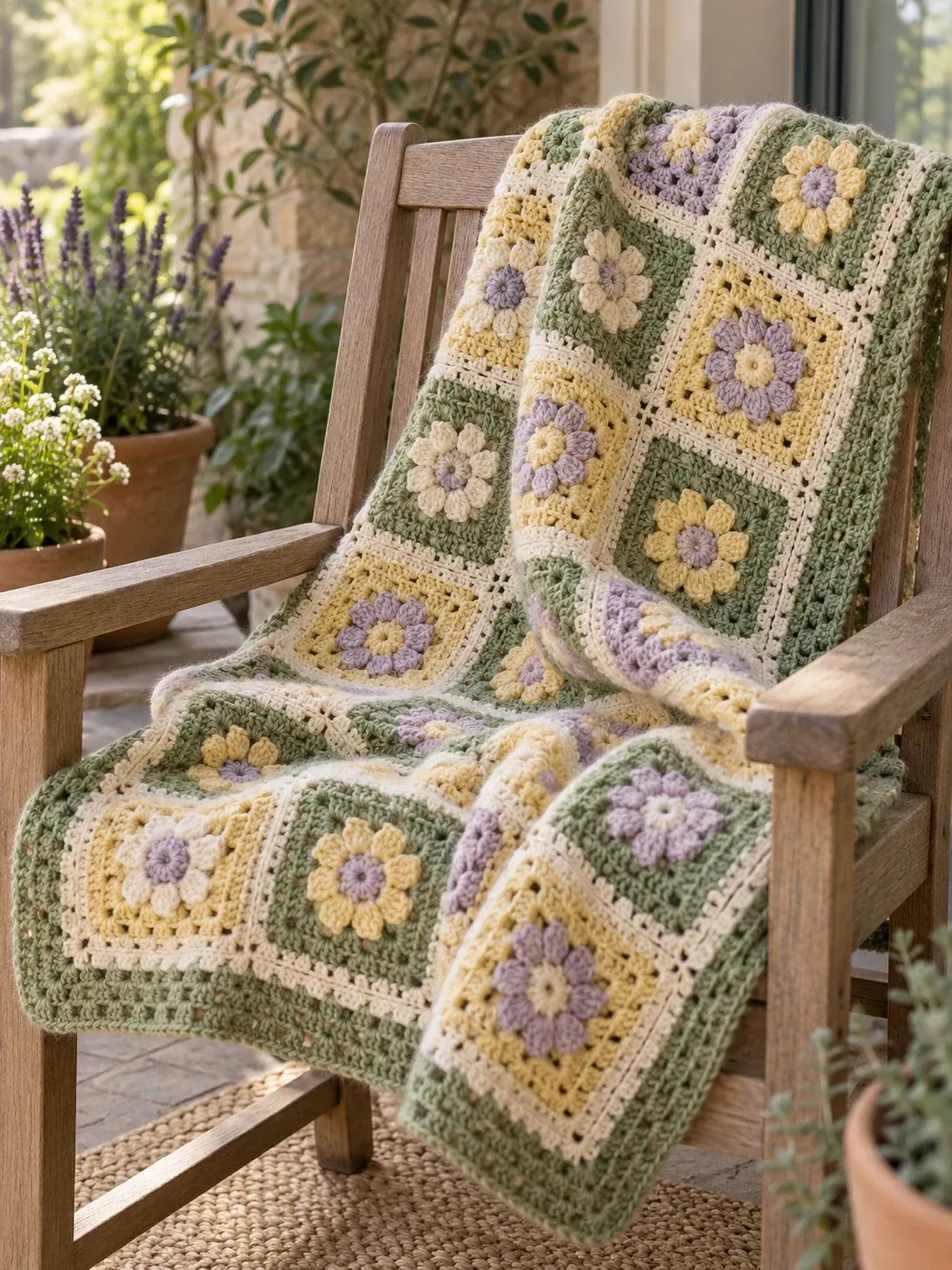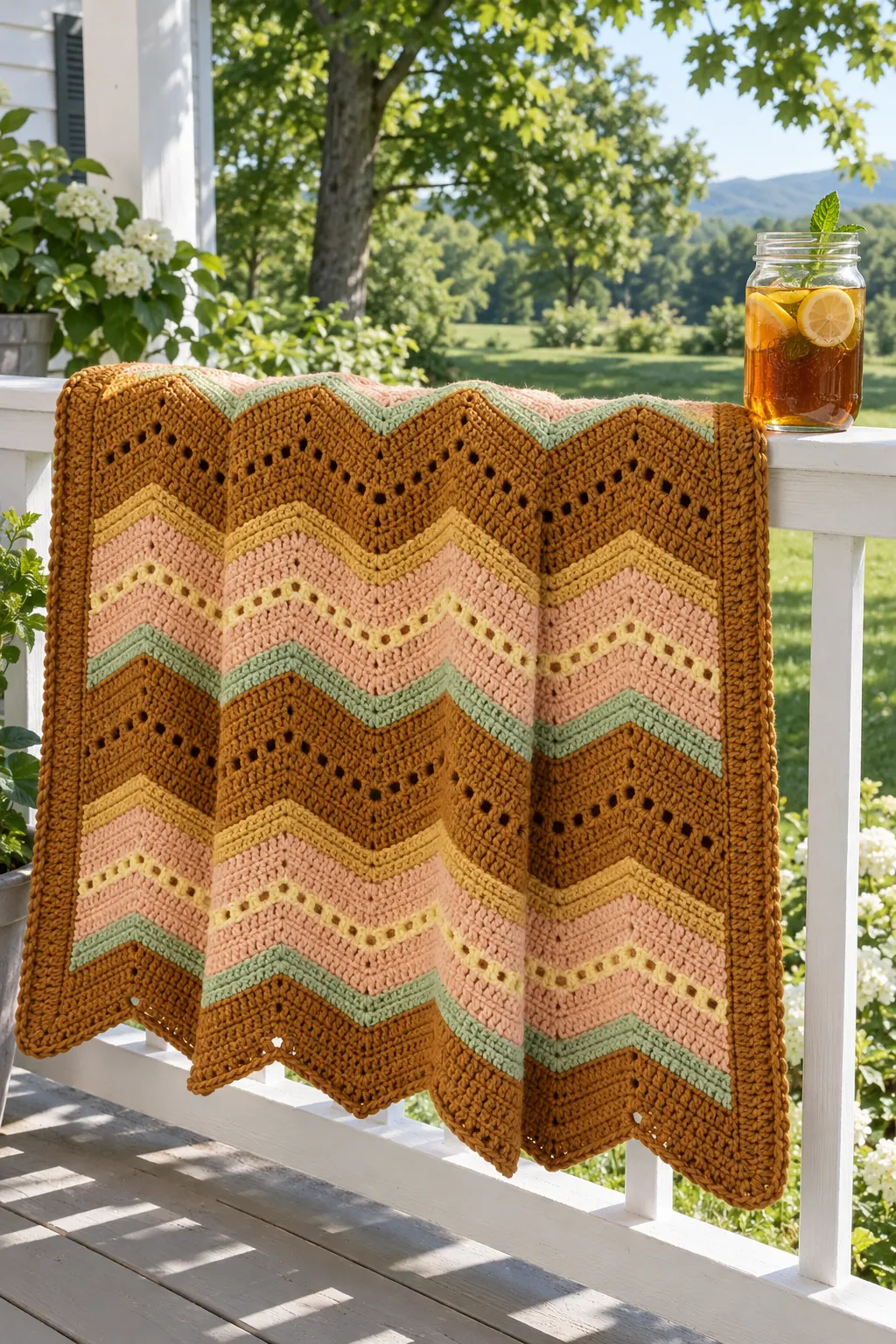
Picture a quart jar of tea steeping on a porch railing in July, a few lemon slices floating near the top and a sprig of mint pushed down the side. The Sun Tea Throw takes its colors from that jar. It’s an eyelet chevron crochet blanket in a worsted cotton blend, with deep amber, honey, soft peach, pale lemon and mint stacked in sharp zigzags from edge to edge.
Every 10-row color sequence mixes solid double crochet rows, a pair of single crochet ridges and two lines of small eyelets. The holes let air through without turning the fabric into a net, so it makes a light cover for a cool June night and still looks tidy folded over the back of a glider. You can make it as a lapghan, a throw or a twin.
Is this eyelet chevron crochet blanket a good first chevron?
You only need three stitches: the chain, single crochet and double crochet. If the abbreviations in the card look like a secret code, the guide to reading a pattern walks you through them.
The new part is the shape. A chevron is a row of peaks and valleys, and here each slope has 11 stitches. At every peak you work (dc, ch 2, dc) into the little chain-2 space of the peak below, which adds stitches and pushes the point up. At every valley you skip 2 stitches, which pulls the dip down by the same amount. So the count never moves: 22 stitches and one ch-2 space per chevron, on every row.
The eyelet rows follow the same peaks and valleys, but they alternate one double crochet with one chain. Each chain sits over a skipped stitch. On the next row you work a double crochet right into that chain space, and the holes stay single and neat.
The last round of the border is reverse single crochet, also called crab stitch. It’s an ordinary single crochet worked backward, from left to right, and the loops twist into a little rope.
Since every color change happens at the end of a row, the pattern is rated Easy. Do expect to count, though. A chevron shows a missing stitch within two rows.
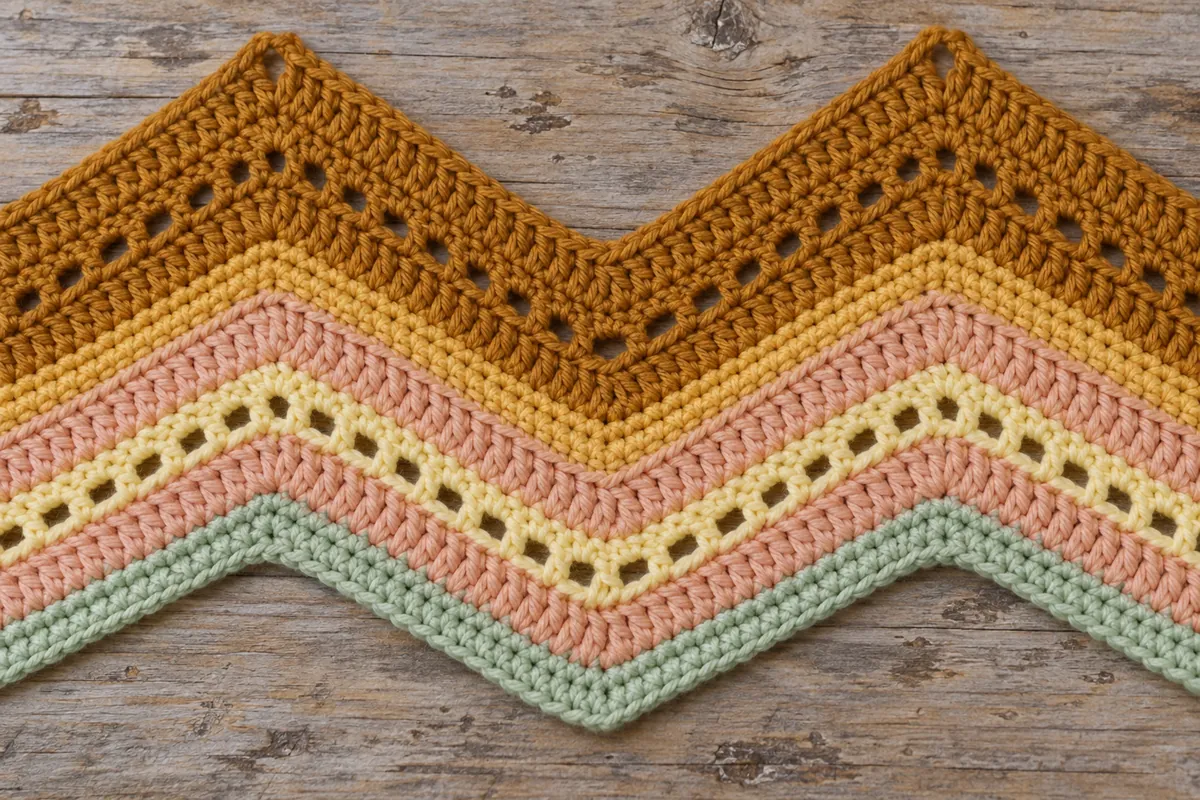
A #4 cotton blend that keeps the eyelets crisp
Look for a 4 on the label, with worsted or aran next to it. The amounts in the card assume about 180 yd (165 m) per 100 g skein and a 5.5 mm (I-9) hook. A cotton-acrylic blend suits this blanket best. The cotton gives clean stitch definition, so the points stay sharp and each eyelet reads as a real hole. The acrylic keeps a twin from getting heavy and helps it hold its shape after washing.
Pure cotton is fine for the lapghan, but think twice before a twin. A big cotton blanket weighs a lot on your lap during the last chevrons, and it can stretch lengthwise when it hangs off the side of the bed. Skip fuzzy or brushed yarns too: their halo fills the eyelets and blurs the zigzag.
Amber goes into the top band, every Amber band, both side bands and the border, so buy all of it from one dye lot. If you substitute, compare yards per 100 g rather than brand names. Every number here stays an estimate until your swatch shows how you work this mix of tall and short rows, so weigh each ball before and after it.
If you’d like the open look in a lighter yarn, the Honeysuckle Throw works mesh rows into a softer DK ripple.
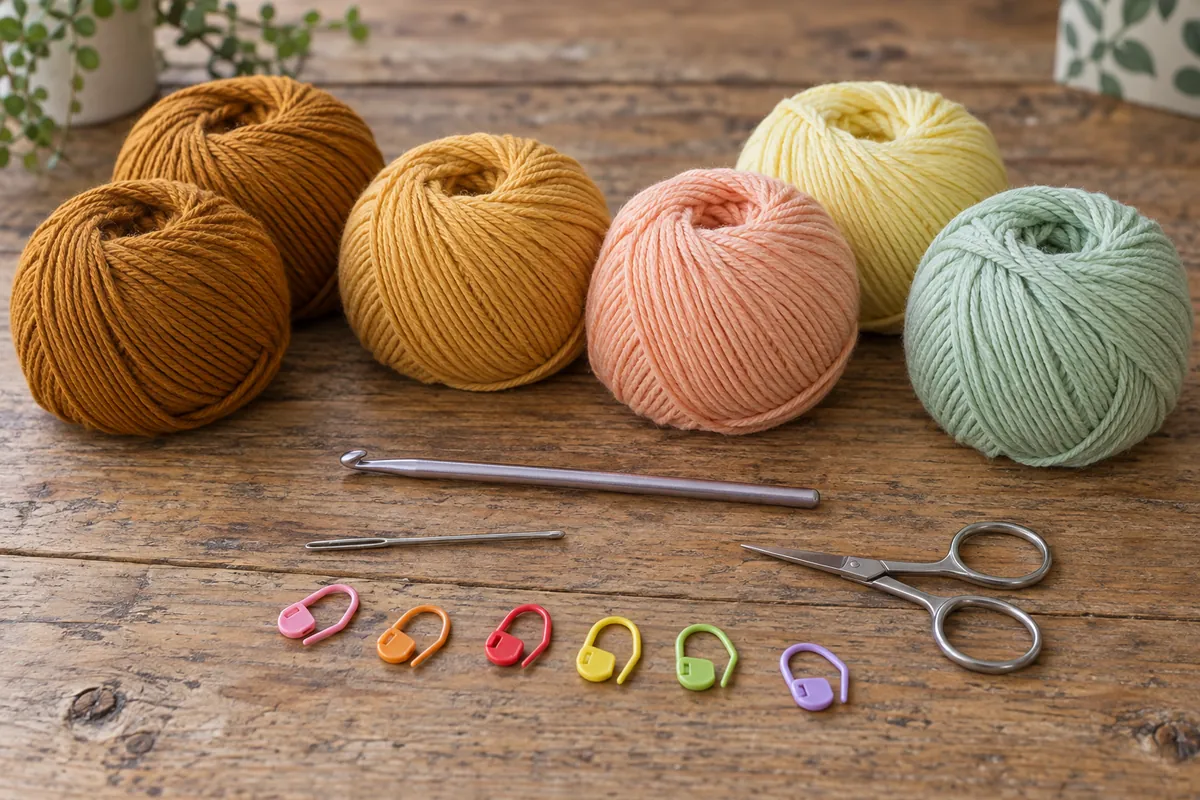
Amber, honey, peach, lemon and mint, row by row
Amber, a deep golden brown, is the main color. It opens the blanket with a three-row band (solid, eyelet, solid), closes every color sequence with the same three rows and frames everything in the border. Honey follows each Amber band with two rows of single crochet, a narrow gold ridge. Peach comes next, one solid row on each side of a single eyelet row worked in pale Lemon, so the lace line glows in the middle of a soft band. Mint adds two more single crochet rows before the next Amber band.
Want a different mood? Keep the same five jobs: a dark main color, a mid tone for the first ridge, a soft color to frame the eyelets, a pale eyelet line and a second ridge color.
- Sun Tea: amber, honey, peach, lemon and mint, as written in the card.
- Raspberry Shrub: deep raspberry, coral, blush, ivory and sage.
- Hayloft: rust, mustard, oatmeal, butter yellow and olive.
- Lilac Hour: plum, lilac, pale pink, ivory and gray-green.
One rule matters more than the shades: the eyelet color must be lighter than its frame, or the holes disappear. Photograph your skeins together in black and white to check.
Six, nine or twelve chevrons: lapghan, throw and twin
Each chevron takes 23 foundation chains and comes out about 5 1/4 in (13.2 cm) wide, so the blanket grows by whole chevrons. The length grows by whole color sequences of about 4 3/8 in (11.2 cm). All three sizes open with the Amber band and end with the Amber band of the last sequence, so the top and bottom match. The card is written as Lapghan [Throw, Twin].
- Lapghan: about 35 × 47 in (89 × 120 cm). Ch 138, 6 chevrons, 10 sequences, 103 rows, 166 sc in the first row of each side band. Amber 665 yd, Peach 285 yd, Honey and Mint 175 yd each, Lemon 115 yd.
- Throw: about 50 1/2 × 60 1/4 in (128 × 153 cm). Ch 207, 9 chevrons, 13 sequences, 133 rows, 214 sc per side band. Amber 1,135 yd, Peach 555 yd, Honey and Mint 340 yd each, Lemon 225 yd.
- Twin: about 66 × 91 1/4 in (168 × 232 cm). Ch 276, 12 chevrons, 20 sequences, 203 rows, 326 sc per side band. Amber 2,115 yd, Peach 1,140 yd, Honey and Mint 695 yd each, Lemon 460 yd.
Because the blanket only grows in whole chevrons and sequences, the lapghan comes out about 1 in narrower and shorter than a standard 36 × 48 in lapghan, and the twin about 1 1/4 in longer than 90 in. A measured swatch may shift these estimates a little.
Keeping 22 stitches between every peak
Clip a removable marker into each ch-2 space of Row 1 and move the markers up every few rows. Before you start a row, check that each peak you’re about to work sits right above one. Then count each chevron as you finish it: 22 stitches, with the ch-2 space left out of the count. A peak that starts to lean sideways almost always means one stitch too many or too few in the slope just before it.
The edges follow one rule on every row: work into the edge stitch, then skip the stitch next to it. On solid rows the chain 3 stands in for that edge stitch. Eyelet rows begin with a chain 4 and skip 2 stitches, because that chain doubles as the first eyelet. Miss a skip and the row grows by one stitch at the edge.
After an eyelet row, every ch-1 space counts as a stitch. Work your double crochet into the space itself rather than into the chain, and the count stays right.
Plan for ends. Each color is cut once its rows are done, which leaves about 125 ends on the lapghan, 160 on the throw and 245 on the twin. Nearly all of them hang at the two side edges, because every color change happens on the last stitch of a row. You won’t need a needle for those. In the first row of each side band, lay the tails along the row ends and crochet over them for about 2 in (5 cm), then trim what’s left once the band is done. Only the half dozen ends from the bands and the border need weaving in.
Cotton relaxes when it’s wet. Pin the peaks and valleys along the top and bottom edges, let the blanket dry flat, and the zigzag sharpens up.
US crochet terms
The pattern
Materials
- Worsted weight yarn (#4), smooth cotton-acrylic blend, about 180 yd (165 m) per 100 g skein, in 5 colors (estimate, 15% margin included):
- Amber (deep golden brown): about 665 [1,135, 2,115] yd (610 [1,040, 1,935] m), 370 [630, 1,175] g, 4 [7, 12] skeins
- Honey (warm gold): about 175 [340, 695] yd (160 [310, 635] m), 100 [190, 385] g, 1 [2, 4] skeins
- Peach (soft apricot): about 285 [555, 1,140] yd (265 [510, 1,045] m), 160 [310, 635] g, 2 [4, 7] skeins
- Lemon (pale butter yellow): about 115 [225, 460] yd (105 [205, 420] m), 65 [125, 255] g, 1 [2, 3] skeins
- Mint (soft pale green): about 175 [340, 695] yd (160 [310, 635] m), 100 [190, 385] g, 1 [2, 4] skeins
- 5.5 mm (I-9) crochet hook
- Yarn needle
- 6 [9, 12] removable stitch markers, plus a few spares
Gauge
1 chevron (22 sts and 1 ch-2 sp), measured from peak to peak = about 5 1/4 in (13.2 cm); one 10-row color sequence (Rows 4–13), measured straight up a column = about 4 3/8 in (11.2 cm); 7 dc rows = 4 in (10 cm); with a 5.5 mm (I-9) hook, after blocking. Estimate: check your own gauge on a swatch before you start.
Swatch: with Amber, ch 46. Work Rows 1–13 of the Body, working each section from * only once (2 chevrons: 44 sts and 2 ch-2 sps). Block the swatch, then measure the distance between the 2 peaks and the height of Rows 4–13.
Finished size
- Lapghan: about 35 × 47 in (89 × 120 cm)
- Throw: about 50 1/2 × 60 1/4 in (128 × 153 cm)
- Twin: about 66 × 91 1/4 in (168 × 232 cm)
- Measured after blocking, border included (about 2 in / 5 cm on each long side and 1/2 in / 1.5 cm at the top and bottom). Length is measured straight down a column from edge to edge; the points are not included. Estimates based on the gauge above.
Abbreviations
- ch chain
- ch- refers to a chain or space already made (for example, ch-2 sp)
- dc double crochet
- rep repeat
- reverse sc reverse single crochet (see Notes)
- RS right side
- sc single crochet
- sk skip
- sl st slip stitch
- sp(s) space(s)
- st(s) stitch(es)
- WS wrong side
- yo yarn over
Notes
- Sizes are written as Lapghan [Throw, Twin]. A number given once applies to all sizes.
- Construction: the blanket is worked in rows from one short end to the other, in 6 [9, 12] chevrons with 11 sts on each slope. Each peak is worked as (st, ch 2, st) in the ch-2 sp of the peak below; each valley skips 2 sts. The count never changes: 22 sts and 1 ch-2 sp per chevron, on every row.
- Stitch multiple: the foundation chain is a multiple of 23 (23 ch per chevron). To resize, add or remove 23 ch and one * repeat per chevron; every stitch count changes by 22 per chevron.
- Row types: Solid rows (dc), Eyelet rows (dc and ch-1 sps) and Sc rows. Row 1 is the RS.
- Edges: at each end of every row, work into the edge st and skip the st next to it. On Eyelet rows, the ch 4 at the start and the last ch 1 each skip 2 sts.
- Turning chains: on Solid rows, ch 3 counts as a dc. On Eyelet rows, ch 4 counts as a dc and a ch-1 sp. On Sc rows, ch 1 never counts as a st and is never worked into. Stitch counts include the turning chains; ch-2 sps are not sts.
- First and last st: the first st of a row is the st at the base of the turning ch. The last st is the top of the turning ch of the row below (on Row 2, the 3rd of the 3 skipped ch at the start of Row 1; after an Eyelet row, the 3rd ch of its ch 4). After a Sc row, the last st is the first sc of that row.
- After an Eyelet row, each ch-1 sp counts as a st: work into the space.
- Color changes: change colors on the last stitch of each color run: work it until 2 loops remain and finish it with the next color, then turn. The turning ch is worked in the new color. Cut the old color, leaving a 6 in (15 cm) tail, and leave a 6 in (15 cm) tail of the new color. Every change happens at the end of a row, so all tails hang at the side edges.
- Tails: do not weave in the body tails. Row 1 of each side band is worked over them: lay the tails of that edge along the row ends, pointing the way you’re working, crochet over each one for about 2 in (5 cm), then trim the rest once the band is done. Weave in only the band and border ends.
- Row ends: work around the post of the edge st, or under the turning ch where it counts as a st. Work 2 sc in the end of each dc row (Solid and Eyelet) and 1 sc in the end of each sc row.
- Reverse sc (crab stitch): worked from left to right (right to left if you crochet left-handed). Without turning, insert the hook in the next st to the right, yo, pull up a loop, yo, pull through both loops. The loops twist into a rope-like edge.
- Keep count: place a marker in each ch-2 sp of Row 1 and move the markers up as you go. Count each chevron (22 sts) when you finish it.
- Yardage and sizes are estimates based on the gauge above.
Instructions
Body
- Foundation: With Amber, ch 138 [207, 276].
- Row 1 (RS, Amber, Solid row): Dc in 4th ch from hook (3 skipped ch count as a dc), dc in next 8 ch, (dc, ch 2, dc) in next ch, *dc in next 10 ch, sk next 2 ch, dc in next 10 ch, (dc, ch 2, dc) in next ch; rep from * 4 [7, 10] more times, dc in next 10 ch. Turn. (132 [198, 264] sts and 6 [9, 12] ch-2 sps)
- Row 2 (WS, Amber, Eyelet row): Ch 4 (counts as dc and ch-1 sp), sk next 2 sts, [dc in next st, ch 1, sk next st] 4 times, (dc, ch 2, dc) in next ch-2 sp, *[ch 1, sk next st, dc in next st] 5 times, sk next 2 sts, [dc in next st, ch 1, sk next st] 5 times, (dc, ch 2, dc) in next ch-2 sp; rep from * 4 [7, 10] more times, [ch 1, sk next st, dc in next st] 4 times, ch 1, sk next 2 sts, dc in last st. Turn. (132 [198, 264] sts, including 60 [90, 120] ch-1 sps, and 6 [9, 12] ch-2 sps)
- Row 3 (RS, Amber, Solid row): Ch 3 (counts as dc), sk next st, dc in next 9 sts, (dc, ch 2, dc) in next ch-2 sp, *dc in next 10 sts, sk next 2 sts, dc in next 10 sts, (dc, ch 2, dc) in next ch-2 sp; rep from * 4 [7, 10] more times, dc in next 9 sts, sk next st, dc in last st, changing to Honey on this last dc; cut Amber. Turn. (132 [198, 264] sts and 6 [9, 12] ch-2 sps)
- Row 4 (WS, Honey, Sc row): Ch 1 (does not count), sc in first st, sk next st, sc in next 9 sts, (sc, ch 2, sc) in next ch-2 sp, *sc in next 10 sts, sk next 2 sts, sc in next 10 sts, (sc, ch 2, sc) in next ch-2 sp; rep from * 4 [7, 10] more times, sc in next 9 sts, sk next st, sc in last st. Turn. (132 [198, 264] sts and 6 [9, 12] ch-2 sps)
- Row 5 (RS, Honey, Sc row): Work as Row 4, changing to Peach on the last sc; cut Honey. Turn. (132 [198, 264] sts and 6 [9, 12] ch-2 sps)
- Row 6 (WS, Peach, Solid row): Work as Row 3, changing to Lemon on the last dc; cut Peach. Turn. (132 [198, 264] sts and 6 [9, 12] ch-2 sps)
- Row 7 (RS, Lemon, Eyelet row): Work as Row 2, changing to Peach on the last dc; cut Lemon. Turn. (132 [198, 264] sts, including 60 [90, 120] ch-1 sps, and 6 [9, 12] ch-2 sps)
- Row 8 (WS, Peach, Solid row): Work as Row 3, changing to Mint on the last dc; cut Peach. Turn. (132 [198, 264] sts and 6 [9, 12] ch-2 sps)
- Row 9 (RS, Mint, Sc row): Work as Row 4. Turn. (132 [198, 264] sts and 6 [9, 12] ch-2 sps)
- Row 10 (WS, Mint, Sc row): Work as Row 4, changing to Amber on the last sc; cut Mint. Turn. (132 [198, 264] sts and 6 [9, 12] ch-2 sps)
- Row 11 (RS, Amber, Solid row): Work as Row 3 without changing color. Turn. (132 [198, 264] sts and 6 [9, 12] ch-2 sps)
- Row 12 (WS, Amber, Eyelet row): Work as Row 2. Turn. (132 [198, 264] sts, including 60 [90, 120] ch-1 sps, and 6 [9, 12] ch-2 sps)
- Row 13 (RS, Amber, Solid row): Work as Row 3, changing to Honey on the last dc; cut Amber. Turn. (132 [198, 264] sts and 6 [9, 12] ch-2 sps)
- Rows 14–103 [14–133, 14–203]: Rep Rows 4–13 9 [12, 19] more times, with the same stitch counts. On the very last row (a Row 13), do not change color, do not turn and do not fasten off: keep Amber for the left side band. (10 [13, 20] color sequences, 103 [133, 203] rows)
Side bands
- Left band, Row 1 (RS): With Amber still on the hook, ch 1 and rotate the blanket to work down the left side edge, from the last row to the foundation chain. Working over the yarn tails of this edge (see Notes), work 2 sc in the end of each dc row and 1 sc in the end of each sc row. Turn. (166 [214, 326] sc)
- Left band, Rows 2–5: Ch 1 (does not count), sc in each sc across. Turn after Rows 2–4; fasten off after Row 5. (166 [214, 326] sc)
- Right band, Row 1 (RS): With RS facing and the foundation chain at the bottom, join Amber with sl st in the end of Row 1 at the lower right corner. Ch 1, then work up the right side edge and over the yarn tails of this edge: 2 sc in the end of each dc row and 1 sc in the end of each sc row. Turn. (166 [214, 326] sc)
- Right band, Rows 2–5: Ch 1 (does not count), sc in each sc across. Turn after Rows 2–4; fasten off after Row 5. (166 [214, 326] sc)
Border
- Round 1 (RS): Join Amber with sl st in the last sc of Row 5 of the right band (top right corner). Ch 1, 3 sc in same st. Top edge: sc in the end of each of next 4 band rows; along the last body row, sc in first st (top of the ch 3), sk next st, sc in next 9 sts, 3 sc in next ch-2 sp, *sc in next 10 sts, sk next 2 sts, sc in next 10 sts, 3 sc in next ch-2 sp; rep from * 4 [7, 10] more times, sc in next 9 sts, sk next st, sc in last st; sc in the end of each of next 4 band rows. Left side: 3 sc in first sc of Row 5 of the left band, sc in each of next 164 [212, 324] sc, 3 sc in last sc. Bottom edge: sc in the end of each of next 4 band rows; working in the free loops of the foundation chain, sc in each of next 10 ch, *sk next ch (it holds a peak of Row 1), sc in next 10 ch, 3 sc around the next 2 skipped ch, sc in next 10 ch; rep from * 4 [7, 10] more times, sk next ch, sc in next 10 ch (the last one is the 3rd ch of the foundation, at the base of the Row 1 turning ch); sc in the end of each of next 4 band rows. Right side: 3 sc in first sc of Row 5 of the right band, sc in each of next 164 [212, 324] sc; join with sl st in first sc. (629 [863, 1,225] sc: 146 [215, 284] across the top, 143 [212, 281] across the bottom and 164 [212, 324] on each side between the corners, plus 3 sc in each of the 4 corners)
- Round 2 (RS): Ch 1, sc in same st as join, then reverse sc in each sc around, corner sts included; join with sl st in first sc. Fasten off. (629 [863, 1,225] sts)
- Weave in the remaining ends.
Washing a five-color cotton chevron
Check your yarn label first. Most cotton-acrylic blends can go in the machine on a cold, gentle cycle, and cold water keeps amber and peach from bleeding into the pale lemon rows. For the first wash, add a color-catcher sheet and skip bleach or detergents with optical brighteners, which can dull the mint.
Dry the blanket flat, or tumble it on low only until it’s damp, then lay it out and nudge the points back into line. Never hang a wet twin over a clothesline or a door: the weight of wet cotton pulls the chevrons longer. Between seasons, fold it on a shelf rather than hanging it, for the same reason.
Questions about the Sun Tea Throw
Can I make this eyelet chevron crochet blanket in 100% cotton?
Yes, especially the lapghan. Pure cotton is heavier and has less spring, so make the swatch in your cotton and compare the peak-to-peak width before you chain. Expect a twin in pure cotton to feel noticeably heavier and to stretch a little in length over time.
Why is there a chain-2 space at every peak instead of 3 dc in one stitch?
The ch-2 space gives each new row a clear target: every peak goes into it, so you can find the point even on an eyelet row. It also leaves a small opening at each tip that matches the eyelets. A 3-dc peak works too, but every count and row in the card would change.
Can I work the eyelet rows as solid rows instead?
Yes. Work a Solid row wherever the card says Eyelet row. The stitch count stays at 22 per chevron, the blanket uses a little more Amber and Lemon, and you get a plain chevron crochet blanket without the lace lines. For a solid, cozy wave in bulky yarn, the Oat Milk throw is built on the same peak-and-valley idea.
How do I make it wider or longer without changing the chevrons?
Add or remove whole chevrons: 23 foundation chains and one more * repeat in every row per chevron. Each one adds about 5 1/4 in and 22 stitches to every count. For length, add or remove whole 10-row sequences; each changes the side band by 16 sc and the length by about 4 3/8 in.
Why do the top and bottom edges stay pointed after the border?
The border follows the zigzag instead of filling it. Along both short ends, the first round puts 3 sc at each outward point and skips stitches at each inward point, like the body rows. Pin the points when you block.
Quick recap
- With Amber, chain 138 [207, 276] and work the 3-row Amber band.
- Work the 10-row color sequence 10 [13, 20] times, ending with its Amber band.
- Work a 5-row single crochet band down each long side, crocheting over the yarn tails.
- Work a round of single crochet all around, with 3 sc in each corner and each outward point.
- Finish with a round of reverse single crochet and weave in the last few ends.
Draped over a porch glider, the Sun Tea Throw looks like bands of brewed tea and fruit, with a lace line in every sequence to let the evening air through. It’s an eyelet chevron crochet blanket made for the warm months, and once the first sequence is done, the rhythm is easy to keep. If a peak won’t line up or a count doesn’t add up, send a note through the Contact page and say which size and row you’re on.