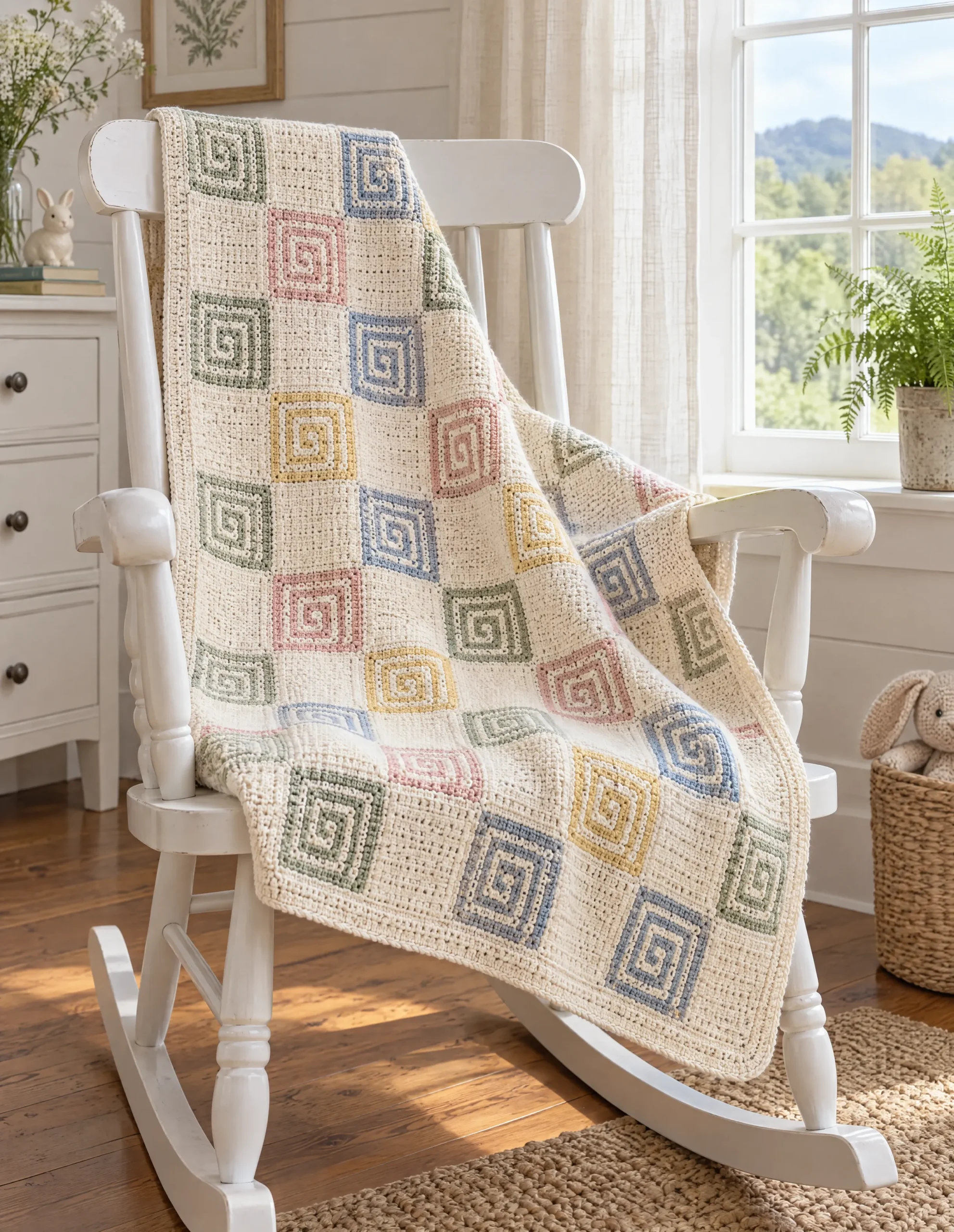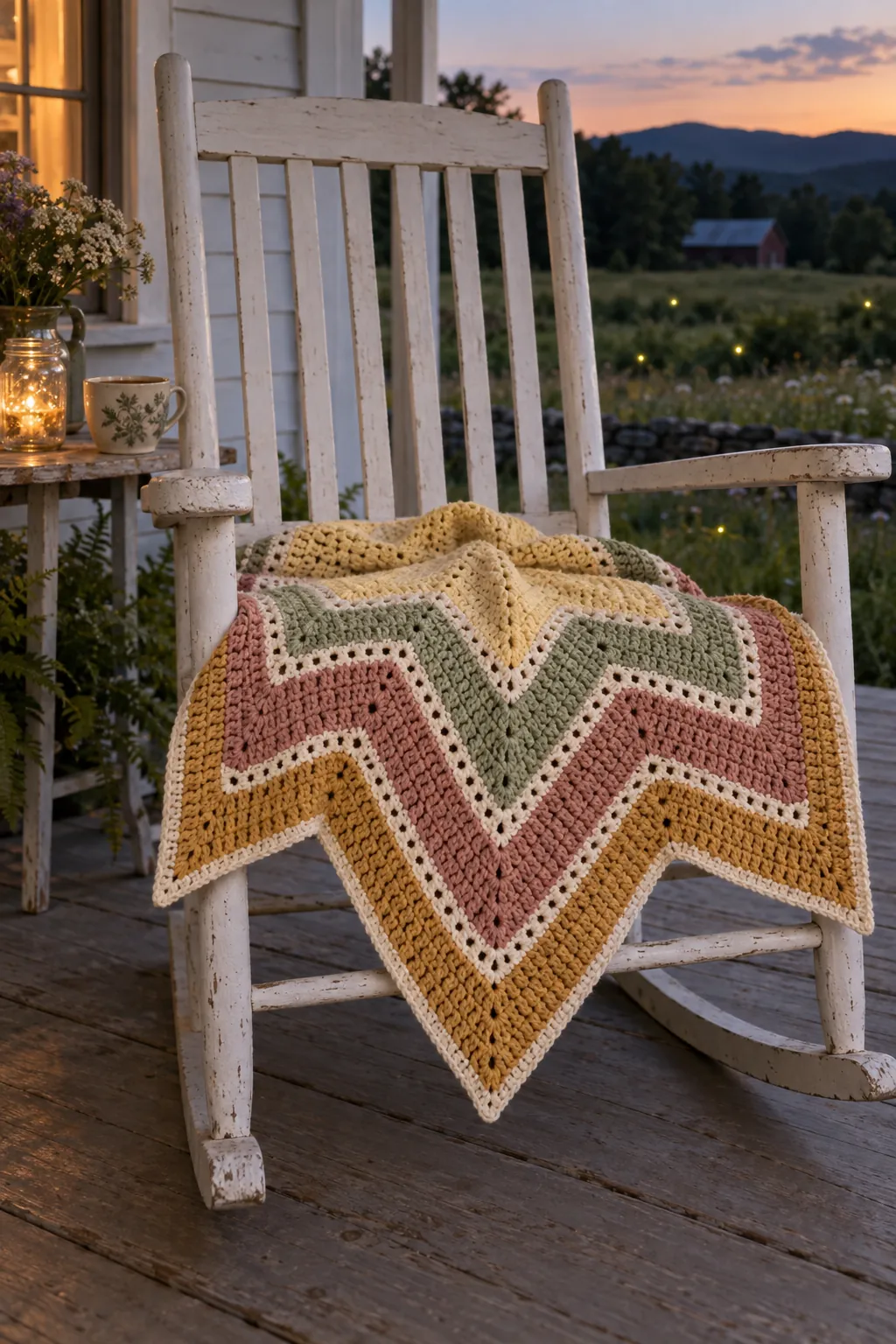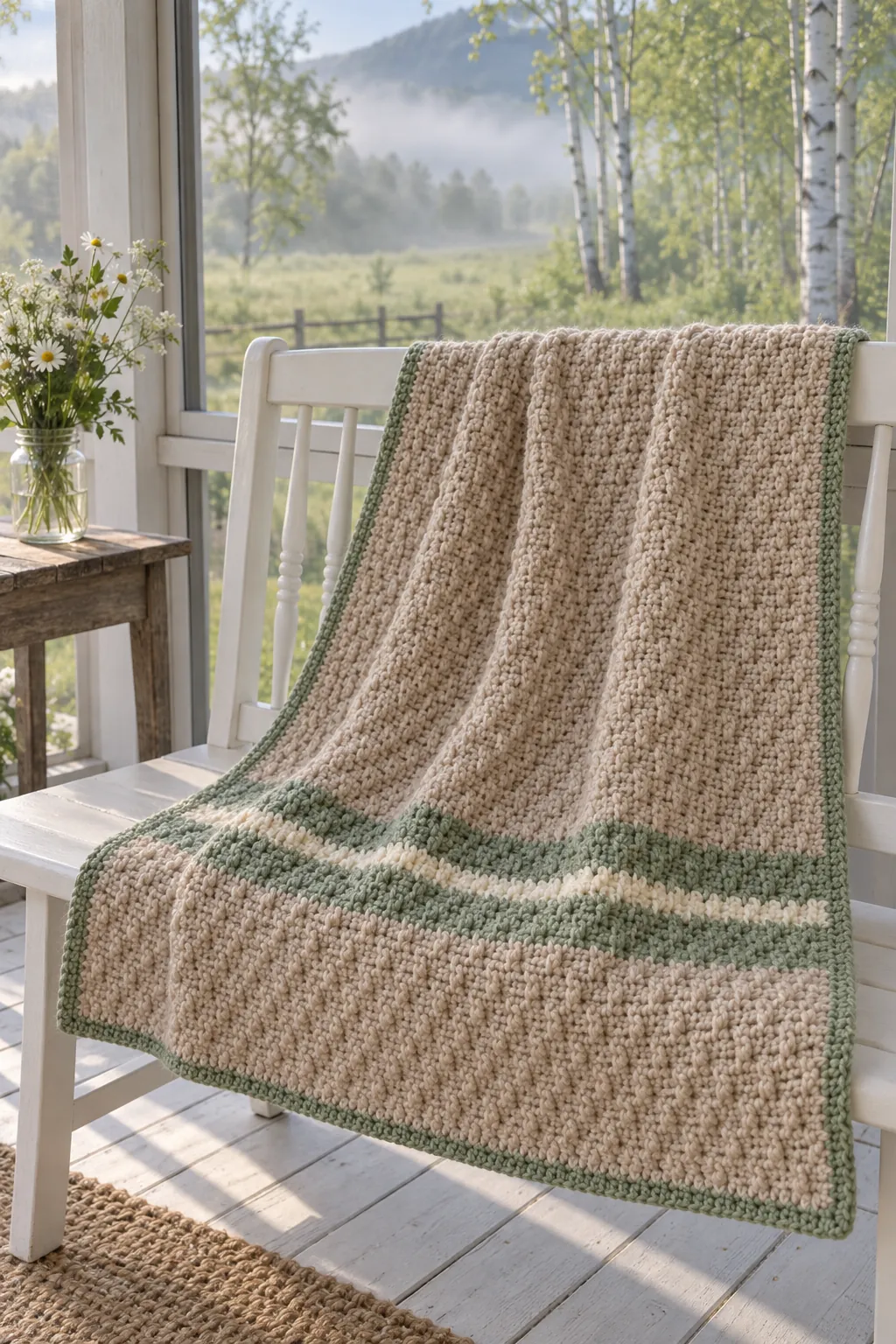
On a Vermont morning in May, mist can sit low over the hayfields and turn everything under it soft and pale. This alpine stitch baby blanket borrows three of those colors: a warm oat for the body, a gray-green sage like new birch leaves, and one thin stripe of cream. Small raised posts cover the whole surface in staggered rows, so the fabric has the nubby, springy feel of a knit thermal shirt.
You’ll work it flat in rows with a DK cotton blend and a 4.0 mm hook, so it stays breathable on a June stroller walk. The card covers a 30 × 34 in (76 × 86 cm) stroller blanket, a 36 × 45 in (91 × 114 cm) play mat and a 42 × 51 1/2 in (107 × 131 cm) blanket for a toddler bed. The colors change only eight times, so you’ll finish with about 16 tails, not dozens.
Can you make this alpine stitch baby blanket without post-stitch experience?
Yes, if a row of double crochet already feels easy. Apart from one, the stitches are basics you probably know, mainly the chain, the single crochet and the double crochet. If brackets like 115 [139, 163] slow you down, keep the Beginner Guide’s page on reading a crochet pattern open beside the card.
The new stitch is the front post treble crochet, written FPtr. You wrap the yarn twice, then slide the hook around the post, the upright column, of a double crochet two rows down, coming in from the front. The two wraps make the FPtr long enough to reach back up past the single crochet row in between, so it stands out on the front like a small rib.
Every other row is plain single crochet, a rest between post rows. The catch, and the reason it’s rated Intermediate, is that post rows come in two versions that start differently. Mix them up and the bumps stack instead of staggering.
If you’d rather wait on post stitches, a beginner cotton-blend afghan with lacy stripes uses only chains and single crochet.
Why a DK cotton blend suits this textured baby blanket
Check the label for the number 3, the Light symbol, usually sold as DK, with roughly 230 to 260 yards per 100 g ball. A cotton and acrylic blend fits best. Cotton breathes and keeps every post crisp, and acrylic cuts the weight and adds the stretch a stitch this dense needs to stay soft.
Choose a smooth, tightly plied yarn, since your hook travels behind each post and loose plies split there. Skip fuzzy or chenille yarns: their pile fills the gaps and the staggered pattern disappears.
The stroller size uses about 3 balls of Oat and the toddler bed size about 8, so buy all your Oat from one dye lot. A second lot would show as a faint band.
Work the gauge swatch first: 22 chains and 12 rows on the 4.0 mm (G-6) hook should measure about 5 1/4 × 4 in (13.5 × 10 cm). Cotton blends can shrink or relax in the wash, so wash and dry the swatch, then measure again. Check the height as closely as the width, since the length depends on how your sc and dc rows stack up.
Where the oat, sage and cream bands fall
Oat is the background. It works the first 14 rows, about 4 2/3 in (12 cm), the last 13 rows and the whole center, which runs about 10 2/3 [21 1/3, 28] in (27 [54, 71] cm) depending on the size. Near each end sits one band: 8 rows of Sage, 4 rows of Cream, then 8 more rows of Sage, about 6 2/3 in (17 cm) altogether. Sage comes back for the border and ties the two bands together.
Oat only ever meets Sage, and so does Cream. So Sage is the shade that has to stand apart: pick it clearly darker than the other two. Oat and Cream can be close cousins, since they never touch.
These sets keep the same light, darker, light balance:
- Morning Mist: oat, sage and cream, the colors in the card.
- Sea Smoke: driftwood beige, dusty blue and ivory.
- Rhubarb Patch: oatmeal, muted rose and cream.
- Haymow: pale linen, caramel and soft white.

Three baby sizes from one 16-stitch gauge
All three sizes share the gauge, the bands and the three-round border, which adds a little over 1/2 in (1.5 cm) per side. The card is written for the stroller size, with the others in brackets. Yardage is an estimate with about 10% extra.
- Stroller, 30 × 34 in (76 × 86 cm): ch 116, 99 rows, border rounds of 530, 538 and 546 sc. About 750 yd of Oat, 500 yd of Sage and 100 yd of Cream, 1,350 yd (1,234 m) in all.
- Play mat, 36 × 45 in (91 × 114 cm): ch 140, 131 rows, border rounds of 674, 682 and 690 sc. About 1,400 yd of Oat, 625 yd of Sage and 125 yd of Cream, 2,150 yd (1,966 m) in all.
- Toddler bed, 42 × 51 1/2 in (107 × 131 cm): ch 164, 151 rows, border rounds of 782, 790 and 798 sc. About 2,000 yd of Oat, 725 yd of Sage and 150 yd of Cream, 2,875 yd (2,629 m) in all.
For another width, chain any even number: each 2 chains change it by about 1/2 in (1.3 cm). For another length, add or remove repeats of Rows 3–6 in the Oat center, so the bands stay put. Each repeat is about 1 1/3 in (3.4 cm), roughly 50 [60, 70] yd of Oat and 6 more sc on each side of every border round.
For a bed-sized blanket with this same texture, the worsted throw that goes up to a twin is a better route.
Babies younger than 12 months sleep safest with nothing loose around them, so keep this blanket out of the crib, the bassinet and any other sleep space. The stroller and play mat sizes are for awake time with someone watching, and the toddler bed size is for after the first birthday. Skip buttons, beads, pompoms or sewn-on shapes, which a small child can pull off and swallow.
Staying on track with two post rows and a cream stripe
Let the row number pick the start. Post rows are the even rows. If the number divides by 4 (Rows 4, 8, 12), start with one dc before the first FPtr. If not (Rows 6, 10, 14), start with two. Keep the current row number on a sticky note.
Every FPtr wraps a plain double crochet, never a post. If your hook is heading for a raised stitch, you’ve drifted one over.
Skip the sc sitting above the post you just wrapped, or the row grows. Count at the end of each sc row for 115 [139, 163] sts, with a marker every 20 stitches.
Pull each FPtr up to the height of the dc beside it. Tight posts pucker the fabric and narrow the blanket.
Every right-side row begins and ends with a plain dc, and the ch 2 doesn’t count, so the first dc goes into the very first stitch. The straight columns at both sides make the border easy to space.
Don’t cut Sage at the cream stripe. The stripe is 4 rows tall and ends at the edge where it began, so Sage waits there for the last dc of Row 26, and again at Row 78 [110, 130]. Keep the carried strand loose; the border covers it.
Cotton blends are slippery, so weave each tail about 3 in (7.5 cm) through a sc row of the same color, then turn and go back a short way.
US crochet terms
The pattern
Materials
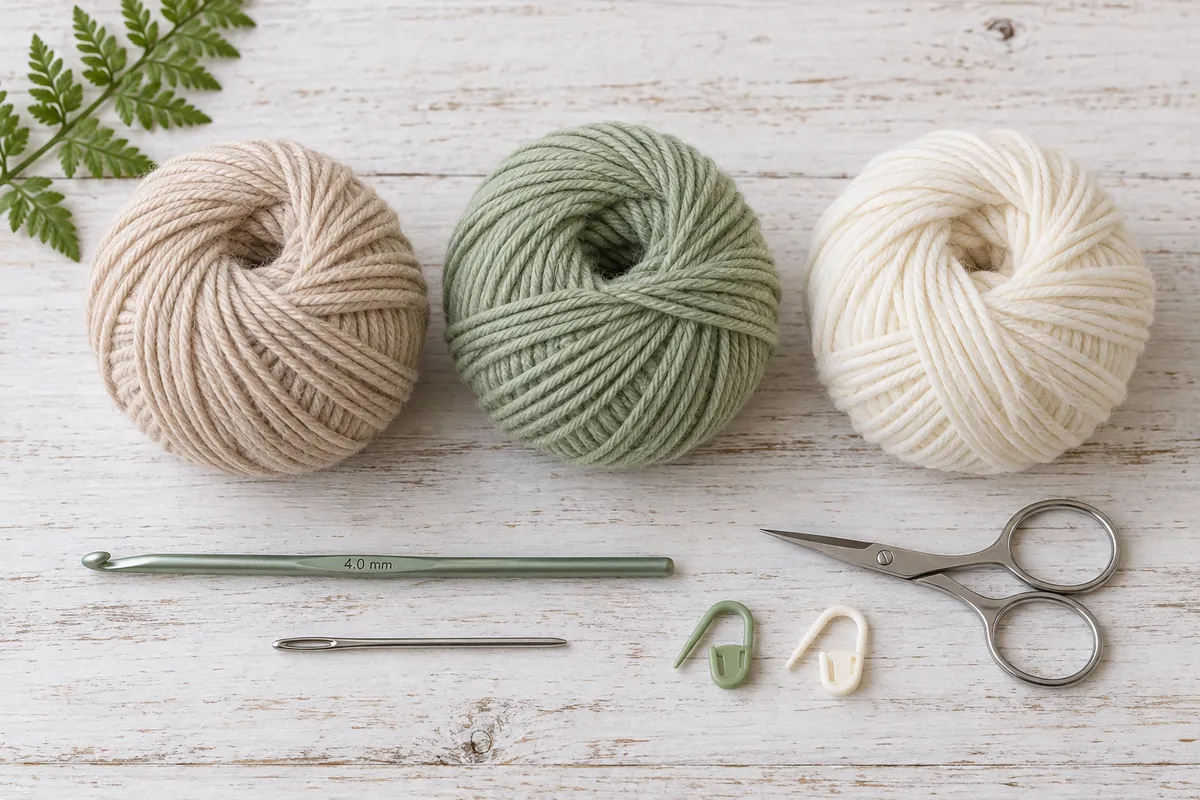
- DK weight yarn (CYC 3, Light) in a cotton-acrylic blend, about 1,350 [2,150, 2,875] yd (1,234 [1,966, 2,629] m) in total (estimate, with about 10% extra):
- Oat (warm light beige): 750 [1,400, 2,000] yd (686 [1,280, 1,829] m), about 3 [6, 8] balls
- Sage (soft gray-green): 500 [625, 725] yd (457 [572, 663] m), about 2 [3, 3] balls
- Cream (off-white): 100 [125, 150] yd (91 [114, 137] m), 1 [1, 1] ball
- Ball counts assume about 250 yd (229 m) per 3.5 oz (100 g) ball.
- Crochet hook: 4.0 mm (US G-6), or the size needed to get gauge.
- Yarn needle.
- Locking stitch markers: 1 for the RS, plus a few to mark every 20 sts.
- Scissors.
Gauge
- 16 sts and 12 rows = 4 in (10 cm) in alpine stitch (Rows 3–6), with a 4.0 mm hook.
- Swatch, in one color: Ch 22. Work Rows 1–6, then Rows 3–6 once more, then Rows 3–4 (21 sts, 12 rows). It should measure about 5 1/4 in (13.5 cm) wide and 4 in (10 cm) tall.
- Wash and dry the swatch the way you will wash the blanket, then measure again.
- More than 16 sts in 4 in: try a larger hook. Fewer: try a smaller hook.
Finished size
- Stroller: 30 × 34 in (76 × 86 cm).
- Play mat: 36 × 45 in (91 × 114 cm).
- Toddler bed: 42 × 51 1/2 in (107 × 131 cm).
- Border included, measured flat after washing.
Abbreviations
- ch chain
- dc double crochet
- FPtr front post treble crochet (see Notes)
- rep repeat
- RS right side
- sc single crochet
- sk skip
- sl st slip stitch
- st(s) stitch(es)
- WS wrong side
- yo yarn over
Notes
- Sizes are written Stroller [Play mat, Toddler bed]. When only one number is given, it applies to all sizes.
- Turning chains never count as a st: ch 1 on sc rows, ch 2 on dc rows. Work the first st of each row into the first st, at the base of the turning chain.
- FPtr: Yo twice. Insert the hook from the front, behind the post (the upright body) of the indicated st and back out to the front, so the post lies across the hook. Yo and draw up a loop to the height of the current row, then (yo, draw through 2 loops) 3 times.
- Each FPtr wraps the dc 2 rows below, directly under the next st. Sk the sc behind each FPtr so the st count stays the same.
- Even-numbered rows are RS rows, and the FPtr stand out on the RS. Mark the RS on Row 2.
- Every RS row begins and ends with a plain dc, so the side edges have no posts.
- Stitch multiple: any odd number of sts (5 or more). Foundation ch: multiple of 2 (any even number, 6 or more). Each 2 ch added or removed changes the width by about 1/2 in (1.3 cm). Each repeat of Rows 3–6 adds about 1 1/3 in (3.4 cm) of length.
- Color change: change colors only at the end of a RS row. Work the last dc until 2 loops remain, drop the old color, yo with the new color and draw through. Cut the old color, leaving a 6 in (15 cm) tail, except Sage at the start of each Cream stripe: leave Sage uncut and carry it loosely up the side for 4 rows. The border covers it.
- Weave in tails on the WS through sc rows of the same color. Cotton blends are slippery: weave each tail about 3 in (7.5 cm), then turn and weave back a short way.
- Safety: Never leave a loose blanket in a crib, bassinet or any sleep space for a baby under 12 months. Use the Stroller and Play mat sizes for supervised awake time. Do not add buttons, beads, pompoms or anything a child could pull off.
Instructions
Body
- Foundation: With Oat, ch 116 [140, 164].
- Row 1 (WS): Sc in 2nd ch from hook and in each ch across. Turn. (115 [139, 163] sc)
- Row 2 (RS): Ch 2, dc in each st across. Turn. (115 [139, 163] dc)
- Row 3 (WS): Ch 1, sc in each st across. Turn. (115 [139, 163] sc)
- Row 4 (RS): Ch 2, dc in first st, *FPtr around next dc 2 rows below, sk sc behind FPtr, dc in next st; rep from * across. Turn. (115 [139, 163] sts: 57 [69, 81] FPtr and 58 [70, 82] dc)
- Row 5 (WS): Rep Row 3. (115 [139, 163] sc)
- Row 6 (RS): Ch 2, dc in first 2 sts, *FPtr around next dc 2 rows below, sk sc behind FPtr, dc in next st; rep from * to last st, dc in last st. Turn. (115 [139, 163] sts: 56 [68, 80] FPtr and 59 [71, 83] dc)
- Rows 7–14: Rep Rows 3–6 twice. Change to Sage at the end of Row 14. (115 [139, 163] sts on every row from here on)
- Rows 15–22: With Sage, rep Rows 3–6 twice. Change to Cream at the end of Row 22; do not cut Sage.
- Rows 23–26: With Cream, rep Rows 3–6 once. Change to Sage at the end of Row 26 and cut Cream.
- Rows 27–34: With Sage, rep Rows 3–6 twice. Change to Oat at the end of Row 34.
- Rows 35–66 [35–98, 35–118]: With Oat, rep Rows 3–6 8 [16, 21] times. Change to Sage at the end of the last row.
- Rows 67–74 [99–106, 119–126]: With Sage, rep Rows 3–6 twice. Change to Cream at the end of the last row; do not cut Sage.
- Rows 75–78 [107–110, 127–130]: With Cream, rep Rows 3–6 once. Change to Sage at the end of the last row and cut Cream.
- Rows 79–86 [111–118, 131–138]: With Sage, rep Rows 3–6 twice. Change to Oat at the end of the last row.
- Rows 87–98 [119–130, 139–150]: With Oat, rep Rows 3–6 3 times.
- Row 99 [131, 151] (WS): Rep Row 3. Fasten off. The body measures about 28 3/4 × 33 [34 3/4 × 43 3/4, 40 3/4 × 50 1/4] in (73 × 84 [88 × 111, 104 × 128] cm). (115 [139, 163] sc)
Border
- Round 1 (RS): With RS facing, join Sage with a sl st in the first st of the last row. Ch 1, 3 sc in same st (corner), sc in each st across to last st, 3 sc in last st (corner). Working down the side in the row ends of Rows 98 [130, 150] to 2, work 1 sc in the end of each sc row and 2 sc in the end of each dc row (146 [194, 224] sc). Working in the free loops of the foundation ch at the base of the Row 1 sts, 3 sc in first ch (corner), sc in each ch to last ch, 3 sc in last ch (corner). Work up the other side in the row ends of Rows 2 to 98 [130, 150] in the same way (146 [194, 224] sc). Join with sl st to first sc. (530 [674, 782] sc: 4 corner sts, plus 115 [139, 163] along the top and the bottom and 148 [196, 226] along each side between corner sts)
- Round 2 (RS): Do not turn. Sl st in next sc (corner st). Ch 1, 3 sc in same st, *sc in each st to next corner st, 3 sc in corner st; rep from * 2 more times, sc in each st to end. Join with sl st to first sc. (538 [682, 790] sc: 4 corner sts, plus 117 [141, 165] along the top and the bottom and 150 [198, 228] along each side)
- Round 3 (RS): Rep Round 2. Fasten off. (546 [690, 798] sc: 4 corner sts, plus 119 [143, 167] along the top and the bottom and 152 [200, 230] along each side)
Finishing
- Weave in all remaining tails on the WS.
- Wet or mist the blanket, lay it flat, pat it to the finished measurements and let it dry completely.
Washing an oat and sage cotton-blend baby blanket
Your yarn label has the final word. Most cotton-acrylic DK blends go in the machine on a gentle cycle with a mild detergent. Skip fabric softener, which can leave a film on cotton. Wash the blanket alone or with a color catcher sheet the first time, since a strong sage could tint the cream stripe.
Tumble dry on low if the label allows, or dry it flat on a towel, patted back to size. Don’t hang it wet: dense cotton holds a lot of water and stretches lengthwise. Store it folded.
Morning Mist questions about weight, yarn and the Sage posts
How much does a finished alpine stitch baby blanket weigh?
More than a lacy blanket, but DK keeps it manageable. By estimate, the stroller size weighs a little over 1 lb (about 490 g), the play mat about 1 3/4 lb (770 g) and the toddler bed size about 2 1/4 lb (1,035 g). That suits a stroller or a rug; the safe-sleep rule still stands.
Why do flecks of Oat show in the first Sage post row?
The first post row in each new color wraps around double crochets of the previous color, two rows down. So a little Oat peeks out at the base of the first Sage posts, and a little Sage shows under the first Cream ones. It’s part of the look: each band eases in over a row instead of starting on a hard line. Full-height posts keep the flecks small.
Can I use 100% cotton or a baby acrylic instead of a blend?
Yes, if you match the gauge, but each one changes the blanket. Pure cotton is heavier, has less give and can shrink in a hot dryer. A baby acrylic is lighter but warmer and less breathable, so it suits an October baby better than a July one. Swatch and wash either one first.
Will the raised posts catch little fingers?
No. Alpine stitch has no chain spaces or open holes, and at this gauge the posts lie close together. The only spot where a loose strand could form is where Sage travels past the cream stripe, and the border rounds cover it.
Can I work the border in Oat or Cream instead of Sage?
Yes. The three rounds take about 85 [110, 125] yd, so move that amount from Sage to the color you pick. With Oat, you don’t even need to fasten off after the last row: turn, ch 1 and begin Round 1 in the stitch you just made, which is a corner. Oat looks quieter; Cream gives a pale outline and needs a second ball for the toddler bed size.
Quick recap
- Chain 116 [140, 164] in Oat, then work one row of sc and one row of dc.
- Work Rows 3–6, the alpine stitch repeat, with each FPtr around a dc two rows below.
- Follow the band order: Oat, Sage, Cream, Sage, the Oat center, Sage, Cream, Sage, Oat, changing color only at the end of a RS row.
- Finish the body with a sc row, for 99 [131, 151] rows in all.
- Work three rounds of Sage sc with 3 sc in each corner.
- Weave in the tails, then wet the blanket and dry it flat.
Tuck this alpine stitch baby blanket into a stroller basket for the first warm walk of spring, or spread it on the rug for tummy time and let small hands find the bumps. If a count in the card doesn’t match what’s on your hook, or you’d like help planning another color set, the Contact page is open.