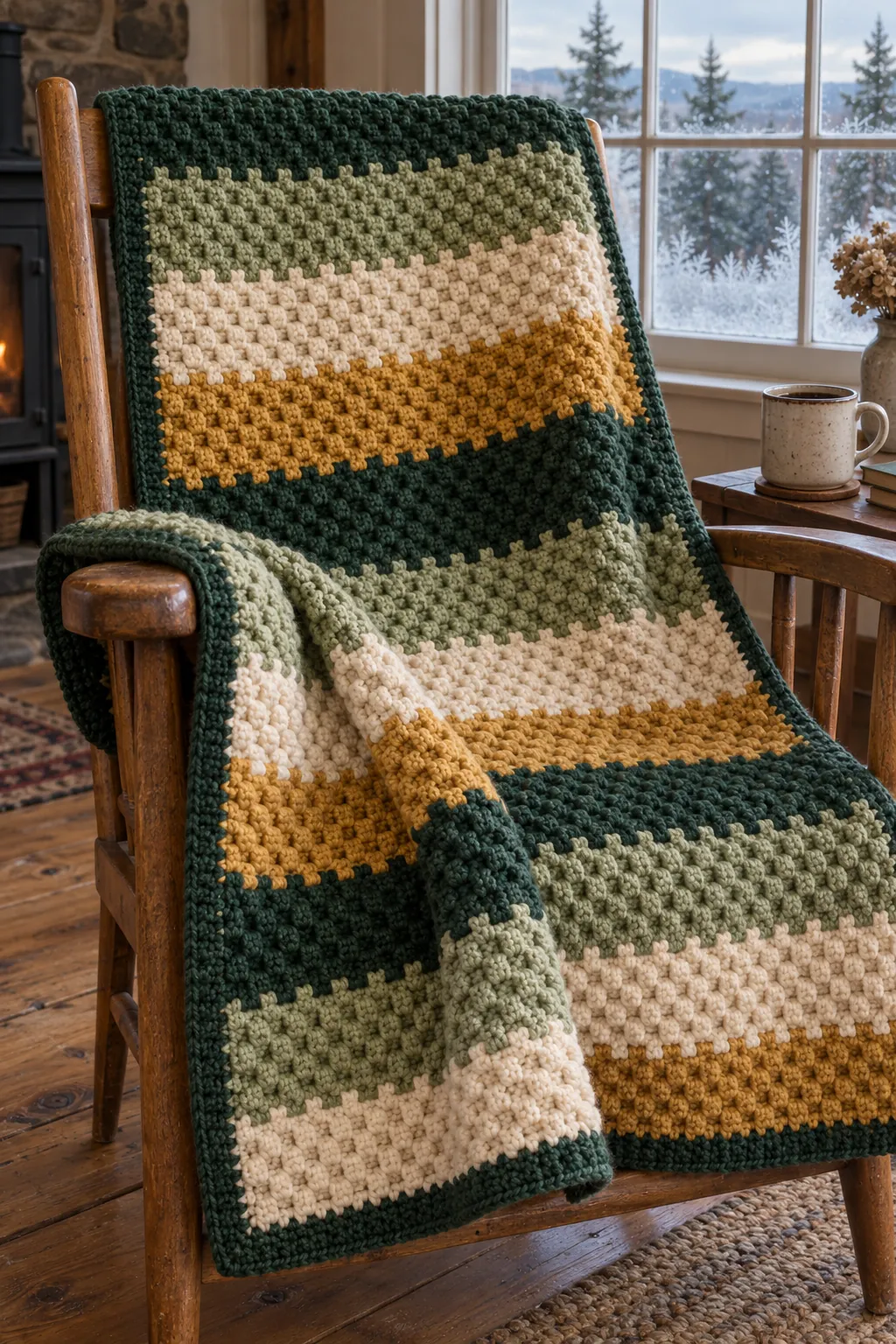
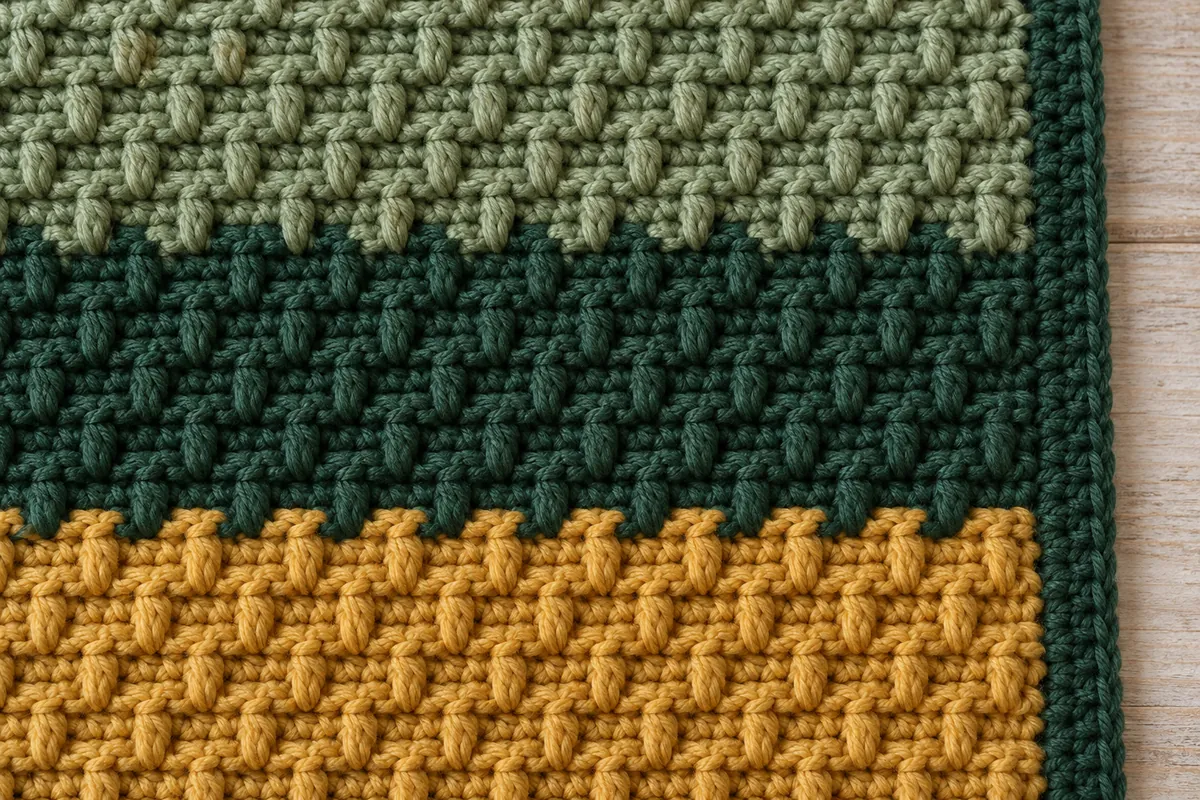
Picture a late October afternoon on a Vermont ridge, when the maples have dropped their leaves and the balsam firs are the only green left on the hill. This alpine stitch crochet blanket borrows that palette: deep balsam green and soft sage, with oatmeal cream and a warm honey gold so it never feels somber. Front post stitches stand up from the surface in tiny staggered columns, so the fabric almost looks knitted and feels thick and springy.
Each stripe is one four-row repeat, and the colors cycle in the same order to the last stripe. You’ll work it flat in rows with worsted yarn and a 5.5 mm hook, then frame it with two rounds of single crochet in balsam. The pattern card covers a 50-inch throw, a roomier 60-inch throw and a twin, all in the same brackets.
Is this alpine stitch crochet blanket a good first post-stitch project?
It’s a fair first post-stitch project if you don’t mind counting. Three of the stitches are basics: the chain, the single crochet and the double crochet. If the brackets and abbreviations in the card look unfamiliar, the Beginner Guide explains how to read a crochet pattern.
The fourth stitch is the new one: the front post treble crochet, written FPtr. Instead of going into the top of a stitch, your hook goes around its post, the upright body of the stitch, from the front and two rows down. You wrap the yarn twice first so it’s tall enough to reach the current row. Because the FPtr takes the place of the single crochet sitting right above it, you skip that single crochet and the count stays the same.
That’s why it’s rated Intermediate: every dc row asks you to find the right post, and a missed one shifts the texture by a stitch. If you’ve made a bulky throw that also leans on front post stitches, the motion will feel familiar. Here the posts sit between plain single crochet rows, for a finer, nubbier surface.
Choosing a worsted yarn for a dense post-stitch throw
Look for a 4 on the label, usually printed as Medium or worsted, with a suggested hook between 5 and 5.5 mm. This throw is worked on a 5.5 mm (I-9) hook at 14 stitches and 12 rows to 4 inches. The larger hook in that range keeps this thick fabric soft.
Acrylic and acrylic-wool blends suit it best. They’re light for their bulk and keep the columns crisp, and a superwash wool blend adds warmth for a bed in January. Skip pure cotton here: a cotton throw in this stitch would be very heavy and would sag a bit longer with every wash. Skip fuzzy yarns too, since the halo hides the texture.
All those posts eat yarn, and the throw alone needs close to 3,000 yards. Buy all of your Balsam at once from a single dye lot, since it frames both ends and the border. If you switch brands, compare yards per skein, then work the gauge swatch in the card: 22 chains and 12 rows should measure 6 × 4 in (15 × 10 cm).
If you’d rather stay in worsted for the season but step down a level, a classic plaid throw in the same yarn weight is rated Easy.
How balsam, sage, oatmeal and honey stack up in the stripes
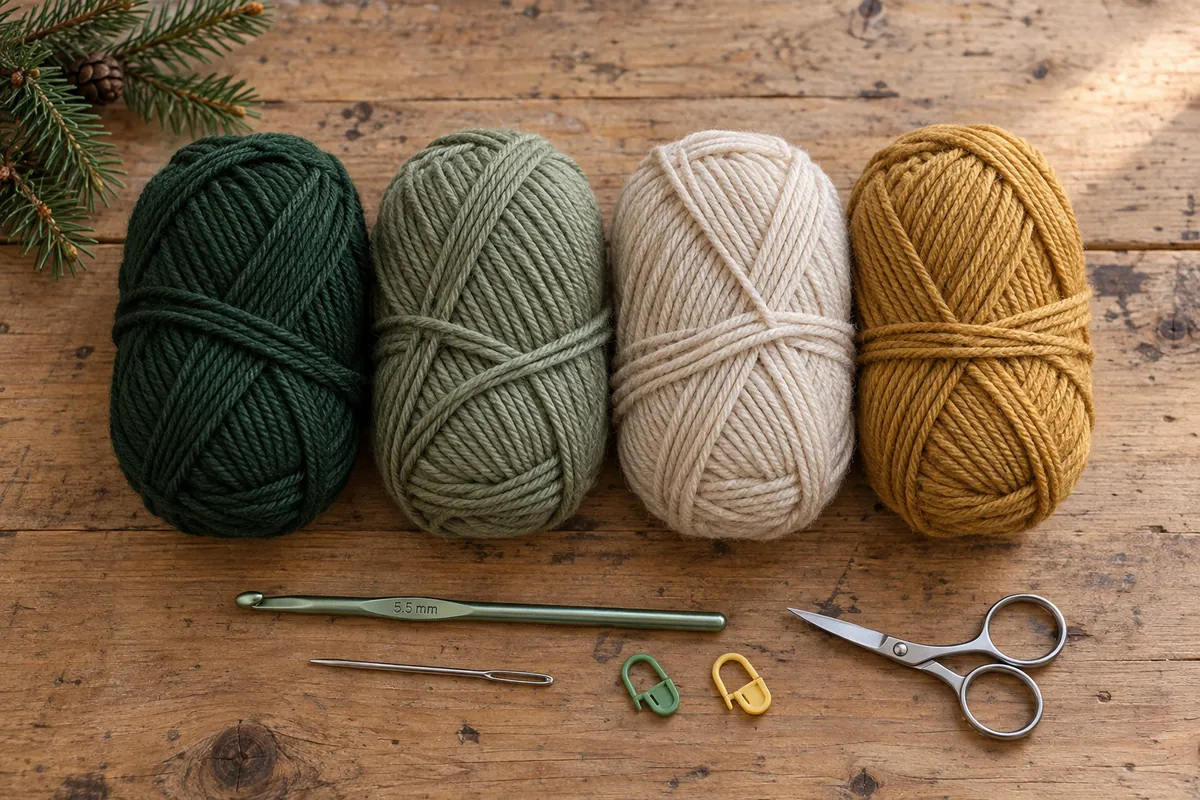
Balsam (A) is the frame. It works the first three rows, every fourth stripe, the last stripe and both border rounds, so it’s the color you’ll use most. Sage (B) softens each change, Oatmeal (C) lets the posts read from a distance, and Honey (D) warms up a mostly green blanket.
At every color change, the first dc row of the new stripe wraps its posts around the old color’s double crochets. So the edge of each stripe looks toothed instead of ruled straight, with little dashes of the new color reaching down into the old one. Four-row stripes show that broken edge without turning the throw into speckles.
Other four-color sets work if you keep the card’s order: dark frame, middle shade, light shade, warm accent.
- Cranberry Bog: deep cranberry, dusty rose, cream and charcoal.
- Granite Quarry: charcoal, pebble gray, cream and slate blue.
- Sugarhouse: chocolate brown, caramel, cream and rust.
- Lichen and Stone: olive, moss, pale gray and mustard.
Before you buy, line up the four skeins and take a black-and-white photo with your phone. If two turn the same gray, swap one, or those stripes will blur.
Throw, large throw or twin: 171, 207 or 227 stitches across
The card gives the throw first and the other two sizes in brackets. Measurements include the border after light blocking, and yardage is an estimate with about 10% extra.
- Throw: 50 × 60 1/2 in (127 × 154 cm). Chain 172, 179 rows (44 stripes above the bottom band), 802 sc in the last border round. About 850 yd of Balsam and 700 yd each of Sage, Oatmeal and Honey, 2,950 yd (2,700 m) in all.
- Large throw: 60 × 71 in (152 × 180 cm). Chain 208, 211 rows (52 stripes), 954 sc in the last border round. About 1,150 yd of Balsam and 1,000 yd each of the other three, 4,150 yd (3,795 m) in all.
- Twin: 66 × 92 1/2 in (168 × 235 cm). Chain 228, 275 rows (68 stripes), 1,154 sc in the last border round. About 1,600 yd of Balsam and 1,450 yd each of the other three, 5,950 yd (5,440 m) in all.
Think carefully about the twin. In this stitch it weighs roughly 6 1/2 to 7 1/2 lb (3 to 3.4 kg), and the last fifty rows will sit heavy on your lap. The large throw lands in between at about 4 1/2 to 5 1/4 lb.
To make your own size, keep an odd number of stitches. The foundation chain can be any even number, and every 2 chains you add or remove change the width by a little over 1/2 in (1.5 cm).
Finding the right post two rows down, stitch after stitch
The post you want is always directly below the next stitch, two rows down. On Row 3 that’s a single crochet from Row 1. From Row 5 on it’s a double crochet, and it’s always one the posts of the last dc row left alone. If your hook lands on a raised FPtr, you’ve drifted one stitch over.
Row 5 and Row 7 start differently, and mixing them up is the usual way the texture goes wrong. Row 5 opens with the turning chain and one plain dc before the first post. Row 7 goes straight to a post after the turning chain. To tell them apart, look two rows down at the edge where you’re starting: if the second stitch there is a post, you need the extra dc.
Skip the single crochet behind every post. It hides behind the FPtr, and working into it adds a stitch. Count after each sc row, with a marker every 20 stitches, so a wrong total only means recounting one section.
Pull each FPtr up to the height of the row you’re working. Tight posts pucker the fabric and narrow the throw.
On sc rows, the last sc goes into the top of the turning chain. Missing it loses an edge stitch and slants the side.
Expect about 90 tails on the throw, 108 on the large throw and 140 on the twin. Weave each one through the back of a single crochet row of the same color, where the posts won’t push it to the front, a few each evening.
US crochet terms
The pattern
Materials
- Worsted weight yarn (CYC 4, Medium) in acrylic or an acrylic-wool blend, about 2,950 [4,150, 5,950] yd (2,700 [3,795, 5,440] m) in total (estimate, with about 10% extra):
- A, Balsam (deep pine green): 850 [1,150, 1,600] yd (777 [1,052, 1,463] m)
- B, Sage: 700 [1,000, 1,450] yd (640 [914, 1,326] m)
- C, Oatmeal (cream): 700 [1,000, 1,450] yd (640 [914, 1,326] m)
- D, Honey (golden yellow): 700 [1,000, 1,450] yd (640 [914, 1,326] m)
- Crochet hook: 5.5 mm (US I-9), or the size needed to get gauge.
- Yarn needle.
- Locking stitch markers: 1 to mark the right side, plus a few to mark every 20 sts while counting.
- Scissors.
Gauge
- 14 sts and 12 rows = 4 in (10 cm) in the alpine stitch pattern, with a 5.5 mm hook.
- Swatch, in one color: Ch 22. Work Rows 1–3, then Rows 4–7 twice, then Row 4 once more (21 sts, 12 rows). It should measure 6 in (15 cm) wide and 4 in (10 cm) tall.
- Too many sts: try a larger hook. Too few sts: try a smaller hook.
Finished size
- Throw: 50 × 60 1/2 in (127 × 154 cm).
- Large throw: 60 × 71 in (152 × 180 cm).
- Twin: 66 × 92 1/2 in (168 × 235 cm).
- Measured after light blocking, border included.
Abbreviations
- ch chain
- dc double crochet
- FPtr front post treble crochet (see Notes)
- rep repeat
- RS right side
- sc single crochet
- sk skip
- sl st slip stitch
- st(s) stitch(es)
- tch turning chain
- WS wrong side
- yo yarn over
Notes
- Sizes are written as Throw [Large throw, Twin]. When only one number is given, it applies to all sizes.
- Ch 1 at the start of sc rows does not count as a st. Ch 3 at the start of dc rows counts as the first dc; on the next sc row, work the last sc in the 3rd ch of that tch. This rule is the same for every row.
- FPtr: yo twice, insert hook from front to back to front around the post (the upright body) of the indicated st, yo and pull up a loop to the height of the current row, [yo and pull through 2 loops] 3 times.
- Every FPtr is worked around the st 2 rows below, directly under the next st. Always sk the sc behind each FPtr (the sc sitting on top of the st you wrapped), so the st count stays the same.
- Row 1 and every odd-numbered row are RS rows, and the FPtr show on the RS. Place a marker on the RS.
- Stitch multiple: any odd number of sts. Foundation ch: multiple of 2 + 2 (any even number). Each 2 ch added or removed changes the width by about 1/2 in (1.5 cm).
- Stripes: Rows 1–3 are worked in A. After that, each repeat of Rows 4–7 is one stripe, in the order B, C, D, A, repeated. The last stripe is always A.
- Color change: on the last dc of Row 3, and of every Row 7 except the last row of the body, work the dc until 2 loops remain on the hook, drop the old color, yo with the new color and pull through. Cut the old color, leaving a 6 in (15 cm) tail.
- Weave in tails on the WS through sc rows of the same color.
Instructions
Body
- Foundation: With A, ch 172 [208, 228].
- Row 1 (RS): Sc in 2nd ch from hook and in each ch across. Turn. (171 [207, 227] sc)
- Row 2 (WS): Ch 1, sc in each st across. Turn. (171 [207, 227] sc)
- Row 3 (RS): Ch 3, *FPtr around next sc 2 rows below, sk sc behind FPtr, dc in next sc; rep from * across. Change to B on the last dc. Turn. (171 [207, 227] sts: 85 [103, 113] FPtr and 86 [104, 114] dc, counting the tch)
- Row 4 (WS): Ch 1, sc in each st across, ending with sc in 3rd ch of tch. Turn. (171 [207, 227] sc)
- Row 5 (RS): Ch 3, dc in next sc, *FPtr around next dc 2 rows below, sk sc behind FPtr, dc in next sc; rep from * to last st, dc in last st. Turn. (171 [207, 227] sts: 84 [102, 112] FPtr and 87 [105, 115] dc)
- Row 6 (WS): Rep Row 4. (171 [207, 227] sc)
- Row 7 (RS): Ch 3, *FPtr around next dc 2 rows below, sk sc behind FPtr, dc in next sc; rep from * across. Change to C on the last dc. Turn. (171 [207, 227] sts: 85 [103, 113] FPtr and 86 [104, 114] dc)
- Rows 8–179 [8–211, 8–275]: Rep Rows 4–7 another 43 [51, 67] times, working one stripe per repeat in the order C, D, A, B, then repeating that order, and changing to the next color at the end of every Row 7 except the last. The body has 44 [52, 68] stripes above the first 3 rows and ends with a Row 7 in A. It measures about 59 3/4 [70 1/4, 91 3/4] in (152 [179, 233] cm). Do not fasten off. (171 [207, 227] sts on every row)
Border
- Round 1 (RS): With A, do not turn. Ch 1. Working down the left side in the row ends, starting with the end of the second-to-last row, work 1 sc in the end of each row, with 2 sc instead of 1 in every other dc row, starting with the first dc row you reach (222 [262, 342] sc). Working in the free loops of the foundation ch that hold the sts of Row 1, 3 sc in the first ch (corner), sc in each of the next 169 [205, 225] ch, 3 sc in the next ch (corner). Work up the right side as for the left side, ending with the end of the second-to-last row (222 [262, 342] sc). 3 sc in the top of the tch of the last row (corner), sc in each of the next 169 [205, 225] sts, 3 sc in the last st (corner). Join with sl st to the first sc. (794 [946, 1146] sc: 3 at each corner, 169 [205, 225] across the top and the bottom, 222 [262, 342] along each side)
- Round 2 (RS): Ch 1, do not turn. Sc in the same st as the join and in each sc around, working 3 sc in the center sc of each corner. Join with sl st to the first sc. Fasten off. (802 [954, 1154] sc: 3 at each corner, 171 [207, 227] across the top and the bottom, 224 [264, 344] along each side)
Finishing
- Weave in all remaining tails on the WS.
- Block lightly: mist or wet the throw, lay it flat to the finished measurements and let it dry completely.
Washing a heavy balsam and oatmeal post-stitch throw
Follow the yarn label. Acrylic and most acrylic-wool blends can go in the machine on a cold, gentle cycle, and so can superwash wool, as long as you lay it flat to dry. A fabric this dense holds a lot of water, and hanging it wet will stretch the length.
Give the first wash a color catcher sheet, or wash the throw alone. Saturated shades like Balsam and Honey can bleed in the first wash, and Oatmeal is where it would show. Acrylic can then tumble dry on low. Store the throw folded on a shelf or in a cotton bag rather than over a hanger, since its own weight would pull it out of shape in a season.
Balsam Ridge questions about stripes, stitch counts and hook size
Can I make this alpine stitch crochet blanket with just two colors?
Yes. Work the bottom band in A, then alternate: B for every odd-numbered stripe and A for every even-numbered one. Each size has an even number of stripes (44, 52 or 68), so the last stripe is still A and the border matches. Plan on a little more than half the total yardage in A, since it also covers the band and the border, and the rest in B.
My stitch count is off after a dc row. Where did it go?
Two habits cause almost every miscount. Working a dc into the single crochet behind an FPtr adds a stitch, and missing the turning chain at the end of an sc row loses one. If the count is right but the new posts sit on top of old posts instead of between them, you’ve mixed up Row 5 and Row 7: Row 5 starts with a plain dc after the turning chain, Row 7 doesn’t.
How do I make the throw longer without breaking the stripe order?
Add full cycles of four stripes (B, C, D and A) before you finish. Each cycle is 16 rows, adds about 5 1/3 in (13.5 cm) and uses roughly 65 [75, 85] yd of each color. The body still ends with an A stripe, and each side of the first border round gains 20 sc for every cycle you add.
Will the twin size be too heavy to use on a bed?
It’s heavy, roughly 6 1/2 to 7 1/2 lb (3 to 3.4 kg), and on a cold night that weight is welcome. Over a comforter it stays put. For something easier to carry around the house, choose the large throw.
Can I go down to a 5.0 mm hook for a firmer fabric?
Only if your swatch comes out loose, since the hook’s job is reaching 14 stitches and 12 rows to 4 in. If you get fewer stitches than that with 5.5 mm, a 5.0 mm (H-8) will bring you closer. If you’re already on gauge, a smaller hook makes the throw narrower and stiffer, and it uses more yarn per square inch than the estimates allow for.
Quick recap
- Chain 172 [208, 228] in Balsam and work two rows of single crochet.
- Work Row 3, the first post row, with each FPtr around a single crochet of Row 1.
- Work Rows 4–7 a total of 44 [52, 68] times, changing color after Row 3 and after every Row 7 but the last, in the order Sage, Oatmeal, Honey, Balsam.
- Stop after 179 [211, 275] rows, ending with a Balsam stripe.
- Work two rounds of Balsam single crochet with 3 sc at each corner.
- Weave in the tails along sc rows of the same color and block lightly.
When the first snow sticks to the balsams up on the ridge, this alpine stitch crochet blanket will be ready on the couch, or across the foot of the bed if you went for the twin. If a count in the card doesn’t add up on your hook, or you’d like help working out another palette, send a note through the Contact page.