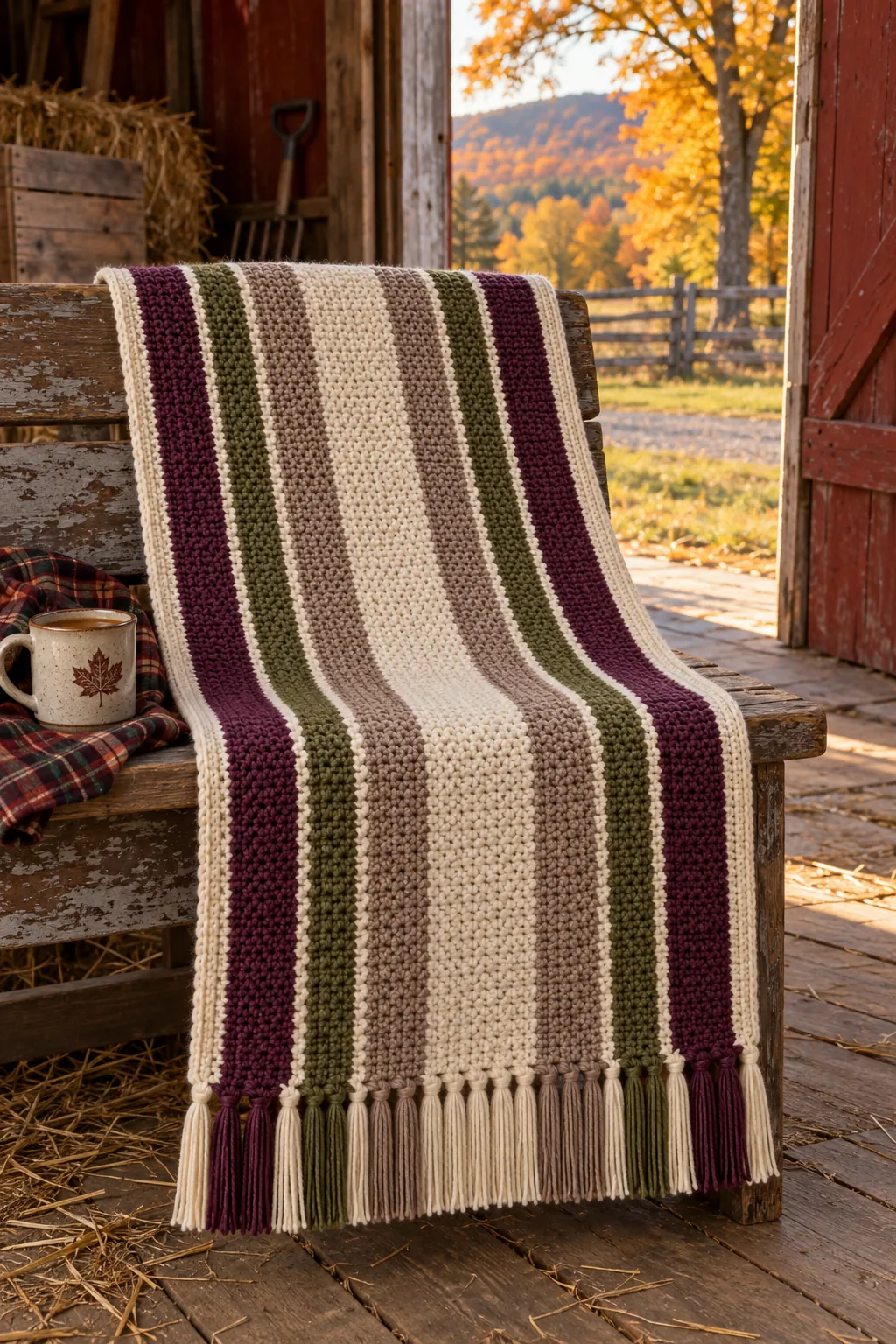
Picture an October barn dance off a Vermont back road, a fiddle tuning up under the lanterns and a pile of folded blankets by the door for when the night turns cold. The Barn Dance Throw belongs on that pile. It’s a griddle stitch crochet blanket in worsted yarn, striped in plum, olive, driftwood taupe and buttermilk cream, and every stripe ends in a fringe of its own color.
You work it sideways, from one long edge to the other. That’s why the stripes run the whole length of the blanket, and why every row ends on a short side, right where the fringe gets knotted. The card comes in three sizes: a lapghan, a throw and a twin.
Is this griddle stitch crochet blanket a good step up from plain rows?
It’s marked Easy. The body uses a chain, single crochet and double crochet, nothing more. Griddle stitch alternates them across the row: single, double, single, double. On the next row, every single crochet goes into a double crochet below it, and every double crochet goes into a single crochet. Short and tall stitches nest into each other, and you get a fine, pebbly texture that looks almost the same on both sides.
Each row opens with a ch 1 that doesn’t count as a stitch, and you never work into it. The first stitch is a single crochet in the double crochet that ended the row before. The last one is always a double crochet. All three sizes have an even stitch count, so the pairs come out right every time.
If abbreviations like rep from * still slow you down, the Beginner Guide explains how to read a crochet pattern. The one new technique is the fringe knot, called a lark’s head: fold three strands in half, pull the fold through the end of a row, pass the cut ends through that loop and snug it up. If you’ve made the snowy bulky throw in moss stitch, the short-stitch rhythm will feel familiar, just finer.
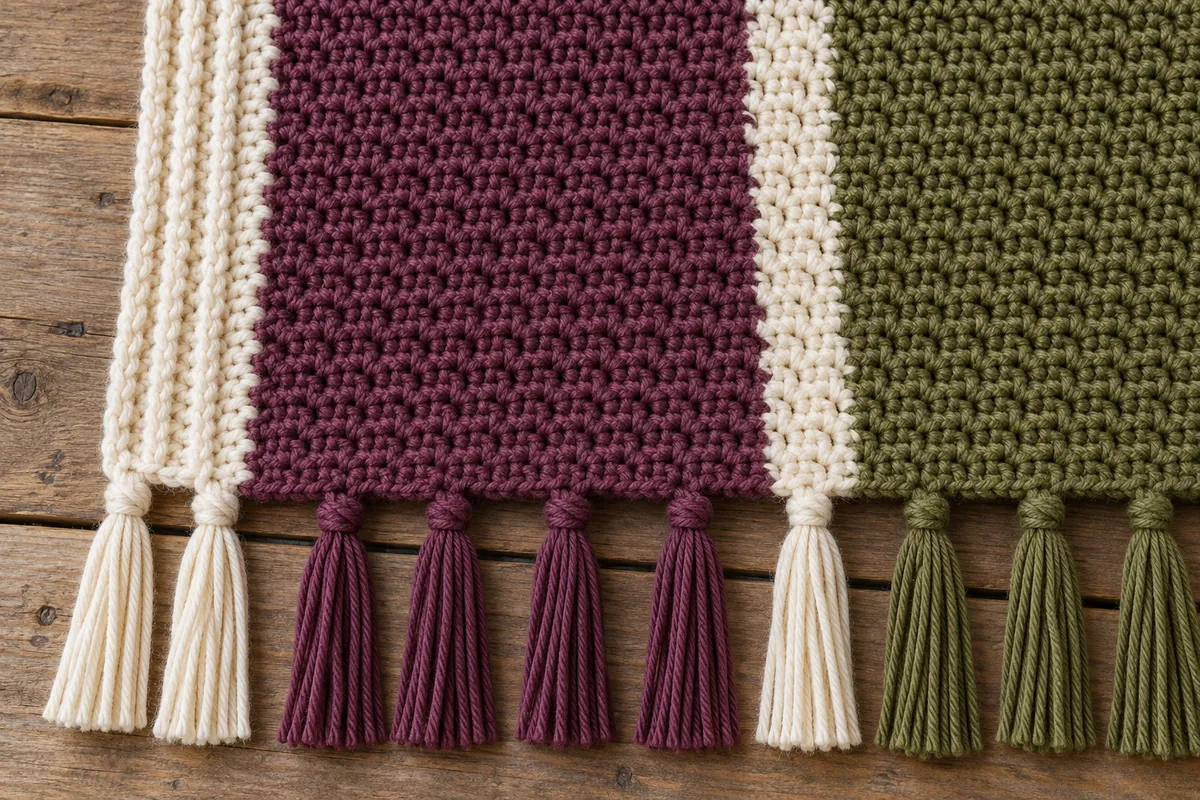
Worsted acrylic that holds a heavy fringe and survives the washer
Use a smooth worsted weight yarn, the #4 medium on the label. A plied acrylic is the first choice here. It’s soft and machine washable, and its fringe stays neat after a wash instead of going stringy. A cotton-acrylic blend drapes a little more and works well for the lapghan and the throw.
Skip cotton blends for the twin. Griddle stitch is a dense fabric, and the twin already takes about 7 lb (3.3 kg) of acrylic yarn once the fringe is on. Cotton would make it heavier still and slow to dry.
The fringe comes from the same four yarns, so it washes and fades with the blanket. Skip brushed or fuzzy yarns: their strands mat together in the washer, and the griddle texture disappears under the halo.
Buttermilk is the big one, about 1,142 [1,987, 3,909] yd. Buy it all from one dye lot and check the number on every label. A second lot would show as a long line through the cream center.
The card is built on 14 stitches and 12 rows to 4 in (10 cm) in griddle stitch with a 6.0 mm hook. That gauge is an estimate until a measured swatch confirms it, and so is every yardage figure on this page. Work the 30-stitch swatch from the card, block it and count the center 4 in. More stitches than 14? Go up to a 6.5 mm hook. Fewer? Try 5.5 mm. Rows matter just as much here, because the rows set the width of the blanket.
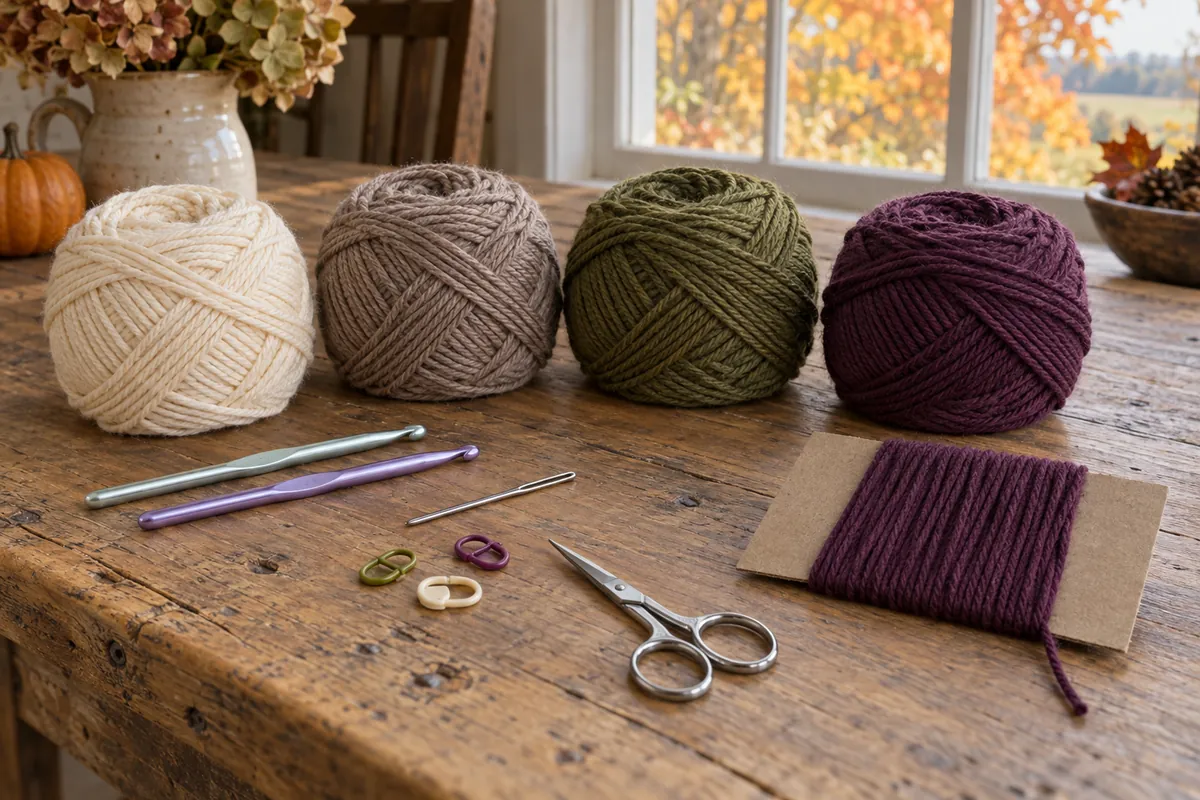
Plum edges, a buttermilk center and fringe that follows each stripe
Buttermilk (A) is the main color. It fills the wide center panel and the four thin stripes, works the ridged border on both long sides, and makes most of the fringe. Plum (D) takes the outer stripe along each long edge. As the darkest shade, it frames the whole blanket. Olive (C) sits next, and driftwood taupe (B) eases the step from olive into all that cream.
Each fringe takes the color of the row it’s knotted into, so the short ends repeat the stripe sequence: a run of plum at each corner, then olive, taupe, and a long stretch of cream in the middle. On the throw, that’s 12 plum, 8 olive, 8 taupe and 47 buttermilk fringes along each short side.
A few other four-color sets that work with the same layout:
- Barn Dance: buttermilk, driftwood taupe, olive and plum, as written.
- Woodpile: cream, oatmeal, moss green and chestnut brown.
- Lake Fog: ivory, pale gray, slate blue and navy.
- Bittersweet: cream, blush, terracotta and deep red.
Whatever you pick, keep the darkest shade for the outer stripes and the lightest for the center. When you cut the fringe later, drop each color’s strands into its own labeled bag with the count written on it. And if you’d rather see stripes cross each other, the worsted plaid throw for cabin season does exactly that.
Lapghan, throw and twin, all worked from one long edge
The card is written as Lapghan [Throw, Twin]. The fringe adds 6 in (15 cm) at each short end and isn’t counted in the sizes. Yardage is an estimate that includes the border, the fringe and a 15 % margin.
- Lapghan, about 35 3/4 × 48 in (91 × 122 cm): chain 169 (about 48 in long), 101 rows, 168 sc in each border row, 106 fringes; about 1,142 yd buttermilk, 269 yd plum, 202 yd olive and 202 yd taupe.
- Throw, about 50 1/4 × 60 in (128 × 152 cm): chain 211 (about 60 in long), 145 rows, 210 sc in each border row, 150 fringes; about 1,987 yd buttermilk, 497 yd plum, 332 yd olive and 332 yd taupe.
- Twin, about 66 1/4 × 90 1/4 in (168 × 229 cm): chain 317 (about 90 in long), 193 rows, 316 sc in each border row, 198 fringes; about 3,909 yd buttermilk, 978 yd plum, 611 yd olive and 611 yd taupe.
With its fringe, the twin runs about 102 in (259 cm) from end to end, so it hangs over the foot of the bed.
For a custom size, count 3 1/2 stitches per inch of length and 3 rows per inch of width, then add 2 in for the border. Keep the stitch count even, so the griddle pairs work out, and the row count odd, so the closing row lands on the right side like Row 1.
Making a crochet blanket with fringe hang straight: the long chain, the pairs and the knots
The foundation chain is the longest part of this pattern: 169 [211, 317] chains, about 48 [60, 90] in. Make it with the 6.5 mm hook so it can’t pull the bottom edge in, and clip a marker every 20 chains. Counting 8 [10, 15] markers beats counting 169 [211, 317] loops. Before Row 1, check it against a tape measure: it should reach the full blanket length without stretching.
Work Row 1 into the back bumps of the chain, the little ridge on its underside. The front V of each chain stays on the bottom edge and looks like the top of a row, which gives the border a clean place to go later.
Check the pairs as you go. A single crochet always sits on a double crochet, and a double on a single. Two of the same stacked on top of each other means a stitch went missing or crept in.
Knot the fringe only after both borders are done, one color band at a time, and trim it last, once every knot is on.
US crochet terms
The pattern
Materials
- Worsted weight yarn (#4 medium), acrylic or cotton-acrylic blend (acrylic for the twin), estimated 1,815 [3,148, 6,109] yd (1,660 [2,878, 5,585] m) in total, in skeins of about 364 yd (333 m), 7 oz (198 g):
- A, Buttermilk: 1,142 [1,987, 3,909] yd (1,044 [1,817, 3,573] m), 4 [6, 11] skeins
- B, Driftwood (taupe): 202 [332, 611] yd (185 [303, 559] m), 1 [1, 2] skeins
- C, Olive: 202 [332, 611] yd (185 [303, 559] m), 1 [1, 2] skeins
- D, Plum: 269 [497, 978] yd (246 [455, 894] m), 1 [2, 3] skeins
- 6.0 mm (J-10) crochet hook
- 6.5 mm (K-10½) crochet hook, for the foundation chain
- Yarn needle
- About 16 removable stitch markers
- Stiff card 6 1/2 in (16.5 cm) wide, for cutting the fringe
- Sharp scissors, or a rotary cutter and ruler
Gauge
14 sts and 12 rows = 4 in (10 cm) in griddle stitch with the 6.0 mm hook, after blocking (estimate). The 4 border rows measure about 1 in (2.5 cm) (estimate). Swatch: with the 6.5 mm hook, ch 31; change to the 6.0 mm hook and work Row 1 (30 sc), Row 2, Row 3 another 22 times, then a closing row of sc (25 rows). It measures about 8 1/2 in (22 cm) wide.
Finished size
- Lapghan: about 35 3/4 × 48 in (91 × 122 cm)
- Throw: about 50 1/4 × 60 in (128 × 152 cm)
- Twin: about 66 1/4 × 90 1/4 in (168 × 229 cm)
- Measured after blocking, border included, fringe not included. The fringe adds 6 in (15 cm) at each short end.
Abbreviations
- BLO back loop only
- ch chain
- dc double crochet
- hdc half double crochet
- rep repeat
- RS right side
- sc single crochet
- sl st slip stitch
- st(s) stitch(es)
- WS wrong side
- yo yarn over
Notes
- Sizes are written as Lapghan [Throw, Twin]. A number given once applies to all sizes.
- Stitch multiple: multiple of 2 + 1 chains (an even number of sts). To resize, allow 3 1/2 sts per inch of length and 3 rows per inch of width; keep the st count even and the row count odd.
- The blanket is worked lengthwise: the foundation chain runs along one long side, the rows build the width, and the row ends form the two short sides, where the fringe goes.
- Ch 1 at the start of a row does not count as a st; never work into it. Each griddle row starts with sc in the first st (a dc) and ends with dc in the last st (a sc).
- Row 1 is the RS.
- Change colors on the last stitch of each color run: work it until 2 loops remain (3 for hdc) and finish it with the next color. In this pattern, that is the last dc of the row: dc until 2 loops remain, yo with the new color and pull through both loops, turn, and work the ch 1 with the new color.
- Leave tails of at least 8 in (20 cm) at every color change and fastening off. Do not weave them in; they are locked into the fringe.
- Border rows are all worked with the RS facing: fasten off at the end of each row and rejoin at the same end, so every ridge shows on the RS.
- Fringe knot: fold 3 strands of one color in half, ends matched. With the WS facing, insert the hook from the WS to the RS through the stated row end (around the post of that row’s edge st), catch the fold and pull it through to the WS. Pull all the ends through the loop, then hold the top of the fringe and pull the ends gently until the knot sits snug against the edge without puckering it. The collar of the knot lies on the WS and a flat bar shows on the RS. Keep the same side on the whole blanket.
- Self-check: in every griddle row, sc sits on dc and dc sits on sc. Two sc or two dc stacked means a missed or extra st.
Instructions
Body
- Foundation: With the 6.5 mm hook and D, ch 169 [211, 317] loosely. Change to the 6.0 mm hook.
- Row 1 (RS): Sc in the back bump of the 2nd ch from hook and in the back bump of each ch across. (168 [210, 316] sc)
- Row 2: Ch 1, turn, sc in first st, dc in next st, *sc in next st, dc in next st; rep from * across. (168 [210, 316] sts)
- Row 3: Ch 1, turn, sc in first st (a dc), dc in next st (a sc), *sc in next dc, dc in next sc; rep from * across, ending with dc in the last sc. (168 [210, 316] sts)
- Rows 4–8 [4–12, 4–16]: Rep Row 3, changing to A on the last dc of the last row. (168 [210, 316] sts)
- Rows 9–11 [13–16, 17–21]: With A, rep Row 3, changing to C on the last dc of the last row. (168 [210, 316] sts)
- Rows 12–17 [17–24, 22–31]: With C, rep Row 3, changing to A on the last dc of the last row. (168 [210, 316] sts)
- Rows 18–20 [25–28, 32–36]: With A, rep Row 3, changing to B on the last dc of the last row. (168 [210, 316] sts)
- Rows 21–26 [29–36, 37–46]: With B, rep Row 3, changing to A on the last dc of the last row. (168 [210, 316] sts)
- Rows 27–75 [37–109, 47–147]: With A, rep Row 3, changing to B on the last dc of the last row. (168 [210, 316] sts)
- Rows 76–81 [110–117, 148–157]: With B, rep Row 3, changing to A on the last dc of the last row. (168 [210, 316] sts)
- Rows 82–84 [118–121, 158–162]: With A, rep Row 3, changing to C on the last dc of the last row. (168 [210, 316] sts)
- Rows 85–90 [122–129, 163–172]: With C, rep Row 3, changing to A on the last dc of the last row. (168 [210, 316] sts)
- Rows 91–93 [130–133, 173–177]: With A, rep Row 3, changing to D on the last dc of the last row. (168 [210, 316] sts)
- Rows 94–100 [134–144, 178–192]: With D, rep Row 3. (168 [210, 316] sts)
- Row 101 [145, 193] (RS): Ch 1, turn, sc in each st across. Fasten off. (168 [210, 316] sc)
- Total: 101 [145, 193] rows. The body measures about 33 3/4 [48 1/4, 64 1/4] in (86 [123, 163] cm) wide.
- Blocking: Lay the body flat, mist it with water, pat it to size and let it dry.
Border (both long sides)
- Top side, Row 1: With the RS facing and the last row along the top, join A with a sl st in the first st at the right-hand end, ch 1 (does not count), sc in the same st and in each st across. Fasten off. (168 [210, 316] sc)
- Top side, Row 2: With the RS facing, join A with a sl st in the BLO of the first st at the same end as Row 1, ch 1 (does not count), sc BLO in the same st and in each st across. Fasten off. (168 [210, 316] sc)
- Top side, Rows 3–4: Rep Row 2. (168 [210, 316] sc)
- Foundation side, Row 1: Turn the blanket so the foundation chain runs along the top, RS facing. Join A with a sl st under both loops of the first chain V at the right-hand end, ch 1 (does not count), sc under both loops of the same V and of each V across, working only into the 168 [210, 316] chains that hold a Row 1 sc. Fasten off. (168 [210, 316] sc)
- Foundation side, Rows 2–4: Work as Top side, Rows 2–4. (168 [210, 316] sc)
- Corners: none. The border rows stop at the short sides, where the fringe covers their ends.
Fringe
- Cutting: Wrap the yarn loosely around the 6 1/2 in card and cut along one edge, for strands 13 in (33 cm) long. Cut 198 [282, 378] strands in A, 36 [48, 60] in B, 36 [48, 60] in C and 48 [72, 96] in D. (318 [450, 594] strands) Keep each color separate.
- Placement: On each short side, knot 1 fringe of 3 strands at the end of every odd-numbered row (Rows 1, 3, 5 and so on to Row 101 [145, 193]), in the color of that row, then 1 fringe in A through the end of border Row 3 at each corner. Use the same rows on both short sides.
- Count per short side: 8 [12, 16] in D, 6 [8, 10] in C, 6 [8, 10] in B and 33 [47, 63] in A, corners included. (53 [75, 99] fringes per side, 106 [150, 198] in all)
- Tails: When you knot the fringe nearest to a tail, lay the tail in with the strands before pulling the ends through the loop, so the knot locks it. If no fringe sits at that row end, weave the tail along the edge to the nearest fringe position first.
- Trimming: Lay each short side flat, comb the strands straight and trim them all to 6 in (15 cm).
Washing plum stripes and a cream fringe in the same load
Plum is the color to watch, because it sits right next to cream fringe. Before the first wash, dampen a corner of a plum stripe and press it with a white paper towel. If any color transfers, wash the blanket alone in cold water with a color-catcher sheet.
An acrylic version can go in the machine on a gentle, cold cycle. Before you start it, gather each fringed end in a loose bundle and tie it with a scrap of yarn, or slip the blanket into a large mesh laundry bag, so the strands don’t knot around each other. Tumble dry on low and take it out while it’s still a little damp. Then lay it flat, untie the bundles and comb the fringe straight with your fingers. A cotton-acrylic blend does better drying flat all the way.
Trim any strands that come out long after a wash back to 6 in. Store the blanket folded with the fringe on top, not crushed under a heavy stack.
Barn Dance Throw questions
Why does my griddle stitch crochet blanket have little steps along the row ends?
Every row starts with a short single crochet and ends with a taller double crochet, and the rows change direction. So each short side alternates a short row end with a tall one. That small step is part of the stitch, not a mistake. Leave the stitch count alone; the fringe knots sit right on those ends and hide them.
Why is this throw worked sideways instead of from the bottom up?
Working from one long edge to the other puts every row end on the short sides, which is exactly where the fringe goes. Each knot has a row end to hold onto, and each fringe can match the stripe it hangs from.
I found two double crochets stacked on top of each other. How do I fix it?
Somewhere in that row, a stitch was skipped or doubled, so the sc and dc slipped out of step. Pull the row back to the first stacked pair and rework it, checking that each sc lands in a dc. Then count the row: it should still have 168 [210, 316] stitches.
Can I knot a fringe on every row instead of every other row?
Yes, for a fuller, heavier fringe. Knot one more fringe at each even-numbered row end, in that row’s color. Plan on about 125 [180, 240] yd more yarn in all, split among the four colors in the same proportions as the stripes. Try both spacings on your swatch first.
Do the color-change tails really disappear into the fringe?
They do, as long as you leave them at least 8 in (20 cm) long. Lay each tail in with the three strands of the nearest fringe before you pull the ends through the loop. The knot grips it, and when you trim the fringe to 6 in, the tail gets trimmed with it. Border tails go into the corner fringes the same way.
Quick recap
- Chain 169 [211, 317] loosely in plum and work a row of sc into the back bumps of the chain.
- Work griddle rows, sc in each dc and dc in each sc, changing colors at row ends for 11 stripes, then close with a row of sc.
- Work 4 border rows in buttermilk along each long side: 1 row of sc, then 3 rows of sc in the back loop only.
- Cut 13 in strands and knot 3-strand fringes at every odd row end and at the border corners, in each stripe’s color.
- Trim the fringe to 6 in.
When the last strand is trimmed, give the Barn Dance Throw one good shake and watch the stripes swing out into their fringe. If a count in this griddle stitch crochet blanket doesn’t match what’s on your hook, or a band of fringe comes out short, send a note through the Contact page.