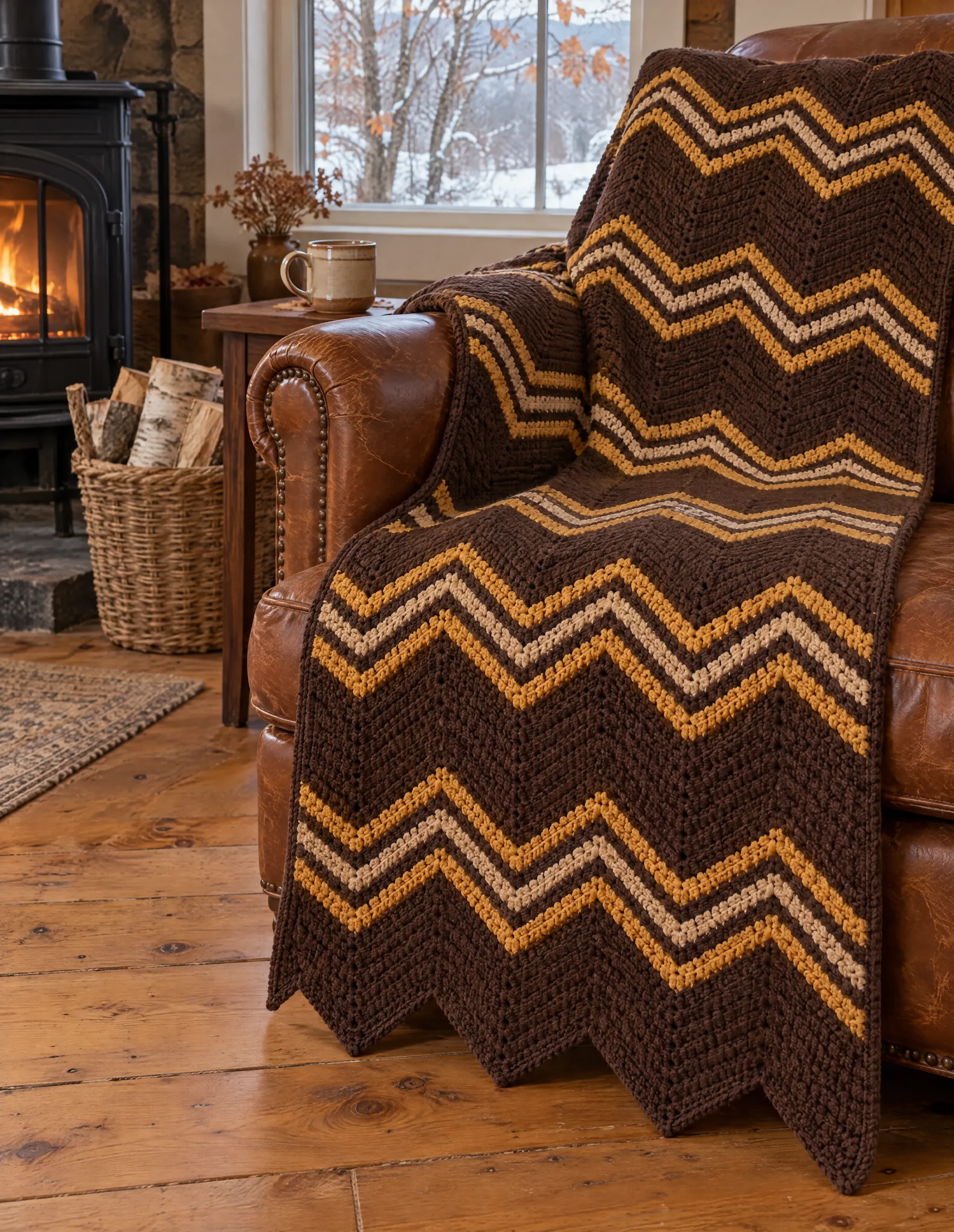
Picture a November evening with the woodstove ticking and a deep brown afghan thrown over the arm of an old leather armchair, its zigzags catching the lamplight. The Honey Walnut is a single crochet chevron afghan made for that kind of evening: thick and warm, with wide walnut bands and a narrow flash of honey and oat every 26 rows.
Its proportions come from a 1951 vintage design, and the pattern below keeps that construction stitch for stitch. You get it in modern worsted yarn and a 5.0 mm hook, in three sizes from a sofa throw to a queen bed, with the count printed after every row.
Is a single crochet chevron afghan a good first zigzag?
It’s a gentle one. You only need two things: the chain for the foundation and single crochet for everything else. If “sc BLO” or “sk” look cryptic, the guide to reading a crochet pattern explains each abbreviation before you start.
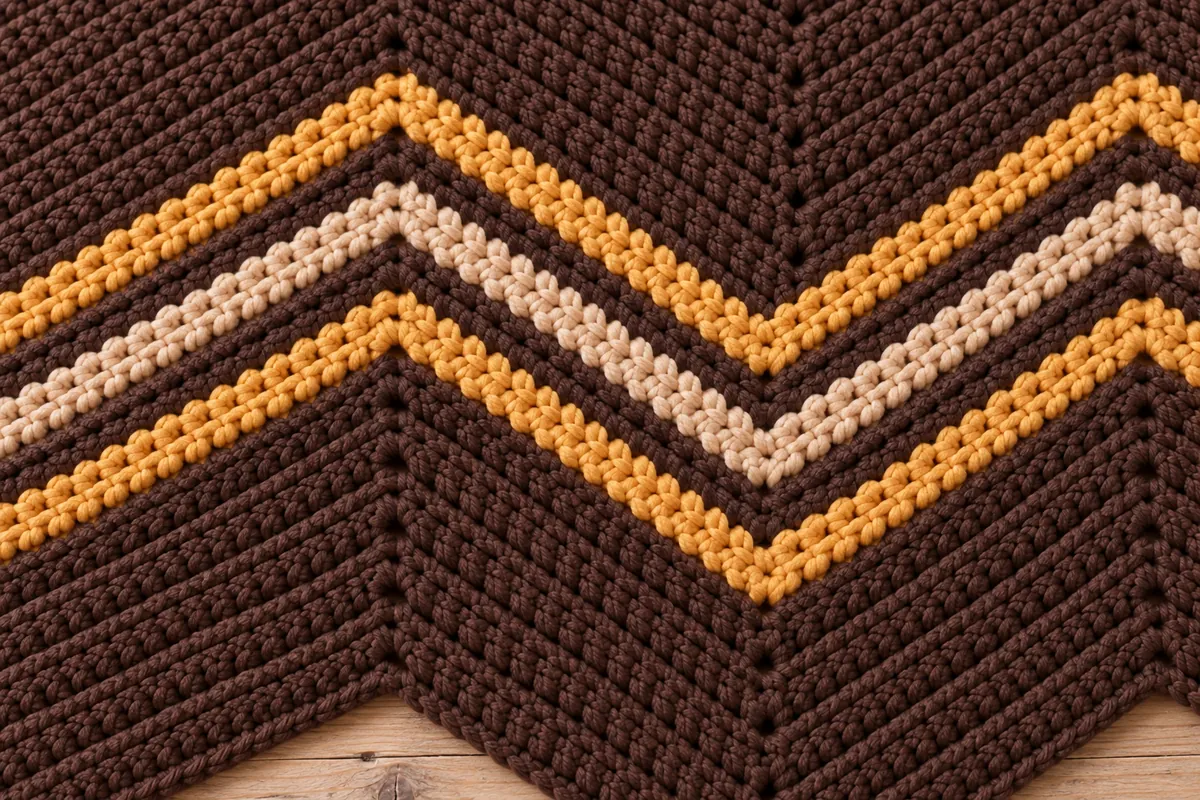
The new technique is the back loop. From Row 2 on, you slide your hook under only the loop farther from you, and the loop you leave behind becomes a raised ridge. Those ridges follow every peak and valley, so the fabric looks corrugated up close and reads as crisp chevrons from across the room.
The zigzag itself works the same way on every row. At each peak you put 3 sc into one stitch, which adds 2 stitches. At each valley you skip 2 stitches, which takes 2 away. The count never changes, so a row that ends with 290 stitches tells you everything went right.
The pattern is rated Easy because every color change happens at the end of a row. What asks for patience is length: a throw row has 290 stitches, and a queen row has 522.
Worsted yarn that can carry a dense afghan
Look for a 4 on the label, with worsted next to it. The amounts in the card assume balls of about 200 yd (183 m) per 100 g, so compare yards per 100 g if your yarn comes in a different put-up.
Single crochet in back loops makes a close, heavy fabric. A soft acrylic or an acrylic-wool blend keeps a queen manageable and goes through the washer. Pure wool is lovely and very warm, but a queen in wool gets heavy on your lap during the last bands. Skip cotton for the bigger sizes: it adds weight and stretches when a long afghan hangs off a bed.
Walnut is the big purchase in every size, about 2,800 yd for the throw and 8,505 yd for the queen. Buy all of it from one dye lot. A change of lot in the middle of a wide brown band shows as a faint line that you can’t hide.
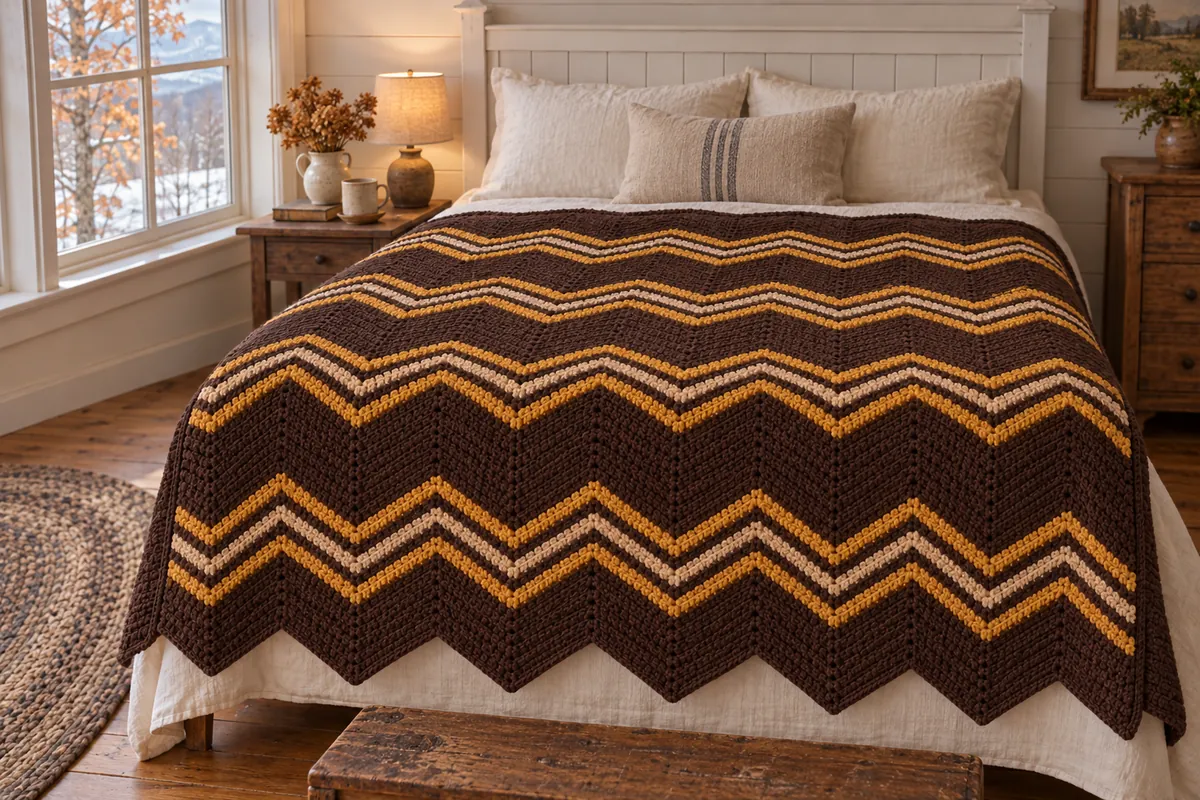
Before the first long chain, work the gauge swatch in the card. It’s only 56 chains, and it tells you whether your peaks will land at 4 7/8 in apart. If you’d rather start a lighter chevron in a cotton blend, the airy eyelet ripple of the Sun Tea Throw is a warm-weather cousin.
Walnut bands with a ribbon of honey and oat
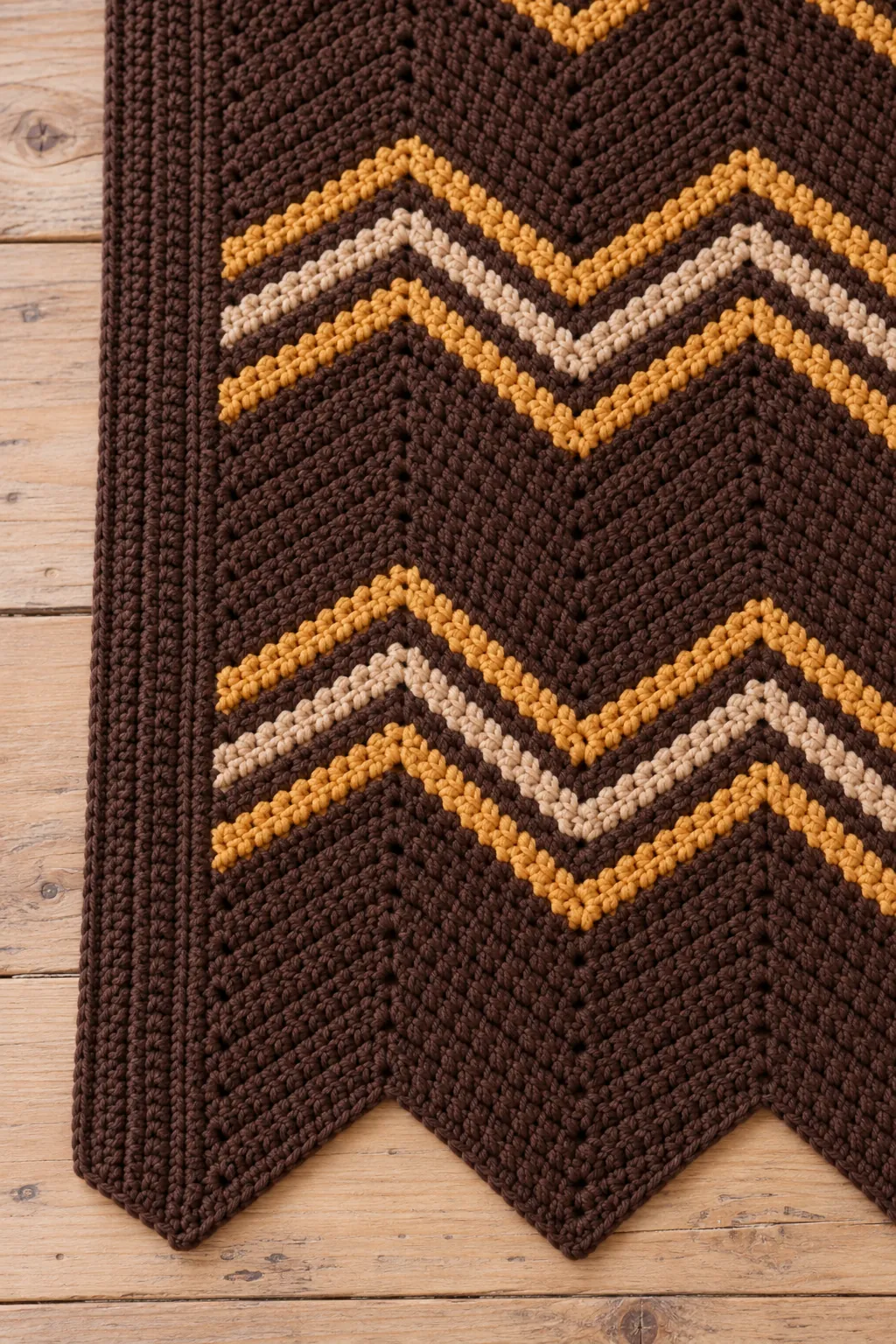
Walnut does most of the work: it opens and closes the afghan, fills a 16-row band in each repeat and frames the side edges. Between the bands sits a stripe group of five 2-row stripes, always in the same order: honey, walnut, oat, walnut, honey. The walnut rows inside the group keep honey and oat from blurring, and the whole group reads as one thin ribbon of light.
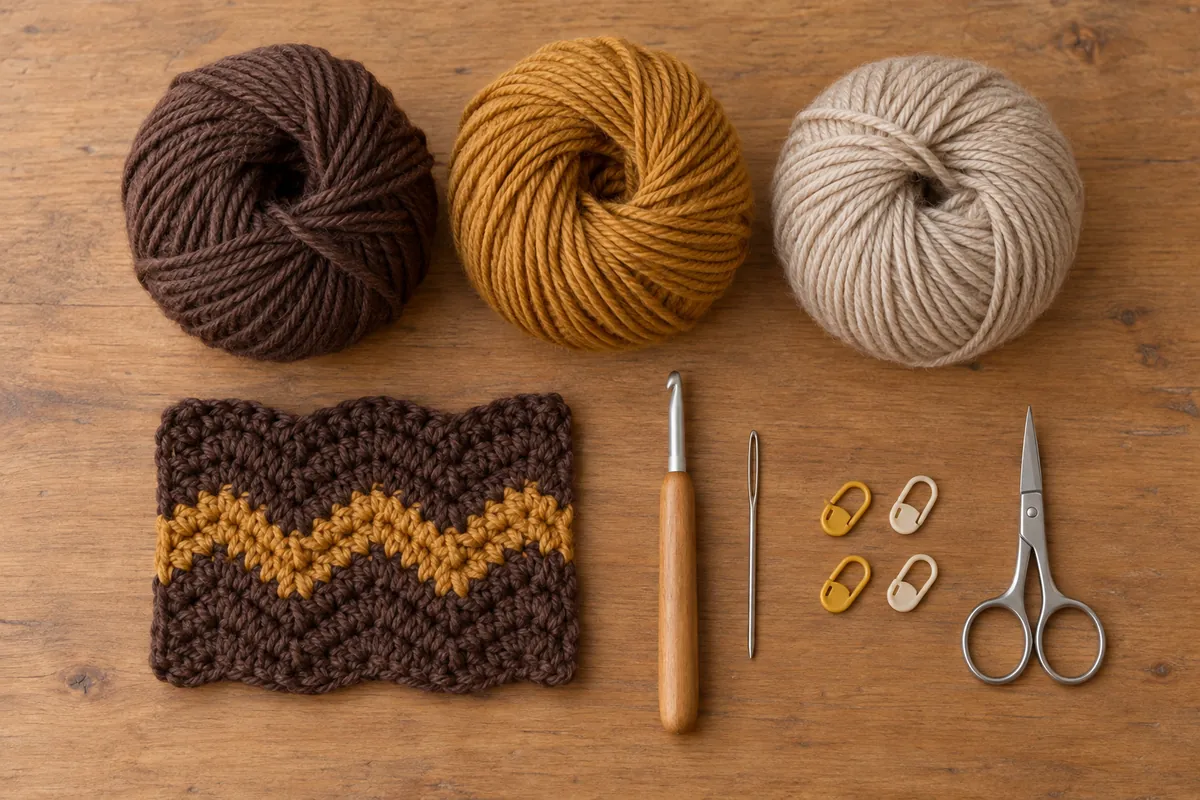
Any three colors work if they keep the same jobs: a deep main color, a warm accent for the outer stripes and a pale shade for the middle one.
- Honey Walnut: deep walnut brown, amber honey and warm oat, as written in the card.
- Sage Meadow: deep sage green, soft golden yellow and cream.
- Slate Harbor: charcoal slate, rust and oatmeal.
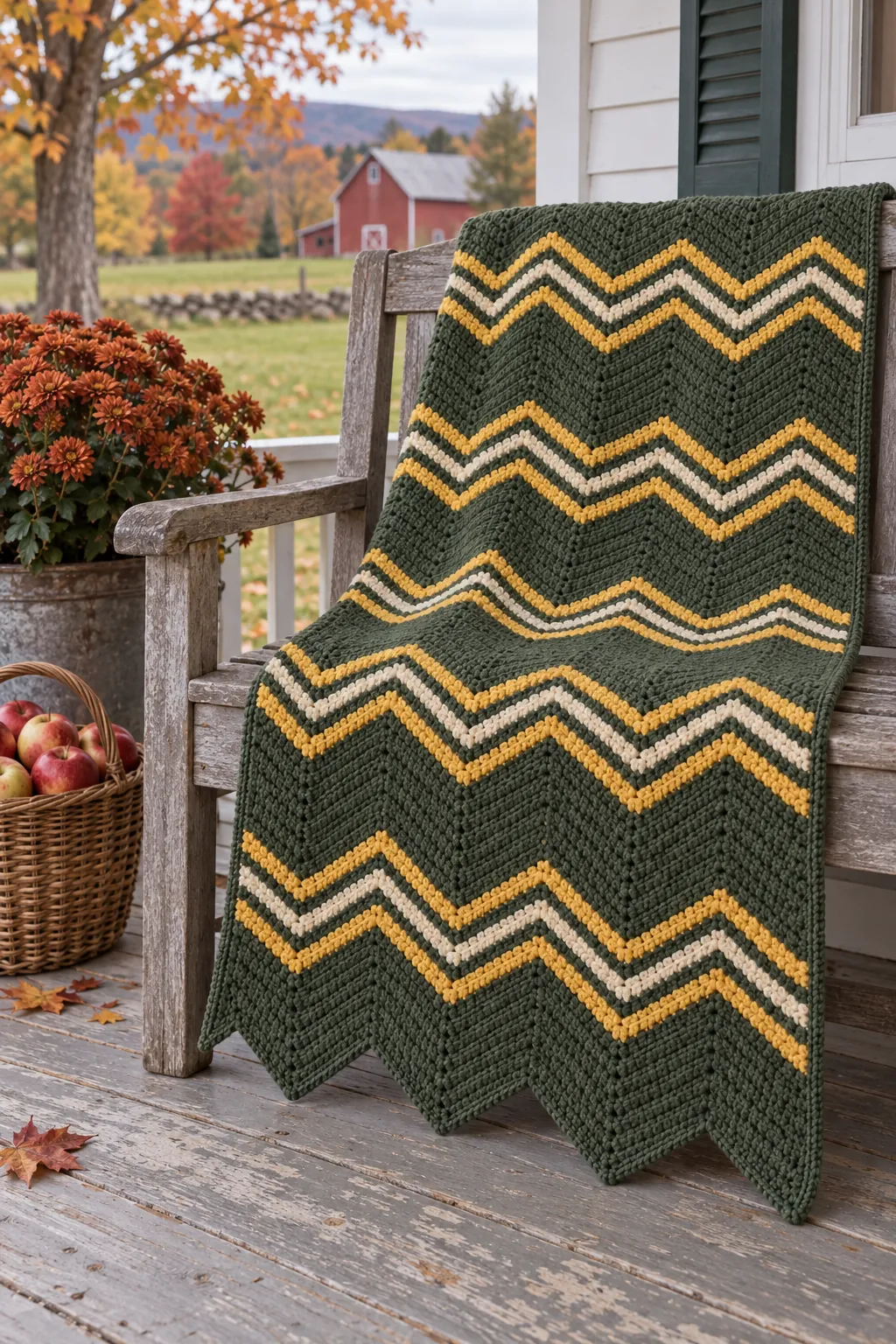
Lay one ball of each color side by side in daylight before you buy the rest. Your middle stripe should look clearly paler than the main color, or the ribbon goes flat.
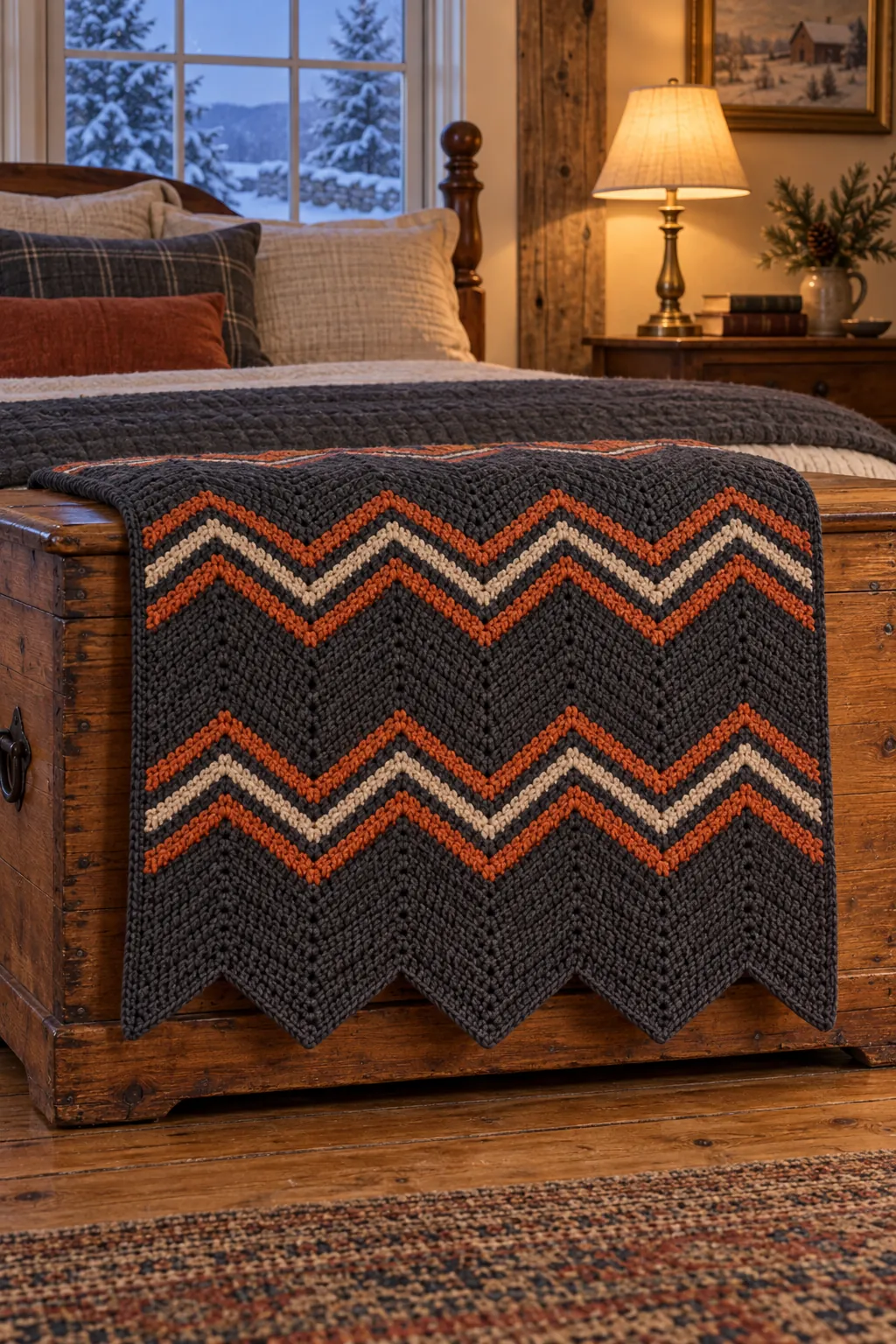
Throw, twin or queen: whole peaks and whole stripe groups
The afghan grows in whole peaks across and whole 26-row stripe sequences up. Each peak adds 28 chains to the start, and each sequence adds about 8 in (20 cm). The card is written as Throw [Twin, Queen].
- Throw: about 49 1/4 × 59 3/4 in (125 × 152 cm). Ch 280, 10 peaks, 194 rows, 2 edging rows on each long side. Walnut about 2,800 yd, Honey 503 yd, Oat 252 yd.
- Twin: about 65 3/4 × 89 3/4 in (167 × 228 cm). Ch 364, 13 peaks, 292 rows, 6 edging rows on each long side. Walnut 5,600 yd, Honey 1,028 yd, Oat 514 yd.
- Queen: about 90 × 99 3/4 in (229 × 253 cm). Ch 504, 18 peaks, 324 rows, 6 edging rows on each long side. Walnut 8,505 yd, Honey 1,552 yd, Oat 776 yd.
Peaks come in steps of about 4 7/8 in, which can’t land exactly on every bed width. That’s why the twin and queen get 4 more edging rows on each side than the throw: about 1 in more per side, without touching a single chevron. Your own gauge may move these sizes a little.
Keeping 290 stitches and stacked peaks, row after row
Clip a removable marker into the center stitch of each peak on Row 2, and move the markers up every few rows during the first walnut band. Before each peak, check that you’re about to work into the stitch with a marker. A peak that drifts sideways almost always means one stitch too many or too few on the slope just before it.
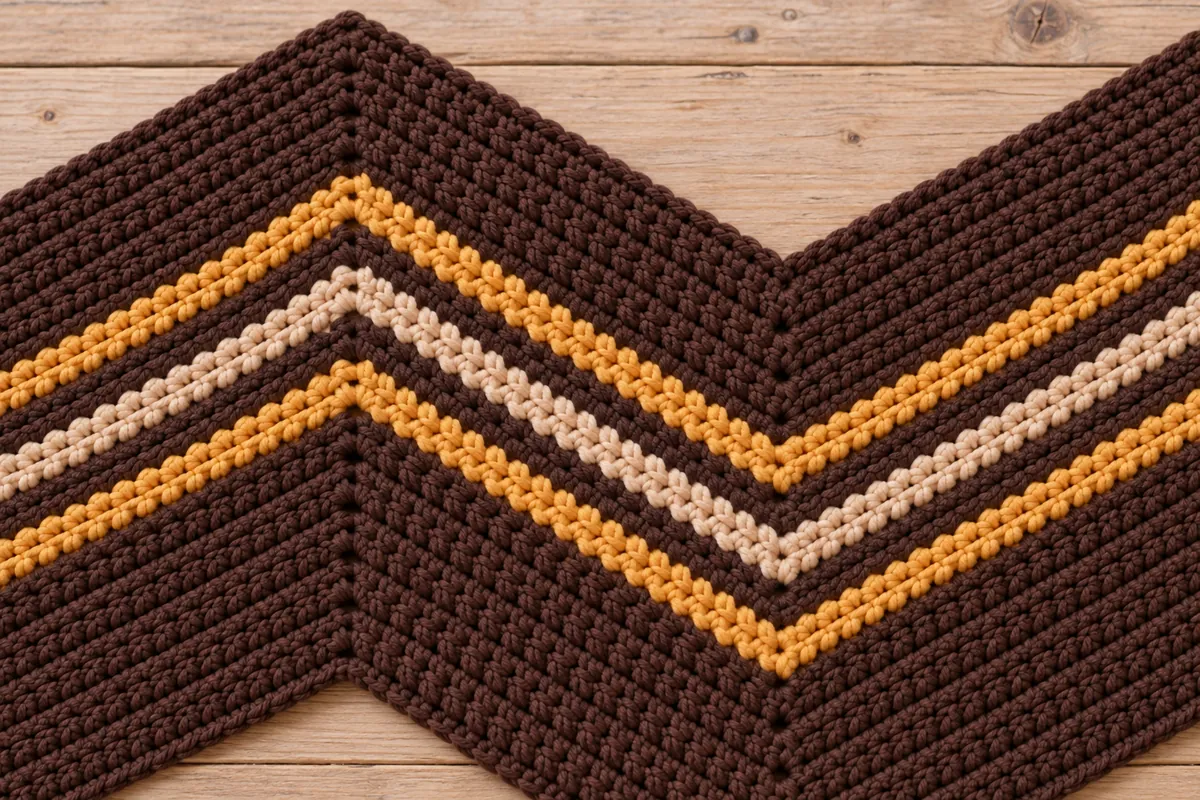
Count the slopes as you go: 13 sc down from each peak, skip 2, then 13 sc up to the next. The two ends follow their own rule. Each row starts with sc, skip 1, 12 sc, and ends with 12 sc, skip 1, sc. That skipped stitch keeps the long sides straight. Forget it and the edge grows by one stitch per row.
The foundation chain is long, and a tight chain pulls the bottom points out of shape. Chain loosely, or use a hook one size larger for the chain only. Place a marker every 28 chains while you go, so you can check the count without starting over.
Each stripe color is cut at the end of its rows, which leaves a lot of tails on the long sides. Weave them in along the row ends before the side edging: once the edging covers them, they stay put.
US crochet terms
The pattern
Materials
- Worsted weight yarn (#4), soft acrylic, wool blend or wool, about 200 yd (183 m) per 100 g ball, in 3 colors (estimate, a little extra included):
- Walnut (deep brown, main color): about 2,800 [5,600, 8,505] yd (2,560 [5,121, 7,777] m), 14 [28, 43] balls
- Honey (amber gold): about 503 [1,028, 1,552] yd (460 [940, 1,419] m), 3 [6, 8] balls
- Oat (warm beige): about 252 [514, 776] yd (230 [470, 710] m), 2 [3, 4] balls
- Total: about 3,555 [7,142, 10,833] yd (3,251 [6,531, 9,906] m), 19 [37, 55] balls
- 5.0 mm (H-8) crochet hook, or size needed to obtain gauge
- Yarn needle
- Scissors
- Removable stitch markers
Gauge
1 repeat (29 sts, from the center st of one peak to the center st of the next) = about 4 7/8 in (12.4 cm); 13 rows = 4 in (10 cm); in pattern, measured flat. Your size may vary with your gauge: if your repeat is wider, try a smaller hook; if it’s narrower, try a larger hook.
Swatch:
- Swatch Row 1: Ch 56. Sc in 2nd ch from hook and in each of next 12 ch, 3 sc in next ch, sc in each of next 13 ch, sk next ch, sc in each of next 13 ch, 3 sc in next ch, sc in each of last 13 ch, turn. (58 sts)
- Swatch Rows 2–20: Ch 1 (does not count as a st), sc BLO in first st, sk next st, sc BLO in each of next 12 sts, 3 sc BLO in next st, sc BLO in each of next 13 sts, sk next 2 sts, sc BLO in each of next 13 sts, 3 sc BLO in next st, sc BLO in each of next 12 sts, sk next st, sc BLO in last st, turn. (58 sts)
Fasten off, lay the swatch flat and measure the repeat across, peak to peak, then the rows straight up.
Finished size
- Throw: about 49 1/4 × 59 3/4 in (125 × 152 cm)
- Twin: about 65 3/4 × 89 3/4 in (167 × 228 cm)
- Queen: about 90 × 99 3/4 in (229 × 253 cm)
- Measured flat. Width includes the side edging; length is measured straight up the center of the afghan. Estimates based on the gauge above.
Abbreviations
- approx. approximately
- BLO back loop only
- ch chain
- rep repeat
- RS right side
- sc single crochet
- sc BLO single crochet in the back loop only
- sk skip
- sl st slip stitch
- st(s) stitch(es)
Notes
- Sizes are written as Throw [Twin, Queen]. A number given once applies to all sizes.
- Turning chain: the ch 1 at the start of each row does not count as a stitch. Work the first sc into the first stitch of the row.
- Back loops: Row 1 is worked into the foundation chain. From Row 2 on, every stitch of the body is worked into the back loop only (the loop farther from you).
- Right side: Row 1 is the RS. Place a marker on it. Back-loop ridges form on both faces, so the afghan looks good from either side.
- Peaks and valleys: a peak is 3 sc worked into one stitch; on the next row, the 3 sc of each peak go into the center stitch of the 3. A valley is 2 skipped stitches at the bottom of each V (on Row 1, a single skipped chain). Each peak adds 2 stitches and each valley removes 2, so every row has the same count.
- Edges: every row after Row 1 begins with sc in the first stitch and a skipped stitch, and ends with a skipped stitch and sc in the last stitch. This keeps the long sides straight.
- Counting: check your count at the end of every row in the first band. Peaks must sit directly above peaks, and valleys above valleys. A marker in the center stitch of every peak helps on the first rows.
- Color changes: change colors on the last stitch of the row. Work that stitch until 2 loops remain on the hook, drop the old color, yarn over with the new color and pull it through both loops. Cut the old color, leaving a 6 in (15 cm) tail, then turn and work the next row in the new color.
- Stitch multiple: the foundation chain is a multiple of 28; each repeat adds 28 ch and 29 sts to every row (one more peak). To change the width, add or remove 28 ch per repeat and change the repeat count in Row 1 and in the Pattern Row by the same number.
- Length: one Stripe Sequence is 26 rows, about 8 in (20 cm). Add or remove whole sequences to change the length; yarn amounts change too.
- Yardage and sizes are estimates based on the gauge above.
Instructions
Body
The Pattern Row is used for every row after Row 1:
- Pattern Row: Ch 1 (does not count as a st), sc BLO in first st, sk next st, sc BLO in each of next 12 sts, *3 sc BLO in next st (center st of the peak), sc BLO in each of next 13 sts, sk next 2 sts (valley), sc BLO in each of next 13 sts; rep from * 8 [11, 16] more times (9 [12, 17] times in all), 3 sc BLO in next st, sc BLO in each of next 12 sts, sk next st, sc BLO in last st, turn. (290 [377, 522] sts)
- Row 1 (RS): With Walnut, ch 280 [364, 504]. Sc in 2nd ch from hook and in each of next 12 ch, *3 sc in next ch (peak), sc in each of next 13 ch, sk next ch (valley), sc in each of next 13 ch; rep from * 8 [11, 16] more times (9 [12, 17] times in all), 3 sc in next ch, sc in each of last 13 ch, turn. (290 [377, 522] sts: 10 [13, 18] peaks and 9 [12, 17] valleys)
- Rows 2–14 [2–11, 2–14]: With Walnut, work the Pattern Row 13 [10, 13] times. On the last stitch of Row 14 [11, 14], change to Honey. (290 [377, 522] sts)
Stripe Sequence (26 rows, every row worked as the Pattern Row; change to the next color on the last stitch of the last row of each band):
| Rows of the sequence | Color | Rows |
|---|---|---|
| 1–2 | Honey | 2 |
| 3–4 | Walnut | 2 |
| 5–6 | Oat | 2 |
| 7–8 | Walnut | 2 |
| 9–10 | Honey | 2 |
| 11–26 | Walnut | 16 |
- Rows 15–170 [12–271, 15–300]: Work the Stripe Sequence 6 [10, 11] times. On the last stitch of Row 170 [271, 300], change to Honey. (290 [377, 522] sts)
- Rows 171–180 [272–281, 301–310]: Work rows 1–10 of the Stripe Sequence once more: 2 rows Honey, 2 rows Walnut, 2 rows Oat, 2 rows Walnut, 2 rows Honey. On the last stitch of Row 180 [281, 310], change to Walnut. (290 [377, 522] sts)
- Rows 181–194 [282–292, 311–324]: With Walnut, work the Pattern Row 14 [11, 14] times. Fasten off after Row 194 [292, 324]. (290 [377, 522] sts)
The body has 194 [292, 324] rows. Weave in all tails along the side edges before starting the side edging.
Side edging (Walnut)
- Edging Row 1: With RS facing, join Walnut with a sl st in the end of Row 1 at the bottom of one long side. Ch 1, sc in the end of the same row and in the end of each row across, ending in the end of Row 194 [292, 324], turn. (194 [292, 324] sc)
- Edging Row 2: Ch 1 (does not count as a st), sc BLO in each sc across, turn. (194 [292, 324] sc) Throw only: fasten off here.
- Edging Rows 3–6, Twin and Queen only: Work Edging Row 2 four more times. Fasten off after Edging Row 6. (292 sc for the Twin, 324 sc for the Queen)
- Second long side: With RS facing, join Walnut with a sl st in the end of Row 194 [292, 324] at the top of the other long side. Work Edging Rows 1–2 [1–6, 1–6] the same way, ending Edging Row 1 in the end of Row 1. (194 [292, 324] sc in every edging row)
The top and bottom edges have no edging: they keep their points.
Finishing
- Weave in the remaining tails along the edging rows.
- Lay the afghan flat, mist it lightly or hold a steam iron just above it without pressing, pat the peaks and valleys into shape and let it dry completely before moving it.
Washing a heavy walnut and honey afghan
Follow the care line on your yarn label first. For acrylic, a gentle machine cycle in cool water works well; for wool and wool blends, hand wash in cool water or use a wool cycle with a wool wash. Squeeze the water out without wringing, then roll the afghan in a couple of towels.
Always dry it flat. Wet single crochet holds a lot of water, and a twin or queen hung over a line stretches lengthwise and pulls the points long. A clean bedspread on the floor of a spare room makes a good drying table. Store the afghan folded on a shelf or in a blanket chest, never hung by a corner, and add a cedar block if it’s wool.
Honey Walnut questions about peaks, edging and gauge
Is a single crochet chevron afghan stiff?
Not when the gauge is right. Worked with a 5.0 mm hook in worsted, single crochet in back loops is dense but bends easily, because the ridges act like small hinges. If your swatch feels like cardboard, go up a hook size and measure the repeat again.
Why is gauge measured from peak to peak?
Chevron stitches lean along the slopes, so counting stitches over 4 in gives a misleading number. One full repeat, from the center of one peak to the center of the next, tells you directly how wide the afghan will be.
Why does Row 1 skip only one chain at each valley?
The chain has no stitches yet, so one skipped chain is enough to start the V. From Row 2 on, you skip 2 stitches at each valley to balance the 2 stitches that each peak adds.
Can I make the afghan wider or longer?
Yes. Each extra peak adds 28 chains to the start and 29 stitches to every row; add one repeat to the count in Row 1 and in the Pattern Row. For length, add or remove a whole 26-row Stripe Sequence, about 8 in. Plan extra yarn for both.
Quick recap
- Chain 280 [364, 504] in Walnut and work Row 1 with its peaks and single skipped chains.
- Work the walnut starting band in the Pattern Row, in back loops only.
- Repeat the 26-row Stripe Sequence 6 [10, 11] times, then work its five narrow stripes once more.
- Finish with the walnut ending band.
- Work 2 [6, 6] rows of side edging along each long side, then weave in the ends and block flat.
The Honey Walnut is a single crochet chevron afghan to keep on the hook through a whole season, one long, steady row at a time. For another big ripple worked in a more open stitch, the Lakeshore summer bedspread is worth a look. If a row or a count puzzles you along the way, ask through the Contact page.