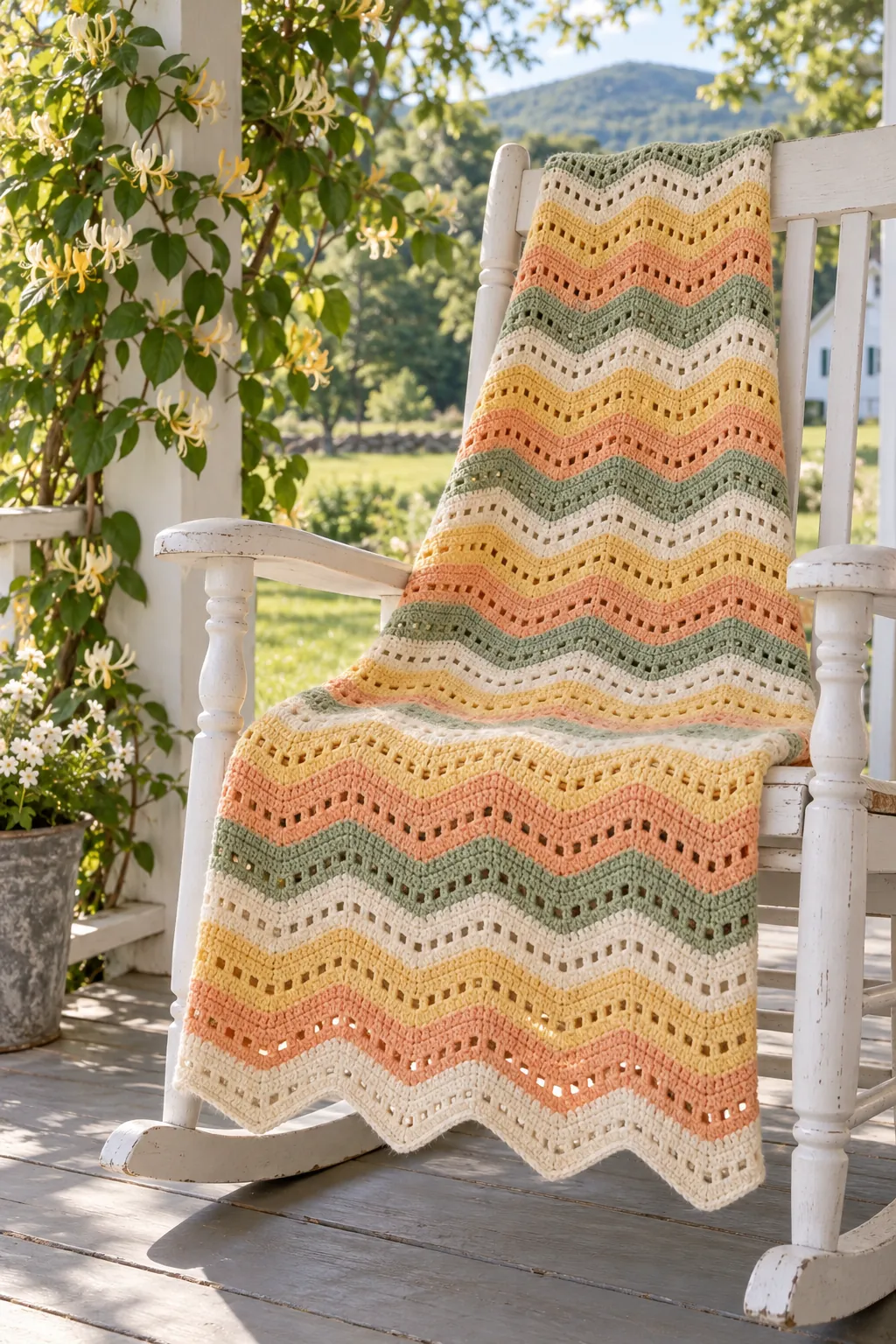
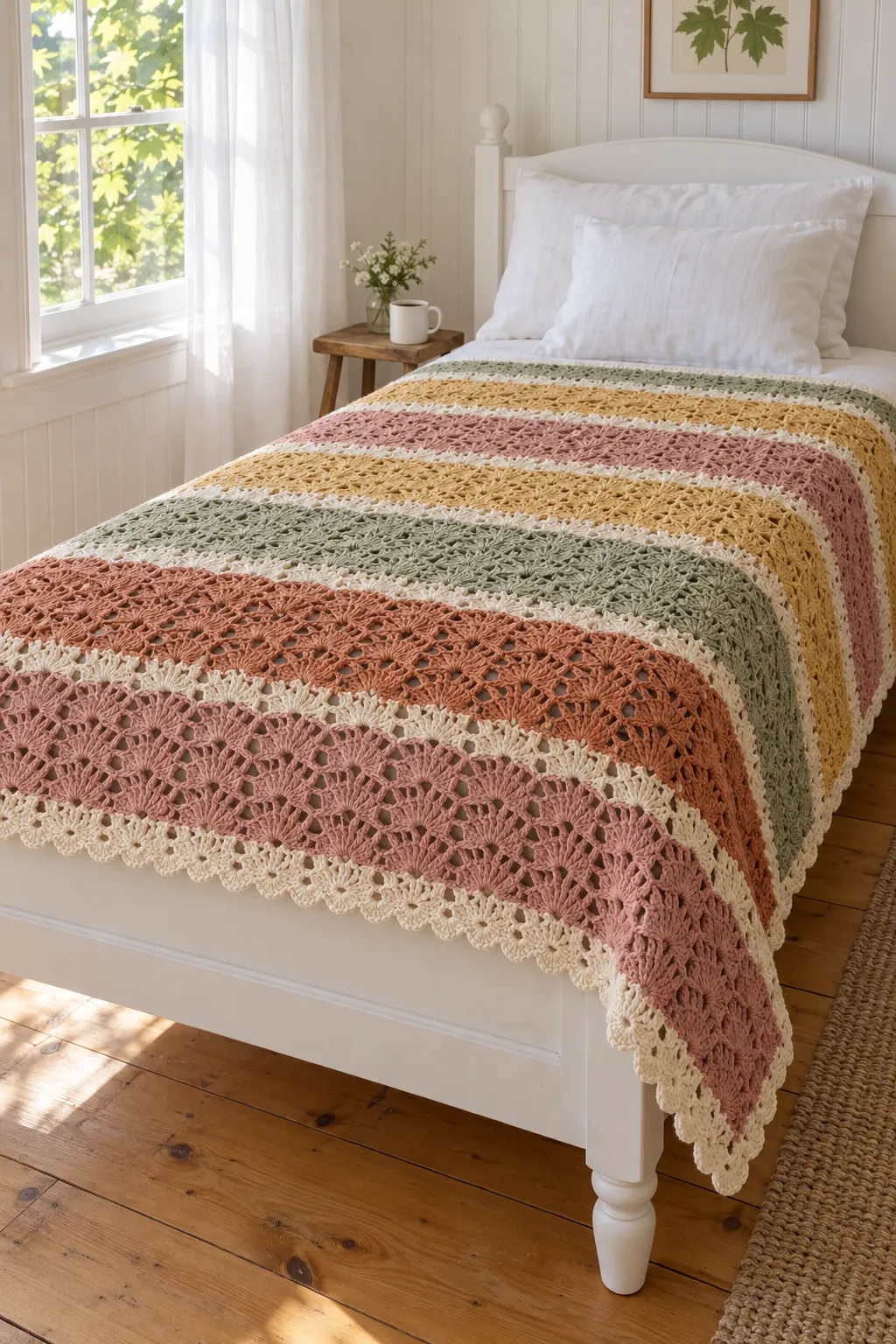
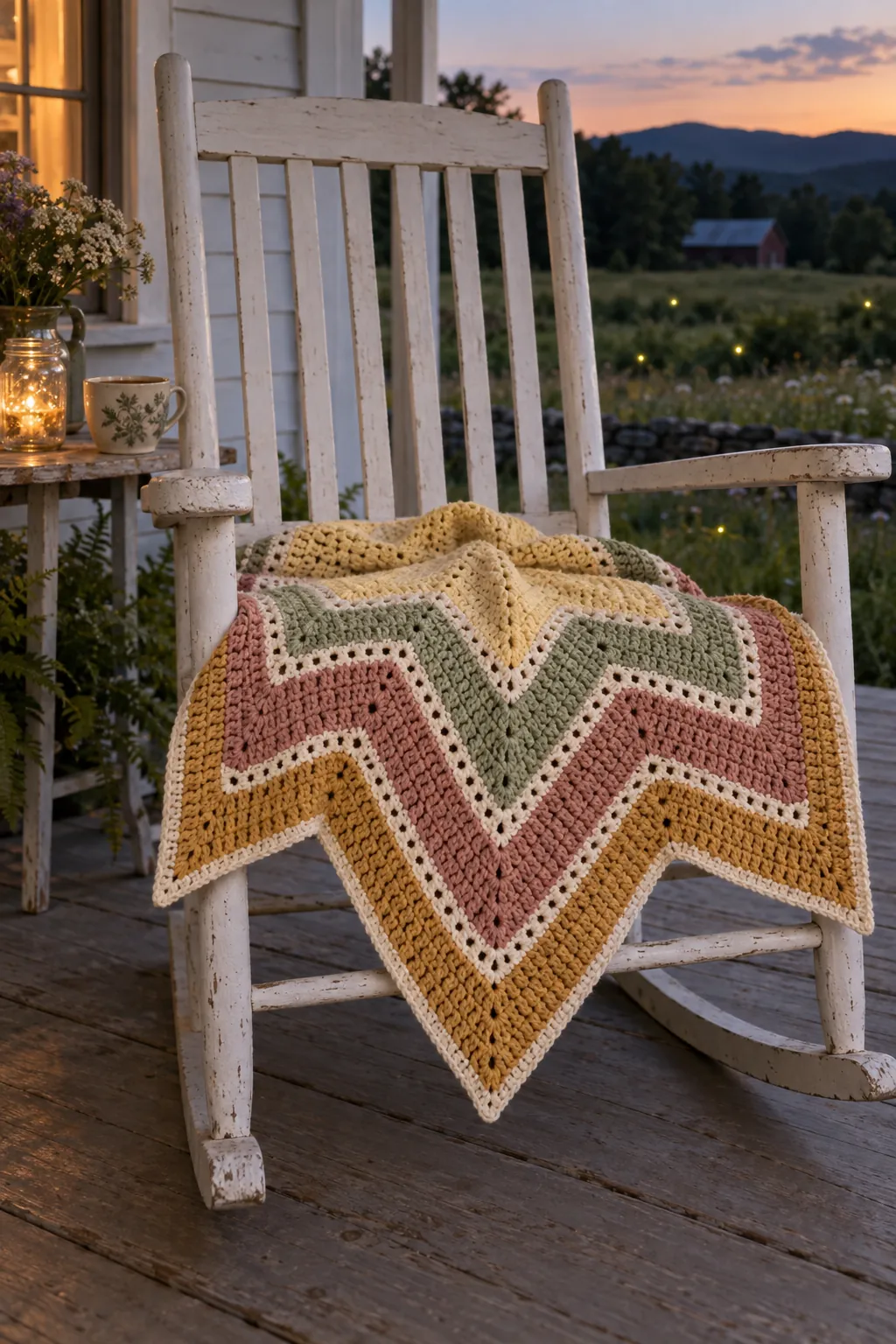
Picture a porch glider on a June morning in Vermont, the meadow beyond the railing pink with red clover, and a big square of red and butter stripes thrown over the armrest. The Red Clover Medallion is a striped square crochet afghan that starts with twelve double crochets in a ring and grows outward, round after round, until it covers a sofa or the top of a bed.
Wide clover red bands alternate with fine stripes of butter, oat, garnet and espresso, and a long knotted fringe finishes all four sides. The pattern below gives every round of three sizes with its exact stitch count, so you never have to count in your head.
Is this striped square crochet afghan a good long project for a beginner?
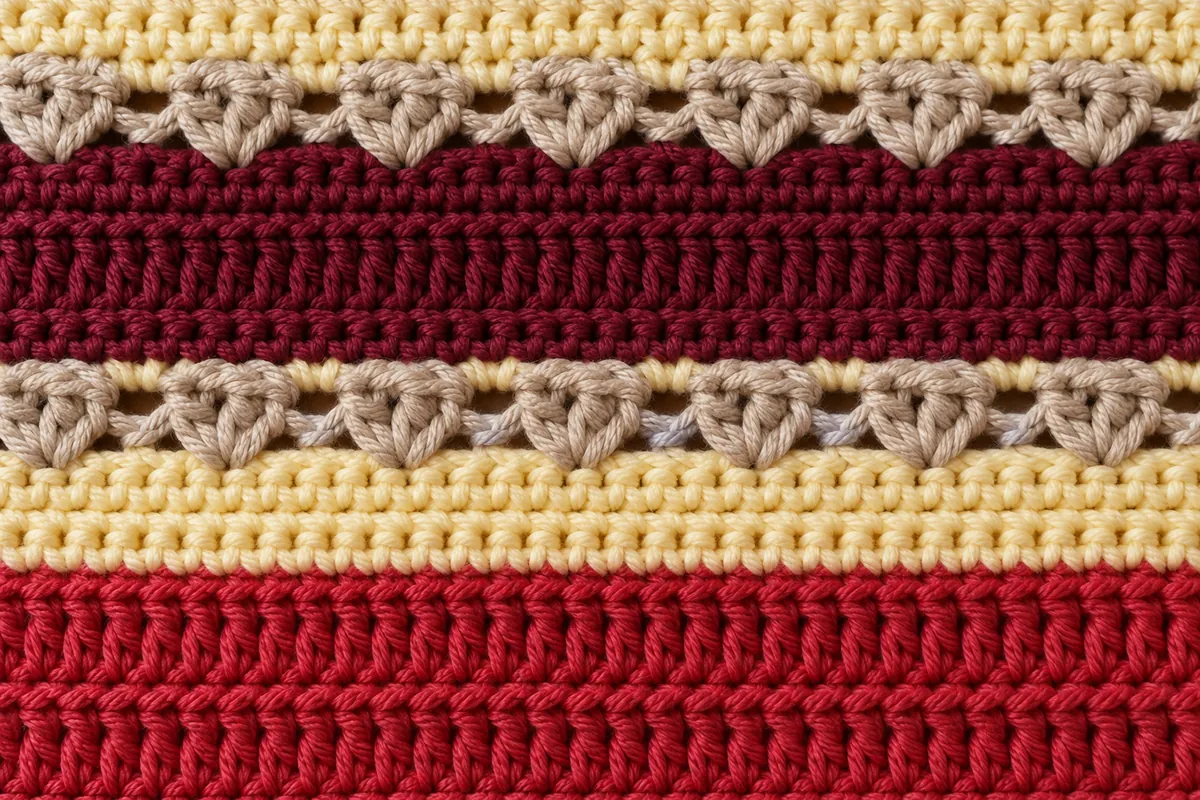
If you can work a chain, a single crochet and a double crochet, you already know almost everything it uses. The one extra stitch is a 2-dc cluster: two double crochet legs started in the same stitch and closed together at the top, so they look like a small bundle. The Notes spell it out, and the guide to reading a crochet pattern covers the abbreviations.
The level is Easy, but the scale is real. The small size has 72 rounds, the medium 100 and the large 128, and the last round of the large holds 1,544 stitches. Nothing is tricky once you’re in the rhythm. The challenge is staying with it.
Most square afghans are made of many small squares sewn together. This one is a single square from the first stitch to the fringe, like the center medallion of a quilt that never stopped growing. The stripes meet on four clean diagonals, and there’s no seam anywhere.
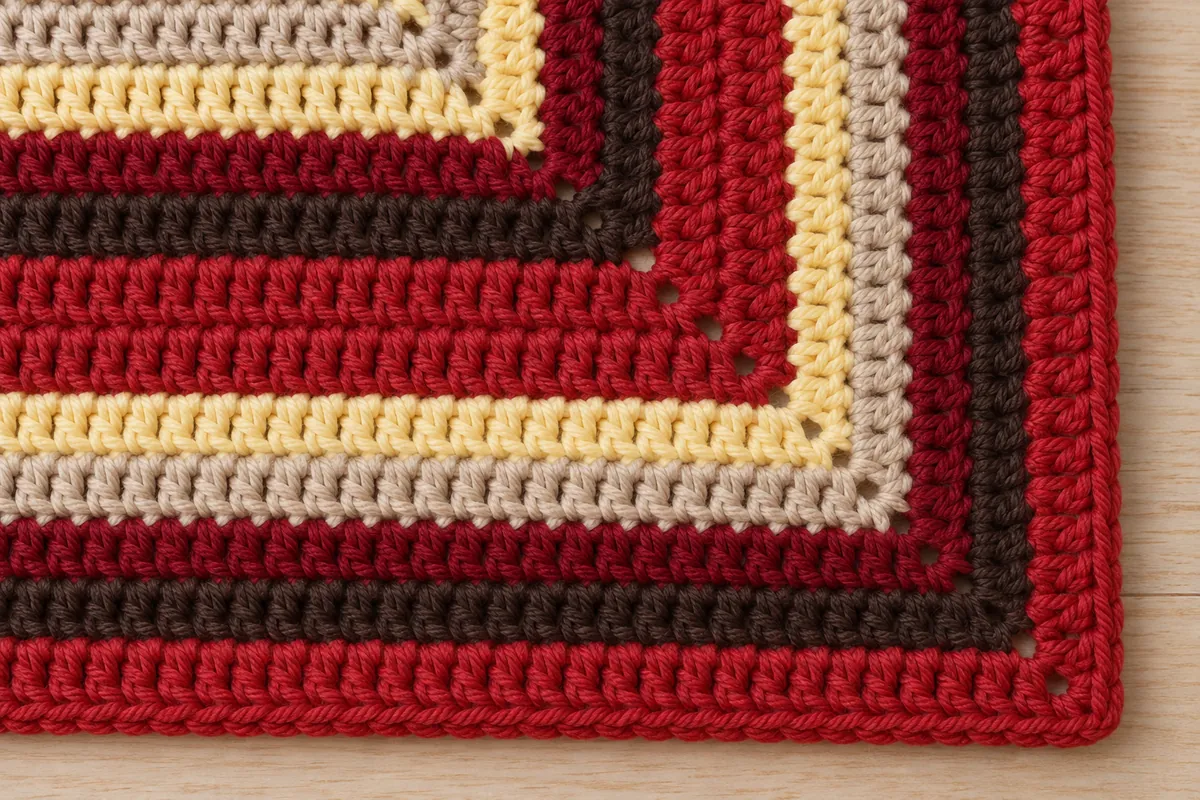
Three kinds of rounds give the stripes their character. Runs of five double crochet rounds build the wide red bands quickly. Pairs of single crochet rounds draw short, crisp lines in butter or espresso. Open cluster rounds in oat, or sometimes in red, add a light, lacy line where a small chain bridges each skipped stitch.
A DK cotton blend for a light summer square
Look for a 3 on the label, with DK or light next to it. A cotton-acrylic blend keeps a big square light enough for June evenings and goes through the washer; a soft wool blend makes it warmer for a cool cabin. The hook is a 4.5 mm (7), and the gauge is 18 double crochets and 9 double crochet rounds over 4 in (10 cm).
The card also gives two early checkpoints: the square should measure about 4 7/8 in (12.4 cm) along one side after Round 6, and about 12 in (30.5 cm) after Round 16. Measure at both. A square that’s already a little big at Round 16 ends up several inches too wide at Round 128.
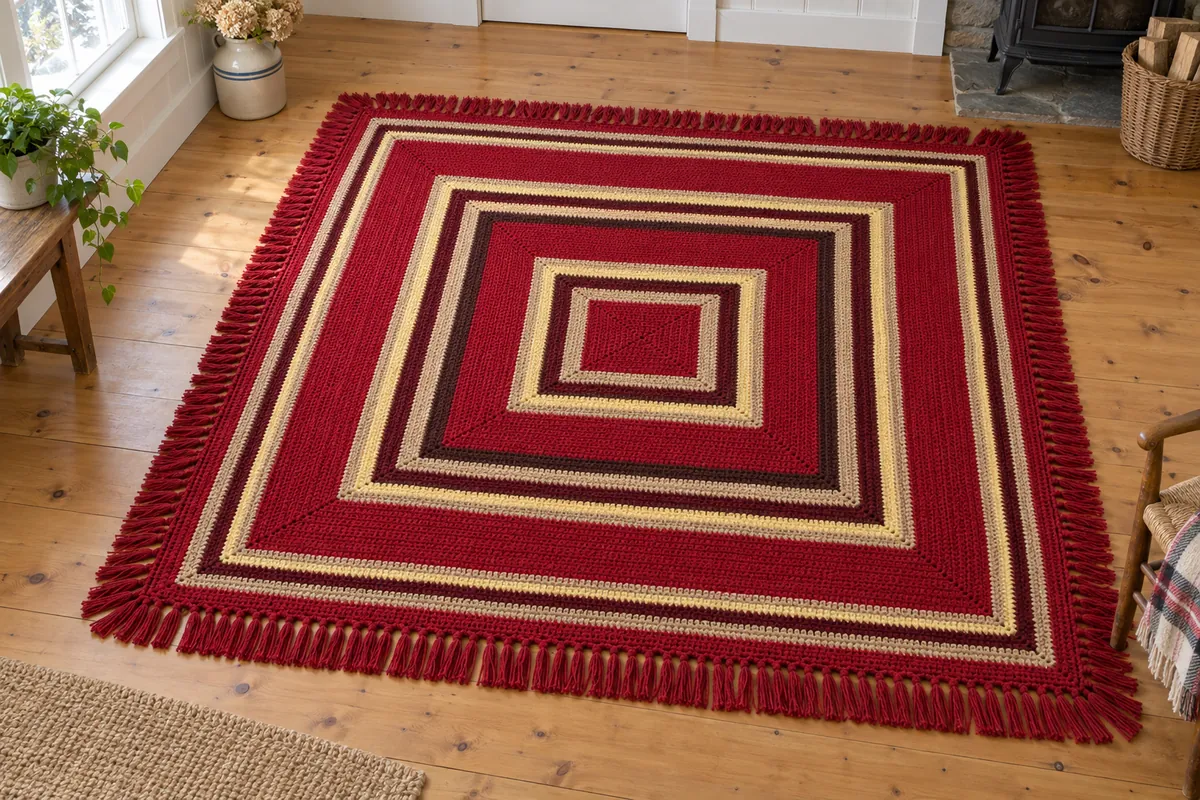
Clover red is the big purchase: it fills the wide bands, the last round and the fringe. Buy all of it from one dye lot, since a second lot shows as a ring of slightly different red right around the square. The fringe is listed on its own line in the card, so you can leave it out and save that yarn.
Clover red with butter, oat, garnet and espresso
Each palette keeps the same five jobs. A is the main color of the wide bands and the fringe. B and C are light colors for the fine stripes. D is the darkest accent, a thin line or two per stripe group. E is a deeper shade of A, used for a three-round band in each repeat.
- Red Clover: A clover red, B butter, C oat, D espresso, E garnet, as written.
- Meadow Sage: A sage, B honey, C cream, D bark brown, E fern, soft and green for a sunroom.
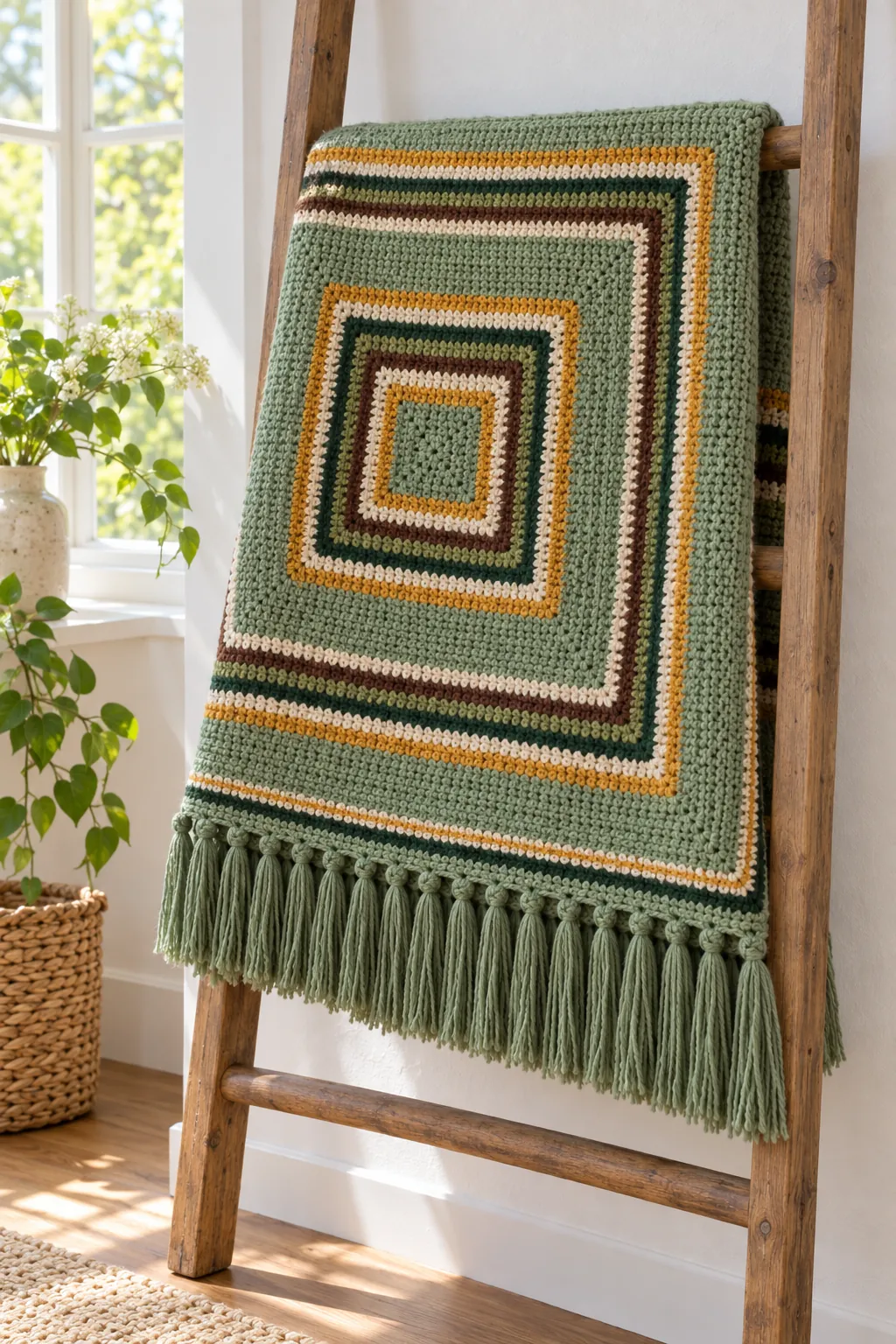
- Lake Champlain: A lake blue, B buttercream, C sand, D navy, E slate, cool and calm for a guest room.

Keep the light colors truly light against the main color. The fine stripes are what draw the medallion, and if B and C sit too close to A, the square turns into one big red blur from across the porch.
Small, medium and large from the same center
All three sizes share the same 18-round center and the same 26-round outer bands. The only difference is how many times you work the 28-round stripe repeat in the middle: once, twice or three times. Each extra pass adds about 18 in (45 cm) to every side. The card is written as Small [Medium, Large], and the sizes are measured without the fringe, which adds about 6 1/2 in (16.5 cm) on each side.
- Small: about 50 × 50 in (127.5 × 127.5 cm), a sofa throw. 72 rounds, 904 stitches in the last round, 460 fringes. A about 2,024 yd plus 412 yd for the fringe, B 724 yd, C 278 yd, D 111 yd, E 352 yd.
- Medium: about 68 × 68 in (172.7 × 172.7 cm), a topper for a twin or full bed. 100 rounds, 1,224 stitches, 620 fringes. A 3,607 yd plus 555 yd, B 1,461 yd, C 506 yd, D 258 yd, E 640 yd.
- Large: about 86 × 86 in (218 × 218 cm), a topper for a queen bed. 128 rounds, 1,544 stitches, 780 fringes. A 5,627 yd plus 698 yd, B 2,458 yd, C 807 yd, D 460 yd, E 1,021 yd.
Since the square isn’t a rectangle, it drapes over a bed corner to corner as easily as side to side. Measure the top of your mattress before you choose.
Finding the hidden stitch and keeping 128 rounds flat
The first stitch after each corner hides behind the corner stitches. Look for it on every side. Skipping it is the most common reason for a short count, and the count per side in the card is there to catch it: each round’s total divided by 4.
Every round starts in a corner space. When you change color, join the new one in a different corner from the last one, so the joins spread around the square instead of piling up in one place. Lay the tail of each new color along the top of the round below and work the next 8 stitches over it. That takes care of about half the ends as you go.
The cluster rounds say “even sides” or “odd sides”. A cluster goes in every other stitch, so when a side of the round below has an even number of stitches, the last cluster lands right before the corner. When it’s odd, one stitch is left over, and you skip it. The card tells you which case each round is.
Lay the square flat every few rounds. If it cups like a bowl, your stitches are too tight; if it ruffles at the edges, too loose. Change the hook, never the counts.

For another blanket that grows as one piece from the center, the one-square baby blanket in soft chenille works the same way at a much smaller scale.
US crochet terms
The pattern
Materials
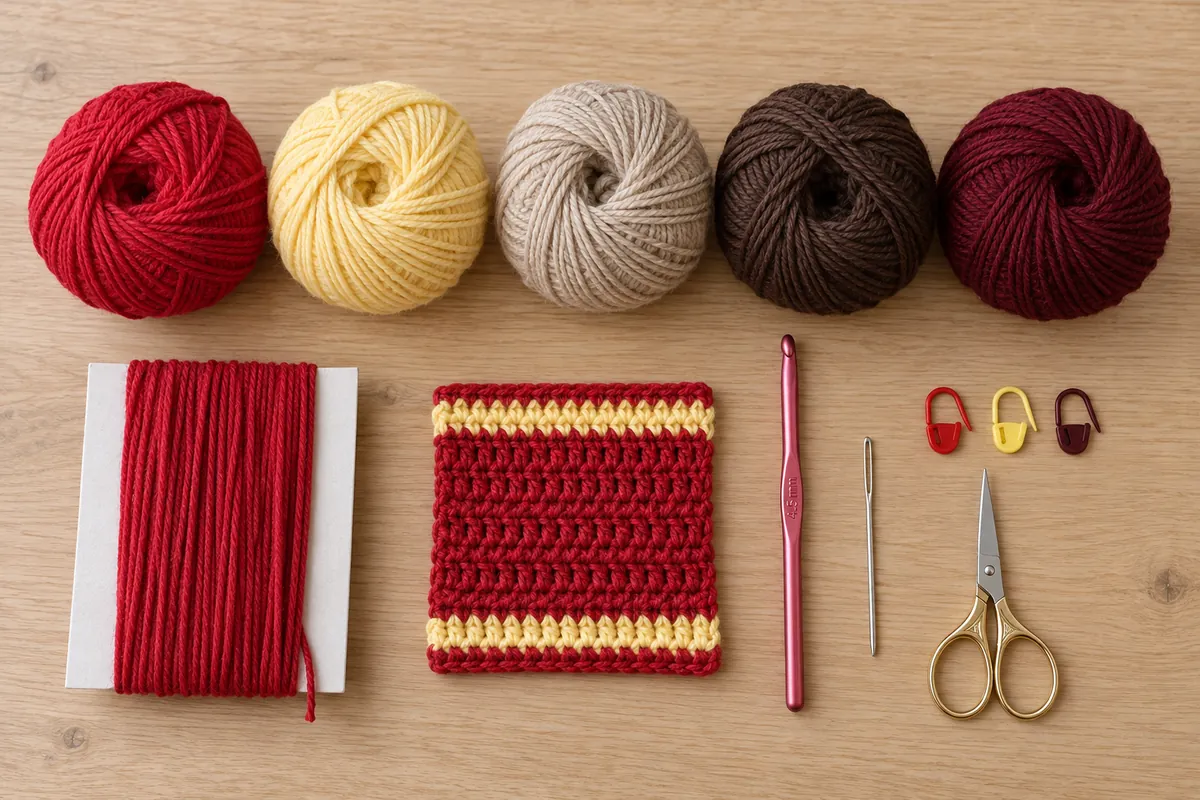
- DK weight yarn (#3, light), cotton-acrylic blend or soft wool blend, in 5 colors (estimate, about 15% extra included):
- A, Clover Red (rounds): about 2,024 [3,607, 5,627] yd (1,851 [3,298, 5,145] m)
- A, Clover Red (fringe): about 412 [555, 698] yd (377 [507, 638] m)
- B, Butter: about 724 [1,461, 2,458] yd (662 [1,336, 2,248] m)
- C, Oat: about 278 [506, 807] yd (254 [463, 738] m)
- D, Espresso: about 111 [258, 460] yd (101 [236, 421] m)
- E, Garnet: about 352 [640, 1,021] yd (322 [585, 934] m)
- 4.5 mm (7) crochet hook, or size needed to obtain gauge
- Yarn needle, scissors and a few stitch markers
- A stiff card 7 in (18 cm) wide, for cutting the fringe
Gauge
18 dc and 9 dc rounds = 4 in (10 cm), with a 4.5 mm (7) hook. After Round 6, the square measures about 4 7/8 in (12.4 cm) along one side, from corner space to corner space; after Round 16, about 12 in (30.5 cm). If your square is larger, try a smaller hook; if it’s smaller, try a larger hook. Estimate: your size may vary with your gauge.
Finished size
- Small: about 50 × 50 in (127.5 × 127.5 cm), 72 rounds
- Medium: about 68 × 68 in (172.7 × 172.7 cm), 100 rounds
- Large: about 86 × 86 in (218 × 218 cm), 128 rounds
- Measured without the fringe, which adds about 6 1/2 in (16.5 cm) on each side. Estimates based on the gauge above.
Abbreviations
- approx approximately
- beg beginning
- ch chain
- ch- refers to a chain or space already made, for example a ch-2 sp
- CL cluster (see Notes)
- dc double crochet
- rep repeat
- RS right side
- sc single crochet
- sk skip
- sl st slip stitch
- sp(s) space(s)
- st(s) stitch(es)
- yo yarn over
Notes
- Sizes are written as Small [Medium, Large]. A number given once applies to all sizes. The counts after each round give the total, the corner spaces and the count per side.
- The afghan is worked in joined rounds with the RS facing. Never turn.
- The ch 3 at the start of a dc round counts as a dc. The ch 1 at the start of a sc round does not count as a st. The beg CL counts as one CL. The joining sl st is never counted.
- From Round 3 on, every round starts in a corner sp:
- Change to a new color: fasten off the old color, leaving a 6 in (15 cm) tail. Join the new color with a sl st in any corner sp, leaving a 6 in (15 cm) tail.
- Continue with the same color: sl st in each st to the next corner sp, then sl st in the corner sp.
- Joining each new color in a different corner from the last one spreads the joins around the square.
- Ends: approx. 56 [84, 112] tails. Lay the tail of each new color along the top of the round below and work the next 8 sts over it, then trim it. Weave the other tails in on the wrong side with the yarn needle. Working over removes about half of the ends.
- Count per side: each round’s total ÷ 4. Each corner group counts half on one side and half on the next.
- In the round after a cluster round, each CL and each ch-1 sp counts as one st.
- The first st after each corner hides behind the corner stitches. Look for it on every side: skipping it is the most common cause of a short count.
- Lay the square flat every few rounds. If it cups, your stitches are too tight; if it ruffles, too loose. Change the hook, not the stitch counts.
- No stitch multiple: the square grows by passes of the stripe repeat (Rounds 19 to 46), 1 [2, 3] passes in all. Each extra pass adds 80 sts per side, approx. 18 in (45 cm).
- A ring of 4 ch joined with a sl st can replace the magic ring; it leaves a small hole in the center.
- CL (2-dc cluster): [yo, insert hook in the st, yo, pull up a loop, yo, pull through 2 loops] 2 times, yo, pull through all 3 loops on the hook.
- Beg CL (beginning cluster): ch 3 (counts as the first leg), dc in the same sp.
- Dc round: ch 3 (counts as dc), (dc, ch 2, 2 dc) in the same corner sp, *dc in each st to the next corner sp, (2 dc, ch 2, 2 dc) in the corner sp; rep from * twice more, dc in each st to the end, join with a sl st in the top of the ch-3. Each dc round adds 16 sts.
- Sc round: ch 1, (sc, ch 3, sc) in the same corner sp, *sc in each st to the next corner sp, (sc, ch 3, sc) in the corner sp; rep from * twice more, sc in each st to the end, join with a sl st in the first sc. Each sc round adds 8 sts.
- Cluster round (N repeats per side, even or odd sides): beg CL in the corner sp, ch 2, CL in the same sp. *[Ch 1, sk next st, CL in next st] N times, ch 1; on odd sides only, sk the next st; (CL, ch 2, CL) in the next corner sp. Rep from * twice more. [Ch 1, sk next st, CL in next st] N times, ch 1; on odd sides only, sk the next st; join with a sl st in the top of the beg CL. On even sides nothing is skipped before the corner: after the last ch 1, go straight to the corner sp.
- Last round: ch 1, 3 sc in the same corner sp, *sc in each st to the next corner sp, 3 sc in the corner sp; rep from * twice more, sc in each st to the end, join with a sl st in the first sc. Fasten off.
- Yardage and sizes are estimates based on the gauge above.
Instructions
Center (all sizes)
- Round 1: With A, make a magic ring. Ch 3 (counts as dc), 11 dc in the ring. Pull the tail to close the center, then join with a sl st in the top of the ch-3. (12 dc)
- Round 2: Continue with A. Ch 3 (counts as dc), (dc, ch 2, 2 dc) in the same st as the join, *dc in next 2 sts, (2 dc, ch 2, 2 dc) in next st; repeat from * twice more, dc in next 2 sts, join with a sl st in the top of the ch-3. (24 sts, 4 ch-2 corner sps; 6 dc per side)
Center stripes (all sizes)
- Round 3: Continue with A. Dc round. (40 sts, 4 ch-2 corner sps; 10 dc per side)
- Round 4: Continue with A. Dc round. (56 sts, 4 ch-2 corner sps; 14 dc per side)
- Round 5: Continue with A. Dc round. (72 sts, 4 ch-2 corner sps; 18 dc per side)
- Round 6: Continue with A. Dc round. (88 sts, 4 ch-2 corner sps; 22 dc per side)
- Round 7: Change to B. Sc round. (96 sts, 4 ch-3 corner sps; 24 sc per side)
- Round 8: Continue with B. Sc round. (104 sts, 4 ch-3 corner sps; 26 sc per side)
- Round 9: Change to A. Dc round. (120 sts, 4 ch-2 corner sps; 30 dc per side)
- Round 10: Change to B. Sc round. (128 sts, 4 ch-3 corner sps; 32 sc per side)
- Round 11: Continue with B. Sc round. (136 sts, 4 ch-3 corner sps; 34 sc per side)
- Round 12: Change to A. Dc round. (152 sts, 4 ch-2 corner sps; 38 dc per side)
- Round 13: Continue with A. Dc round. (168 sts, 4 ch-2 corner sps; 42 dc per side)
- Round 14: Continue with A. Dc round. (184 sts, 4 ch-2 corner sps; 46 dc per side)
- Round 15: Continue with A. Dc round. (200 sts, 4 ch-2 corner sps; 50 dc per side)
- Round 16: Continue with A. Dc round. (216 sts, 4 ch-2 corner sps; 54 dc per side)
- Round 17: Change to B. Sc round. (224 sts, 4 ch-3 corner sps; 56 sc per side)
- Round 18: Change to D. Sc round. (232 sts, 4 ch-3 corner sps; 58 sc per side)
Stripe repeat, first pass (all sizes)
- Round 19: Change to A. Dc round. (248 sts, 4 ch-2 corner sps; 62 dc per side)
- Round 20: Continue with A. Dc round. (264 sts, 4 ch-2 corner sps; 66 dc per side)
- Round 21: Continue with A. Dc round. (280 sts, 4 ch-2 corner sps; 70 dc per side)
- Round 22: Continue with A. Dc round. (296 sts, 4 ch-2 corner sps; 74 dc per side)
- Round 23: Continue with A. Dc round. (312 sts, 4 ch-2 corner sps; 78 dc per side)
- Round 24: Change to B. Sc round. (320 sts, 4 ch-3 corner sps; 80 sc per side)
- Round 25: Continue with B. Sc round. (328 sts, 4 ch-3 corner sps; 82 sc per side)
- Round 26: Change to C. Cluster round, 41 repeats per side, even sides. (340 sts: 172 CL and 168 ch-1 sps, 4 ch-2 corner sps; 85 sts per side)
- Round 27: Change to E. Sc round. (348 sts, 4 ch-3 corner sps; 87 sc per side)
- Round 28: Continue with E. Dc round. (364 sts, 4 ch-2 corner sps; 91 dc per side)
- Round 29: Continue with E. Sc round. (372 sts, 4 ch-3 corner sps; 93 sc per side)
- Round 30: Change to C. Cluster round, 46 repeats per side, odd sides. (380 sts: 192 CL and 188 ch-1 sps, 4 ch-2 corner sps; 95 sts per side)
- Round 31: Change to B. Sc round. (388 sts, 4 ch-3 corner sps; 97 sc per side)
- Round 32: Continue with B. Sc round. (396 sts, 4 ch-3 corner sps; 99 sc per side)
- Round 33: Change to A. Dc round. (412 sts, 4 ch-2 corner sps; 103 dc per side)
- Round 34: Continue with A. Dc round. (428 sts, 4 ch-2 corner sps; 107 dc per side)
- Round 35: Continue with A. Dc round. (444 sts, 4 ch-2 corner sps; 111 dc per side)
- Round 36: Continue with A. Dc round. (460 sts, 4 ch-2 corner sps; 115 dc per side)
- Round 37: Continue with A. Dc round. (476 sts, 4 ch-2 corner sps; 119 dc per side)
- Round 38: Change to B. Sc round. (484 sts, 4 ch-3 corner sps; 121 sc per side)
- Round 39: Change to D. Sc round. (492 sts, 4 ch-3 corner sps; 123 sc per side)
- Round 40: Change to A. Cluster round, 61 repeats per side, odd sides. (500 sts: 252 CL and 248 ch-1 sps, 4 ch-2 corner sps; 125 sts per side)
- Round 41: Change to B. Sc round. (508 sts, 4 ch-3 corner sps; 127 sc per side)
- Round 42: Continue with B. Dc round. (524 sts, 4 ch-2 corner sps; 131 dc per side)
- Round 43: Continue with B. Sc round. (532 sts, 4 ch-3 corner sps; 133 sc per side)
- Round 44: Change to A. Cluster round, 66 repeats per side, odd sides. (540 sts: 272 CL and 268 ch-1 sps, 4 ch-2 corner sps; 135 sts per side)
- Round 45: Change to D. Sc round. (548 sts, 4 ch-3 corner sps; 137 sc per side)
- Round 46: Change to B. Sc round. (556 sts, 4 ch-3 corner sps; 139 sc per side)
In every pass of the stripe repeat, the two C rounds and the two single A rounds are cluster rounds, and each run of three rounds in E or in B is worked as sc, dc, sc.
Stripe repeat, second pass (Medium and Large only; Small goes on to the Outer bands)
- Round 47: Change to A. Dc round. (572 sts, 4 ch-2 corner sps; 143 dc per side)
- Round 48: Continue with A. Dc round. (588 sts, 4 ch-2 corner sps; 147 dc per side)
- Round 49: Continue with A. Dc round. (604 sts, 4 ch-2 corner sps; 151 dc per side)
- Round 50: Continue with A. Dc round. (620 sts, 4 ch-2 corner sps; 155 dc per side)
- Round 51: Continue with A. Dc round. (636 sts, 4 ch-2 corner sps; 159 dc per side)
- Round 52: Change to B. Sc round. (644 sts, 4 ch-3 corner sps; 161 sc per side)
- Round 53: Continue with B. Sc round. (652 sts, 4 ch-3 corner sps; 163 sc per side)
- Round 54: Change to C. Cluster round, 81 repeats per side, odd sides. (660 sts: 332 CL and 328 ch-1 sps, 4 ch-2 corner sps; 165 sts per side)
- Round 55: Change to E. Sc round. (668 sts, 4 ch-3 corner sps; 167 sc per side)
- Round 56: Continue with E. Dc round. (684 sts, 4 ch-2 corner sps; 171 dc per side)
- Round 57: Continue with E. Sc round. (692 sts, 4 ch-3 corner sps; 173 sc per side)
- Round 58: Change to C. Cluster round, 86 repeats per side, odd sides. (700 sts: 352 CL and 348 ch-1 sps, 4 ch-2 corner sps; 175 sts per side)
- Round 59: Change to B. Sc round. (708 sts, 4 ch-3 corner sps; 177 sc per side)
- Round 60: Continue with B. Sc round. (716 sts, 4 ch-3 corner sps; 179 sc per side)
- Round 61: Change to A. Dc round. (732 sts, 4 ch-2 corner sps; 183 dc per side)
- Round 62: Continue with A. Dc round. (748 sts, 4 ch-2 corner sps; 187 dc per side)
- Round 63: Continue with A. Dc round. (764 sts, 4 ch-2 corner sps; 191 dc per side)
- Round 64: Continue with A. Dc round. (780 sts, 4 ch-2 corner sps; 195 dc per side)
- Round 65: Continue with A. Dc round. (796 sts, 4 ch-2 corner sps; 199 dc per side)
- Round 66: Change to B. Sc round. (804 sts, 4 ch-3 corner sps; 201 sc per side)
- Round 67: Change to D. Sc round. (812 sts, 4 ch-3 corner sps; 203 sc per side)
- Round 68: Change to A. Cluster round, 101 repeats per side, odd sides. (820 sts: 412 CL and 408 ch-1 sps, 4 ch-2 corner sps; 205 sts per side)
- Round 69: Change to B. Sc round. (828 sts, 4 ch-3 corner sps; 207 sc per side)
- Round 70: Continue with B. Dc round. (844 sts, 4 ch-2 corner sps; 211 dc per side)
- Round 71: Continue with B. Sc round. (852 sts, 4 ch-3 corner sps; 213 sc per side)
- Round 72: Change to A. Cluster round, 106 repeats per side, odd sides. (860 sts: 432 CL and 428 ch-1 sps, 4 ch-2 corner sps; 215 sts per side)
- Round 73: Change to D. Sc round. (868 sts, 4 ch-3 corner sps; 217 sc per side)
- Round 74: Change to B. Sc round. (876 sts, 4 ch-3 corner sps; 219 sc per side)
Stripe repeat, third pass (Large only; Medium goes on to the Outer bands)
- Round 75: Change to A. Dc round. (892 sts, 4 ch-2 corner sps; 223 dc per side)
- Round 76: Continue with A. Dc round. (908 sts, 4 ch-2 corner sps; 227 dc per side)
- Round 77: Continue with A. Dc round. (924 sts, 4 ch-2 corner sps; 231 dc per side)
- Round 78: Continue with A. Dc round. (940 sts, 4 ch-2 corner sps; 235 dc per side)
- Round 79: Continue with A. Dc round. (956 sts, 4 ch-2 corner sps; 239 dc per side)
- Round 80: Change to B. Sc round. (964 sts, 4 ch-3 corner sps; 241 sc per side)
- Round 81: Continue with B. Sc round. (972 sts, 4 ch-3 corner sps; 243 sc per side)
- Round 82: Change to C. Cluster round, 121 repeats per side, odd sides. (980 sts: 492 CL and 488 ch-1 sps, 4 ch-2 corner sps; 245 sts per side)
- Round 83: Change to E. Sc round. (988 sts, 4 ch-3 corner sps; 247 sc per side)
- Round 84: Continue with E. Dc round. (1004 sts, 4 ch-2 corner sps; 251 dc per side)
- Round 85: Continue with E. Sc round. (1012 sts, 4 ch-3 corner sps; 253 sc per side)
- Round 86: Change to C. Cluster round, 126 repeats per side, odd sides. (1020 sts: 512 CL and 508 ch-1 sps, 4 ch-2 corner sps; 255 sts per side)
- Round 87: Change to B. Sc round. (1028 sts, 4 ch-3 corner sps; 257 sc per side)
- Round 88: Continue with B. Sc round. (1036 sts, 4 ch-3 corner sps; 259 sc per side)
- Round 89: Change to A. Dc round. (1052 sts, 4 ch-2 corner sps; 263 dc per side)
- Round 90: Continue with A. Dc round. (1068 sts, 4 ch-2 corner sps; 267 dc per side)
- Round 91: Continue with A. Dc round. (1084 sts, 4 ch-2 corner sps; 271 dc per side)
- Round 92: Continue with A. Dc round. (1100 sts, 4 ch-2 corner sps; 275 dc per side)
- Round 93: Continue with A. Dc round. (1116 sts, 4 ch-2 corner sps; 279 dc per side)
- Round 94: Change to B. Sc round. (1124 sts, 4 ch-3 corner sps; 281 sc per side)
- Round 95: Change to D. Sc round. (1132 sts, 4 ch-3 corner sps; 283 sc per side)
- Round 96: Change to A. Cluster round, 141 repeats per side, odd sides. (1140 sts: 572 CL and 568 ch-1 sps, 4 ch-2 corner sps; 285 sts per side)
- Round 97: Change to B. Sc round. (1148 sts, 4 ch-3 corner sps; 287 sc per side)
- Round 98: Continue with B. Dc round. (1164 sts, 4 ch-2 corner sps; 291 dc per side)
- Round 99: Continue with B. Sc round. (1172 sts, 4 ch-3 corner sps; 293 sc per side)
- Round 100: Change to A. Cluster round, 146 repeats per side, odd sides. (1180 sts: 592 CL and 588 ch-1 sps, 4 ch-2 corner sps; 295 sts per side)
- Round 101: Change to D. Sc round. (1188 sts, 4 ch-3 corner sps; 297 sc per side)
- Round 102: Change to B. Sc round. (1196 sts, 4 ch-3 corner sps; 299 sc per side)
Outer bands (all sizes)
- Round 47 [75, 103]: Change to A. Dc round. (572 [892, 1212] sts, 4 ch-2 corner sps; 143 [223, 303] dc per side)
- Round 48 [76, 104]: Continue with A. Dc round. (588 [908, 1228] sts, 4 ch-2 corner sps; 147 [227, 307] dc per side)
- Round 49 [77, 105]: Continue with A. Dc round. (604 [924, 1244] sts, 4 ch-2 corner sps; 151 [231, 311] dc per side)
- Round 50 [78, 106]: Continue with A. Dc round. (620 [940, 1260] sts, 4 ch-2 corner sps; 155 [235, 315] dc per side)
- Round 51 [79, 107]: Continue with A. Dc round. (636 [956, 1276] sts, 4 ch-2 corner sps; 159 [239, 319] dc per side)
- Round 52 [80, 108]: Continue with A. Dc round. (652 [972, 1292] sts, 4 ch-2 corner sps; 163 [243, 323] dc per side)
- Round 53 [81, 109]: Continue with A. Dc round. (668 [988, 1308] sts, 4 ch-2 corner sps; 167 [247, 327] dc per side)
- Round 54 [82, 110]: Continue with A. Dc round. (684 [1004, 1324] sts, 4 ch-2 corner sps; 171 [251, 331] dc per side)
- Round 55 [83, 111]: Continue with A. Dc round. (700 [1020, 1340] sts, 4 ch-2 corner sps; 175 [255, 335] dc per side)
- Round 56 [84, 112]: Continue with A. Dc round. (716 [1036, 1356] sts, 4 ch-2 corner sps; 179 [259, 339] dc per side)
- Round 57 [85, 113]: Continue with A. Dc round. (732 [1052, 1372] sts, 4 ch-2 corner sps; 183 [263, 343] dc per side)
- Round 58 [86, 114]: Continue with A. Dc round. (748 [1068, 1388] sts, 4 ch-2 corner sps; 187 [267, 347] dc per side)
- Round 59 [87, 115]: Continue with A. Dc round. (764 [1084, 1404] sts, 4 ch-2 corner sps; 191 [271, 351] dc per side)
- Round 60 [88, 116]: Continue with A. Dc round. (780 [1100, 1420] sts, 4 ch-2 corner sps; 195 [275, 355] dc per side)
- Round 61 [89, 117]: Continue with A. Dc round. (796 [1116, 1436] sts, 4 ch-2 corner sps; 199 [279, 359] dc per side)
- Round 62 [90, 118]: Continue with A. Dc round. (812 [1132, 1452] sts, 4 ch-2 corner sps; 203 [283, 363] dc per side)
- Round 63 [91, 119]: Change to B. Sc round. (820 [1140, 1460] sts, 4 ch-3 corner sps; 205 [285, 365] sc per side)
- Round 64 [92, 120]: Continue with B. Sc round. (828 [1148, 1468] sts, 4 ch-3 corner sps; 207 [287, 367] sc per side)
- Round 65 [93, 121]: Change to C. Cluster round, 103 [143, 183] repeats per side, odd sides. (836 [1156, 1476] sts: 420 [580, 740] CL and 416 [576, 736] ch-1 sps, 4 ch-2 corner sps; 209 [289, 369] sts per side)
- Round 66 [94, 122]: Change to E. Sc round. (844 [1164, 1484] sts, 4 ch-3 corner sps; 211 [291, 371] sc per side)
- Round 67 [95, 123]: Continue with E. Dc round. (860 [1180, 1500] sts, 4 ch-2 corner sps; 215 [295, 375] dc per side)
- Round 68 [96, 124]: Continue with E. Sc round. (868 [1188, 1508] sts, 4 ch-3 corner sps; 217 [297, 377] sc per side)
- Round 69 [97, 125]: Change to C. Cluster round, 108 [148, 188] repeats per side, odd sides. (876 [1196, 1516] sts: 440 [600, 760] CL and 436 [596, 756] ch-1 sps, 4 ch-2 corner sps; 219 [299, 379] sts per side)
- Round 70 [98, 126]: Change to B. Sc round. (884 [1204, 1524] sts, 4 ch-3 corner sps; 221 [301, 381] sc per side)
- Round 71 [99, 127]: Continue with B. Sc round. (892 [1212, 1532] sts, 4 ch-3 corner sps; 223 [303, 383] sc per side)
- Round 72 [100, 128]: Change to A. Last round. Fasten off. (904 [1224, 1544] sts; 223 [303, 383] sc along each side between the 3-sc corner groups)
After the last round, the square has 904 [1224, 1544] sts: 223 [303, 383] sc along each side and 3 sc at each corner.
Fringe
- Step 1: Wrap A loosely around the 7 in (18 cm) card and cut along one edge: each strand is 14 in (36 cm) long. Each fringe takes 2 strands.
- Fringes: 460 [620, 780] in all, which is 920 [1240, 1560] strands.
- Step 2: Hold the square with the wrong side facing. For each fringe, fold 2 strands in half, insert the hook from the wrong side to the RS under both loops of the sc, catch the fold and pull it through to the wrong side, then pull the ends through the loop and snug the knot against the edge.
- Step 3: Start at any corner: *1 fringe in each of the 3 sc of the corner group, 1 fringe in the first sc of the side, [sk 1 sc, 1 fringe in next sc] 111 [151, 191] times; rep from * around. The last fringe of each side sits in its last sc, next to the corner group. Each side gets 112 [152, 192] fringes, and each corner 3.
- Step 4: Comb the strands straight and trim them evenly to approx. 6½ in (16.5 cm).
Finishing
- Weave in any tails that are left before you knot the fringe. Block the afghan to size: mist it or wet it according to the yarn label, lay it flat on towels or blocking mats, and pat it square, with both diagonals the same length. Let it dry completely before you move it.
Washing deep reds next to butter and oat
Deep reds can bleed into light stripes in the first washes. Before you start, wash a scrap of clover red and garnet with a scrap of butter and oat, and check the light pieces. For the afghan itself, wash it on its own in cold water with a color-catcher sheet the first few times.
Cotton-acrylic blends can usually go in the machine on a cold, gentle cycle and dry flat; wool blends often need a hand wash. Give the fringe a gentle shake and comb it straight while it’s still damp. A big square dries best laid flat over a clean sheet on the floor or across two drying racks, never hung by one edge.
Red Clover questions about rounds, clusters and fringe
Can a striped square crochet afghan stop between two sizes?
The square grows by whole passes of the 28-round stripe repeat, and each pass adds about 18 in (45 cm) to every side. The card gives the counts for one, two and three passes, each followed by the outer bands. Stopping elsewhere would break the stripe order of the outer bands, so pick the closest size.
How do I count rounds of more than a thousand stitches?
Count one side at a time. Divide the total in parentheses by 4: that’s the number of stitches between two corner spaces, each corner group counting half on one side and half on the next. Counting one side at a time is faster and catches a missing stitch right where it happened.
Can I leave the fringe off?
Yes. The last round, with three single crochets at each corner, already gives a neat, finished edge. Without the fringe, you can skip the fringe line of the yarn amounts.
Will a worsted weight yarn work instead of DK?
The counts would stay the same, but bigger stitches make a larger square that takes a lot more yarn. The sizes and amounts here are worked out for DK at the stated gauge.
Quick recap
- Choose your size: small, medium or large, from one, two or three passes of the stripe repeat.
- Pick a palette and buy DK yarn in five colors.
- Work the 18-round center and check your size after Round 6 and Round 16.
- Work the stripe repeat 1 [2, 3] times, then the 26 rounds of the outer bands, starting each round in a corner.
- Knot the fringe and block the square flat.
Twelve stitches in a ring is all it takes to start this striped square crochet afghan, and every round after that comes with its count. If a round or a corner puzzles you along the way, ask through the Contact page.