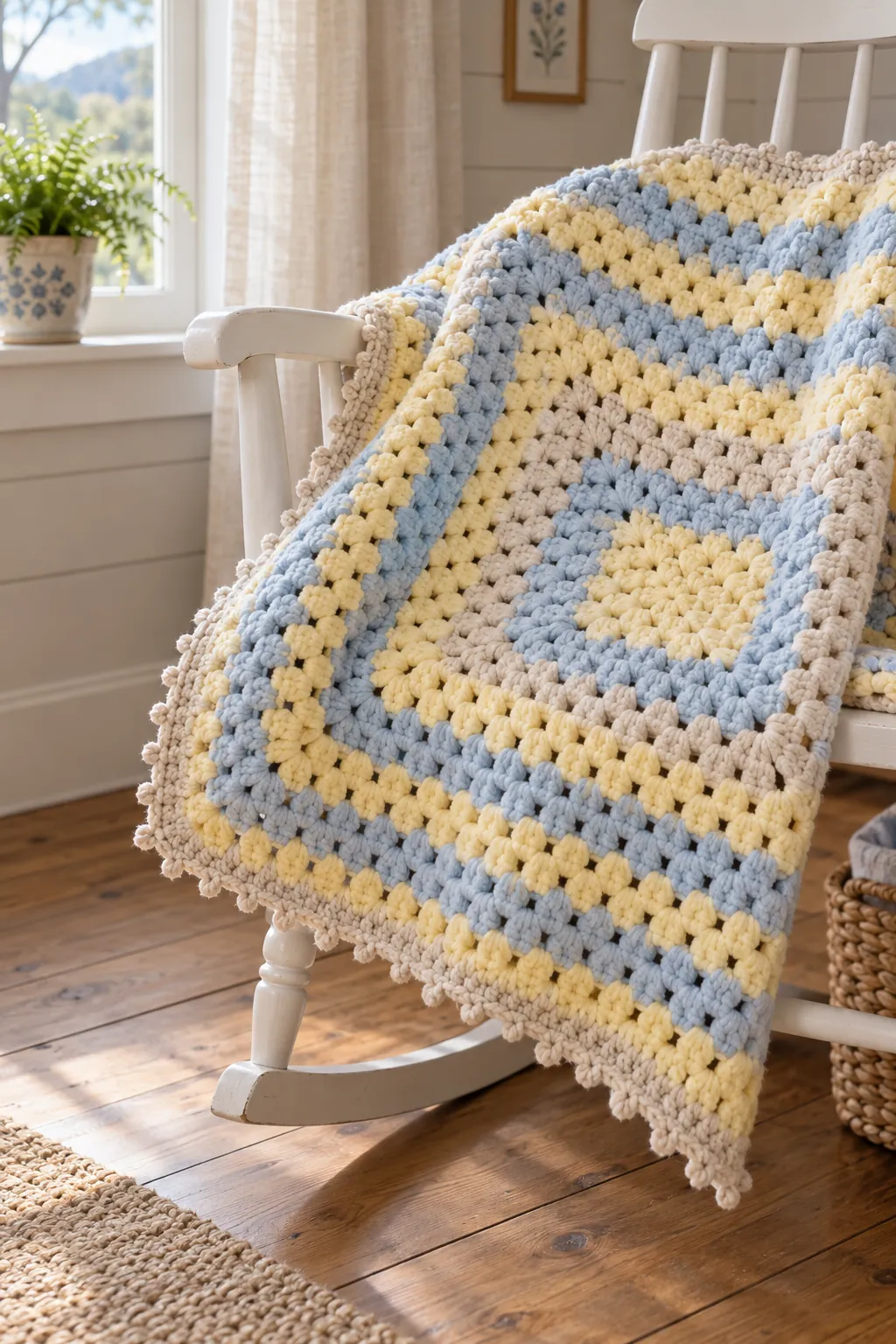
Picture a stack of soft yarn on the kitchen table and a baby shower two weekends away. This big granny square baby blanket is built for that kind of deadline. It starts as a small ring of double crochet and grows outward, one round and one color at a time, until it is a full square with a little picot edge. Super bulky chenille does most of the work: every round adds about 1⅝ in (4 cm) to the width, so you can watch the blanket double in size over a single evening.
There’s only one piece, so there’s nothing to seam at the end. Along each side you work pairs of double crochet tucked between the pairs of the round below, and the corners grow in a set rhythm. The colors rotate butter, powder blue and oatmeal, and the card below gives two square sizes, about 30 × 30 in and 35 × 35 in.
Is this big granny square baby blanket a good first round project?
If you can make a chain, a single crochet and a double crochet, you have every stitch this blanket uses. The pattern is rated Easy rather than Beginner for two reasons: you work in joined rounds instead of rows, and each side follows a small counting rule. If the brackets and asterisks in the card look like code, the guide to reading a crochet pattern walks through them.
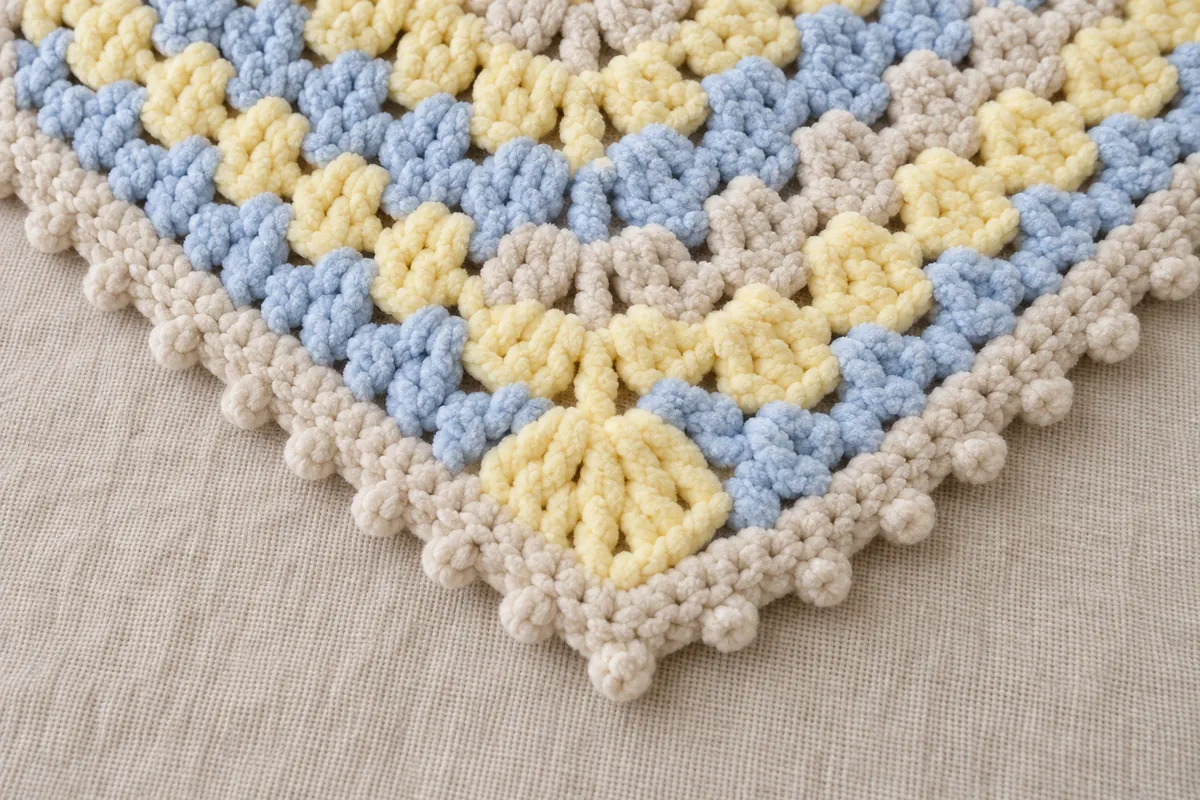
Three things may be new. The magic ring is an adjustable loop you crochet into for Round 1, then pull closed like a drawstring, so the center has no hole. A “group” here means 2 double crochet worked into the gap between two stitches of the round below, not into their tops. The picot on the last round is a sc followed by 3 chains and a slip stitch back into the same stitch, which makes a tiny bump. Each one is spelled out in the card, so the printed page stands on its own.
Counting is gentle, too. Every side of a round holds exactly a quarter of the stitches, so after Round 8 (88 sts) each side between corner spaces holds 22 double crochet. If a side comes out different, the fix is always nearby.
Picking a super bulky chenille for the Buttercup rounds
Look for the number 6 (Super Bulky) on the label. The card was planned around a 100% polyester chenille made for babies, such as Bernat Baby Blanket: 300 g balls of 220 yd (201 m), machine wash and dry, with an 8 mm hook suggested on the band. Chenille suits this design because its plush pile fills the small gaps between the groups, so the fabric looks solid even though no stitch is worked into another stitch’s top.
Skip wool roving and loosely spun bulky yarns for this one. A baby blanket gets washed often, and roving tends to pill and felt where a polyester chenille keeps its shape.
Dye lots matter more than usual in the larger size, where every color takes 2 balls. Check that the lot numbers match on both balls of each color before you leave the store. If you swap brands, compare yards per ball instead of ball weight: chenilles vary a lot in length for the same grams.
The size table is an estimate until it is checked against your own hook and hands. Rounds 1 and 2 should make a square of about 4 in (10 cm). Crochet Round 10, lay it flat and compare it with the gauge line in the card before buying the rest of the yarn.
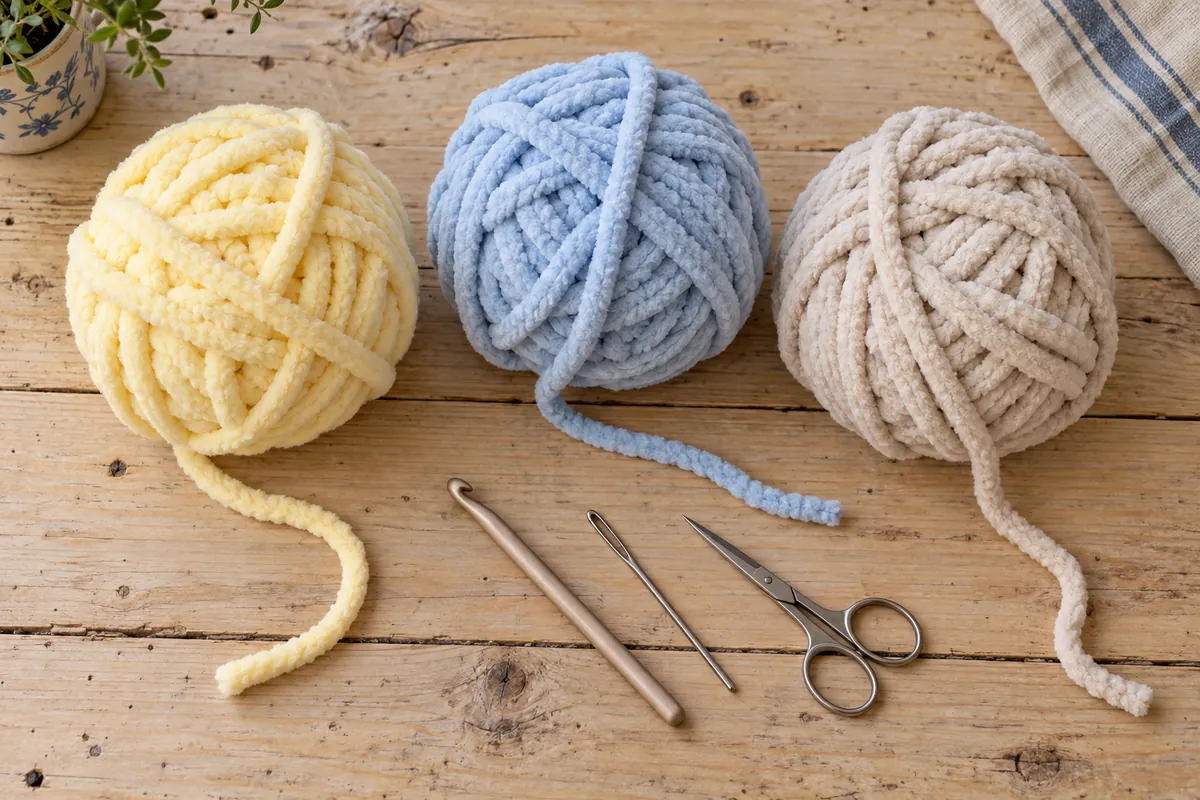
How butter, powder blue and oatmeal share the rounds
The three colors rotate in a fixed order, and because the corner rhythm also repeats every 3 rounds, each color always lands on the same kind of round. Butter takes the center and, from Round 10 on, every round with the large (4 dc, ch 2, 4 dc) corners, so the corners show four soft yellow diagonals. Powder blue takes the solid closing round. Oatmeal frames everything: it carries the sc round and the picot edge, which keeps the outline calm against the pastels.
If you’d like a different mood, keep one warm neutral for the border and pick two lighter shades for the center:
- Peach Orchard: peach, oatmeal and pale gray, with gray at the center.
- Lilac Morning: lilac, soft gray and cream, cream on the border.
- Sea Glass: seafoam, sand and cream, sand on the border.
- Fawn: caramel, light sand and cream, caramel on the large-corner rounds.
Before you commit, lay the three balls side by side and take a black-and-white photo with your phone. If two colors turn into the same gray, the rounds will blur together; swap one for a lighter or darker shade.
Choosing between the 30-inch and 35-inch squares
Because the blanket grows from the center, it can only ever be a square. The site’s baby sizes are rectangles, so the two sizes below match their width instead: the baby width and the stroller width. Both are written in the card, smallest first.
- Baby, about 30 × 30 in (77 × 77 cm): Rounds 1–16, a solid closing Round 17, then 2 border rounds (19 rounds in all). The sc border round has 228 sts (54 sc along each side plus 3 at each corner) and 112 picots. Yarn, estimate: butter about 193 yd (176 m), powder blue about 210 yd (192 m), oatmeal about 251 yd (229 m).
- Stroller, about 35 × 35 in (90 × 90 cm): Rounds 1–19, a solid closing Round 20, then 2 border rounds (22 rounds in all). The sc border round has 268 sts (64 sc along each side plus 3 at each corner) and 132 picots. Yarn, estimate: butter about 266 yd (243 m), powder blue about 286 yd (261 m), oatmeal about 332 yd (303 m).
That works out to 4 balls for the baby size (1 butter, 1 blue, 2 oatmeal) and 6 for the stroller size (2 of each). If you’d rather work classic three-stitch clusters in a bed size, the Green Mountain throw built from many small squares uses that construction, and the First Frost blanket, worked in rows in super bulky yarn is a gift-sized option with no corners to track.
Keeping the Buttercup corners square, round after round
- Find the gap before you find the stitch. In chenille, the tops of the stitches disappear into the pile. Stretch the fabric slightly between your fingers and you’ll see the small gap between two double crochets: that’s where each group goes.
- Split the 4-dc corner halves. On Rounds 7, 11 and 14, and on Round 17 of the Stroller size, the corner you’re working past has 4 dc on each side of its space. The side rule treats them as 2 + 2, so one group lands in the middle of those 4 dc. Skipping 2, then working into the gap, gives exactly that.
- Check the quarter count. Divide the round total in the card by 4: that’s how many dc sit along each side between two corner spaces. Count one side after every round while the square is small.
- Lay it flat after every round. A square that cups needs looser stitches; one that ripples at the corners usually has an extra group on that side. Fix it now, while the round is short.
- Secure the magic ring for real. Chenille is slippery. Weave the ring tail through the first round in one direction, then back in the opposite direction, before you trim it.
- Treat stray loops gently. If a little loop of chenille pokes out of the fabric, ease it back in with the yarn needle rather than cutting it.
US crochet terms
The pattern
Materials
- Yarn: super bulky (#6) 100% polyester chenille baby yarn, machine washable, such as Bernat Baby Blanket (300 g / 220 yd / 201 m per ball). Yardage (estimate):
- Butter (soft yellow): about 193 [266] yd (176 [243] m), 1 [2] skeins
- Powder Blue: about 210 [286] yd (192 [261] m), 1 [2] skeins
- Oatmeal (warm cream): about 251 [332] yd (229 [303] m), 2 [2] skeins
- Hook: 8.0 mm / L-11
- Yarn needle, scissors
Gauge
Rounds 1–2 = 4 × 4 in (10 × 10 cm) in pattern. Each double crochet round from Round 3 on adds about 1⅝ in (4 cm) to the width of the square. Estimate: not yet measured on a swatch in this yarn.
Finished size
About 30 x 30 [35 x 35] in (77 x 77 [90 x 90] cm), picot edge included, after blocking. Sizes: Baby [Stroller].
Abbreviations
- beg beginning
- ch chain
- ch-2 sp chain-2 space
- dc double crochet
- rep repeat
- sc single crochet
- sk skip
- sl st slip stitch
- sp(s) space(s)
- st(s) stitch(es)
Notes
- Two sizes: Baby [Stroller]. A single number applies to both sizes. Rounds 1–16 are the same in both sizes; Rounds 17–19 of the body are for the Stroller size only.
- The blanket is one square worked in joined rounds from the center out, right side facing. Never turn the work. No stitch multiple: it starts from a magic ring, not a foundation chain. To change the size, add or remove full 3-round cycles (Rounds 8–10 and their repeats).
- There is no turning chain, since the work is never turned. In dc rounds, the ch 3 at the start of each round counts as the first dc; in sc rounds, the ch 1 at the start of each round does not count. Close each round with a sl st in the top of the beg ch-3 (dc rounds) or in the first sc (sc rounds). The joining sl st is never counted as a stitch.
- One color per round, in the order Butter, Powder Blue, Oatmeal. Fasten off at the end of each round, leaving a 6 in (15 cm) tail, and join the next color with a sl st in any corner ch-2 sp. The two border rounds are both Oatmeal: do not fasten off between them.
- Tails: lay the new color’s starting tail along the top of the previous round and work at least 8 sts over it, then trim it. Weave in every other tail with the yarn needle on the wrong side. This blanket goes in the washing machine, so do not skip this step.
- Magic ring: wrap the yarn twice around two fingers, insert the hook under the strands, pull up a loop and ch 1 to secure it (this ch 1 is not a st). Work Round 1 into the ring, then pull the tail until the center closes before joining.
- Corner: (2 dc, ch 2, 2 dc) in the corner ch-2 sp. At the start of a round: ch 3, (dc, ch 2, 2 dc) in the same sp.
- Medium corner: (3 dc, ch 2, 3 dc) in the corner ch-2 sp. At the start of a round: ch 3, (2 dc, ch 2, 3 dc) in the same sp.
- Large corner: (4 dc, ch 2, 4 dc) in the corner ch-2 sp. At the start of a round: ch 3, (3 dc, ch 2, 4 dc) in the same sp.
- Group: 2 dc worked in the space between 2 dc of the previous round, below their tops.
- Side rule: [sk next 2 dc, group in sp before next dc] the stated number of times, then sk the last 2 dc before the next corner ch-2 sp. Each group sits between two groups of the round below; a 4-dc corner half is treated as 2 + 2.
- Picot: sc in the st, ch 3, sl st in the same st the sc was worked into. The ch-3 loop is not a st.
- Check: each side between two corner ch-2 sps holds one quarter of the round total. Lay the square flat after each round; it should neither cup nor ripple.
- Baby safety: never leave a loose blanket in a crib or sleep space with a baby under 12 months; use it for supervised awake time or a stroller. Add no buttons, beads or sewn-on pieces.
Instructions
Body
- Round 1 (Butter): Make a magic ring. Ch 3 (counts as dc), 2 dc in ring, ch 2, [3 dc in ring, ch 2] 3 times. Pull the tail to close the ring. Join with sl st in top of beg ch-3. Fasten off. (12 [12] sts, 4 [4] ch-2 sps)
- Round 2 (Powder Blue): Join with sl st in any ch-2 sp. Ch 1 (does not count), (sc, ch 2, sc) in same sp, sc in each of next 3 dc, *(sc, ch 2, sc) in next ch-2 sp, sc in each of next 3 dc; rep from * 2 more times. Join with sl st in first sc. Fasten off. (20 [20] sts, 4 [4] ch-2 sps)
- Round 3 (Oatmeal): Join with sl st in any ch-2 sp. Ch 3, (dc, ch 2, 2 dc) in same sp, [sk next sc, 2 dc in next sc] twice, sk next sc, *corner in next ch-2 sp, [sk next sc, 2 dc in next sc] twice, sk next sc; rep from * 2 more times. Join with sl st in top of beg ch-3. Fasten off. (32 [32] sts, 4 [4] ch-2 sps)
- Round 4 (Butter): Join with sl st in any corner ch-2 sp. Starting corner in same sp, side rule with 3 groups, *corner in next ch-2 sp, side rule with 3 groups; rep from * 2 more times. Join and fasten off. (40 [40] sts, 4 [4] ch-2 sps)
- Round 5 (Powder Blue): Join with sl st in any corner ch-2 sp. Starting medium corner in same sp, side rule with 4 groups, *medium corner in next ch-2 sp, side rule with 4 groups; rep from * 2 more times. Join and fasten off. (56 [56] sts, 4 [4] ch-2 sps)
- Round 6 (Oatmeal): Join with sl st in any corner ch-2 sp. Starting large corner in same sp, sk next 3 dc, group in sp before next dc, [sk next 2 dc, group in sp before next dc] 4 times, sk next 3 dc, *large corner in next ch-2 sp, sk next 3 dc, group in sp before next dc, [sk next 2 dc, group in sp before next dc] 4 times, sk next 3 dc; rep from * 2 more times. Join and fasten off. (72 [72] sts, 4 [4] ch-2 sps)
- Round 7 (Butter): Join with sl st in any corner ch-2 sp. Starting corner in same sp, side rule with 8 groups, *corner in next ch-2 sp, side rule with 8 groups; rep from * 2 more times. Join and fasten off. (80 [80] sts, 4 [4] ch-2 sps)
- Round 8 (Powder Blue): Work as Round 7, with 9 groups on each side. (88 [88] sts, 4 [4] ch-2 sps)
- Round 9 (Oatmeal): Work as Round 7, with 10 groups on each side. (96 [96] sts, 4 [4] ch-2 sps)
- Round 10 (Butter): Join with sl st in any corner ch-2 sp. Starting large corner in same sp, side rule with 11 groups, *large corner in next ch-2 sp, side rule with 11 groups; rep from * 2 more times. Join and fasten off. (120 [120] sts, 4 [4] ch-2 sps)
- Round 11 (Powder Blue): Work as Round 7, with 14 groups on each side. (128 [128] sts, 4 [4] ch-2 sps)
- Round 12 (Oatmeal): Work as Round 7, with 15 groups on each side. (136 [136] sts, 4 [4] ch-2 sps)
- Round 13 (Butter): Work as Round 10, with 16 groups on each side. (160 [160] sts, 4 [4] ch-2 sps)
- Round 14 (Powder Blue): Work as Round 7, with 19 groups on each side. (168 [168] sts, 4 [4] ch-2 sps)
- Round 15 (Oatmeal): Work as Round 7, with 20 groups on each side. (176 [176] sts, 4 [4] ch-2 sps)
- Round 16 (Butter): Work as Round 10, with 21 groups on each side. (200 [200] sts, 4 [4] ch-2 sps)
- Baby size: go to the closing round (Round 17).
- Round 17, Stroller size only (Powder Blue): Work as Round 7, with 24 groups on each side. (208 sts, 4 ch-2 sps)
- Round 18, Stroller size only (Oatmeal): Work as Round 7, with 25 groups on each side. (216 sts, 4 ch-2 sps)
- Round 19, Stroller size only (Butter): Work as Round 10, with 26 groups on each side. (240 sts, 4 ch-2 sps)
- Round 17 [20], closing round (Powder Blue): Join with sl st in any corner ch-2 sp. Ch 3, (dc, ch 2, 2 dc) in same sp, dc in each dc across to next corner ch-2 sp, *corner in next ch-2 sp, dc in each dc across to next corner ch-2 sp; rep from * 2 more times. Join with sl st in top of beg ch-3. Fasten off. (216 [256] sts, 4 [4] ch-2 sps)
Border
- Round 18 [21], sc round (Oatmeal): Join with sl st in any corner ch-2 sp. Ch 1 (does not count), 3 sc in same sp, sc in each dc across to next corner ch-2 sp, *3 sc in next ch-2 sp, sc in each dc across to next corner ch-2 sp; rep from * 2 more times. Join with sl st in first sc. Do not fasten off. (228 [268] sts): 3 sc at each corner and 54 [64] sc along each side.
- Round 19 [22], picot round (Oatmeal): Ch 1 (does not count), sc in same sc as join, *picot in next sc (center sc of the corner), sc in next sc, [picot in next sc, sc in next sc] 27 [32] times**, sc in next sc; rep from * 3 more times, ending the last rep at **. Join with sl st in first sc. Fasten off. (228 [268] sts), including 112 [132] picots.
- Finishing: Weave in the remaining tails. Lay the blanket flat, pat it into a square and check that all four sides and both diagonals match.
Washing a chenille square in butter, blue and oatmeal
Polyester chenille baby yarn is labeled machine wash and dry, which is a big part of its appeal for gifts. Wash the blanket cold on a gentle cycle and tumble dry on low; a large mesh laundry bag keeps the picots from catching on other clothes. Take it out of the dryer while it’s still slightly warm and lay it flat, pulling the corners square with your hands.
Skip the iron and any hot steam pressed directly onto the pile, since heat can flatten chenille for good. Don’t be surprised by a little lint after the first wash or two. Store the blanket folded loosely in a cotton bag rather than plastic, so the oatmeal border stays fresh between uses.
Buttercup questions about corners, sizes and picots
Why does this big granny square baby blanket switch to large corners on some rounds?
The groups along the sides add only 2 dc per side each round, which isn’t quite enough to keep a square flat as it grows. The medium corner on Round 5 and the large corners on Rounds 6, 10, 13, 16 and 19 add the extra width at the points, where the square needs it most. Without them, the center would start to cup as the rounds pile up.
Can it be made as a rectangle to match the other baby sizes?
Not with this construction. Each round adds the same amount to every side, so the blanket always stays square. For a rectangle, choose a pattern worked in rows; to go bigger here, add one more full cycle of Rounds 8–10, which adds about 5 in (12 cm) to each side and needs noticeably more yarn in every color.
Where exactly is the “space before the next dc” in fluffy yarn?
It’s the small gap between two dc, just below their tops, where the posts of two stitches meet. In chenille, stretch the fabric gently sideways and the gap opens. Insert the hook straight down through it, from the right side to the back, and work both dc of the group there.
Can the picot edge be swapped for something plainer?
Yes. You can stop after the sc round for a clean, flat edge, or work a reverse single crochet (crab stitch) in place of the picots for a corded look. Both sit on the same 228 [268] stitches of the sc round, so nothing before the border changes.
Are the picots safe on a baby blanket?
Each picot is a short ch-3 loop closed with a slip stitch into the stitch below, so nothing dangles. Keep the loops snug, not long, and check them along with the woven tails after every wash. As with any baby blanket, use it for awake time under supervision, never in a sleep space with a baby under 12 months.
Quick recap
- Make a magic ring and work Round 1 in butter, then a sc round in powder blue.
- Work Rounds 3–10, changing color every round and using the corner named for each round.
- Repeat the 3-round cycle of Rounds 8–10 through Round 16 [19].
- Work the solid powder blue closing round, then the oatmeal sc round.
- Finish with the oatmeal picot round, weave in the tails and lay the square flat.
A big granny square baby blanket like this one rewards a quiet evening and a full mug: by the time the oatmeal picots go around, you have a soft square ready to wrap. If a round won’t lie flat or the counts drift, send a note through the Contact page with the round number and your stitch count per side.