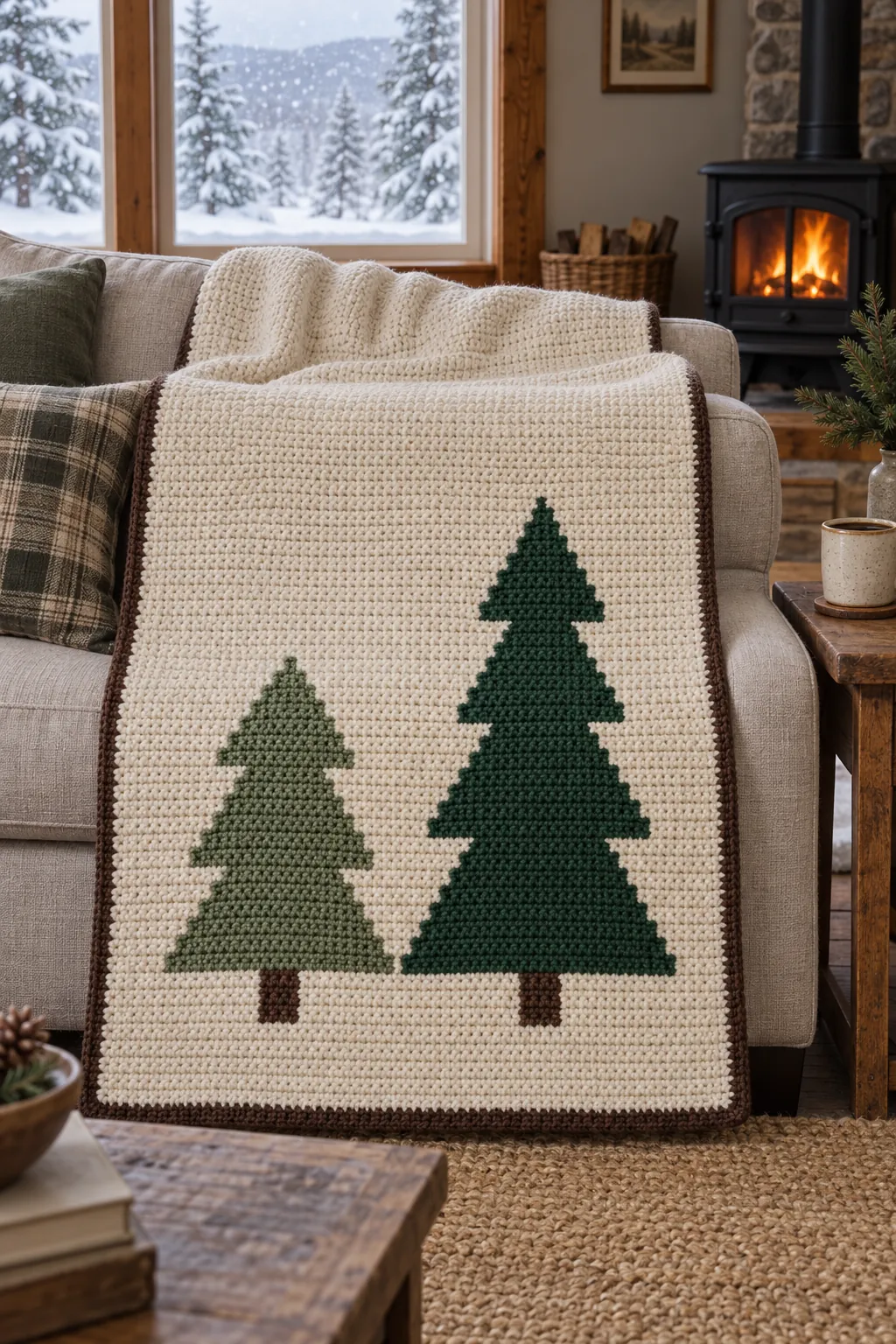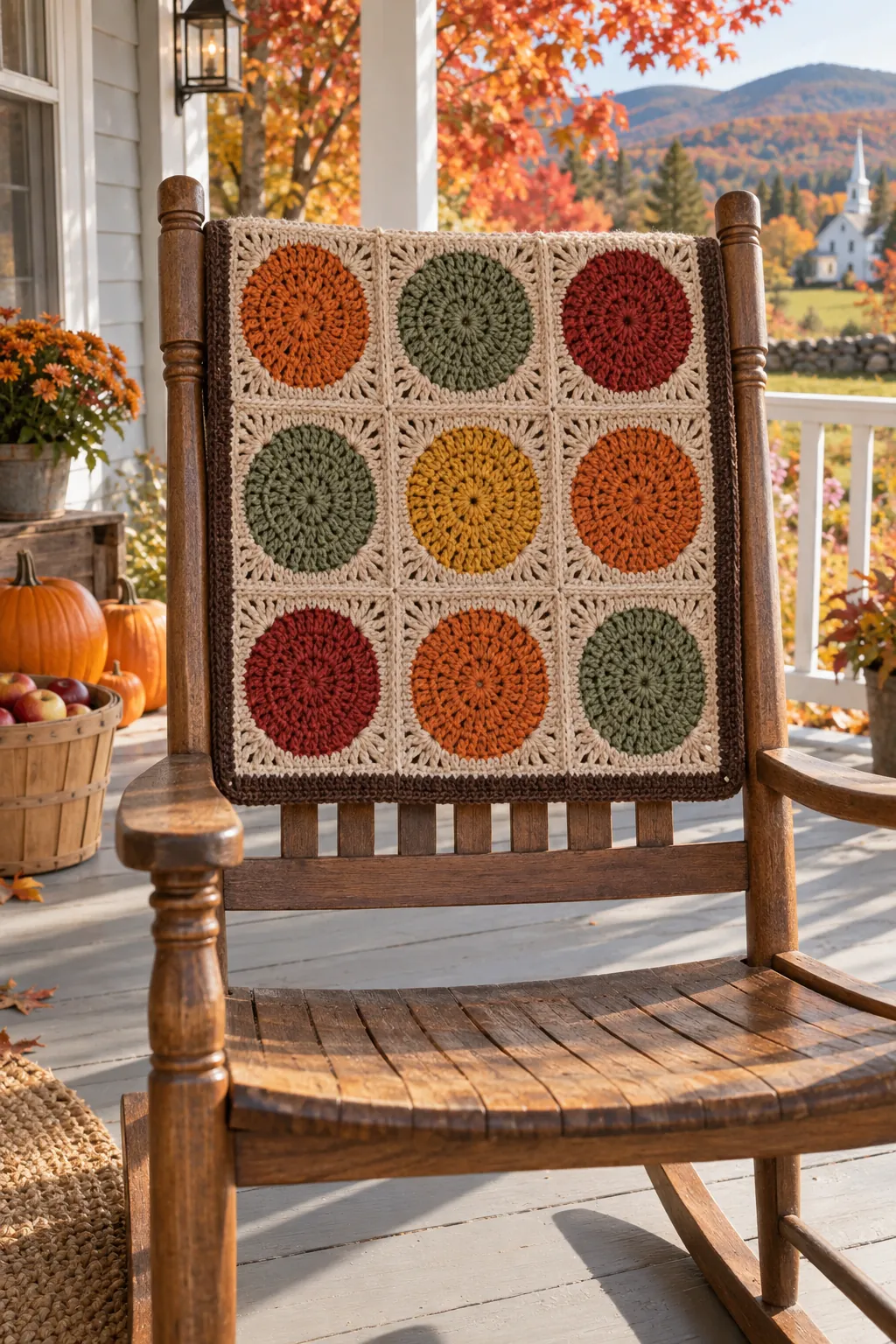
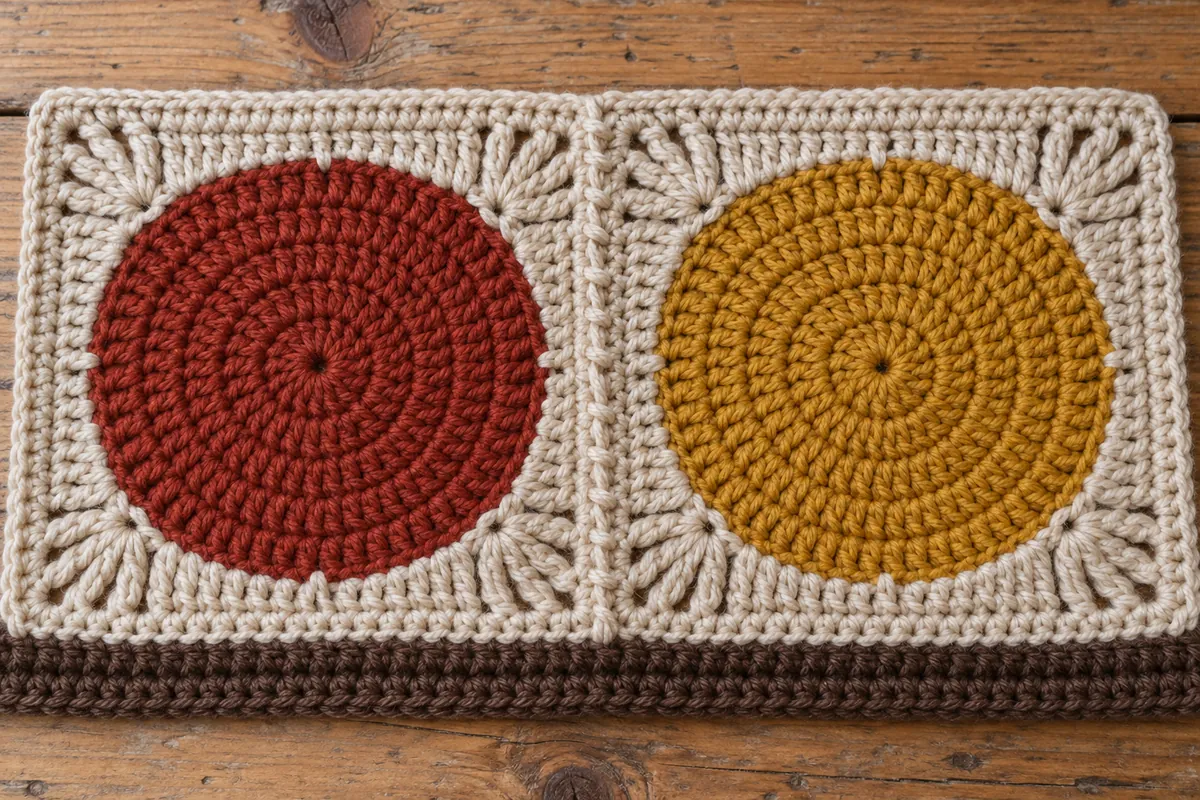
Every October there’s one night when the moon rises huge and orange over the stubble fields, so low it looks close enough to touch. The Harvest Moon Afghan puts four of those moons on repeat: pumpkin, honey, brick and sage circles, each one framed in soft oatmeal. It’s a circle in a square crochet blanket, so every motif starts as a flat circle of double crochet and finishes as a square that lines up with its neighbors.
The colors run in diagonal lines across the blanket, which keeps the layout calm instead of random, and a walnut border closes the whole thing like a picture frame. You’ll work it in worsted weight with a 5.0 mm hook. The card gives two sizes, a throw for the couch and a twin for the bed, and every motif follows the same nine rounds.
Is a circle in a square crochet blanket the right step after granny squares?
It’s a good next step if you’ve made a few granny squares and you’re comfortable counting stitches in the round. The rating is Intermediate: each motif changes color halfway through, and Round 6 turns a circle into a square with stitches of four different heights.
The stitches themselves are familiar. The circle is all double crochet, with a chain at the start of each round. The square-up round adds single crochet, half double crochet and the treble crochet, written tr. A treble is a taller double crochet: wrap the yarn twice before inserting the hook, then work off the loops two at a time, three times. Tall trebles go at the corners, where the square sits farthest from the circle, and short single crochets go at the middle of each side, where the circle almost touches the edge. If the brackets and abbreviations look unfamiliar, the Beginner Guide shows how to read a crochet pattern.
Two small techniques may be new. The adjustable ring is a loop of yarn you work the first 12 stitches into, then pull closed so the center has no hole; a ch-4 ring works too. And the beginning chains never count as stitches, so the first real stitch of each round goes into the same stitch as the join, which keeps the joins small.
For a gentler warm-up, try an easier afghan of worsted squares made from leftovers.
Smooth worsted for 42 or 88 motifs, and one dye lot of oatmeal
Look for the number 4 on the label. Choose a smooth, plied acrylic or an acrylic and superwash wool blend, warm enough for winter and fine in the washer. Skip fuzzy yarns: the graduated stitches of Round 6 only read as a clean circle when every stitch is crisp.
Oatmeal is the yarn to plan carefully. It frames every motif and does the seaming, so it makes up about 60% of the total. Buy all of it at once, in a single dye lot: two lots of a pale neutral can look identical in the skein and still show as a warmer patch in the blanket. The circle colors are more forgiving, since each circle is its own small island.
Mixing brands is fine for the circles if the strands look equally thick. When you substitute, go by yardage, not by skein count. One circle takes about 23 yd, so a 200 yd skein covers about 8 circles.
Make one full motif before you buy the whole lot. After Round 5, the circle should measure about 5 1/4 in (13.3 cm) across, and the finished motif about 8 1/4 in (21 cm) per side. Bigger than 8 1/2 in? Switch to a 4.5 mm (US 7) hook. Smaller than 8 in? Try 5.5 mm (I-9). A quarter inch per motif sounds small, but across the 11 motifs of the twin it adds almost 3 in.
Four moons on an oatmeal ground: pumpkin, honey, brick and sage
Oatmeal is the background, the constant that makes every circle read as a circle. Walnut, the darkest shade, only appears in the border, so the edge looks finished. The four circle colors are close in depth on purpose: pumpkin and brick are the warm anchors, honey brightens, and sage cools things down so the afghan never turns into one big orange blur.
The layout follows one rule. In the top row, the circles go pumpkin, honey, brick, sage, then start again. Each row below starts one color later, so every color steps down and to the left on a diagonal, and no two circles of the same color share a side. On the throw you’ll make 10 pumpkin, 11 honey, 11 brick and 10 sage circles. On the twin, 22 of each.
For a different palette, keep a pale background, four circle colors of similar depth and a dark border. A few combinations that hold that balance:
- Harvest Moon: oatmeal ground, pumpkin, honey, brick and sage circles, walnut border, as written.
- Apple Orchard: cream ground, crimson, gold, moss and plum circles, charcoal border.
- Maple Sugar: ivory ground, amber, rust, caramel and olive circles, chocolate border.
Before you commit, crochet Rounds 1 and 2 in each circle color, set the discs on the oatmeal skein and step back a few feet. If two colors melt together, swap one.
If motif work in worsted is your thing, an afghan of octagons joined with small squares is another Intermediate project in the same weight.
Throw or twin: 42 or 88 motifs of 8 1/4 inches
There’s no foundation chain. The blanket grows in whole motifs of about 8 1/4 in (21 cm), and the three-round border adds about 1 in (2.5 cm) on every side. The card lists sizes as throw [twin].
- Throw: 6 motifs across and 7 down (42 motifs), about 51 1/2 × 59 3/4 in (131 × 152 cm). Border Round 1 has 780 sc. About 2,200 yd of oatmeal, 300 yd each of pumpkin, honey, brick and sage, and 300 yd of walnut.
- Twin: 8 across and 11 down (88 motifs), about 68 × 92 3/4 in (173 × 236 cm). Border Round 1 has 1,140 sc. About 4,650 yd of oatmeal, 600 yd of each circle color and 400 yd of walnut.
The twin hangs about 15 in over each side of a 38 in twin mattress and covers the 75 in length with room to tuck. It’s a heavy piece: around 8 lb (3.6 kg) in acrylic, against about 4 lb (1.8 kg) for the throw. Every yardage here is an estimate with a 15% margin built in.
To resize, add or remove whole rows or columns of motifs, keep the diagonal color order, and work 30 sc per motif edge in border Round 1.
Keeping 60 stitches round and 28 stitches square
Count the circle by the dozen. Every circle round adds exactly 12 stitches: 12, 24, 36, 48, 60. A circle off by even two stitches makes one side of Round 6 longer than the others.
Mark the corners before Round 6. Clip a marker into the 1st, 16th, 31st and 46th stitches of Round 5. Each marked stitch gets a (tr, ch 2, tr) corner, and the 14 stitches between markers get the same height sequence every time. If you reach a marker early or late, you know right away which side is off.
Work the trebles loosely. The corners need height to reach the square. Pull the first loop of each tr up to the height of its neighbors instead of snugging it down. Tight trebles are the main reason corners look rounded.
Crochet over the tails. Each motif leaves 4 ends, so that’s 168 motif ends on the throw and 352 on the twin, plus about 142 and 314 from seams. Lay the circle tails along the top of Round 5 and work the stitches of Round 6 over them, along with the oatmeal starting tail.
Block before you seam. Pin each motif to 8 1/4 in square on a foam mat, mist it and let it dry. Blocked motifs line up stitch for stitch.
Lay out the whole blanket first. Place every motif on the floor in diagonal order and take a photo with your phone. Sew one row at a time, checking the photo as you go.
US crochet terms
The pattern
Materials
- Worsted weight yarn (CYC #4 Medium), smooth acrylic or acrylic and superwash wool blend, about 200 yd (183 m) per 3.5 oz (100 g) skein. Estimated yardage:
- Oatmeal (motif frames and seams): 2,200 [4,650] yd (2,012 [4,252] m), 11 [24] skeins.
- Pumpkin: 300 [600] yd (274 [549] m), 2 [3] skeins.
- Honey: 300 [600] yd (274 [549] m), 2 [3] skeins.
- Brick: 300 [600] yd (274 [549] m), 2 [3] skeins.
- Sage: 300 [600] yd (274 [549] m), 2 [3] skeins.
- Walnut (border): 300 [400] yd (274 [366] m), 2 [2] skeins.
- Total: about 3,700 [7,450] yd (3,383 [6,812] m).
- 5.0 mm (H-8) crochet hook.
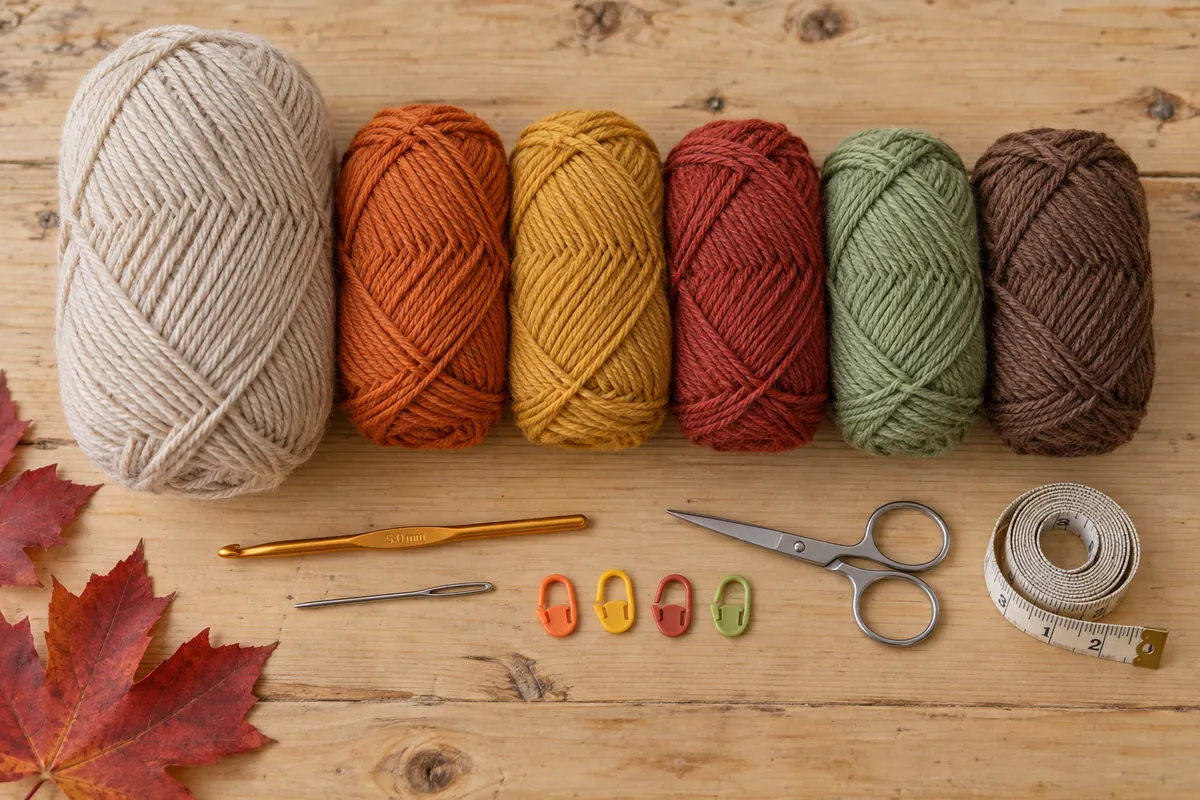
- Yarn needle, scissors and tape measure.
- 4 locking stitch markers.
- Rustproof pins and a foam mat or folded towel for blocking.
Gauge
- 14 dc and 8 rows = 4 in (10 cm) in rows of dc with the 5.0 mm (H-8) hook.
- Circle after Round 5: about 5 1/4 in (13.3 cm) across.
- Finished motif (Rounds 1–9): about 8 1/4 in (21 cm) square after blocking.
Finished size
- Throw: about 51 1/2 × 59 3/4 in (131 × 152 cm), 6 × 7 motifs.
- Twin: about 68 × 92 3/4 in (173 × 236 cm), 8 × 11 motifs.
- Measured flat after blocking, border included.
Abbreviations
- ch chain
- dc double crochet
- hdc half double crochet
- rep repeat
- RS right side
- sc single crochet
- sl st slip stitch
- sp(s) space(s)
- st(s) stitch(es)
- tr treble crochet
- yo yarn over
Notes
- Sizes are written as throw [twin]. A single number applies to both sizes.
- Motifs are worked in rounds with the RS facing. Do not turn.
- Beginning chains never count as a st: ch 1 before sc, ch 2 before dc, ch 3 before tr. Work the first st of each round as stated and join each round with sl st in the first st, not in the chain.
- Adjustable ring: wrap the yarn around 2 fingers, insert the hook under the loop, yo and pull up a loop, then work Round 1 into the ring and pull the tail to close it. Or ch 4 and join with sl st in first ch to form a ring.
- tr (treble crochet): yo twice, insert hook in st, yo and pull up a loop (4 loops on hook), [yo and draw through 2 loops] 3 times.
- Circle colors: make 10 [22] Pumpkin, 11 [22] Honey, 11 [22] Brick and 10 [22] Sage circles. Rounds 6–9 of every motif are Oatmeal.
- Each motif uses about 23 yd of its circle color and 43 yd of Oatmeal (estimates).
- Rounds 7–9 and border Rounds 2–3: when a round starts with sl sts, work the last side into those sts as usual.
- Work the sts of Round 6 over the circle tails and the Oatmeal starting tail to reduce weaving in.
- Stitch multiple: no foundation chain. The blanket grows in whole motifs of about 8 1/4 in (21 cm). To resize, add or remove whole rows or columns, keep the layout rule, and work 30 sc per motif edge in border Round 1.
Instructions
Motif (make 42 [88])
- Round 1: with circle color, make an adjustable ring. Ch 2, 12 dc in ring, join with sl st in first dc. Pull the tail to close the ring. (12 dc)
- Round 2: ch 2, 2 dc in same st as join and in each st around, join. (24 dc)
- Round 3: ch 2, 2 dc in same st as join, dc in next st, *2 dc in next st, dc in next st; rep from * around, join. (36 dc)
- Round 4: ch 2, dc in same st as join, 2 dc in next st, dc in next st, *dc in next st, 2 dc in next st, dc in next st; rep from * around, join. (48 dc)
- Round 5: ch 2, dc in same st as join and in next 2 sts, 2 dc in next st, *dc in next 3 sts, 2 dc in next st; rep from * around, join. Fasten off. (60 dc)
- Check: the circle measures about 5 1/4 in (13.3 cm) across.
- Corner markers: counting from any st of Round 5, place a marker in the 1st, 16th, 31st and 46th sts. (14 unmarked sts between markers)
- Round 6: join Oatmeal with sl st in any marked st. Ch 3, (tr, ch 2, tr) in same st, *tr in next st, 2 dc in next st, dc in next 2 sts, hdc in next st, sc in next 4 sts, hdc in next st, dc in next 2 sts, 2 dc in next st, tr in next st**, (tr, ch 2, tr) in next marked st; rep from * 2 more times, then from * to ** once, join with sl st in first tr. Remove markers. (18 sts on each side between corner ch-2 sps: 72 sts and 4 ch-2 sps)
- Round 7: sl st in next ch-2 sp, ch 2, (2 dc, ch 2, 2 dc) in same sp, *dc in each st across to next ch-2 sp, (2 dc, ch 2, 2 dc) in ch-2 sp; rep from * 2 more times, dc in each st across, join with sl st in first dc. (22 dc on each side: 88 dc and 4 ch-2 sps)
- Round 8: sl st in next dc and in next ch-2 sp, ch 2, (2 dc, ch 2, 2 dc) in same sp, *dc in each st across to next ch-2 sp, (2 dc, ch 2, 2 dc) in ch-2 sp; rep from * 2 more times, dc in each st across, join with sl st in first dc. (26 dc on each side: 104 dc and 4 ch-2 sps)
- Round 9: sl st in next dc and in next ch-2 sp, ch 1, (sc, ch 2, sc) in same sp, *sc in each st across to next ch-2 sp, (sc, ch 2, sc) in ch-2 sp; rep from * 2 more times, sc in each st across, join with sl st in first sc. Fasten off. (28 sc on each side: 112 sc and 4 ch-2 sps)
- Blocking: pin the motif to 8 1/4 in (21 cm) square, mist and let dry.
Joining
- Layout: arrange the motifs RS up in 6 [8] columns and 7 [11] rows. In Row 1, place the circles from left to right as Pumpkin, Honey, Brick, Sage, and rep across. Start each following row with the next color in that order (Row 2 with Honey, Row 3 with Brick, Row 4 with Sage, Row 5 with Pumpkin, and so on), then continue in the same order. Each color runs in diagonal lines, and no 2 circles of the same color share a side.
- Seams: hold 2 neighboring motifs RS together, edges matched. With Oatmeal and the yarn needle, whipstitch through both loops of each pair of matching sts: 1 stitch in each corner ch-2 sp and 1 in each of the 28 sc between them (30 stitches per edge). Fasten off.
- Sew the motifs of each row into a strip, then sew the strips together the same way, adding 1 stitch across each point where 4 corners meet. (71 [157] motif edges sewn)
Border
- Round 1 (RS): with RS facing, join Walnut with sl st in the ch-2 sp at any blanket corner. Ch 1, (sc, ch 2, sc) in same sp, *sc in each sc along the motif edges and 1 sc in each corner ch-2 sp on either side of every seam (2 sc per seam), across to next blanket corner ch-2 sp, (sc, ch 2, sc) in corner sp; rep from * 2 more times, work along the last edge the same way, join with sl st in first sc. (180 [240] sc across top and bottom edges and 210 [330] sc along each side edge, between corner ch-2 sps; 780 [1,140] sc and 4 ch-2 sps)
- Round 2: sl st in next ch-2 sp, ch 2, (2 dc, ch 2, 2 dc) in same sp, *dc in each sc across to next corner ch-2 sp, (2 dc, ch 2, 2 dc) in corner sp; rep from * 2 more times, dc in each sc across, join with sl st in first dc. (184 [244] dc across top and bottom edges and 214 [334] dc along each side edge; 796 [1,156] dc and 4 ch-2 sps)
- Round 3: sl st in next dc and in next ch-2 sp, ch 1, 3 sc in same sp, *sc in each dc across to next corner ch-2 sp, 3 sc in corner sp; rep from * 2 more times, sc in each dc across, join with sl st in first sc. Fasten off. (184 [244] sc across top and bottom edges and 214 [334] sc along each side edge, plus 3 sc at each corner; 808 [1,168] sc)
Finishing
- Weave in the remaining ends through sts of the same color.
- Lay the blanket flat, mist it lightly, pat the edges straight and let it dry.
Washing an oatmeal afghan with pumpkin and brick circles
Brick and pumpkin are the shades to check, since each circle touches oatmeal all the way around. Before you start, soak a short length of each in a white bowl of warm water for ten minutes. If the water tints, pick another skein, or wash the finished afghan with a color-catching sheet for the first few washes.
Machine wash cold on a gentle cycle with mild detergent, in a large front-loading machine for the twin. Tumble dry low or dry it flat on a clean sheet, and while it’s still damp, square up the edges with your hands so the motifs stay true. Don’t hang it over a line: the weight stretches the seams.
For storage, fold it along a seam between two rows of motifs and keep it in a breathable cotton bag. With a wool blend, tuck in a cedar block for the summer months.
Harvest Moon questions, from the first ring to the last corner
Why do the corners of my circle in a square crochet blanket motifs look rounded?
Usually the trebles at the corners are too short or worked too tightly, so they can’t reach the corner of the square. Pull each tr up to full height, and check that the 4 single crochets sit at the middle of each side. Blocking finishes the job: pin each corner out to a sharp point and let the motif dry.
Why is my circle wavy or cupped before I start the square?
A wavy circle has too many stitches for its size, and a cupped one has too few, or your tension tightened as the rounds grew. Check the counts first: 12, 24, 36, 48 and 60. If the numbers are right, relax your grip in Rounds 4 and 5, where the circle is widest, and keep the same hook for both colors.
Do the circles have to follow the diagonal order?
No, but plan before you sew. The diagonal rule keeps the four colors evenly spread and stops two circles of the same color from sharing a side. To place them freely, lay everything out first and check that each color shows up in every row.
Can I add a row or column of motifs without breaking the diagonals?
Yes. A new bottom row starts with the color after the one that opened the row above (Row 8 of the throw starts with Sage), and a new column continues each row’s order. A row of 6 motifs takes about 320 yd more oatmeal, a column of 7 about 370 yd, so buy it with the rest, in one dye lot. Border Round 1 gains 30 sc per added motif.
Why are the seams lumpy where four corners meet?
Four ch-2 corner spaces meet there. Work one whipstitch through each corner ch-2 space, then add one stitch across the junction to draw the four corners together. Keep the whipstitches snug but not tight, or the seam will pucker.
Quick recap
- Make 42 [88] circles of 5 rounds of dc in pumpkin, honey, brick and sage.
- Frame each circle in oatmeal: one square-up round with trebles at the corners, two dc rounds and one sc round.
- Block every motif to about 8 1/4 in square.
- Lay the motifs out in diagonal color order, whipstitch them into rows, then join the rows.
- Work three walnut border rounds (sc, dc, sc), weave in the ends and block.
When the border is done, spread the Harvest Moon Afghan over the couch or the bed and follow the diagonals of color across it. If a count in this circle in a square crochet blanket doesn’t match what’s on your hook, or a corner won’t sit square, send a note through the Contact page.