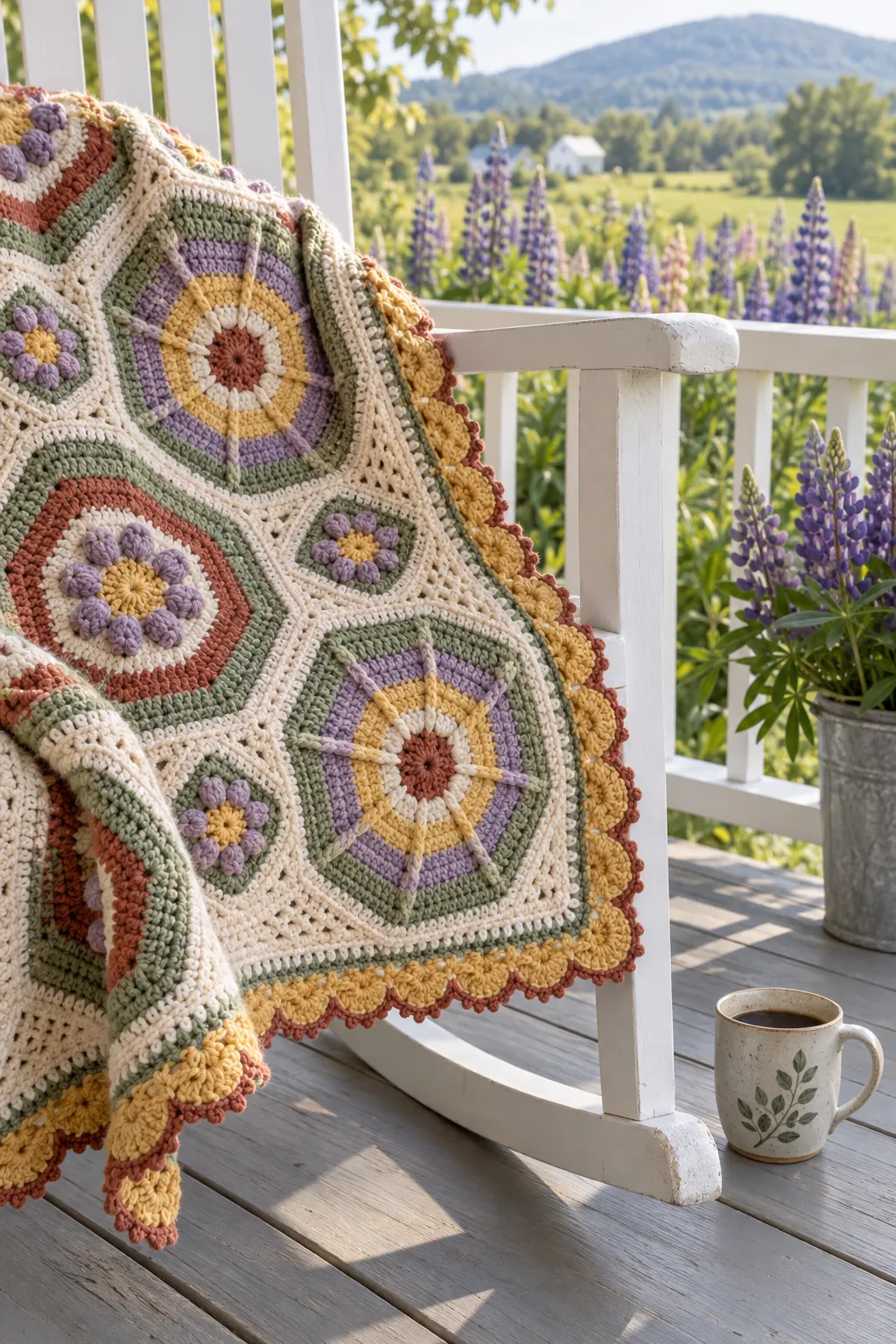
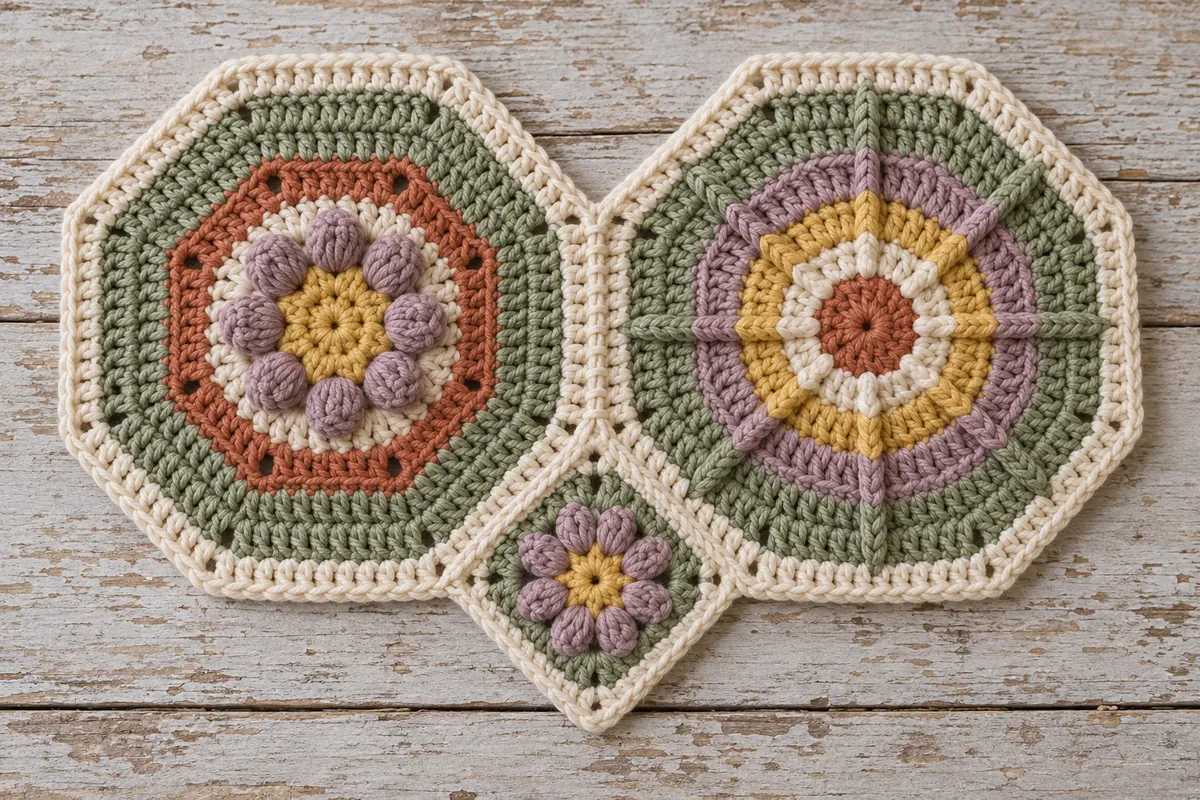
Every June the lupines come up along Vermont’s back roads, purple spikes standing in the tall grass, and it’s hard not to slow the car down to look. This octagon crochet blanket keeps a bit of that field on the couch. Two kinds of octagons take turns across it. One has a ring of lilac popcorns around a honey center, the other has raised spokes that run out like rays. Little flower squares sit in the gaps between them, and half-squares fill the edges so the afghan ends up a tidy rectangle with cut corners.
It’s worked in a worsted cotton blend, so it’s light enough for a cool summer night on the porch. Each piece is small enough to carry anywhere, and one octagon fits in an evening. The sewing comes at the end, and that’s the part where this pattern asks for a little patience.
Is this octagon crochet blanket a good next step after squares?
It’s rated Intermediate for good reason. No single stitch is hard, but there are 46 pieces in the throw, a color change on almost every round, and corners where three pieces meet. If you’ve finished a granny square blanket, you’re ready.
Here’s what you’ll use:
- Chain, single crochet and double crochet, the base of every piece.
- Treble crochet (tr): a double crochet with one extra yarn over at the start, so it stands one chain taller.
- Popcorn: five double crochets in one stitch, closed at the top so they bulge forward like a bead.
- Front post double and treble crochet (FPdc, FPtr): instead of working into the top of a stitch, you work around its post from the front. That’s what lifts the spokes.
- Cluster: three double crochets worked into one stitch and finished together. Eight of them make the petals of the flower square.
- Magic ring: an adjustable loop you crochet into, then pull shut so the center has no hole.
- Whipstitch: a simple overcast seam made with a yarn needle.
If the abbreviations look like alphabet soup, the guide to reading a pattern walks you through them. And if front post stitches are new to you, try them first on the Woodstove Waffle throw, which is all raised texture.
A worsted cotton blend that keeps the popcorns plump
Look for a 4 (worsted) on the yarn label, ideally a cotton and acrylic blend close to half and half. The cotton gives crisp stitch definition, so popcorns and spokes stand up instead of melting into the fabric. The acrylic keeps the afghan lighter and softer than pure cotton, which matters a lot once you get to the twin or queen.
Buy all your cream at once, from one dye lot. It surrounds every motif, so a slightly different lot shows.
Check the terracotta before you start. Warm reds and rusts sometimes bleed, and every bit of it sits right next to cream. Wet a short snip, press it on a white paper towel, and let it dry. If you see color, pick a different terracotta.
You can substitute any worsted yarn that gives you 14 dc over 4 in (10 cm) with an H-8 (5 mm) hook. Just don’t mix brands within one color. Two “worsted” cottons can differ in thickness, and then a side of 15 stitches on one piece won’t measure the same as 15 on the next.
Make one Popcorn Octagon before anything else and measure it from flat side to flat side. You’re aiming for about 10 3/4 in (27 cm). If yours is bigger, try a 4.5 mm hook. If it’s smaller, go up to an I-9 (5.5 mm).
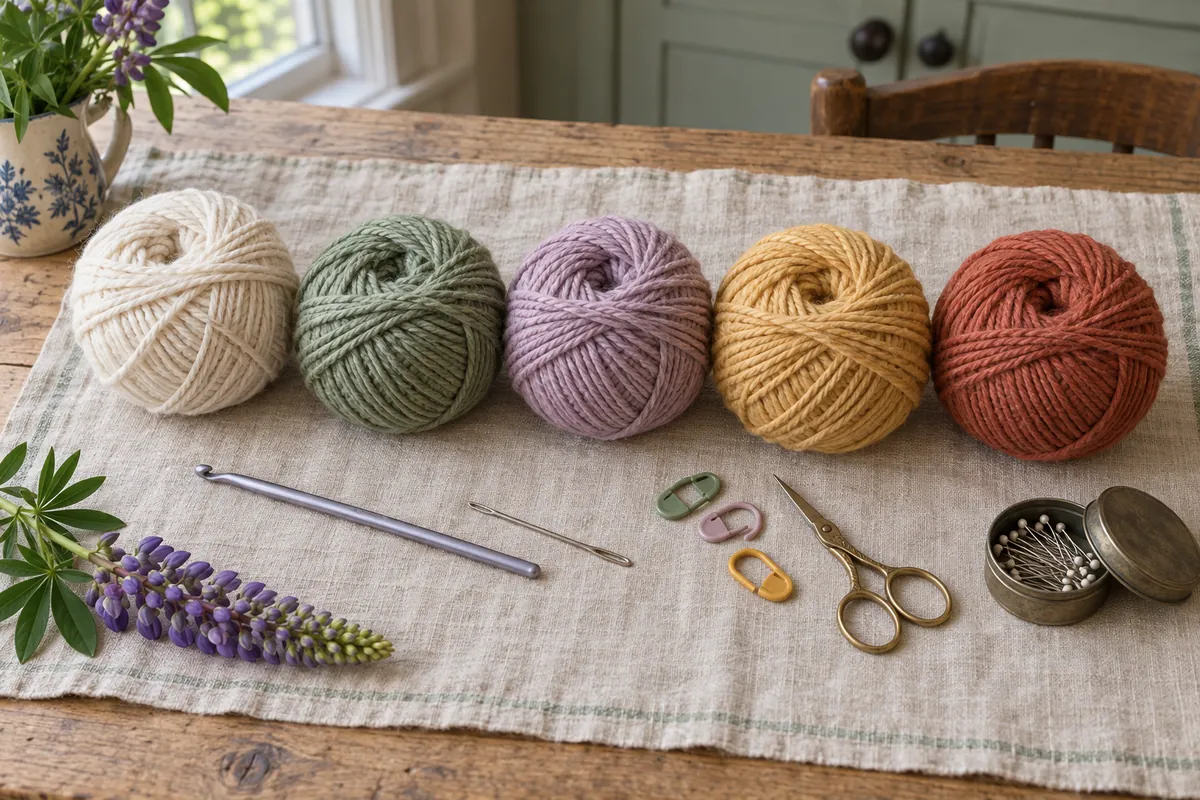
Cream, sage and lupine: what each color does in the octagons
- Cream is the ground. It works the last two rounds of every piece, the seams and the second border round, so the motifs float on it and the afghan stays bright for summer.
- Sage turns each octagon from a circle into eight sides over three rounds. It also edges the triangles and starts the border, like leaves around the flowers.
- Lupine, a dusty lilac, is the color the blanket is named for. It makes the popcorns, the petals of every flower square and the tips of the triangles.
- Honey warms the centers: the middle of each Popcorn Octagon and flower square, one ring of the Spoke Octagon, and the shells of the border.
- Terracotta is used sparingly: the center of the Spoke Octagon, one ring of the Popcorn Octagon, and the picot edge.
If you’d like a different mood, keep the same five roles and try one of these:
- Blueberry Hill: cream, soft green, denim blue, mustard and rust.
- Garden Party: oatmeal, fern green, pink, butter yellow and coral.
- Lake Morning: ivory, slate blue, periwinkle, pale gold and sand.
One firm rule: keep the ground color the same on every piece. When the outer rounds change from motif to motif, the seams turn busy and the octagon shapes get lost. Make one of each piece in your colors before you commit to 13 balls of yarn.
Throw, twin and queen: octagons, squares and triangles for each size
The pattern card is written for the throw. Every size uses the same four pieces and the same border. Only the counts change. Each octagon measures about 10 3/4 in (27 cm) across, and the border adds about 1 1/2 in (4 cm) on each side.
- Throw (written in the card), about 46 × 57 in (117 × 145 cm): 4 octagons across and 5 down (10 Popcorn, 10 Spoke), 12 Flower Squares, 14 Edge Triangles. Border Round 1 has 640 sc. About 2,320 yd (2,121 m): cream 1,090, sage 750, lupine 180, honey 160, terracotta 140.
- Twin, about 68 × 89 in (173 × 226 cm): 6 across and 8 down (24 Popcorn, 24 Spoke), 35 Flower Squares, 24 Edge Triangles. Border Round 1 has 1,000 sc. About 5,370 yd (4,910 m): cream 2,590, sage 1,750, lupine 440, honey 310, terracotta 280.
- Queen, about 89 × 100 in (226 × 254 cm): 8 across and 9 down (36 Popcorn, 36 Spoke), 56 Flower Squares, 30 Edge Triangles. Border Round 1 has 1,216 sc. About 7,980 yd (7,297 m): cream 3,870, sage 2,610, lupine 670, honey 440, terracotta 390.
Yardage is an estimate. It includes seams, tails and about 10% extra. Want your own size? Pick how many octagons go across and down. You’ll need (across − 1) × (down − 1) Flower Squares and 2 × (across − 1) + 2 × (down − 1) Edge Triangles, and the border instructions work for any count.
Keeping 15 stitches on every side so 46 pieces fit together
Everything in this afghan depends on one number. The last round of every octagon, the last round of every square and the last row of every triangle end with 15 stitches between corners. Count each side before you fasten off. One stitch off shows the moment you start sewing.
The most common reason for a short side is the beginning chain. On the rounds that start with ch 5 or ch 6, that chain counts as the first stitch plus the corner space. So when you close the round, join into the 3rd ch of a ch-5 or the 4th ch of a ch-6: that’s the top of the stitch the chain stands in for. Join anywhere else and the first side ends up one stitch short or one stitch long.
Popcorns need to close from the front. When you take the hook out of the loop, put it back in through the first dc from front to back, and the popcorn bulges toward you.
For the spokes, skip the stitch hiding behind each front post stitch. If a spoke starts to drift sideways, you’ve wrapped the wrong post.
There are 12 tails on every octagon. Crochet over the old tails for the first few stitches of each new round and you’ll have far less weaving at the end. Trim them after blocking, not before.
Block the pieces in batches before you sew. Cut an octagon of the right size out of a cereal box and pin each piece around it, then spritz with water and let it dry. Then lay everything out on the bed and snap a photo of the layout to sew from.
US crochet terms
The pattern
Materials
- Worsted weight (4) cotton-acrylic blend yarn, about 200 yd (183 m) per 100 g ball; about 2,320 yd (2,121 m) in total for the throw (estimate):
- Cream: 1,090 yd (997 m), 6 balls
- Sage: 750 yd (686 m), 4 balls
- Lupine (dusty lilac): 180 yd (165 m), 1 ball
- Honey: 160 yd (146 m), 1 ball
- Terracotta: 140 yd (128 m), 1 ball
- H-8 (5 mm) crochet hook
- Yarn needle
- Scissors
- Stitch markers (optional, to mark corners)
- Rust-proof pins and a foam mat for blocking
Gauge
- 14 dc and 8 rows = 4 in (10 cm) in rows of dc.
- Popcorn Octagon, Rounds 1–4 = about 4 1/4 in (11 cm) from flat side to flat side.
- Finished octagon = about 10 3/4 in (27 cm) from flat side to flat side. Flower Square = about 4 1/2 in (11.5 cm) per side.
Finished size
- About 46 × 57 in (117 × 145 cm) after blocking, measured across the straight edges. The four corners are cut on the diagonal.
Abbreviations
- ch chain
- sl st slip stitch
- sc single crochet
- dc double crochet
- tr treble crochet
- FPdc front post double crochet
- FPtr front post treble crochet
- yo yarn over
- st(s) stitch(es)
- sp(s) space(s)
- sk skip
- rep repeat
- RS right side
Notes
- Octagons and squares are worked in joined rounds with the RS facing; do not turn. Triangles are worked in rows from a magic ring.
- Beginning ch-3 counts as a dc, ch-5 counts as a dc and a ch-2 sp, and ch-6 counts as a tr and a ch-2 sp. Join each round with a sl st to the top of the beginning ch-3, the 3rd ch of the ch-5 or the 4th ch of the ch-6.
- When you work a FPdc or FPtr, skip the st behind it. Each post st counts as one st.
- Check your counts: Round 9 of each octagon, Round 5 of each square and Row 4 of each triangle have 15 sts on each side between corners.
- Leave a 6 in (15 cm) tail at each color change. Crochet over tails as you go, or weave them in.
- Throw layout: 5 rows of 4 octagons. Rows 1, 3 and 5: Popcorn, Spoke, Popcorn, Spoke. Rows 2 and 4: Spoke, Popcorn, Spoke, Popcorn. A Flower Square fills each of the 12 diamond-shaped gaps, and an Edge Triangle fills each of the 14 notches along the edges (3 on each short edge, 4 on each long edge).
- Twin, about 68 × 89 in (173 × 226 cm): 6 octagons across and 8 down (24 Popcorn, 24 Spoke), 35 Flower Squares, 24 Edge Triangles. Estimated yarn: Cream 2,590 yd, Sage 1,750 yd, Lupine 440 yd, Honey 310 yd, Terracotta 280 yd.
- Queen, about 89 × 100 in (226 × 254 cm): 8 octagons across and 9 down (36 Popcorn, 36 Spoke), 56 Flower Squares, 30 Edge Triangles. Estimated yarn: Cream 3,870 yd, Sage 2,610 yd, Lupine 670 yd, Honey 440 yd, Terracotta 390 yd.
- The border instructions work for every size.
Instructions
Special stitches
- Popcorn: 5 dc in same st, remove hook from loop, insert hook from front to back in top of first dc of the group, place loop back on hook and pull it through.
- Beginning popcorn: ch 3, 4 dc in same st, remove hook from loop, insert hook from front to back in top of ch-3, place loop back on hook and pull it through.
- Cluster: [yo, insert hook in st, yo, pull up a loop, yo, pull through 2 loops] 3 times in same st, yo, pull through all 4 loops on hook.
- Beginning cluster: ch 3, [yo, insert hook in st, yo, pull up a loop, yo, pull through 2 loops] 2 times in same st, yo, pull through all 3 loops on hook.
Popcorn Octagon (make 10)
- Round 1: With Honey, make a magic ring. Ch 3 (counts as dc), 15 dc in ring. Pull ring closed and join with sl st to top of ch-3. Fasten off. (16 dc)
- Round 2: Join Lupine with sl st in any dc. Beginning popcorn in same st, ch 2, dc in next dc, ch 2, *popcorn in next dc, ch 2, dc in next dc, ch 2*; rep from * 6 more times; join with sl st to top of beginning popcorn. Fasten off. (8 popcorns, 8 dc, 16 ch-2 sps)
- Round 3: Join Cream with sl st in the ch-2 sp just after any popcorn. Ch 3, dc in same sp, dc in next dc, 2 dc in next ch-2 sp, *sk popcorn, 2 dc in next ch-2 sp, dc in next dc, 2 dc in next ch-2 sp*; rep from * 6 more times; join. Fasten off. (40 dc)
- Round 4: Join Terracotta with sl st in the first dc after any popcorn. Ch 3, dc in next 4 dc, ch 2, *dc in next 5 dc, ch 2*; rep from * 6 more times; join. Fasten off. (40 dc, 8 corner ch-2 sps)
- Round 5: Join Sage with sl st in any corner ch-2 sp. Ch 5 (counts as dc and ch 2), dc in same sp, *dc in each dc to next corner, (dc, ch 2, dc) in corner sp*; rep from * 6 more times, dc in each remaining dc; join with sl st to 3rd ch of ch-5. (56 dc, 7 on each side)
- Round 6: Sl st into corner ch-2 sp. Ch 6 (counts as tr and ch 2), tr in same sp, *tr in each st to next corner, (tr, ch 2, tr) in corner sp*; rep from * 6 more times, tr in each remaining st; join with sl st to 4th ch of ch-6. (72 tr, 9 on each side)
- Round 7: Rep Round 6. Fasten off. (88 tr, 11 on each side)
- Round 8: Join Cream with sl st in any corner ch-2 sp. Work as Round 6 from “Ch 6”. (104 tr, 13 on each side)
- Round 9: Sl st into corner ch-2 sp. Ch 5 (counts as dc and ch 2), dc in same sp, *dc in each st to next corner, (dc, ch 2, dc) in corner sp*; rep from * 6 more times, dc in each remaining st; join with sl st to 3rd ch of ch-5. Fasten off. (120 dc, 15 on each side)
Spoke Octagon (make 10)
- Round 1: With Terracotta, make a magic ring. Ch 3 (counts as dc), 15 dc in ring. Pull ring closed and join. Fasten off. (16 dc)
- Round 2: Join Cream with sl st in any dc. Ch 3, dc in same st, FPdc around next dc, *2 dc in next dc, FPdc around next dc*; rep from * 6 more times; join. Fasten off. (16 dc, 8 FPdc)
- Round 3: Join Honey with sl st in the dc just before any FPdc. Ch 3, dc in same st, FPdc around next FPdc, 2 dc in next dc, *2 dc in next dc, FPdc around next FPdc, 2 dc in next dc*; rep from * 6 more times; join. Fasten off. (32 dc, 8 FPdc)
- Round 4: Join Lupine with sl st in the 3rd st after any FPdc. Ch 3, dc in next dc, FPdc around next FPdc, dc in next 2 dc, ch 2, *dc in next 2 dc, FPdc around next FPdc, dc in next 2 dc, ch 2*; rep from * 6 more times; join. Fasten off. (32 dc, 8 FPdc, 8 corner ch-2 sps; 5 sts on each side)
- Round 5: Join Sage with sl st in any corner ch-2 sp. Ch 5 (counts as dc and ch 2), dc in same sp, *dc in next 2 dc, FPdc around next FPdc, dc in next 2 dc, (dc, ch 2, dc) in next corner sp*; rep from * 6 more times, dc in next 2 dc, FPdc around next FPdc, dc in next 2 dc; join with sl st to 3rd ch of ch-5. (48 dc, 8 FPdc; 7 sts on each side)
- Round 6: Sl st into corner ch-2 sp. Ch 6 (counts as tr and ch 2), tr in same sp, *tr in next 3 sts, FPtr around next FPdc, tr in next 3 sts, (tr, ch 2, tr) in next corner sp*; rep from * 6 more times, tr in next 3 sts, FPtr around next FPdc, tr in next 3 sts; join with sl st to 4th ch of ch-6. (64 tr, 8 FPtr; 9 sts on each side)
- Round 7: Sl st into corner ch-2 sp. Ch 6, tr in same sp, *tr in next 4 sts, FPtr around next FPtr, tr in next 4 sts, (tr, ch 2, tr) in next corner sp*; rep from * 6 more times, tr in next 4 sts, FPtr around next FPtr, tr in next 4 sts; join. Fasten off. (80 tr, 8 FPtr; 11 sts on each side)
- Round 8: Join Cream with sl st in any corner ch-2 sp. Ch 6, tr in same sp, *tr in next 5 sts, FPtr around next FPtr, tr in next 5 sts, (tr, ch 2, tr) in next corner sp*; rep from * 6 more times, tr in next 5 sts, FPtr around next FPtr, tr in next 5 sts; join. (96 tr, 8 FPtr; 13 sts on each side)
- Round 9: Sl st into corner ch-2 sp. Ch 5 (counts as dc and ch 2), dc in same sp, *dc in each st to next corner, (dc, ch 2, dc) in corner sp*; rep from * 6 more times, dc in each remaining st; join with sl st to 3rd ch of ch-5. Fasten off. (120 dc, 15 on each side)
Flower Square (make 12)
- Round 1: With Honey, make a magic ring. Ch 1, 8 sc in ring. Pull ring closed and join with sl st to first sc. Fasten off. (8 sc)
- Round 2: Join Lupine with sl st in any sc. Beginning cluster in same st, ch 2, *cluster in next sc, ch 2*; rep from * 6 more times; join with sl st to top of beginning cluster. Fasten off. (8 clusters, 8 ch-2 sps)
- Round 3: Join Sage with sl st in any ch-2 sp. Ch 3 (counts as dc), (dc, ch 2, 2 dc) in same sp, 3 dc in next ch-2 sp, *(2 dc, ch 2, 2 dc) in next ch-2 sp, 3 dc in next ch-2 sp*; rep from * 2 more times; join. Fasten off. (28 dc, 7 on each side)
- Round 4: Join Cream with sl st in any corner ch-2 sp. Ch 3, (dc, ch 2, 2 dc) in same sp, *dc in each dc to next corner, (2 dc, ch 2, 2 dc) in corner sp*; rep from * 2 more times, dc in each remaining dc; join. (44 dc, 11 on each side)
- Round 5: Sl st in next dc and into corner ch-2 sp. Ch 3, (dc, ch 2, 2 dc) in same sp, *dc in each dc to next corner, (2 dc, ch 2, 2 dc) in corner sp*; rep from * 2 more times, dc in each remaining st; join. Fasten off. (60 dc, 15 on each side)
Edge Triangle (make 14)
- Row 1 (RS): With Lupine, make a magic ring. Ch 3 (counts as dc), 2 dc in ring, ch 2, 3 dc in ring. Pull ring closed; do not join. Fasten off. (6 dc, 1 ch-2 sp)
- Row 2 (RS): Join Sage with sl st in top of ch-3 of Row 1. Ch 3, 2 dc in same st, dc in next 2 dc, (2 dc, ch 2, 2 dc) in ch-2 sp, dc in next 2 dc, 3 dc in last dc. Fasten off. (14 dc; 7 on each side of the ch-2 sp)
- Row 3 (RS): Join Cream with sl st in top of ch-3 of Row 2. Ch 3, 2 dc in same st, dc in next 6 dc, (2 dc, ch 2, 2 dc) in ch-2 sp, dc in next 6 dc, 3 dc in last dc. Do not fasten off. (22 dc; 11 on each side)
- Row 4 (WS): Ch 3 (counts as dc), turn. 2 dc in first st, dc in next 10 dc, (2 dc, ch 2, 2 dc) in ch-2 sp, dc in next 10 sts, 3 dc in top of ch-3. Fasten off. (30 dc; 15 on each side)
Blocking and joining
- Block every piece to size: octagons about 10 3/4 in (27 cm) from flat side to flat side, squares about 4 1/2 in (11.5 cm) per side, triangles about 4 1/2 in (11.5 cm) on the short sides and 6 1/4 in (16 cm) on the long side.
- Seam: With Cream and a yarn needle, place two pieces RS up, side by side. Whipstitch through the back loops of matching sts: 1 stitch through the corner ch-2 sps, 1 through each of the 15 pairs of sts, 1 through the next corner ch-2 sps (17 stitches). On a triangle, start at its ch-2 point and end at the outer edge.
- Step 1: Sew the octagons of each row together along their flat sides, following the layout in the Notes.
- Step 2: Sew the rows together along the flat sides.
- Step 3: Sew a Flower Square into each diamond-shaped gap, one side at a time.
- Step 4: Sew an Edge Triangle into each notch, long side facing out. Leave the cut sides of the 4 corner octagons open.
Border
- Round 1: With RS facing, join Sage with sl st in the corner ch-2 sp at the start of any straight edge (just after the cut side of a corner octagon). Ch 1, sc in same sp, *sc in next 15 dc, [sc in corner ch-2 sp, 19 sc across long side of next triangle, sc in corner ch-2 sp of next octagon, sc in next 15 dc] to end of edge, (sc, ch 1, sc) in corner ch-2 sp, sc in next 15 dc of cut side, (sc, ch 1, sc) in corner ch-2 sp*; rep from * 3 more times, ending the last rep with (sc, ch 1) in last corner sp; join with sl st to first sc. Fasten off. (640 sc: 125 on each short edge, 161 on each long edge and 17 on each cut side, counted between ch-1 sps; 8 ch-1 sps)
- Triangle edge: for the 19 sc, work 3 sc in the end of Row 4, 3 sc in Row 3, 2 sc in Row 2, 1 sc in Row 1, 1 sc in the ring at the center, then 1 sc in Row 1, 2 sc in Row 2, 3 sc in Row 3 and 3 sc in Row 4. Work these sts loosely; if a triangle edge pulls in, block it flat with the edge straight.
- Round 2: Join Cream with sl st in any ch-1 corner sp. Ch 4 (counts as dc and ch 1), dc in same sp, *dc in each sc to next ch-1 sp, (dc, ch 1, dc) in ch-1 sp*; rep from * 6 more times, dc in each remaining sc; join with sl st to 3rd ch of ch-4. Fasten off. (656 dc: 127 on each short edge, 163 on each long edge, 19 on each cut side; 8 ch-1 sps)
- Round 3: Join Honey with sl st in the first dc after any ch-1 sp. Ch 1, sc in same st, *[sk 2 dc, 5 dc in next dc, sk 2 dc, sc in next dc] to next ch-1 sp, 5 dc in ch-1 sp, sc in next dc*; rep from * around, omitting the last sc; join with sl st to first sc. Fasten off. (116 shells: 21 on each short edge, 27 on each long edge, 3 on each cut side, 1 in each ch-1 sp)
- Round 4: Join Terracotta with sl st in any sc of Round 3. *Sc in next 2 dc, (sc, ch 3, sc) in next dc, sc in next 2 dc, sl st in next sc*; rep from * around, working the last sl st in the joining sl st. Fasten off. (116 picots)
- Weave in all ends. Spritz the finished afghan with water, pin it flat with the edges straight, and let it dry.
Washing an afghan with a cream ground and terracotta accents
Your yarn label has the final word, but most cotton and acrylic blends handle a cold, gentle machine wash. For the first few washes, add a color-catcher sheet. It’s cheap insurance for all that cream sitting next to terracotta and lilac. A twin or queen is happier in a large front-loader at a laundromat, since a top-loader agitator can stretch the seams.
Dry it flat over a drying rack, or tumble it on low and pull it out while it’s still a little damp, then lay it flat to finish. High heat can soften the acrylic and flatten the popcorns. Store the afghan folded loosely on a shelf rather than hung over a rail. Hanging stretches the seams.
Questions about the Lupine Field octagons
Can I make this octagon crochet blanket with only one kind of octagon?
Yes. From Round 5 on, both octagons follow the same plan: the same colors, the same stitch heights and the same counts, with the Spoke Octagon simply keeping its post stitches. Round 9 is identical on both, so they finish with 15 sts on each side and the same size. Make 20 Popcorn Octagons or 20 Spoke Octagons for the throw and follow the rest of the pattern as written. The yarn totals shift slightly between lupine, honey and terracotta, so buy an extra ball of whichever center color you use most.
My octagon looks wavy after the treble rounds. Will it flatten?
A gentle wave at the corners after Round 6 or 7 is normal. Round 9 and blocking pull it flat. If the sides ruffle too, your trebles are probably taller than the pattern’s, so try a 4.5 mm hook. Measuring after Round 4 catches this early: you want about 4 1/4 in (11 cm).
Why do some of my popcorns sink to the back?
A popcorn closes toward the side where you put the hook back in. If you insert it from back to front, the bump pops out on the wrong side. Push any sunken popcorn through to the front with a finger before you start Round 3, and it will usually stay there once you skip it.
What if a Flower Square comes out smaller than the octagon side?
Check the count first: 15 dc on each side. If the count is right but the square is short, block it to 4 1/2 in (11.5 cm). The cotton blend stretches a little. If it’s still more than 1/2 in (1 cm) short, redo Round 5 with an I-9 (5.5 mm) hook.
Could I sew the pieces with sage instead of cream?
You can, and it outlines each shape like a leaded window. Cream disappears into the outer rounds, so the seams don’t show. Sage draws a thin green line around every octagon and square.
Quick recap
- Make 10 Popcorn Octagons and 10 Spoke Octagons, each with 15 dc on every side of Round 9.
- Make 12 Flower Squares and 14 Edge Triangles.
- Block every piece to size.
- Sew the octagons in a checkerboard of 5 rows of 4, then sew in the squares and triangles.
- Work the four-round border: sage sc, cream dc, honey shells and terracotta picots.
When the last picot is done, spread your octagon crochet blanket over a chair in the sun and give yourself a minute to look at it. If a corner or a count gives you trouble along the way, send a note through the contact page and say which round you’re on. For more flowers in a lighter project, the Wildflower Meadow squares use the same worsted weight.