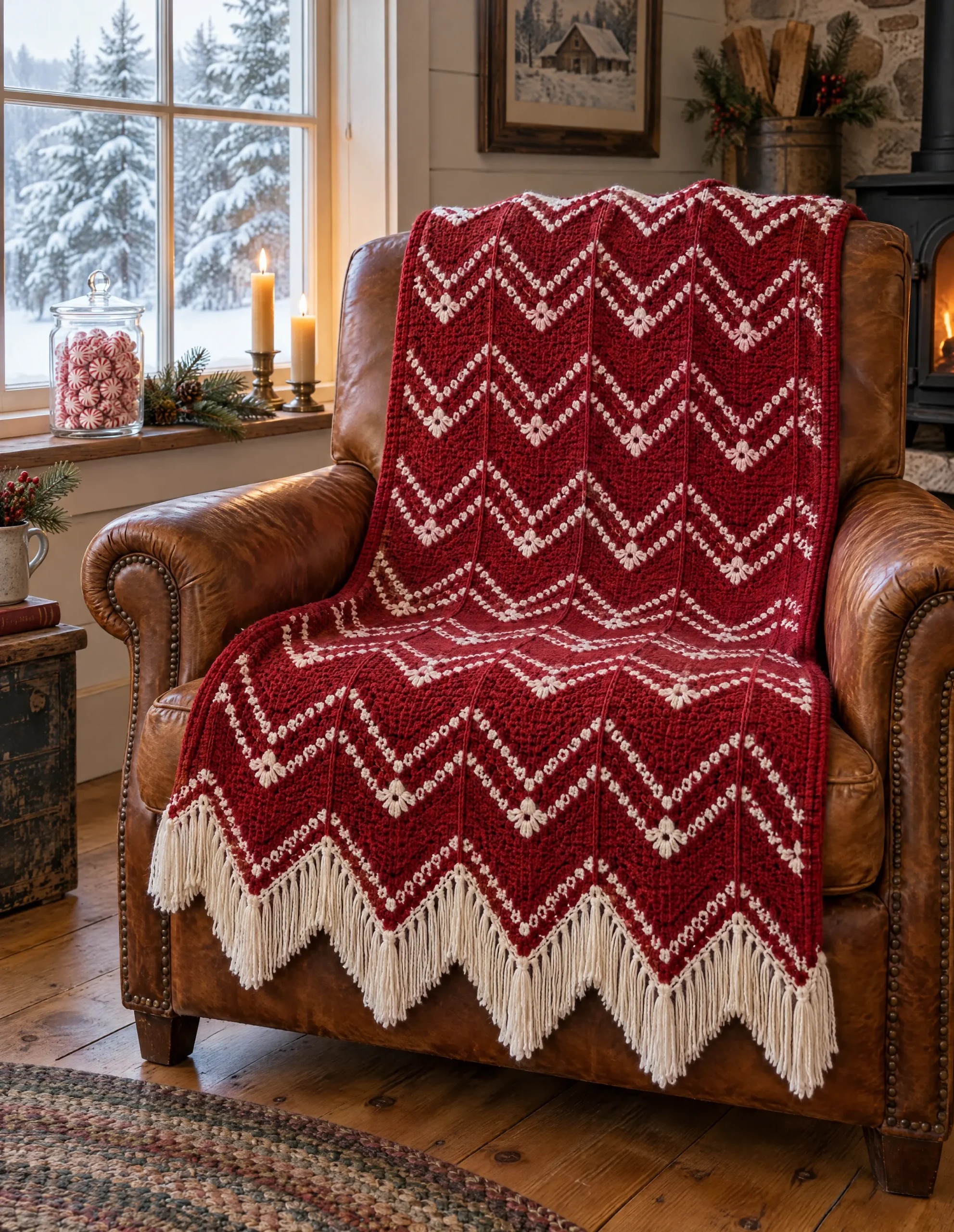
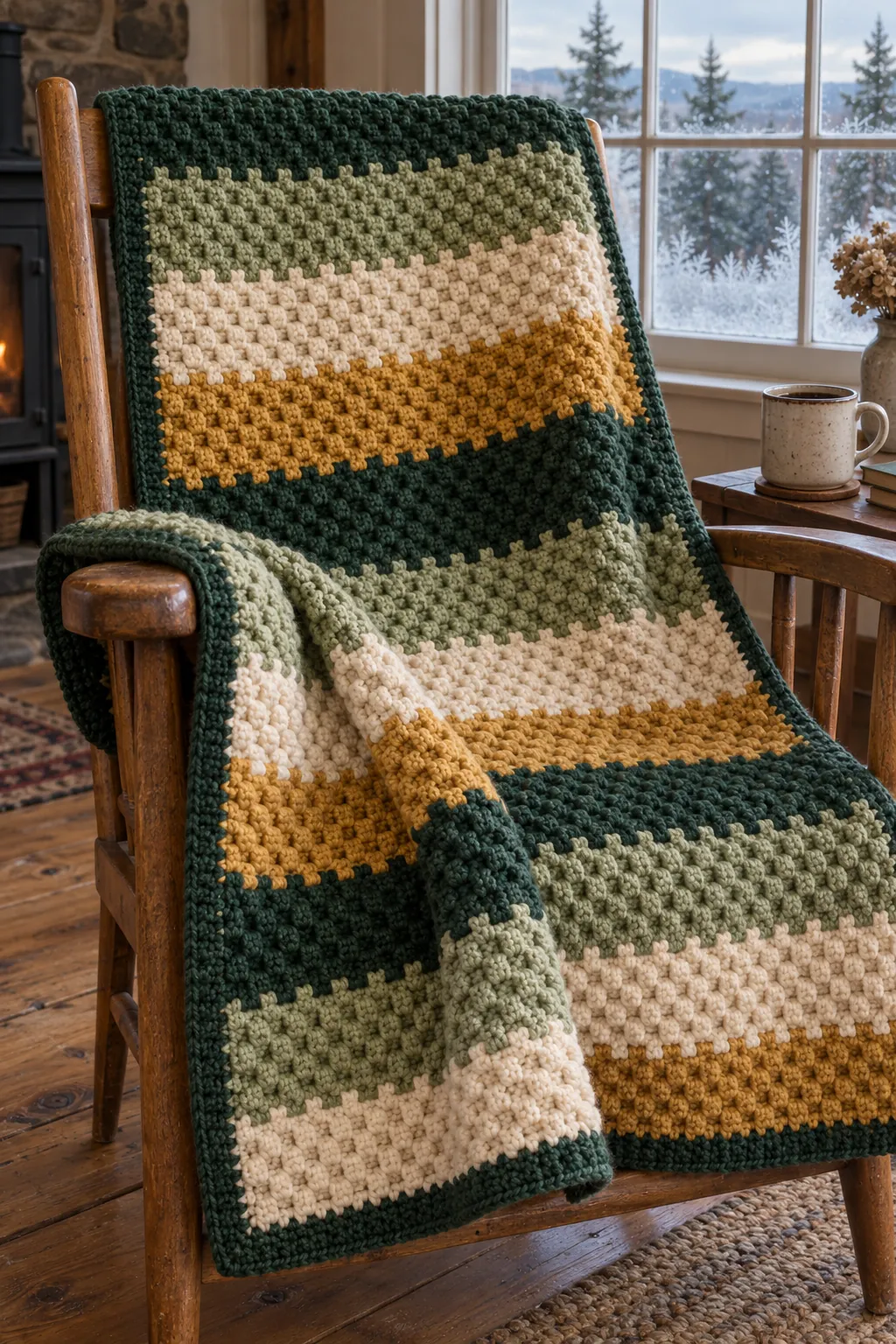
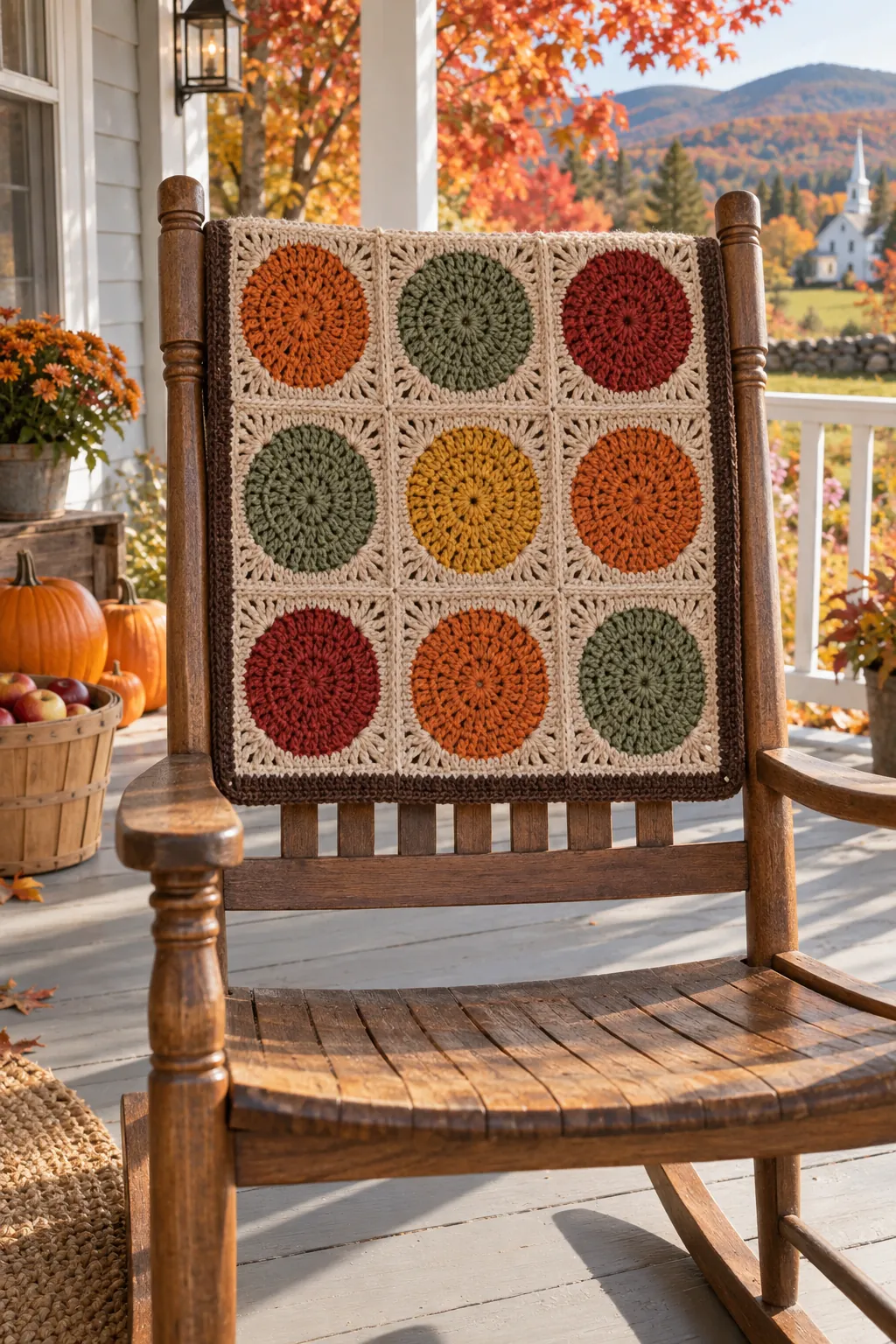
Picture a December evening in Vermont, snow piling up against the porch rail and a basket of navy, honey and ivory stars waiting by the lamp. This join as you go crochet blanket is built one small star at a time, and each new star hooks onto its neighbors while you finish its last round. When the last star of the last strip is done, the afghan is already in one piece and only the border is left.
The Winter Lantern Afghan uses six-point stars about 4 in (10 cm) across, worked in worsted weight yarn and set in vertical strips that nest into each other like a honeycomb. Every other strip sits half a star higher, so lines of the same color climb diagonally across the blanket. A four-round navy border with a picot edge follows the star outline and keeps the edge softly scalloped. The pattern comes in two sizes, a 36 × 48 in lapghan and a 50 × 60 in throw. Gold and navy feel festive in December, but the same stars look just as right on a spring couch.

Is this join as you go crochet blanket the right next project for you?
If you can work double crochet in the round, you already have most of what you need. Each star uses only the chain, single crochet, half double crochet, double crochet and treble crochet, plus slip stitches to close the rounds. Treble crochet (tr) is the tallest of the group: wrap the yarn twice before inserting the hook, then work the loops off two at a time. If the abbreviations still look like a code, the guide to reading a pattern walks through them.
The new skill is the joining. Halfway up a point, between its two treble crochets, you reach over to the finished star next door and work one single crochet into the tip of its point. Then you finish your own point as usual. A star near the edge joins at one or two points, and a star in the middle joins at three. That’s why this pattern is rated Intermediate, even though no single stitch is hard. The first ten stars feel slow; after that, a rhythm settles in: three rounds, a few joins, weave in, next star.
Each star starts with a magic ring, an adjustable loop you pull closed after the first round, so the center stays small and neat instead of leaving a hole.
Choosing a worsted yarn that keeps six points crisp
Look for a smooth, plied worsted weight yarn with a 4 (Medium) symbol on the label. A smooth yarn shows the graded stitches of each point clearly. Fuzzy yarns, mohair blends and bouclé blur the tips, and the joins become hard to find.
Acrylic is the easiest choice for a blanket that will be washed often. A wool blend drapes more softly and feels warmer, but check that it can go in the washing machine before you commit to 196 stars.
Buy each color in one dye lot if you can. If you have to mix lots, spread the new skein across several strips instead of finishing one strip with it.
Before you start, make three stars and join them as the first three stars of the chart. Measure one star from tip to tip through the center, then the distance between two star centers in the same strip. The sizes below are estimates for stars of about 4 in (10 cm), so a bigger star means a bigger blanket and more yarn. Change the hook by one size until your stars land close to 4 in.
For holiday shimmer, you can hold a fine metallic crochet thread together with the worsted yarn through every round. It’s a lovely variation, but two strands make a thicker, larger star, so the gauge changes. Swatch three joined stars again with both strands, try a 6 mm hook if the fabric feels stiff, and plan fewer stars per strip if your stars grow.
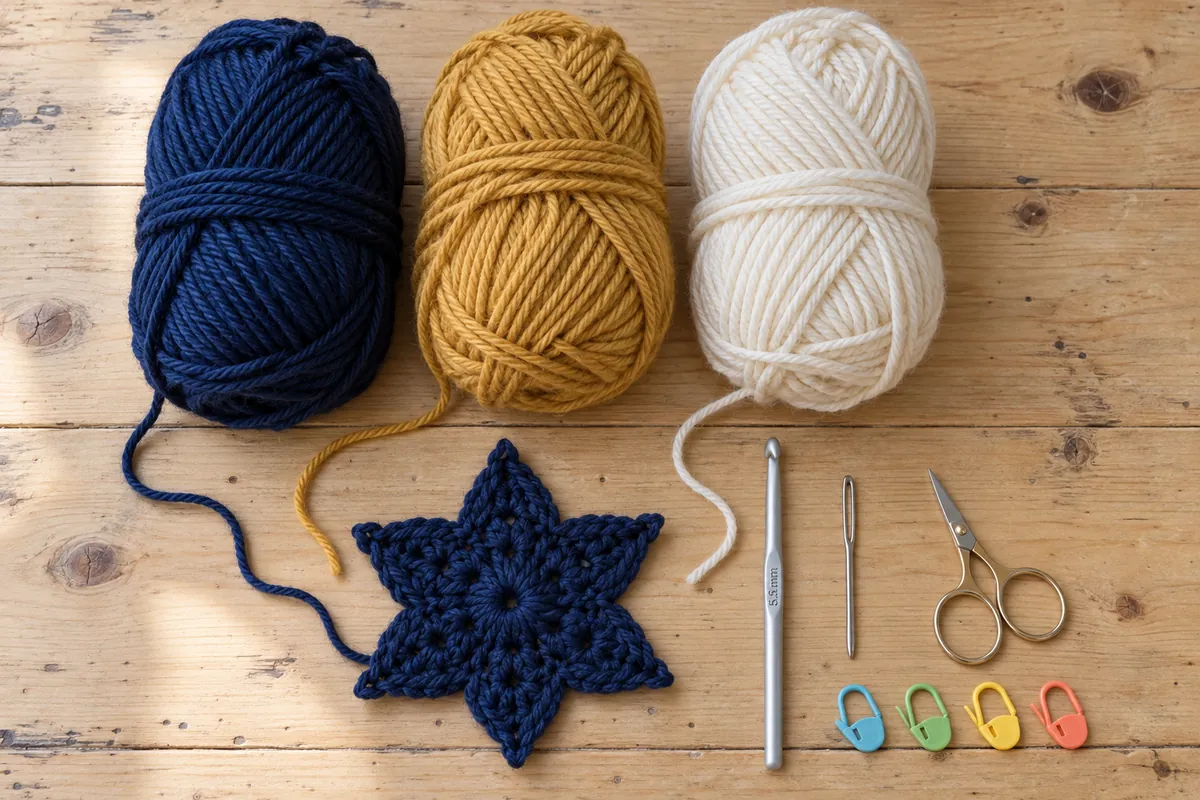
Midnight, Honey Gold and Snow in climbing diagonal lines
Midnight is the deep navy anchor. It fills about a third of the stars and the whole border, so it frames the edge and gives the lighter stars something to glow against. Honey Gold is the lantern light, a warm mustard that reads festive in December and sunny in May. Snow, a soft ivory, keeps the blanket from feeling heavy.
The colors follow one rule. Every strip repeats Midnight, Snow, Honey Gold from the bottom up, and the starting color moves on every two strips. Because each even strip sits half a star higher, a star and its upper right neighbor always share a color, and that’s what draws the diagonal lines. The full chart for both sizes is printed in the pattern card, star by star, so you never have to guess from a photo.
Other combinations that keep the same dark, medium and light balance:
- Midnight Lantern: navy, honey gold and ivory, as written.
- Cranberry Bog: cranberry, cream and deep spruce green.
- Lake Champlain: slate blue, sea glass and white.
- Woodsmoke: charcoal, rust and cream.
Keep the darkest color for the border: a pale one shows every smudge. And sort the yarn into three bags labeled with the chart letters M, H and S, so you never grab the wrong one in dim evening light.
Two sizes, counted in strips and stars
Both sizes match the house sizes of the site, and the card is written for both as Lapghan [Throw]. Every number below is an estimate based on a 4 in star; your swatch has the last word.
- Lapghan, about 36 × 48 in (92 × 122 cm): 10 strips of 11 stars, 110 stars (38 Midnight, 36 Honey Gold, 36 Snow), 289 joined points, 408 chain spaces in the first border round, about 1,550 yd (1,417 m) in all: 649 yd Midnight, 451 yd Honey Gold, 451 yd Snow.
- Throw, about 50 × 60 in (126 × 152 cm): 14 strips of 14 stars, 196 stars (66 Midnight, 64 Honey Gold, 66 Snow), 533 joined points, 548 chain spaces in the first border round, about 2,658 yd (2,429 m) in all: 1,045 yd Midnight, 794 yd Honey Gold, 819 yd Snow.
The yardage includes a 15 percent margin. To change the size, add or remove whole strips (about 3⅜ in, 8.6 cm each) or one star in every strip (about 4 in, 10 cm). Keep an even number of strips so the opposite corners match.
If motif-by-motif blankets appeal to you, a hexagon coverlet in summer colors builds a bed-size piece the same patient way, and for more December color there’s a granny coverlet dressed for Christmas.
Keeping 110 stars flat, joined and in order
- Weave in as you go. Each star leaves two tails, one from the magic ring and one from the last round. Weave both on the wrong side the moment the star is finished. Saved for later, they turn into 220 ends on the lapghan, or 392 on the throw, tangled around the joins.
- Count to 48. A star with no joins has 48 stitches in its last round, eight per point. Each joined point adds one. If a point comes out lopsided, count it before blaming the join.
- Find the tip before you join. The tip is the small gap between the two treble crochets at the top of a point. Insert the hook there from front to back, not through one of the trebles, or the join will twist the point.
- Work flat. Lay the finished part on a table and slide the new star into place before its first join.
- Keep the chart beside you. Print the color chart and the joining list, and check off each star. A mistake twenty stars back means a lot of undoing.
- Keep the trebles snug. Hold the two wraps firmly on the hook. Loose trebles make long, floppy points that don’t line up with their neighbors.
- Expect the edge to dip. Odd strips end half a star lower than even strips at the top and bottom. The border follows those dips on purpose.
US crochet terms
The pattern
Materials
- Yarn: worsted weight (CYC #4) acrylic or machine-washable wool blend, in 3 colors. Estimated yardage (estimate, 15% margin included):
- Midnight (deep navy), stars and border: about 649 [1,045] yd (593 [956] m)
- Honey Gold (warm mustard): about 451 [794] yd (412 [726] m)
- Snow (soft ivory): about 451 [819] yd (412 [749] m)
- Total: about 1,550 [2,658] yd (1,417 [2,429] m)
- Hook: 5.5 mm / I-9, or the size that gives the gauge
- Yarn needle, scissors, 4 locking stitch markers (border corners)
Gauge
- One star (Rounds 1–3) = about 4 in (10 cm) from tip to tip through the center, after blocking.
- Joined stars: about 4 in (10 cm) from one star center to the next in the same strip, and about 3⅜ in (8.6 cm) from one strip center to the next.
- These are estimates, not measurements from a swatch. Make and join 3 stars before starting and compare.
Finished size
About 36 × 48 [50 × 60] in (92 × 122 [126 × 152] cm), measured across the star tips with the border, after blocking. The edges are scalloped.
Abbreviations
- beg beginning
- ch chain
- ch-sp chain space
- dc double crochet
- hdc half double crochet
- rep repeat
- RS right side
- sc single crochet
- sk skip
- sl st slip stitch
- sp(s) space(s)
- st(s) stitch(es)
- tr treble crochet (yo twice, insert hook, yo, pull up a loop, [yo, pull through 2 loops] 3 times)
- WS wrong side
- yo yarn over
Notes
- Sizes: Lapghan [Throw]. When only one number is given, it applies to both sizes.
- The afghan is made of six-point stars worked in joined rounds, RS facing. Each star is joined to its finished neighbors while you work its last round (join as you go). Work the stars of each strip from the bottom up, and the strips from left to right. Even-numbered strips sit half a star higher than odd-numbered strips.
- No stitch multiple: each star starts from a magic ring, not a foundation chain. To resize, add or remove whole strips (about 3⅜ in / 8.6 cm each) or the same number of stars in every strip (about 4 in / 10 cm each). Keep an even number of strips. Each strip or star added changes the matching edges of border Round 1 by 10 ch-2 sps.
- There is no turning chain: the work is never turned. The ch 3 at the start of Round 1 counts as the first dc. The ch-5 loops of Round 2 and the ch-2 sps of border Round 1 are not stitches. In border Rounds 2 and 3, the ch 4 at the start of the round counts as a dc and a ch-1 sp.
- Points of a star are named by where they face once the star sits in the blanket: Top, Upper Right, Lower Right, Bottom, Lower Left, Upper Left. The tip of a point is the gap between its 2 tr.
- Free point: (sc, hdc, dc, tr, tr, dc, hdc, sc) in one ch-5 sp (8 sts).
- Joined point: (sc, hdc, dc, tr) in the ch-5 sp, joining sc, (tr, dc, hdc, sc) in the same ch-5 sp (9 sts). Joining sc: with both stars RS up and flat, insert the hook from front to back into the tip of the neighbor’s point, yo, pull up a loop, yo, pull through both loops on the hook.
- Picot: (sc, ch 3, sl st in same sp). The ch-3 loop is not a stitch; each picot counts as 1 st.
- Ends: fasten off each star with a 6 in (15 cm) tail and weave both tails in on the WS before you start the next star.
- Left-handed crocheters: the joining list is the same, because the point names describe the blanket. The border travels the other way around, so read each edge’s steps from the end back to the start.
Instructions
Star (make 110 [196])
Use the color the chart gives for each star.
- Round 1 (RS): Make a magic ring, ch 3 (counts as dc), 11 dc in ring, pull the tail to close the center, join with sl st in top of beg ch-3. (12 dc)
- Round 2: *Ch 5, sk next dc, sc in next dc; rep from * 4 more times, ch 5, sk last dc, join with sl st in base of first ch-5. (6 loops: 6 ch-5 sps)
- Round 3: *Free point in next ch-5 sp; rep from * 5 more times, working a joined point instead at each point the joining list gives for this star; join with sl st in first sc. Fasten off. (48 sts on a star with no joined point; 49, 50 or 51 sts with 1, 2 or 3 joined points)
Joining list
Before the first join, turn the new star so its points line up with its neighbors. Then work its points in order around and join each listed point when you reach it.
- Strip 1: Star 1 has no joined point. Stars 2 to 11 [14]: join the Bottom point to the Top point of the star below.
- Even strips (2, 4, 6…):
- Star 1: join the Lower Left point to the Upper Right point of Star 1 in the strip on the left, and the Upper Left point to the Lower Right point of Star 2 in the strip on the left.
- Stars 2 to 10 [13]: join the Bottom point to the Top point of the star below, the Lower Left point to the Upper Right point of the star with the same number in the strip on the left, and the Upper Left point to the Lower Right point of the star one number higher in the strip on the left.
- Star 11 [14]: join the Bottom point to the Top point of the star below, and the Lower Left point to the Upper Right point of Star 11 [14] in the strip on the left.
- Odd strips (3, 5, 7…):
- Star 1: join the Upper Left point to the Lower Right point of Star 1 in the strip on the left.
- Stars 2 to 11 [14]: join the Bottom point to the Top point of the star below, the Lower Left point to the Upper Right point of the star one number lower in the strip on the left, and the Upper Left point to the Lower Right point of the star with the same number in the strip on the left.
- Totals: 10 [14] strips of 11 [14] stars, 110 [196] stars, 289 [533] joined points.
Color chart
M = Midnight, H = Honey Gold, S = Snow. Each strip repeats Midnight, Snow, Honey Gold from the bottom up. Strips 1 and 2 start with Midnight, Strips 3 and 4 with Honey Gold, Strips 5 and 6 with Snow, then the cycle starts again with Strips 7 and 8.
Lapghan (110 stars: 38 Midnight, 36 Honey Gold, 36 Snow). Rows are star numbers, top star first; columns are strips, left to right.
| Star / Strip | 1 | 2 | 3 | 4 | 5 | 6 | 7 | 8 | 9 | 10 |
|---|---|---|---|---|---|---|---|---|---|---|
| 11 | S | S | M | M | H | H | S | S | M | M |
| 10 | M | M | H | H | S | S | M | M | H | H |
| 9 | H | H | S | S | M | M | H | H | S | S |
| 8 | S | S | M | M | H | H | S | S | M | M |
| 7 | M | M | H | H | S | S | M | M | H | H |
| 6 | H | H | S | S | M | M | H | H | S | S |
| 5 | S | S | M | M | H | H | S | S | M | M |
| 4 | M | M | H | H | S | S | M | M | H | H |
| 3 | H | H | S | S | M | M | H | H | S | S |
| 2 | S | S | M | M | H | H | S | S | M | M |
| 1 | M | M | H | H | S | S | M | M | H | H |
Throw (196 stars: 66 Midnight, 64 Honey Gold, 66 Snow). Rows are star numbers, top star first; columns are strips, left to right.
| Star / Strip | 1 | 2 | 3 | 4 | 5 | 6 | 7 | 8 | 9 | 10 | 11 | 12 | 13 | 14 |
|---|---|---|---|---|---|---|---|---|---|---|---|---|---|---|
| 14 | S | S | M | M | H | H | S | S | M | M | H | H | S | S |
| 13 | M | M | H | H | S | S | M | M | H | H | S | S | M | M |
| 12 | H | H | S | S | M | M | H | H | S | S | M | M | H | H |
| 11 | S | S | M | M | H | H | S | S | M | M | H | H | S | S |
| 10 | M | M | H | H | S | S | M | M | H | H | S | S | M | M |
| 9 | H | H | S | S | M | M | H | H | S | S | M | M | H | H |
| 8 | S | S | M | M | H | H | S | S | M | M | H | H | S | S |
| 7 | M | M | H | H | S | S | M | M | H | H | S | S | M | M |
| 6 | H | H | S | S | M | M | H | H | S | S | M | M | H | H |
| 5 | S | S | M | M | H | H | S | S | M | M | H | H | S | S |
| 4 | M | M | H | H | S | S | M | M | H | H | S | S | M | M |
| 3 | H | H | S | S | M | M | H | H | S | S | M | M | H | H |
| 2 | S | S | M | M | H | H | S | S | M | M | H | H | S | S |
| 1 | M | M | H | H | S | S | M | M | H | H | S | S | M | M |
Border
Work the whole border in Midnight, RS facing.
- Point step: ch 2, hdc in next dc, ch 2, dc between points (between the 2 sc where two points of the same star meet), ch 2, hdc in next dc, ch 2, sc in next tip. (4 sts, 4 ch-2 sps)
- Join step: ch 2, hdc in next dc, ch 2, dc between points, ch 2, tr in the joining sc between the two stars, ch 2, dc between points, ch 2, hdc in next dc, ch 2, sc in next tip. (6 sts, 6 ch-2 sps)
- Corner tips: place a marker in the Upper Left point of the top star of Strip 1 (top-left corner), the Lower Left point of Star 1 of Strip 1 (bottom-left), the Lower Right point of Star 1 of the last strip (bottom-right) and the Upper Right point of the top star of the last strip (top-right).
- Round 1: Join with sc in the top-left corner tip, ch 2, sc in same tip. Left edge: [point step, join step] 10 [13] times, point step, working (sc, ch 2, sc) in the bottom-left corner tip instead of the last sc. Bottom edge: [2 point steps followed by 2 join steps] 4 [6] times, 2 point steps, join step, point step, working (sc, ch 2, sc) in the bottom-right corner tip instead of the last sc. Right edge: work as the left edge, with (sc, ch 2, sc) in the top-right corner tip. Top edge: work as the bottom edge, ending the last point step with ch 2 instead of the last sc; join with sl st in first sc. (408 [548] sts, 408 [548] ch-2 sps: 104 [134] along each side edge, 98 [138] along the top and bottom edges, 1 in each corner)
- Round 2: Sl st in corner ch-2 sp, ch 4 (counts as dc, ch 1), (dc, ch 1) twice in same sp (corner group made). Left edge: [dc in next ch-2 sp, ch 1, (dc, ch 1) twice in next ch-2 sp] 52 [67] times; corner group of (dc, ch 1) 3 times in corner sp. Bottom edge: [dc in next ch-2 sp, ch 1, (dc, ch 1) twice in next ch-2 sp] 49 [69] times; corner group. Right edge: as left edge; corner group. Top edge: as bottom edge; join with sl st in 3rd ch of beg ch-4. (618 [828] sts, 618 [828] ch-1 sps: 156 [201] along each side edge, 147 [207] along the top and bottom edges, 3 in each corner group)
- Round 3: Sl st in next ch-1 sp, ch 4 (counts as dc, ch 1), (dc, ch 1) in same sp, (dc, ch 1) twice in each of next 2 ch-1 sps. Left edge: (dc, ch 1) in each of next 155 [200] ch-1 sps; corner: (dc, ch 1) twice in each of next 4 ch-1 sps. Bottom edge: (dc, ch 1) in each of next 146 [206] ch-1 sps; corner. Right edge: as left edge; corner. Top edge: (dc, ch 1) in each of next 146 [206] ch-1 sps, (dc, ch 1) twice in last ch-1 sp; join with sl st in 3rd ch of beg ch-4. (634 [844] sts, 634 [844] ch-1 sps)
- Round 4: Sl st in next ch-1 sp, ch 1, sc in same sp, picot in each of next 2 ch-1 sps (corner). Left edge: [sc in next ch-1 sp, picot in next ch-1 sp] 80 [102] times, sc in each of next 1 [2] ch-1 sps; picot in each of next 2 ch-1 sps (corner). Bottom edge: [sc in next ch-1 sp, picot in next ch-1 sp] 75 [105] times, sc in each of next 2 ch-1 sps; corner. Right edge: as left edge; corner. Top edge: [sc in next ch-1 sp, picot in next ch-1 sp] 75 [105] times, sc in next ch-1 sp; join with sl st in first sc. Fasten off. (634 [844] sts, including 318 [422] picots)
Finishing
- Weave in the border tails. Lay the afghan flat, pin each star tip and border scallop, mist with water and let it dry completely before unpinning.
Washing a navy and ivory afghan without dulling the stars
An acrylic afghan can go in the machine on a cold, gentle cycle, then lie flat to dry or tumble on low. Deep navy can release a little dye in the first washes, so add a color-catcher sheet and wash the afghan on its own the first time. Wool blends need more care: follow the label, and if it says hand wash, use cool water and a wool wash, press the water out in a towel and never wring.
Dry the afghan flat and pin out the border scallops while it’s damp so the picots sit evenly. Store it folded in a cotton bag rather than plastic. If you added metallic thread, use the gentlest setting and skip the dryer, since heat can dull the shine.
Winter Lantern questions about stars, joins and points
Which points get joined on each star of this join as you go crochet blanket?
Stars in Strip 1 join only at the Bottom point, to the star below. Stars in later strips join at up to three points: the Bottom point to the star below, and the Lower Left and Upper Left points to stars in the strip on the left. The first and last stars of each strip have fewer joins, and the joining list in the card spells out each case.
Why do some stars have 48 stitches and others 51?
The joining single crochet belongs to the new star’s last round, so each joined point has 9 stitches instead of 8. A star with no joins ends at 48 stitches, and a star joined at three points ends at 51. Both are right.
Why does the top edge dip between the strips?
Every even-numbered strip sits half a star higher than the odd ones, so the top and bottom edges alternate between high and low stars. The border follows that outline instead of filling it, which leaves a soft scalloped edge. A straight edge would need half stars along the top and bottom, and this pattern doesn’t include them.
Can I add metallic thread for holiday sparkle?
Yes. Hold a fine metallic crochet thread together with the worsted yarn through every round of every star. Since the two strands travel together, you’ll need about as many yards of thread as of yarn for every part you hold it with. The second strand makes each star larger and a little stiffer, so swatch three joined stars, adjust the hook and plan fewer stars if yours grow.
Can I make it bigger than the throw?
Yes, by adding whole strips for width and the same number of stars to every strip for length. Each strip adds about 3⅜ in (8.6 cm) and each star about 4 in (10 cm). Keep an even number of strips, follow the color rule in the card and recount the border: every strip or star you add changes its edges of border Round 1 by 10 chain spaces.
Quick recap
- Make and join three stars to check your gauge against the 4 in (10 cm) target.
- Work Strip 1 from the bottom up, joining each star’s Bottom point to the star below.
- Work the remaining strips from left to right, following the joining list and the color chart.
- Weave in both tails of each star as soon as it’s finished.
- Mark the four corner tips and work the four-round Midnight border, ending with picots.
A join as you go crochet blanket asks for patience at the start and pays it back at the end: the day the last star is done, the afghan is finished except for its border. If a star refuses to line up or a count won’t come out, send a note through the Contact page.