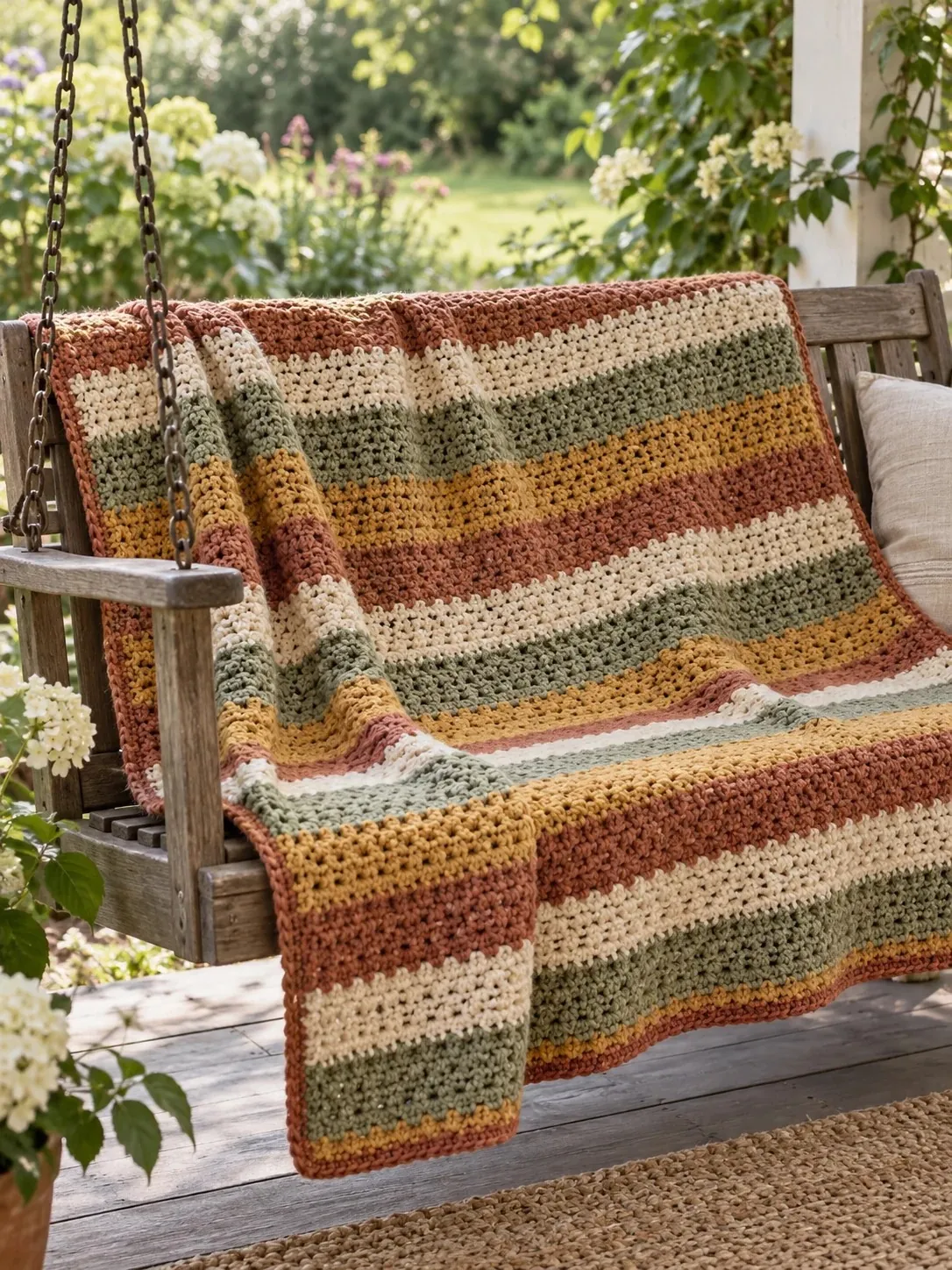
Picture June to September, with supper on the porch swing more often than at the table. This crochet picnic blanket was made for those evenings, and for the lake days and town band concerts in between. It’s 20 stripes of terracotta, cream, sage and mustard, worked in the suzette stitch with bulky cotton-blend yarn. That makes it sturdy enough to spread on the grass and soft enough to pull over your knees when the sun drops behind the hills.
The fabric is thick and pebbly, with tiny holes that let it breathe on a warm afternoon. Every row repeats the same two-stitch move, so after the first stripe you’ll mostly be counting colors. The pattern is written for about 50 × 60 in (127 × 152 cm), room for two people and a basket, and three other sizes follow. Folded, it fits in a tote and can ride in the back of your car all summer.
Is this crochet picnic blanket a good next step after your first rows?
It is, if you’ve already worked a few rows of single crochet and double crochet and you’re ready for some texture. Those two stitches make the whole body, plus the chain you start from. The border is two rounds of single crochet in terracotta, and each round closes with a slip stitch: put your hook into the first stitch, wrap the yarn, and pull it through everything on the hook.
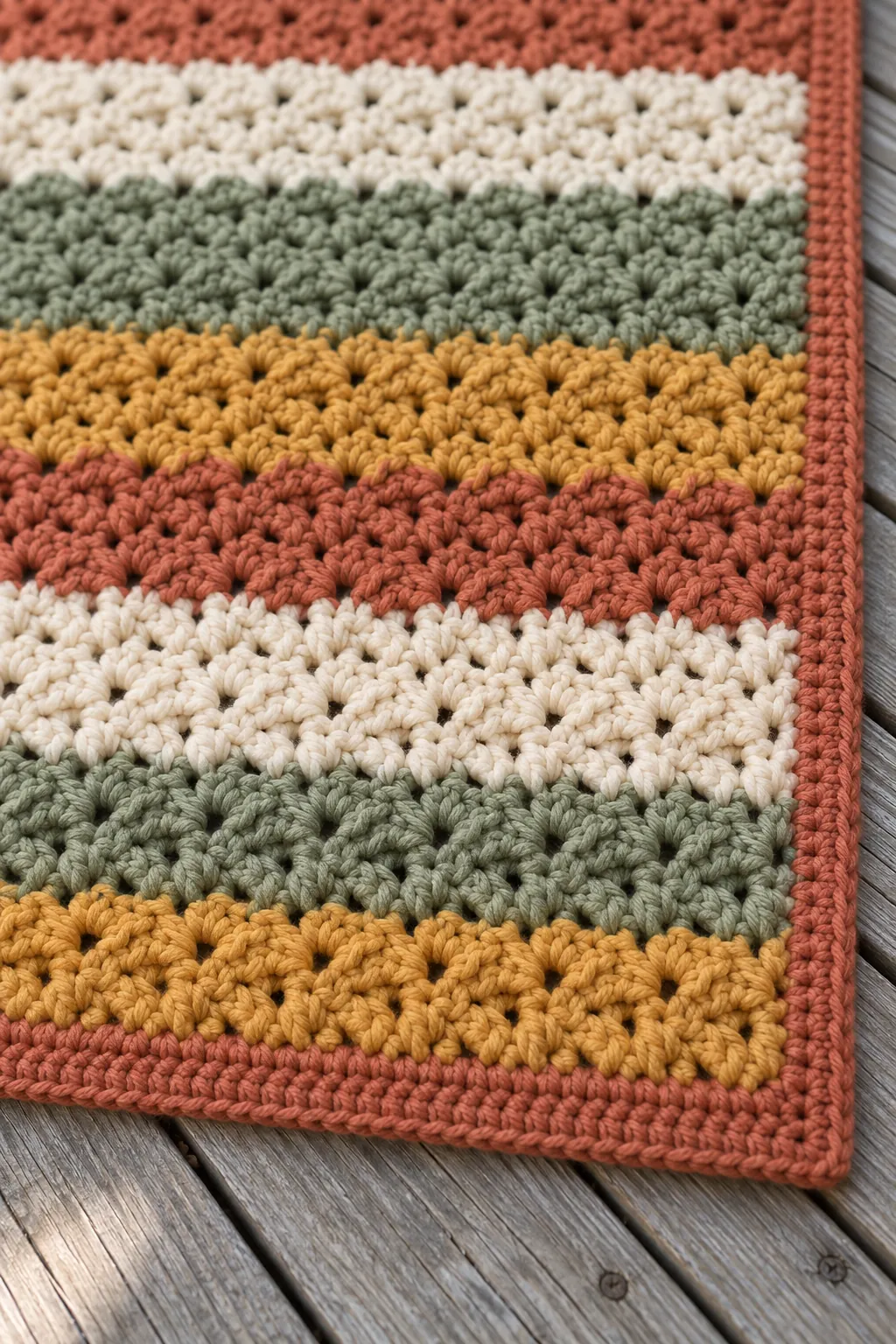
The stitch pattern is called suzette. You work a single crochet and a double crochet into the same stitch, skip the next stitch, and repeat. This pattern calls that pair a cluster. On the way back, you skip each double crochet and put a new cluster into each single crochet. The taller dc leans over the stitch you skipped, and that lean is what makes the bumps and pinholes you see in the photo.
It’s rated Easy rather than Beginner for two reasons. Suzette asks you to tell a sc from a dc on the row below, which takes a stripe or two to learn. And 19 color changes, all at row ends, leave plenty of yarn ends. If you’d rather start with one plain stitch, the three-color throw in wide half double crochet stripes is a gentler first striped project.
The pattern card uses short forms like sk, rep and (sc, dc). If the asterisks and parentheses look like code, the Beginner Guide has a section on reading the abbreviations in a pattern.
Bulky #5 cotton blend for a blanket that goes on the grass
Look for a 5 and the word “bulky” on the label, with a suggested hook of around 6.5 mm (US K-10.5). That hook gives the dense, pebbly fabric in the photo.
For a blanket that lives outdoors, choose a cotton and acrylic blend, roughly half and half. The cotton keeps it cool on bare legs; the acrylic makes it lighter and quicker to dry. All-cotton bulky works, but suzette is a dense stitch, so the throw gets heavy, close to 4 lb, and it stays damp for hours if it lands on dew. Plain acrylic is fine too, a little warmer and shinier. Leave wool out of this one. Grass stains and spilled lemonade mean frequent washing, and most wool wants gentle care.
Buy all of each color in one trip and compare the lot numbers on the bands. A second lot of cream can lean slightly yellow, and in 8-row stripes it shows.
Go by yards, not skeins: divide each color’s yardage by the length on the band and round up. For 525 yd of cream in 120 yd skeins, that’s 5.
Make the 19-stitch swatch from the pattern card before you chain 148. Suzette width is easy to misjudge: at 13 stitches over 4 in instead of 12, the body comes out about 45 in wide, not 49. Wash the swatch too, with a scrap of terracotta tied to it, and you’ll know right away whether the red bleeds into the cream.
Terracotta, cream, sage and mustard: what each stripe is doing
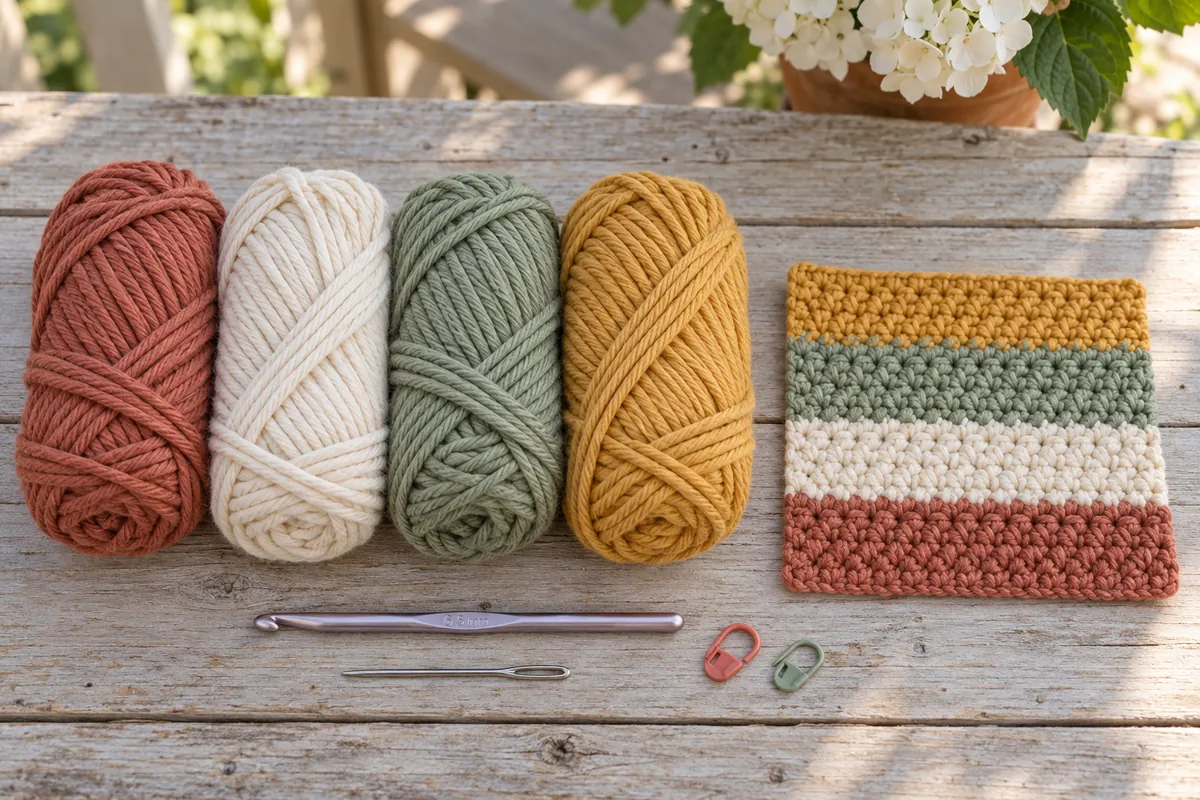
The colors run in one order the whole way down: terracotta (A), cream (B), sage (C), mustard (D), 8 rows each, five times over. Terracotta is the anchor. It starts the blanket and makes the border, so it frames the softer colors. Cream gives your eye a rest between two warm shades and makes the stripes readable from across a lawn. Sage cools things down. Mustard brings the sun back.
In the photo, a few stripes look narrower where the blanket folds and the last mustard band is thinner than the rest; the pattern keeps every stripe at 8 rows for a tidier repeat.
Other sets that work in the same order, deep, light, cool, then bright:
- Lake day: navy, white, sea glass green, coral.
- Blueberry field: dusty blue, oat, lavender gray, butter yellow.
- Farm stand: tomato red, cream, olive, pumpkin.
- Garden shed: clay brown, linen, eucalyptus, honey.
Keep one truly light color in the set. Four mid-tones blur into one muddy band from a few steps away. Before you buy, line up the four skeins and squint at them: you should still see four separate stripes.
Porch Swing in four sizes, from stroller to picnic for two
All four sizes use the same gauge and full A, B, C, D repeats, so each one starts with terracotta and ends with mustard. The card covers the throw. Yardage is an estimate with about 10% spare, rounded up to the next 25 yd; color A includes the chain and both border rounds.
- Stroller, about 30 × 36 in (76 × 91 cm): ch 88, 87 sts, 96 rows (12 stripes); border 398 then 406 sc; A about 250 yd (229 m), B, C and D about 200 yd (183 m) each.
- Lap, about 40 × 48 in (102 × 122 cm): ch 118, 117 sts, 128 rows (16 stripes); border 530 then 538 sc; A about 425 yd (389 m), B, C and D about 350 yd (320 m) each.
- Throw, about 50 × 60 in (127 × 152 cm), the size in the card: ch 148, 147 sts, 160 rows (20 stripes); border 662 then 670 sc; A about 625 yd (572 m), B, C and D about 525 yd (480 m) each.
- Picnic for two, about 60 × 71 in (152 × 180 cm): ch 178, 177 sts, 192 rows (24 stripes); border 794 then 802 sc; A about 875 yd (800 m), B, C and D about 750 yd (686 m) each.
The stroller size is for a baby who’s awake and watched, never for sleep. For a lighter baby blanket, Maple Lane’s peach and cream stripes in plain single crochet are a better fit.
Keeping 147 stitches and 20 stripes on track
- Mark the lone sc. Every row ends with one single crochet on its own, and the next row’s first cluster goes into it. It hides against the edge, so keep a marker in it.
- Clusters go into sc, never into dc. The sc of a cluster is the short, snug stitch at its base. The dc is the taller one leaning to the side. When in doubt, follow the lean: the skipped stitch is always the one the dc covers.
- Count clusters, not stitches. 73 is much easier to count than 147, especially with a marker every 10 clusters on Row 1.
- Chain loosely. A tight foundation chain pulls the bottom edge narrower than the top. If your chains feel snug, make the 148 with an 8 mm (US L-11) hook and switch back to 6.5 mm for Row 1.
- Measure after the first stripe. Eight rows should stand close to 3 in (7.5 cm) tall and the row about 49 in (124 cm) wide.
- Cut at every color. Each color returns only every 32 rows, more than 11 in up the side, too far to carry. That leaves about 40 tails in the body, so weave in each stripe’s ends as you finish it, or crochet over them at the start of the next stripe.
- Expect the changes on one edge. With 8 rows per stripe, every color change lands on the side where you began Row 1.
US crochet terms
The pattern
Materials
- Yarn: bulky (#5) machine-washable yarn, cotton and acrylic blend, about 2,200 yd (2,012 m) in total. Yardage is an estimate; buy each color from one dye lot.
- Color A, terracotta: about 625 yd (572 m)
- Color B, cream: about 525 yd (480 m)
- Color C, sage: about 525 yd (480 m)
- Color D, mustard: about 525 yd (480 m)
- Hook: 6.5 mm (US K-10.5)
- Optional: 8 mm (US L-11) hook for the foundation chain
- Large-eye yarn needle, 2 or more stitch markers, scissors, measuring tape
Gauge
- 12 sts (6 clusters) and 11 rows = 4 in (10 cm) in suzette stitch
- Swatch: ch 20. Work Row 1 and Row 2 of the body as written below (9 clusters and 1 sc; 19 sts). Work 18 rows in total, about 6 1/4 × 6 1/2 in (16 × 17 cm), and measure 4 in (10 cm) across the middle.
- More than 12 sts in 4 in: go up a hook size. Fewer: go down one.
Finished size
- About 50 × 60 in (127 × 152 cm) with the border, before blocking
- Body before the border: about 49 × 58 in (124 × 148 cm)
Abbreviations
- ch chain
- sc single crochet
- dc double crochet
- sl st slip stitch
- st(s) stitch(es)
- sk skip
- yo yarn over
- rep repeat
Notes
- Cluster: (sc, dc) in the same st.
- The ch 1 at the start of each row does not count as a st.
- Every row has 73 clusters and 1 sc at the end (147 sts). The first cluster of each row goes into that last sc of the row below. Place a stitch marker in it.
- Clusters are always worked into the sc of the row below; the dc of each cluster is skipped.
- Stripes: 8 rows each, in the order A, B, C, D, worked 5 times (20 stripes, 160 rows), ending with D.
- Color change: work the last sc of the row until 2 loops remain, yo with the new color and pull it through both loops. Cut the old color, leaving a 6 in (15 cm) tail. All color changes fall on the same edge.
- Weave in tails as you finish each stripe, or work over them for the first few sts of the next row.
- Border corners: 3 sc in the same st. Border sides: 9 sc for each 8-row stripe (1 sc in the end of each row, and 2 sc in the end of the 4th row). If a side ruffles, work 1 sc in every row end for a few stripes; if it pulls tight, add 1 more sc per stripe.
- To change the size: ch any even number. Each row has 1 st fewer than the ch. With this gauge, 6 sts (3 clusters) add 2 in (5 cm) of width, and one A, B, C, D repeat (32 rows) adds about 11 1/2 in (30 cm) of length. Border Round 1 has 2 × (sts + 4) + 18 × stripes sc; Round 2 adds 8.
Instructions
Body
- Foundation: With A, loosely ch 148.
- Row 1 (A): (Sc, dc) in 2nd ch from hook, *sk next ch, (sc, dc) in next ch; rep from * to last 2 ch, sk next ch, sc in last ch. (73 clusters and 1 sc; 147 sts)
- Row 2 (A): Ch 1, turn. (Sc, dc) in first sc, *sk next dc, (sc, dc) in next sc; rep from * to last 2 sts, sk next dc, sc in last sc. (147 sts)
- Rows 3–8 (A): Rep Row 2. Change to B at the end of Row 8.
- Rows 9–16 (B): Rep Row 2. Change to C at the end of Row 16.
- Rows 17–24 (C): Rep Row 2. Change to D at the end of Row 24.
- Rows 25–32 (D): Rep Row 2. Change to A at the end of Row 32.
- Rows 33–160: Rep Row 2, changing color every 8 rows in the same order (A, B, C, D). You will work the 4-stripe sequence 4 more times and end with Row 160 in D. (20 stripes; body measures about 49 × 58 in / 124 × 148 cm)
- Fasten off D.
Border
- Round 1 (A): Join A with a sl st in the first st of Row 160. Ch 1, 3 sc in the same st (corner), sc in each of next 145 sts, 3 sc in last st (corner). Working down the side: in each stripe, sc in the end of each row, working 2 sc in the end of its 4th row (9 sc per stripe; 180 sc). Working into the opposite side of the foundation chain (the single extra ch at one end stays empty): 3 sc in first ch (corner), sc in each of next 145 ch, 3 sc in last ch (corner). Working up the other side: 9 sc per stripe as before (180 sc). Join with a sl st to the first sc. (662 sc: 151 across top and bottom, corners included, and 180 along each side)
- Round 2 (A): Ch 1, do not turn. Sc in the same st as the join and in each st around, working 3 sc in the center sc of each corner. Join with a sl st to the first sc. (670 sc)
- Finishing: Fasten off and weave in all ends.
Shaking out grass and washing four colors that sit side by side
Give the blanket a good shake before you fold it after a picnic. Suzette’s bumps catch grass, clover heads and the odd burr, and they come out more easily while everything is dry. A grass stain usually lifts with a drop of dish soap worked in before the wash.
Most cotton and acrylic bulky blends go in the machine on a cold, gentle cycle, but check the band. For the first few washes, wash it alone or with towels in similar shades and add a color-catching sheet, because terracotta and mustard sit right against the cream.
Cotton holds a lot of water, and a wet throw this size is heavy. Don’t hang it over a line or a railing: the weight drags the stripes longer and they won’t spring back. Tumble dry on low if the label allows, or lay it flat across a drying rack in the shade. Strong sun fades terracotta and mustard faster than sage, so bring it in after the picnic instead of leaving it on the swing all season. Between summers, store it folded in a cotton bag or a basket, away from bright windows.
Questions about the Porch Swing blanket
Can I put a crochet picnic blanket straight on the grass?
On dry grass, yes. On damp ground, the cotton in the yarn soaks up moisture and the little holes of suzette let it through. Spread a thin waterproof sheet or an old shower curtain underneath, and the blanket stays dry and cleaner.
What’s the difference between suzette and lemon peel stitch?
Both mix single and double crochet and look pebbly. Lemon peel alternates one sc and one dc in separate stitches across the row, without skipping any. Suzette puts both into the same stitch and skips the next one, which gives a loftier fabric with tiny holes.
Why is my blanket getting narrower?
It’s almost always the row end. The lone sc there is easy to skip, and so is the cluster that belongs in it on the next row. Count your clusters after every row of the first stripe: 73, plus that last sc.
Can I make a matching cushion for the porch swing?
Yes. For a 16 in (41 cm) pillow form, make two squares: ch 50 and work 44 rows of suzette (49 sts). Hold them together, sc through both layers all around with 3 sc in each corner, and slip the form in before closing the last side. Plan on about 400 yd (366 m).
What if my swatch turns the cream pink?
Pick a different terracotta before you buy the rest. A color-catching sheet traps loose dye in the wash, but it can’t fix a yarn that keeps bleeding into the cream beside it. Test the mustard the same way.
Quick recap
- Make the 19-stitch swatch and check for 12 sts and 11 rows over 4 in on a 6.5 mm (US K-10.5) hook.
- With terracotta, ch 148 and work Row 1: 73 clusters and 1 sc (147 sts).
- Work 160 rows of suzette, changing color every 8 rows: terracotta, cream, sage, mustard, five times over.
- Join terracotta and work 2 rounds of sc around, with 3 sc in each corner (662, then 670 sc).
- Weave in the ends and wash following the yarn band.
Take this crochet picnic blanket somewhere with a view, whether that’s a porch swing, a lake beach or a patch of the town green on concert night. If your count drifts or you need a size that isn’t here, send a note through the contact page and say what you’re making.