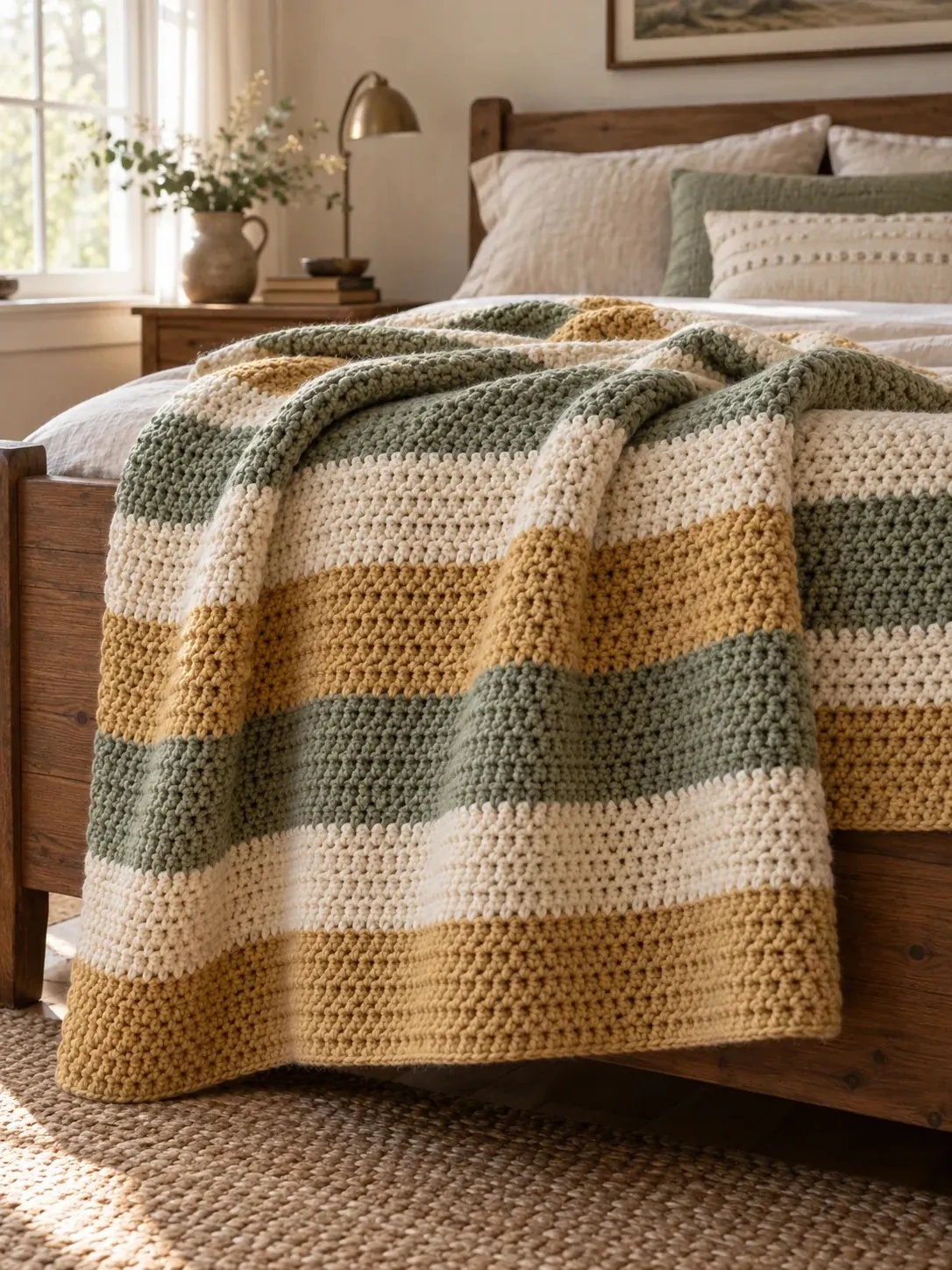
This single crochet blanket lives at the foot of our guest bed, folded in thirds and waiting for whoever drives up to Vermont for the weekend. It’s made of wide bands of mustard, cream and sage in bulky yarn, and every row is the same plain single crochet, back and forth. I named it for the slow Saturdays it was made on: one stripe after breakfast, and sometimes another once the coffee had gone cold.
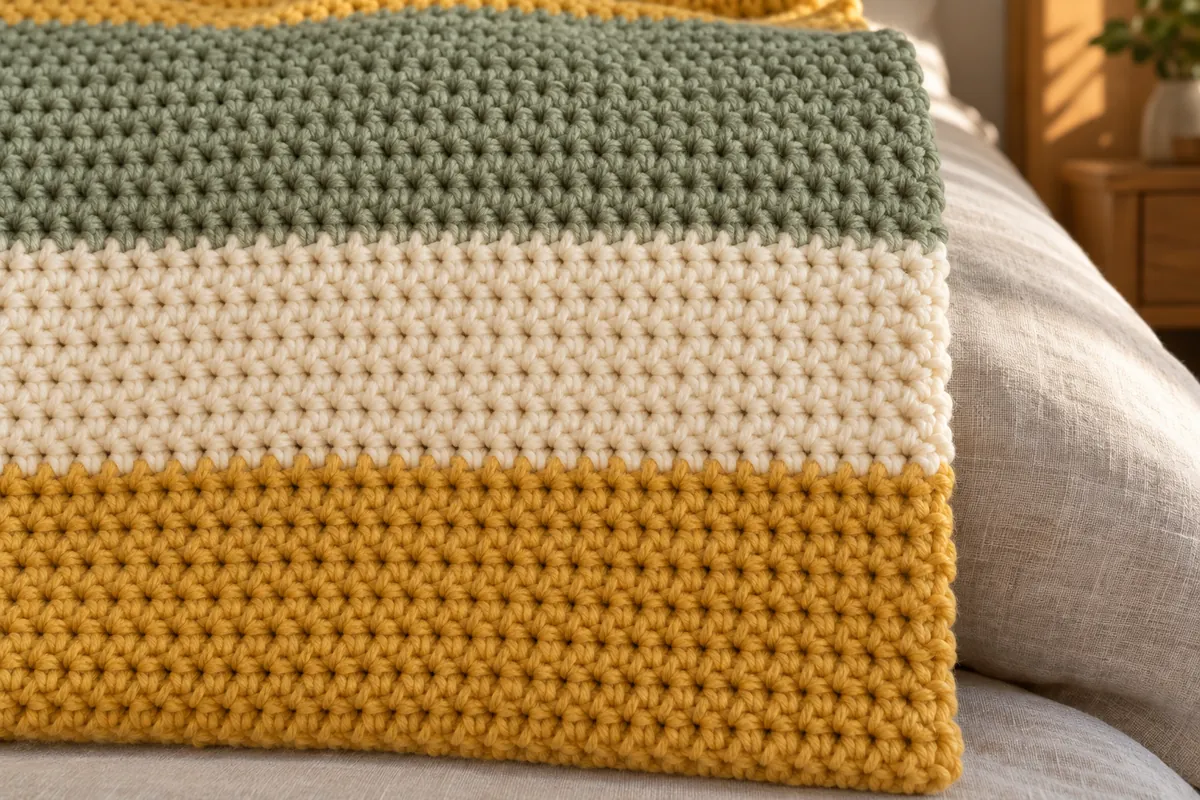
The throw in the pattern is about 50 × 62 in (127 × 158 cm). That’s 112 stitches across and 156 rows, split into 13 stripes of 12 rows each. There’s no border to add at the end, so the side edges you crochet are the edges you keep, and the tips below spend a little time on keeping them straight. One small difference from the photo: on the far side of the bed, a cream stripe follows a sage one. The pattern keeps a strict mustard, cream, sage order from bottom to top.
Is a single crochet blanket like this one right for your first throw?
If you can make a chain and a single crochet, you already know every stitch in it. Each row is 112 sc, and you start it with a ch 1 that doesn’t count as a stitch.
The one new skill is the color change, and it’s smaller than it sounds. On the last stitch of a stripe, work the single crochet until you have 2 loops on your hook, then pull the new color through those 2 loops instead of the old one. The new color is already on your hook when you chain 1 and turn, so the next stripe starts with a clean line.
That’s why I’ve rated it Beginner. Nothing here is tricky; the challenge is staying with it. Each stripe is 1,344 stitches, and you’ll make 13 of them.
If notation like sc or (112 sc) is new to you, the Beginner Guide explains how to read a crochet pattern. And if you’d like rows that grow a bit faster, my cream, sage and taupe throw in half double crochet uses a taller stitch in the same bulky weight.
Bulky yarn on a bigger hook for softer single crochet
Look for a 5 on the label, often sold as bulky or chunky. Single crochet is the densest of the basic stitches, so I work this blanket on an 8 mm (US L-11) hook, which is at the large end of what most bulky labels suggest. The bigger loops loosen the fabric enough that it folds over the end of a bed instead of standing up like a mat.
Acrylic is the easy choice. It’s soft and machine washable, and most brands carry all three shades in one line, which keeps the stripes the same thickness. A wool-acrylic blend is warmer and a bit springier. I’d skip 100% cotton at this size. Bulky cotton in single crochet is heavy, and a 62 in (158 cm) length of it stretches every time you lift it.
Buy all the skeins of one color at the same time and check that they share a dye lot number. With five mustard stripes, a skein from a different lot can show up as one stripe that’s slightly greener or browner than the others. Mixing brands is riskier: one stripe can come out wider.
Before you switch to a different yarn, make a swatch. Chain 17, work 16 sc for 14 rows, and measure 4 in (10 cm) in the middle. You want 9 sc and 10 rows. If you count more stitches, your blanket will come out smaller and use more yarn, so go up a hook size. If you count fewer, go down one.
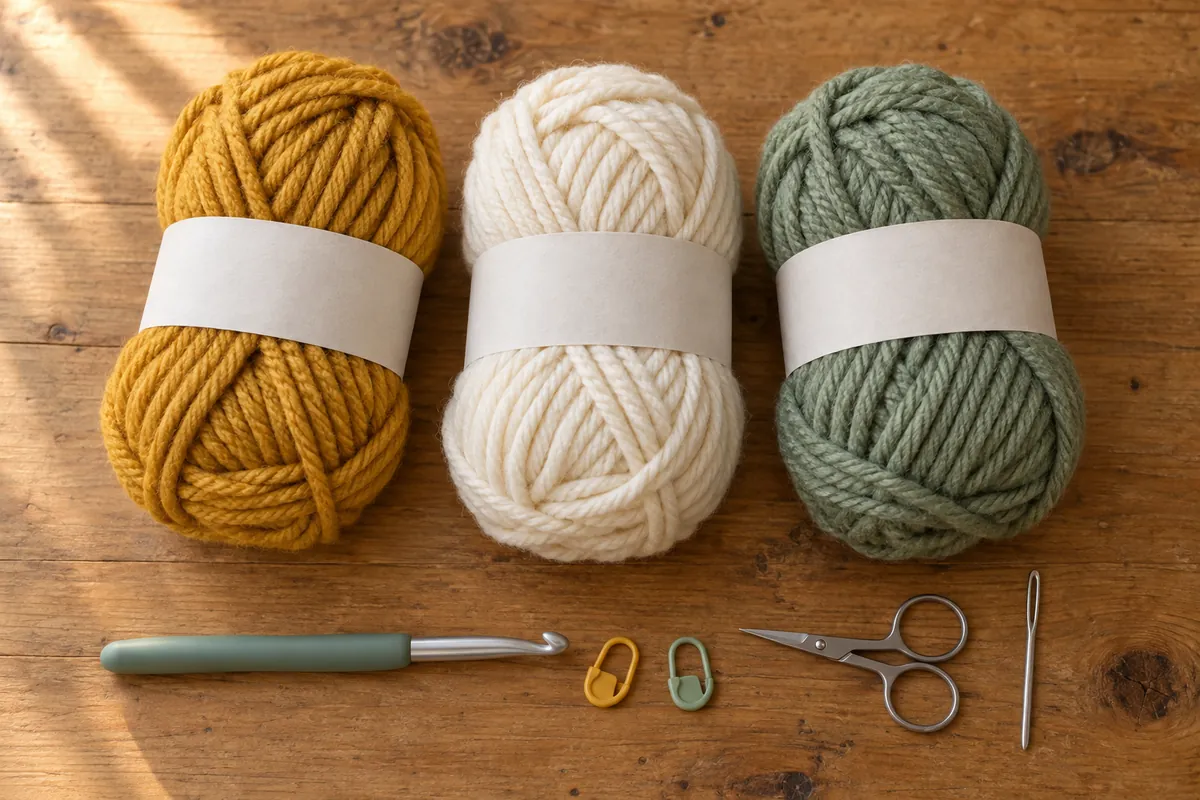
Mustard, cream and sage in 12-row bands
Mustard is Color A. It starts the blanket and finishes it, so it makes 5 of the 13 stripes and covers both short ends. Cream, Color B, always sits between mustard and sage, so the two darker shades never touch. Sage, Color C, cools the mustard down and keeps the whole thing from reading too yellow. Each band is 12 rows, about 4.8 in (12 cm) tall.
If these aren’t your colors, keep the same roles: one warm shade, one light, one muted. Some combinations I’d happily put on a bed:
- Rust, oatmeal and slate blue: deeper, and good against dark wood furniture.
- Blush, ivory and eucalyptus: softer, for a room with white sheets and lots of light.
- Mustard, charcoal and cream: more graphic, if your bedroom leans modern.
- Terracotta, sand and olive: earthy, close to the original in mood.
Before buying, lay the three skeins side by side and take a black-and-white photo. The light color should clearly stand out from the other two. If the warm and muted shades turn into the same gray, that’s fine for this pattern, because the light stripe always separates them.
Weekend Stripe in lap, throw, twin and queen sizes
The pattern is written for the throw. For another size, change the foundation chain and the number of stripes. Each stripe stays at 12 rows, and the number of stripes is always one more than a multiple of 3, so every size begins and ends with mustard.
- Lap, about 40 × 48 in (102 × 122 cm): ch 91 (90 sc), 10 stripes (120 rows). Yarn: 450 yd (411 m) of mustard, 350 yd (320 m) each of cream and sage.
- Throw, about 50 × 62 in (127 × 158 cm): ch 113 (112 sc), 13 stripes (156 rows). Yarn: 700 yd (640 m) of mustard, 550 yd (503 m) each of cream and sage. This is the size in the pattern.
- Twin, about 66 × 91 in (167 × 232 cm): ch 149 (148 sc), 19 stripes (228 rows). Yarn: 1,300 yd (1,189 m) of mustard, 1,100 yd (1,006 m) each of cream and sage.
- Queen, about 90 × 91 in (228 × 232 cm): ch 203 (202 sc), 19 stripes (228 rows). Yarn: 1,750 yd (1,600 m) of mustard, 1,500 yd (1,372 m) each of cream and sage.
Widths come from 9 sc per 4 in, lengths from 10 rows per 4 in. For the yarn, I allowed about 3.3 in (8.4 cm) of yarn per bulky single crochet, added 10% and rounded up to the next 50 yd. Treat those numbers as estimates, since your tension decides the real amount, and buy an extra skein of each color for the twin and queen.
To turn yardage into skeins, divide by the yardage on your label and round up. With 150 yd (137 m) skeins, the throw takes 5 skeins of mustard and 4 each of cream and sage.
For a baby-sized version in single crochet stripes, the peach and cream blanket I make for new babies fits a stroller.
Holding 112 stitches and tidying 26 tails
- Chain loosely. A tight foundation chain pulls the bottom edge in. Make the chain with a 9 mm (US M/N-13) hook, then switch to the 8 mm for Row 1.
- Mark both ends of the row. The first sc goes into the very first stitch, right at the base of your ch 1. The last sc goes into the last stitch, which hides just under the turning chain of the row below. Those are the two that get skipped. Clip a marker into each and move them up every few rows.
- Count by the stripe. Count every row of the first stripe, then once at the end of each 12-row stripe, while a mistake is still easy to pull back.
- Keep the ch 1 snug. A loose turning chain leaves a little loop at every row-end, and 156 of them make a wavy side. Keep it the size of one stitch.
- Cut, don’t carry. Each color waits 24 rows before it comes back, about 9.6 in (24 cm). Cut each color as you finish its stripe, leaving a 6 in (15 cm) tail.
- Weave tails into their own color. Thirteen stripes means 26 tails. Run each one along the row inside a stripe of the same color for about 3 in (8 cm), then back a few stitches. A cream tail woven into mustard will peek through.
US crochet terms
The pattern
Materials
- Bulky weight (#5) acrylic or wool-blend yarn, about 1,800 yd (1,646 m) in total (estimate):
- Color A, mustard: 700 yd (640 m)
- Color B, cream: 550 yd (503 m)
- Color C, sage: 550 yd (503 m)
- 8 mm (US L-11) crochet hook
- 9 mm (US M/N-13) crochet hook for the foundation chain (optional)
- 2 stitch markers
- Yarn needle and scissors
Gauge
9 sc and 10 rows = 4 in (10 cm) in single crochet on an 8 mm hook.
To check: ch 17, work 16 sc for 14 rows, and measure 4 in (10 cm) in the center of the swatch.
Finished size
About 50 × 62 in (127 × 158 cm), measured flat. There is no border.
Abbreviations
- ch chain
- sc single crochet
- st(s) stitch(es)
Notes
- The ch 1 at the start of each row does not count as a stitch. Every row has 112 sc.
- Stripe order, 12 rows each: A, B, C, repeated 4 times, then 1 more stripe of A (13 stripes, 156 rows).
- To change color: work the last sc of the stripe until 2 loops remain on the hook, drop the old color, yarn over with the new color and pull it through both loops. Ch 1 and turn with the new color.
- Cut the old color after each stripe, leaving a 6 in (15 cm) tail. Do not carry the yarn up the side: with no border, the strands would show.
- Place a marker in the first and last st of the row and move them up as you work.
- Other sizes: chain the number of sc you want plus 1, and work a number of stripes equal to a multiple of 3 plus 1, so the blanket starts and ends with A.
- Yardage is an estimate. Buy all skeins of each color from the same dye lot.
Instructions
Body
- Foundation: With A and the larger hook, ch 113. Switch to the 8 mm hook.
- Row 1: Sc in 2nd ch from hook and in each ch across, turn. (112 sc)
- Rows 2–12: Ch 1, sc in each st across, turn. (112 sc) Change to B on the last st of Row 12.
- Rows 13–24: With B, ch 1, sc in each st across, turn. (112 sc) Change to C on the last st of Row 24.
- Rows 25–36: With C, ch 1, sc in each st across, turn. (112 sc) Change to A on the last st of Row 36.
- Rows 37–144: Work the 3-stripe sequence 3 more times (12 rows with A, 12 rows with B, 12 rows with C), working every row as ch 1, sc in each st across, turn. Change color on the last st of every 12th row. (112 sc in every row)
- Rows 145–156: With A, ch 1, sc in each st across, turn. (112 sc) Do not turn after Row 156. Fasten off.
Finishing
- Ends: Weave in all 26 tails, each one into a stripe of its own color.
- Blocking: Wash or mist the blanket following the yarn label, lay it flat at 50 × 62 in (127 × 158 cm) and let it dry completely.
Washing three bulky stripes with cream in the middle
Wash the whole blanket the way the most delicate of your three yarns asks. For acrylic, a cool gentle cycle and a low tumble dry work well. Take it out while it’s still slightly damp and let it finish flat. A wool blend goes on a wool or hand-wash cycle in cold water, then dries flat, never in the dryer.
The cream stripes are the ones to protect. For the first wash, add a color-catcher sheet, because mustard and sage dye can tint a pale yarn, especially in wool blends. Wet bulky yarn is heavy, so lift the throw in your arms, not by one corner.
To store it, fold it in thirds and keep it on a shelf or at the foot of the bed. Hung over a door for months, single crochet slowly stretches in the rows that carry the weight.
Questions about the Weekend Stripe Blanket
Why is my single crochet blanket getting narrower?
You’re almost certainly skipping the last stitch of the row. It sits right under the turning chain of the row below and is easy to miss. Count your stitches, and if you’re under 112, pull back to the row where it started. The markers at both ends stop it from happening again.
Can I carry the yarn up the side instead of cutting it?
Not on this one. Each color is away for 24 rows, nearly 10 in (24 cm), and with no border those long strands would sit on the edge and snag. Cutting gives you more tails, but the edge stays clean.
Which side is the front?
Both sides of single crochet look alike, but the stripe lines don’t. One side shows a crisp line where a new color starts, and the other shows small dots of the old color. Every stripe begins on an odd-numbered row, so the crisp lines all land on the same side. Look after your first color change and pick the side you like.
Can I add a border?
Yes, even though the blanket in the photo has none. Join A at a corner and work 1 round of sc: 3 sc in each corner stitch, 1 sc in each st along the top and bottom, and 1 sc in each row-end along the sides. That’s 544 sc for the throw and about 60 yd (55 m) more of A. If the sides ripple, skip 1 row-end in every 10.
How long does the throw take?
It’s about 17,600 stitches. At 15 to 20 single crochets a minute, that’s roughly 15 to 20 hours of crocheting, plus an evening for the tails. One stripe is a little over an hour at a relaxed pace.
Quick recap
- Swatch with bulky yarn on an 8 mm (US L-11) hook until you get 9 sc and 10 rows in 4 in (10 cm).
- With mustard, ch 113 and work Row 1 (112 sc).
- Work 156 rows of sc in all, changing color every 12 rows: mustard, cream and sage four times, then a final mustard stripe.
- Cut each color as you finish it and weave the 26 tails into stripes of the same color.
- Lay the blanket flat at 50 × 62 in (127 × 158 cm) and let it dry.
I hope this single crochet blanket finds a place at the foot of your bed, or on the guest bed, ready for whoever’s coming for the weekend. If your count drifts or you’d like a size I haven’t listed, write to me and tell me what you’re making.