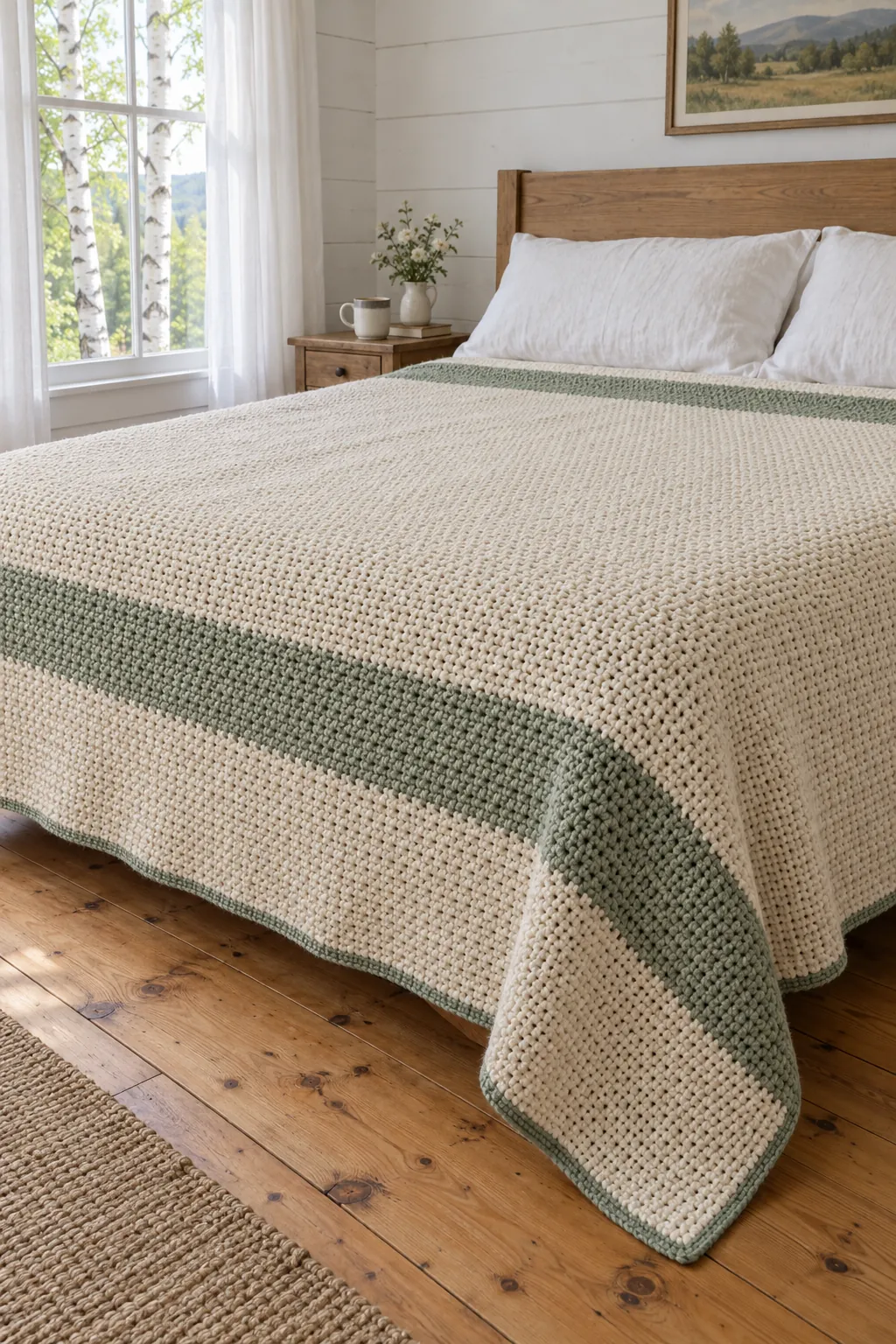
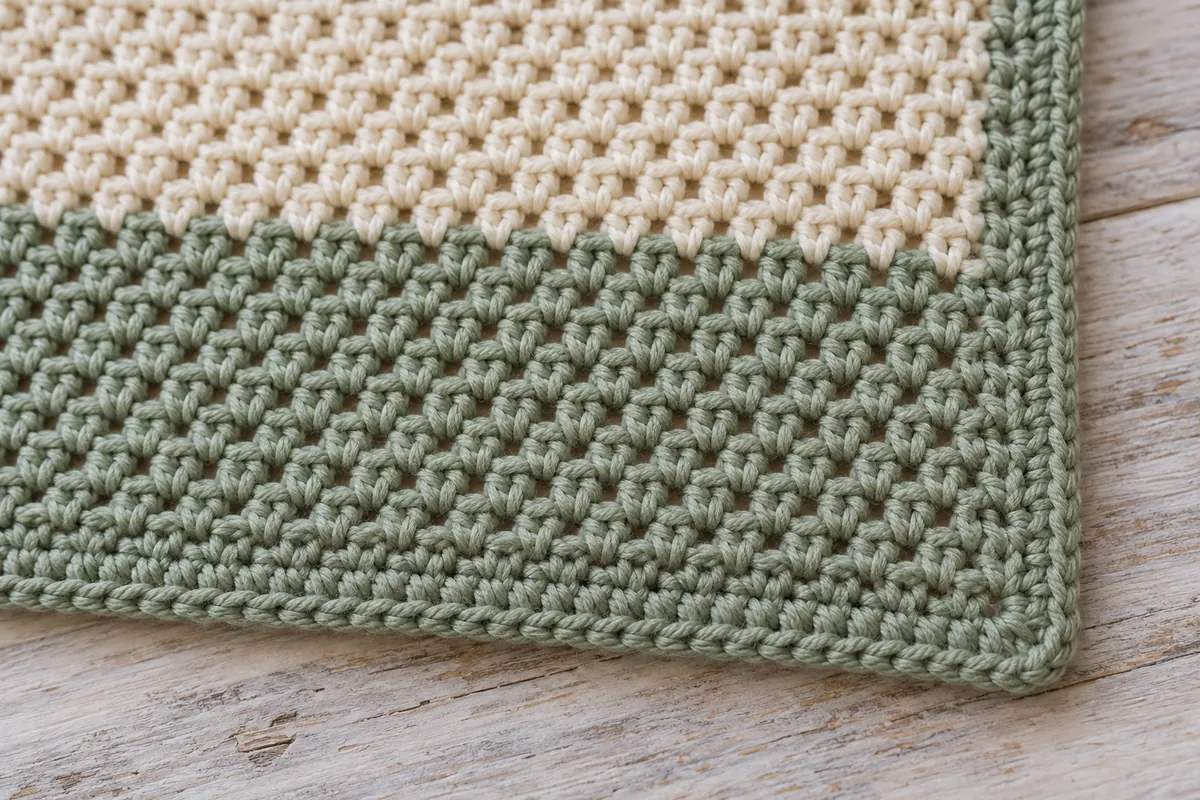
Picture a late-May morning in Vermont, the windows open for the first time since October and the birches outside finally in leaf. This king size crochet blanket was designed for that bed. It’s worked in moss stitch, a quiet checkerboard of single crochets and little chain spaces, in a warm cream called Birch, with a soft sage band near each end and a sage border all the way around.
The pattern is written for twin, queen and king, and all three use the same 401 rows. Only the width changes: 261, 357 or 429 stitches across. What makes it doable is that moss stitch has just two rows to learn, and after the first few inches you’ll be reading your fabric instead of counting it.
Is this king size crochet blanket a sensible first bed-size project?
It’s rated Easy. If you can make a chain and a single crochet, you already know every stitch in it. The challenge is the length of the job, not the technique.
Moss stitch works like this: every single crochet goes into the chain-1 space of the row below, and every chain-1 hops over a single crochet. So the stitches of one row sit in the gaps of the last one, like bricks in a wall, and the fabric ends up flat and a little nubbly. In this version, the first and last stitch of every row is a single crochet worked into the edge stitch, which gives you a solid column down each side and much straighter edges. That’s why Row 2 starts with two single crochets next to each other.
If abbreviations like “ch-1 sp” or “sk” are new to you, the guide to reading a pattern walks through them. And if you’d like to try the stitch on something you can finish in a couple of weekends, the bulky lap throw built on this same stitch makes a good rehearsal.
Worsted cotton blend on a 6 mm hook, for a bed you sleep under in June
Look for a 4 (worsted) on the label, ideally a cotton and acrylic blend close to half and half. Moss stitch is dense, so it eats yarn and it holds warmth. The cotton keeps it breathable on a warm night, and the acrylic keeps the weight down and helps it dry. An all-acrylic worsted works, but the blanket will feel warmer.
The 6 mm (J-10) hook is bigger than most worsted labels suggest, and that’s on purpose. On a smaller hook, moss stitch turns stiff and stands away from the mattress. At 6 mm it drapes over the side of the bed the way a coverlet should.
Yardage is based on balls of about 200 yd (183 m) per 3.5 oz (100 g). For the queen, that’s about 6,620 yd of Birch and 1,290 yd of Sage. Buy all of the Birch at once, from one dye lot: cream lots can differ by a shade, and on 345 rows of the same color a change shows up like a tan line. If you ever have to switch lots, do it at the end of a Sage band, where the color change already breaks the field.
Then work the gauge swatch in the card. You want 16 stitches and 18 rows over 4 in (10 cm), counting each single crochet and each chain-1. If you get 17 stitches instead, the king comes out about 6 in narrower, so go up half a hook size and try again.
Birch, Sage, and where the two bands fall
Birch is the field. It covers 345 of the 401 rows, so the moss stitch texture does most of the talking. Each Sage band is 28 rows, about 6 in (15 cm) wide, and starts 36 rows (about 8 in) from the end. On a queen or king, the foot band lands right at the end of the mattress. The two ends are identical, so you can turn the blanket around every season and let both halves wear evenly. The Sage border frames it and hides the wear that cream edges show first.
Moss stitch does something nice at a color change. The first Sage stitches drop into the spaces between the last Birch stitches, so the line between the two colors looks gently dotted rather than ruled. Combinations that work well with that soft line:
- Birch Hollow: warm cream and sage, as written.
- Sugarhouse: oatmeal with a maple-syrup brown.
- Lake Champlain: pale stone gray with slate blue.
- Rhubarb Patch: cream with a dusty rose.
Before you buy 40 balls of anything, hold one ball of each color side by side and take a black-and-white photo with your phone. If they come out almost the same gray, the bands will fade into the field from across the room.
Twin, queen and king at 90 inches long: stitches and yardage
All three sizes are 401 rows long and about 90 in (229 cm) with the border. The card gives every number as Twin [Queen, King].
- Twin, about 66 × 90 in (168 × 229 cm): ch 262, 261 sts per row. Border Round 1 has 1,244 sc and Round 2 has 1,252. About 5,820 yd (5,322 m): Birch 4,850 yd, Sage 970 yd. It hangs about 14 in over each side of a twin mattress.
- Queen, about 90 × 90 in (229 × 229 cm): ch 358, 357 sts per row. Border 1,436 sc, then 1,444. About 7,910 yd (7,233 m): Birch 6,620 yd, Sage 1,290 yd. About 15 in of drop on each side.
- King, about 108 × 90 in (275 × 229 cm): ch 430, 429 sts per row. Border 1,580 sc, then 1,588. About 9,470 yd (8,659 m): Birch 7,950 yd, Sage 1,520 yd. About 16 in of drop on each side.
These yardages are estimates, with the border, tails and about 10% extra included. Your tension can move them by hundreds of yards, so keep a ball or two in reserve until the border is done.
For a size of your own, chain any even number. Each row has one stitch fewer than the chain, and every 4 stitches make about 1 in of width. Keep an odd number of rows so you finish on a Row 3. If you’d rather have movement than texture on the same beds, a striped wave spread in worsted cotton covers twin through king as well.
Keeping 429 stitches honest across 401 rows of moss stitch
A chain of 430 tends to tighten as you go, and a tight chain makes the bottom edge pull in. Make it with a 6.5 mm hook, or just chain loosely, then switch to the 6 mm for Row 1. Clip a marker into every 50th chain. Counting 8 markers plus 30 chains is a lot calmer than counting 430 twice.
Row 1 is a built-in check. With an even chain, the last single crochet lands exactly in the last chain. One chain left over, or one short, means your count is off, so fix it before Row 2.
After that, trust the fabric. Every single crochet should sit in a gap, and every chain should sit on top of a single crochet. If you ever see two single crochets stacked straight on top of each other anywhere except the edge columns, you’ve worked into a stitch instead of a space. Pull back to that spot. A count of the single crochets at each color change is a good habit too: 179 on a Row 3 for the queen, 180 on a Row 2.
The ends of the rows are where moss stitch usually goes wrong. Row 2 begins with two single crochets side by side: one in the edge stitch, one in the first space. Row 3 ends with a chain-1, a skipped stitch and a single crochet in the very last stitch. Miss either of those and you’ll gain or lose a stitch on that edge.
By Row 200, a queen weighs around 4 lb. Work at a table, or rest the finished part folded on a footstool, so the weight doesn’t hang from your hook and stretch the newest rows.
US crochet terms
The pattern
Materials
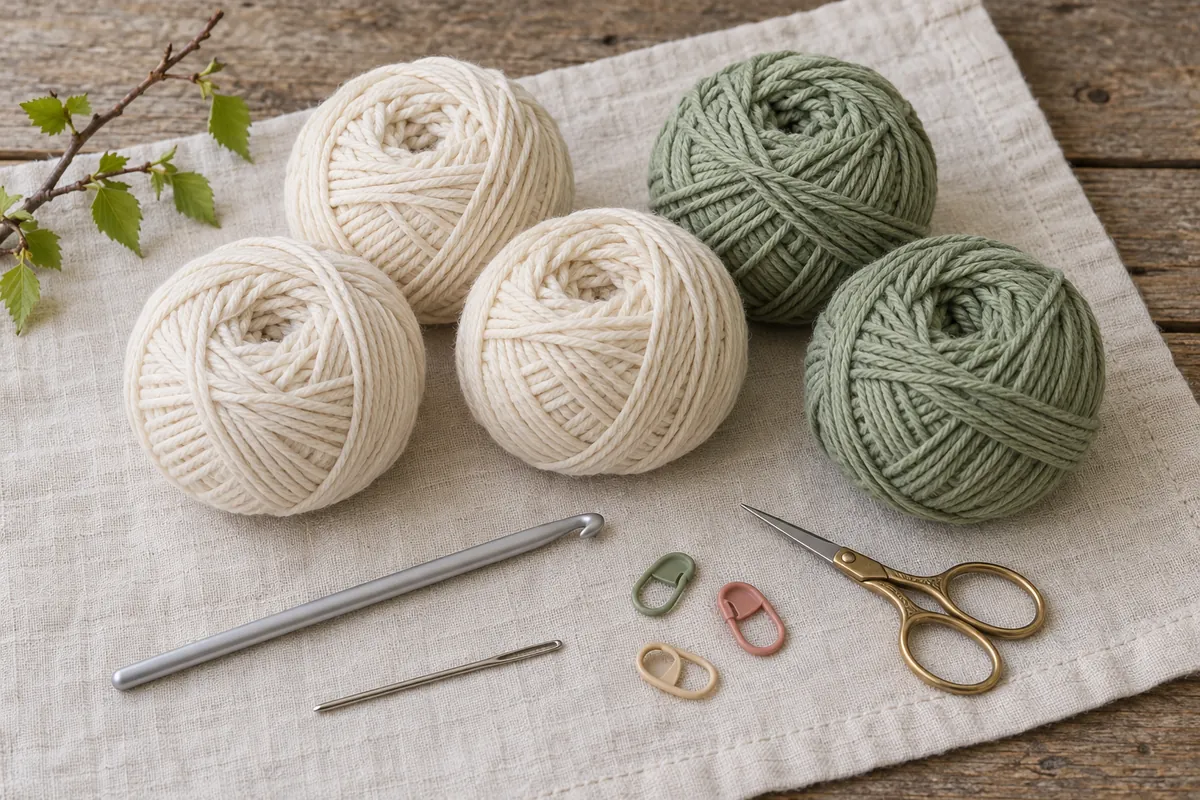
- Worsted weight (#4) cotton-acrylic blend yarn, about 200 yd (183 m) per 3.5 oz (100 g) ball. Estimated total, including about 10% extra: 5,820 [7,910, 9,470] yd (5,322 [7,233, 8,659] m).
- Birch (warm cream): 4,850 [6,620, 7,950] yd (4,435 [6,053, 7,269] m), 25 [34, 40] balls
- Sage (soft gray-green): 970 [1,290, 1,520] yd (887 [1,180, 1,390] m), 5 [7, 8] balls
- 6 mm (US J-10) crochet hook
- 6.5 mm (US K-10.5) crochet hook for the foundation chain (optional)
- About 10 locking stitch markers
- Yarn needle
- Scissors
Gauge
- 16 sts and 18 rows = 4 in (10 cm) in moss stitch with a 6 mm hook, counting each sc and each ch-1 as 1 st.
- Gauge swatch: ch 22. Work Rows 1–3 as written, then rep Rows 2–3 until you have 21 rows (21 sts per row). The swatch measures about 5 1/4 in (13.3 cm) wide and a little under 4 3/4 in (12 cm) tall. Measure the gauge over the middle.
Finished size
- Twin: about 66 × 90 in (168 × 229 cm).
- Queen: about 90 × 90 in (229 × 229 cm).
- King: about 108 × 90 in (275 × 229 cm).
- All sizes are measured after light blocking, including the border.
Abbreviations
- ch chain
- ch-1 sp chain-1 space
- rep repeat
- sc single crochet
- sk skip
- sl st slip stitch
- st(s) stitch(es)
- yo yarn over
Notes
- Sizes are written as Twin [Queen, King]. A single number applies to all sizes.
- The ch 1 at the beginning of each row is a turning chain and does not count as a st. Each sc and each ch-1 counts as 1 st. Every row has 261 [357, 429] sts.
- Stitch multiple: the foundation chain is any even number (multiple of 2). Each row has 1 st fewer than the chain, and 4 sts make about 1 in (2.5 cm) of width.
- Moss stitch: in the body, every sc is worked into a ch-1 sp and every ch-1 skips a sc, so the sc of each row sit between the sc of the row below. The first and last st of every row is a sc worked into the edge sc, which keeps the side edges straight.
- Color layout: Rows 1–36 Birch, Rows 37–64 Sage, Rows 65–337 Birch, Rows 338–365 Sage, Rows 366–401 Birch. The border is worked in Sage.
- To change color, work the last sc of the row until 2 loops remain on the hook, yo with the new color and draw it through both loops. Cut the old color, leaving a 6 in (15 cm) tail, and weave each tail into rows of its own color.
- Yardage is an estimate based on the gauge above. Buy each color from a single dye lot.
Instructions
Body
- Foundation: With Birch and the 6.5 mm hook (or the 6 mm hook, chaining loosely), ch 262 [358, 430], placing a marker in every 50th ch. Change to the 6 mm hook.
- Row 1: Sc in 2nd ch from hook, *ch 1, sk next ch, sc in next ch*; rep from * across, ending with a sc in the last ch. Remove the markers as you reach them. (261 [357, 429] sts: 131 [179, 215] sc and 130 [178, 214] ch-1 sps)
- Row 2: Ch 1 (does not count as a st), turn. Sc in first sc, sc in next ch-1 sp, *ch 1, sk next sc, sc in next ch-1 sp*; rep from * across to last sc, sc in last sc. (261 [357, 429] sts: 132 [180, 216] sc and 129 [177, 213] ch-1 sps)
- Row 3: Ch 1, turn. Sc in first sc, *ch 1, sk next sc, sc in next ch-1 sp*; rep from * until 2 sc remain, ch 1, sk next sc, sc in last sc. (261 [357, 429] sts: 131 [179, 215] sc and 130 [178, 214] ch-1 sps)
- Rows 4–401: Rep Rows 2–3 until you have 401 rows, ending with a Row 3, following the color layout in Notes: change to Sage at the end of Row 36, to Birch at the end of Row 64, to Sage at the end of Row 337 and to Birch at the end of Row 365. The body measures about 89 in (226 cm) from the foundation. At the end of Row 401, change to Sage in the last sc. (261 [357, 429] sts in every row)
Border
- Round 1: Ch 1, turn. Working across the top of Row 401, 3 sc in first sc, sc in each ch-1 sp and each sc across to last sc, 3 sc in last sc (265 [361, 433] sc). Working down the side in row ends, *sc in each of next 8 row ends, sk next row end*; rep from * 43 more times, sc in each of last 5 row ends (357 sc). Working in the free loops on the other side of the foundation ch, sk the first ch (the extra ch at this corner), 3 sc in next ch, sc in each ch across to last ch, 3 sc in last ch (265 [361, 433] sc). Working up the second side in row ends, rep the side sequence (357 sc). Join with sl st to first sc. (1,244 [1,436, 1,580] sc)
- Round 2: Ch 1, do not turn. Sc in same st as join, 3 sc in next sc, *sc in each sc to center sc of next 3-sc corner, 3 sc in center sc*; rep from * 2 more times, sc in each remaining sc; join with sl st to first sc. Fasten off. (1,252 [1,444, 1,588] sc)
- Finishing: Weave in all ends. Lay the blanket flat, mist it with water, pat the edges straight and let it dry completely.
Washing a queen or king in cream and sage cotton blend
Read your label first, but most cotton and acrylic blends take a cold, gentle machine wash. Add a color-catcher sheet for the first few washes, since each Sage band sits right against Birch on both sides. A blanket this size needs a large front-loader, so plan a trip to the laundromat.
Moss stitch is dense, and it holds a lot of water. Run an extra spin cycle, then tumble on low just until it’s damp, not bone dry. Finish drying it flat: over the bed it belongs to, or across two drying racks pushed together. Skip the clothesline. Wet cotton blend stretches under its own weight, and a 90-inch blanket can come down several inches longer than it went up. For storage over the winter, fold it in thirds across the Birch field, so the creases don’t land in the Sage bands, and keep it in a cotton bag rather than plastic.
Questions about Birch Hollow
How much does a finished king size crochet blanket like this weigh?
Going by the estimated yardage and a 200 yd per 100 g ball, the king comes in around 10 1/2 lb (4.7 kg), the queen around 8 3/4 lb (4 kg) and the twin around 6 1/2 lb (2.9 kg). In 100% cotton it would be noticeably heavier, which is one more reason to choose a blend.
Why does Row 2 start with two single crochets side by side?
Those two stitches are what keep the edge straight. The first one sits on top of the edge stitch from Row 1, and the second one goes into the first chain space, which is where the regular moss stitch pattern begins.
My fabric looks like plain single crochet with no little gaps. What went wrong?
You’re probably working into the single crochets instead of the chain spaces. In moss stitch, your hook only ever goes into the space under a chain, except at the two edge stitches. Pull back to the first row that looks solid and watch for the gap each time you insert your hook.
Can I put a Sage band at the foot only?
Yes. Work Rows 1–36 in Birch, Rows 37–64 in Sage, then Birch from Row 65 to the end. Use that end as the foot. You’ll need about 390 [540, 640] yd less Sage and the same amount more Birch.
Can I make it longer for a deep pillow-top mattress?
Add rows in pairs, in the long Birch section between the bands, so the bands stay 8 in from each end and you still finish on a Row 3. Every 10 extra rows add about 2 1/4 in (5.6 cm) and use about 140 [192, 230] yd of Birch. For the border sides, keep working 8 sc and skipping 1 row end, then work a sc in each remaining row end.
Quick recap
- Chain 262 [358, 430] in Birch, with a marker every 50 chains.
- Work Row 1 into the chain, then repeat Rows 2–3 of moss stitch for 401 rows.
- Work the two 28-row Sage bands at Rows 37–64 and 338–365.
- In Sage, work 2 rounds of sc around the whole blanket, with 3 sc in each corner.
- Weave in the ends, mist and pat the edges straight, then let it dry flat.
A king size crochet blanket is a long road, row after quiet row of the same two stitches. Then one day the second Sage band comes off your hook, and you can see the whole thing taking shape on the bed. If you choose your own color pair or work out a size for an unusual mattress, the contact page is always open for questions and notes.