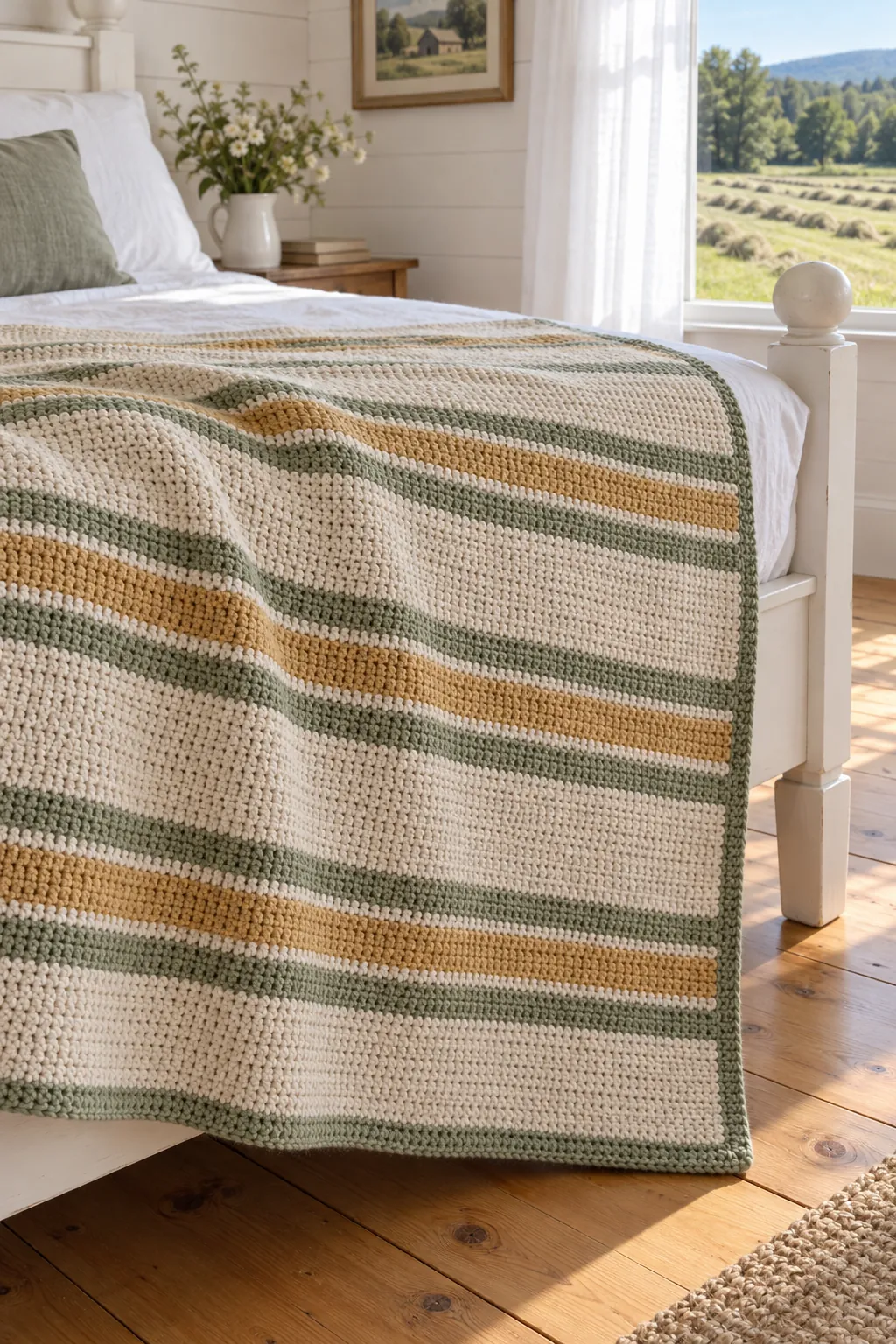
Picture a Vermont hayfield in late June, the cut rows drying in the sun and a green hedge along the stone wall. The Hayfield Coverlet borrows those colors: a soft oat background, narrow bands of sage, and a wheat-gold stripe at the heart of every repeat. It’s an extended half double crochet blanket, worked flat in rows from one short end to the other and sized for a twin, full or queen bed.
The stripes follow one 15-row repeat that reads the same from either side of the wheat: six rows of oat, two of sage, one of oat, three of wheat, one of oat, two of sage. Because the sequence mirrors around that wheat band, the coverlet looks balanced whichever end you’re standing at. Three rounds of sage single crochet frame it all.
Is this extended half double crochet blanket right for a first big project?
Yes, if you can already make a chain and a half double crochet. The main stitch, the extended half double crochet (ehdc), starts like an hdc: yarn over, insert the hook, pull up a loop. Then you yarn over and pull through just one loop, which leaves three loops on the hook, and a last yarn over through all three finishes it. That one extra pull makes the stitch a little taller and looser than a plain hdc, so the fabric falls over the side of a bed instead of standing stiff. The border is plain single crochet.
Every row is worked the same way, and colors only change at the end of a row. The turning chain is ch 2 and it never counts as a stitch, so each row starts in the very first stitch. If an abbreviation in the card is new to you, the Beginner Guide explains how to read a crochet pattern.
What makes this a big project is length, not difficulty: the twin has 218 stitches per row and 201 rows, about 44,000 stitches before the border.
Cotton-blend worsted for a spring and summer bed
Look for the number 4 on the label, the worsted symbol, and pair it with a 5.5 mm (I-9) hook. A cotton and acrylic blend, roughly half and half, suits this coverlet best. The cotton keeps it cool and matte on a warm night, and the acrylic keeps it lighter and less prone to stretching than pure cotton. It’s still heavy: at about 200 yd per 3.5 oz (100 g) skein, the twin weighs around 6 lb (2.7 kg) and the queen around 9 lb (4.1 kg). Pure cotton would be heavier again, and the long rows could slowly grow.
Skip splitty yarns with loose plies: the hook goes under both loops 218 to 310 times a row, and a splitty yarn snags on each one.
Buy each color in a single dye lot, and all the oat at once: it covers 110 of the twin’s 201 rows, and a lot change in a six-row oat band shows in daylight. If you substitute, compare yardage per skein, since cotton blends range widely in yards per 100 g.
Before you commit to 14 skeins of oat, make a gauge swatch. Ch 24, work Row 1 into the 3rd ch from the hook (22 stitches), then 11 more rows. Measure in the middle: you want 14 stitches and 9 rows in 4 in (10 cm). With more stitches than that, go up to a 6.0 mm (J-10) hook. With fewer, go down to 5.0 mm (H-8). One stitch off per 4 in changes the twin’s width by 4 to 5 in.
Oat, sage and wheat in a mirrored 15-row repeat
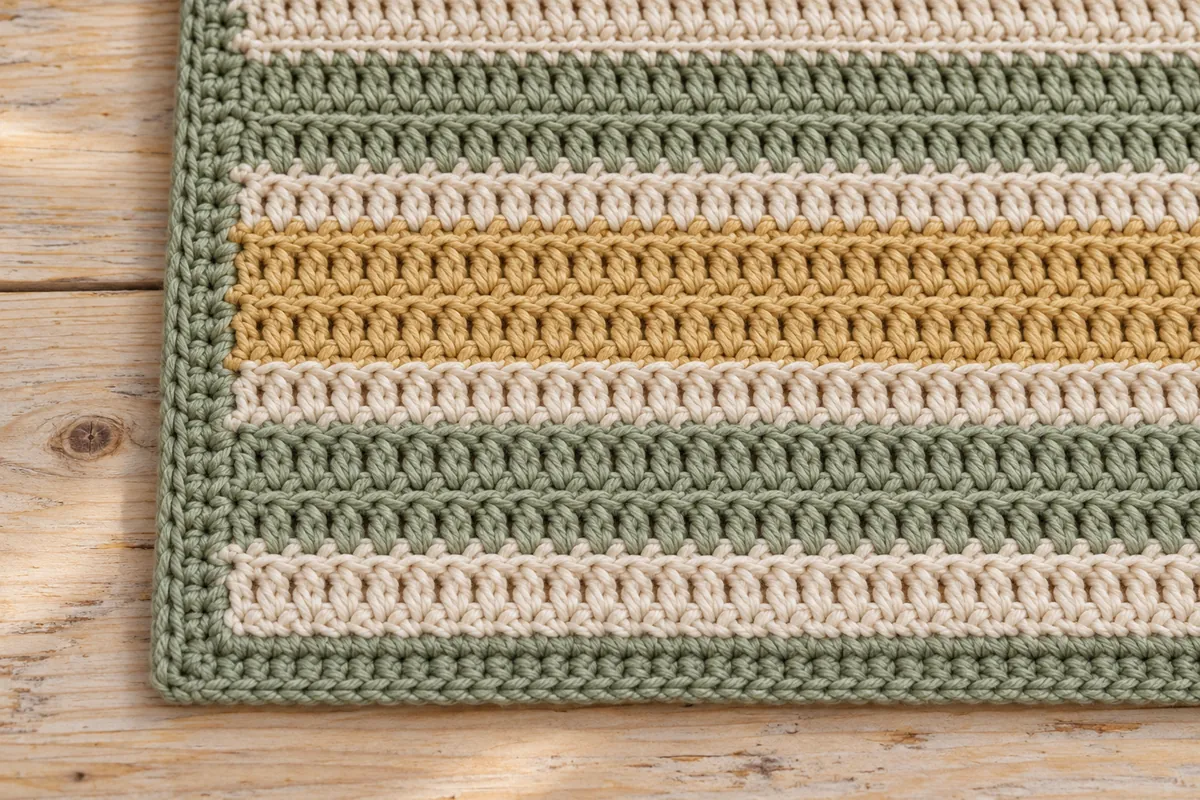
Oat is the ground color. It takes the wide six-row bands and the single rows that sit on each side of the wheat. Sage brackets the wheat with a pair of two-row stripes, and wheat is the warm accent in the center, three rows tall. Each repeat holds 8 rows of oat, 4 of sage and 3 of wheat, and the coverlet starts and ends with six oat rows so both short ends match.
If you change the palette, keep those roles: a quiet ground, a medium color for the paired stripes and a warmer or deeper accent.
- Hayfield: oat, sage and wheat, as written.
- Sugar Snap: cream, pea green and pale butter yellow.
- Rhubarb Patch: oatmeal, dusty rose and deep raspberry.
- Blueberry Barrens: natural white, soft denim blue and lavender gray.
- Lake Champlain: ivory, gray-blue and sandy tan.
Before you buy, lay the skeins in stripe order: oat, sage, oat, wheat, oat, sage. The single oat rows are under 1/2 in tall, so a medium color and accent close in value will read as one muddy band. Squint at the line, and if two colors blur together, swap one.
Twin, full or queen: 218 to 310 stitches and 13 or 14 repeats
The foundation chain works with any number of stitches plus 2, so the width can match any bed. Length comes from the 15-row repeats, each about 6 2/3 in (17 cm), plus six closing oat rows, and the border adds about 3/4 in on every side. The card lists sizes as twin [full, queen]. Every yardage is an estimate with about 10% extra built in.
- Twin: about 64 × 91 in (162 × 231 cm). Ch 220 for 218 stitches, 201 rows (13 repeats plus 6 oat rows), 1,048 sc in border Round 1. About 2,800 yd oat, 1,600 yd sage and 1,000 yd wheat.
- Full: about 80 × 91 in (203 × 231 cm). Ch 276 for 274 stitches, 201 rows, 1,160 sc in border Round 1. About 3,500 yd oat, 1,950 yd sage and 1,250 yd wheat.
- Queen: about 90 × 97 1/2 in (229 × 248 cm). Ch 312 for 310 stitches, 216 rows (14 repeats plus 6 oat rows), 1,276 sc in border Round 1. About 4,250 yd oat, 2,350 yd sage and 1,550 yd wheat.
The twin and full hang about 13 in over each side of their mattresses (38 and 54 in wide) and about 16 in past the foot. The queen drops about 15 in on each side of a 60 in queen and 17 in at the foot.
If a bed-size piece feels like too much for a first blanket, a bulky throw in plain single crochet rows has the same row-by-row rhythm in far fewer stitches. For waves instead of straight bands on a bed, there’s a worsted ripple sized for a mattress.
Straight sides and steady counts across 201 rows
Chain with a bigger hook. Make the foundation chain with a 6.0 mm (J-10) hook, then switch to 5.5 mm for Row 1. A tight chain pulls the bottom edge in, and the first oat band ends up narrower than the last.
Mark every 50. Clip a locking marker every 50 chains, move each one into Row 1 as you reach it, then move them up every 10 rows. Counting 310 stitches from zero is where mistakes slip in.
Find the end stitches on purpose. The ch 2 doesn’t count, so the first ehdc goes into the stitch right at the base of the chain. At the far end, the last stitch sits tucked against the turning chain of the row below and is easy to miss. One skipped stitch at the edge every few rows is enough to make the long sides wander.
Count at every color change. The twin changes color 78 times. Each change is a natural checkpoint: count before you join the new yarn, and you’ll catch a missing stitch while it’s only one row back.
Measure each repeat. Every 15 rows should add about 6 2/3 in. If the piece grows faster, your tension has relaxed with the rhythm, so tighten up or drop to a 5.0 mm hook.
Weave tails into their own color. The twin leaves 158 tails. Run each one back along its own row so an oat tail never shows through a sage stripe.
US crochet terms
The pattern
Materials
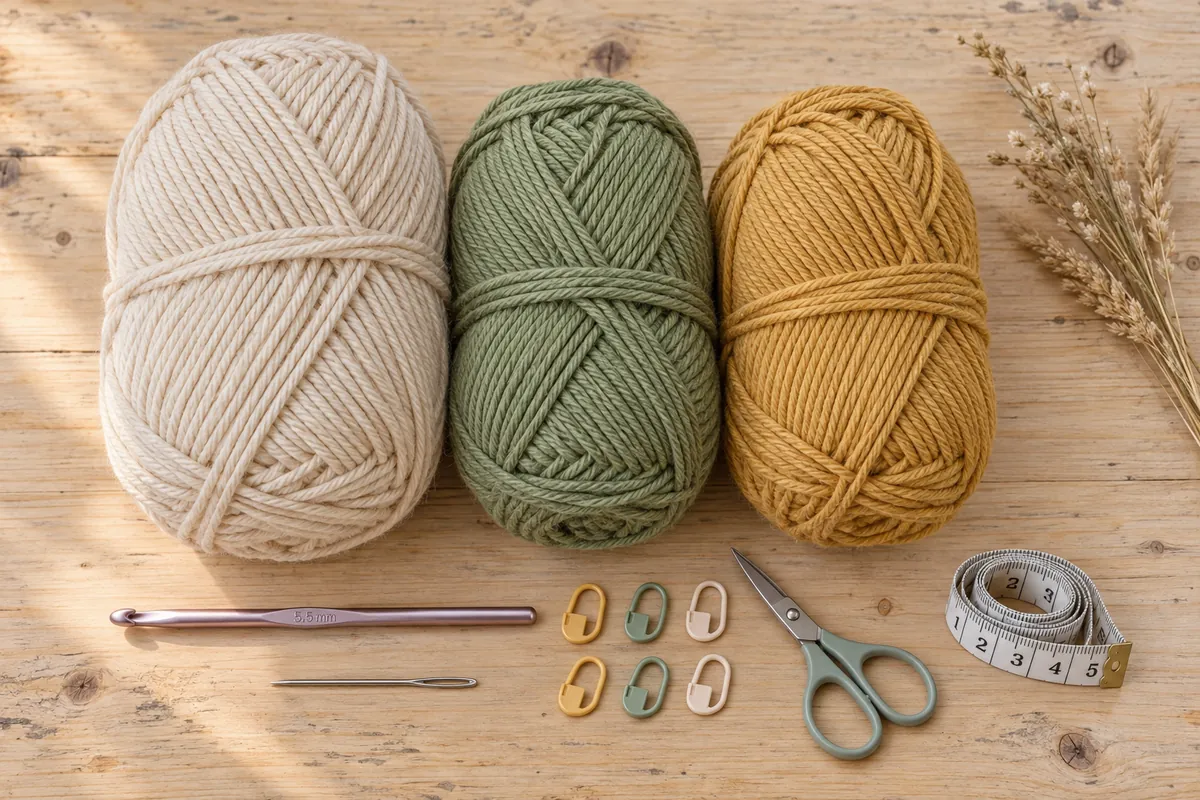
- Worsted weight yarn (CYC #4 Medium), cotton and acrylic blend (about 50/50), about 200 yd (183 m) per 3.5 oz (100 g) skein. Estimated yardage:
- Oat: 2,800 [3,500, 4,250] yd (2,560 [3,200, 3,886] m), 14 [18, 22] skeins.
- Sage: 1,600 [1,950, 2,350] yd (1,463 [1,783, 2,149] m), 8 [10, 12] skeins.
- Wheat: 1,000 [1,250, 1,550] yd (914 [1,143, 1,417] m), 5 [7, 8] skeins.
- Total: about 5,400 [6,700, 8,150] yd (4,938 [6,126, 7,452] m).
- 5.5 mm (I-9) crochet hook.
- 6.0 mm (J-10) crochet hook, for the foundation chain.
- Yarn needle, scissors and tape measure.
- 6 locking stitch markers.
Gauge
- 14 sts and 9 rows = 4 in (10 cm) in ehdc rows with the 5.5 mm (I-9) hook.
- Gauge swatch: ch 24, work Row 1 (22 sts), then 11 more rows as Row 2. The swatch measures about 6 1/4 in (16 cm) wide and 5 1/4 in (13.5 cm) tall. Measure in the middle.
- One 15-row stripe repeat = about 6 2/3 in (17 cm).
Finished size
- Twin: about 64 × 91 in (162 × 231 cm).
- Full: about 80 × 91 in (203 × 231 cm).
- Queen: about 90 × 97 1/2 in (229 × 248 cm).
- Measured flat after light blocking, border included.
Abbreviations
- ch chain
- ehdc extended half double crochet
- rep repeat
- sc single crochet
- sl st slip stitch
- st(s) stitch(es)
- yo yarn over
Notes
- Sizes are written as twin [full, queen]. A single number applies to all sizes.
- ehdc (extended half double crochet): yo, insert hook in st, yo and pull up a loop (3 loops on hook), yo and pull through 1 loop (3 loops on hook), yo and pull through all 3 loops.
- The ch 2 at the start of each row does not count as a st, in every row. Work the first ehdc of each row in the first st, at the base of the ch 2. In the border, the ch 1 at the start of a round does not count as a st either.
- Stitch multiple: foundation ch = any number of sts + 2. Ch 220 [276, 312] gives 218 [274, 310] sts.
- Stripe sequence (15 rows): 6 rows Oat, 2 rows Sage, 1 row Oat, 3 rows Wheat, 1 row Oat, 2 rows Sage. Each repeat uses 8 rows of Oat, 4 of Sage and 3 of Wheat. The coverlet ends with 6 rows of Oat so both short ends match.
- Color change: work the last ehdc of the row up to its final yo (3 loops on hook), drop the old color, yo with the new color and pull through all 3 loops. Cut the old color, leaving a 6 in (15 cm) tail. Ch 2 with the new color and turn.
- Make the foundation ch with the 6.0 mm (J-10) hook, placing a marker every 50 ch, then switch to the 5.5 mm (I-9) hook for Row 1.
- To resize: change the foundation ch for width (any number of sts + 2) and add or remove whole 15-row repeats for length, always ending with 6 rows of Oat. Each repeat adds about 6 2/3 in (17 cm).
- Total rows: 201 [201, 216].
Instructions
Body
- Foundation: with Oat and the 6.0 mm (J-10) hook, ch 220 [276, 312]. Change to the 5.5 mm (I-9) hook.
- Row 1 (Oat): ehdc in 3rd ch from hook (2 skipped ch do not count as a st), ehdc in each ch across. Turn. (218 [274, 310] ehdc)
- Row 2 (Oat): ch 2 (does not count as a st), ehdc in first st and in each st across. Turn. (218 [274, 310] ehdc)
- Rows 3–6 (Oat): rep Row 2, changing to Sage at end of Row 6. (218 [274, 310] ehdc)
- Rows 7–8 (Sage): rep Row 2, changing to Oat at end of Row 8. (218 [274, 310] ehdc)
- Row 9 (Oat): rep Row 2, changing to Wheat. (218 [274, 310] ehdc)
- Rows 10–12 (Wheat): rep Row 2, changing to Oat at end of Row 12. (218 [274, 310] ehdc)
- Row 13 (Oat): rep Row 2, changing to Sage. (218 [274, 310] ehdc)
- Rows 14–15 (Sage): rep Row 2, changing to Oat at end of Row 15. (218 [274, 310] ehdc; first stripe repeat done)
- Rows 16–195 [16–195, 16–210]: work the stripe sequence of Rows 1–15 another 12 [12, 13] times, working every row as Row 2 and changing colors as set, ending with a Sage row and changing to Oat. (218 [274, 310] ehdc; 13 [13, 14] repeats done)
- Check: the piece measures about 86 2/3 [86 2/3, 93 1/3] in (220 [220, 237] cm) long.
- Rows 196–201 [196–201, 211–216] (Oat): rep Row 2. Fasten off at end of last row. (218 [274, 310] ehdc; 201 [201, 216] rows in total)
Border
- Round 1: with the last row along the top, join Sage with sl st in first st of last row. Ch 1 (does not count as a st), 3 sc in same st (corner), sc in each st across to last st, 3 sc in last st (corner). Working down the side in row ends: 2 sc in end of each odd-numbered row and sc in end of each even-numbered row. Working along the opposite side of the foundation ch, into the 218 [274, 310] ch that hold the sts of Row 1: 3 sc in first of these ch (corner), sc in each of next 216 [272, 308] ch, 3 sc in last of these ch (corner). Working up the other side in row ends: 2 sc in end of each odd-numbered row and sc in end of each even-numbered row. Join with sl st in first sc. (216 [272, 308] sc across top and bottom, 302 [302, 324] sc along each side, 3 sc at each corner; 1,048 [1,160, 1,276] sc)
- Round 2: ch 1 (does not count as a st), do not turn. Sc in first sc, 3 sc in next sc (corner), *sc in each sc across to center sc of next corner, 3 sc in center sc; rep from * 2 more times, sc in each remaining sc, join with sl st in first sc. (218 [274, 310] sc across top and bottom, 304 [304, 326] sc along each side, 3 sc at each corner; 1,056 [1,168, 1,284] sc)
- Round 3: ch 1 (does not count as a st), sc in first 2 sc, 3 sc in next sc (corner), *sc in each sc across to center sc of next corner, 3 sc in center sc; rep from * 2 more times, sc in each remaining sc, join with sl st in first sc. Fasten off. (220 [276, 312] sc across top and bottom, 306 [306, 328] sc along each side, 3 sc at each corner; 1,064 [1,176, 1,292] sc)
Finishing
- Weave in each tail along the back of sts of its own color.
- Lay the coverlet flat, mist it with water, pat the edges straight and let it dry completely.
Washing a cotton-blend coverlet with oat beside sage and wheat
Sage and wheat sit right against pale oat, so soak a short length of each beside a strip of oat in warm water for ten minutes before the first wash. If any color tints the oat, add a color-catching sheet to the first few washes.
Wash cold on a gentle cycle with a mild detergent and no bleach, which can yellow the oat and fade the sage. A dry twin weighs about 6 lb and a wet one far more, so use a large front-loading machine, at a laundromat if yours is small. Tumble dry on low until the coverlet is just damp, then lay it flat to finish. Hanging a wet cotton blend over a railing stretches the ehdc rows lengthwise.
Store it folded in a cotton bag, out of direct sun, which fades wheat gold faster than the other colors.
Hayfield Coverlet questions, from foundation chain to last sage round
What does an extended half double crochet blanket feel like compared to plain hdc rows?
It’s softer and drapes more. The extra pull-through adds a little height and a looser body to each stitch, so the fabric bends easily over the edge of a mattress. The rows also grow a bit faster than hdc rows would. The trade-off is slightly more yarn per stitch.
Why does each row start with ch 2 if it doesn’t count as a stitch?
An ehdc stands taller than an hdc, and a ch 1 is too short to lift the yarn to row height, so the edge pulls tight and puckers. Ch 2 brings the yarn up to the right height. Because it never counts, the first ehdc always goes into the first stitch and every row keeps 218 [274, 310] stitches.
Can I swap the sage and wheat stripes?
Yes. As long as each repeat stays 15 rows, the row counts and border numbers don’t change. Wheat then takes the paired two-row stripes and sage the three-row center, so buy the sage yardage in wheat and the wheat yardage in sage.
How do I make the coverlet longer or shorter without breaking the stripe sequence?
Add or remove whole 15-row repeats and always finish with the six oat rows. Each repeat adds about 6 2/3 in and roughly 380 [475, 540] yd across all three colors. In border Round 1, keep the rule of 2 sc in each odd-numbered row and 1 sc in each even-numbered row, which adds 22 or 23 sc per side for every extra repeat.
Is a cotton blend too heavy for the queen?
It’s heavy, around 9 lb, though spread across a bed it feels like a solid summer coverlet rather than a weight on your chest. For something lighter, choose a blend with more acrylic than cotton, or make the full, which saves about 1 1/2 lb.
Quick recap
- Chain 220 [276, 312] with the 6.0 mm hook and work Row 1 of ehdc with the 5.5 mm hook.
- Work the 15-row stripe repeat 13 [13, 14] times: 6 oat, 2 sage, 1 oat, 3 wheat, 1 oat, 2 sage.
- Finish with 6 rows of oat so both ends match.
- Work 3 rounds of sage sc around the edge, with 3 sc in each corner.
- Weave each tail into its own color, then mist and dry the coverlet flat.
When the last sage round is joined, spread the Hayfield Coverlet over the bed and check that the oat bands sit level at both ends. If a count in this extended half double crochet blanket doesn’t match what’s on your hook, send a note through the Contact page.