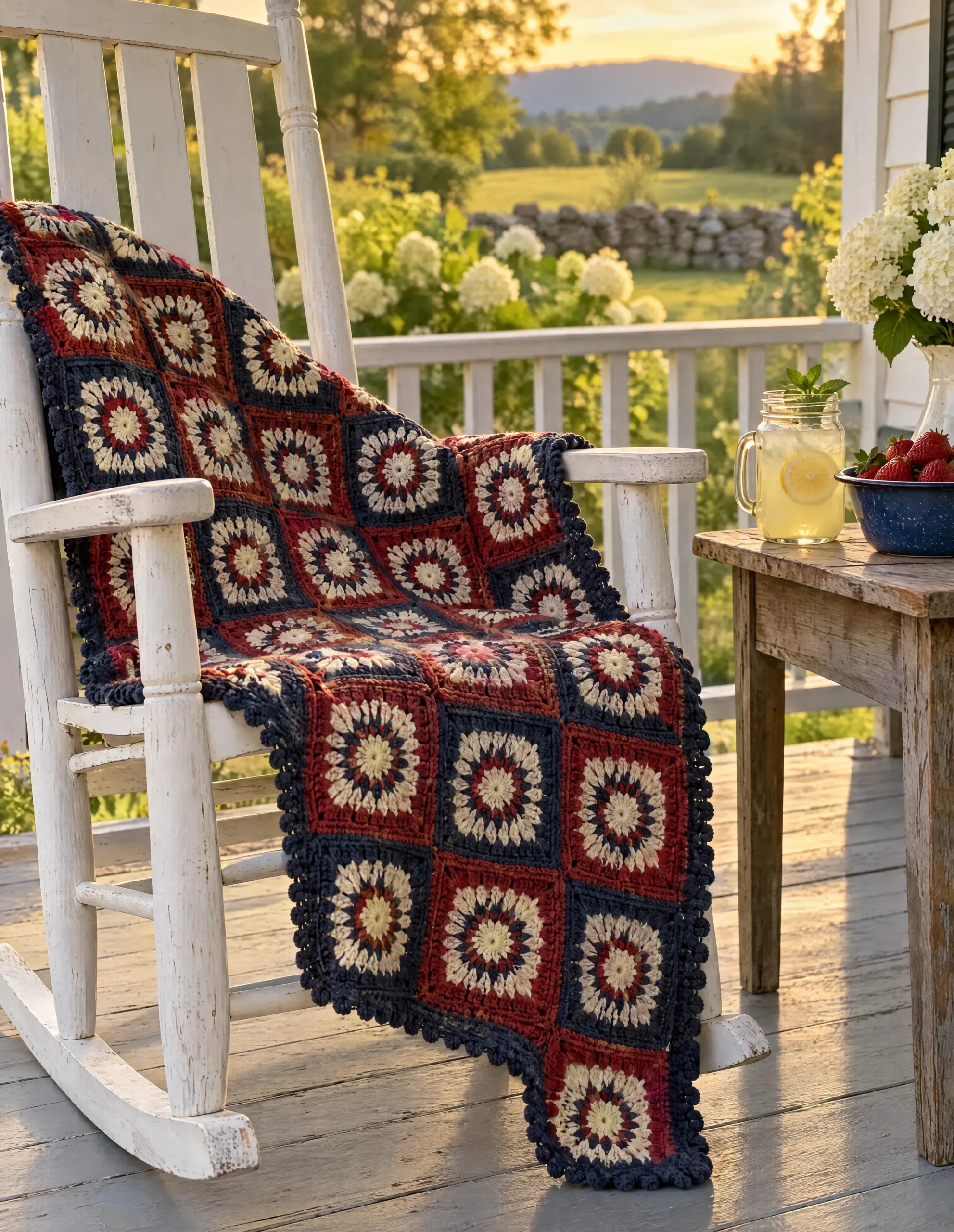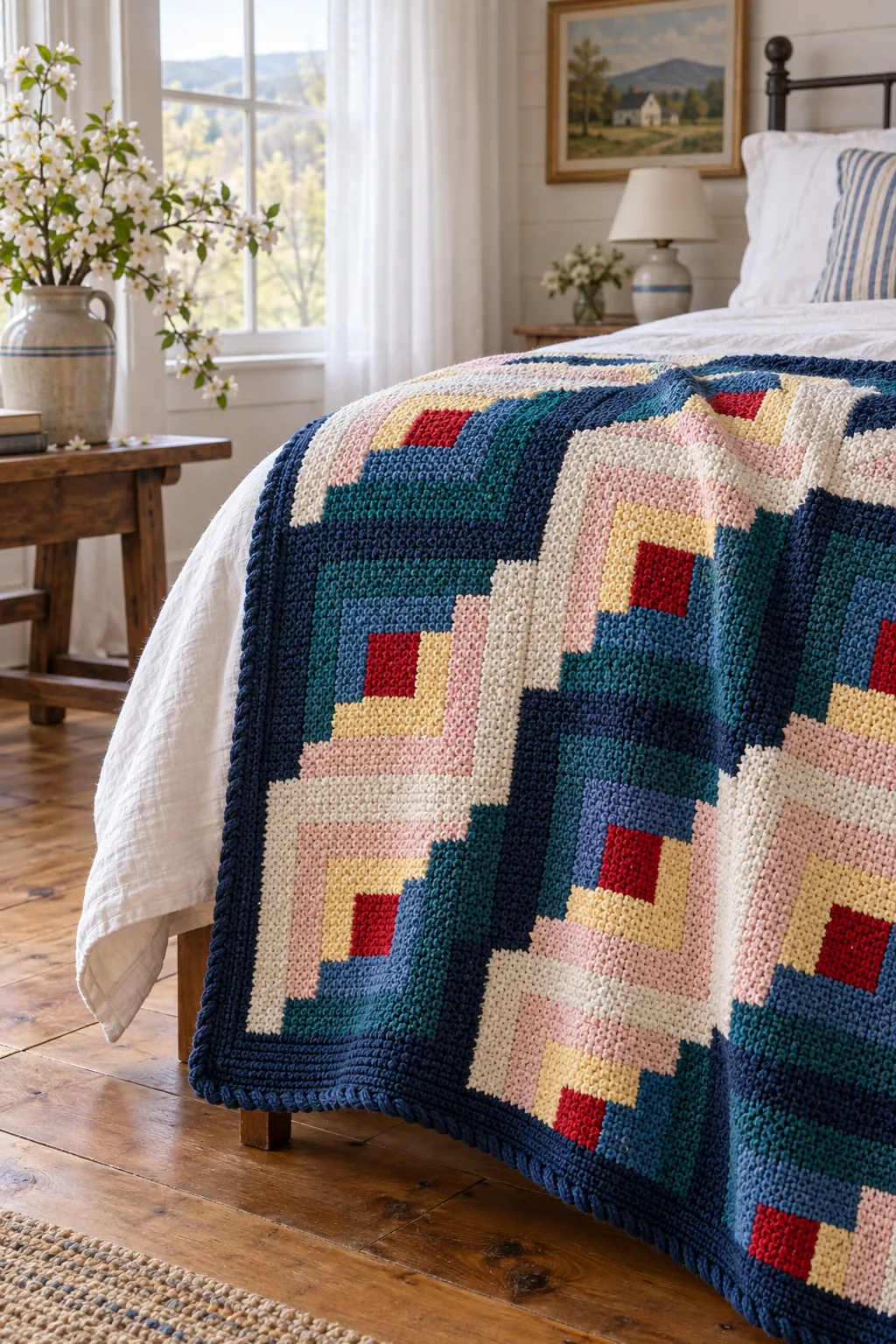
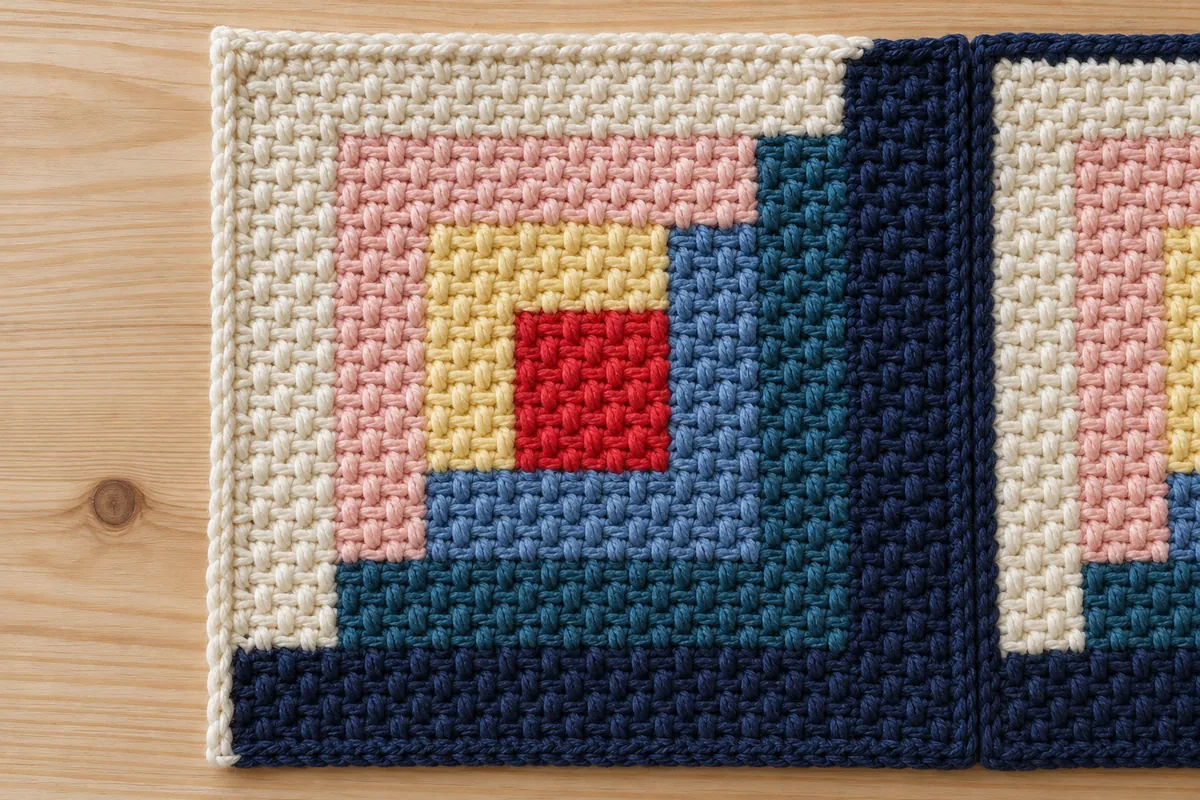
In late April, a week or two after mud season lets go, the first fields on a Vermont hill farm get plowed. From the ridge, the rows run off on a slant, dark soil beside pale stubble. The Spring Furrow Afghan borrows that view. It’s a log cabin crochet blanket made of identical moss stitch blocks: a small poppy red center, then twelve narrow logs wrapped around it, butter, blush and ivory on two sides, denim, deep teal and navy on the other two.
Every block is split on the diagonal, light on one half and dark on the other. Set the blocks in a checkerboard of two orientations and the halves meet in long slanted stripes, the layout quilters call Straight Furrow. The card gives a lapghan, a throw and a twin, all from the same 11½-inch block.
Is this log cabin crochet blanket a good first Intermediate project?
It is, if moss stitch already feels easy in your hands. Each block has twelve logs picked up along three kinds of edges, the edging round changes color halfway around, and four blocks meet at every seam corner. It’s all plain moss stitch; the real effort is keeping count on Row 1 of every log.
Only two stitches do the work, the chain and the single crochet. Moss stitch alternates them: every single crochet lands in a ch-1 space of the row below, and every chain 1 sits over a single crochet. You count both as stitches. The border adds single crochet in the back loop only, which leaves a fine ridge on the right side, and a last round of reverse single crochet, also called crab stitch, worked from left to right so it twists into a cord. Every abbreviation in the card is spelled out in the guide to reading a pattern.
The new technique is the log itself. A log is a strip of 5 moss rows worked straight onto the edge of the block. Its first row picks up 1 stitch per row end, 1 stitch per stitch along the top of an earlier log, and 1 stitch per chain along the bottom of the center, always alternating sc and ch 1. After each log you turn the block a quarter turn clockwise, and the next log covers the whole side now facing you, ends of earlier logs included. To get the texture into your hands first, the all-cream moss stitch throw is a calm place to start.
Cotton-blend worsted in seven colors, and one test block
Choose a worsted (#4 medium) cotton-acrylic blend, roughly half and half. Cotton keeps the moss texture crisp and lets a spring blanket breathe. Acrylic keeps the weight down. A 100 % cotton worsted works, but a twin gets heavy and stiff. Skip brushed or fuzzy yarns: the logs are only 5 rows wide, and a halo blurs the line between the light and dark halves.
Buy each color in a single dye lot, Navy and Ivory above all. Navy goes into every block, the seams and the border. Ivory makes the outer light logs, half of each edging round and the twin frame. A second lot of either shows up as a band across the furrows.
If you substitute, swap a whole color, never part of one, and keep the light and dark groups clearly apart. Then make one full block as your swatch. After its edging round and blocking, it should measure 11½ in (29 cm) square, with equal diagonals. Too big means a smaller hook, too small a bigger one. The block also shows whether your logs lie flat along the row ends, which a plain moss swatch can’t.

Poppy hearths, buttery light and indigo furrows
Each color has a job. Poppy is the center, the hearth of the old quilt block, and it’s the only warm red in the blanket, so the centers read as a scatter of small sparks. Butter, Blush and Ivory are the light logs, getting paler toward the edge of the block. Denim, Deep Teal and Navy are the dark logs, getting deeper toward the edge. The outer pair, Ivory and Navy, draws the furrows, so those two need the strongest contrast.
Other palettes that keep the same light and dark logic:
- Cherry Orchard: cherry centers; cream, shell pink and oat light logs; plum, wine and chocolate dark logs.
- Blueberry Barrens: goldenrod centers; cloud white, sky and pale lilac light logs; cornflower, indigo and midnight dark logs.
- Maple Sugar: amber centers; ivory, honey and tan light logs; rust, brick and walnut dark logs.
Before you buy, line up your six log colors from lightest to darkest in daylight and take a black-and-white photo with your phone. All three lights should look lighter than all three darks. If a light and a dark turn the same gray, the furrow loses its edge there, so swap one of them.
Twelve, twenty or thirty-five blocks
Every size uses the same block; only the block count and the border change. The card is written as Lapghan [Throw, Twin].
- Lapghan, about 36½ × 48 in (93 × 122 cm): 12 blocks, 3 across and 4 down, then 4 border rounds starting with 652 sc. Yarn: Poppy 155 yd, Butter 125 yd, Denim 165 yd, Blush 200 yd, Deep Teal 235 yd, Ivory 345 yd, Navy 615 yd.
- Throw, about 49 × 60½ in (125 × 154 cm): 20 blocks, 4 across and 5 down, then 6 border rounds starting with 836 sc. Yarn: Poppy 260 yd, Butter 210 yd, Denim 270 yd, Blush 330 yd, Deep Teal 390 yd, Ivory 570 yd, Navy 1,080 yd.
- Twin, about 66¾ × 89½ in (169 × 227 cm): 35 blocks, 5 across and 7 down, an 11-row Ivory moss frame about 2¾ in (7 cm) wide, then 7 border rounds starting with 1,198 sc. Yarn: Poppy 450 yd, Butter 365 yd, Denim 470 yd, Blush 580 yd, Deep Teal 685 yd, Ivory 1,765 yd, Navy 1,860 yd.
Each block starts with the same 16 chains for the center and grows to 44 rows each way. The twin gets a frame because a fixed square block can’t reach both twin measurements with a narrow border alone. That frame is just one more round of four logs, worked around the whole blanket. All the numbers are estimates until the test block is measured, and the yardage includes a 15 % margin.
Keeping twelve logs square, block after block
Clip a locking marker into log 1 as soon as it’s done. It marks the top of the block, and at assembly it tells you which way to turn each block for the furrows.
Count Row 1 of every log by sections, not as one long run. From log 5 on, it starts with 5 stitches along the row ends of the log you just finished, covers the top of an earlier log, and ends with 5 stitches along the row ends of the next log. When a total is off, you’ll know which section to recount. Rows 2 to 5 keep that count.
Two spots in the first round break the routine on purpose. Log 3 skips the first 2 foundation chains, because log 2 already covers that corner. Log 4 ends with a ch 1 that skips nothing, so its last sc lands right in the corner. Both keep the stitch count odd, which moss stitch needs.
Logs of the same color run without cutting. With 5 rows, the yarn always finishes in the corner where the next log begins, so you work log 1, turn the block and carry straight on into log 2.
Work over the tails as you go. Each new color joins in the corner where the old one stopped, so lay both tails along the edge and crochet the next 8 or more stitches of Row 1 over them. That leaves about 2 ends per block for the needle, plus the seam and border ends: roughly 50 [80, 140] in all.
Lay the block flat after each round of logs. A log that ruffles has too many stitches; one that pulls the corners in has too few. When the block is finished, pin it to an 11½-inch cardboard square with corners checked against a ruler, mist it and let it dry before seaming.
US crochet terms
The pattern
Materials
- Yarn: #4 medium (worsted) cotton-acrylic blend, about 197 yd (180 m) per 3.5 oz (100 g) skein. Total about 1,840 [3,110, 6,175] yd, estimate (no measured swatch yet), 15 % margin included.
- Poppy (red): 155 [260, 450] yd, 142 [238, 411] m, 1 [2, 3] skeins
- Butter: 125 [210, 365] yd, 114 [192, 334] m, 1 [2, 2] skeins
- Blush: 200 [330, 580] yd, 183 [302, 530] m, 2 [2, 3] skeins
- Ivory: 345 [570, 1,765] yd, 315 [521, 1,614] m, 2 [3, 9] skeins
- Denim: 165 [270, 470] yd, 151 [247, 430] m, 1 [2, 3] skeins
- Deep Teal: 235 [390, 685] yd, 215 [357, 626] m, 2 [2, 4] skeins
- Navy: 615 [1,080, 1,860] yd, 562 [988, 1,701] m, 4 [6, 10] skeins
- Hook: 5.5 mm / I-9, or size needed to obtain gauge.
- Yarn needle, scissors, 1 locking stitch marker per block, an 11.5 in (29 cm) cardboard square and pins for blocking.
Gauge
- 17 sts and 16 rows = 4 in (10 cm) in moss stitch, blocked. Estimate.
- Center (15 sts × 14 rows): about 3.5 in (9 cm) square. Estimate.
- Finished block, edging round included: 11.5 in (29 cm) square, blocked. Estimate.
- Edging and border: 1 round of sc or reverse sc = about 1/4 in (6 mm). Estimate.
Finished size
- 36.5 × 48 in (93 × 122 cm) [49 × 60.5 in (125 × 154 cm), 66.75 × 89.5 in (169 × 227 cm)], blocked, border included. Estimate.
Abbreviations
- BLO back loop only
- ch chain
- ch- chain or space already made (ch-1 sp)
- rep repeat
- RS right side
- sc single crochet
- sk skip
- sl st slip stitch
- sp(s) space(s)
- st(s) stitch(es)
- WS wrong side
- yo yarn over
Notes
- Moss stitch uses an odd number of sts. Each sc and each ch-1 sp counts as 1 st. Foundation ch = sts + 1.
- The ch 1 at the start of a row does not count as a st. Never work into it.
- The RS is the side facing you on Row 1 of the center and on Row 1 of every log. Moss stitch looks almost the same on both sides, so tie a scrap of yarn on the RS of the center.
- Each log has 5 rows. After the last row of a log, rotate the block a quarter turn clockwise, keeping the RS facing you. The logs then go around the center counterclockwise: top, left, bottom, right.
- Along row ends, work 1 st per row end: sc in a row end, then ch 1 over the next one. Along the top of a log: sc in each ch-1 sp, ch 1 over each sc.
- A log ends in the corner where the next one starts. Work the two logs of each color without cutting the yarn.
- New colors: leave a 6 in (15 cm) tail, join with a sl st where stated, ch 1 and sc in the same place. Lay the new tail and the old color’s tail along the edge and work the next 8 sts or more over them. Weave in the foundation tail and any other remaining tails on the WS. About 18 tails per block, 16 worked over, 2 left to weave in.
- Light half: logs 1, 2, 5, 6, 9 and 10 (top and left). Dark half: logs 3, 4, 7, 8, 11 and 12 (bottom and right).
- Block each block to 11.5 in (29 cm) square on a template, diagonals equal, before seaming.
- The blanket has no stitch multiple: to resize, add or remove whole blocks (11.5 in each way) and adjust the border.
- All counts, sizes and yardage are estimates until a test block is measured.
Instructions
Moss rows and special stitches
- Row A (1 sc at each end): Ch 1, turn, sc in first sc, *ch 1, sk next sc, sc in next ch-1 sp; rep from * to last 2 sc, ch 1, sk next sc, sc in last sc.
- Row B (2 sc at each end): Ch 1, turn, sc in first sc, sc in next ch-1 sp, *ch 1, sk next sc, sc in next ch-1 sp; rep from * to last sc, sc in last sc.
- Reverse sc (crab stitch): working from left to right, insert hook in next st to the right, yo, pull up a loop, yo, pull through both loops on hook.
Center (make 12 [20, 35])
- Foundation: With Poppy, ch 16.
- Row 1 (RS): Sc in 2nd ch from hook, *ch 1, sk next ch, sc in next ch; rep from * across. (15 sts: 8 sc, 7 ch-1 sps)
- Row 2: Work Row B. (15 sts: 9 sc, 6 ch-1 sps)
- Rows 3–14: Work Row A and Row B alternately, ending with a Row B. (15 sts) Fasten off at the top right corner, leaving a 6 in (15 cm) tail.
Logs (each block)
- Log 1 (top, Butter), Row 1: With RS facing and Row 14 at the top, join Butter with a sl st in the sc at the top right corner, ch 1, sc in same sc, *ch 1, sk next sc, sc in next ch-1 sp; rep from * to last 2 sc, ch 1, sk next sc, sc in last sc. (15 sts)
- Log 1, Rows 2–5: Work Row B, Row A, Row B, Row A. (15 sts) Place a marker in log 1. Do not fasten off.
- Log 2 (left, Butter), Row 1: Rotate the block a quarter turn clockwise. Ch 1, sc in end of Row 5 of log 1, [ch 1, sk next row end, sc in next row end] twice; along the side of the center, [ch 1, sk next row end, sc in next row end] 7 times. (19 sts)
- Log 2, Rows 2–5: Work Row B, Row A, Row B, Row A. (19 sts) Fasten off.
- Log 3 (bottom, Denim), Row 1: Rotate a quarter turn clockwise. Join Denim with a sl st in end of Row 5 of log 2, ch 1, sc in same row end, [ch 1, sk next row end, sc in next row end] twice; working in the free loops of the center’s foundation ch, ch 1, sk first 2 ch, sc in next ch, [ch 1, sk next ch, sc in next ch] 6 times. (19 sts)
- Log 3, Rows 2–5: Work Row B, Row A, Row B, Row A. (19 sts) Do not fasten off.
- Log 4 (right, Denim), Row 1: Rotate a quarter turn clockwise. Ch 1, sc in end of Row 5 of log 3, [ch 1, sk next row end, sc in next row end] twice; along the side of the center, [ch 1, sk next row end, sc in next row end] 7 times; along the row ends of log 1, [ch 1, sk next row end, sc in next row end] twice, ch 1, sc in last row end. (25 sts)
- Log 4, Rows 2–5: Work Row B, Row A, Row B, Row A. (25 sts) Fasten off.
- Log 5 (top, Blush), Row 1: Rotate a quarter turn clockwise. Join Blush with a sl st in end of Row 5 of log 4, ch 1, sc in same row end, [ch 1, sk next row end, sc in next row end] twice; along the top of log 1, ch 1, sk first sc, sc in next ch-1 sp, [ch 1, sk next sc, sc in next ch-1 sp] 6 times, ch 1, sk last sc; along the row ends of log 2, sc in end of Row 1, [ch 1, sk next row end, sc in next row end] twice. (25 sts)
- Log 5, Rows 2–5: Work Row B, Row A, Row B, Row A. (25 sts) Do not fasten off.
- Log 6 (left, Blush), Row 1: Rotate a quarter turn clockwise. Ch 1, sc in end of Row 5 of log 5, [ch 1, sk next row end, sc in next row end] twice; along the top of log 2, ch 1, sk first sc, sc in next ch-1 sp, [ch 1, sk next sc, sc in next ch-1 sp] 8 times, ch 1, sk last sc; along the row ends of log 3, sc in end of Row 1, [ch 1, sk next row end, sc in next row end] twice. (29 sts)
- Log 6, Rows 2–5: Work Row B, Row A, Row B, Row A. (29 sts) Fasten off.
- Log 7 (bottom, Deep Teal), Row 1: Rotate a quarter turn clockwise. Join Deep Teal with a sl st in end of Row 5 of log 6, ch 1, sc in same row end, [ch 1, sk next row end, sc in next row end] twice; along the top of log 3, ch 1, sk first sc, sc in next ch-1 sp, [ch 1, sk next sc, sc in next ch-1 sp] 8 times, ch 1, sk last sc; along the row ends of log 4, sc in end of Row 1, [ch 1, sk next row end, sc in next row end] twice. (29 sts)
- Log 7, Rows 2–5: Work Row B, Row A, Row B, Row A. (29 sts) Do not fasten off.
- Log 8 (right, Deep Teal), Row 1: Rotate a quarter turn clockwise. Ch 1, sc in end of Row 5 of log 7, [ch 1, sk next row end, sc in next row end] twice; along the top of log 4, ch 1, sk first sc, sc in next ch-1 sp, [ch 1, sk next sc, sc in next ch-1 sp] 11 times, ch 1, sk last sc; along the row ends of log 5, sc in end of Row 1, [ch 1, sk next row end, sc in next row end] twice. (35 sts)
- Log 8, Rows 2–5: Work Row B, Row A, Row B, Row A. (35 sts) Fasten off.
- Log 9 (top, Ivory), Row 1: Rotate a quarter turn clockwise. Join Ivory with a sl st in end of Row 5 of log 8, ch 1, sc in same row end, [ch 1, sk next row end, sc in next row end] twice; along the top of log 5, ch 1, sk first sc, sc in next ch-1 sp, [ch 1, sk next sc, sc in next ch-1 sp] 11 times, ch 1, sk last sc; along the row ends of log 6, sc in end of Row 1, [ch 1, sk next row end, sc in next row end] twice. (35 sts)
- Log 9, Rows 2–5: Work Row B, Row A, Row B, Row A. (35 sts) Do not fasten off.
- Log 10 (left, Ivory), Row 1: Rotate a quarter turn clockwise. Ch 1, sc in end of Row 5 of log 9, [ch 1, sk next row end, sc in next row end] twice; along the top of log 6, ch 1, sk first sc, sc in next ch-1 sp, [ch 1, sk next sc, sc in next ch-1 sp] 13 times, ch 1, sk last sc; along the row ends of log 7, sc in end of Row 1, [ch 1, sk next row end, sc in next row end] twice. (39 sts)
- Log 10, Rows 2–5: Work Row B, Row A, Row B, Row A. (39 sts) Fasten off.
- Log 11 (bottom, Navy), Row 1: Rotate a quarter turn clockwise. Join Navy with a sl st in end of Row 5 of log 10, ch 1, sc in same row end, [ch 1, sk next row end, sc in next row end] twice; along the top of log 7, ch 1, sk first sc, sc in next ch-1 sp, [ch 1, sk next sc, sc in next ch-1 sp] 13 times, ch 1, sk last sc; along the row ends of log 8, sc in end of Row 1, [ch 1, sk next row end, sc in next row end] twice. (39 sts)
- Log 11, Rows 2–5: Work Row B, Row A, Row B, Row A. (39 sts) Do not fasten off.
- Log 12 (right, Navy), Row 1: Rotate a quarter turn clockwise. Ch 1, sc in end of Row 5 of log 11, [ch 1, sk next row end, sc in next row end] twice; along the top of log 8, ch 1, sk first sc, sc in next ch-1 sp, [ch 1, sk next sc, sc in next ch-1 sp] 16 times, ch 1, sk last sc; along the row ends of log 9, sc in end of Row 1, [ch 1, sk next row end, sc in next row end] twice. (45 sts)
- Log 12, Rows 2–5: Work Row B, Row A, Row B, Row A. (45 sts) Do not fasten off.
Edging round (each block)
- Round 1: Rotate the block so log 1 is at the top; the hook is at the top right corner. With Navy, ch 1, 3 sc in last sc made (corner); along the top, sc in end of Rows 4, 3, 2 and 1 of log 12, changing to Ivory in the last sc. Cut Navy. With Ivory, sc in each of the 35 sts of log 9, sc in end of Rows 1–4 of log 10, 3 sc in end of Row 5 of log 10 (corner); along the left side, sc in each of the next 38 sts of log 10, working 2 sc in the last of them and changing to Navy in the second one. Cut Ivory. With Navy, sc in end of Rows 1–4 of log 11, 3 sc in end of Row 5 of log 11 (corner); along the bottom, sc in each of the next 38 sts of log 11, working 2 sc in the last of them, sc in end of Rows 1–4 of log 12, 3 sc in end of Row 5 of log 12 (corner); along the right side, sc in each of the next 43 sts of log 12; join with a sl st in first sc. (184 sc: 43 on each side and 3 in each corner) Fasten off.
- Blocking: Pin the block to the 11.5 in (29 cm) template, mist it and let it dry. Check that both diagonals are equal.
Layout
- Orientation A: log 1 at the top. Orientation B: the same block turned 180°, log 1 at the bottom.
- Lapghan (3 across, 4 down): layout rows 1 and 3, A B A; layout rows 2 and 4, B A B. (6 A, 6 B)
- Throw (4 across, 5 down): layout rows 1, 3 and 5, A B A B; layout rows 2 and 4, B A B A. (10 A, 10 B)
- Twin (5 across, 7 down): layout rows 1, 3, 5 and 7, A B A B A; layout rows 2, 4 and 6, B A B A B. (18 A, 17 B)
- The light halves form diagonal stripes running from lower left to upper right.
Assembly
- Short seams: With Navy, hold two neighboring blocks of a layout row RS together, corners matching. Sl st through the back loops of both blocks from corner sc to corner sc (47 sl sts: the center sc of each corner and the 45 sts between). Fasten off. Join all the blocks of each layout row this way.
- Long seams: Join the layout rows the same way, RS together. Where four blocks meet, work 1 sl st through all the corner sc there. Fasten off and weave in the seam ends.
Frame (Twin only)
- Frame log 1 (top), Row 1: With RS facing and the long sides vertical, join Ivory with a sl st in the corner sc at the top right of the blanket, ch 1, sc in same st, [ch 1, sk next st, sc in next st] 115 times across the top, working the 2 joined corner sc at each seam as 1 st and ending in the top left corner sc. (231 sts)
- Frame log 1, Rows 2–11: Work Row B and Row A alternately, ending with a Row A. (231 sts) Do not fasten off.
- Frame log 2 (left), Row 1: Rotate a quarter turn clockwise. Ch 1, sc in end of Row 11 of frame log 1, [ch 1, sk next row end, sc in next row end] 5 times; along the left edge of the blocks, [ch 1, sk next st, sc in next st] 161 times, working the 2 joined corner sc at each seam as 1 st and ending in the bottom left corner sc. (333 sts)
- Frame log 2, Rows 2–11: Work Row B and Row A alternately, ending with a Row A. (333 sts) Do not fasten off.
- Frame log 3 (bottom), Row 1: Rotate a quarter turn clockwise. Ch 1, sc in end of Row 11 of frame log 2, [ch 1, sk next row end, sc in next row end] 5 times; along the bottom edge of the blocks, [ch 1, sk next st, sc in next st] 115 times, working the 2 joined corner sc at each seam as 1 st and ending in the bottom right corner sc. (241 sts)
- Frame log 3, Rows 2–11: Work Row B and Row A alternately, ending with a Row A. (241 sts) Do not fasten off.
- Frame log 4 (right), Row 1: Rotate a quarter turn clockwise. Ch 1, sc in end of Row 11 of frame log 3, [ch 1, sk next row end, sc in next row end] 5 times; along the right edge of the blocks, [ch 1, sk next st, sc in next st] 160 times, working the 2 joined corner sc at each seam as 1 st, ch 1, sk next st (the last st before the top right corner); along the row ends of frame log 1, sc in end of Row 1, [ch 1, sk next row end, sc in next row end] 5 times. (343 sts)
- Frame log 4, Rows 2–11: Work Row B and Row A alternately, ending with a Row A. (343 sts) Fasten off.
Border (Navy)
- Round 1: With RS facing, join Navy with a sl st in the top right corner st of the blanket (Lapghan and Throw: center sc of the block’s corner; Twin: last st of Row 11 of frame log 4). Ch 1, 3 sc in same st, *sc in each st along the side to the next corner st, 3 sc in corner st; rep from * twice more, sc in each st along the last side; join with a sl st in first sc. Lapghan and Throw: sc in each edging sc and 1 sc in each seam, through the 2 joined corner sc, for 137 [183] sts on each short side and 183 [229] sts on each long side. Twin: sc in each frame st and in each frame row end, adding 1 sc at the middle of the bottom and of the right side, for 251 sts on each short side and 342 sts on each long side. (652 [836, 1,198] sc)
- Rounds 2–3 [2–5, 2–6]: Sl st in next st (the center sc of the corner), ch 1, 3 sc BLO in same st, *sc BLO in each st to next corner center sc, 3 sc BLO in it; rep from * twice more, sc BLO in each st to end; join with a sl st in first sc. Each round adds 8 sts. (Round 2: 660 [844, 1,206] sc; Round 3: 668 [852, 1,214] sc; Throw Rounds 4–5: 860, 868 sc; Twin Rounds 4–6: 1,222, 1,230, 1,238 sc)
- Round 4 [6, 7]: Ch 1, reverse sc in each st around; join with a sl st in first st. (668 [868, 1,238] sts) Fasten off and weave in the ends.
Washing a cotton-blend log cabin with poppy red centers
Red and navy are the dyes most likely to run. Before you start, wet a short length of Poppy and one of Navy, squeeze each inside a white paper towel and look for color. If either stains, rinse those skeins in cold water until it runs clear, and let them dry before you crochet.
Wash the finished blanket cold on a gentle cycle, with a color-catcher sheet the first few times. Tumble dry on low or dry it flat, and pull the blocks back into squares while it’s still damp. Store it folded, not over a rack, so the long seams don’t stretch.
Questions about the Spring Furrow Afghan
Do I have to make two kinds of blocks for the furrows?
No. Every block is identical. Orientation B is simply a block turned upside down, with log 1 at the bottom. The layout lines in the card tell you which way to place each one.
Can I use a Barn Raising layout for this log cabin crochet blanket?
Yes, if your grid has an even number of blocks both ways, such as 4 × 4 or 6 × 8. Barn Raising turns the blocks so the halves form concentric diamonds around the middle, which needs a true center line. The three written sizes have an odd count in one direction, so they use Straight Furrow.
Why is the edging round worked in two colors?
It follows the outer logs: Ivory over the light half and Navy over the dark half. Once the blocks are seamed, two edging rounds sit side by side along each seam, and matching colors keep the furrows unbroken. One color all around would draw lines between the blocks.
What if my test block doesn’t measure 11½ inches?
Change hooks before you make more. A block that comes out ½ inch too big makes the throw about 2 inches too wide, because every block carries the same stitch counts. Rework the test block with a smaller hook, or a bigger one if yours came out small, until it blocks to 11½ inches.
Quick recap
- Make 12 [20, 35] blocks: a 15-stitch Poppy center, then 12 logs of 5 rows, light on the top and left, dark on the bottom and right.
- Work the Ivory and Navy edging round and block each block to 11½ in.
- Lay out the blocks in orientations A and B as the chart shows.
- Seam them with Navy slip stitches through the back loops, short seams first.
- For the twin, add the Ivory moss frame.
- Work the Navy border and finish with a round of reverse single crochet.
The fun part comes when the third or fourth block goes down on the floor next to the others and the first diagonal shows up. If you make this log cabin crochet blanket and a step in the card isn’t clear, send a note through the contact page.