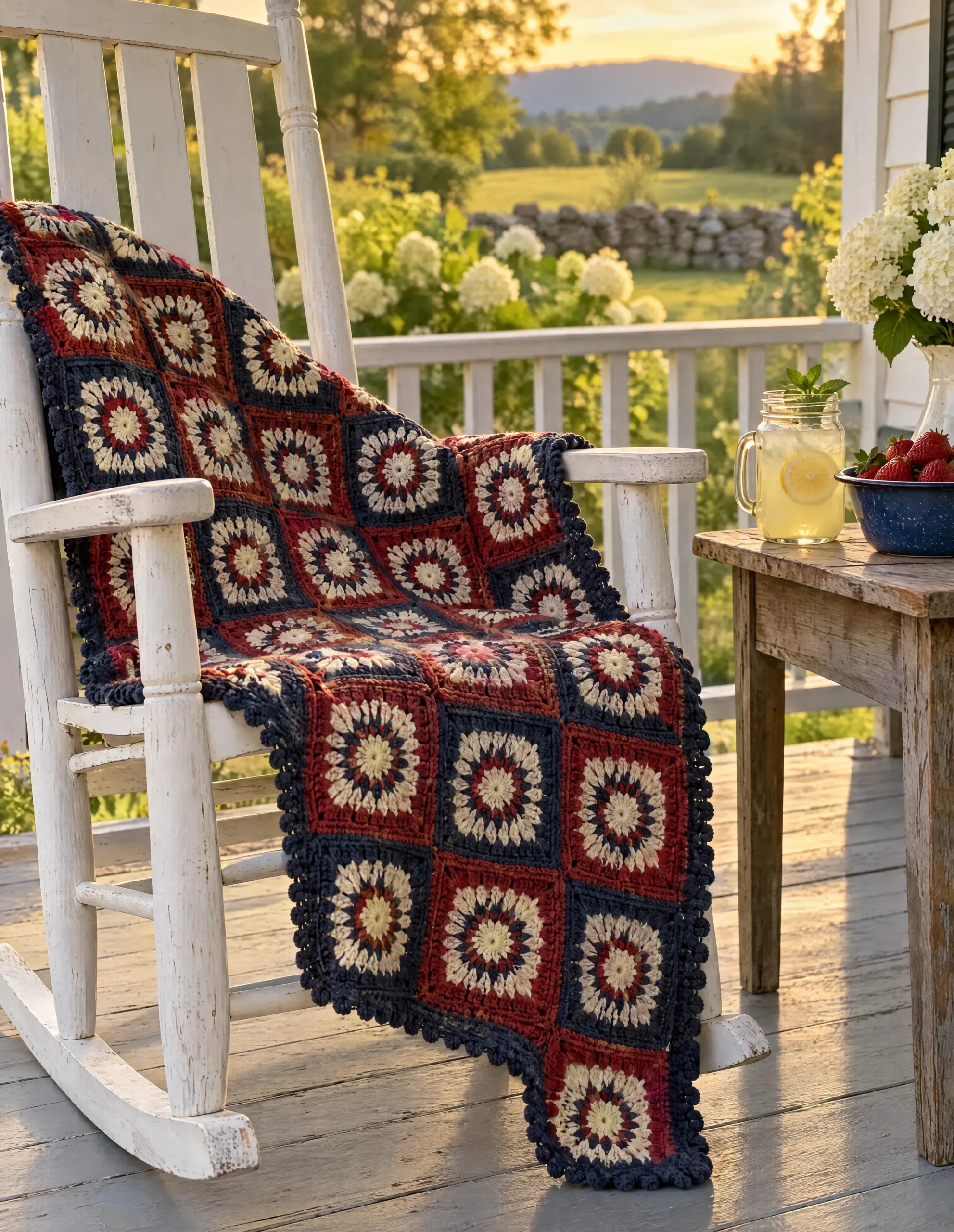
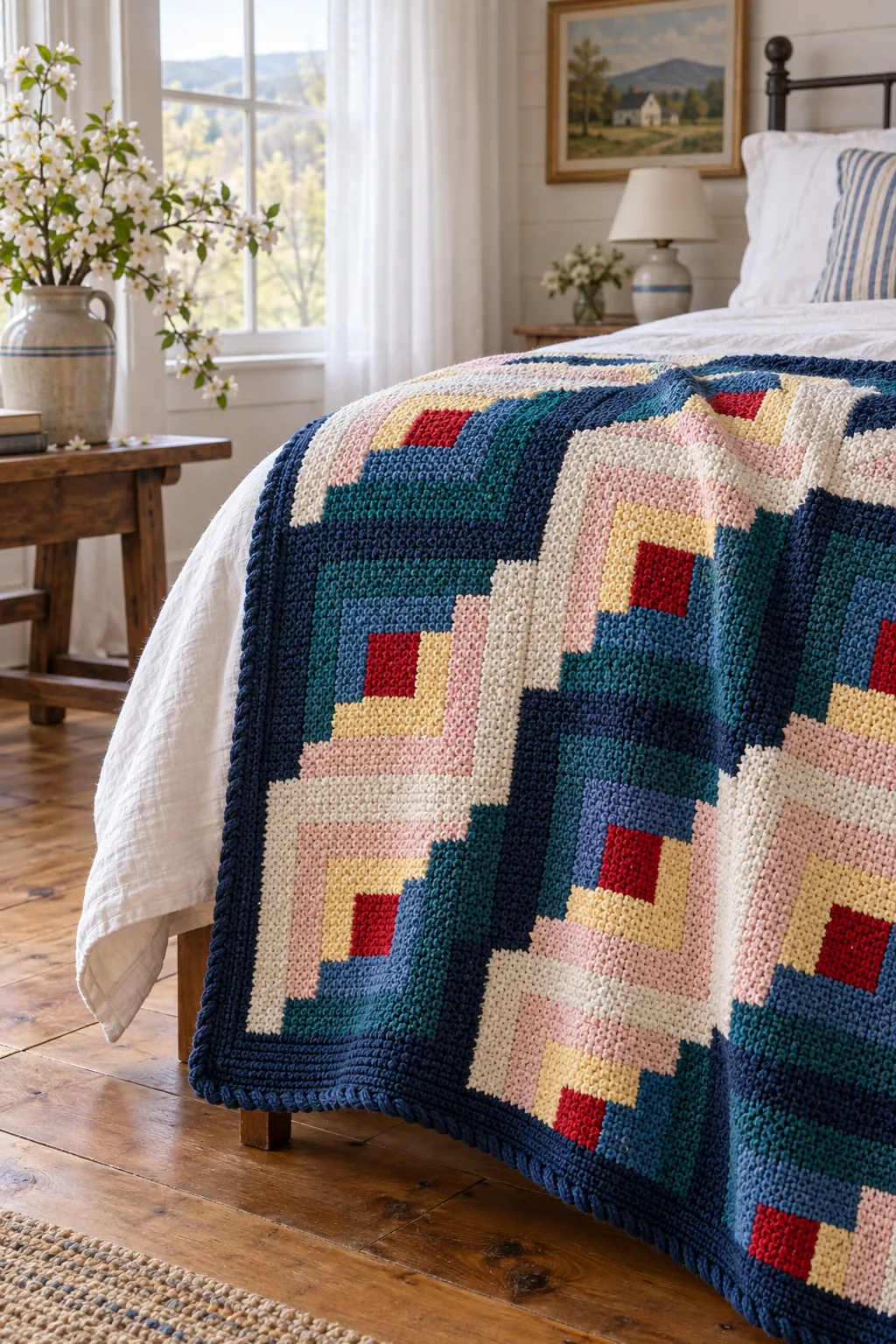
Picture a July afternoon at the edge of a Vermont hayfield. The bee balm is up to your knees, shaggy and red, and the bees are working it one flower at a time. The Bee Balm Coverlet takes its colors from that scene: honey, raspberry, blush and sage, with a light oatmeal frame around every piece. It’s a crochet hexagon blanket built from one six-round motif with a little cluster-petal flower in the middle, made in three color variants so two neighbors never match.
The outline is what makes it different. Joined hexagons usually leave zigzag edges. Here, flat half hexagons fill the long sides and pointed ones fill the top and bottom, so you finish with four straight edges and a wide banded border. The card gives three sizes: a lapghan, a throw and a twin.
Is this crochet hexagon blanket a good next step after granny squares?
It’s rated Intermediate, and the label is honest. Every hexagon changes color five times. The edges need two half shapes worked in rows, and the seams meet in points where three pieces come together. None of it is hard on its own. There’s just a lot of it.
The stitches are basic ones. You’ll use the chain, the slip stitch, the single crochet for the frame and border, and the double crochet for most of the motif. The petals are 3-dc clusters: three double crochets worked into one space but left unfinished, then closed together with a single pull-through. The last border round is reverse single crochet, also called crab stitch, worked backward from left to right so the edge twists into a cord. If the abbreviations still slow you down, the guide to reading a pattern has them all in one place.
Two techniques may be new. The magic ring is an adjustable loop you work the first round into, then pull shut like a drawstring. The half hexagons are worked in rows that mirror the rounds of the full motif, always with the right side facing you. You fasten off at the end of each row and join the next color at the start, exactly as you would on a new round. If you’ve already made flower-center granny squares in spring colors, the color joins will feel familiar.
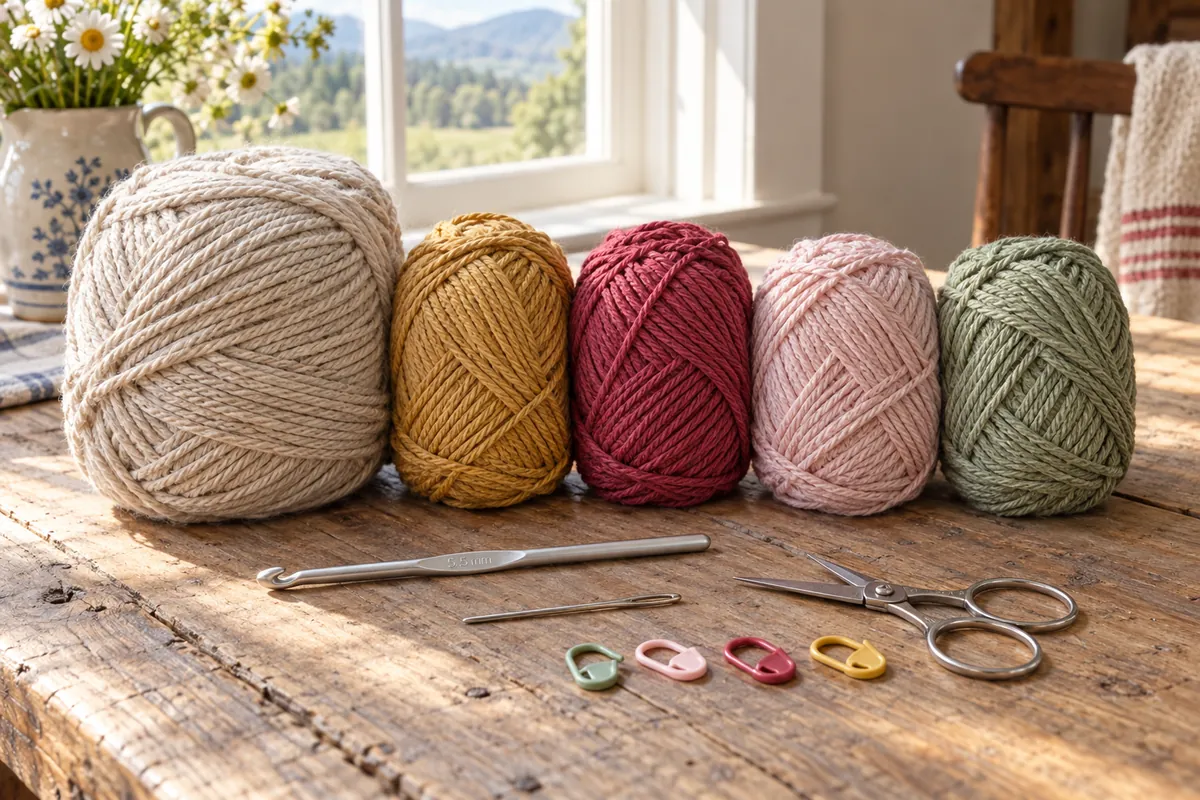
A worsted cotton blend, one dye lot of oatmeal and a swatch hexagon
Look for the #4 medium symbol on the label. A cotton-acrylic blend suits a summer coverlet. It breathes and keeps the cluster petals crisp, and it’s lighter than pure cotton. Even so, the twin weighs about 5.6 lb (2.6 kg). In 100 % cotton it would be heavier, and the long seams would stretch more each time it’s washed. Plain acrylic works too.
Skip brushed or fuzzy yarns. The petals blur, and on a seam you can’t tell one loop from the next. Buy all five colors in the same line from the same brand. Two brands that both say “worsted” can still differ in thickness, and then the hexagons come out different sizes and the sides won’t seam stitch for stitch.
Oatmeal is the one to watch. It frames every piece and joins every seam, and most of the border is oatmeal too, so get the whole amount from one dye lot. The card assumes skeins of about 197 yd (180 m) per 3.5 oz (100 g). With a different put-up, divide the yardage by your label length.
Your swatch here is a real hexagon. Work one and block it, then measure. It should be about 7 in (17.8 cm) from point to point and 6 in (15.4 cm) from side to side. If it’s bigger, try a 5.0 mm hook; if it’s smaller, a 6.0 mm. Make one half hexagon of each shape too, and lay the straight edges flat. These measurements set the grid, so every count and yardage on this page is an estimate until they’re in.
Three variants, five colors and an oatmeal frame around every piece
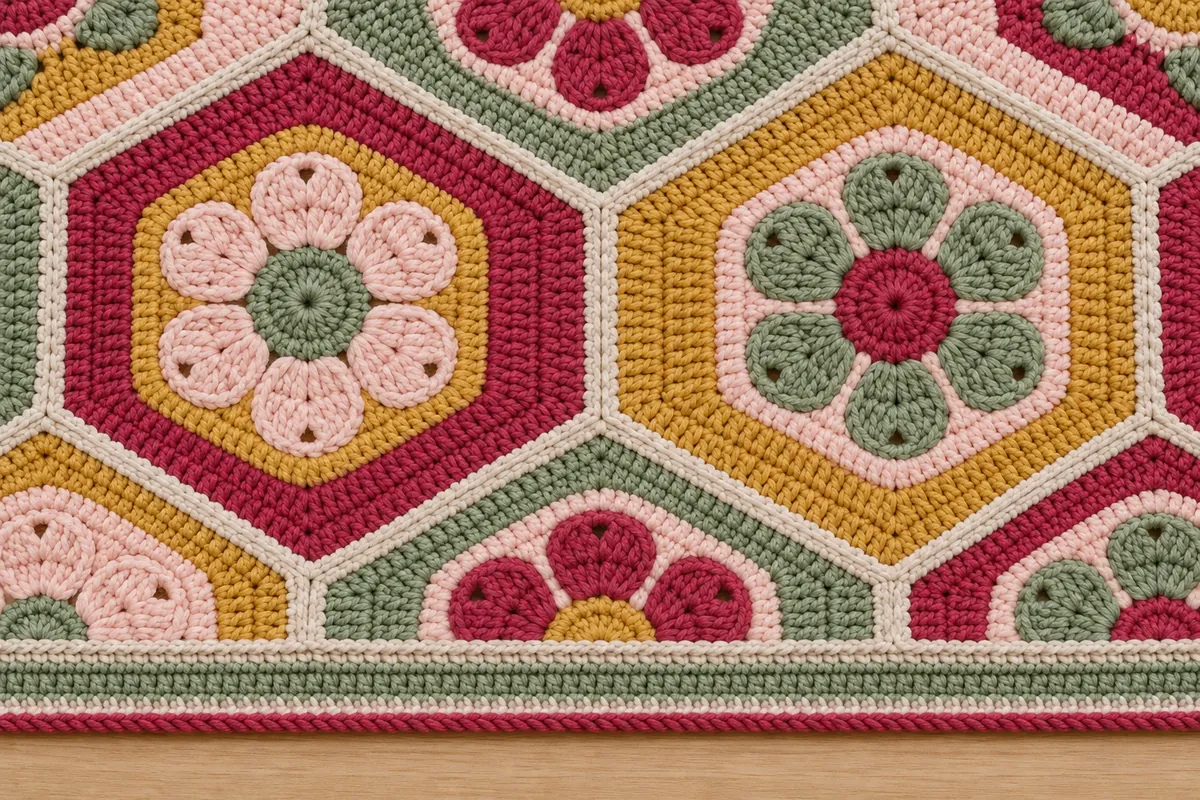
Each variant uses the same four inner colors in a different order. Rounds 4 and 5 form the widest band, and that band is what you see from across the room: sage on Variant 1, raspberry Bee Balm on Variant 2, honey on Variant 3. The chart places the variants so that no two touching pieces share a band color. The petals in Round 2 always contrast with that band, and blush in Round 3 lightens Variants 1 and 3.
- Variant 1: honey center, raspberry petals, blush ring, sage band.
- Variant 2: sage center, blush petals, honey ring, raspberry band.
- Variant 3: raspberry center, sage petals, blush ring, honey band.
Other five-color sets that work the same way:
- Blueberry Hill: cream frame, navy, periwinkle, pale blue and butter yellow.
- Orchard: cream frame, apple green, coral, peach and gold.
- Creek Stone: light gray frame, slate, rust, sand and moss.
- Lilac Lane: ivory frame, lilac, plum, mint and lemon.
Keep the frame the lightest color, and pick three band colors of about the same strength so no variant jumps out. Before you buy everything, make one hexagon of each variant and set them side by side.
Lapghan, throw and twin, counted in hexagons and half hexagons
The card is written Lapghan [Throw, Twin]. Sizes include the border, and yardage includes seams, tails and a 15 % margin.
- Lapghan, 36 × 47.5 in (91 × 121 cm): 31 hexagons, 8 flat and 10 pointed half hexagons, rows 5 hexagons wide, 11 border rounds starting at 470 sc. Oatmeal 520 yd, honey 210 yd, raspberry 255 yd, blush 140 yd, sage 355 yd.
- Throw, 50 × 60 in (127 × 153 cm): 58 hexagons, 10 flat and 14 pointed half hexagons, rows 7 wide, 15 border rounds starting at 616 sc. Oatmeal 815 yd, honey 385 yd, raspberry 425 yd, blush 245 yd, sage 725 yd.
- Twin, 66 × 89.5 in (168 × 228 cm): 142 hexagons, 16 flat and 20 pointed half hexagons, rows 10 wide, 11 border rounds starting at 934 sc. Oatmeal 1,625 yd, honey 880 yd, raspberry 910 yd, blush 555 yd, sage 1,075 yd.
Hexagons only grow in whole steps. One more hexagon per row adds about 6 in (15.4 cm) of width, and one more pair of rows adds about 10.5 in (26.7 cm) of length. The border makes up the difference, which is why the throw gets 15 rounds and the other two get 11. Once your swatch hexagon is measured, those border counts may change.
Flat petals, square edges and fewer of those 1,850 ends
Check Round 2 before you go on. Count 12 clusters, 6 ch-2 spaces and 6 ch-1 spaces, then lay the flower on the table. If it cups, your chains are too tight; work them looser. Do the same check after Round 6, when the hexagon should lie flat with six crisp corners.
Plan for the ends early. Each hexagon leaves about 10 tails and each half hexagon about 12. That’s around 530 [870, 1,850] ends before any shortcut. Lay each new color’s starting tail along the top of the previous round and crochet over it for at least 8 stitches; that alone removes about half. The tails on the straight edges of the half hexagons can wait, because border Round 1 works over them.
Finish each piece as you go: weave in a piece’s remaining ends as soon as its frame round is done, then drop it in the bag for its variant. A stack of finished hexagons is ready to seam the day you want to start, and you never face a whole weekend of ends.
The half hexagons stay square only if you never turn them. Join each row in the first stitch, and pull the magic ring tight so the straight edge closes at the center.
Then come the seams. Work the slip stitch seam one side at a time, from corner ch-1 space to corner ch-1 space, 11 stitches each. Where a third piece meets the point, put your hook through every corner ch-1 space there and make a single slip stitch through all of them. That closes the little hole that likes to open at hexagon junctions. Keep the seam loose enough that it matches the side it joins.
Before border Round 1, clip a marker at every seam on the edge. Then you only count 22 stitches per flat half, 20 per pointed half and 11 per hexagon side.
US crochet terms
The pattern
Materials
- Yarn: #4 medium (worsted) cotton-acrylic blend, about 197 yd (180 m) per 3.5 oz (100 g) skein. Total about 1,475 [2,585, 5,030] yd, estimate (no measured swatch yet), 15 % margin included.
- Oatmeal (MC): 520 [815, 1,625] yd, 472 [742, 1,482] m, 3 [5, 9] skeins
- Honey: 210 [385, 880] yd, 192 [352, 802] m, 2 [2, 5] skeins
- Bee Balm (raspberry): 255 [425, 910] yd, 231 [388, 831] m, 2 [3, 5] skeins
- Blush: 140 [245, 555] yd, 127 [221, 503] m, 1 [2, 3] skeins
- Sage: 355 [725, 1,075] yd, 323 [661, 981] m, 2 [4, 6] skeins
- Hook: 5.5 mm (I-9), or size needed to obtain gauge.
- Yarn needle, scissors, 6 stitch markers, 3 bags or labels to sort the variants.
Gauge
- Hexagon (Rounds 1–6): 7 in (17.8 cm) point to point, about 6 in (15.4 cm) side to side, each side 3.5 in (8.9 cm), blocked. Estimate.
- Flat half hexagon: straight edge 7 in (17.8 cm), about 3 in (7.7 cm) high. Pointed half hexagon: straight edge 6 in (15.4 cm), 3.5 in (8.9 cm) high. Estimate.
- Border: 4 rounds of sc = 1 in (2.6 cm). Estimate.
Finished size
- 36 × 47.5 in (91 × 121 cm) [50 × 60 in (127 × 153 cm), 66 × 89.5 in (168 × 228 cm)], blocked, border included. Estimate.
Abbreviations
- beg beginning
- BLO back loop only
- ch chain
- ch- chain or space already made (ch-2 sp)
- cl cluster (see Special stitches)
- dc double crochet
- MC main color
- rep repeat
- RS right side
- sc single crochet
- sl st slip stitch
- sp(s) space(s)
- st(s) stitch(es)
- yo yarn over
Notes
- Work every hexagon and half hexagon with the RS facing. Never turn.
- In dc rounds and rows, the beginning ch 3 counts as a dc, including the first 3 chains of a ch 4 or ch 5. In sc rounds and rows, the ch 1 does not count as a st.
- Fasten off at the end of each round or row and join the next color with a sl st where stated, leaving a 6 in (15 cm) tail. Rounds 4 and 5 of the hexagon use the same color without fastening off.
- Ends: about 10 per hexagon and 12 per half hexagon, about 530 [870, 1,850] in all. Lay each new color’s starting tail along the top of the previous round and work over it for at least 8 sts: this removes about half. Leave the tails on the straight edges of the half hexagons for border Round 1, which works over them. Weave in the remaining ends of each piece as soon as it is finished.
- Start with a magic ring (or ch 4 and join with a sl st, which leaves a small hole). On half hexagons, pull the ring tight so the straight edge has no gap.
- Check that the piece lies flat after Round 2 and Round 6. If it cups, work the chains more loosely.
- No foundation chain and no stitch multiple. To resize, add hexagons: about 6 in (15.4 cm) of width per hexagon in each row, about 10.5 in (26.7 cm) of length per pair of rows. Then adjust the number of border rounds.
- Seams: slip stitch seam with MC, RS together, through the back loops of both pieces, one side at a time from corner ch-1 sp to corner ch-1 sp (11 sts per side). Work loosely so each seam stays as long as the side it joins. Where three pieces meet, make one sl st through all the corner ch-1 sps at that point.
- All counts, sizes and yardage are estimates until a swatch is measured.
Instructions
Special stitches
- Beg-cl (beginning cluster): ch 2, [yo, insert hook in sp, yo, pull up a loop, yo, pull through 2 loops] twice, yo, pull through all 3 loops on hook.
- Cl (3-dc cluster): [yo, insert hook in sp, yo, pull up a loop, yo, pull through 2 loops] 3 times, yo, pull through all 4 loops on hook.
- Petal: (cl, ch 2, cl) in same sp.
- Corner shell: (2 dc, ch 2, 2 dc) in same sp.
- V-corner: (dc, ch 2, dc) in same sp.
- Frame corner: (sc, ch 1, sc) in same sp.
- Reverse sc (crab stitch): working from left to right, insert hook in next st to the right, yo, pull up a loop, yo, pull through both loops.
Color variants
- Variant 1: Round or Row 1 Honey, 2 Bee Balm, 3 Blush, 4–5 Sage, 6 Oatmeal.
- Variant 2: Round or Row 1 Sage, 2 Blush, 3 Honey, 4–5 Bee Balm, 6 Oatmeal.
- Variant 3: Round or Row 1 Bee Balm, 2 Sage, 3 Blush, 4–5 Honey, 6 Oatmeal.
Hexagon
- Make 31 [58, 142]: 10 [18, 45] in Variant 1, 10 [22, 52] in Variant 2, 11 [18, 45] in Variant 3.
- Round 1: Magic ring. Ch 3, dc in ring, ch 2, [2 dc in ring, ch 2] 5 times. Pull the tail to close the ring; join with sl st in top of beg ch-3. Fasten off. (12 dc, 6 ch-2 sps)
- Round 2: Join next color with sl st in any ch-2 sp. (Beg-cl, ch 2, cl) in same sp, ch 1, [petal in next ch-2 sp, ch 1] 5 times; join with sl st in top of beg-cl. Fasten off. (12 cl, 6 ch-2 sps, 6 ch-1 sps)
- Round 3: Join next color with sl st in any ch-2 sp. Ch 3, (dc, ch 2, 2 dc) in same sp, dc in next ch-1 sp, [corner shell in next ch-2 sp, dc in next ch-1 sp] 5 times; join with sl st in top of beg ch-3. Fasten off. (30 dc, 5 on each side, 6 ch-2 sps)
- Round 4: Join next color with sl st in any ch-2 sp. Ch 3, (ch 2, dc) in same sp, dc in next 5 dc, [V-corner in next ch-2 sp, dc in next 5 dc] 5 times; join with sl st in top of beg ch-3. Do not fasten off. (42 dc, 7 on each side, 6 ch-2 sps)
- Round 5: Sl st in next ch-2 sp. Ch 3, (ch 2, dc) in same sp, dc in next 7 dc, [V-corner in next ch-2 sp, dc in next 7 dc] 5 times; join with sl st in top of beg ch-3. Fasten off. (54 dc, 9 on each side, 6 ch-2 sps)
- Round 6: Join Oatmeal with sl st in any ch-2 sp. Ch 1, frame corner in same sp, sc in next 9 dc, [frame corner in next ch-2 sp, sc in next 9 dc] 5 times; join with sl st in first sc. Fasten off. (66 sc, 11 on each side, 6 ch-1 sps)
Pointed half hexagon
- Make 10 [14, 20]: 4 [4, 6] in Variant 1, 4 [6, 8] in Variant 2, 2 [4, 6] in Variant 3.
- Row 1: Magic ring. Ch 5 (counts as dc and ch-2 sp), [2 dc in ring, ch 2] twice, dc in ring. Pull the tail tight. Fasten off. (6 dc, 3 ch-2 sps)
- Row 2: With RS facing, join next color with sl st in 3rd ch of beg ch-5. Ch 3, [petal in next ch-2 sp, ch 1] twice, petal in next ch-2 sp, dc in last dc. Fasten off. (2 dc, 6 cl, 3 ch-2 sps, 2 ch-1 sps)
- Row 3: Join next color with sl st in top of beg ch-3. Ch 3, corner shell in next ch-2 sp, [dc in next ch-1 sp, corner shell in next ch-2 sp] twice, dc in last dc. Fasten off. (16 dc, 3 ch-2 sps)
- Row 4: Join next color with sl st in top of beg ch-3. Ch 3, dc in next 2 dc, V-corner in next ch-2 sp, [dc in next 5 dc, V-corner in next ch-2 sp] twice, dc in next 2 dc, dc in last st. Fasten off. (22 dc, 3 ch-2 sps)
- Row 5: Join the same color with sl st in top of beg ch-3. Ch 3, dc in next 3 dc, V-corner in next ch-2 sp, [dc in next 7 dc, V-corner in next ch-2 sp] twice, dc in next 3 dc, dc in last st. Fasten off. (28 dc, 3 ch-2 sps)
- Row 6: Join Oatmeal with sl st in top of beg ch-3. Ch 1, sc in same st, sc in next 4 dc, frame corner in next ch-2 sp, [sc in next 9 dc, frame corner in next ch-2 sp] twice, sc in next 4 dc, sc in last st. Fasten off. (34 sc, 3 ch-1 sps: 2 sides of 11 sc and 2 half sides of 6 sc)
Flat half hexagon
- Make 8 [10, 16]: 4 [5, 8] in Variant 1, 4 [0, 0] in Variant 2, 0 [5, 8] in Variant 3.
- Row 1: Magic ring. Ch 4 (counts as dc and ch-1 sp), [2 dc in ring, ch 2] twice, 2 dc in ring, ch 1, dc in ring. Pull the tail tight. Fasten off. (8 dc, 2 ch-2 sps, 2 ch-1 sps)
- Row 2: With RS facing, join next color with sl st in 3rd ch of beg ch-4. Ch 4, cl in first ch-1 sp, ch 1, petal in next ch-2 sp, ch 1, petal in next ch-2 sp, ch 1, cl in last ch-1 sp, ch 1, dc in last dc. Fasten off. (2 dc, 6 cl, 2 ch-2 sps, 5 ch-1 sps)
- Row 3: Join next color with sl st in 3rd ch of beg ch-4. Ch 4, 2 dc in first ch-1 sp, dc in next ch-1 sp, corner shell in next ch-2 sp, dc in next ch-1 sp, corner shell in next ch-2 sp, dc in next ch-1 sp, 2 dc in last ch-1 sp, ch 1, dc in last dc. Fasten off. (17 dc, 2 ch-2 sps, 2 ch-1 sps)
- Row 4: Join next color with sl st in 3rd ch of beg ch-4. Ch 4, dc in first ch-1 sp, [dc in next 5 dc, V-corner in next ch-2 sp] twice, dc in next 5 dc, dc in last ch-1 sp, ch 1, dc in last dc. Fasten off. (23 dc, 2 ch-2 sps, 2 ch-1 sps)
- Row 5: Join the same color with sl st in 3rd ch of beg ch-4. Ch 4, dc in first ch-1 sp, [dc in next 7 dc, V-corner in next ch-2 sp] twice, dc in next 7 dc, dc in last ch-1 sp, ch 1, dc in last dc. Fasten off. (29 dc, 2 ch-2 sps, 2 ch-1 sps)
- Row 6: Join Oatmeal with sl st in 3rd ch of beg ch-4. Ch 1, sc in same st, sc in first ch-1 sp, [sc in next 9 dc, frame corner in next ch-2 sp] twice, sc in next 9 dc, sc in last ch-1 sp, sc in last dc. Fasten off. (35 sc, 2 ch-1 sps: 3 sides of 11 sc)
Assembly chart
- Hexagons sit with a point at the top. Read the chart from top to bottom: H = hexagon, F = flat half hexagon, P = pointed half hexagon, and the number is the variant.
- B rows start and end with a flat half hexagon, straight edge on the side of the blanket. A rows are hexagons only, offset by half a hexagon. Pointed half hexagons sit straight edge out, each one pointing into the dip between two pieces of the B row below or above it.
- Lapghan: P row P2 P1 P3 P2 P1; B rows F1 H3 H2 H1 H3 F2; A rows H2 H1 H3 H2 H1. Order: P, B, A, B, A, B, A, B, P.
- Throw: P row P2 P1 P3 P2 P1 P3 P2; B rows F1 H3 H2 H1 H3 H2 H1 F3; A rows H2 H1 H3 H2 H1 H3 H2. Order: P, then B and A alternating (5 B rows, 4 A rows, starting and ending with B), then P.
- Twin: P row P2 P1 P3 P2 P1 P3 P2 P1 P3 P2; B rows F1 H3 H2 H1 H3 H2 H1 H3 H2 H1 F3; A rows H2 H1 H3 H2 H1 H3 H2 H1 H3 H2. Order: P, then B and A alternating (8 B rows, 7 A rows, starting and ending with B), then P.
Joining
- Step 1: Seam the hexagons of each row into a strip, side to side, following the chart (B strips: 4 [6, 9] hexagons; A strips: 5 [7, 10] hexagons).
- Step 2: Seam the strips together in chart order, one hexagon side at a time. At each point where three hexagons meet, make one sl st through all the corner ch-1 sps that meet there.
- Step 3: Set a flat half hexagon into each notch at the ends of the B rows and seam its 3 sides.
- Step 4: Seam the pointed half hexagons of the top row into a strip along their half sides (6 sts each). Seam the strip to the top of the blanket, one side at a time. Rep for the bottom row.
Border
- Round 1: With RS facing, join Oatmeal with sl st in the outer corner sc of the top right pointed half hexagon. Ch 1, 3 sc in same st. Working over the tails on the straight edges, sc evenly around: 22 sc on the straight edge of each flat half hexagon (2 sc in the end of Rows 1–5 and 1 sc in the end of Row 6 on each half), 20 sc on the straight edge of each pointed half hexagon (1 sc in the end of Row 1, 2 sc in the ends of Rows 2–5 and 1 sc in the end of Row 6 on each half), and 1 sc in each sc of the hexagon sides and of the short sides of the corner pieces. Skip the corner ch-1 sps at the seams. Work 3 sc in each of the other 3 blanket corners; join with sl st in first sc. (131 [164, 263] sc on each long side and 98 [138, 198] sc on each short side between corner groups; 470 [616, 934] sc)
- Round 2: Ch 1, sc in same st, sc in each sc around, working 3 sc in the center sc of each corner group; join with sl st in first sc. (478 [624, 942] sc)
- Round 3: Rep Round 2. Fasten off. (486 [632, 950] sc)
- Round 4: Join Sage with sl st in the first sc after any corner group. Ch 1, sc BLO in same st, sc BLO in each sc around, working 3 sc BLO in the center sc of each corner group; join with sl st in first sc. (494 [640, 958] sc)
- Rounds 5–7 [5–11, 5–7]: Ch 1, sc BLO in same st, sc BLO in each sc around, working 3 sc BLO in the center sc of each corner group; join. Fasten off at the end of the last round. (518 [696, 982] sc at the end)
- Round 8 [12, 8]: Join Oatmeal with sl st in the first sc after any corner group. Ch 1, sc in same st, sc in each sc around, working 3 sc in the center sc of each corner group; join. (526 [704, 990] sc)
- Rounds 9–10 [13–14, 9–10]: Rep Round 2. Fasten off at the end of the last round. (542 [720, 1,006] sc at the end)
- Round 11 [15, 11]: Join Bee Balm with sl st in any sc. Ch 1, reverse sc in each sc around; join with sl st in first st. Fasten off. (542 [720, 1,006] sts)
- Each sc round adds 2 sts on every side and 8 sts in all. Border width: about 2.8 [3.8, 2.8] in (7.2 [9.8, 7.2] cm). Estimate.
Finishing
- Weave in the remaining ends. Wet block the coverlet flat to the finished size and let it dry completely.
Washing a cotton-blend coverlet with raspberry and honey hexagons
Machine wash on a cold, gentle cycle. Strong raspberry and honey dyes can run in the first wash, so toss in a color-catcher sheet the first couple of times, and never wash the coverlet with whites. Tumble dry on low, or lay it flat across two drying racks. Don’t hang it wet over a line: the seams carry the weight and the hexagons stretch out of shape.
If a seam slip stitch breaks, fix it right away with a strand of oatmeal and a yarn needle before the hole grows. Store the coverlet folded in a cotton bag or on a shelf, not in plastic, so the cotton can breathe.
Questions about the Bee Balm hexagons
Why does this crochet hexagon blanket need two kinds of half hexagons?
Hexagons only line up straight in one direction. A flat half hexagon squares off the long sides, but the top and bottom would still dip between the pieces. The pointed half hexagon fills those dips, so all four edges come out straight.
Can I start the hexagons with a chain ring instead of a magic ring?
Yes, for the full hexagons. Chain 4, join with a slip stitch and work Round 1 into the ring; you’ll get a small hole in the flower center. For the half hexagons, stick with the magic ring, because a chain ring leaves a gap in the middle of the straight edge.
What if my hexagon cups or ruffles after the petal round?
Cupping usually means tight chains between the clusters, so work them looser. Ruffling means too much slack: firm up your tension, or try the next hook size down for Rounds 1 to 3. Keep the same hook for every piece once the swatch hexagon is right.
Can I narrow the wide border?
Not without changing the size. The hexagons set the size in fixed steps, and the border fills the gap to the target. A swatch hexagon a little bigger than 7 in means fewer border rounds, so measure before you decide.
How do I keep the variants in the right places while seaming?
Sort the finished pieces into three bags, one per variant, and lay out a full row on the floor before you seam it. Each row of the chart repeats the same order, so once the first B row and A row are right, the rest follow.
Quick recap
- Make the hexagons in three variants, six rounds each, weaving in the ends of every piece as you finish it.
- Make the flat and pointed half hexagons in rows, RS facing, one color per row.
- Seam the hexagons into strips, then join the strips in chart order.
- Set the flat half hexagons into the side notches and seam on the rows of pointed half hexagons.
- Work the border in oatmeal, sage and oatmeal, then finish with a round of reverse single crochet in raspberry.
A crochet hexagon blanket takes a while, but the Bee Balm Coverlet gives you something to look forward to on every piece: a fresh flower each time you start one, and a clean straight edge at the end. If you’d like more motif work in the same colors of early summer, the lupine-colored afghan of octagons and little squares is a good companion project. Stuck on a petal round or a half shape? Send your question through the contact page.