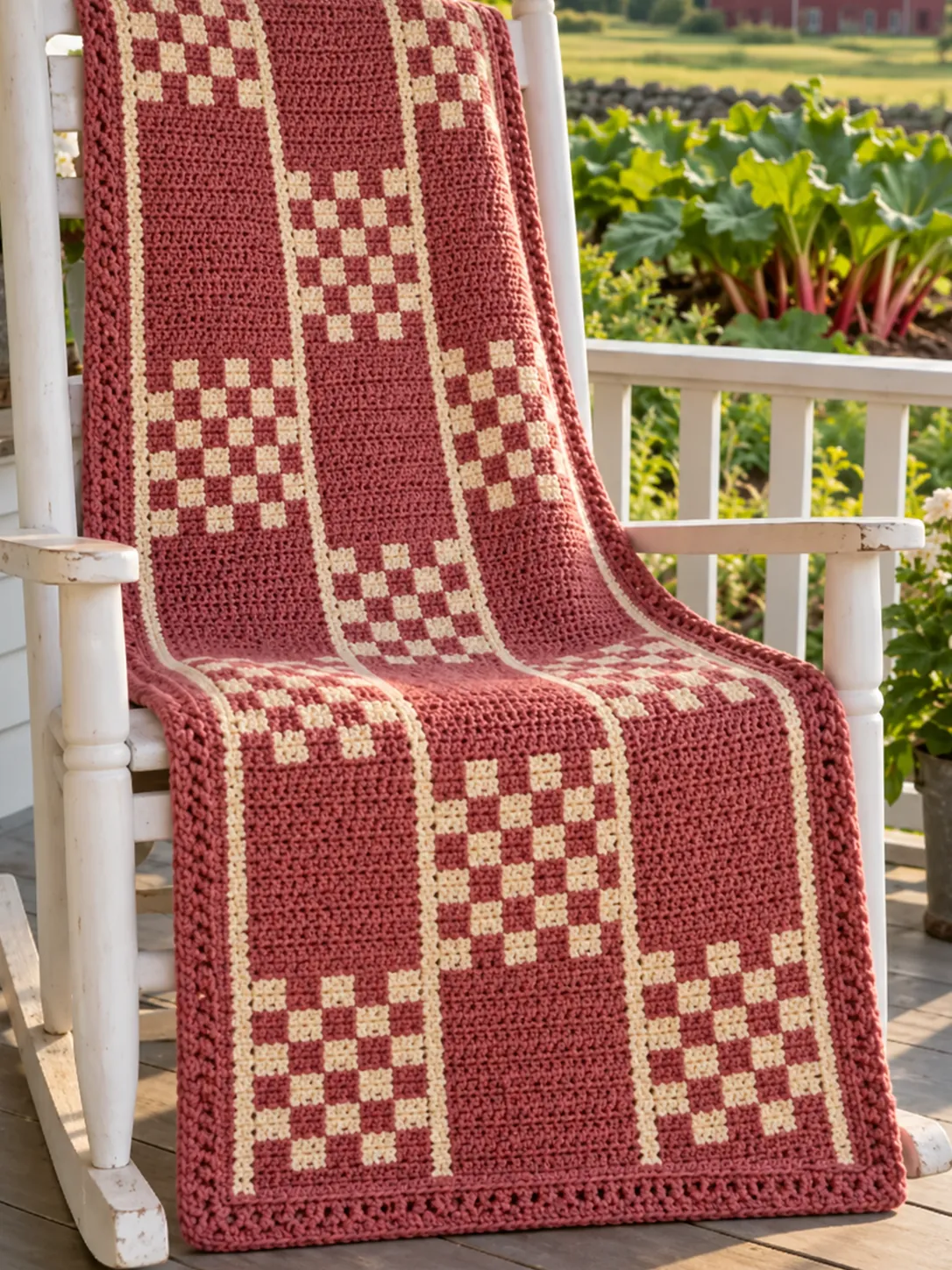
Picture the back corner of a Vermont garden in early June, when the rhubarb stalks have turned deep pink and the big leaves flop over the path. The Rhubarb Patch Throw takes that pink and pairs it with cream. It’s a checkered crochet blanket in worsted double crochet, built from narrow strips. Some blocks are filled with small checks, 4 stitches wide and 2 rows tall, and the others are plain rhubarb. Because the strips alternate, those blocks line up into one big checkerboard across the couch or the bed.
Each strip is only 20 stitches wide, so you never manage two colors across a whole blanket at once. A round of cream single crochet frames every strip, and once the strips are joined, those rounds sit side by side as thin cream lines. Lap, throw and twin sizes all use the same strip.
Is this checkered crochet blanket a good next step after stripes?
It is, if you’re at ease with a chain and rows of double crochet, where the chain 3 at the start of each row counts as the first stitch. The strip edging, the seams and the border add single crochet, slip stitches and one round of reverse single crochet. That last one is a single crochet worked backward, from left to right, so each stitch twists into a small rope.
The pattern is rated Intermediate because of what happens inside the checkered blocks. You change color in the middle of the row, every 4 stitches. The trick is to change one stitch early: work the last stitch of a color until 2 loops are left on the hook, then pull the new color through those 2 loops. That stitch keeps the old color, and the loop on your hook is already the new one.
The color you’re not using doesn’t dangle at the back. You lay it along the top of the row below and work your stitches over it, so it travels hidden inside the double crochet until its turn comes again. The solid blocks give your hands a break, with plain rhubarb rows and nothing to carry.
To join, you hold two strips right sides together and slip stitch through the back loops of their cream edgings, so the seam ridge stays on the wrong side.
If a line like with CC, dc in next 4 sts still looks cryptic, the Beginner Guide explains how to read the abbreviations in a pattern. And if you’d like to practice color changes before taking on mid-row ones, a bulky throw that only changes color at the ends of rows is a gentler first step.

A #4 yarn smooth enough to hide a carried strand
Look for the number 4 on the label, with worsted, aran or afghan next to it. The amounts in the card assume a yarn of about 180 m (197 yd) per 100 g, worked on a 5.5 mm (I-9) hook. Pick a smooth, plied acrylic or cotton-acrylic blend. Fuzzy yarns blur the edges of the checks, and their halo lets the carried strand peek through.
Skip 100% cotton for this one. Every checkered row holds a second strand inside it, so those blocks are thicker and heavier than plain double crochet, and a pure cotton twin sags when wet. A blend stays lighter and holds its shape.
Buy all the rhubarb from one dye lot. It fills the solid blocks, half of the checks and the border, so a new lot would show as a slightly different pink right next to the old one.
Substituting? Compare meters per 100 g rather than brands, then make the checker swatch from the card, carrying the strand, since the carried yarn changes both stitch and row gauge. Weigh both balls before and after the swatch: every amount here is an estimate until you know what your tension uses.
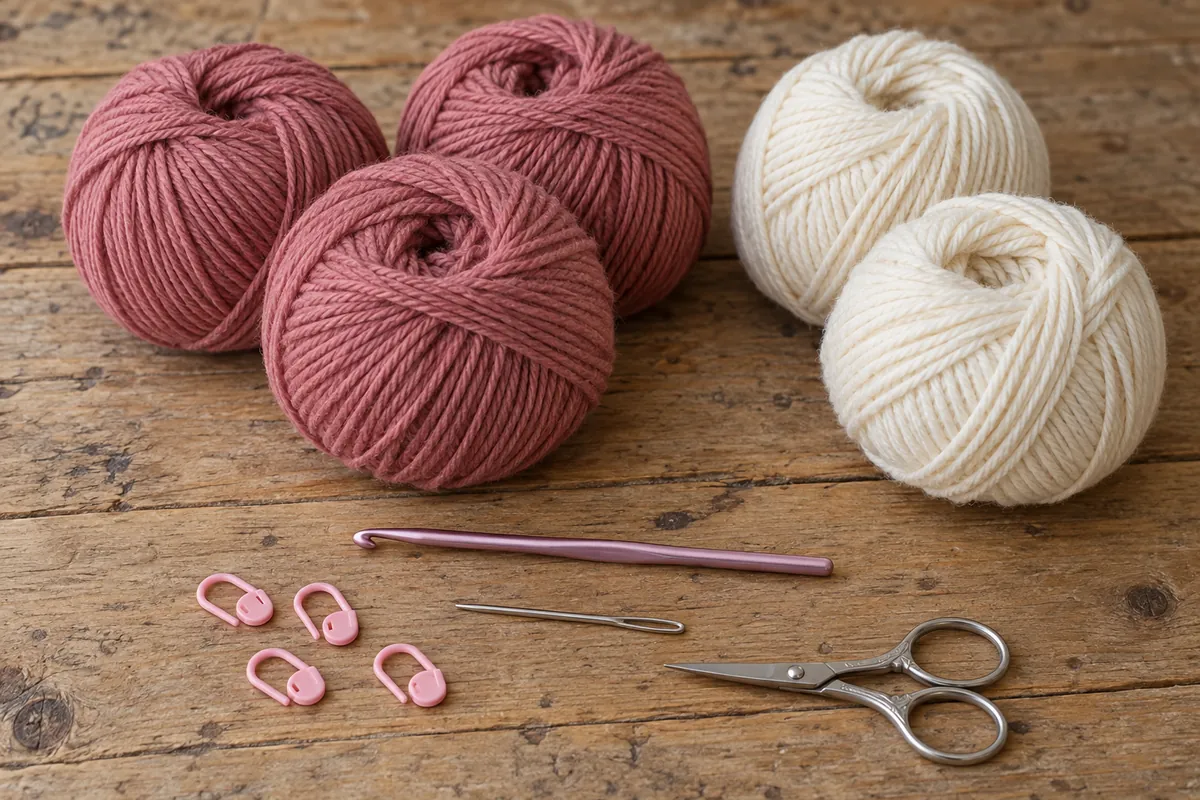
Rhubarb and cream, or another pair with real contrast
Rhubarb is the main color (MC). It works the solid blocks, half of every checkered block and the 4-round border. Cream is the contrast color (CC): the other half of the checks, the edging round around each strip and the seams, which is why those cream lines read so clearly between the strips.
A few pairs that suit the pattern:
- Rhubarb Patch: dusty rhubarb pink with cream, as written in the card.
- Sugar Snap: a soft pea green with cream, fresh in a sunny room.
- Blueberry Field: faded denim blue with ivory.
- Maple Cream: warm honey with ivory, lovely against pine furniture.
Before you buy, photograph the two skeins side by side in black and white. If they turn into the same gray, the checks will blur from across the room. Keep the main color mid-toned, too: a very dark MC, like burgundy or navy, can show through the cream checks where it rides inside them.
Lap, throw and twin from one 20-stitch strip
Every size starts with the same foundation chain of 22, which gives 20 double crochet per row. A block is 20 stitches by 12 rows, about 6 1/8 × 6 7/8 in (15.6 × 17.4 cm), or close to 7 in wide once its cream edging is on. Strip A starts and ends with a checkered block, Strip B starts and ends with a solid one, and there’s always one more A than B. The card is written as Lap [Throw, Twin].
- Lap, about 35 1/4 × 50 1/2 in (90 × 128 cm): 5 strips (3 A and 2 B) of 7 blocks, 84 rows each; border Round 1 of 568 sc; about 455 g of rhubarb and 215 g of cream.
- Throw, about 48 1/2 × 64 1/4 in (123 × 163 cm): 7 strips (4 A and 3 B) of 9 blocks, 108 rows each; border Round 1 of 752 sc; about 785 g of rhubarb and 380 g of cream.
- Twin, about 62 × 91 1/2 in (157 × 233 cm): 9 strips (5 A and 4 B) of 13 blocks, 156 rows each; border Round 1 of 1,032 sc; about 1,410 g of rhubarb and 690 g of cream.
Each size is a whole number of blocks, so the measurements land near the usual lap, throw and twin sizes rather than right on them. All dimensions and amounts are estimates based on 13 dc and 7 rows to 4 in, with a 10% margin on the yarn. To resize, add or remove strips two at a time and blocks two at a time, so the outer strips stay A.
Square checks and straight strips, block after block
Count in fours. Every row is five runs of 4 stitches, and the chain 3 counts as the first stitch of the first run. A run of 3 or 5 usually means an edge slipped: the first double crochet goes into the second stitch, and the last one into the top of the turning chain.
Put a marker on the right side of Row 1. On right-side rows, hold the carried strand toward the back before you work over it; on wrong-side rows, hold it toward you. Either way, it stays on the wrong side of the stitches, where it’s least likely to show.
Give the carried strand a small tug each time you switch back to it. Too loose and it peeks out between the posts. Too tight and the strip puckers and narrows. A checkered block should be as wide as a solid one, about 6 1/8 in; if yours come out narrower, ease off the carried strand.
At the end of each checkered row, bring the carried strand up the side and make the chain 3 around it. It stays tucked at the edge, and the cream edging round covers it later.
Cut the cream at the end of every checkered block and join it again at the start of the next one, leaving 6 in (15 cm) tails at the edge. Carrying it through a solid block would only thicken the plain rows, and it could show through the pink.
Before seaming, lay all the strips side by side. If one runs long, recount the rows of its blocks.
US crochet terms
The pattern
Materials
- Worsted weight yarn (#4), smooth acrylic or cotton-acrylic blend, about 180 m (197 yd) per 100 g, in 2 colors (estimate, 10% margin included):
- MC (Rhubarb, dusty pink): 455 [785, 1,410] g, about 900 [1,550, 2,780] yd (820 [1,415, 2,540] m), 5 [8, 15] skeins of 100 g
- CC (Cream): 215 [380, 690] g, about 430 [750, 1,360] yd (390 [685, 1,245] m), 3 [4, 7] skeins of 100 g
- 5.5 mm (I-9) crochet hook
- Yarn needle
- Removable stitch markers
Gauge
13 dc and 7 rows = 4 in (10 cm) in the checker pattern, carrying the unused color, with a 5.5 mm (I-9) hook. Estimate: measure your own gauge on a checker swatch before you start.
Swatch: with MC, ch 30. Row 1: carrying CC from the start, work 28 dc in runs of 4 (MC, CC, MC, CC, MC, CC, MC). Work 16 rows, swapping the colors every 2 rows as in the Checker block. Cut CC and work 12 more rows of plain MC dc. Block the swatch, then measure 4 in across the center of the checker rows, and compare 12 checker rows with the 12 plain rows (see Notes, Block height).
One block = 20 dc × 12 rows, about 6 1/8 × 6 7/8 in (15.6 × 17.4 cm).
Finished size
- Lap: about 35 1/4 × 50 1/2 in (90 × 128 cm)
- Throw: about 48 1/2 × 64 1/4 in (123 × 163 cm)
- Twin: about 62 × 91 1/2 in (157 × 233 cm)
- Measurements include the border, about 1 in (2.5 cm) wide, after light blocking. Estimates based on the gauge above.
Abbreviations
- CC contrasting color (Cream)
- ch chain
- dc double crochet
- MC main color (Rhubarb)
- rep repeat
- reverse sc reverse single crochet (see Notes)
- RS right side
- sc single crochet
- sl st slip stitch
- st(s) stitch(es)
- WS wrong side
- yo yarn over
Notes
- Sizes are written as Lap [Throw, Twin]. A number given once applies to all sizes.
- Construction: the blanket is made of 20-st strips of dc, joined side by side. Each strip is a column of 12-row blocks that alternate between Checker blocks (checks 4 sts wide and 2 rows tall, in MC and CC) and Solid blocks (MC only). Strip A starts and ends with a Checker block; Strip B starts and ends with a Solid block.
- Stitch multiple: foundation chain = a multiple of 4 + 2, with an odd number of 4-st runs (for example ch 14, 22 or 30). Each strip here is ch 22 for 20 dc, or 5 runs.
- Turning chain: the ch 3 at the start of every dc row counts as the first dc. Skip the st at the base of the ch-3 and work the last dc of each row in the top ch of the previous row’s ch-3. The ch 1 at the start of sc rounds does not count as a st.
- Row 1 is the RS: odd rows are RS rows and even rows are WS rows. Place a marker on the RS of Row 1. Turn at the end of every row.
- Color changes: change colors on the last stitch of each color run: work it until 2 loops remain and finish it with the next color. At the end of a row, do this on the last st when the next row starts with the other color, so the ch-3 is in the new color.
- Carrying (Checker blocks only): on every row of a Checker block, carry the color not in use. Lay it along the top of the row below and work each st over it, so it is enclosed inside the sts. On RS rows, hold the carried strand toward the back; on WS rows, hold it toward you. Give it a gentle tug before you switch back to it, and work firmly and evenly.
- Row ends in Checker blocks: turn, bring the carried strand up the side, hold it along the edge and work the ch-3 around it, then lay it along the top of the row.
- CC is joined at the start of each Checker block (laid along the top of the row below, with a 6 in / 15 cm tail at the edge) and cut at the end of each Checker block (6 in / 15 cm tail). MC runs the whole length of the strip. Nothing is carried in Solid blocks.
- Block height: 12 checker rows and 12 plain MC rows should both measure about 6 7/8 in (17.4 cm). If the plain rows of your swatch are noticeably shorter or taller, use a hook 0.5 mm larger or smaller for the Solid blocks only, and keep 12 rows in every block.
- The edges of the checks may shift slightly between RS and WS rows. This is normal for checks worked in rows.
- Reverse sc (border Round 4): without turning, work from left to right (right to left if you crochet left-handed). Insert the hook in the next st to the right, yo, pull up a loop, yo, pull through both loops on the hook.
- Hide the CC tails in the cream edging round of each strip, by working over them or weaving them in afterward.
Instructions
Checker block (12 rows, 20 dc)
Worked on top of a Solid block, or after Row 1 of Strip A. Block Row 1 is always a RS row.
- Block Row 1 (RS, carried strand at the back): If a Solid block is below, lay CC along the top of the row below, with a 6 in (15 cm) tail at the edge. With MC, ch 3 around CC (counts as a dc), dc in next 3 sts; with CC, dc in next 4 sts; with MC, dc in next 4 sts; with CC, dc in next 4 sts; with MC, dc in next 4 sts. Turn. (20 dc: 12 MC, 8 CC)
- Block Row 2 (WS, carried strand toward you): With MC, ch 3 around the carried strand (counts as a dc), dc in next 3 sts; with CC, dc in next 4 sts; with MC, dc in next 4 sts; with CC, dc in next 4 sts; with MC, dc in next 4 sts, changing to CC in the last st. Turn. (20 dc: 12 MC, 8 CC)
- Block Row 3 (RS, carried strand at the back): With CC, ch 3 around the carried strand (counts as a dc), dc in next 3 sts; with MC, dc in next 4 sts; with CC, dc in next 4 sts; with MC, dc in next 4 sts; with CC, dc in next 4 sts. Turn. (20 dc: 12 CC, 8 MC)
- Block Row 4 (WS, carried strand toward you): With CC, ch 3 around the carried strand (counts as a dc), dc in next 3 sts; with MC, dc in next 4 sts; with CC, dc in next 4 sts; with MC, dc in next 4 sts; with CC, dc in next 4 sts, changing to MC in the last st. Turn. (20 dc: 12 CC, 8 MC)
- Block Row 5 (RS, carried strand at the back): With MC, ch 3 around the carried strand (counts as a dc), dc in next 3 sts; with CC, dc in next 4 sts; with MC, dc in next 4 sts; with CC, dc in next 4 sts; with MC, dc in next 4 sts. Turn. (20 dc: 12 MC, 8 CC)
- Block Row 6 (WS, carried strand toward you): With MC, ch 3 around the carried strand (counts as a dc), dc in next 3 sts; with CC, dc in next 4 sts; with MC, dc in next 4 sts; with CC, dc in next 4 sts; with MC, dc in next 4 sts, changing to CC in the last st. Turn. (20 dc: 12 MC, 8 CC)
- Block Row 7 (RS, carried strand at the back): With CC, ch 3 around the carried strand (counts as a dc), dc in next 3 sts; with MC, dc in next 4 sts; with CC, dc in next 4 sts; with MC, dc in next 4 sts; with CC, dc in next 4 sts. Turn. (20 dc: 12 CC, 8 MC)
- Block Row 8 (WS, carried strand toward you): With CC, ch 3 around the carried strand (counts as a dc), dc in next 3 sts; with MC, dc in next 4 sts; with CC, dc in next 4 sts; with MC, dc in next 4 sts; with CC, dc in next 4 sts, changing to MC in the last st. Turn. (20 dc: 12 CC, 8 MC)
- Block Row 9 (RS, carried strand at the back): With MC, ch 3 around the carried strand (counts as a dc), dc in next 3 sts; with CC, dc in next 4 sts; with MC, dc in next 4 sts; with CC, dc in next 4 sts; with MC, dc in next 4 sts. Turn. (20 dc: 12 MC, 8 CC)
- Block Row 10 (WS, carried strand toward you): With MC, ch 3 around the carried strand (counts as a dc), dc in next 3 sts; with CC, dc in next 4 sts; with MC, dc in next 4 sts; with CC, dc in next 4 sts; with MC, dc in next 4 sts, changing to CC in the last st. Turn. (20 dc: 12 MC, 8 CC)
- Block Row 11 (RS, carried strand at the back): With CC, ch 3 around the carried strand (counts as a dc), dc in next 3 sts; with MC, dc in next 4 sts; with CC, dc in next 4 sts; with MC, dc in next 4 sts; with CC, dc in next 4 sts. Turn. (20 dc: 12 CC, 8 MC)
- Block Row 12 (WS, carried strand toward you): With CC, ch 3 around the carried strand (counts as a dc), dc in next 3 sts; with MC, dc in next 4 sts; with CC, dc in next 4 sts; with MC, dc in next 4 sts; with CC, dc in next 4 sts. If a Solid block follows, change to MC in the last st, cut CC (6 in / 15 cm tail) and turn. At the end of a strip, fasten off both colors. (20 dc: 12 CC, 8 MC)
Solid block (12 rows, 20 dc)
- Solid Rows 1–12: With MC, ch 3 (counts as a dc), dc in next 19 sts. Turn. (20 dc)
Strip A (make 3 [4, 5])
- Foundation: With MC, ch 22.
- Row 1 (RS): Lay CC along the top of the chain, with a 6 in (15 cm) tail, and work over it. With MC, dc in 4th ch from hook (the 3 skipped ch count as a dc) and in next 2 ch; with CC, dc in next 4 ch; with MC, dc in next 4 ch; with CC, dc in next 4 ch; with MC, dc in next 4 ch. Turn. (20 dc: 12 MC, 8 CC)
- Rows 2–12: Work Checker block Rows 2–12. (20 dc)
- Rows 13–24: Work Solid block Rows 1–12. (20 dc)
- Rows 25–36: Work Checker block Rows 1–12. (20 dc)
- Rows 37–84 [37–108, 37–156]: Rep Rows 13–36 2 [3, 5] more times, ending with Checker block Row 12. Fasten off both colors. (20 dc; 84 [108, 156] rows, 7 [9, 13] blocks, about 48 [61 3/4, 89 1/8] in or 122 [157, 226] cm long)
Strip B (make 2 [3, 4])
- Foundation: With MC, ch 22.
- Row 1 (RS): Dc in 4th ch from hook (the 3 skipped ch count as a dc) and in each ch across. Turn. (20 dc)
- Rows 2–12: Work Solid block Rows 2–12. (20 dc)
- Rows 13–24: Work Checker block Rows 1–12. (20 dc)
- Rows 25–36: Work Solid block Rows 1–12. (20 dc)
- Rows 37–84 [37–108, 37–156]: Rep Rows 13–36 2 [3, 5] more times, ending with Solid block Row 12. Fasten off. (20 dc; 84 [108, 156] rows, 7 [9, 13] blocks)
Strip edging (work on every strip)
- Round 1 (RS): With RS facing, join CC with sl st in the top right corner st. Ch 1, 3 sc in same st (corner), sc in each of next 18 sts, 3 sc in last st (corner); working along the row ends of the side, 2 sc in each row end (168 [216, 312] sc); working in the opposite side of the foundation chain, 3 sc at the base of the first st (corner), sc at the base of each of next 18 sts, 3 sc at the base of the last st (corner); working along the row ends of the other side, 2 sc in each row end (168 [216, 312] sc); join with sl st to first sc. Fasten off. (384 [480, 672] sc: 20 between the corner center sc on each short side, 170 [218, 314] on each long side, plus 4 corner center sc)
Joining
- Layout: Lay the strips RS up in the order A, B, A, B and so on, ending with A, all with the foundation chain at the bottom.
- Seam 1: Place the first 2 strips RS together, long edges aligned. With CC, insert the hook through the back loops of the top corner center sc of both strips, yo, pull up a loop. Sl st through the back loops of each following pair of sts down the long side, ending in the bottom corner center sc of both strips. Fasten off. (172 [220, 316] pairs of sts joined)
- Seams 2–4 [2–6, 2–8]: Join each next strip to the last joined strip the same way, keeping the A, B order. (5 [7, 9] strips, 4 [6, 8] seams)
Border
- Round 1 (RS): With RS facing, join MC with sl st in the corner center sc at the top right corner of the blanket. Ch 1, 3 sc in same st; *sc in each st to the corner center sc of the next blanket corner, 3 sc in that st; rep from * 2 more times, sc in each remaining st; join with sl st to first sc. At each seam, work 1 sc in each of the 2 joined corner sc. (568 [752, 1,032] sc: 108 [152, 196] along the top and bottom, 170 [218, 314] along each side, 3 in each corner)
- Round 2: Sl st in next sc (corner center). Ch 1, 3 sc in same st; *sc in each st to the center sc of the next corner, 3 sc in that st; rep from * 2 more times, sc in each remaining st; join with sl st to first sc. (576 [760, 1,040] sc: 110 [154, 198] along the top and bottom, 172 [220, 316] along each side, 3 in each corner)
- Round 3: Rep Round 2. (584 [768, 1,048] sc: 112 [156, 200] along the top and bottom, 174 [222, 318] along each side, 3 in each corner)
- Round 4: Ch 1, sc in same st as join. Without turning, working from left to right, reverse sc in each st around; join with sl st to first sc. Fasten off and weave in all ends. (584 [768, 1,048] sts)
Washing rhubarb and cream without pink in the checks
Wash the finished throw by itself the first time, in cold water on a gentle cycle, with a color-catcher sheet. A saturated pink can release a little dye, and the cream checks are where it would show first. Acrylic and cotton-acrylic blends can tumble dry on low, or you can lay the blanket flat over two drying racks. Don’t hang a wet twin from a line: its weight stretches the strips. Keep a hot iron away from acrylic, and fold along the seams for storage, so creases never cross the checks.
Rhubarb Patch Throw questions
Why does a bit of cream show through the rhubarb checks?
Double crochet is a tall, fairly open stitch, so the strand riding inside it can peek out between the posts. Hold the carried strand toward the wrong side on every row and keep your stitches firm. If your swatch still shows more than a few flecks, try a 5 mm (H-8) hook for the checkered blocks only, and check that they stay as wide as the solid ones.
Do the checkered and solid blocks have to be the same height?
Yes, or the blocks won’t line up across the seams. With the gauge in the card, 12 checkered rows and 12 plain rows both measure about 6 7/8 in. Measure both on your swatch. If the plain rows come out noticeably shorter or taller, go up or down 0.5 mm for the solid blocks and keep 12 rows in every block.
Can I use a third color for the solid blocks?
Yes. All the plain rhubarb sits in the solid blocks, so a third color simply takes its place there. Plan on about 245 [440, 825] g of the new color, and the rhubarb for the checks and border drops to about 215 [345, 590] g. The cream amounts stay the same.
How many yarn tails does this checkered crochet blanket leave?
About 66 [106, 172], before counting any new skeins. Most of them are cream: two for every checkered block, where the cream is joined and cut. They all end at the strip edges, so you can work over them in the cream edging round and trim them afterward.
Can I work it in one piece instead of strips?
Not with this pattern. In one piece, the cream would have to ride through the solid blocks too, thickening the plain rows and showing through the pink. Strips keep the carried strand inside the checks, and they’re light to hold while you count runs of 4.
Quick recap
- Crochet 3 [4, 5] Strip A and 2 [3, 4] Strip B, 84 [108, 156] rows each, alternating checkered and solid blocks of 12 rows.
- Work one round of cream single crochet around each strip.
- Join the strips in the order A, B, A with slip stitches through the back loops, right sides together.
- Work 3 rounds of rhubarb single crochet around the whole blanket.
- Finish with a round of reverse single crochet and weave in the last ends.
Once the last seam is in, the Rhubarb Patch Throw reads like an old garden quilt, with thin cream lines holding the checks and the pink squares in place. It’s a checkered crochet blanket you can carry from the couch to the porch all summer long. If a run of 4 or a row count doesn’t add up on your hook, send a note through the Contact page and say which strip and row you’re on.