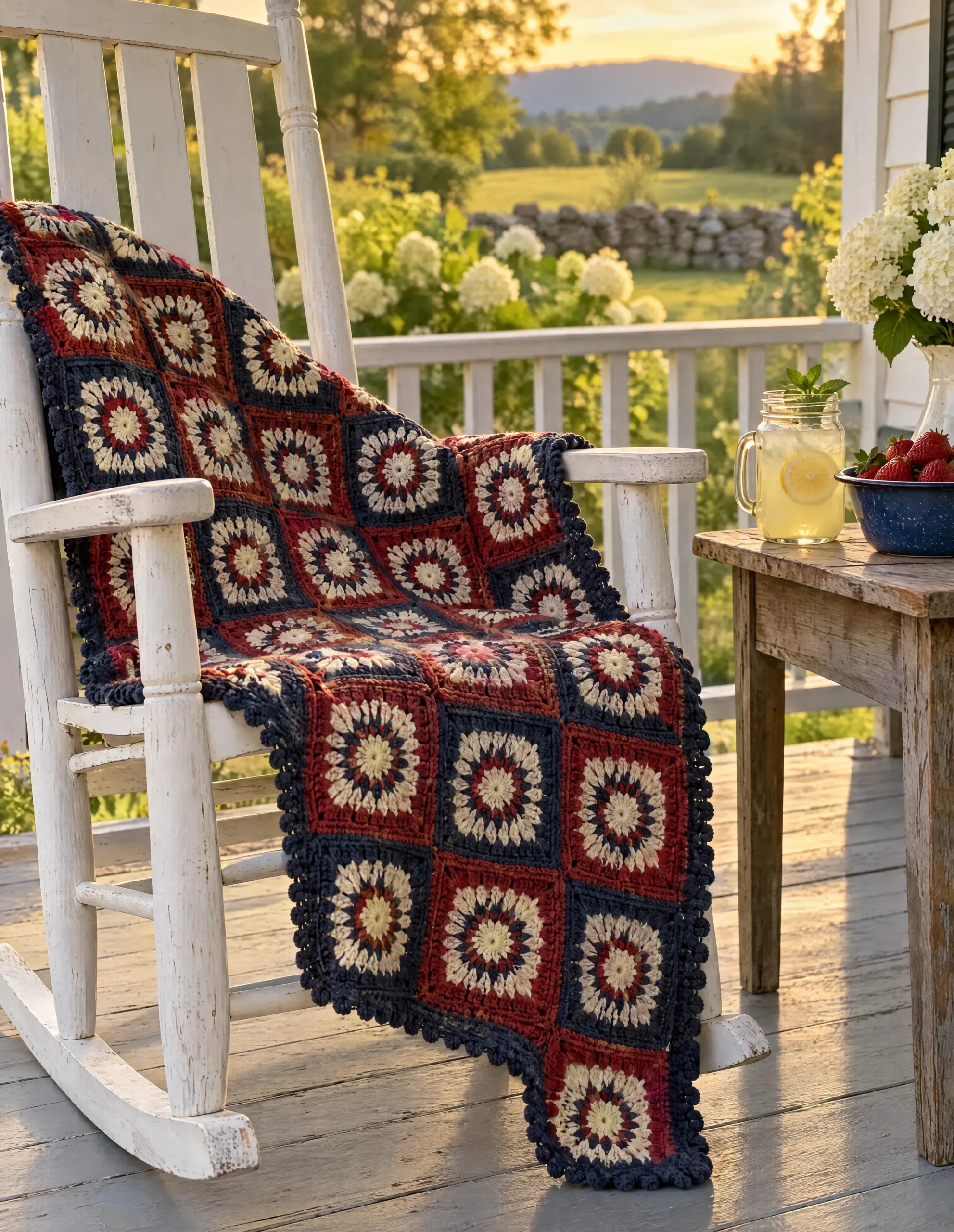
Picture the last light of a July evening on the porch, a jar of lemonade sweating on the rail and fireworks still an hour away. The Firecracker Square Afghan belongs right there: a red white and blue crochet blanket made of small squares, each with a buttermilk center and long cream stitches that burst outward across rings of barn red and deep navy, like sparks leaving a rocket.
Plump puff stitches frame every square, in red on half of them and navy on the others, and a checkerboard layout sets them side by side. The pattern below covers a throw, a twin and a queen, with every round, seam and border count written out.
Is this red white and blue crochet blanket a good next step after granny squares?
If you’re comfortable with the chain, single crochet and double crochet, and you’ve finished a few squares in rounds, it is. It’s rated Intermediate for three reasons: each square changes color five times, two of its six rounds use spike stitches that reach down into a lower round, and the afghan is sewn from many small pieces. If the abbreviations are new to you, the guide to reading a crochet pattern walks through them.
In most squares, each round sits on the one below. Here, two cream rounds break that rule. Some of their stitches dive down one more round, so a long cream stitch lies across the colored ring like a ray. Round 3 sends its rays across the red or navy of Round 2, and Round 5 sends a second set across the ring of Round 4. At every corner, two rays split apart from a single point, which gives each square a crisp, starry corner.
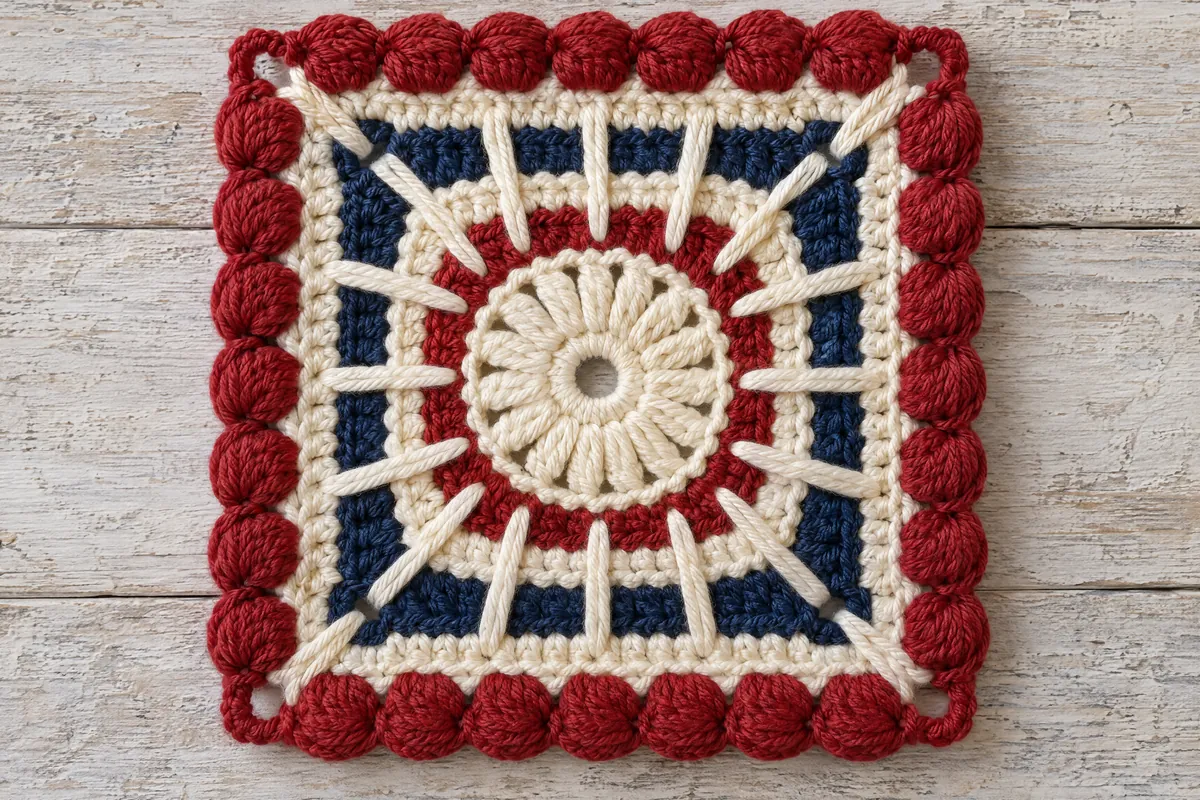
The outer round is a frame of 28 small puffs, 7 on each side. A puff is three loose loops pulled up in the same place and closed together, and the card explains how to keep them even. Those puffs are what make the checkerboard read from across the room: a red frame, a navy frame, a red frame again.
Worsted yarn and a firm 4 mm hook
Look for a 4 on the label, with worsted or medium next to it. Wool, a wool blend or a soft acrylic all work; for a summer porch blanket, a soft acrylic washes easily after a picnic. The amounts in the card assume skeins of about 200 yd (183 m) per 100 g.
The hook is a 4.0 mm (G-6), smaller than the one printed on most worsted labels. It keeps the squares firm, so the spike rays lie flat against the rings and the puffs stand up. With a bigger hook, the spikes loosen into loops and the puffs flatten.
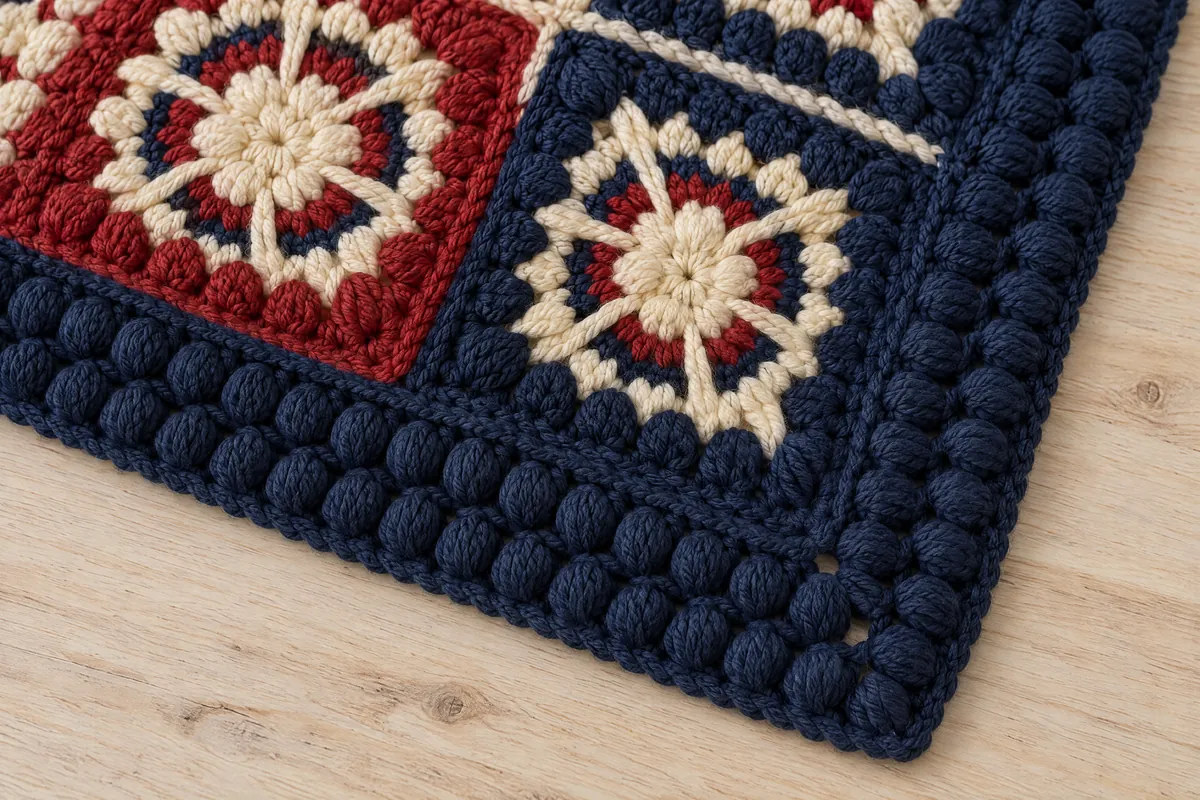
Navy is the biggest purchase, since it also makes every seam and the border: about 1,561 yd for the throw. Buy each color from a single dye lot. Make one red-framed square and block it before you buy everything: it should measure 4 in (10 cm) across.
Barn red, buttermilk and navy, or a softer trio
Each palette keeps the same three jobs. A is the center and the spike rays, B and C share the rings and the puff frames, and C also makes the seams and the border. Keep A clearly lighter than B and C, so the rays stand out.
- Front Porch: A buttermilk, B barn red, C deep navy, as written.

- Sea Glass: A natural, B sea glass green, C deep teal.
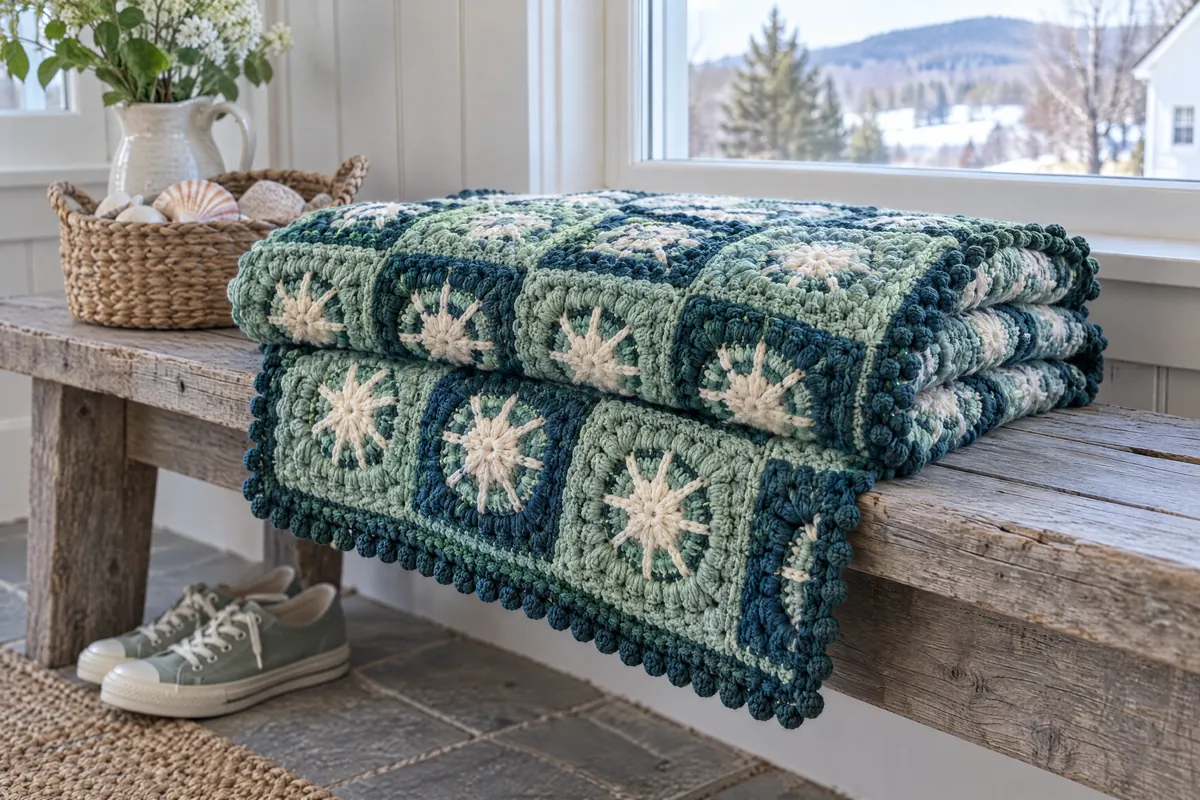
- Sunflower Barn: A oatmeal, B mustard, C rust.

Bright white instead of buttermilk makes the rays pop even more against the navy; buttermilk gives a softer, vintage look that hides everyday wear. Whichever you choose, use it for both the centers and the rays.
Throw, twin or queen in 4-inch squares
All three sizes use the same two squares; only the number of squares and the number of border rounds change. Each border round adds about 1/2 in on every side, and the number of rounds brings each size close to its target. The card is written as Throw [Twin, Queen].
- Throw: about 51 × 59 in (130 × 150 cm). 12 × 14 squares, 84 red and 84 navy, 3 border rounds. A 1,542 yd, B 1,055 yd, C 1,561 yd.
- Twin: about 66 × 90 in (168 × 229 cm). 16 × 22 squares, 176 of each, 2 border rounds. A 3,231 yd, B 2,211 yd, C 2,813 yd.
- Queen: about 91 × 99 in (231 × 251 cm). 22 × 24 squares, 264 of each, 3 border rounds. A 4,846 yd, B 3,316 yd, C 4,348 yd.
Every square takes about 9 yd of buttermilk and a little over 6 yd of red, so even the queen grows at the same pace as the throw, just for longer.
Spike stitches, tails and a strip-by-strip checkerboard
A spike double crochet goes into the round before the previous one, two rounds below the one you’re working, directly under the next stitch. Draw the loop up to the height of the current round without pulling the fabric, then finish the double crochet. The spike covers the next stitch of the round below, so you skip that stitch, and the count stays the same.
Round 5 is the round to read twice. At each corner, both spikes go into the same ch-2 space of Round 3, and each one covers one of the two corner single crochets of Round 4. Pin a marker on the corner space of Round 3 before you start, so you can find it under the navy or red.
Each round is one color, so you fasten off at the end of every round. Work the new color’s tail and the old tail of the round below over the first 8 stitches, and only the two tails of Round 6 are left to weave in. That’s 336 tails on the throw instead of more than a thousand.

Finish and block a full strip of squares before sewing it, and keep the strips in order in a basket. Odd strips start with a red-framed square, even strips with a navy one, so the checkerboard comes out right. Each edge takes 9 whipstitches: the corner space, the 7 puffs, the other corner space.
If you enjoy motif afghans that build square by square, the circle-in-a-square afghan in harvest colors and the navy and honey star afghan make good companions for the rest of the year.
US crochet terms
The pattern
Materials
- Worsted weight yarn (#4), wool, wool blend or soft acrylic, about 200 yd (183 m) per 100 g skein, in 3 colors (estimate; C includes the seams and the border):
- A, Buttermilk (centers and spike rays): about 1,542 [3,231, 4,846] yd (1,410 [2,954, 4,431] m), 8 [17, 25] skeins
- B, Barn Red: about 1,055 [2,211, 3,316] yd (965 [2,022, 3,032] m), 6 [12, 17] skeins
- C, Deep Navy: about 1,561 [2,813, 4,348] yd (1,427 [2,572, 3,976] m), 8 [15, 22] skeins
- 4.0 mm (G-6) crochet hook
- Yarn needle with a large eye
- Scissors
- Rustproof pins and a blocking mat or folded towel
Gauge
One square = 4 in (10 cm) from side to side after Round 6, blocked, with a 4.0 mm (G-6) hook. Make one Red Block and block it before starting the afghan. If it measures more than 4 in, use a smaller hook; if it measures less, use a larger hook. Estimate: your size may vary with your gauge.
Finished size
- Throw: about 51 × 59 in (130 × 150 cm), 12 × 14 squares, 3 border rounds
- Twin: about 66 × 90 in (168 × 229 cm), 16 × 22 squares, 2 border rounds
- Queen: about 91 × 99 in (231 × 251 cm), 22 × 24 squares, 3 border rounds
- Border included. Estimates based on the gauge above.
Abbreviations
- approx. approximately
- ch chain
- ch-2 sp the space under a ch 2 made on an earlier round
- dc double crochet
- puff puff stitch (see Notes)
- rep repeat
- Rnd round
- RS right side
- sc single crochet
- sk skip
- sl st slip stitch
- sp(s) space(s)
- spike dc spike double crochet (see Notes)
- st(s) stitch(es)
- WS wrong side
- yo yarn over
Notes
- Sizes are written as Throw [Twin, Queen]. A number given once applies to all sizes. Every square has the same counts in every size: 16, 24, 28, 36, 44 and 28 sts in Rounds 1 to 6.
- Rounds, never turned: Every square is worked from the center out in joined rounds with the RS facing you. The work is never turned.
- Chain ring: Each square starts on a ring of 6 chains. It leaves a small hole at the center, which is part of the look.
- Starting chains: The ch 3 at the start of Round 1 counts as a dc. The ch 1 at the start of Rounds 2, 3, 4 and 5 does not count as a stitch. The joining sl st is never counted.
- One color per round: Fasten off at the end of every round, leaving a 6 in (15 cm) tail, and join the next color where the round says. The colors of each round are listed at the start of each block.
- Tails: Lay the new color’s tail and the tail of the round below along the top of the round below and work the first stitches over them, for at least 8 stitches, then trim. The two tails of Round 6 are woven in on the WS with the yarn needle. That leaves 2 tails per square to weave, 336 [704, 1056] in all, plus the border tails: weave them as each square is finished.
- Puff stitch (puff): Yo, insert the hook in the stated place, yo, pull up a loop to the height of a dc (3 loops on the hook). (Yo, insert the hook in the same place, yo, pull up a loop to the same height) twice (7 loops on the hook). Yo, pull through all 7 loops, ch 1 to close. The ch 1 is the top of the puff and is not counted on its own: each puff counts as 1 stitch. Keep the loops loose and even.
- Starting a round with a puff: Join the yarn with a sl st in the stated place, pull the loop up to the height of a dc, then make the puff in the same place.
- Puff in a space between two puffs: (border). Insert the hook in the gap between two neighboring puffs of the round below, under the strands that join them, never into a puff.
- Spike double crochet (spike dc): Yo, insert the hook from front to back in the stitch or space named by the round, in the round before the previous one (2 rounds below the round you are working), directly below the next stitch. Yo, draw the loop through and up to the height of the round you are working, without pulling the fabric (3 loops on the hook). (Yo, pull through 2 loops) twice. The spike covers the next stitch of the previous round: skip that stitch. Each spike dc counts as 1 stitch.
- Spikes in Round 3: go into the dc of Round 1. Spikes in Round 5 go into the sc and the ch-2 sps of Round 3.
- Round 5 corners: At each corner, both spike dc go into the ch-2 sp of Round 3, and each one covers one of the two corner sc of Round 4 (the sc just before the corner sp and the sc just after it). The 2 sc of the corner go in the ch-2 sp of Round 4.
- Corner counts: “On each side” counts the stitches between two corner sps, the stitches of the corner groups included.
- Hook size: The 4.0 mm hook is smaller than the hook printed on most worsted labels. It keeps the squares firm, so the spikes lie flat and the puffs stand up.
- Yardage and sizes are estimates based on the gauge above.
Instructions
Red Block (make 84 [176, 264])
Colors: Rnd 1 A, Rnd 2 B, Rnd 3 A, Rnd 4 C, Rnd 5 A, Rnd 6 B.
- Ring (A): Ch 6, join with sl st in the first ch to form a ring.
- Round 1 (A): Ch 3 (counts as a dc), 15 dc in the ring; join with sl st in the top of the beginning ch-3. Fasten off. (16 sts)
- Round 2 (B): Join B with sl st in the top of the beginning ch-3 of Round 1. Ch 1, 3 sc in the same st, *sc in each of the next 3 dc, 3 sc in the next dc; rep from * 2 more times, sc in each of the next 3 dc; join with sl st in the first sc. Fasten off. (24 sts: a group of 3 sc at each corner, 3 sc between the groups)
- Round 3 (A): Join A with sl st in the first sc of any 3-sc corner group. Ch 1, sc in the same st, *(spike dc, ch 2, spike dc) in the dc of Round 1 below the center sc of the group (sk that center sc), sc in the next sc, [spike dc in the dc of Round 1 below the next sc (sk that sc), sc in the next sc] twice; rep from * 2 more times, (spike dc, ch 2, spike dc) in the dc of Round 1 below the center sc of the last group (sk that center sc), sc in the next sc, spike dc in the dc of Round 1 below the next sc (sk that sc), sc in the next sc, spike dc in the dc of Round 1 below the next sc (sk that sc); join with sl st in the first sc. Fasten off. (28 sts, 4 ch-2 sps; 7 sts on each side)
- Round 4 (C): Join C with sl st in any corner ch-2 sp. Ch 1, (sc, ch 2, sc) in the same sp, *sc in each of the next 7 sts (sc and spike dc alike), (sc, ch 2, sc) in the next corner ch-2 sp; rep from * 2 more times, sc in each of the next 7 sts; join with sl st in the first sc. Fasten off. (36 sts, 4 ch-2 sps; 9 sc on each side)
- Round 5 (A): Join A with sl st in any corner ch-2 sp. Ch 1, sc in the same sp, spike dc in the ch-2 sp of Round 3 below (sk the next sc), *[sc in the next sc, spike dc in the sc of Round 3 below the next sc (sk that sc)] 3 times, sc in the next sc, spike dc in the ch-2 sp of Round 3 below the next corner (sk the next sc), 2 sc in the corner ch-2 sp of Round 4, spike dc in the same ch-2 sp of Round 3 (sk the next sc); rep from * 2 more times, [sc in the next sc, spike dc in the sc of Round 3 below the next sc (sk that sc)] 3 times, sc in the next sc, spike dc in the ch-2 sp of Round 3 below the first corner (sk the next sc), sc in the first corner ch-2 sp; join with sl st in the first sc. Fasten off. (44 sts: 7 sts along each side and a group of spike dc, 2 sc, spike dc at each corner)
- Round 6 (B): Join B with sl st in the first sc of Round 5. Pull the loop up to the height of a dc, puff in the same st, *[sk the next spike dc, puff in the next sc] 5 times, (puff, ch 2, puff) in the next sc; rep from * 2 more times, [sk the next spike dc, puff in the next sc] 5 times, puff in the first sc (the st that holds the first puff), ch 2; join with sl st in the top of the first puff. Fasten off. (28 sts, 4 ch-2 sps; 7 puffs on each side)
Round 6 works only into the sc of Round 5: every spike dc of Round 5 is skipped, and the corner group goes in the second sc of each corner pair.
Navy Block (make 84 [176, 264])
Work as for the Red Block, swapping B and C: Rnd 1 A, Rnd 2 C, Rnd 3 A, Rnd 4 B, Rnd 5 A, Rnd 6 C. Every count stays the same.
Blocking the squares
Weave in the Round 6 tails. Pin each square RS up to a 4 in (10 cm) square, corners square, mist it with water or cover it with a damp cloth, and let it dry completely before joining. All squares, red and navy, must block to the same size.
Joining
Layout: the afghan is made of 14 [22, 24] strips of 12 [16, 22] squares, worked across the width. Strip 1 and every odd strip start with a Red Block; strip 2 and every even strip start with a Navy Block. Along each strip the two blocks alternate, so each strip holds 6 [8, 11] Red Blocks and 6 [8, 11] Navy Blocks, and the colors form a checkerboard over the whole afghan.
Whipstitch seam: use C for every seam.
- Seam step 1: Thread the yarn needle with C, leaving a 6 in (15 cm) tail.
- Seam step 2: Place two squares RS together, edges aligned, corner sps matched.
- Seam step 3: Pass the needle through both corner ch-2 sps, then a second time through the same place to lock the yarn.
- Seam step 4: Insert the needle from front to back under both loops of the top of the next puff of the front square and of the matching puff of the back square, bring the yarn over the top of the edges, and repeat. Pull each stitch snug, not tight.
- Seam step 5: Each edge takes 9 whipstitches: the corner sp, the 7 puffs, the other corner sp. End with a locking stitch in the corner sps.
- Seam step 6: The seam ridge sits on the WS.
Order: first sew the squares of each strip together: 154 [330, 504] short seams in all. Then sew the strips together along their long edges, one strip at a time: 13 [21, 23] long seams. Along a long seam, keep matching the squares edge by edge, 9 whipstitches per square. Where 4 squares meet, pass the needle through all 4 corner sps before going on, and take the cross seam through the same point. Never join a new length of yarn where 4 squares meet: start it in the middle of a square’s edge.
Border
Work with C and the RS facing you. The top and bottom edges are the short edges (12 [16, 22] squares), the sides the long edges (14 [22, 24] squares). Twin: work Rounds 1 and 2. Throw and Queen: work Rounds 1, 2 and 3.
- Round 1: Join C with sl st in the corner ch-2 sp at the top right corner of the afghan. Pull the loop up to the height of a dc, (puff, ch 2, puff) in the same sp. *Along the side, on each square: puff in each of the 6 sps between two puffs of the square’s edge; at each seam: puff in the corner ch-2 sp of the square just worked and puff in the corner ch-2 sp of the next square. At the next corner of the afghan, (puff, ch 2, puff) in the corner ch-2 sp. Rep from * 2 more times, then work along the last side the same way; join with sl st in the top of the first puff. Do not fasten off. Count per side, corner puffs included: short sides (96 [128, 176] sts), long sides (112 [176, 192] sts). Round total: (416 [608, 736] sts, 4 [4, 4] ch-2 sps)
- Round 2: Sl st in the corner ch-2 sp. Pull the loop up to the height of a dc, (puff, ch 2, puff) in the same sp, *puff in each sp between two puffs to the next corner ch-2 sp, (puff, ch 2, puff) in the corner ch-2 sp; rep from * 2 more times, puff in each sp between two puffs to the end; join with sl st in the top of the first puff. Count per side, corner puffs included: short sides (97 [129, 177] sts), long sides (113 [177, 193] sts). Round total: (420 [612, 740] sts, 4 [4, 4] ch-2 sps). Twin: fasten off. Throw and Queen: do not fasten off.
- Round 3 (Throw and Queen only): Work as for Round 2. Count per side, corner puffs included: short sides 98 sts for the Throw, 178 sts for the Queen; long sides 114 sts for the Throw, 194 sts for the Queen. Round total: 424 sts for the Throw, 744 sts for the Queen, 4 ch-2 sps. Fasten off.
Each border round adds 1 puff on each side and 4 puffs in all.
Finishing
- Weave in the border tails on the WS. Lay the afghan flat on towels or a clean carpet, pat it out to the finished size, mist it lightly or cover it with damp towels, and let it dry completely.
Washing red and navy next to cream
Red and navy can bleed onto cream in the first washes. Wash a scrap of each with a scrap of buttermilk before you start. Then wash the afghan on its own the first few times, in cool water, with a color-catcher sheet.
For a machine-washable yarn, use a gentle cycle and lay the afghan flat to dry, so the squares keep their shape. Wool afghans can be hand washed in cool water and dried flat. Don’t hang it to dry: the weight of the wet squares stretches the seams, and a stretched seam pulls the checkerboard out of line.
Firecracker questions about rays, borders and colors
Can a red white and blue crochet blanket use bright white instead of buttermilk?
Yes. Bright white makes the rays pop even more against the navy, while buttermilk gives a softer, vintage look. Use the same color for both the centers and the rays, since they’re worked in the same rounds.
How do the cream rays cross the red and navy rings?
They’re spike double crochets. Each one goes down into the round before the previous one and is drawn up to the height of the round you’re working, so it lies across the colored ring. The stitch it covers is skipped, so the count stays the same.
Why does the twin get two border rounds while the throw and queen get three?
Each square measures 4 in, so the afghan grows in 4 in steps. Each border round adds about 1/2 in on every side, and two rounds land the twin right on 66 × 90 in. A third round brings the throw and the queen close to theirs.
My puffs look uneven. How do I fix them?
Pull every loop of a puff up to the same height, about the height of a double crochet, before you close it. Pulling the first loop high and the others short makes lopsided puffs. A firmer hook hold and a smaller hook both help them stand up straight.
Quick recap
- Make 84 [176, 264] red-framed squares and the same number of navy-framed squares, six rounds each.
- Block every square to 4 in (10 cm).
- Sew each strip of 12 [16, 22] squares, alternating red and navy, then sew the 14 [22, 24] strips together.
- Work 3 [2, 3] rounds of navy puff border.
- Weave in the last tails and block the afghan flat.
One small burst at a time, this red white and blue crochet blanket turns into a whole summer of fireworks. If a round or a seam puzzles you, ask through the Contact page.