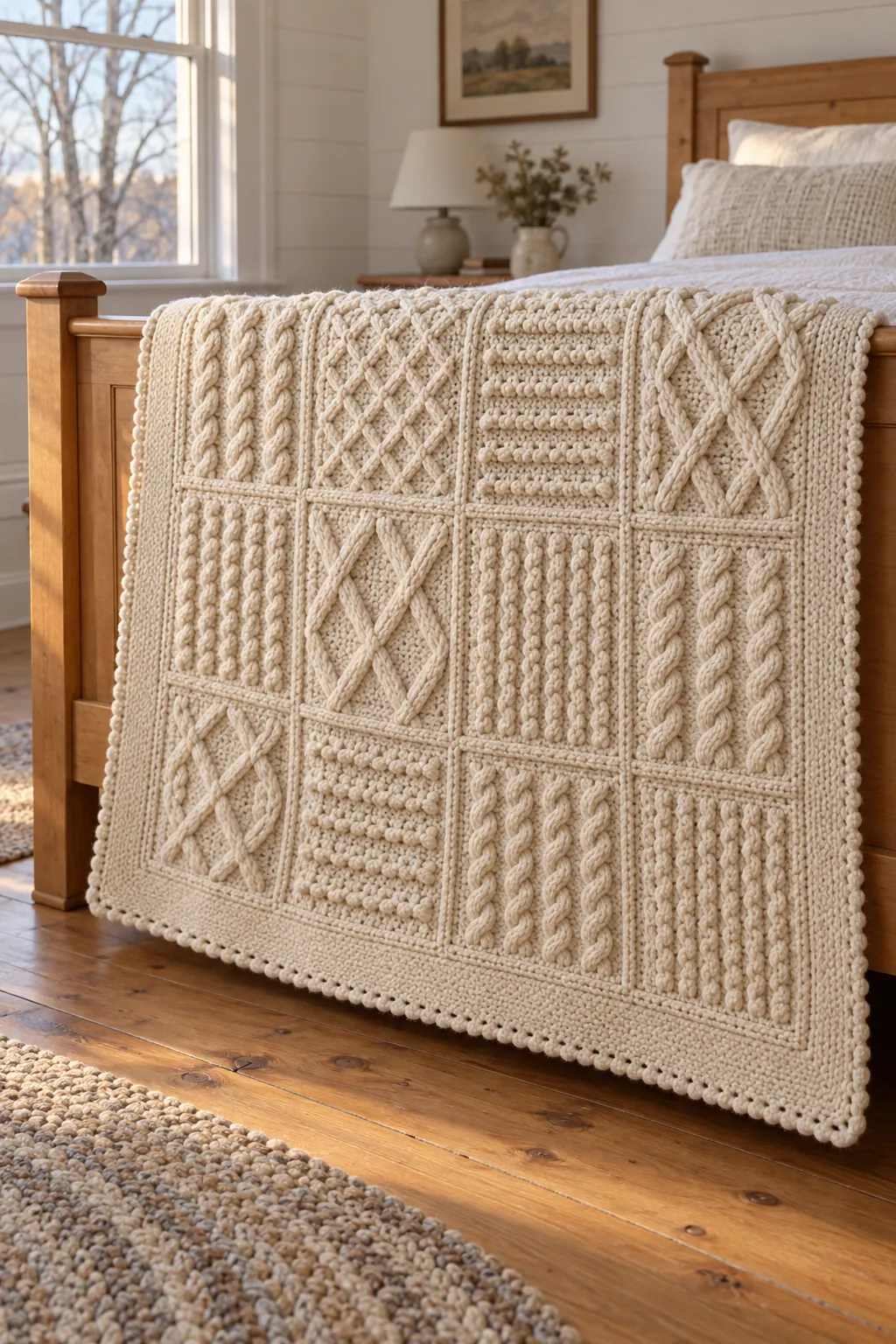
Picture a gray November afternoon, the woodstove ticking, and a heavy cream afghan pulled over your knees, its surface carved like an old fieldstone wall. That’s the idea behind this crochet cable blanket: one natural color, four kinds of raised texture, and nothing to distract from the light sliding across every crossing. Each square block carries its own design, rope columns in one, a diamond trellis in the next, then a pair of big cables that open into diamonds, then rows of tiny twists, and the blocks step across the blanket in diagonal bands.
Fieldstone is worked in worsted weight yarn on a 5.5 mm hook, one block at a time, in half double crochet rows with the texture built from front post stitches. It comes in two sizes: a throw of 20 blocks and a full bed size of 56. This is an Experienced pattern. None of the stitches is exotic, but every right-side row asks you to cross posts in front of or behind each other, keep exact counts and skip the correct stitch behind every post.
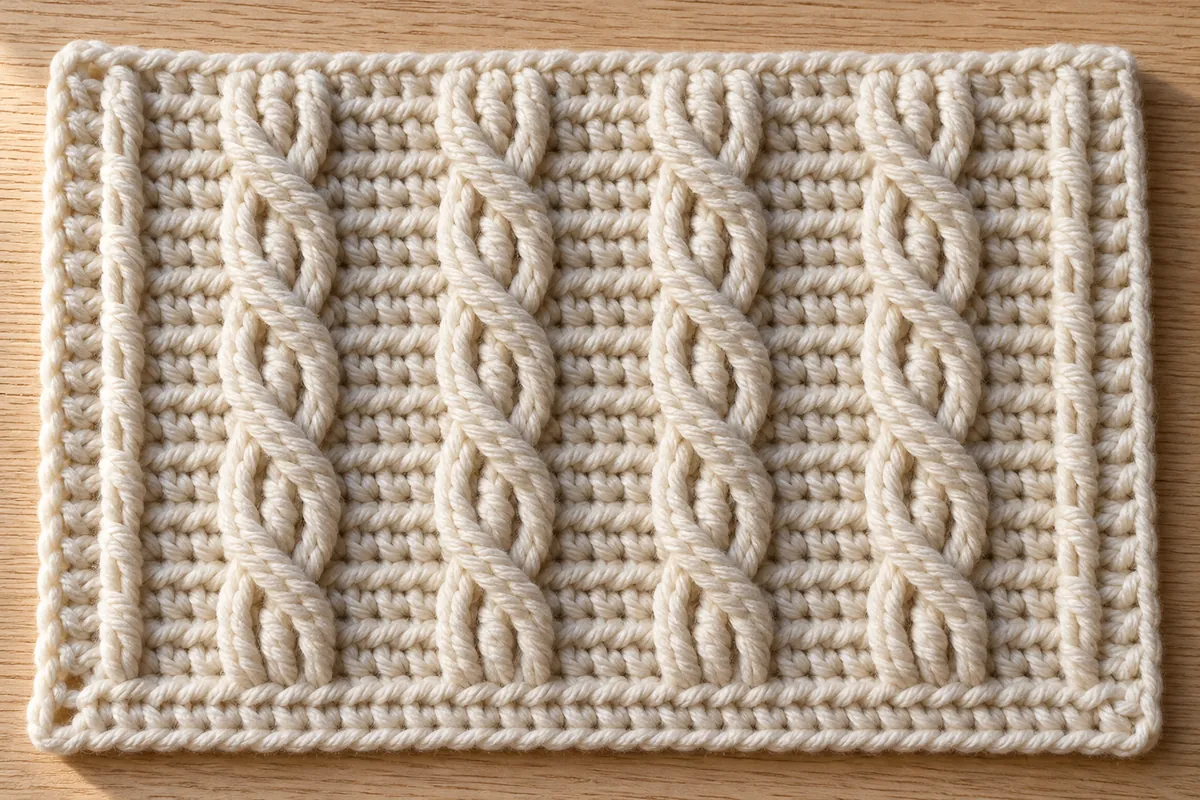
Is this crochet cable blanket the right next step for you?
If you’ve already finished a post stitch blanket, you’re ready. If post stitches are new to you, start with a waffle-textured throw and come back afterward.
The ground of every block is the half double crochet, worked in rows from a chain. The relief comes from two post stitches:
- Front post double crochet (FPdc): a double crochet worked around the body of a stitch from the front instead of into its top. Here it always goes around the stitch 2 rows below, so it reaches down past the plain row in between and stands proud of the fabric.
- Front post treble crochet (FPtr): the same idea with two yarn overs. The extra length lets a post travel sideways when it crosses another one.
A cable crossing simply changes the order. You skip a stitch or two, work posts around the next ones, then go back for the skipped ones, either in front of the new posts or behind them. That front-or-behind choice decides which strand sits on top. The border uses single crochet, one round of half double crochet in the front loops only, and a final round of reverse single crochet, a single crochet worked from left to right so it rolls into a little cord, spaced here with chain-2 loops. All the abbreviations are listed in the card, and the guide to reading a pattern covers brackets and repeats.
A gentle order for your first blocks: Picket Twists (D), then Rope Fence (A), Orchard Trellis (B), and Stone Arch (C) last, because its cables slant apart and cross back over an 8-row repeat.
A smooth cream worsted that lets every crossing show
Look for a medium weight yarn with the number 4 on the label (worsted or afghan weight). Smooth, tightly plied yarn gives crisp posts; brushed, fuzzy, chenille or bouclé yarns blur the crossings into lumps. Acrylic washes easily and holds its shape; a wool blend gives a springier relief and blocks beautifully but needs gentler washing.
Cable fabric eats yarn: every post adds a second layer. Plan on about 3,809 yd (3,482 m) for the throw and about 9,134 yd (8,349 m) for the full, or 11 and 26 skeins of 364 yd (333 m). Those totals are an estimate that already includes a 15% margin. Buy everything from one dye lot: on a single-color blanket, a slightly different cream shows as a patchy block in daylight.
Your gauge swatch is one finished block. Before its edging it should measure about 10½ in (26.5 cm) square over 31 stitches and 29 rows, and 11 in (28 cm) with the edging round. Picket Twists is one stitch wider and loses that stitch with a single decrease in its edging. Bigger block, go down a hook size; smaller, go up. One block uses roughly 155 yd (142 m), estimate.
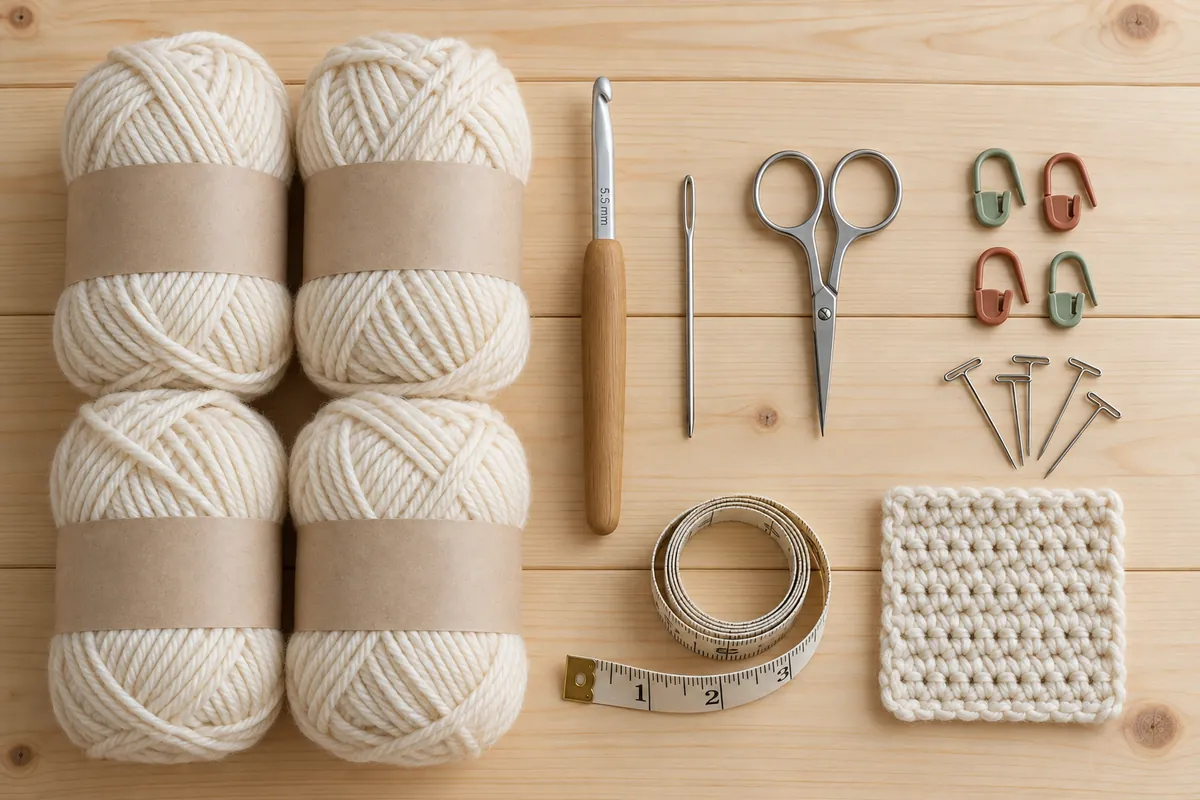
Why Fieldstone stays in one natural cream
The pattern lives on shadow. Every raised post throws a thin shadow on the flat half double crochet beside it, and a pale, warm shade shows those shadows best. Stripes or contrasting blocks would pull the eye to color and flatten the texture.
Good light neutrals to try:
- Natural cream (as written): the classic undyed look, warm rather than bright white.
- Oatmeal: a touch darker, kinder to a sofa that sees daily use.
- Buttermilk: a soft yellowish cream that glows by lamplight.
Before you commit, work Rows 1 to 7 of Rope Fence, photograph it by a window and turn the photo black and white. If the ropes still read clearly, the shade works.
Throw or full: sizing Fieldstone by the block
Every edged block measures 11 in (28 cm) square, so the size of the afghan is set by how many blocks you make. The card gives the throw first and the full in brackets.
- Throw, about 49½ × 60½ in (126 × 154 cm): 4 blocks across and 5 down, 20 blocks (5 of each design). The border has 9 rounds, from 594 stitches on Round 1 to a last round of 325 reverse single crochets. Yarn: about 3,809 yd (3,482 m), estimate.
- Full, about 79½ × 90½ in (202 × 230 cm): 7 blocks across and 8 down, 56 blocks (14 of each design). The border has 4 rounds, from 990 stitches to a last round of 503 reverse single crochets. Yarn: about 9,134 yd (8,349 m), estimate.
The throw gets a wider border because 4 × 5 blocks alone come out a little narrow for a 50 × 60 in throw.
Here are the placement charts, read from the top row down, every block with its Row 1 at the bottom. The letters stand for Rope Fence (A), Orchard Trellis (B), Stone Arch (C) and Picket Twists (D). Each design steps one block left on the next row, forming diagonals.
Throw
| Block row | 1 | 2 | 3 | 4 |
|---|---|---|---|---|
| 1 | A | B | C | D |
| 2 | B | C | D | A |
| 3 | C | D | A | B |
| 4 | D | A | B | C |
| 5 | A | B | C | D |
Full
| Block row | 1 | 2 | 3 | 4 | 5 | 6 | 7 |
|---|---|---|---|---|---|---|---|
| 1 | A | B | C | D | A | B | C |
| 2 | B | C | D | A | B | C | D |
| 3 | C | D | A | B | C | D | A |
| 4 | D | A | B | C | D | A | B |
| 5 | A | B | C | D | A | B | C |
| 6 | B | C | D | A | B | C | D |
| 7 | C | D | A | B | C | D | A |
| 8 | D | A | B | C | D | A | B |
If you enjoy building a blanket from separate blocks, the log cabin block afghan in moss stitch is also seamed with slip stitches, with color doing the work instead of relief.
Keeping every count and all 29 rows true in the four blocks
- Skip the hidden half double crochet. Every post stitch takes the place of the stitch sitting behind it in the row just below. Miss that skip once and the row gains a stitch. Count each right-side row against the breakdown printed in the card, posts and half double crochets separately.
- Find the right stitch 2 rows below. On Row 3 it’s a Row 1 half double crochet. On later rows it’s usually the post you made 2 rows earlier, so the posts stack into columns. In a crossing, the skipped stitch 2 rows below is the one directly under the stitch you skipped.
- Keep Row 1 at the bottom. Clip a marker to the right side of each block with its letter. When you lay out the blocks, every foundation edge goes down; a block turned sideways or upside down makes its crossings lean the wrong way.
- Loosen up on the trebles. If a block puckers, your FPtr are pulling: draw each first loop up to the height of the row.
- Block each square before joining. Pin it to 11 in square with matching diagonals and let it dry.
- Growing the blanket. For a longer or wider afghan, add whole rows or columns of blocks and keep the diagonal letter sequence going. Each added block adds 11 in, about 155 yd (estimate), and 33 stitches to Round 1 of the border on that side.
- Sage or rust instead of cream. A solid mid-tone sage or a warm rust keeps enough shadow for the relief to show. Pick a solid, not a heather, and steer clear of very dark shades like navy or charcoal, where the crossings disappear in lamplight.
US crochet terms
The pattern
Materials
- Yarn: smooth worsted weight (CYC #4 Medium), acrylic or wool blend, one solid natural cream color, about 3,809 [9,134] yd (3,482 [8,349] m), or 11 [26] skeins of 364 yd (333 m), estimate; buy all of it in one dye lot.
- Hook: 5.5 mm / I-9, or the size needed to obtain gauge.
- Notions: yarn needle, scissors, 4 locking stitch markers, rust-proof pins and a blocking board.
Gauge
One block before the edging: 31 sts and 29 rows = about 10½ × 10½ in (26.5 × 26.5 cm) in the block pattern, blocked, or about 12 sts and 11 rows = 4 in (10 cm). One edged block: 11 × 11 in (28 × 28 cm), blocked. These figures are an estimate: check your first block before making the others.
Finished size
Throw about 49½ × 60½ in (126 × 154 cm) [Full about 79½ × 90½ in (202 × 230 cm)], after blocking, estimate.
Abbreviations
- ch chain
- FLO front loop only
- FPdc front post double crochet
- FPtr front post treble crochet
- hdc half double crochet
- hdc2tog half double crochet 2 together
- rev sc reverse single crochet
- RS right side
- sc single crochet
- sk skip
- sl st slip stitch
- sp(s) space(s)
- st(s) stitch(es)
- WS wrong side
Notes
- Skill level: Experienced (crossed and slanted post stitches on the RS rows).
- The afghan is made of 20 [56] blocks in four designs, 5 [14] of each: A Rope Fence, B Orchard Trellis, C Stone Arch, D Picket Twists. Blocks A, B and C are 31 sts wide, block D is 32 sts wide; every block has 29 rows and ends with 31 hdc on each side after its edging round. The blocks are the same for both sizes, so their counts show a single number.
- Turning chain: the ch 2 at the start of every row does not count as a stitch. Work the first hdc into the first st and the last hdc into the last st; never work into a turning chain. The 2 chains skipped at the start of Row 1 do not count either.
- Stitch multiple: there is no stitch multiple to resize the blocks. Blocks A, B and C start with ch 33, block D with ch 34, so the edges match for joining; make the afghan bigger by adding blocks.
- Odd rows are RS rows and even rows are WS rows of plain hdc. Clip a marker to the RS of each block.
- Post stitches are worked on RS rows only, around the st 2 rows below: the st of the previous RS row directly beneath. On Row 3 that st is a Row 1 hdc; later it is usually a post. Behind every post stitch, skip the hdc of the row just below, so the count never changes.
- In a crossing, the skipped st 2 rows below is the st 2 rows below the st you skipped.
- The first and last st of every row are always plain hdc.
- RS row counts list the posts and the hdc separately.
- Special stitches:
- FPdc: yo, insert the hook from front to back to front around the post of the st 2 rows below, yo, pull up a loop to the height of the row, [yo, pull through 2 loops] twice. Skip the st behind it.
- FPtr: yo twice, insert the hook from front to back to front around the post of the st 2 rows below, yo, pull up a loop, [yo, pull through 2 loops] 3 times. Skip the st behind it.
- Slanted FPtr (Block C): an FPtr worked around a post 2 rows below that sits 1 st to the side of the st you are working, so the post moves 1 st on a diagonal. The row tells you which posts to use.
- Rope twist (uses 3 sts): sk next st, FPdc around each of next 2 sts 2 rows below, working in front of the 2 FPdc just made, FPdc around the skipped st 2 rows below.
- Trellis cross (uses 3 sts): sk next 2 sts, FPtr around next st 2 rows below, working behind the FPtr just made, hdc in the 2nd skipped st, working in front of the FPtr just made, FPtr around the 1st skipped st 2 rows below.
- Front cross (uses 4 sts): sk next 2 sts, FPtr around each of next 2 sts 2 rows below, working in front of the 2 FPtr just made, FPtr around each of the 2 skipped sts 2 rows below.
- Twist (uses 2 sts): sk next st, FPdc around next st 2 rows below, working in front of the FPdc just made, FPdc around the skipped st 2 rows below.
- hdc2tog: [yo, insert the hook in the next st, yo, pull up a loop] twice (5 loops on hook), yo, pull through all 5 loops.
- hdc FLO: an hdc worked under the front loop only of the st (the loop nearer to you).
- Rev sc: working from left to right (right to left if you crochet left-handed), insert the hook in the next st to the right, yo, pull up a loop, yo, pull through both loops.
- Blocking: pin each block to 11 × 11 in (28 × 28 cm) with equal diagonals. Wet block wool blends; for acrylic, hold a steamer above the block without touching it. Never press the relief flat.
Instructions
Starting blocks A, B and C
- Foundation: Ch 33.
- Row 1 (RS): Hdc in 3rd ch from hook and in each ch across. (31 sts)
- Row 2 (WS): Ch 2, turn, hdc in each st across. (31 sts)
Block A: Rope Fence (make 5 [14])
- Rows 1–2: Work as Starting blocks A, B and C. (31 sts)
- Row 3: Ch 2, turn, hdc in first st, FPdc around next st 2 rows below, [hdc in next 3 sts, FPdc around each of next 3 sts 2 rows below] 4 times, hdc in next 3 sts, FPdc around next st 2 rows below, hdc in last st. (31 sts: 14 FPdc, 17 hdc)
- Row 4: Work as Row 2. (31 sts)
- Row 5: Ch 2, turn, hdc in first st, FPdc around next st 2 rows below, [hdc in next 3 sts, rope twist] 4 times, hdc in next 3 sts, FPdc around next st 2 rows below, hdc in last st. (31 sts: 14 FPdc, 17 hdc)
- Row 6: Work as Row 2. (31 sts)
- Row 7: Work as Row 3. (31 sts: 14 FPdc, 17 hdc)
- Rows 8–27: Repeat Rows 4–7 five times.
- Rows 28–29: Work Rows 4 and 5 once more. (31 sts) Do not fasten off; work the Block edging.
Block B: Orchard Trellis (make 5 [14])
- Rows 1–2: Work as Starting blocks A, B and C. (31 sts)
- Row 3: Ch 2, turn, hdc in first st, FPdc around next st 2 rows below, [trellis cross, hdc in next st] 6 times, trellis cross, FPdc around next st 2 rows below, hdc in last st. (31 sts: 2 FPdc, 14 FPtr, 15 hdc)
- Row 4: Work as Row 2. (31 sts)
- Row 5: Ch 2, turn, hdc in first st, FPdc around next st 2 rows below, hdc in next 2 sts, [trellis cross, hdc in next st] 6 times, hdc in next st, FPdc around next st 2 rows below, hdc in last st. (31 sts: 2 FPdc, 12 FPtr, 17 hdc)
- Row 6: Work as Row 2. (31 sts)
- Row 7: Work as Row 3. The first and last trellis cross each start a new post around an hdc 2 rows below; the trellis posts nearest the edges rest on every Row 5 repeat. (31 sts: 2 FPdc, 14 FPtr, 15 hdc)
- Rows 8–27: Repeat Rows 4–7 five times.
- Rows 28–29: Work Rows 4 and 5 once more. (31 sts) Do not fasten off; work the Block edging.
Block C: Stone Arch (make 5 [14])
- Rows 1–2: Work as Starting blocks A, B and C. (31 sts)
- Row 3: Ch 2, turn, hdc in first st, *FPdc around next st 2 rows below, hdc in next 4 sts, front cross, hdc in next 4 sts, FPdc around next st 2 rows below, hdc in next st; rep from * once more. (31 sts: 4 FPdc, 8 FPtr, 19 hdc)
- Row 4: Work as Row 2. (31 sts)
- Row 5: Ch 2, turn, hdc in first st, *FPdc around next FPdc 2 rows below, hdc in next 3 sts, slanted FPtr around each of the first 2 FPtr of the cable 2 rows below, hdc in next 2 sts, slanted FPtr around each of the last 2 FPtr of the cable 2 rows below, hdc in next 3 sts, FPdc around next FPdc 2 rows below, hdc in next st; rep from * once more. The two pairs move 1 st apart. (31 sts: 4 FPdc, 8 FPtr, 19 hdc)
- Row 6: Work as Row 2. (31 sts)
- Row 7: Ch 2, turn, hdc in first st, *FPdc around next FPdc 2 rows below, hdc in next 2 sts, slanted FPtr around each of the first 2 FPtr of the cable 2 rows below, hdc in next 4 sts, slanted FPtr around each of the last 2 FPtr of the cable 2 rows below, hdc in next 2 sts, FPdc around next FPdc 2 rows below, hdc in next st; rep from * once more. The pairs move 1 st farther apart. (31 sts: 4 FPdc, 8 FPtr, 19 hdc)
- Row 8: Work as Row 2. (31 sts)
- Row 9: Work as Row 5. The pairs move 1 st back toward the center. (31 sts: 4 FPdc, 8 FPtr, 19 hdc)
- Row 10: Work as Row 2. (31 sts)
- Row 11: Ch 2, turn, hdc in first st, *FPdc around next FPdc 2 rows below, hdc in next 4 sts, sk next 2 sts, FPtr around each of the last 2 FPtr of the cable 2 rows below, working in front of the 2 FPtr just made, FPtr around each of the first 2 FPtr of the cable 2 rows below, hdc in next 4 sts, FPdc around next FPdc 2 rows below, hdc in next st; rep from * once more. (31 sts: 4 FPdc, 8 FPtr, 19 hdc)
- Rows 12–27: Repeat Rows 4–11 twice.
- Row 28: Work as Row 2. (31 sts)
- Row 29 (last row): Ch 2, turn, hdc in first st, *FPdc around next FPdc 2 rows below, hdc in next 12 sts, FPdc around next FPdc 2 rows below, hdc in next st; rep from * once more. (31 sts: 4 FPdc, 27 hdc) Do not fasten off; work the Block edging.
Block D: Picket Twists (make 5 [14])
- Foundation: Ch 34.
- Row 1 (RS): Hdc in 3rd ch from hook and in each ch across. (32 sts)
- Row 2 (WS): Ch 2, turn, hdc in each st across. (32 sts)
- Row 3: Ch 2, turn, hdc in first st, FPdc around next st 2 rows below, hdc in next st, [twist, hdc in next st] 9 times, FPdc around next st 2 rows below, hdc in last st. (32 sts: 20 FPdc, 12 hdc)
- Row 4: Work as Row 2. (32 sts)
- Row 5: Ch 2, turn, hdc in first st, FPdc around next st 2 rows below, hdc in next st, [twist, hdc in next st, FPdc around each of next 2 sts 2 rows below, hdc in next st] 4 times, twist, hdc in next st, FPdc around next st 2 rows below, hdc in last st. (32 sts: 20 FPdc, 12 hdc)
- Rows 6–25: Repeat Rows 2–5 five times.
- Rows 26–27: Work Rows 2 and 3 once more. (32 sts)
- Row 28: Work as Row 2. (32 sts)
- Row 29 (last row): Ch 2, turn, hdc in first st, FPdc around next st 2 rows below, hdc in next 28 sts, FPdc around next st 2 rows below, hdc in last st. (32 sts: 2 FPdc, 30 hdc) Do not fasten off; work the Block edging.
Block edging (every block)
- Round 1 (WS), blocks A, B and C: Ch 2 (does not count), turn. (Hdc, ch 2, hdc) in first st, hdc in next 29 sts, (hdc, ch 2, hdc) in last st; working along the side, 1 hdc in the end of each of the 29 rows, inserting the hook around the post of the edge hdc; working in the free loops of the foundation chain under the 31 sts of Row 1, (hdc, ch 2, hdc) in the first one, hdc in the next 29, (hdc, ch 2, hdc) in the last one; working along the second side, 1 hdc in the end of each of the 29 rows. Join with a sl st in first hdc. Fasten off. (124 sts: 31 hdc per side, 4 ch-2 corner sps)
- Round 1 (WS), block D: Work as for blocks A, B and C, but across the top and across the 32 free loops of the foundation chain work (hdc, ch 2, hdc) in the first one, hdc in the next 14, hdc2tog over the next 2, hdc in the next 14, (hdc, ch 2, hdc) in the last one. (124 sts: 31 hdc per side, 4 ch-2 corner sps)
- Block every finished block to 11 × 11 in (28 × 28 cm).
Layout
- Lay all blocks RS up, each with its Row 1 at the bottom, in this order (top block row first, letters left to right).
- Throw, block rows 1 to 5: A, B, C, D / B, C, D, A / C, D, A, B / D, A, B, C / A, B, C, D.
- Full, block rows 1 to 8: A, B, C, D, A, B, C / B, C, D, A, B, C, D / C, D, A, B, C, D, A / D, A, B, C, D, A, B / A, B, C, D, A, B, C / B, C, D, A, B, C, D / C, D, A, B, C, D, A / D, A, B, C, D, A, B.
Joining
- Seam method: hold 2 neighboring blocks WS together, edges matching. Join yarn with a sl st through both ch-2 corner sps, sl st through the back loops (the 2 outer loops) of each of the next 31 pairs of hdc, then sl st through both ch-2 corner sps at the other end: 33 sl sts per block edge. The seam makes a raised ridge on the RS that frames each block.
- Strips: in each block row, join the blocks side by side, 3 [6] seams per row, carrying on to the next pair without fastening off. You now have 5 [8] strips.
- Long seams: join the strips in order with 4 [7] long seams of 33 sl sts per block, 132 [231] sl sts per seam. At each junction, go through the corner sps of the 2 blocks on each side before continuing. Weave in all ends.
Border
- Round 1 (RS): With RS facing, join yarn with a sl st in any hdc along a long edge, at least 3 sts from a corner. Ch 1 (does not count), sc in same st, sc in each hdc and in each ch-2 corner sp on either side of every seam around, working (sc, ch 2, sc) in each of the 4 outer corner ch-2 sps. Join with a sl st in first sc. (594 [990] sts: 132 [231] sts across each short side and 165 [264] along each long side, corner sc included; 4 ch-2 corner sps)
- Round 2 (WS): Ch 2 (does not count), turn, hdc FLO in each st around, working (hdc, ch 2, hdc) in each corner ch-2 sp. Join with a sl st in first hdc. Each round adds 2 sts per side. (602 [998] sts, 4 ch-2 corner sps)
- Round 3 (RS): Ch 1 (does not count), turn, sc in each st around, working (sc, ch 2, sc) in each corner ch-2 sp. Join with a sl st in first sc. (610 [1006] sts, 4 ch-2 corner sps)
- Rounds 4–7 (Throw only): Work Rounds 2 and 3 twice more. (618 sts on Round 4, 626 on Round 5, 634 on Round 6, 642 on Round 7, 4 ch-2 corner sps each)
- Round 8 (Throw only, WS): Work Round 2 once more. (650 sts, 4 ch-2 corner sps)
- Round 9 [4], last round (RS): Throw: turn so the RS faces you. Full: do not turn. Ch 1 (does not count); working from left to right, rev sc in first st, *ch 2, sk next st, rev sc in next st; rep from * around, passing over the 4 corner ch-2 sps without working into them, ch 2, join with a sl st in first rev sc. Fasten off and weave in the ends. (325 [503] sts in rev sc, 325 [503] ch-2 sps)
Washing and drying a heavy cream cable afghan
Follow the yarn label first. Acrylic usually takes a gentle cool cycle inside a large mesh bag, so the posts don’t snag, with a mild detergent and no bleach, which can yellow a natural cream. Wool blends prefer a hand wash or a wool cycle.
Wet cable fabric is heavy. Never hang it from a line or a door: the weight pulls the blocks long and stretches the seams. Squeeze out the water, roll the afghan in towels, then dry it flat, turning it once. For acrylic in a dryer, use low heat and finish flat while still slightly damp.
Store it loosely folded in a cotton bag, with tissue between the folds.
Fieldstone questions about crossings, blocks and borders
How much heavier is a crochet cable blanket like this than a plain half double crochet throw?
Noticeably heavier. Each post sits on top of the fabric, so wherever there’s a cable you have two layers of yarn. That’s why the throw needs about 3,809 yd (estimate), and why the care section insists on drying it flat.
Can I swap one of the designs for a cable block from another pattern?
Only if the new block is also 29 rows of half double crochet and ends with 31 hdc on every side after the same edging round, then blocks to 11 in. Any other count makes the slip stitch seams run out of stitches before the corners meet.
Why does Orchard Trellis have 14 treble posts on some rows and 12 on others?
The trellis posts zigzag two stitches left or right on every crossing row. On Row 5 and its repeats, the two trellis posts nearest the edges have nowhere to cross, so they rest as plain hdc and start again on the next crossing row. The count stays at 31 stitches; only the mix of posts and hdc changes.
Why is there a raised ridge between the blocks?
The blocks are seamed back to back, so the slip stitch ridge sits on the front and frames every square like mortar between stones. Holding the blocks face to face instead hides the seam on the back. Either works, as long as every seam in the afghan matches.
Could Fieldstone be made in a queen size?
Not with this card. A layout of 8 blocks by 9 measures about 88 × 99 in before any border, so even a narrow border pushes it past a 90 × 100 in queen in length. The full size is the largest that lands on its target with a proper border.
Quick recap
- Make 5 [14] blocks of each design, 29 rows each, working the posts on the RS rows only.
- Work the hdc edging round on every block and block it to 11 in square.
- Lay out the blocks in diagonal bands, Row 1 always at the bottom.
- Seam them with slip stitches, WS together, first into strips, then strip to strip.
- Work the sc and hdc FLO border rounds and finish with a spaced round of rev sc.
However many blocks you make this winter, this crochet cable blanket rewards patience with a texture that keeps catching the light for years. If a row count doesn’t add up or a crossing leaves you puzzled, send a note through the Contact page.