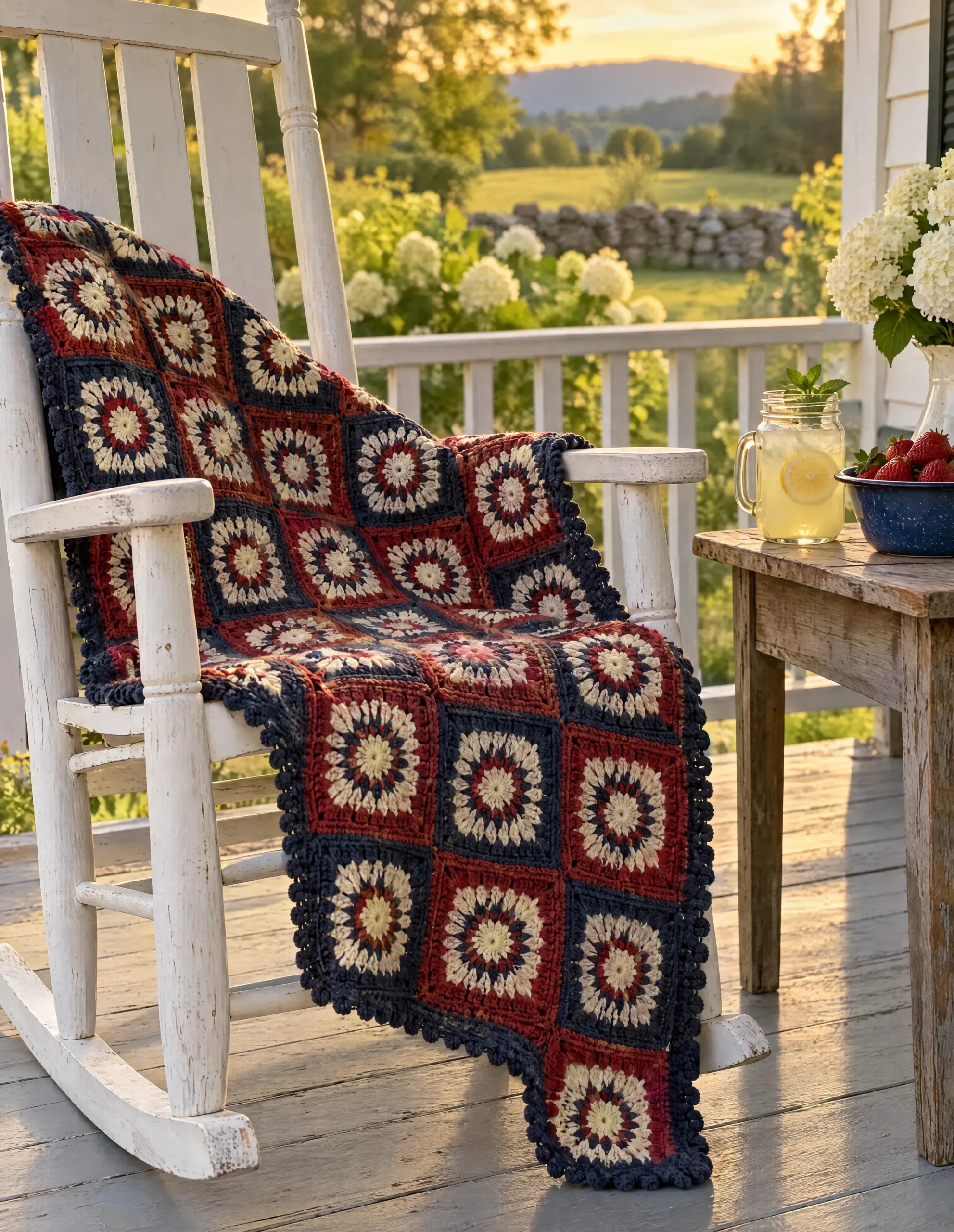
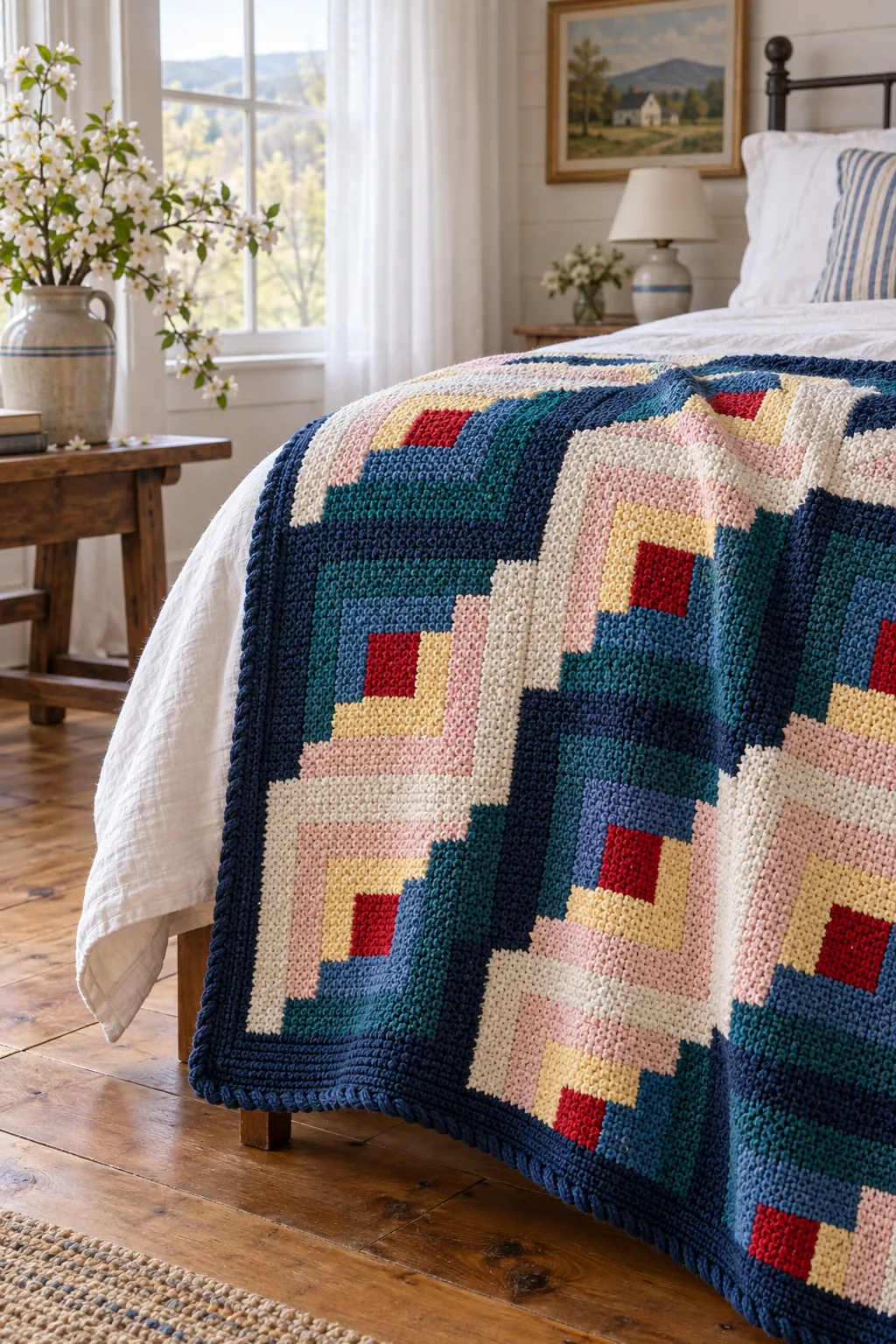
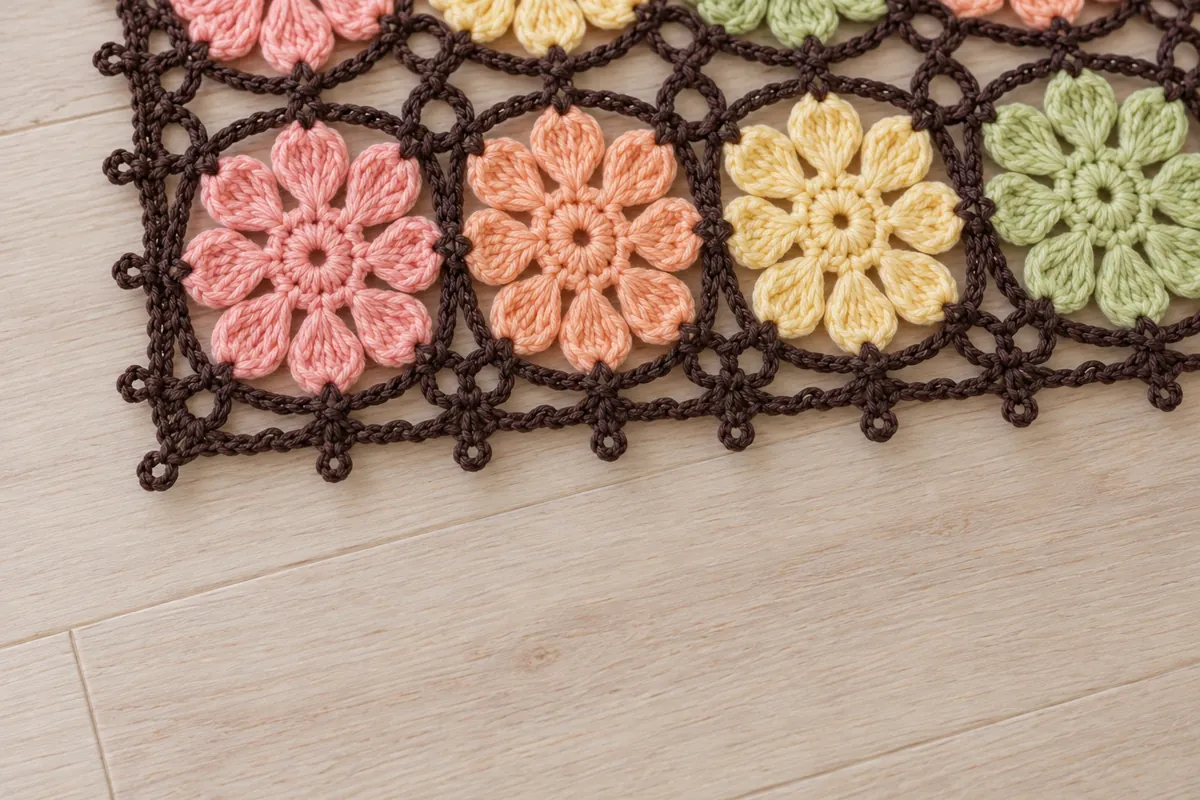
Picture a vegetable garden in early June, the rows of seedlings just tall enough to see from the porch, and a rocking chair with an afghan full of tiny flowers thrown over its arm. The Garden Row is a crochet flower afghan built from hundreds of small motifs: a round flower of eight petals, framed in dark espresso chain loops, then joined to its neighbors in long strips of one color.
Pink, apricot, butter yellow, celery, sage, robin’s egg blue, lilac and oat line up side by side like garden rows. Each motif is three short rounds, so the afghan grows a little every evening. The pattern below gives every round, every join and every stitch of the edge for a lapghan, a throw and a twin.
Is this crochet flower afghan a good first join-as-you-go project?
It’s rated Intermediate, but the stitches are basic: the chain, slip stitch, single crochet, double crochet and treble crochet. Each petal rises on a short chain, opens into a cluster of two trebles worked into the same stitch, and comes back down into the same single crochet of the center. Eight of them and the flower is done. If the abbreviations are new, the guide to reading a crochet pattern explains them.
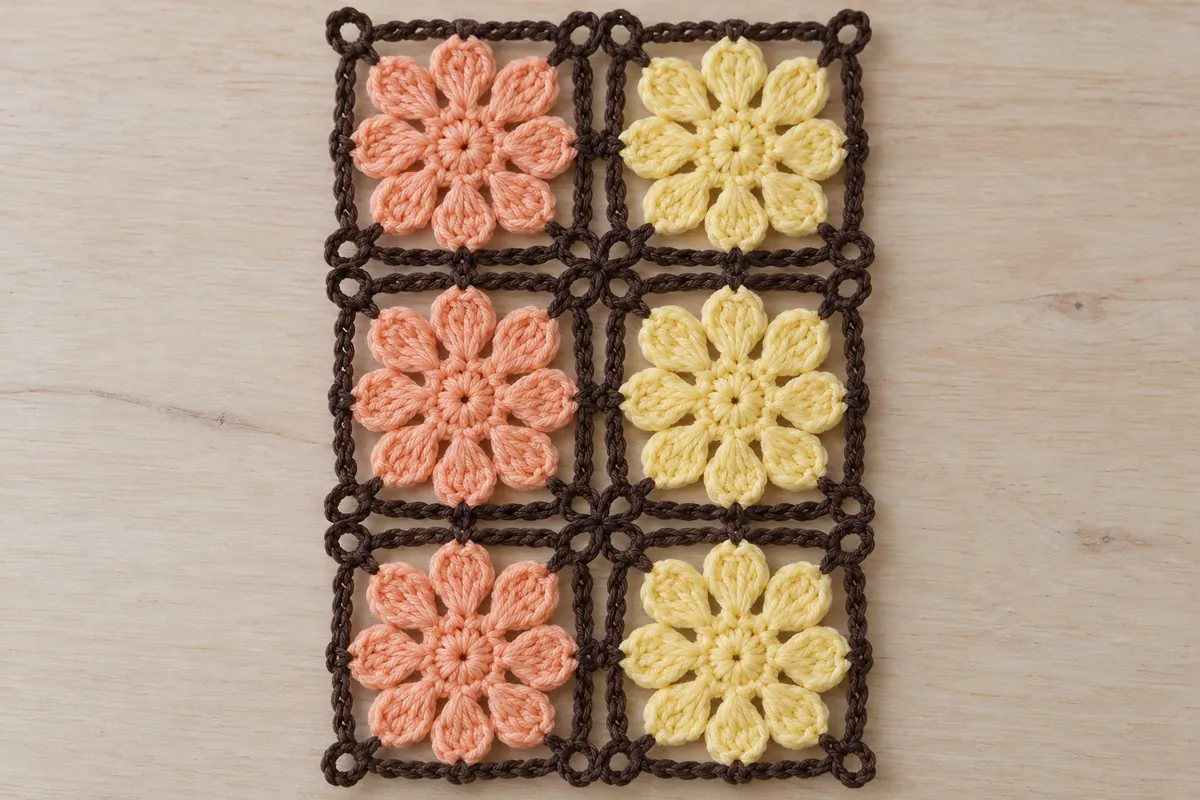
What takes attention is the join. Most motif blankets are made in two stages: you crochet a pile of squares, then spend a weekend sewing them. Here the frame round does both jobs. While you work the espresso loops around a new flower, you slip stitch into the loops of the motifs already finished, so each flower takes its place in the afghan the moment it’s framed.
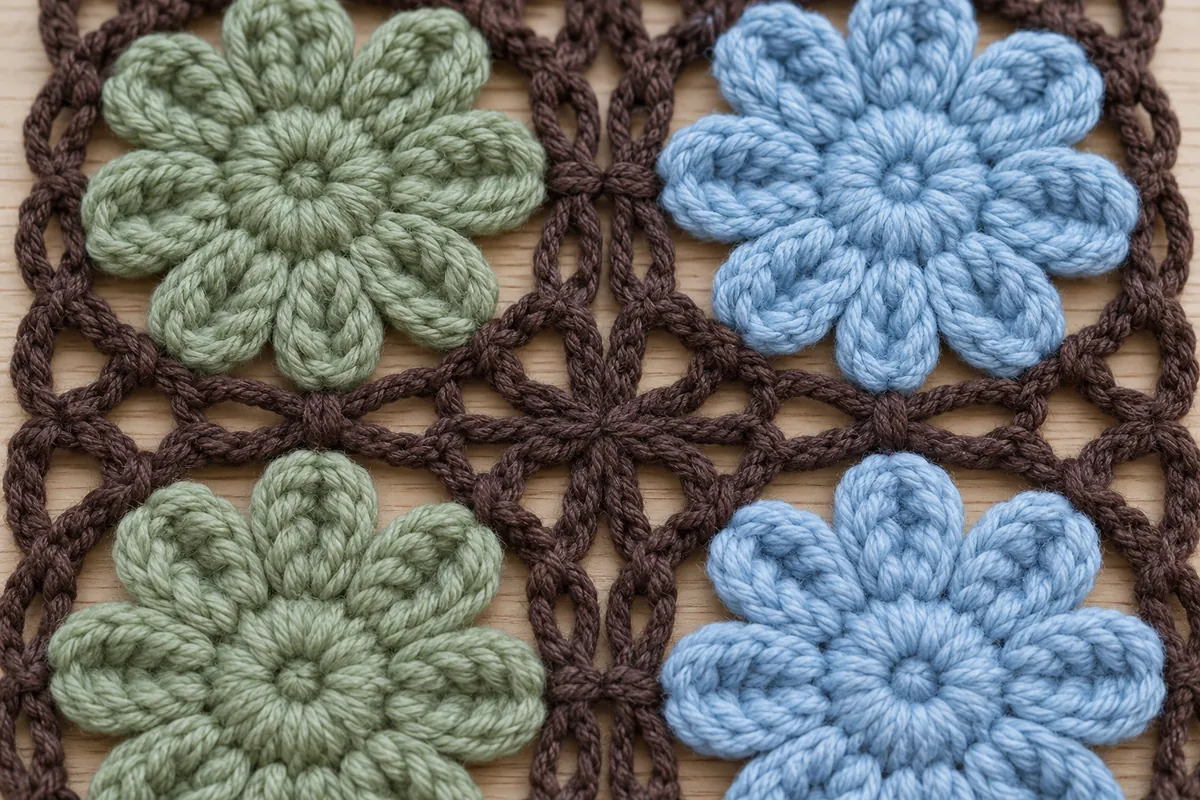
The card writes out the three versions of the frame round: the very first motif with no join, a motif joined on one side, and a motif joined on two sides. When the last motif is in, one picot round finishes all four sides, and that’s the end of the assembly.
A smooth worsted, and leftovers welcome
Look for a 4 on the label, with worsted or medium next to it. Wool, wool blends and acrylic all work, and a smooth yarn shows the petals best. A cotton blend makes a cooler afghan for summer, with a little less spring in the petals.
The hook is a 4 mm (G-6), smaller than most worsted labels suggest. The firm fabric keeps the small petals round and the frame square; with a bigger hook, the petals flop and the corners lose their shape. Make and block three motifs before anything else: one should measure 2.2 in (5.6 cm) square, three joined in a row 6.6 in (16.8 cm).
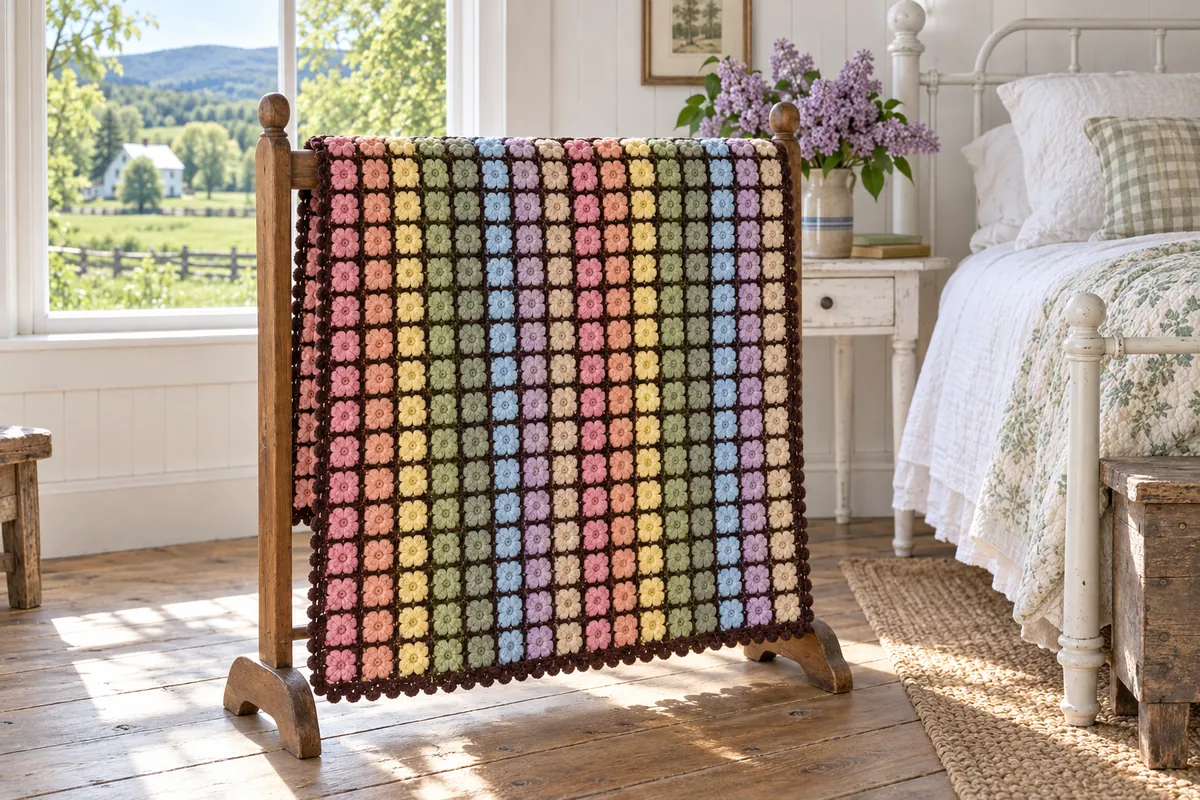
Every flower uses only about 6 yd of its color, so this afghan is kind to leftover worsted. Keep one color for every frame and the edge, and give each strip its own leftover, as long as you have enough for a whole strip: 21, 27 or 40 flowers depending on the size. The frame color is the one to buy in a single dye lot, since it runs through the whole afghan.
A dark frame that makes the petals glow
The frame color is what gives the design its look. Up close, each flower sits alone in its little window. From across the room, the frames melt into a fine dark background, and the eight flower colors read as long stripes running the length of the afghan.
- Garden Row: frame espresso; flowers clover pink, apricot, buttercup, celery, sage, robin’s egg, lilac and oat, as written.
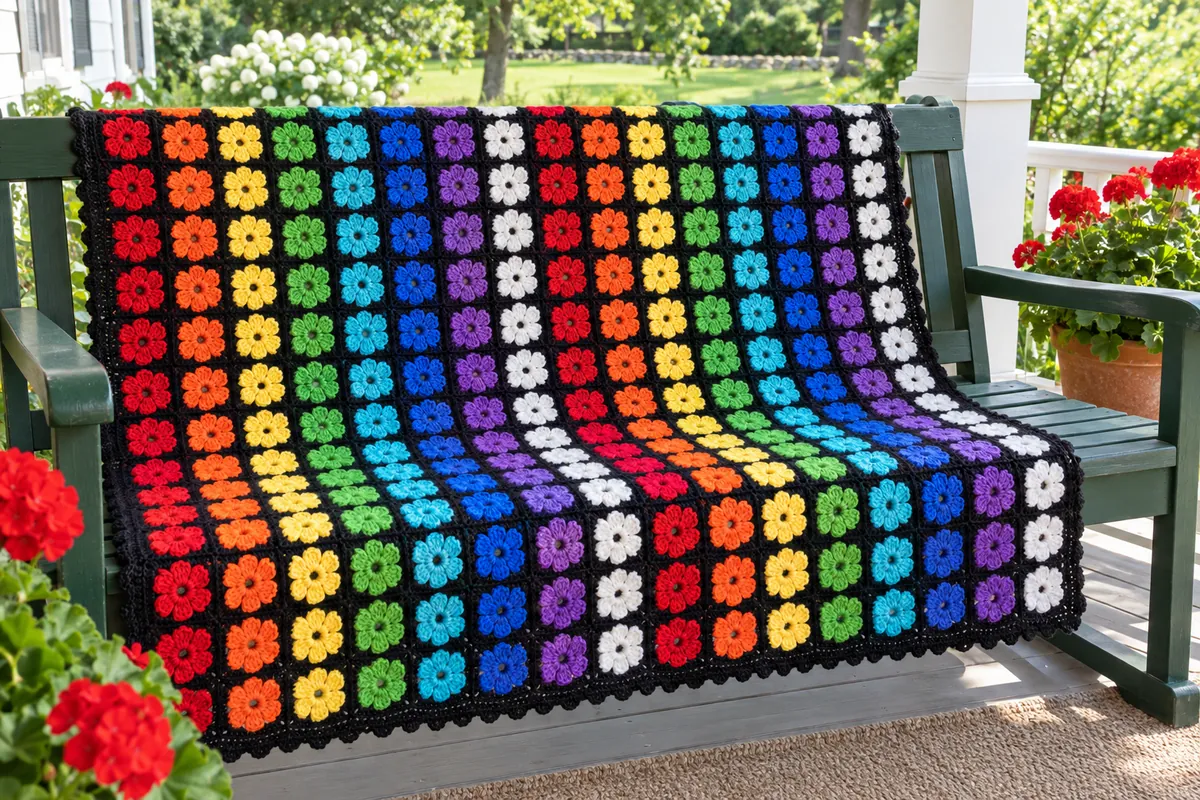
- Parlor Bright: frame black; flowers cherry red, tangerine, lemon, grass green, turquoise, cobalt, violet and white, for the boldest contrast.
- Buttermilk Morning: frame buttermilk, a soft cream; flowers raspberry, coral, marigold, fern, teal, cornflower, plum and rust.
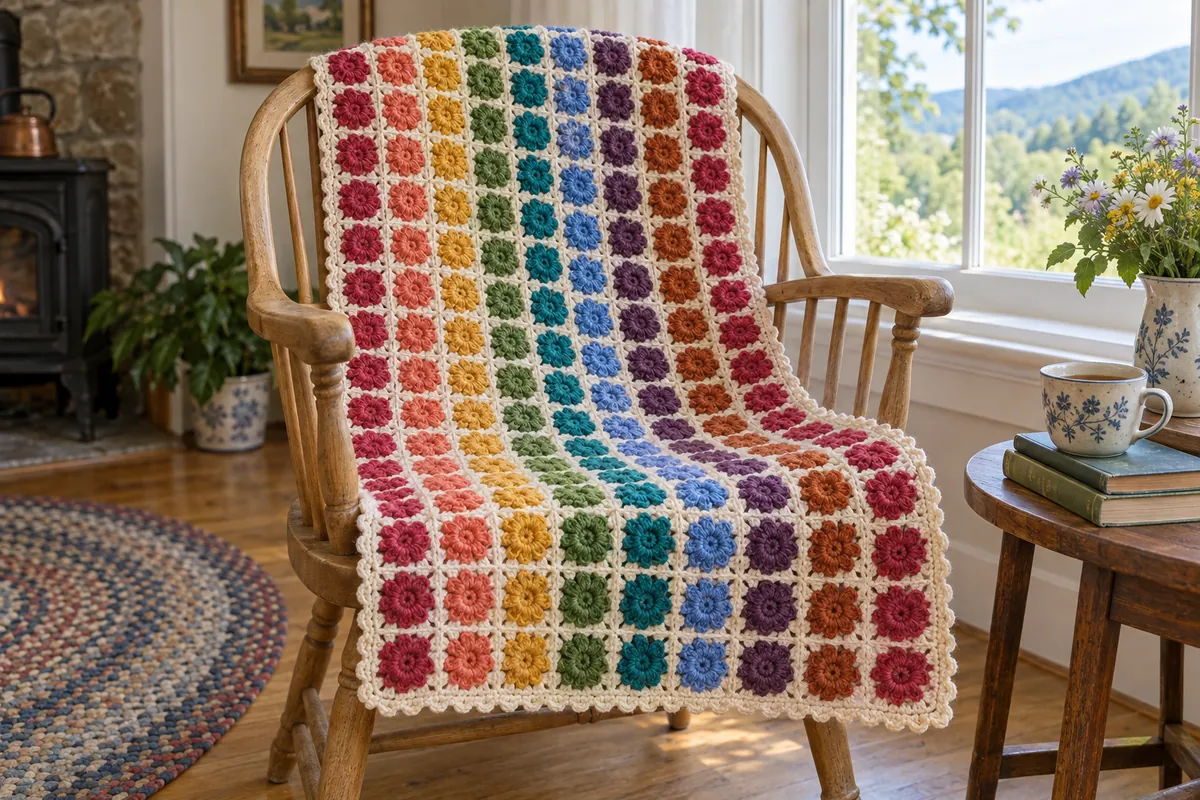
With a light frame, pick deeper flower colors. A pale pink flower in a cream window fades into the frame, while raspberry or teal stands out like an embroidered dot. All three palettes use the same amounts: swap each letter in the card for the color of your palette.
Lapghan, throw and twin, motif by motif
The afghan grows by whole motifs, so there’s no starting chain and no stitch multiple. Each motif adds 2.2 in to the width or the length. The card is written as Lapghan [Throw, Twin], and the sizes include the edge round.
- Lapghan: about 36 × 47 in (92 × 120 cm). 16 strips of 21 motifs, 336 in all. Espresso about 728 yd, each flower color 257 yd.
- Throw: about 49 1/2 × 60 1/2 in (125.5 × 153.5 cm). 22 strips of 27 motifs, 594 in all. Espresso about 1,271 yd, flower colors 331 to 496 yd.
- Twin: about 67 × 89 in (170 × 226 cm). 30 strips of 40 motifs, 1,200 in all. Espresso about 2,539 yd, flower colors 734 to 979 yd.
The counts climb quickly because each motif is small, but the motifs go quickly too. Six of the eight flower colors get an extra strip on the throw and the twin, which is why their amounts are a little higher.
Corner joins, tails and a basket of flowers
The corner rule is the one to remember. Where four motifs meet, the center chain of the corner loop you’re joining into may already hold a join. If it does, work your slip stitch into that same chain, never beside it. All the corner loops then meet at a single point, and the frame stays square.
Name the petals of each flower as you start its frame: Petal 1 is where you join the espresso, then 2 to 8 in order. The even petals become the corners; the odd petals sit at the middle of each side. Side A runs from Petal 2 to Petal 4, Side B from Petal 4 to Petal 6, and those are the only two sides you ever join while working a motif.
Each motif leaves four short tails. Weave in the two flower tails on the wrong side as soon as the flower is finished, before you frame it, and the two frame tails right after the join. A few minutes per motif saves a long evening at the end: the twin has 4,800 tails in all.
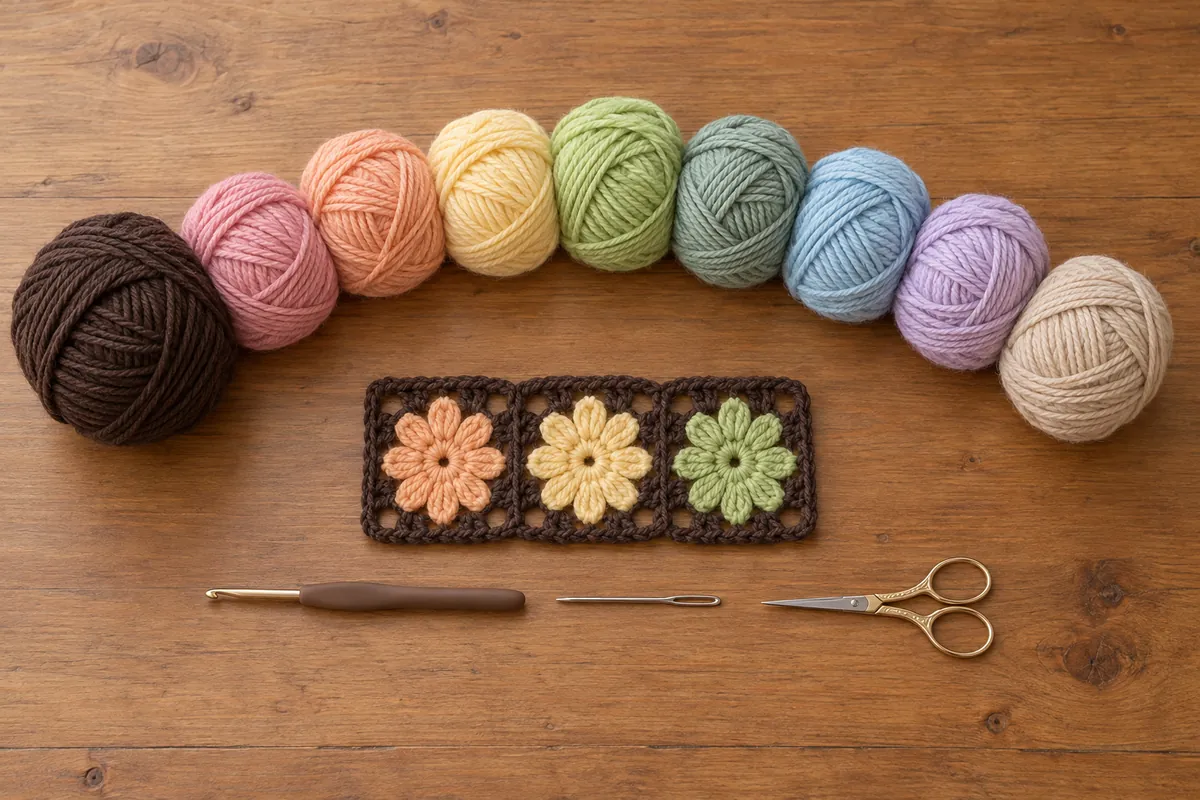
A finished flower waiting for its frame stores well. Keep the flowers in small bags by color, so a whole strip is ready before you start joining it.
If you’ve already joined motifs as you crochet, for example on the six-pointed star afghan, the method will feel familiar. For a gentler flower project in granny squares, the worsted meadow throw with flower-centered squares is a lovely warm-up.
US crochet terms
The pattern
Materials
- Worsted weight yarn (#4), wool, wool blend, acrylic or cotton blend, in 9 colors (estimate, a margin included):
- A, Espresso (frames and edge): about 728 [1,271, 2,539] yd (666 [1,162, 2,322] m)
- B Clover Pink, C Apricot, D Buttercup, E Celery, F Sage and G Robin’s Egg, each: about 257 [496, 979] yd (235 [454, 895] m), for 42 [81, 160] flowers
- H Lilac and I Oat, each: about 257 [331, 734] yd (235 [303, 671] m), for 42 [54, 120] flowers
- Total: about 2,784 [4,909, 9,881] yd (2,546 [4,489, 9,035] m)
- 4 mm (G-6) crochet hook
- Yarn needle with a large eye
- Scissors
- Rustproof pins and a blocking mat or a towel (optional)
Gauge
One motif measures 2.2 in (5.6 cm) square, from corner loop to corner loop, after blocking, with a 4 mm (G-6) hook. Three motifs joined in a row measure 6.6 in (16.8 cm). Make and block 3 motifs before you start: if your motif is larger, try a smaller hook; if it’s smaller, a larger one. Estimate: your size may vary with your gauge.
Finished size
- Lapghan: about 36.2 × 47.2 in (92 × 120 cm), 16 strips of 21 motifs
- Throw: about 49.4 × 60.4 in (125.5 × 153.4 cm), 22 strips of 27 motifs
- Twin: about 67 × 89 in (170.2 × 226.1 cm), 30 strips of 40 motifs
- Edge round included. Estimates based on the gauge above.
Abbreviations
- 2-tr CL 2-treble cluster (see Notes)
- ch chain
- dc double crochet
- rep repeat
- RS right side
- sc single crochet
- sl st slip stitch
- sp(s) space(s)
- st(s) stitch(es)
- tr treble crochet
- WS wrong side
- yo yarn over
Notes
- Sizes are written as Lapghan [Throw, Twin]. A number given once applies to all sizes.
- 2-tr CL (2-treble cluster): [yo twice, insert the hook in the indicated st, yo, pull up a loop (4 loops on hook), (yo, pull through 2 loops) twice] 2 times (3 loops on hook), yo, pull through all 3 loops. Both legs go into the same sc.
- Petal: (ch 4, 2-tr CL, ch 4, sl st) all in the same sc. The chains are part of the petal and do not count as stitches. The top of the cluster is the tip of the petal.
- Picot: ch 3, sl st in the top of the stitch just made: insert the hook under the front loop of that stitch and the strand on its side, just below the top, and pull through. A picot is not a stitch and is never worked into.
- Corner loop: ch 5, sl st in the top of the sc just made, closed exactly like a picot.
- Joined loop: ch 2, insert the hook from front to back in the center ch (the 3rd of 5) of the facing loop of the finished motif, sl st, ch 2.
- Every motif has 3 rounds, worked with the RS facing; the work is never turned. Rounds 1 and 2 are in the strip color, Round 3 is in A.
- Round 1 starts with ch 1, which does not count as a stitch. In Round 3, the sl st that joins A to the first petal counts as that petal’s anchor.
- Petal names (Round 3): call the petal where you join A Petal 1, then number the others 2 to 8 in the order you reach them. Petals 2, 4, 6 and 8 become the corners of the square; Petals 1, 3, 5 and 7 sit at the middle of the sides.
- Loops: Round 3 makes 12 ch-5 loops: 8 side loops and 4 corner loops. The center of a loop is its 3rd ch. Every join and every stitch of the edge round goes into a loop center.
- Side names: Side A runs from the corner at Petal 2 to the corner at Petal 4, Side B from Petal 4 to Petal 6. These are the only sides ever joined while you work a motif.
- Order of work: the motifs are joined in strips that run the length of the afghan. Strip 1 is 21 [27, 40] motifs long, each motif joined to the one before it. Strip 2 lies beside Strip 1, and so on, 16 [22, 30] strips in all. Right-handed crocheters build the afghan from the left edge to the right; left-handed crocheters from the right edge to the left.
- Join types: 1 first motif with no join; 35 [47, 68] motifs joined on Side A only (the rest of Strip 1 and the first motif of every later strip); 300 [546, 1,131] motifs joined on Sides A and B (all the others).
- Corners where motifs meet: if the center ch you are joining into already holds a join, work your sl st into that same ch, so all the corner loops meet at one point. Never join beside it.
- Color order: the strips follow the order B, C, D, E, F, G, H, I, then start again at B. Lapghan: twice through the order. Throw: twice through, then B to G. Twin: three times through, then B to G.
- Tails: each motif leaves 4 tails (2 in the flower color, 2 in A): 1,344 [2,376, 4,800] in all. Weave in the 2 flower tails on the WS as soon as the flower is finished, before you frame it, and the 2 frame tails as soon as the motif is joined. Leave 6 in (15 cm) tails and weave each one about 2 in (5 cm) through the stitches of its own color, then back 1 in (2.5 cm).
- A finished flower waiting for its frame can be stored by color in small bags, so a whole strip is ready before you start joining it.
- Yardage and sizes are estimates based on the gauge above.
Instructions
Flower
Make the flowers of each strip in the strip color (see the color order).
- Round 1: Make a magic ring, ch 1 (does not count), 8 sc in the ring. Pull the tail to close the ring. Join with a sl st in the first sc. (8 sts)
- Round 2: *Ch 4, 2-tr CL in the same sc, ch 4, sl st in the same sc (petal made), sl st in the next sc; rep from * 7 more times. The last sl st lands in the first sc and closes the round. Fasten off, leaving a 6 in (15 cm) tail. (8 petals)
Weave in both tails on the WS.
Frame and joining (Round 3)
Work Round 3 in one of the three ways below, depending on where the motif sits (see the join types in the Notes).
First motif (no join):
- Round 3: With the RS facing, join A with a sl st in the top of any 2-tr CL (Petal 1). Ch 5, sc in the top of the next CL (Petal 2), corner loop. *Ch 5, sc in the next CL, ch 5, sc in the next CL, corner loop; rep from * 2 more times. Ch 5, join with a sl st in the first sl st. Fasten off, leaving a 6 in (15 cm) tail. (8 anchors, 12 ch-5 loops)
Motif joined on Side A:
Lay the new flower RS up, flat beside the finished motif, so that its Side A will lie against the facing side of that motif. The 4 joins of Side A go, in order, into the 4 loops of that facing side: its corner loop, its two side loops, its other corner loop.
- Round 3: With the RS facing, join A with a sl st in the top of any 2-tr CL (Petal 1). Ch 5, sc in the top of the next CL (Petal 2). Ch 2, sl st in the center ch of the facing corner loop, ch 2, sl st in the top of the sc just made (corner joined). Ch 2, sl st in the center ch of the next facing loop, ch 2, sc in the next CL (Petal 3). Ch 2, sl st in the center ch of the next facing loop, ch 2, sc in the next CL (Petal 4). Ch 2, sl st in the center ch of the next facing corner loop, ch 2, sl st in the top of the sc just made (corner joined; Side A is joined). *Ch 5, sc in the next CL, ch 5, sc in the next CL, corner loop; rep from * once more. Ch 5, join with a sl st in the first sl st. Fasten off, leaving a 6 in (15 cm) tail. (8 anchors, 12 ch-5 loops, 4 of them joined)
Motif joined on Sides A and B:
Lay the new flower RS up so that Side A lies against the motif before it in the same strip and Side B against the motif beside it in the previous strip. The corner at Petal 4 is shared by both sides: it joins into the point where the finished motifs already meet.
- Round 3: With the RS facing, join A with a sl st in the top of any 2-tr CL (Petal 1). Ch 5, sc in the top of the next CL (Petal 2). Ch 2, sl st in the center ch of the facing corner loop of the motif before it in the strip, ch 2, sl st in the top of the sc just made. [Ch 2, sl st in the center ch of the next facing loop, ch 2, sc in the next CL] twice (Petals 3 and 4). Ch 2, sl st in the center ch where the corner loops already meet, ch 2, sl st in the top of the sc just made (shared corner joined; Side A is joined). Now join to the motif in the previous strip: [ch 2, sl st in the center ch of the next facing loop, ch 2, sc in the next CL] twice (Petals 5 and 6). Ch 2, sl st in the center ch of the next facing corner loop, ch 2, sl st in the top of the sc just made (Side B is joined). Ch 5, sc in the next CL, ch 5, sc in the next CL, corner loop. Ch 5, join with a sl st in the first sl st. Fasten off, leaving a 6 in (15 cm) tail. (8 anchors, 12 ch-5 loops, 7 of them joined)
Remember the corner rule at every corner join: if the center ch already holds a join, your sl st goes into that same ch.
Color order
The strips follow the order B, C, D, E, F, G, H, I, then start again at B. Lapghan: Strips 1 to 8 and 9 to 16 are B to I. Throw: Strips 1 to 16 are twice B to I, Strips 17 to 22 are B to G. Twin: Strips 1 to 24 are three times B to I, Strips 25 to 30 are B to G.
Joining the afghan
- Strip 1: first motif (no join), then 20 [26, 39] motifs joined on Side A, each to the motif before it. (21 [27, 40] motifs)
- Strips 2 to 16 [22, 30]: first motif joined on Side A to the first motif of the previous strip, then 20 [26, 39] motifs joined on Sides A and B. (21 [27, 40] motifs per strip)
- When the last strip is done: 336 [594, 1,200] motifs, 16 [22, 30] strips of 21 [27, 40] motifs.
Edge round
Every edge motif shows one outer side along the edge of the afghan: a corner loop, a side loop, the anchor of its middle petal, a side loop and a corner loop. Between two edge motifs, their corner loops meet at a join.
- Edge round: With the RS facing, join A with a sl st in the center ch of the last side loop of a long edge, just before a corner, ch 1 (does not count), sc in the same ch.
- Corner: ch 4, sc in the center ch of the corner loop, picot, ch 4.
- Short edge: sc in the center ch of the next side loop, ch 3, dc in the anchor of the middle petal, picot, ch 3, sc in the center ch of the next side loop; *ch 3, dc in the join between the 2 motifs (insert the hook through the point where their corner loops meet), picot, ch 3, sc in the center ch of the next side loop, ch 3, dc in the anchor of the middle petal, picot, ch 3, sc in the center ch of the next side loop; rep from * 15 [21, 29] more times. (63 [87, 119] sts: 32 [44, 60] sc and 31 [43, 59] dc, 31 [43, 59] picots, 62 [86, 118] ch-3 sps)
- Corner: as before.
- Long edge: work as the short edge, repeating from * 20 [26, 39] more times. (83 [107, 159] sts: 42 [54, 80] sc and 41 [53, 79] dc, 41 [53, 79] picots, 82 [106, 158] ch-3 sps)
- Corner, then short edge, then corner: as before.
- Last long edge: sc in the center ch of the next side loop, ch 3, dc in the anchor of the middle petal, picot, ch 3, sc in the center ch of the next side loop; rep from * of the short edge 19 [25, 38] times; ch 3, dc in the next join, picot, ch 3, sc in the center ch of the next side loop, ch 3, dc in the anchor of the middle petal, picot, ch 3, join with a sl st in the first sc. Fasten off. (83 [107, 159] sts with the first sc of the round, 41 [53, 79] picots, 82 [106, 158] ch-3 sps)
- Round total: (296 [392, 560] sts, 148 [196, 280] picots, 288 [384, 552] ch-3 sps and 8 ch-4 sps). Each corner has 1 sc with a picot between 2 ch-4 sps.
Finishing
- Weave in any tails left from the edge round. Lay the afghan flat on a blocking mat, a carpet covered with towels or a bed, smooth the strips straight and pin the edges to the finished size. Wool and wool blends: mist with water until damp and leave to dry. Acrylic: hold a steam iron just above the surface without touching it, then leave to cool and dry before unpinning. Blocking opens the petals and squares the frames.
Washing pastel flowers next to a dark frame
A dark frame next to light flowers can bleed in the first washes. Wash a scrap of the frame color with a scrap of your palest flower color before you start. For the afghan itself, wash by hand or on a gentle cycle in cold water, on its own, with a color-catcher sheet, following the yarn labels, and dry it flat.
Never leave it damp and folded: the espresso can mark the pastels where they touch. Store it folded loosely, away from direct sun, which fades pastels faster than you’d think, especially the lilac and robin’s egg strips.
Garden Row questions about motifs, joins and colors
How many motifs does this crochet flower afghan take?
336 for the lapghan, 594 for the throw and 1,200 for the twin. Each motif is only 2.2 in (5.6 cm) square, which is why the counts climb quickly, and each one is only three short rounds.
What if I join into the wrong loop?
Pull the frame round back to the last correct join and work it again: the flower itself stays intact, since the frame is a separate round in another color. Lay the new flower flat next to its neighbors before each join to check that Side A and Side B face the right motifs.
Can I make all the flowers first and frame them later?
Yes. Rounds 1 and 2 stand on their own, so you can make a whole strip of flowers, weave in their tails and keep them in a bag by color. Only the frame round has to be worked as you join, one motif at a time, in the order of the strips.
Can the strips run across instead of lengthwise?
The strips are only an order of work. Turn the finished afghan a quarter turn and the color stripes run across. Just keep each strip one color while you crochet, so the joins and the color order stay simple.
Quick recap
- Make the flowers of each strip in its color: 8 sc in a ring, then 8 petals.
- Frame the first motif in espresso, then join each new motif on Side A, or on Sides A and B, as you work its frame.
- Build 16 [22, 30] strips of 21 [27, 40] motifs, following the color order.
- Work one edge round with a picot on every tall stitch.
- Weave in the last tails and block the afghan flat.
One small flower at a time, this crochet flower afghan turns into a whole garden of colored rows. If a join or a count puzzles you, ask through the Contact page.